
PPFD and DLI for Houseplants: Chart, Formula & Targets
Find practical PPFD and DLI ranges for houseplants, calculate grow-light timer hours, measure light at canopy level, and acclimate plants safely.
Elena Vargas · Published 2026-05-12 · 27 min read
Key Takeaways
- Replace vague light labels with two measurable numbers, PPFD and DLI. PPFD is measured in umol/m2/s and DLI in mol/m2/day.
- Measure light with a quantum sensor or a phone app such as Photone. A lux meter plus a conversion works as a rough backup if you know your light source.
- Use 100–250 umol/m2/s and 4–9 mol/m2/day as starting ranges for many foliage tropicals. Test them rather than treating them as fixed targets.
- Calculate DLI as PPFD multiplied by photoperiod hours and 0.0036. Then use a timer to preserve a nightly dark period.
- Match plant species to the window and acclimate any move to brighter light gradually. Give the transition several weeks when needed.
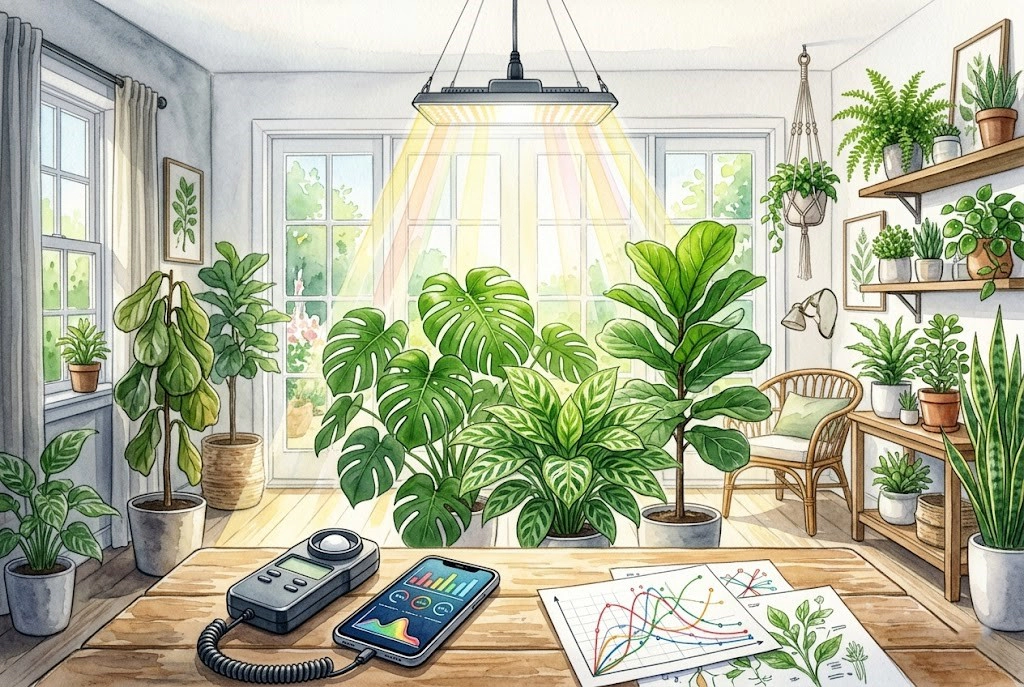
Bright indirect light is hard to act on because it has no number attached. A more useful way to think about a plant like Monstera is in terms of the photons it receives. PPFD describes the photon flux in the roughly 400 to 700 nanometer range, while DLI is the daily total delivered over the photoperiod.
Popular foliage aroids are commonly grown well in the rough neighborhood of 100–250 umol/m2/s and a DLI of about 4–9 mol/m2/day, but treat those as starting ranges to test, not fixed set points. The right value depends on the species, cultivar, temperature, and how the plant was acclimated.
A 2026 HortScience study by Taylor, McCauley & Nackley at Oregon State University measured leaf-level light responses for a set of tropical foliage cultivars.
It gives real numbers for the plants it tested, but it did not redefine retail terms such as low or bright indirect light, and it did not test every houseplant.
Figures for plants outside that study are rough hobbyist estimates to verify by measurement.
Quick Reference
Two Numbers Do Most of the Work
Two numbers do most of the work. PPFD measures the photon rate at a spot in umol/m2/s, while DLI measures the daily total in mol/m2/day.
Light is not the only factor because temperature, water, humidity, CO2, and nutrition also matter. PPFD and DLI still turn a vague care label into something measurable.
Measure the Whole Growing Setup
In an enclosed setup, pair the light reading with the plant cabinet VPD guide, because fixture heat changes leaf temperature and the moisture gradient around the canopy. If you are still planning the enclosure, the IKEA greenhouse cabinet build guide covers lighting, airflow, and sensor placement as one system.
Taylor, McCauley & Nackley – tropical foliage light-response study
I measure PPFD at the center and four edges of the actual canopy with the sensor level at the leaves. The log keeps the lowest, highest, and average readings. A bright center value can hide edge leaves receiving a fraction of that light.
The map is repeated after the plant grows, rotates, or shares the shelf with a taller neighbor. I calculate DLI from the measured photoperiod for each important zone rather than assuming the fixture height still describes the canopy months later.
Why does bright indirect light no longer mean anything?
Bright indirect light has no numerical definition. It appears on a large share of houseplant care tags, yet the actual light at spots people would all describe that way can differ by more than tenfold, so the phrase can point to wildly different conditions.
The 2026 HortScience study (Taylor, McCauley & Nackley, Oregon State University) measured leaf-level light responses for a set of tropical foliage cultivars.
Across the cultivars it tested, light-saturated assimilation was reached roughly in the 145–620 umol/m2/s range. A spread far wider than any single retail phrase can capture.
What is PPFD in plain English?
PPFD Is a Photon Rate
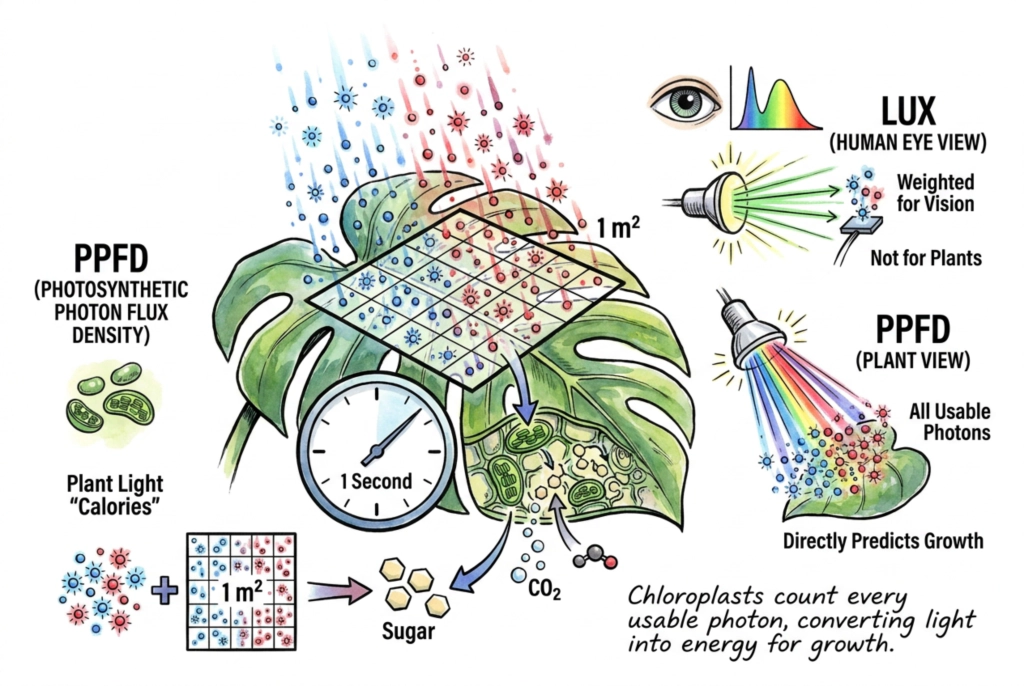
PPFD is the amount of usable plant light reaching a square meter each second. Think of it as the brightness at the leaf, not the brightness your eyes perceive.
Photosynthesis Is Not Linear
More light can increase photosynthesis, but only until another limit takes over. Once the leaf has enough light, extra intensity adds little and may create stress if the plant is hot or unacclimated.
Lux Is Human-Weighted
Lux and foot-candles measure light weighted by the human eye, which peaks around 555 nm (green).
Because plants and the eye respond to different parts of the spectrum, a lux reading can correspond to very different PPFD values depending on the light source. A warm-white LED, for example, produces far fewer usable photons per lux than daylight does.
The eye and the chloroplast are measuring different things.
Apogee Instruments – PPFD vs Lux conversion
What is DLI and why does it matter?
DLI Is the Daily Total
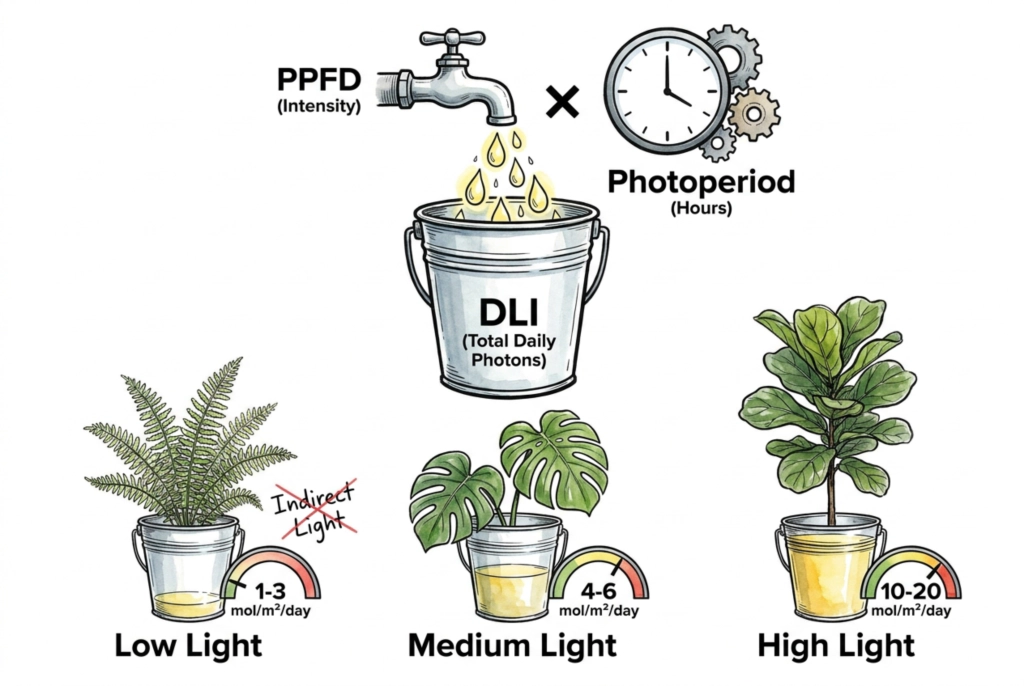
DLI is the Daily Light Integral, total photons received in a 24-hour day, measured in mol/m2/day.
Calculate DLI From PPFD and Hours
DLI equals PPFD multiplied by photoperiod hours multiplied by 0.0036. A plant getting 200 umol/m2/s for 12 hours receives 8.64 mol/m2/day.
Use DLI Bands as Guides
As a rough orientation, many indoor foliage plants are grouped into low, medium, and high DLI bands, on the order of a few mol/m2/day for shade-tolerant plants up to the teens for high-light species.
Greenhouse extension charts publish species-specific DLI ranges. Use them as a guide, not a guarantee.
Purdue Extension – Daily Light Integral chart
What is a light response curve and what do its three points tell you?
| Point | What it Means | Rough range seen in foliage cultivars |
|---|---|---|
| LCP (light compensation point) | Net leaf photosynthesis and respiration balance at zero. A useful low-light reference, not a whole-plant survival threshold. | about 4-12 umol/m2/s (Taylor et al. Cultivars) |
| Working growth range | Where hobbyists commonly see steady growth. This is a practical band, not a measured research value. | roughly 100-250 umol/m2/s (estimate) |
| LSP (light saturation point) | Above this, added light yields little extra photosynthesis. Whether it causes damage depends on duration, temperature, and acclimation. | about 145-620 umol/m2/s (Taylor et al. Cultivars) |
Reading the Light-Response Curve
Below the Compensation Point
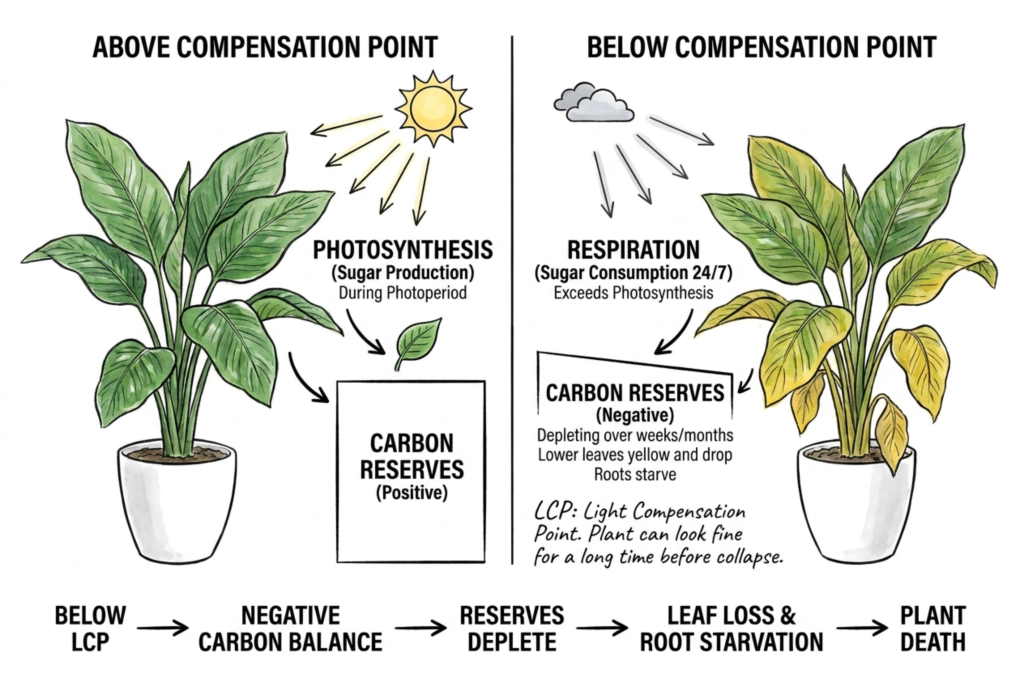
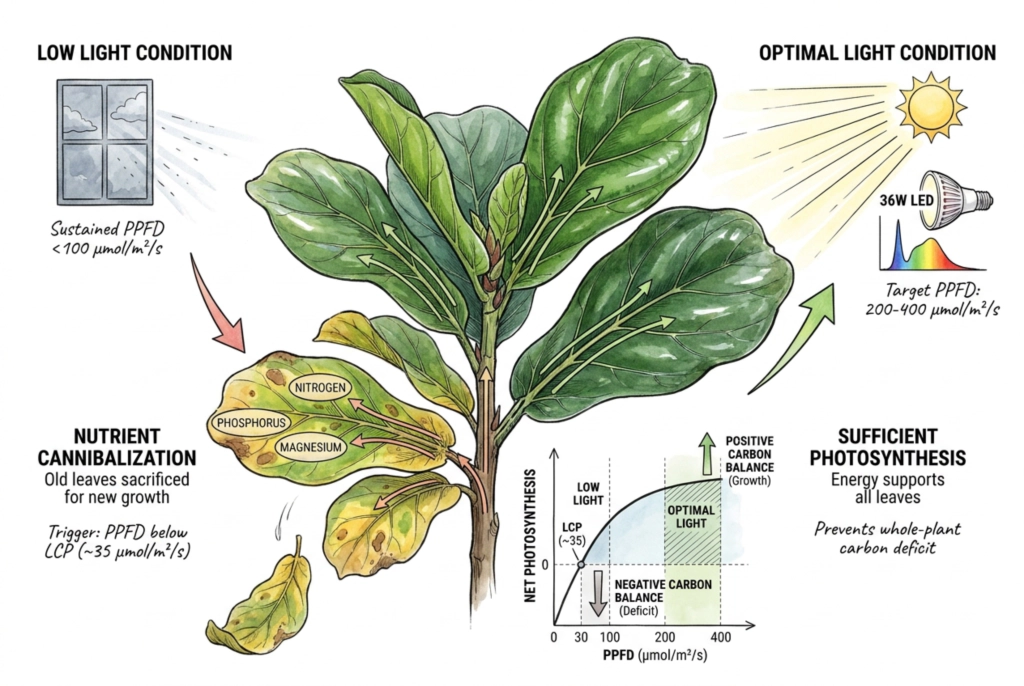
A light-response curve plots a leaf’s net photosynthesis against PPFD. Below the Light Compensation Point (LCP), that leaf uses more sugar in respiration than it makes. Near it, the two balance out.
These are leaf-level, instantaneous measurements taken under set conditions, so they describe a single leaf at a moment, not the whole plant’s daily budget.
Between Compensation and Saturation
Between the compensation point and saturation, more light generally means more photosynthesis. Above the Light Saturation Point (LSP), extra light adds little.
Sustained light well above saturation, especially combined with heat or an unacclimated plant, can cause photodamage, but crossing the saturation point is not itself an instant damage line.
What the Study Can Tell You
The study compared leaf responses at different light levels in selected tropical foliage cultivars. Use its figures to choose a cautious starting range, not as a universal target for every houseplant or room.
Photon Use Is Not Biomass
A leaf can turn more available light into photosynthesis without producing visibly faster growth. Temperature, roots, water, nutrition, and the plant’s own growth pattern still determine what you see.
Why do plants die below the compensation point?
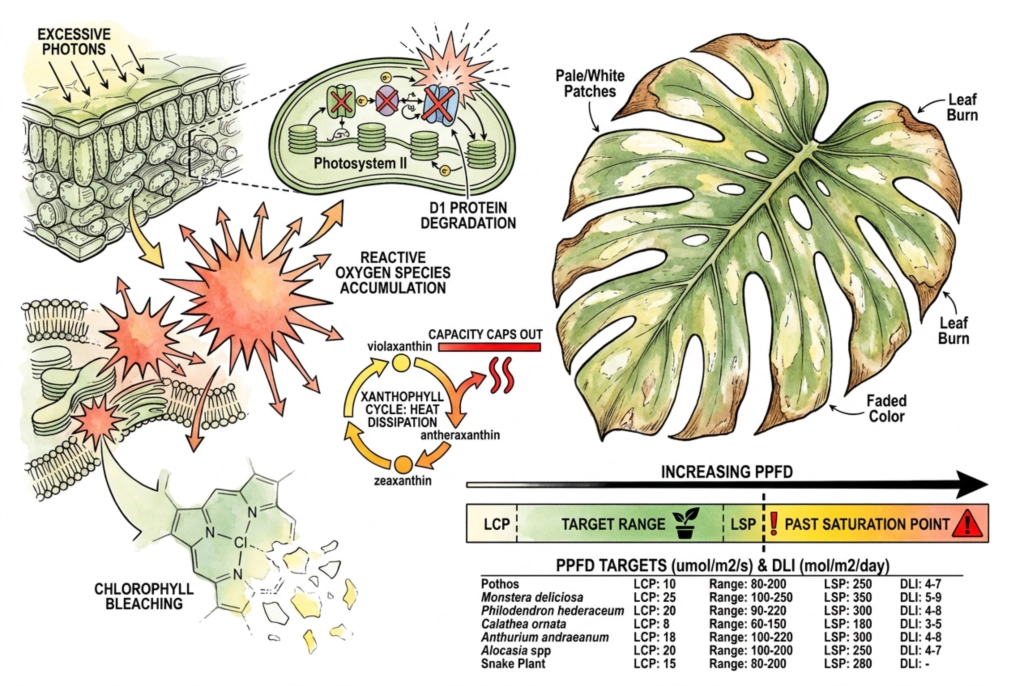
Respiration runs continuously, while photosynthesis only happens during the lit hours. If a whole plant sits in light below its compensation point for long enough, its daily carbon balance can go negative. It uses more sugar than it makes.
When that persists, stored reserves draw down, and the plant may shed lower leaves to support new growth.
This is a gradual, conditional process, not an inevitable timeline. How fast it happens depends on the plant, its size and leaf area, temperature, and how much light the rest of the canopy is getting.
A plant can look fine for a while before decline becomes obvious.
What happens past the saturation point?
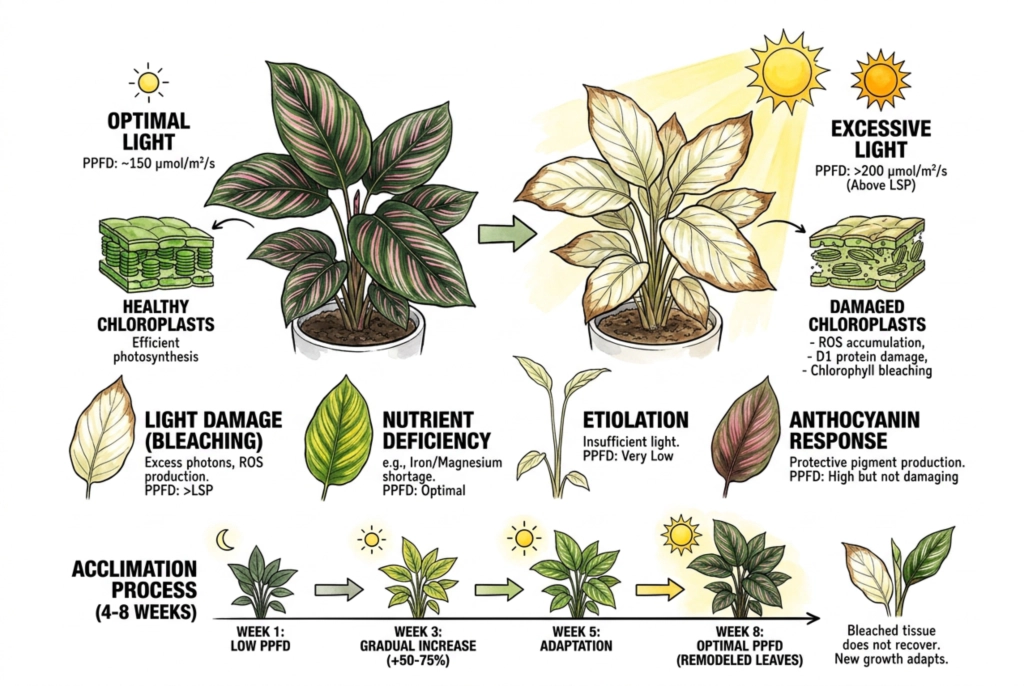
Past saturation, the extra light contributes little to photosynthesis. When light greatly exceeds what a leaf can process, especially with heat or in an unacclimated plant, excess excitation energy can generate reactive oxygen species faster than the leaf handles them.
That can temporarily slow photosynthesis and, in severe cases, bleach chlorophyll into pale patches. Mild stress may ease after you lower the light. Fully bleached or dead tissue does not turn green again.
What Happens to Bleached Leaves
If leaf tissue is fully bleached or dead, it will not turn green again. The plant recovers photosynthetic area through new growth once you bring light back below the level that caused the damage.
Milder light stress can recover on the existing leaves.
What PPFD does each popular houseplant actually need?
| Plant | Rough working PPFD range (umol/m2/s) | Rough DLI range (mol/m2/day) |
|---|---|---|
| Pothos (Epipremnum) | 80-200 | 4-7 |
| Monstera deliciosa | 100-250 | 5-9 |
| Philodendron hederaceum | 90-220 | 4-8 |
| Calathea / Goeppertia | 60-150 | 3-5 |
| Anthurium andraeanum | 100-220 | 4-8 |
| Alocasia spp | 100-200 | 4-7 |
| Snake Plant (Sansevieria) | 80-200 | 4-7 |
| ZZ Plant (Zamioculcas) | 80-180 | 4-6 |
| Hoya carnosa | 150-350 | 6-12 |
| Ficus lyrata | 200-450 | 8-15 |
| Strelitzia nicolai | 250-550 | 10-18 |
How to read this table
The 2026 HortScience study measured only a handful of cultivars (mainly Philodendron, Monstera deliciosa (variegated and non-variegated), Syngonium, and Goeppertia (Calathea relatives)).
Most plants in the table, including Pothos, Anthurium, Alocasia, snake plant, ZZ, Hoya, Ficus, and Strelitzia, were not in that study, so their numbers are rough hobbyist ranges gathered from general growing experience, not measured research values.
Even for the plants that were studied, the paper measured leaf-level responses, not day-long DLI targets.
Treat every row as a starting point to test with a light meter and by watching your own plant, not a precise prescription.
How do these numbers map to real windows?
As a very rough illustration in the northern hemisphere at mid-latitudes, an unobstructed south-facing window around midday in summer can read on the order of 1000–2000 umol/m2/s right at the sill, falling off quickly as you move into the room.
These figures vary enormously with your hemisphere, latitude, season, time of day, sky conditions, glazing, and any outdoor obstructions, so measure your own spot rather than trusting a table.
North-facing windows are generally much dimmer, often a couple hundred umol/m2/s at most on a bright day.
East and west windows peak during their respective half of the day and then fall off. The only reliable way to know your numbers is to measure at the plant’s position.
How do you measure light at home?
| Tool | Stated accuracy | Rough cost | Use Case |
|---|---|---|---|
| LI-COR LI-190R quantum sensor | around +/- 5% (calibration) | high. Also needs a separate meter or logger | Research and reference use |
| Apogee MQ-500 Quantum Meter | around +/- 5% | premium. Check current manufacturer price | Serious hobbyist, self-contained meter |
| Photone app | good agreement when set up correctly. Varies by device and settings | free core, small paid unlocks (check current pricing) | Everyday placement decisions |
| Lux meter + conversion | estimate only. Depends on knowing your spectrum | low | Budget backup, relative comparisons |
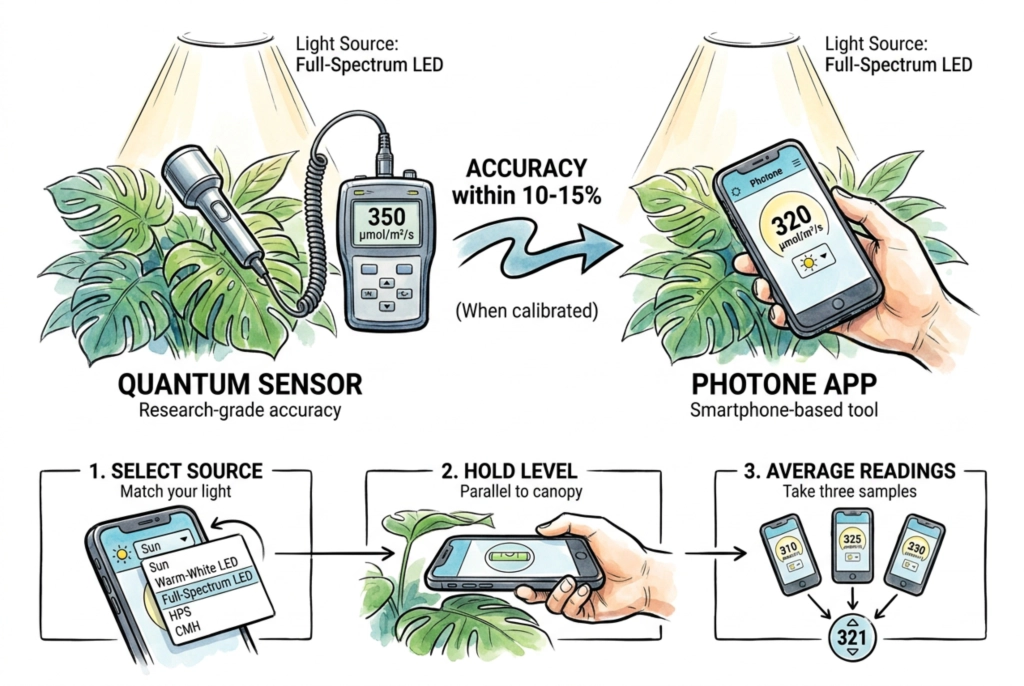
Choose a Measurement Tier
There are roughly three tiers of measurement, from a research-grade quantum sensor down to a phone app or a lux meter with a conversion.
Each trades accuracy for cost, and prices and app pricing change over time, so confirm current figures before buying.
How accurate is the Photone phone app?
On a supported device and set up correctly, Photone can come reasonably close to a quantum sensor, but the agreement depends on your phone model, the diffuser or camera mode you use, choosing the right light source, and holding the phone correctly.
It is a good tool for everyday decisions, not a calibrated instrument, so check the app’s own guidance for accuracy expectations.
Open the app, select your light source from the list (sun, warm-white LED, full-spectrum LED, HPS, CMH), attach the diffuser or use the recommended mode, hold the phone level with the canopy and facing the light, and average a few readings.
For deciding where to place a plant, that is usually enough, but a few midday readings do not capture how the light changes across the day or the seasons.
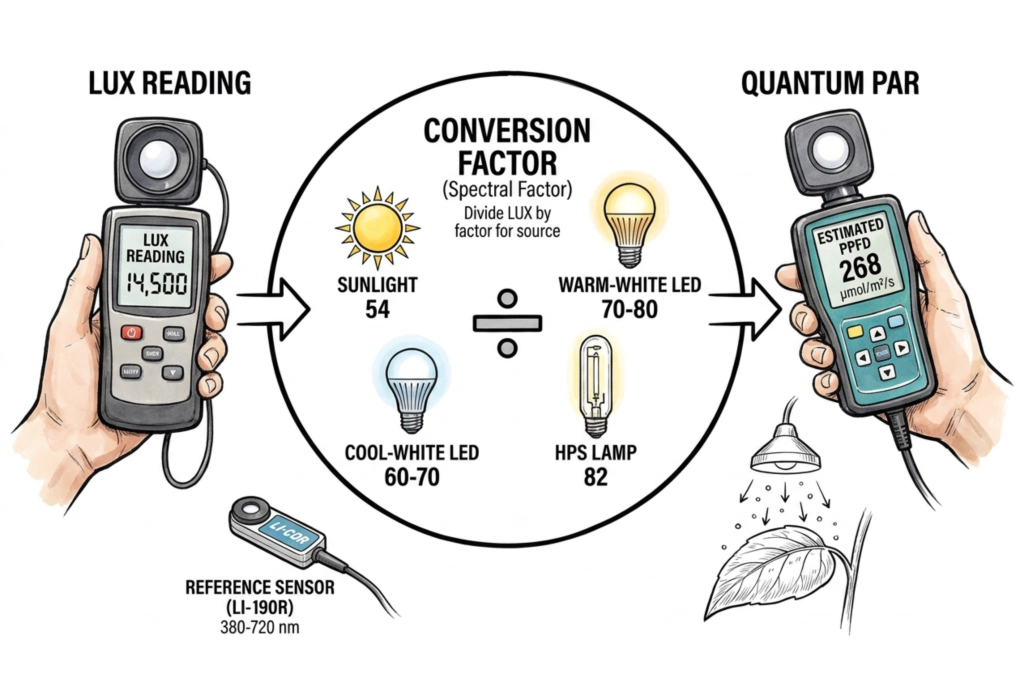
How do you convert lux to PPFD?
Divide lux by an approximate spectral factor for your light source. Often cited values are around 54 for sunlight, higher (roughly 70–80) for warm-white LED, and different again for cool-white LED or HPS.
For example, a meter reading 14,500 lux in noon sunlight works out to about 14,500 / 54 = 268 umol/m2/s.
This only works if you actually know your spectrum. Under mixed daylight-plus-LED light, or through tinted glass, the true factor can differ and the estimate can be off.
Use it for relative comparisons, not precise targets.
Apogee MQ-500 Quantum Meter
The Apogee MQ-500 is a self-contained quantum meter for direct PPFD readings when you need repeatable canopy maps. A supported phone app or a lux meter is sufficient for simple placement comparisons. Use the manufacturer page to confirm the current model and specifications.
Choose Apogee When You Need Repeatable Canopy Maps
You map multiple canopies or fixtures, need repeatable readings across sunlight and LEDs, and will use its sampling or DLI logging enough to justify a research-grade meter.
Skip Apogee When a Phone App Is Enough
Use a simpler meter or a supported phone app when you only need to compare a few plant positions.
Dr.meter LX1330B
Dr.meter LX1330B light meter is useful for repeatable lux comparisons between windows or fixture positions. It does not measure plant-weighted PPFD directly.
Choose Dr.meter for Relative Comparisons
You want inexpensive, repeatable comparisons between windows or fixture positions and know that any conversion to PPFD will only be an estimate.
Skip Dr.meter When You Need Direct PPFD
Skip it when you need a direct PPFD reading, use mixed or unusual spectra, or need a defensible absolute target. A lux-to-PPFD conversion can be wrong enough to change the decision, so confirm the exact model before buying.
LI-COR LI-190R quantum sensor
How does window direction and distance set your PPFD ceiling?
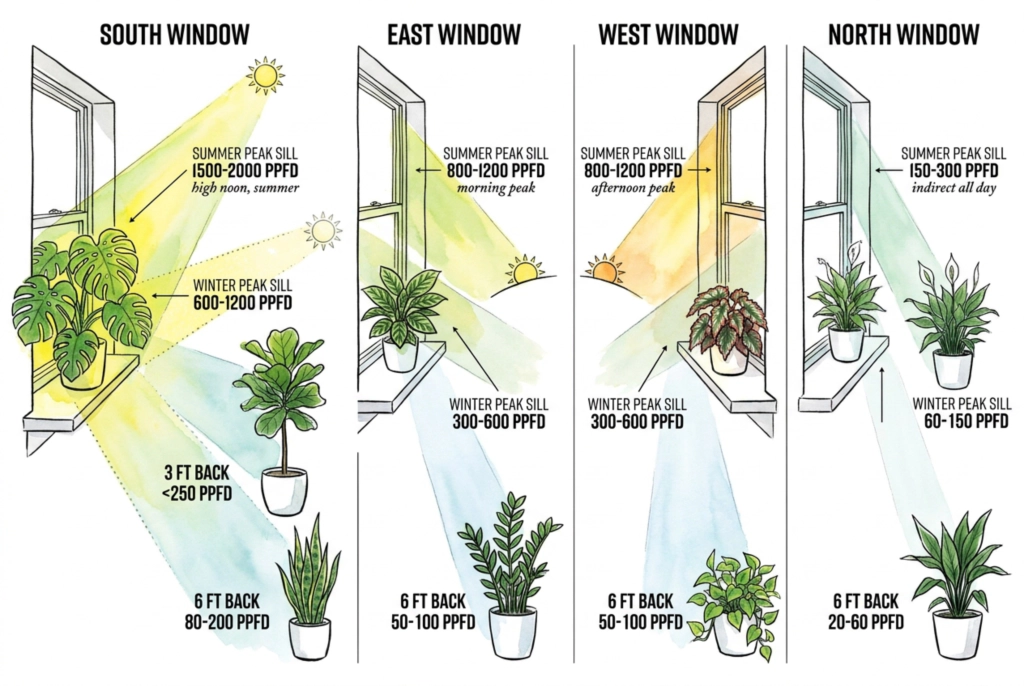
Window direction and season set the rough ceiling on how much light a room can get, and light falls off as you move away from the glass.
A window and the sky are not a single point of light, so the simple double-the-distance, quarter-the-light rule does not apply cleanly indoors. How fast light drops also depends on the window size, room geometry, whether direct sun hits the spot, and reflections off walls.
The reliable move is to measure at the plant, not to calculate from distance.
What is the PPFD at each window direction?
| Window (N. Hemisphere) | Summer peak sill PPFD (illustrative) | Winter peak sill PPFD (illustrative) | Roughly 6 ft back (summer) |
|---|---|---|---|
| South | 1500-2000 | 600-1200 | 80-200 |
| East | 800-1200 | 300-600 | 50-100 |
| West | 800-1200 | 300-600 | 50-100 |
| North | 150-300 | 60-150 | 20-60 |
The table values are illustrative for the northern hemisphere at mid-latitude, not measurements of your window.
They assume clear skies, no outdoor obstruction, and a particular time and date. Change any of those, or your hemisphere and glazing, and the numbers change.
South-facing windows can be very bright near the sill and drop off within a few feet. North-facing windows are usually much dimmer.
East and west windows peak on opposite sides of midday. They are often similar to each other, but not identical. Morning cloud or fog, afternoon heat, and nearby buildings or trees can make one noticeably brighter than the other.
Measure to find out.
How much do curtains and glass cost you?
Glass and curtains cut the light that reaches your plant, but by how much depends on the specific product.
Low-E and tinted double-pane glass can block a meaningful fraction of PAR depending on its coatings and the angle of the sun, and a sheer curtain cuts more on top of that, varying with its fiber, color, weave, and how many layers you hang.
So a bright window behind low-E glass and a closed sheer will read noticeably lower than the outdoor value, but treat that as a reason to re-measure at the plant, not to plug in a fixed percentage.
NICETOWN White Sheer Curtains
NICETOWN white sheer curtains are a reversible way to reduce and diffuse an over-bright window without installing a permanent shade.
Choose NICETOWN When a Window Overexposes Shade Plants
A light reading confirms that a window overshoots a Calathea, Maranta, or other shade plant, and you need a removable sheer rather than a permanent shade.
Skip NICETOWN When You Need Known PAR Reduction
Skip it when you need a known PAR reduction, blackout control, or a different size. White voile only filters light. Its actual effect depends on the fabric, folds, glazing, and sun angle. Measure at canopy height after installation.
How do you choose and position a grow light?
Choose by Delivered PPFD
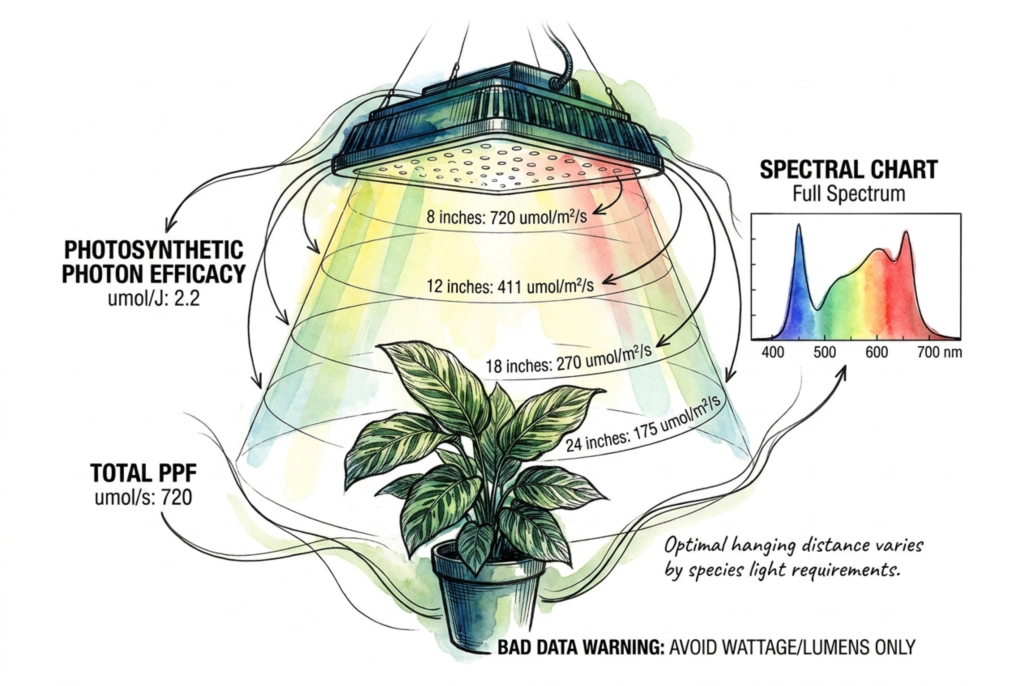
Choose by PPFD at the distance you will actually hang the light, not by wattage alone. Modern white LEDs are far more efficient than incandescent bulbs at turning electricity into usable photons (efficacy varies by fixture, commonly around 2.0–2.4 umol per joule for good white LEDs versus a fraction of that for incandescent).
Position the Fixture for Coverage
Because of that, a modest LED can put more PPFD on a plant than a much higher-wattage incandescent in the same spot, though the exact comparison depends on beam angle, spectrum, and distance.
Position the fixture to land your plant in its working range.
What does a useful grow light spec sheet say?
A useful spec sheet lists PPFD at several distances (for example 8, 12, 18, and 24 inches), the efficacy in umol/J, the total light output (PPF) in umol/s, and a spectral chart.
If a listing shows only wattage and lumens, it is hard to compare for plant use (look for one that publishes PPFD at distance instead).
Watch the difference between PPF and PPFD. PPF is the fixture’s total photon output. PPFD is the density at a spot and distance.
The Mars Hydro TS1000’s official specs list a total PPF around 343 umol/s (about 150 W at roughly 2.3 umol/J). Its per-distance PPFD is a separate, much larger-looking set of numbers for the center of the coverage area.
Use the manufacturer’s PPFD-at-distance figures, and note the measurement conditions (center vs average, tent reflectance, dimmer setting), to pick a hanging height for your target.
If you need to compare fixtures rather than interpret the science, use the aroid grow-light product chooser. It filters options by measured coverage, mounting distance, and verification needs.
How do you set the timer?
Use the DLI Formula in Order
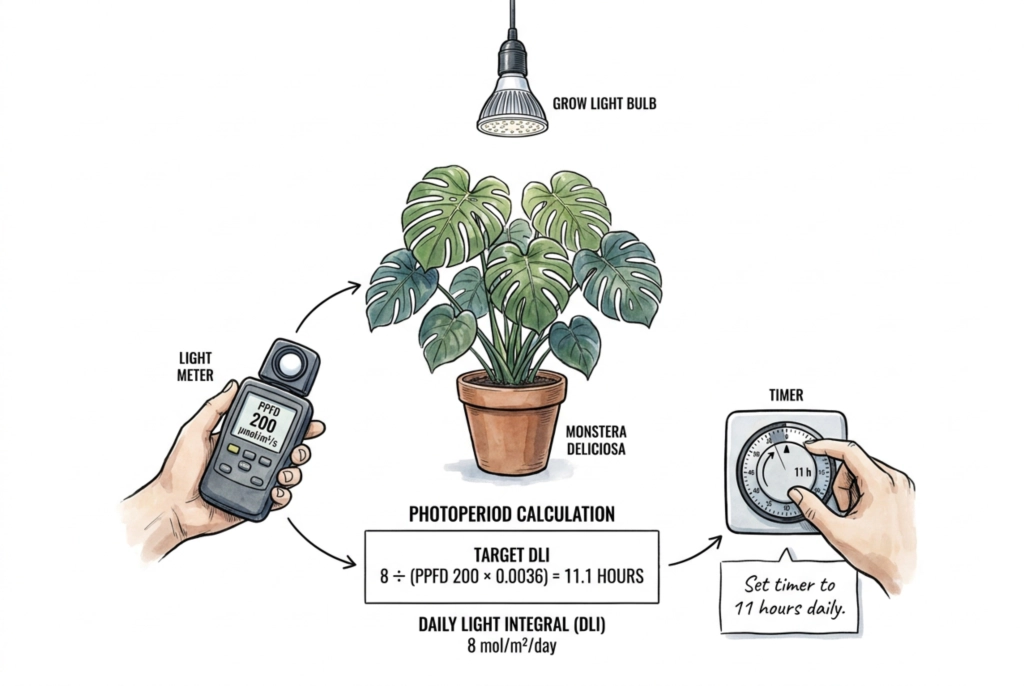
To find the photoperiod, divide the target DLI by PPFD multiplied by 0.0036. The expression is DLI ÷ (PPFD × 0.0036), not (DLI ÷ PPFD) × 0.0036.
For a target DLI of 8 mol/m2/day under a fixture delivering 200 umol/m2/s at the canopy, that is 8 / (200 x 0.0036) = 11.1 hours, so about 11 hours on the timer.
The target DLI of 8 is an example working value, not a measured requirement.
SANSI 36W BR30 Grow Bulb
SANSI 36W BR30 grow bulb suits one compact plant zone when a screw-in bulb is more practical than a hanging fixture. Measure at the leaves because close placement can create a bright center and dim edges.
Choose SANSI for One Compact Plant Zone
You need a normal-looking screw-in bulb over one compact plant zone and have a ventilated open fixture rated for the bulb’s wattage and weight.
Skip SANSI When You Need Shelf-Wide Coverage
Skip it when you need even shelf or cabinet coverage, an enclosed fixture, or a verified canopy-wide PPFD map. Check the socket, fixture rating, and clearance before using any high-output bulb.
MARS HYDRO TS1000 Panel
MARS HYDRO TS1000 panel suits a securely mounted shelf or tent with several plants. Its adjustable output helps you start lower, but you still need readings at the center and edges before setting the timer.
Choose MARS HYDRO for Adjustable Multi-Plant Coverage
You can hang a panel securely above a shelf or tent, need adjustable intensity across several plants, and will measure center and edge PPFD before setting the timer.
Skip MARS HYDRO When Mounting Space Is Limited
Skip it when mounting space is limited, you need a discreet household bulb, or you cannot manage the heat and peak intensity around shade plants. Confirm the exact generation, included controls, and safe mounting arrangement before buying.
How long should you run lights and when do plants need darkness?
Start With a Nightly Dark Period
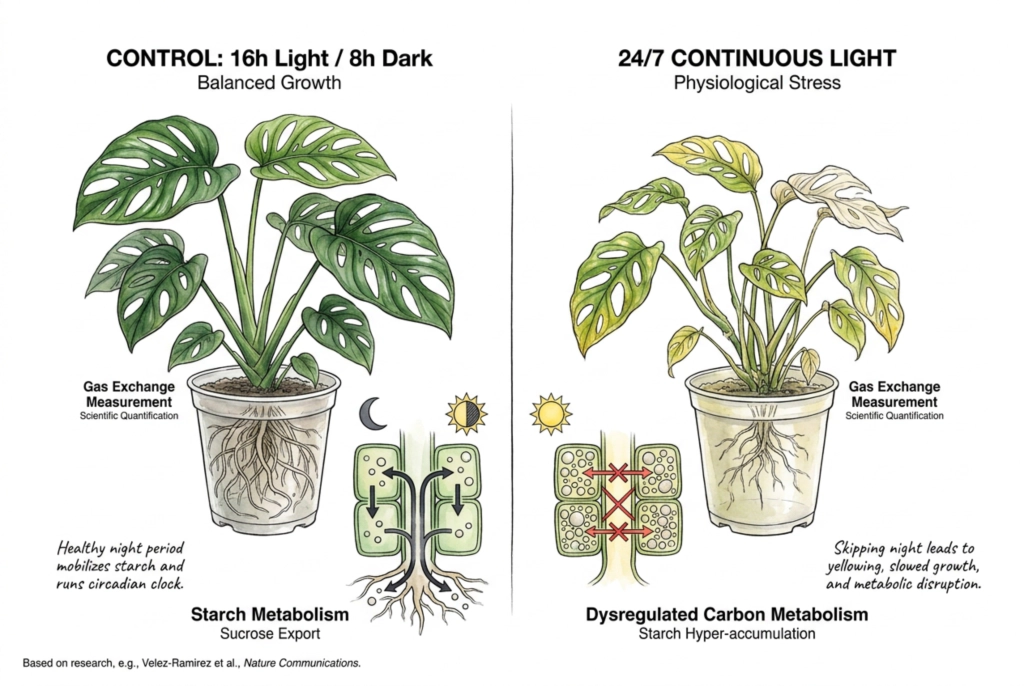
A regular dark period supports sucrose export and the circadian clock, and a conservative default for most foliage houseplants is a photoperiod of about 14–16 hours with several hours of darkness.
How strictly a given plant needs that varies by species. Some plants tolerate very long or continuous light better than others, so treat a nightly dark period as sound general practice rather than a fixed physiological law for every plant.
Does the plant care about long-low versus short-high?
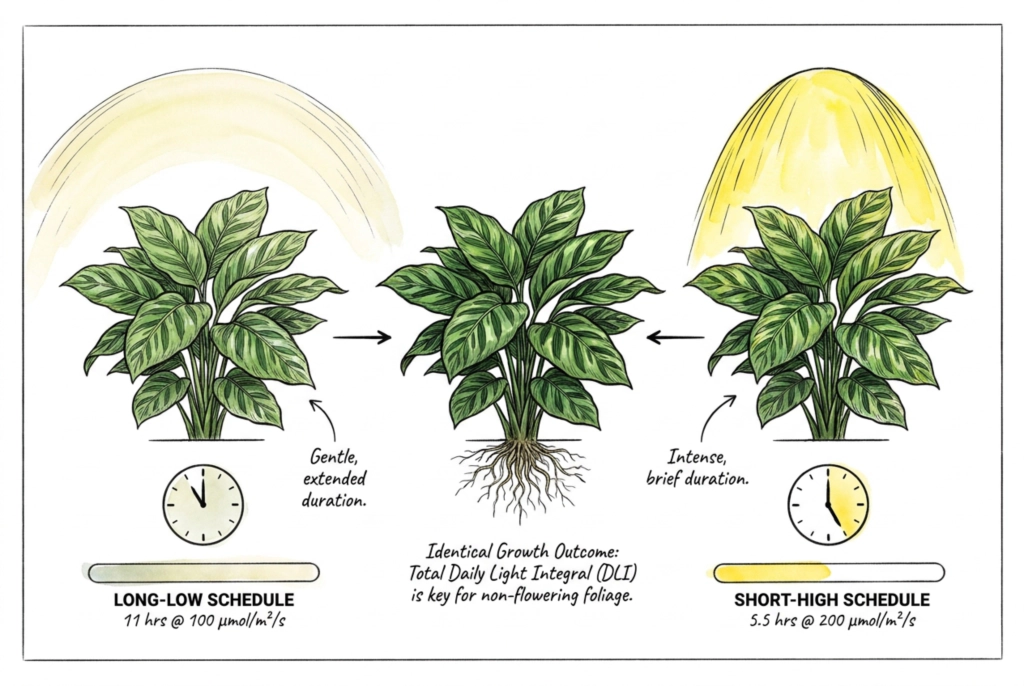
Within a sensible photoperiod, the daily total (DLI) is a big driver of growth, and two schedules with the same DLI often produce broadly similar results.
They are not guaranteed identical, though. Because the light response is nonlinear and photoperiod itself sends signals, delivery pattern can matter, and a very intense short-high schedule can push a shade plant past where it is comfortable.
For example, a DLI of about 4 mol/m2/day can be delivered as roughly 100 umol/m2/s for 11 hours or 200 umol/m2/s for about 5.5 hours.
For a shade-tolerant plant, the gentler 100 umol option is the safer bet, since it keeps peak intensity lower.
What happens under 24/7 light?
Continuous-light injury is real but species-dependent. Research on tomato (Velez-Ramirez and colleagues) documented chlorosis and yield loss under 24-hour light in sensitive genotypes, while other species tolerate continuous light without the same damage.
So it is a genuine caution, not a guarantee that every houseplant will react the same way.
There is no direct study showing that Monstera or other common houseplants develop the same symptoms on a set 2–4 week timeline, so watch your own plant rather than assuming a schedule.
Physiologically, the night period lets plants export sugars, mobilize starch, and run the circadian clock, and disrupting it can dysregulate carbon metabolism and gene expression in sensitive plants.
Keep a Nightly Dark Period
Running grow lights on a timer with a nightly dark period is a safe default, and it also saves energy. Some plants tolerate longer photoperiods, but a regular night rarely hurts.
Velez-Ramirez et al. – Continuous-light injury in tomato
Why does winter wreck your DLI?
At mid-latitudes, indoor winter light at the same window can be a fraction of the summer level (often roughly half, though the exact drop depends on your latitude, window, sky conditions, and any obstructions).
Solar-resource data confirms that outdoor light swings strongly with the seasons, but it reports outdoor sunlight, not the light at your windowsill.
A high-light plant like a Fiddle Leaf Fig that does fine at a bright window in summer can fall short in winter in northern regions, so supplemental LED from roughly October through March is often worth it.
Measure to see whether your own window drops below the plant’s range.
Kasa KP125MP2 Smart Plugs
Kasa KP125MP2 smart plugs can keep two grow-light outlets on a repeatable schedule and show power use. They do not measure the light reaching your plants.
Choose Kasa When You Need Two Scheduled Outlets
You need two independently scheduled grow-light outlets and want energy-use history alongside a consistent nightly dark period.
Skip Kasa When You Need Offline Schedule Retention
Skip them when you need one outlet only, lack the required Wi-Fi or control path, or need verified schedule retention through outages. Confirm the pack count, regional voltage, lamp load, and current firmware behavior before buying.
NREL National Solar Radiation Database
How do you diagnose light problems by symptom?
| Symptom | Possible light-related cause | Also rule out | If it is light |
|---|---|---|---|
| Long, stretched stems. Small pale new leaves | Too little light for growth (etiolation) | Overfeeding, natural reach toward a window | Move brighter or add a grow light, then re-measure |
| Bottom leaves yellowing and dropping | Chronic low light draining the plant’s carbon budget | Overwatering and root rot, nutrient deficiency, normal aging of oldest leaves | Increase light gradually and check watering first |
| Pale or bleached patches on upper leaves | Too much light (photoinhibition/photobleaching) | Sunburn from a sudden move, heat, chemical or spray injury | Reduce light or add a sheer. Trim only dead tissue |
| Red or purple leaf tint | High light (anthocyanin response) (often cosmetic) | Cold, phosphorus issues, or simply the plant’s genetics | Accept the color or reduce light modestly |
Read Symptoms as Clues
Treat the symptom table as a starting checklist, not a one-to-one diagnosis. The same symptom can come from watering, roots, nutrients, temperature, pests, or age as easily as from light, so confirm with a light reading and by checking the other suspects before you make a big change.
In broad terms, stretched and pale growth usually points to too little light, while bleached patches point to too much. A red or purple tint is often just a high-light cosmetic response.
Change one variable at a time.
For dark lesions on Monstera, use the Monstera black-spots diagnostic guide before blaming light. Edema, root stress, pathogens, and physical damage can look similar.
Why does a Fiddle Leaf Fig drop lower leaves?
One common light-related cause is a whole-plant carbon shortfall. In dim conditions the plant pulls mobile nutrients (nitrogen, phosphorus, magnesium) from older leaves to support new growth, so lower leaves yellow and eventually drop.
But a Fiddle Leaf Fig also drops lower leaves from overwatering, root problems, cold drafts, or a recent move, so rule those out too.
If low light is the issue, a Fiddle Leaf Fig is a high-light plant that struggles in genuinely dim spots.
Move it to a brighter position or add a grow light, stepping the light up gradually rather than all at once, and confirm the new spot with a meter.
Why does a Calathea bleach in a sunny spot?
Calathea and their Goeppertia relatives are shade plants, so in a sunny window the light can exceed what the leaf can process.
Excess excitation energy generates reactive oxygen species that can damage Photosystem II and, in bad cases, bleach chlorophyll into pale patches.
This mechanism is established, but the exact saturation point for a given cultivar is not something you can read off a chart, and this species was not among those measured in the 2026 study.
The fix is to move the plant back from the window, add a sheer, or choose a more sun-tolerant plant for that spot.
Fully bleached tissue will not turn green again, but the plant regrows healthy leaves over several weeks once the light is back in a comfortable range (how long depends on the plant, season, and temperature).
How do you safely move a plant to a new light environment?
Increase Light in Stages
Give a move to brighter light several weeks and step the light up gradually rather than all at once (a modest weekly increase, with an even gentler pace when reducing light).
The exact percentages are rules of thumb, not measured thresholds, so watch the plant and back off if leaves show stress.
New Leaves Complete Acclimation
Plants adjust to new light partly through biochemistry (pigment and enzyme changes over days to weeks) and partly through the anatomy of newly grown leaves.
Many structural traits, like leaf thickness and cuticle, are set as a leaf develops, so full adjustment often comes with new growth rather than on the existing leaves.
Why does a new nursery plant burn at the same PPFD it grew under?
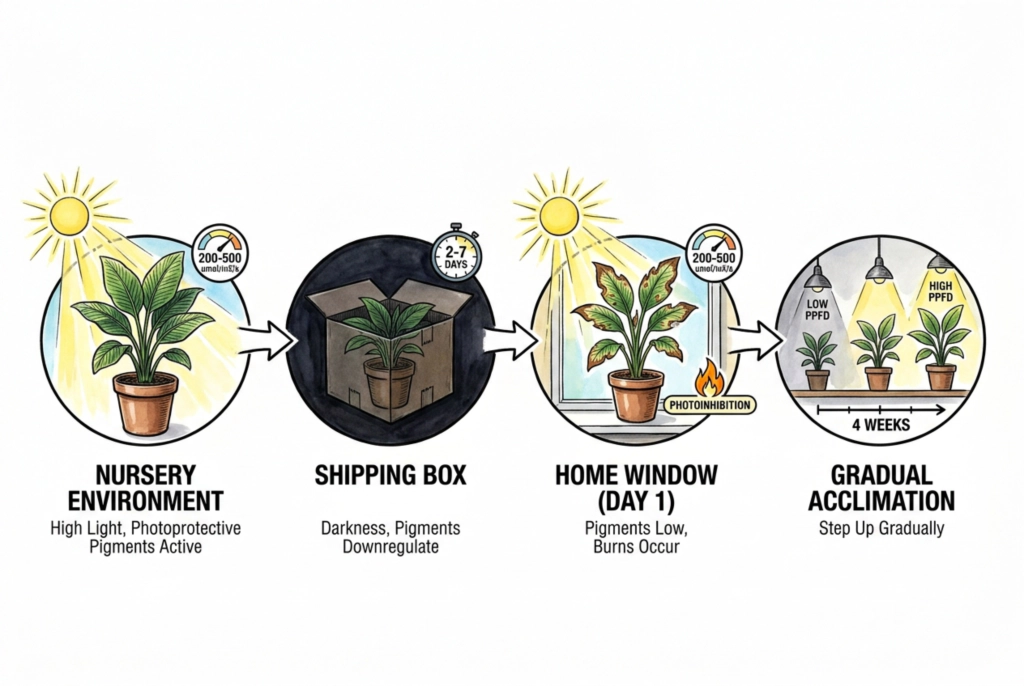
Production greenhouses are often fairly bright, and your window might be similar, but a plant that spent days in a dark shipping box arrives with its photoprotection dialed down.
It can vary a lot by grower, route, and species, so do not assume the new plant is ready for full sun on day one.
Putting it straight into strong light can cause light stress even at a PPFD it handled at the nursery.
Start it lower and raise the light over a few weeks, watching for any bleaching or scorching.
What is the actual acclimation protocol?
A simple approach is to start at roughly a third of the target light and raise it in steps over about four weeks until the plant is at full target. For example, use 30–40% of target in week 1, then 50–60%, then 70–85%, then full.
Keep each jump gradual. If a step causes stress, hold or back off before continuing. Use a dimmable grow light or distance from the window to control the level, and treat the specific percentages as a starting recipe you adjust to the plant.
Coolaroo 50% Shade Cloth
Coolaroo 50% shade cloth suits a large, breathable outdoor acclimation area rather than a single indoor pot. Its UV rating is not a promise of the PPFD reduction underneath it.
Choose Coolaroo for a Large Temporary Shade Area
You need a large, breathable temporary shade area for acclimating many outdoor plants and can mount the fabric securely without trapping heat.
Skip Coolaroo When You Need Verified PAR Reduction
Skip it when you need a small indoor window treatment or a verified 50% PAR reduction. Measure beneath the installed cloth, and confirm its size, color, seller, and delivery eligibility before buying.
Which common houseplant light beliefs does measurement clear up?
Measure Instead of Guessing
Thinking in measured numbers clears up a few common misconceptions. Low-light-tolerant plants still need real light to grow, and purple grow lights are not automatically better than white.
Match the window to the plant rather than assuming every plant needs a south-facing window.
Are low-light tolerant plants OK in dark corners?
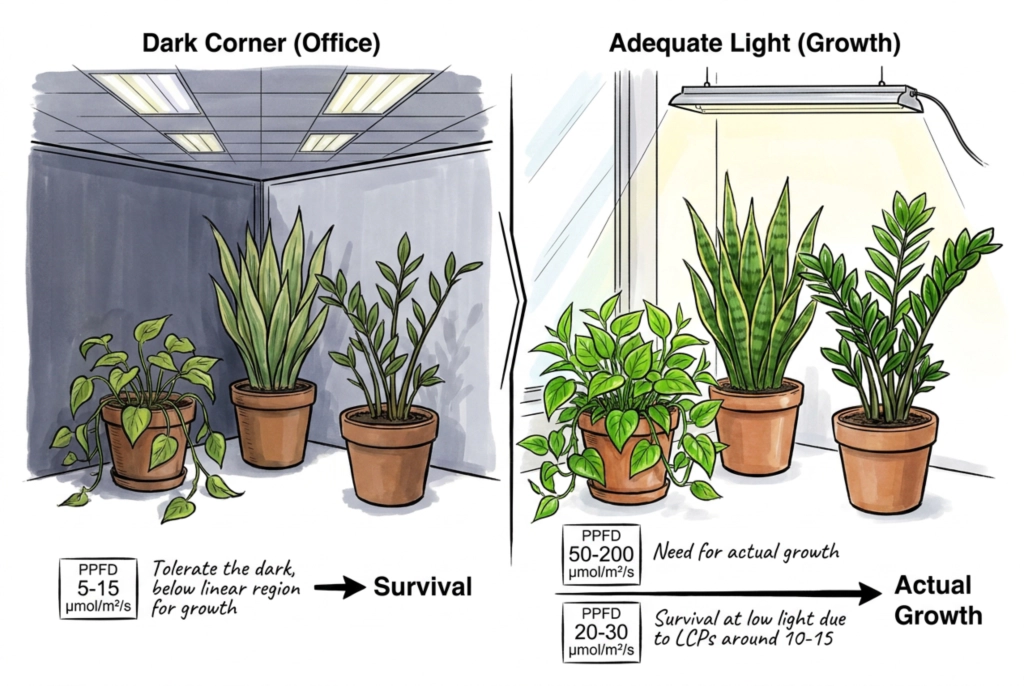
Not really. Tough plants like Pothos, Snake Plant, and ZZ Plant can survive at very low light because their light needs are modest, so they tolerate a dim corner.
But tolerating dark is not the same as growing in it, for actual growth they still want a moderate amount of light.
A windowless interior lit only by ceiling fixtures is often far too dim for a plant to do more than slowly decline, so add a window, move the plant, or add a grow light.
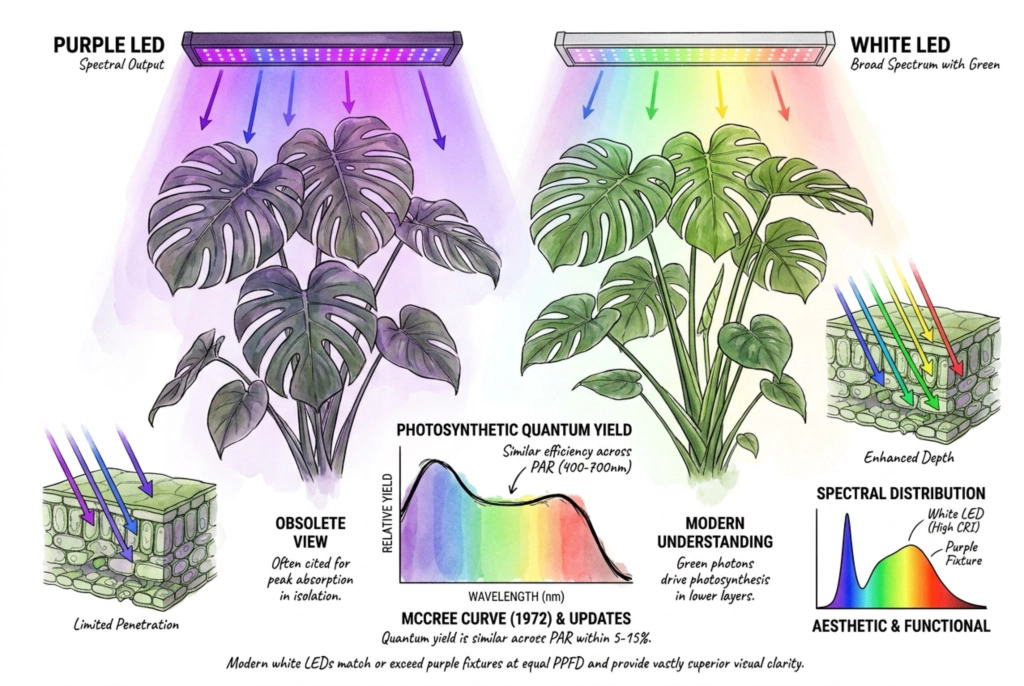
Are purple grow lights better than white?
Usually not. Classic work like McCree’s action spectrum shows that photosynthesis is driven fairly broadly across the visible (PAR) range, not only by red and blue, and green light penetrates deeper into a leaf where it is still used.
So at equal PPFD a good white LED is generally competitive with a purple one, though spectrum can also affect plant shape and other responses, so results are not identical.
For most homes, a high-quality white LED does the job at equal PPFD and looks far more pleasant than a purple glow.
Color-rendering rating describes how light looks to people, not how well a plant grows.
For the evidence behind that spectrum choice, see the white-versus-blurple grow-light review.
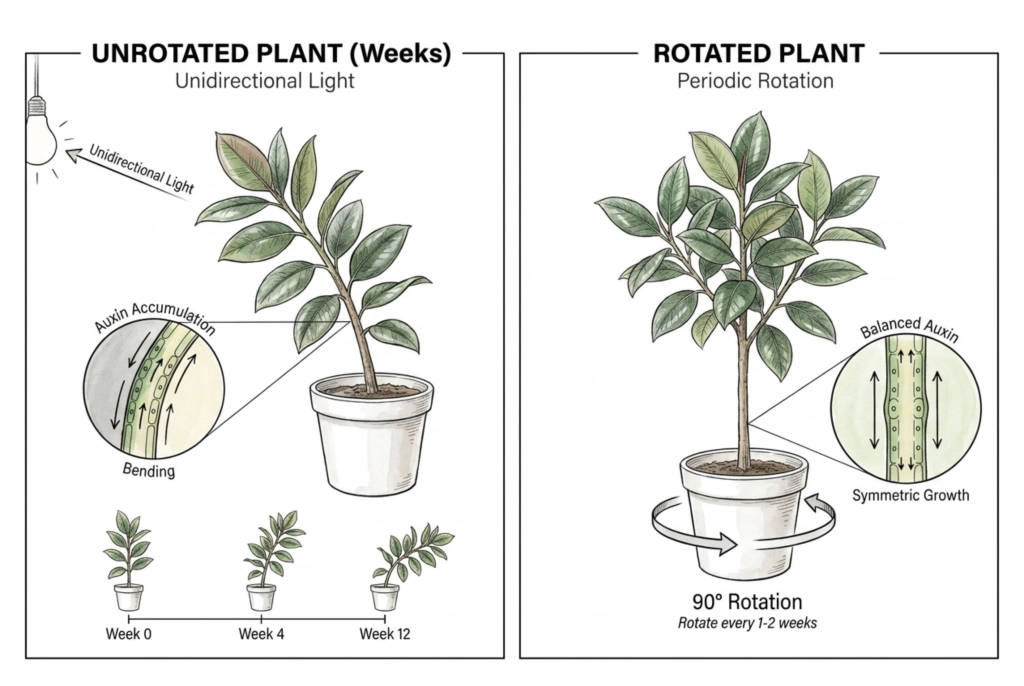
Does rotating the plant actually matter?
For many plants, yes. Light coming from one direction makes stems bend toward it (phototropism), and over weeks a plant lit from one side can develop a lopsided canopy.
Giving a freestanding plant a quarter turn every week or two evens out its growth. This matters less (and can even be counterproductive) for climbers trained on a pole or plants in bud or flower, so use judgment for those.
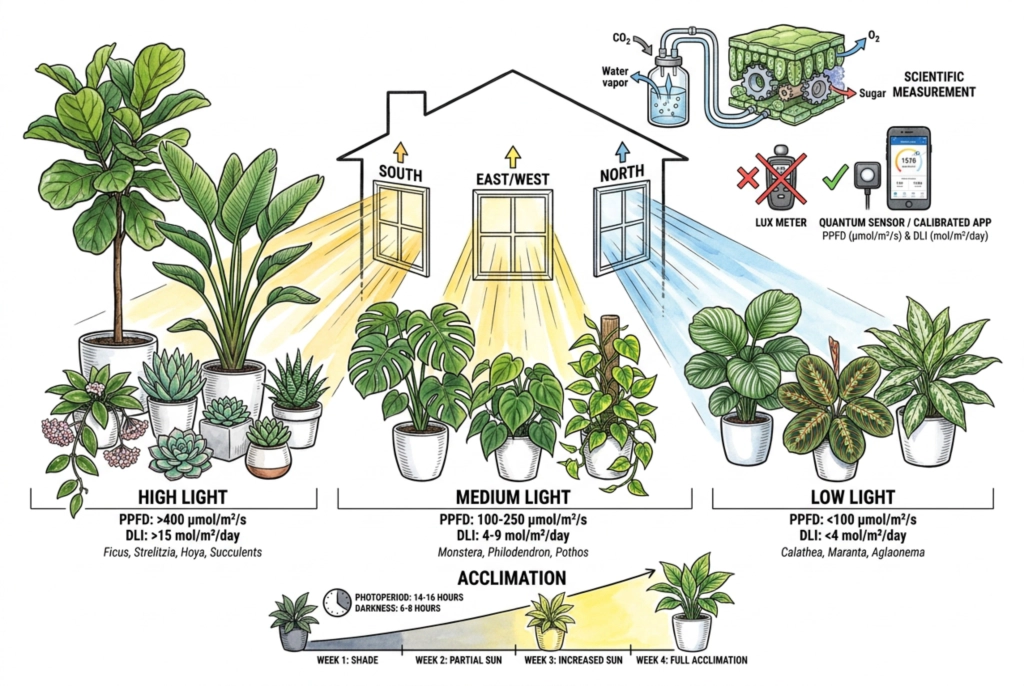
Should every plant have a south window?
No. Match the plant to the window. These directions assume the northern hemisphere, so flip them south of the equator.
A bright south-facing window suits high-light plants like Ficus, Strelitzia, Hoya, and succulents.
East and west windows suit Monstera, Philodendron, and Pothos in moderation, and dimmer north windows suit shade plants like Calathea, Maranta, and Aglaonema.
Because shade tropicals have a low tolerance for strong light, a very bright south window can scorch them, but exact outcomes depend on distance, curtains, and acclimation, so verify with a measurement rather than assuming.
Putting the two numbers to work
The point of PPFD and DLI is to replace a vague care tag with something you can measure and compare.
Read the light at your plant, aim for a sensible range for that species, give a nightly dark period, and step light changes up gradually.
Then let the plant rather than a table be the final judge, adjusting as leaves respond.
The 2026 HortScience study measured leaf-level responses for a small set of cultivars, so figures for other plants remain rough estimates, and the window, glass, curtain, and product values are illustrative rather than measurements of your home.
Light is also only one input. Temperature, water, humidity, and nutrition all shape how a plant actually grows.
Affiliate Disclosure
This article contains Amazon affiliate links. As an Amazon Associate I earn from qualifying purchases. If you use these links, the site may earn a commission at no extra cost to you. Product availability, price, and specifications can change. Check the current listing before buying.