
Aroid Grow Light Product Chooser: PPFD, DLI & Verification
Aroid grow light product chooser: buy by canopy PPFD and DLI, not just watts. Aim for a moderate DLI, verify with a PAR meter, and consider white broad-spectrum LEDs.
Marcus Hale · Published 2026-06-21 · 22 min read
Key Takeaways
- Judge a grow light by canopy PPFD and DLI, not by watts or lumens alone.
- Many foliage aroids do well at a moderate DLI, commonly cited near 6–12 mol/m²/day. The exact target varies by species, cultivar, and maturity.
- DLI equals average PPFD multiplied by hours and 0.0036. Lock the photoperiod with a timer.
- Verify with a quantum PAR meter or a calibrated app with its accuracy limits in mind. Lux meters mis-read LED spectra.
- White broad-spectrum LEDs can match red-blue light at matched photon flux and let you see leaf color naturally.
Choose a grow light by the light that reaches the leaves, not by the wattage on the box alone. First measure the canopy, then set a consistent day length, and adjust only after you see how new growth responds.
Watts, lumens, and heat still matter for electrical load, running cost, and cabinet safety. They do not tell you the canopy dose on their own.
What should I actually buy, and in what order?
Define the Dose Before the Hardware
Buy four things, and buy them in this order. The white broad-spectrum LED fixture delivers the photons, and a canopy light meter proves they land where the plant lives.
A timer then fixes how long the photons fall. An adjustable mount tunes how intense they are.
The decision underneath all of it is light dose. Many foliage aroids are grown well at a moderate canopy PPFD in the rough range of 100 to 300 µmol·m⁻²·s⁻¹ and a daily light integral (DLI) commonly cited near 6 to 12 mol·m⁻²·day⁻¹. Treat these as a starting range, not a universal law. The best target shifts with the species, cultivar, maturity, acclimation, and variegation, and it interacts with temperature, CO₂, and water status.
Commercial Anthurium trials, for example, have used DLIs closer to the lower end and found cultivar-dependent responses.
Land roughly inside that range and most aroids grow compact and healthy. Sit well below it and many stretch (etiolate). Push well above it and heat-tolerant limits and bleaching become a risk.
The response is continuous, not a switch, so use symptoms and a meter to fine-tune rather than assuming a fixed cutoff.
If you do only one thing, choose a fixture whose published light map can reach that range over your shelf, then verify it with a meter before you trust the box.
For the underlying science, our companion guide on PPFD and DLI for houseplants goes deeper than this buying guide needs to.
Daily Light Integral. Measuring Light for Plants
I cut cardboard to the fixture dimensions and suspend it at the planned height before ordering. This exposes blocked doors, hot air trapped above a shelf, glare at seated eye level, and mounting points that product photos hide.
The expected light footprint goes on the shelf for comparison with the mature canopy, not the current pot. If the mockup covers only the center, I choose a different form factor before trying to solve poor distribution with more wattage.
Why do PPFD and DLI decide the purchase, and not watts?
PPFD and DLI anchor the purchase because they describe the photon dose that reaches the leaf, which watts and lumens do not.
PPFD, photosynthetic photon flux density, counts photons in the 400 to 700 nm PAR band hitting one square meter every second, in µmol·m⁻²·s⁻¹. By convention it counts every photon in that band equally. That is a measurement definition, not a claim that every wavelength drives photosynthesis or leaf shape identically.
DLI, the daily light integral, totals those photons over the photoperiod, in mol·m⁻²·day⁻¹.
Dose is not the whole story, though. Spectral distribution, photoperiod, spatial uniformity, and the growing environment (temperature, CO₂, humidity) all shape how a plant responds.
PPFD and DLI are the first numbers to get right, then the specs below refine the choice.
Wattage measures electricity drawn, not photons delivered, and it still matters for load, heat, and running cost. Lumens measure brightness as a human eye sees it.
Neither tells you whether the canopy reaches its dose.
How do I turn PPFD into a daily dose?
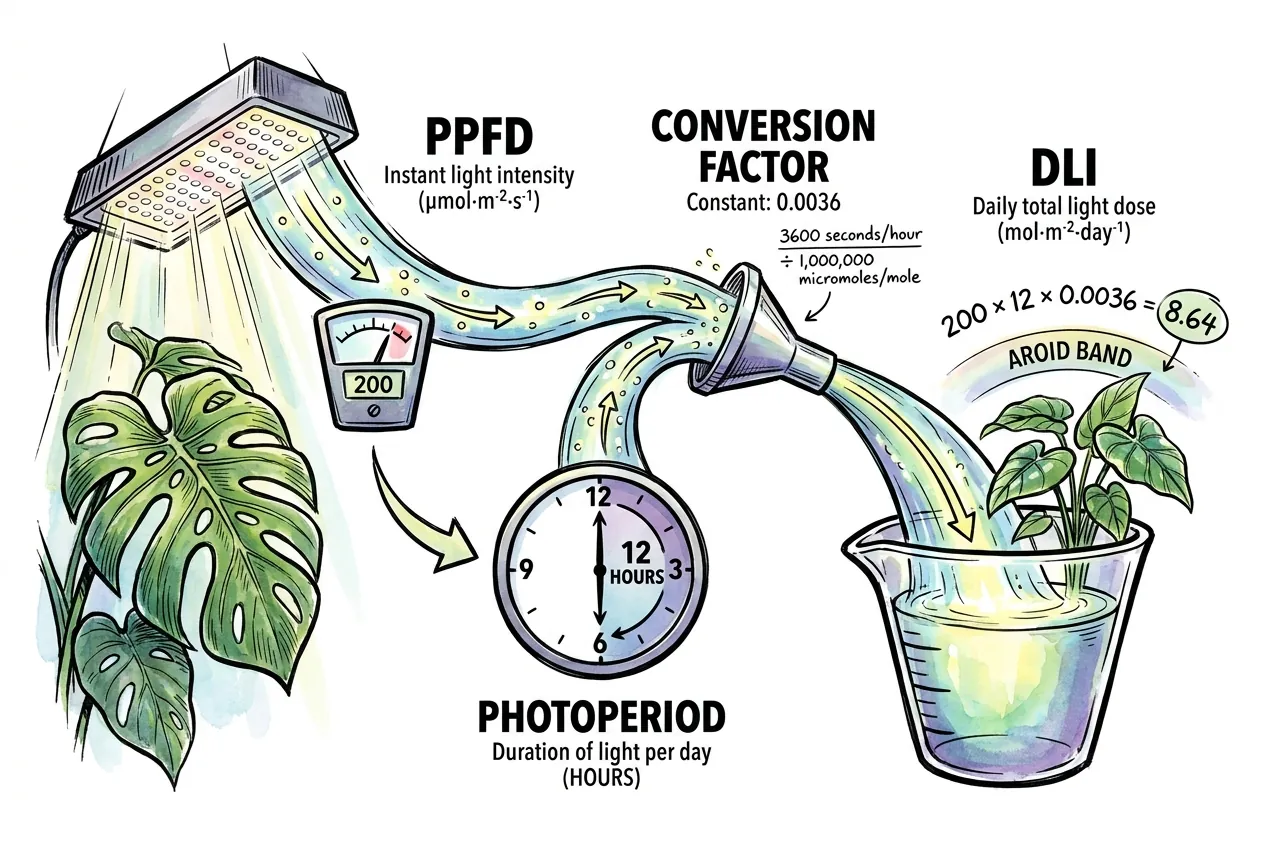
Use one calculation. DLI = average PPFD × hours of light × 0.0036. For example, 200 PPFD for 12 hours is about 8.6 DLI.
When a dimmer or window light changes intensity during the day, use an average reading instead of treating one snapshot as the full day.
Measuring Daily Light Integral in a Greenhouse (HO-238-W)
Daily Light Integral. Measuring Light for Plants
What happens if I overshoot the dose?
Above a leaf’s useful light level, extra intensity stops adding much growth and raises the risk of bleaching. The usual warning is pale, washed-out new growth nearest the fixture.
If a meter reads high and the nearest new leaves bleach, raise or dim the light, then re-measure. Check heat, watering, roots, nutrients, and pests as well, because they can produce similar damage.
Photobleaching of Chlorophyll in Light-Harvesting Complex II Increases in Lipid Environment
What PPFD and DLI do aroids actually need?
Start many foliage aroids around 100 to 300 PPFD at the canopy and about 6 to 12 DLI. Because aroids differ by species, maturity, variegation, and acclimation, treat that as a starting band rather than a universal target.
Shade-adapted foliage plants usually need less light than sun crops. Start toward the lower end for a newly acclimating or highly variegated plant, then raise the dose only when the meter and new growth both support it.
How does the target translate into a number I can buy against?
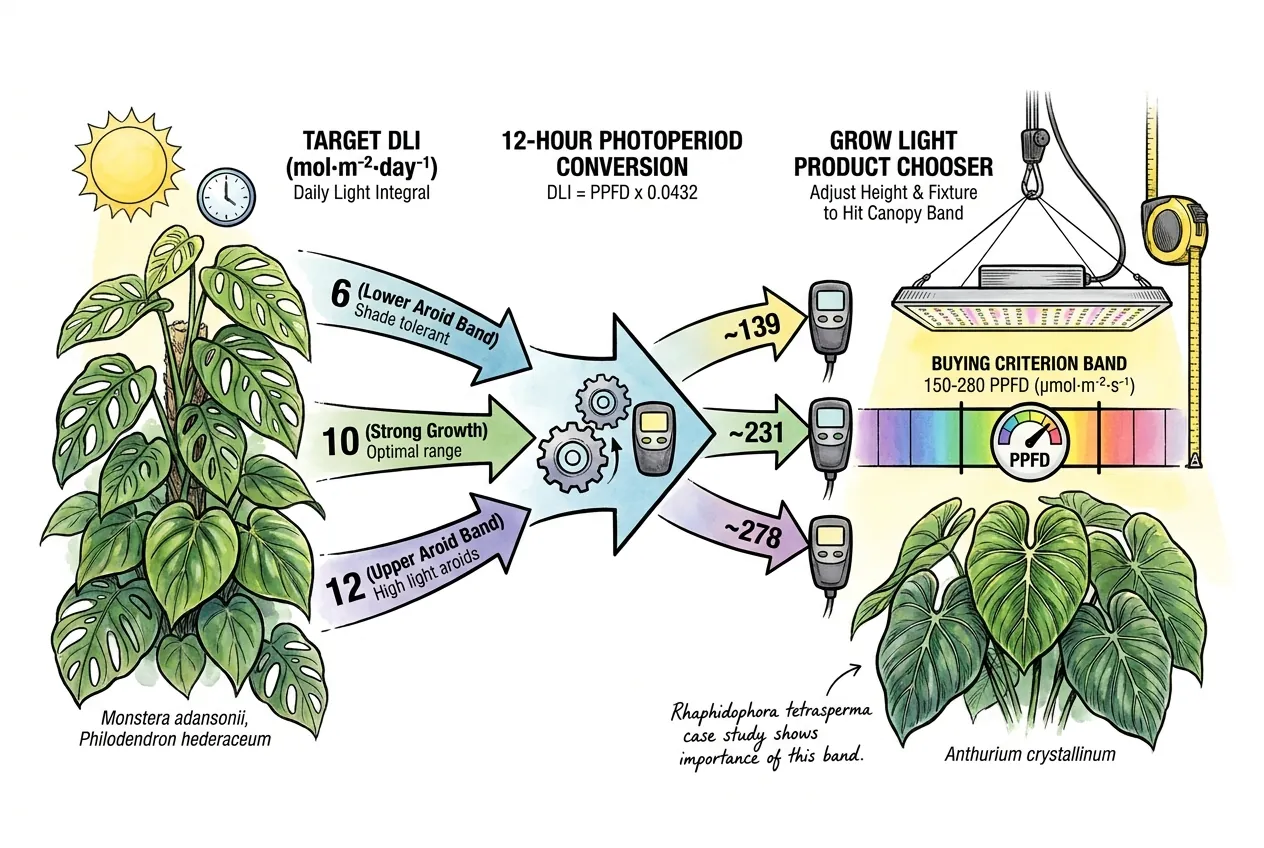
Convert the dose to the PPFD you must measure at the canopy. At a 12-hour photoperiod, DLI equals PPFD × 0.0432, so the math runs backward cleanly.
| Target DLI (mol·m⁻²·day⁻¹) | Required canopy PPFD at 12 h (µmol·m⁻²·s⁻¹) |
|---|---|
| 6 (lower end of the cited range) | ~139 |
| 10 (strong growth) | ~231 |
| 12 (upper end of the cited range) | ~278 |
A fixture that delivers roughly 150 to 280 PPFD at the canopy gives you room to work within the starting band, provided the day length matches. At 12 hours, that produces roughly 6.5 to 12.1 DLI.
Choose intensity and day length together, then confirm the actual result at leaf height. Spectrum, coverage, heat, electrical safety, and fit still decide whether a fixture suits your space.
Measuring Daily Light Integral in a Greenhouse (HO-238-W)
How do I read whether I bought too much or too little?
Read the new growth, because it records roughly the last few weeks of conditions. The two failure directions often look opposite, but confirm with a meter and rule out other causes before you re-tune, since morphology responds to more than light and can lag by weeks.
Too little light often looks like stretch
Long internodes and leaning toward the source commonly signal too little or too directional light.
Small thin leaves and lost fenestration can point the same way, though fenestration also depends heavily on maturity, climbing support, and genetics.
If a meter confirms the dose is low, raise the DLI by lowering the fixture or lengthening the photoperiod.
Too much light often looks like bleach
Pale, yellow-white, or scorched new leaves nearest the fixture can mean PPFD has crossed the saturation and dissipation limit, the photoinhibition mechanism from the section above.
The same look can come from heat, root or watering stress, or nutrient problems, so check those too, if the meter reads high, raise the fixture or dim it, then re-measure.
Why do lumens and lux mislead, and how do I measure correctly?
Lux misleads for grow lights because it is weighted to human vision, which peaks in green near 555 nm, while PPFD counts photons roughly evenly across 400 to 700 nm. A grow spectrum heavy in blue and red, where the eye is least sensitive, reads low on a lux meter even when it is rich in photosynthetic photons.
There is no single lux-to-PPFD multiplier that works across every spectrum, because the conversion changes with the spectrum.
For a fixed, known spectrum you can apply a manufacturer- or meter-derived conversion factor, and lux is still useful for mapping relative uniformity under one fixture.
But to set an absolute PPFD or DLI target with confidence, use a quantum sensor, or a calibrated phone app that reports µmol·m⁻²·s⁻¹ with its accuracy limits understood.
How accurate does my meter need to be?
For precise work, aim for a quantum sensor with a stated accuracy near plus or minus 5 percent, and note this is a target for careful DLI setting rather than a universal requirement for every hobby setup.
Even good sensors are imperfect, because no photodetector responds equally to every photon from 400 to 700 nm without costly filtering, so each carries a small source-dependent spectral error, alongside cosine, temperature, and calibration components.
The Apogee MQ-500 Quantum Meter suits growers who need repeatable PPFD readings across several plants or shelves. Its published calibration and maintenance information make it a stronger reference than an unverified budget meter, but it still cannot choose the right light target for a particular plant.
Be cautious with very cheap PPFD meters, since some are repackaged lux meters applying a fixed multiplier and inherit the spectral error above.
Check the individual meter’s sensor and calibration rather than judging by price alone.
MQ-500 Full-spectrum Quantum Meter
Full-Spectrum Quantum Sensor Support
Where do I take the reading?
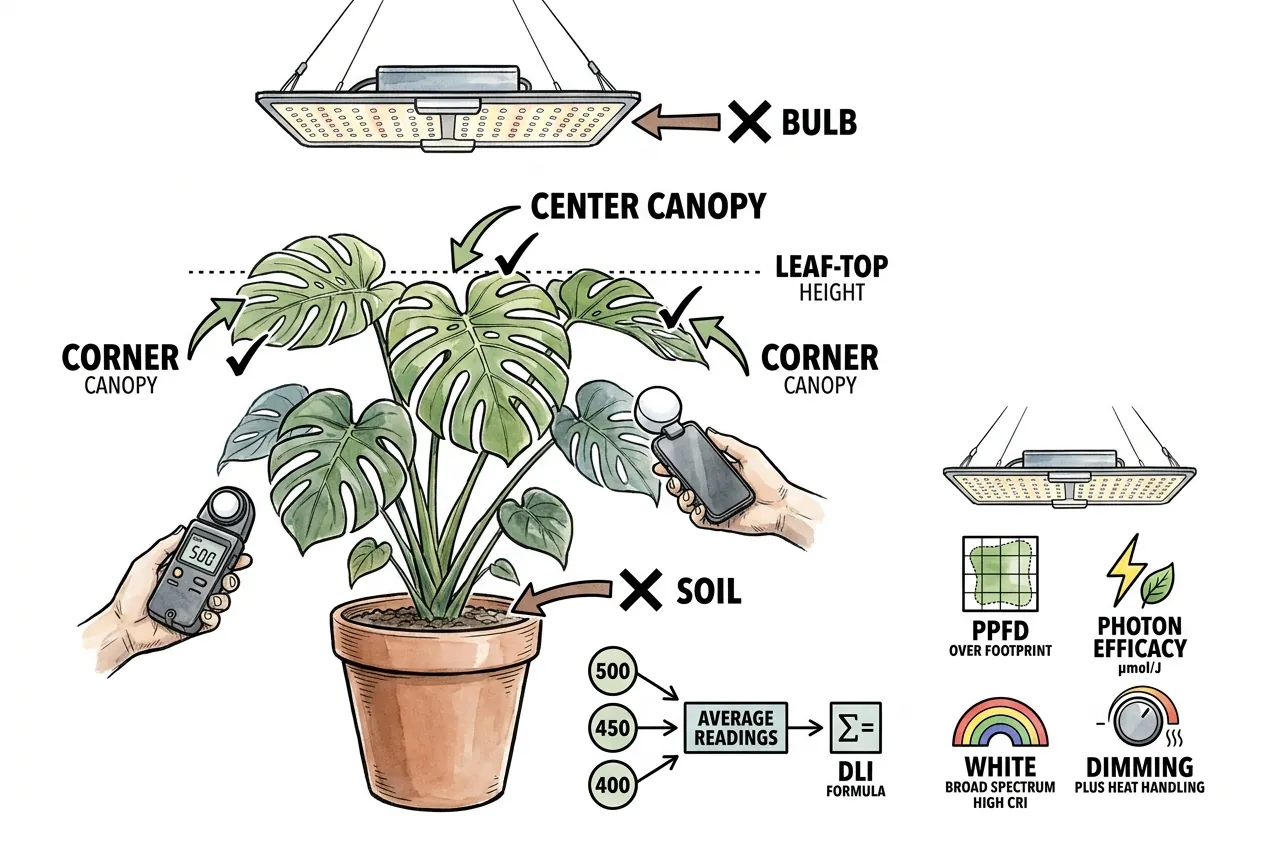
Measure at the canopy, at leaf-top height, not at the bulb and not at the soil. Take readings at the center and the corners of the lit area, because PPFD falls off toward the edges and with height.
For an uneven canopy, note the minimum, mean, and maximum and how uniform they are, rather than trusting a single point.
Set the meter or app to the matching source, LED full spectrum. Average the canopy readings, then drop the average into the DLI formula to choose your photoperiod.
A phone app such as Photone can do this on supported devices with a diffuser, but its accuracy depends on the device, its calibration, and the light source, so treat app readings as an estimate and cross-check with hardware when precision matters.
Which fixture specs separate a real light from marketing?
Start with the fixture’s PPFD map at your mounting distance, then check dimming, heat handling, and the coverage of your shelf. Photon efficacy and high-CRI white output help you compare running cost and leaf visibility, but they do not replace a canopy reading.
For a light that will run daily in a cabinet, also check its safety listing, moisture suitability, voltage and load type, warranty, and cable clearance.
What does the buying rubric look like as a table?
Run any product page against this rubric in two minutes. If a vendor cannot supply a column, treat that claim as unverified until your meter settles it.
| Spec | What to look for | Why it matters | How to verify |
|---|---|---|---|
| PPFD at distance | Published map reaching 150-280 µmol·m⁻²·s⁻¹ over your footprint at your mount height | It is the only output that feeds the DLI formula | Measure at canopy center and corners with a PAR meter |
| Photon efficacy | About 2.3 to 2.8 µmol/J fixture efficacy is efficient. Lower still works, it just costs more to run | Efficiency and running cost, not a pass/fail line for plant health | Check the spec sheet. Compare luminaire not diode numbers |
| Spectrum and CRI | White broad spectrum, CRI 90 or higher for natural viewing. Red-blue blurple can still grow plants | High CRI aids viewing (spotting chlorosis and pests). It is a viewing metric, not a growth-performance rating | Manufacturer spectrum chart and CRI value |
| Dimming and heat | Dimmable. Heat-dissipating form for cabinets | Hit target PPFD without relying only on height. Avoid cabinet heat | Spec sheet. Bulb types warn against enclosed fixtures |
Why choose white broad spectrum over blurple?
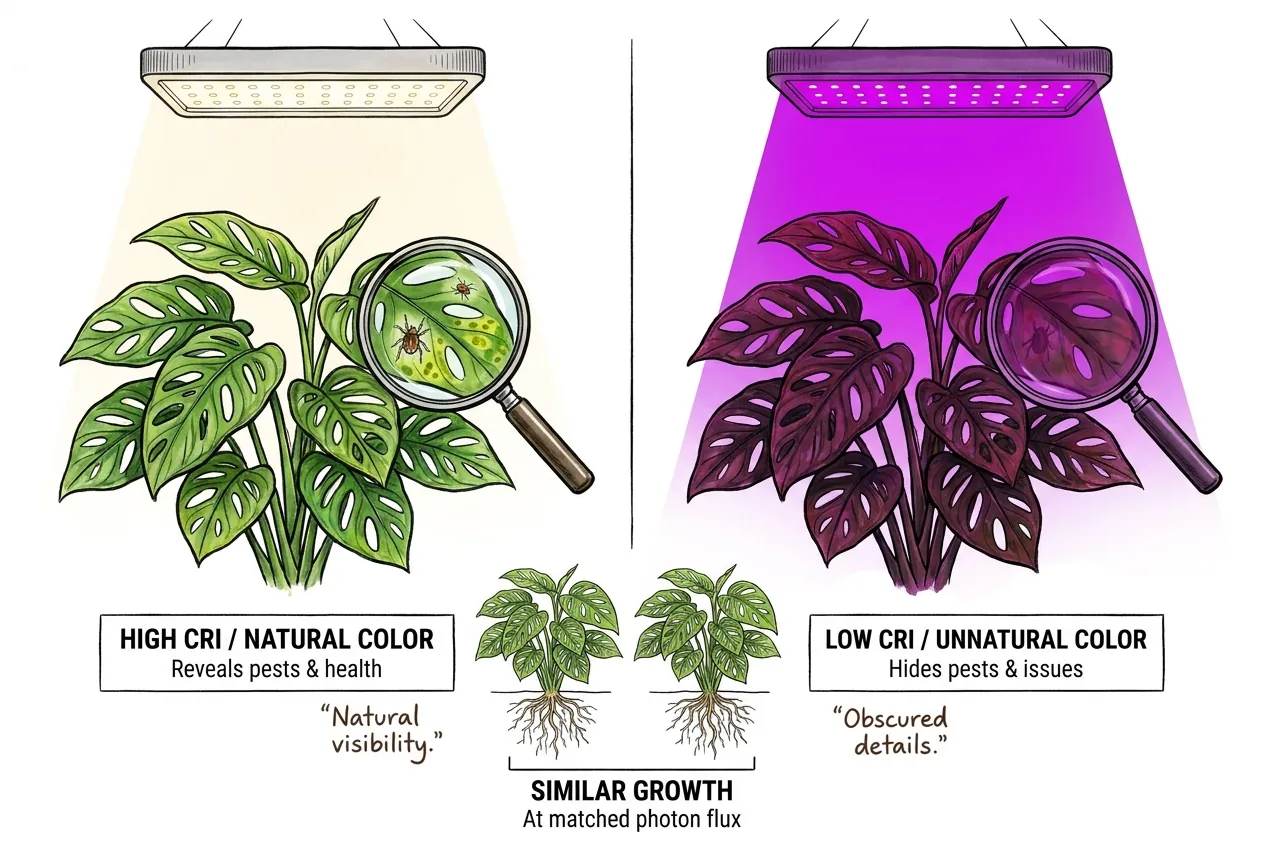
Choose white broad-spectrum light mainly because it lets you read leaf color and spot pests naturally. A red-blue fixture can still grow plants well at the same measured intensity, so replacing a working blurple light is optional.
Do not choose a fixture by color alone. Spectrum can influence form, but its effect depends on the plant and the rest of the setup. Use canopy dose, coverage, and heat management as the primary filters.
Blue Photons from Broad-Spectrum LEDs Control Growth, Morphology, and Coloration of Indoor Hydroponic Red-Leaf Lettuce
Do I need far-red?
For most compact-aroid goals, far-red is optional rather than required. It can lower the red-to-far-red ratio a plant senses, which tends to promote stem elongation, so if you are fighting stretch it may work against you.
That said, far-red is not simply bad. Depending on species, intensity, and the background spectrum, it can also increase photosynthesis, leaf expansion, and biomass.
Whether it helps or hurts is goal-dependent. Treat it as an optional refinement, useful for some setups and best avoided when you want maximum compactness, not a universal buying requirement.
Far-red light in greenhouse and indoor farming
Which products meet each role, and what are the tradeoffs?
Use the products below as examples of the roles a setup may need, not as a ranking. Manufacturer light maps and ratings are a starting check. Your canopy measurement decides whether the fixture covers your actual shelf without excess heat.
Which fixture should I buy for my space?
Match the fixture to your footprint. All three below are white broad spectrum. Shape and intensity are the main differences to weigh, but also compare uniformity, heat, efficiency, durability, safety listing, humidity suitability, and cost before you commit.
Spider Farmer SF1000 suits a full shelf or small cabinet when you need broad coverage and prefer to dim rather than rehang the fixture. It is excessive for a small single-plant setup unless that plant has a wide canopy.
Check the canopy map, cabinet clearance, and heat before installing, then set its output with your meter.
SANSI 36W Grow Light suits one plant in a ventilated standard-socket fixture. Its central beam can be useful for a focused canopy, but it is a poor choice when you need even shelf-wide coverage.
Confirm the socket rating and ventilation, keep it out of a tightly closed fixture, and set distance by measuring rather than by the product-page reading.
Barrina T5 Grow Lights
Barrina T5 Grow Lights suit a shelf that is wider than it is deep, where several strips can spread light more evenly than one central panel. They are a poor fit when you need one intense source for a deep canopy. The available product information does not provide a full PPFD map, so measure the canopy before relying on the result. In a warm, humid cabinet, use clips or fasteners rather than adhesive alone and keep the connectors dry.
SANSI BR30 36W LED Grow Light Bulb
Spider Farmer SF1000 Full-Spectrum Dimmable LED Grow Light
How do I measure the canopy without guessing?
Measure with a quantum meter or a calibrated phone app because fixture-box readings may not match your mounting height or shelf. This is what turns a product claim into your real canopy dose.
Apogee MQ-500 Quantum Meter is the stronger choice when you manage several plants or need repeatable DLI measurements. A supported, calibrated phone app can be adequate for one or two plants, but treat it as an estimate and compare it with a hardware meter when precision matters.
Photone Grow Light Meter. Common Mistakes Guide
MQ-500 Full-spectrum Quantum Meter
How do I lock the photoperiod so the dose is repeatable?
Lock it with a timer, because DLI equals PPFD times photoperiod, and a hand-switched light drifts the dose daily. The timer is the second half of the dose equation.
Kasa Matter Smart Plug KP125MP2 suits growers who want app scheduling and power-use data. Keep it outside a wet cabinet, confirm the outlet and load rating on the exact product, and check the schedule after a power or device reset.
Choose an offline timer instead if network independence matters more than energy data.
BN-LINK timer provides a simple offline schedule for a small LED fixture. It does not show power use, so confirm the fixture’s load and the timer’s current label before use.
Whichever timer you choose, Keep a consistent dark period and recheck the schedule after outages or clock changes.
How do I tune intensity after the light is hung?
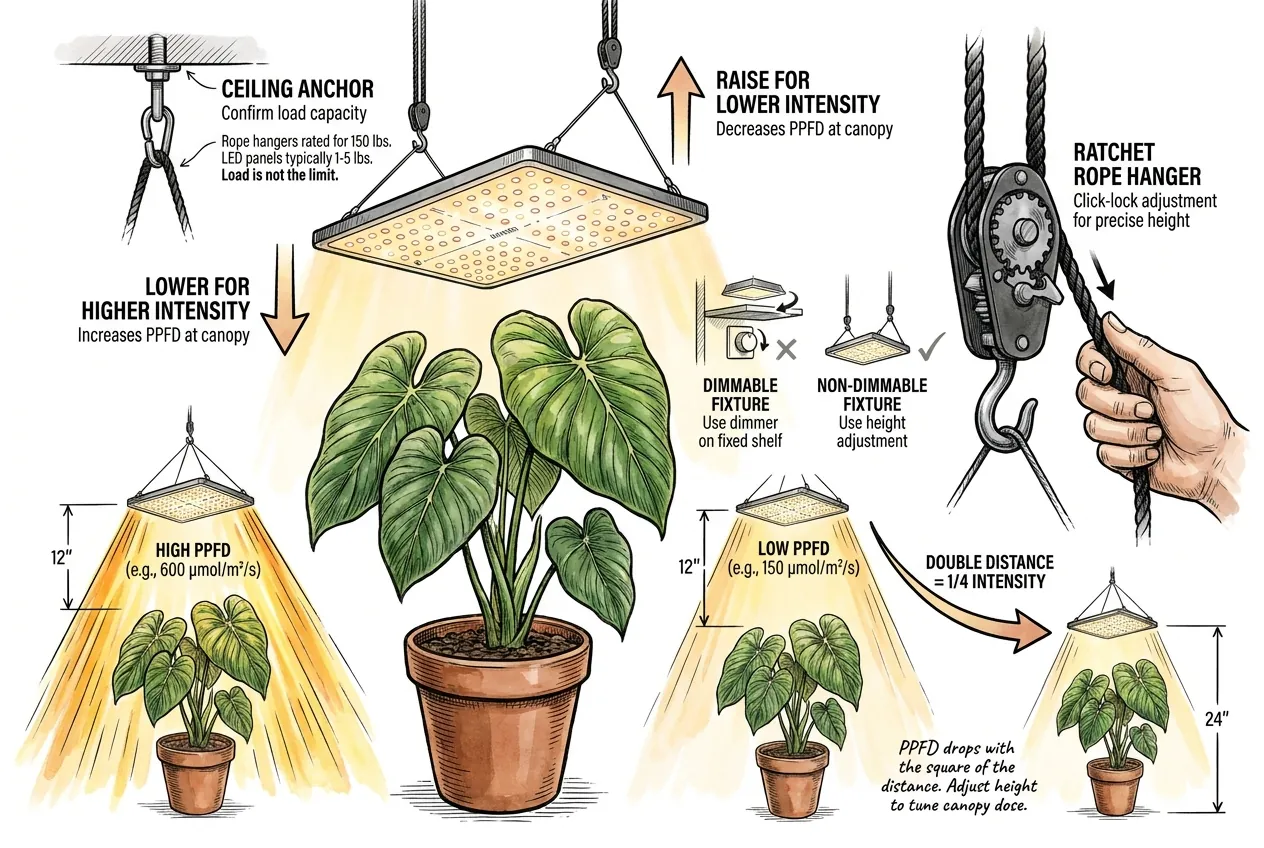
Tune intensity with height. Raising the fixture lowers canopy PPFD, so the mount is a practical intensity dial.
Be careful with the double-the-distance, quarter-the-intensity rule, though. That inverse-square relationship only holds for a small point source viewed from far enough away.
A grow panel or strip is an extended source, and canopies usually sit in its near field, where doubling the height does not reliably quarter the PPFD.
Use the manufacturer’s measured PPFD-versus-height map and your own meter to set the height, not the square law.
Hydro Crunch Ratchet Hangers let you make small height changes when a fixture is not dimmable. Skip them for a dimmable fixed-shelf setup.
The hanger is only as safe as its anchor, hook, rope condition, and mounting geometry, so check the full support path before hanging a fixture.
How do I set the whole system up and verify it?
Follow a fixed five-step sequence, because each step depends on the reading before it. Setting distance before measuring, or photoperiod before knowing PPFD, just guesses.
Step 1. Mount the fixture
Hang the fixture over the canopy center on ratchet hangers, or place a dimmable fixture on a fixed shelf.
Confirm the anchor load rating exceeds the fixture weight, and also check two-point balance, cable strain relief, clearance, and that heat and moisture are managed.
Step 2. Set a starting distance
Begin near the manufacturer’s recommended map height, often around 18 to 24 inches for a panel, but exact height depends on the fixture’s optics, power, and dimmer setting.
This is a starting point to measure from, not a guarantee of any particular PPFD, which you confirm in the next step.
Step 3. Measure at the canopy
Read center and corners at leaf-top height with the meter set to LED, and note the min, mean, max, and uniformity.
If the average runs above your target range raise the fixture, if it runs below, lower it.
Use your own target for the species, and watch heat as well as intensity.
Step 4. Set the photoperiod
Choose hours so DLI = average measured PPFD × hours × 0.0036 lands in your target range, commonly 6 to 12 mol·m⁻²·day⁻¹. A 12 to 14 hour photoperiod with a real dark period is a common starting point, if your measured PPFD is at the high end, shorter hours keep you from overshooting DLI 12 (for example, 280 PPFD for 14 hours gives about 14.1).
Photoperiod needs vary by species, so adjust from results.
Step 5. Verify and keep observing
Re-read PPFD to confirm the setting held. The meter reads immediately and does not need to settle.
New-growth changes can take longer than a week to show, so give the plant time. If growth stretches and a meter confirms low dose, raise it, if new leaves pale and other causes are ruled out, lower it.
Change distance or photoperiod one at a time, never both at once.
Who should not buy each class of product?
Avoid Unneeded Hardware
Being honest about what you do not need saves money. Not every grower needs every tool, and over-buying intensity is as real a mistake as under-buying it.
These are guidelines to weigh against your own space, not hard rules.
You can often skip a panel fixture for a single small specimen, since a BR30 bulb is cheaper, though a large plant with a broad canopy may still want the coverage.
A hardware PAR meter may be more than one or two plants need if a supported, validated phone app with a diffuser gets you close enough, if you want dependable precision, the hardware meter still wins.
Skip ratchet hangers if your fixture is dimmable on a fixed shelf, since you can dim instead of re-hang.
Prefer an offline digital timer over a Wi-Fi smart plug if network-independence matters to you.
And if you are buying new, white broad spectrum is worth favoring over blurple for the viewing advantage at matched flux. That is not a reason to discard a blurple fixture that is already growing your plants well.
What breaks over time, and when do I replace it?
Some grow gear degrades gradually while other parts can fail suddenly, which is why a meter keeps earning its place beyond setup. Four failure modes matter.
LED output decay (L70)
LEDs typically fade over time rather than fail all at once, and L70 is the rated hours until output falls to 70 percent of initial.
The SANSI BR30 lists a 25,000-hour lifespan. A rated lifespan is not necessarily the same figure as an L70 test result, so read the two separately.
As output decays your canopy PPFD drops gradually, so re-measure periodically and lower the fixture to hold the dose (extending the photoperiod also raises DLI, but do not eat into the dark period), then replace when you can no longer reach your target.
Driver failure
The LED driver, essentially the power supply, is a common failure point, and flicker, partial output, or a dead fixture often trace to it, though thermal, connection, or LED-string faults can look similar.
Buy from brands with a warranty. SANSI lists a 5-year protection plan on this bulb.
Sensor drift
Quantum sensors can drift, and the MQ-500 specifies a maximum of under 2 percent per year. That is an upper bound, not a fixed amount that accumulates the same way every year.
Over several years small drift can shift your DLI math, so cross-check against a stable reference periodically.
Phone-app readings can shift with camera and OS changes, so re-check them against a hardware meter when precision matters.
Photoperiod creep
A daylight-saving change that moves both on and off by the same hour keeps the run duration, and therefore DLI, the same. Only the clock time shifts.
The real risks to the schedule are power outages, clock loss, or a program reset, which can change duration.
Use a programmed timer or smart plug and re-confirm the schedule after outages and time changes.
SANSI BR30 36W LED Grow Light Bulb
MQ-500 Full-spectrum Quantum Meter
Frequently asked buyer questions
These answer common objections that come up before a grow-light purchase.
Can I just use a lux meter?
Not reliably on its own. Lux is weighted to human vision, so for an unknown or changing spectrum there is no fixed lux-to-PPFD multiplier and it will mislead you.
For a fixed, known spectrum you can apply a calibrated conversion factor, and lux still helps map relative uniformity, but to set an absolute DLI target use a quantum meter or a calibrated phone app that reports µmol·m⁻²·s⁻¹.
Is a $30 Amazon light enough for a Detolf or Milsbo cabinet?
Sometimes, for one shelf at a modest dose. An inexpensive high-CRI white bulb or a set of strips can reach a useful PPFD at close range on a small shelf, but the exact figure depends on the specific product, height, and area, and only your meter confirms it.
The failure mode is buying on wattage and assuming coverage, so measure rather than assume.
Do I need far-red?
Usually not for compact aroids. Far-red can increase elongation and biomass, which may worsen stretch, so it is optional.
Depending on species, dose, and background light it can also aid photosynthesis and leaf expansion, so treat it as a goal-dependent refinement, not a buying requirement.
How high above the plant should the light sit?
At whatever height puts your target PPFD (commonly around 150 to 280 µmol·m⁻²·s⁻¹) on the canopy for your fixture, which you confirm by measuring.
Raising the fixture lowers intensity, but for a panel or strip the falloff is not a clean inverse-square curve, so set height with a meter and the maker’s map rather than a formula.
If you also manage humidity, our plant cabinet VPD product chooser and VPD control guide pair naturally with this light setup.
Key Takeaways
- Judge by canopy PPFD and DLI, not by watts or lumens alone.
- Many aroids do well near 100-300 µmol·m⁻²·s⁻¹ and DLI 6-12 mol·m⁻²·day⁻¹, but tune the target to your species and conditions.
- DLI = average PPFD × hours × 0.0036. Lock the hours with a timer, and pick PPFD and hours together so you do not overshoot.
- Verify with a quantum meter, or a calibrated app with its limits in mind. Lux meters mis-read LED spectra.
- White broad spectrum can match blurple at matched photon flux and renders leaf color naturally.
Affiliate Disclosure
This article contains Amazon affiliate links. As an Amazon Associate I earn from qualifying purchases. If you use these links, the site may earn a commission at no extra cost to you. Product availability, price, and specifications can change. Check the current listing before buying.