
Terrarium Substrate Mix: Recipes, Layers & Bioactive Soil
Build a terrarium substrate mix that stays aerated. Compare three recipes, choose bark, coir, moss and charcoal, and manage false-bottom water safely.
Marcus Hale · Published 2025-12-17 · 12 min read
Key Takeaways
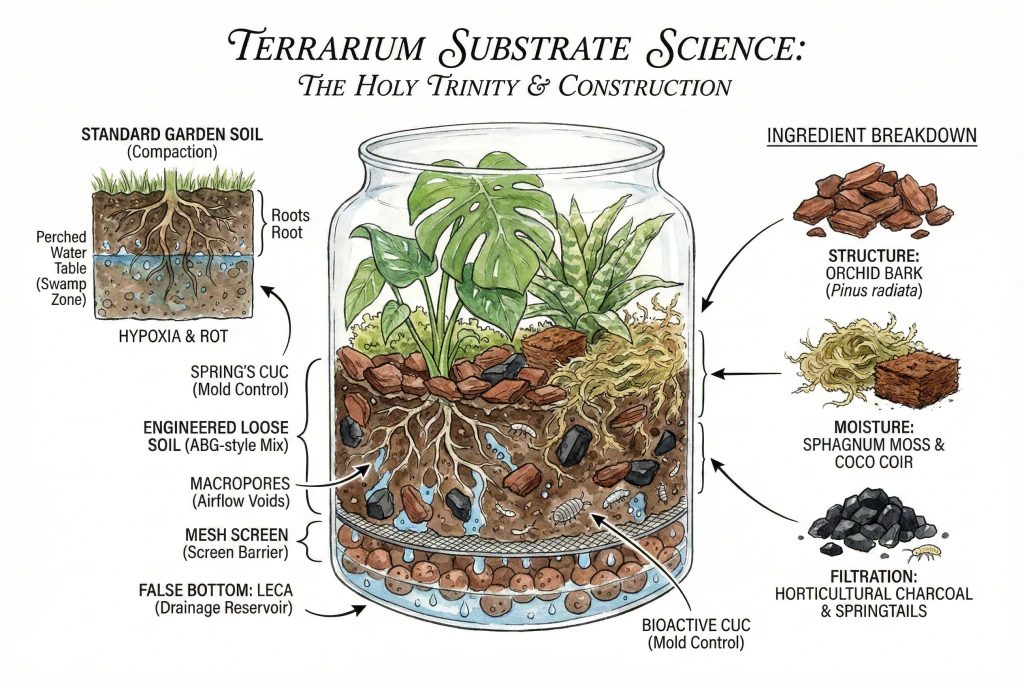
- Terrarium substrate is a water-and-air control system, not just a place to anchor roots. Chunky structure keeps pores open, while moss, coir, and other fine materials hold the moisture plants can use.
- Use recipes as starting points rather than fixed formulas. Particle size, plant species, container shape, humidity, and watering habits change how the same ingredients behave.
- A false bottom stores overflow but does not make overwatering safe. Keep the reservoir visibly below the substrate and provide a way to remove standing water.
- Bioactivity is optional and works only when the physical environment is sound. Springtails and isopods can process some waste, but they cannot correct waterlogged, oxygen-poor, or contaminated soil.
- Inspect the enclosure instead of following a replacement calendar. Odor, compaction, root condition, mold, water level, and salt buildup tell you when the mix needs adjustment.
Choose the right particle size
Avoid play sand or fine beach sand because fine sand fills the larger pores and compacts tightly. The dense texture may feel set, but it is compaction rather than a chemical set. Use washed, coarse horticultural or silica sand with visible, gritty grains that are closer to coarse sugar than flour.
Choose it by particle size and washed status rather than feel alone, and note that coarse sand doesn’t automatically improve a mix. The amount and the overall blend matter.
I pack one liter of mix to a 10-centimeter depth in a straight-sided clear container, level it without pressing, and record its starting weight. After an even 500-milliliter watering, the column rests for 24 hours before I mark surface height, free water, and fines. Three cycles reveal settling without deliberate flooding, while returning within five percent of starting weight keeps each drying stage comparable.
If the column collapses or separates badly, I adjust particle grading before mixing the full batch. A loose recipe on the table can become a dense layer after repeated water movement.
4. Compare three substrate recipes
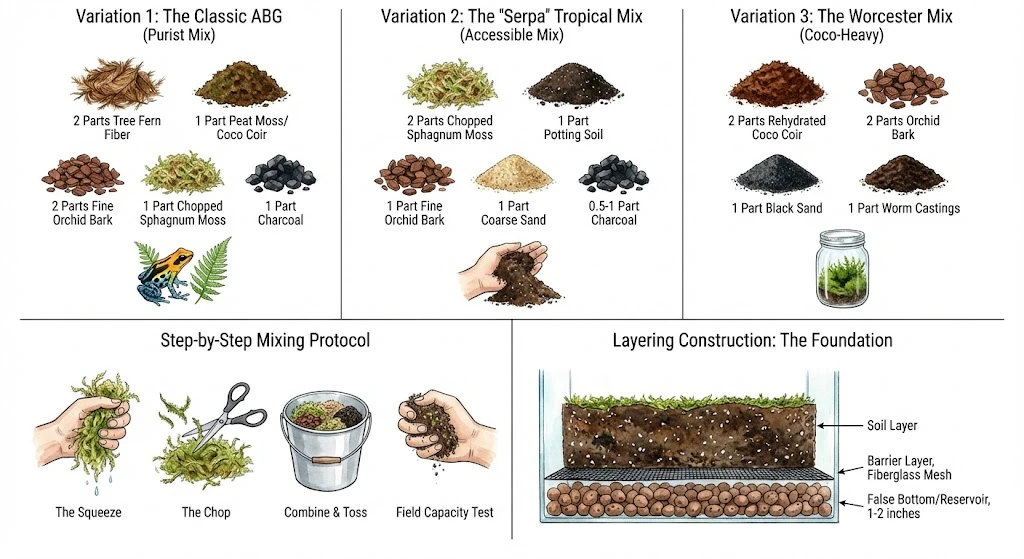
The ABG mix is a widely used vivarium substrate, but its exact history and lifespan are less standardized than hobby shorthand suggests. Community histories generally trace it to botanical and orchid growing that was later adopted by dart-frog keepers, rather than to a single documented Atlanta Botanical Garden formulation for frogs, and primary evidence for a specific five-to-seven-year lifespan is thin.
In practice a well-built ABG-style mix can stay usable for years. These three recipes are widely used starting points to adapt, not lab-tested formulas.
| Mix | Starting ratio by volume | Best fit | Main caution |
|---|---|---|---|
| Classic ABG | 2 tree fern, 1 peat/coir, 2 bark, 1 sphagnum, 1 charcoal | High-humidity tropical vivariums | Tree-fern fiber needs documented legal, sustainable origin |
| Accessible tropical | 2 sphagnum, 1 potting mix, 1 bark, 1 coarse sand, 1 charcoal | Builds using common ingredients | High water-holding fraction. Test before planting |
| Coco-heavy | 4 coir, 4 bark, 2 coarse sand, 1 castings. Optional 1 sphagnum | Peat-free planted jars | Check coir EC and add water conservatively |
Variation 1. Classic ABG (the traditional mix)
This traditional recipe suits high-humidity tropical vivariums, especially animal enclosures with ferns and orchids. Its community history is strongest in dart-frog setups, so adapt the ratios when your terrarium has different plants or ventilation.
- 2 parts tree fern fiber
- 1 part peat moss (or coco coir)
- 2 parts orchid bark (fine)
- 1 part sphagnum moss (chopped)
- 1 part charcoal
Premium New Zealand Sphagnum Moss
Premium New Zealand sphagnum moss is useful when you need a moisture-holding material that can be chopped into a mix. Rehydrate it fully, squeeze out excess water, and keep the amount modest if the container has little ventilation.
Orchiata Orchid Bark
Orchiata orchid bark adds coarse pieces that keep air paths open. It is a structure component rather than a complete substrate, so pair it with a material that holds moisture and a nutrient plan.
Horticultural Charcoal
Mosser Lee horticultural charcoal can add surface area and coarse particles, but charcoal is optional and its effects depend on the dose and source. It should not be treated as a filter that makes stagnant water safe.
Classic ABG Uses Specialized Materials
The classic ABG mix is airy and free-draining internally, but it relies on hard-to-source tree fern fiber. Substituting coir for peat changes the pH, CEC, and wettability, so the result is not identical to the original formula.
Variation 2 (The Accessible Tropical Mix)
Choose this mix when you want to avoid rare ingredients while retaining coarse structure and moisture.
- 2 parts sphagnum moss (chopped)
- 1 part potting soil (peat/coir based, no slow-release fertilizer)
- 1 part fine orchid bark
- 1 part coarse/horticultural sand
- 1 part charcoal
This blend uses cheap, available ingredients but has a high water-holding fraction from moss and potting soil. Test how wet it stays in your vessel before planting, and pick a fixed charcoal amount rather than a wide range.
Check the potting soil’s composition and pH. The absence of fertilizer pellets alone doesn’t guarantee that it’s low-nutrient.
Variation 3 (The Coco-Heavy Mix)
This peat-free option suits closed jars and moss-friendly builds, but the high coir fraction can stay wet longer than the bark-heavy recipes.
- 4 parts coco coir (rehydrated)
- 4 parts orchid bark
- 2 parts coarse, washed, inert sand. Use an uncoated product because color doesn’t indicate size or safety.
- 1 part worm castings (about 8–9% of the mix)
- (optional) 1 part chopped sphagnum for extra retention
The castings stay near the ~10% starting range mentioned earlier rather than a sixth of the mix. This blend can suit plants that want more moisture and nutrients, including many begonias and aroids, though needs vary by species. The high coir fraction holds water, so add water in small amounts and check that it is not staying saturated.
Wiggle Worm Castings
Wiggle Worm castings suit someone who will use a mild organic nutrient source across several enclosures. Keep them a small fraction of the mix because fine particles can reduce air space in a terrarium.
Choose Castings for Multi-Enclosure Use
Choose them when you will use castings across several enclosures, containers, or an outdoor garden and can keep the remainder dry and sealed.
Skip Castings for a Single Small Terrarium
Skip them when you are mixing one small terrarium or cannot verify that the finished mix stays low in salts and open in texture. Castings are fine particles, so more is not better. Compare a smaller local pack before committing to 15 lb if the bulk size does not fit the rest of your planned use.
Biochar – a sustainable soil conditioner for improving soil health, crop production and environment under changing climate. A review
Mixing Protocol
- Hydrate sphagnum and coir separately in warm (not hot), clean water until fully expanded (usually 15 minutes or more, though compressed bricks take longer).
- Squeeze them to damp, not dripping. This is where most people go wrong. Sopping-wet mixing turns charcoal dust to sludge that clogs the pores. Sieving or rinsing out fine charcoal dust first is even more effective.
- Chop the sphagnum into roughly 1-inch bits to help it distribute (this does trade away some of its long-fiber structure).
- Combine coir, moss, bark, charcoal, and sand in a tub and mix until every scoop has a bit of everything. Measure by volume, and if you’re working with dry, dusty material, use gloves and good ventilation.
- A squeezed handful should hold together loosely and crumble when poked. Drips mean it is too wet, so add dry bark or coir. Dust means it is too dry, so mist it. This is a feel test for mixing, not a precise field-capacity measurement, and it doesn’t set your watering dose for a no-drain vessel.
Layering (False Bottom + Mesh Barrier)
In a terrarium the bottom rocks are not a drain to the outside. At best they are an optional overflow reservoir that holds some excess water below the substrate, but water does not readily cross from fine medium into a coarse layer until the medium above is saturated.
That means a coarse bottom layer can push the saturated zone upward and reduce usable rooting depth, a result also described in container-gardening guidance for gravel layers. LECA is light and porous, so it can wick water into the substrate as well.
Treat a false bottom as helpful only when the design keeps water visibly below the substrate and lets you remove excess. For example, use a siphon or a small access tube down to the reservoir so you can see and pump out standing water.
Without that, a bottom layer is not reliable protection against overwatering. Measured watering is what protects the roots. If water is already pooling, use the overwatered terrarium recovery steps before adding more substrate or cleanup organisms.
A fiberglass window-screen mesh between soil and reservoir is useful because it slows fine soil from sifting down into the rocks.
It separates particles, but it does not stop liquid water from wicking up. Avoid paper towel or cheesecloth as a long-term separator because they break down. If you prefer a metal or polymer screen, choose a rust-resistant material because plain steel can corrode.
5. Bioactivity (An Optional Living Soil)
A cleanup crew is optional rather than a requirement for a healthy terrarium. A planted, well-aerated soilless mix can do fine without one. The bioactive terrarium design guide explains how springtails, wood, airflow, and hardscape interact beyond the soil layer.
Springtails (Collembola)
Springtails are tiny arthropods that graze on mold, fungus, and decaying matter while moving through the small voids in charcoal and soil.
Where they are active they can help keep surface mold in check, though the effect depends on the species, food web, and enclosure conditions.
They tend to reduce mold rather than eliminate it, and a bare surface does not guarantee that they will establish. If you seed a culture onto the soil or charcoal during the build, note the species and amount, and remember that wild-collected material can introduce unwanted hitchhikers. A recent laboratory study is suggestive, not proof of general terrarium mold control.
Isopods (e.g., Dwarf White Trichorhina tomentosa)
Isopods break down dead leaves and waste and are popular in larger, planted enclosures. There’s no hard size cutoff (suitability depends on the species, colony size, ventilation, and food).
If you keep them, provide a calcium source and supplemental food, watch for escapes, and stick to small species, since larger ones may nibble delicate plants when underfed.
Soil Allies. Exploring the Combined Potential of Folsomia candida and Trichoderma against Fusarium oxysporum
6. Terrarium substrate troubleshooting FAQ
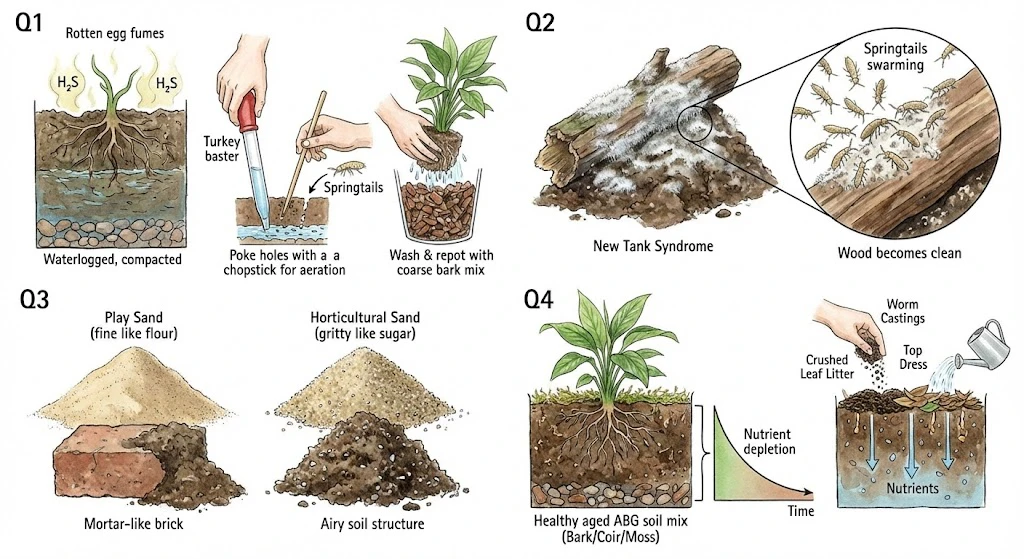
Why does terrarium soil smell like rotten eggs?
A rotten-egg odor often points to reduced, low-oxygen conditions (hydrogen sulfide), but a smell alone isn’t a diagnosis. Other decaying-organic odors exist, and odor intensity isn’t a safety gauge.
Open the lid with the enclosure at arm’s length rather than sniffing closely, then assess the water level, root condition, and substrate.
If the reservoir is holding standing water, remove it (a siphon or access tube works if there’s a head difference).
If conditions are clearly anaerobic or the odor is strong, correct the water level and substrate structure instead of forcing air holes between roots or adding more cleanup crew. Poking a chopstick through the root zone can damage roots and invite pathogens, and springtails do not treat hypoxia or H₂S.
When the substrate is genuinely sour or waterlogged, unpot the plant and assess the roots gently. Rinsing can further damage fragile roots. Rebuild with a coarser mix that contains more bark.
What should I do about white fuzzy mold on terrarium soil?
A transient white bloom feeding on fresh sugars in new wood and soil is common in new setups. First confirm what it is, such as a fuzzy surface bloom rather than pest eggs, root hairs, or a plant pathogen.
Rather than reaching for a fungicide, start by reducing excess moisture and improving airflow because broad sprays can harm the wider ecosystem. If you treat, use a targeted product carefully.
Where springtails are established they often graze the bloom down over a few weeks, though the timing is not guaranteed. Use the terrarium mold-control guide to distinguish a normal startup bloom from a moisture or decay problem. If environmental corrections are not enough, compare targeted options in the terrarium mold-control product chooser.
Can I use playground sand in a terrarium mix?
Play sand is usually a poor choice because it is very fine, packs tightly, and compacts a mix. Use washed, sharp, gritty horticultural sand instead, and judge it by particle size and washed status. A coarse-sugar feel is only a rough cue, not a full test of grain size or salts.
When do I need to replace terrarium soil?
A well-built ABG-style mix can stay usable for years. The organic matter breaks down slowly and available nutrients deplete over time. Decide by inspection, not the calendar. Look at odor, compaction, root health, and pests or disease, and replace it if it is failing or contaminated.
If it is still healthy, a light top-dress can renew nutrients, but base that on plant growth and, ideally, EC or pH checks rather than a fixed annual schedule, since a no-drain jar can accumulate salts and organic matter.
If you add leaf litter, use a known safe plant species free of pesticides, pests, and disease, and add water sparingly so you do not oversaturate the substrate, roughly mimicking a forest-floor cycle.
7. Build the mix, then monitor it
Don’t treat the substrate as filler because it sets the water and air balance around the roots. It also holds and releases moisture and carries the nutrients and, if you want them, the small organisms that process detritus.
A well-built loose mix, chunky bark for structure, moss/coir for moisture, a little charcoal and castings for chemistry and nutrition, over an optional, well-managed reservoir gives your plants a much better shot than dense garden dirt.
It isn’t a set-and-forget system, though. It still depends on measured watering, removing standing water, watching for mold, and refreshing nutrients based on how the plants are doing.
Get the mix right, then keep an eye on it, and it can stay healthy for years.
Affiliate Disclosure
This article contains Amazon affiliate links. As an Amazon Associate I earn from qualifying purchases. If you use these links, the site may earn a commission at no extra cost to you. Product availability, price, and specifications can change. Check the current listing before buying.