
Overwatered Terrarium Fix: Save Your Drowned Plants
How to fix an overwatered terrarium: why flooded soil starves roots of oxygen, how to remove and wick out standing water, inspect roots, improve aeration, and support a bioactive cleanup crew, with the limits of each step.
Marcus Hale · Published 2025-12-17 · 12 min read
Key Takeaways
- Waterlogging starves roots of oxygen because water fills the air gaps in the substrate, and the damage depends on species and flood duration.
- Remove reachable standing water early, but remember that extraction cannot reverse necrotic or infected roots by itself.
- Ventilation and an open lid can help, yet the recovery window depends on the vessel, room, plants, and remaining water rather than a fixed clock.
- Use glass fog, soil sheen, standing water, plant turgor, and root color or odor together instead of treating one symptom as a diagnosis.
- Springtails and long tools support cleanup and access, but neither is a root-rot cure and humid-adapted plants still need appropriate moisture.
A flooded terrarium often will not dry out fast enough on its own, and a saturated root zone can slide into decay. Excess water fills the air gaps in the soil, oxygen supply to the roots slows sharply, and the longer roots remain hypoxic, the more likely you are to lose them.
Acting early improves your odds. If you remove standing water while the roots and crown are still healthy, many overwatered terrariums recover. The outcome depends on plant species, flood duration, whether pathogens are already involved, and the severity of the damage in the vessel.
Why Waterlogged Roots Fail
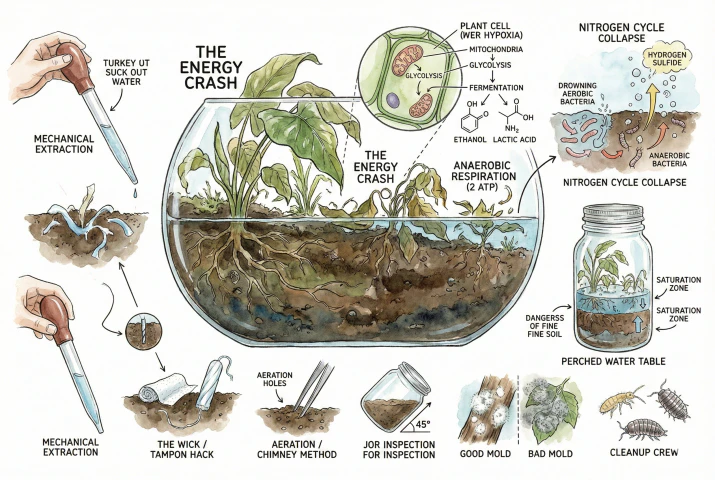
Roots need both water and oxygen. When water fills the air gaps in the substrate, oxygen reaches roots too slowly to support normal growth, nutrient uptake, and defense.
I install a discreet access tube to the lowest drainage area while the build is still open and cap it between checks. It lets me measure or remove accumulated water without excavating roots after a flood.
Before deciding whether to siphon, I mark the water level and time. A rising level after misting and a level that never falls point to different problems, and the trend tells me whether drainage or water input needs attention.
Roots Run Out of Oxygen
Flooded soil leaves roots with far less oxygen than airy soil. Plants can survive a short low-oxygen period, but prolonged saturation leaves roots without enough energy to stay healthy. Tolerance varies by plant and by how long the root zone stays wet.
Separate Waterlogging From Pathogen Rot
Waterlogging can damage roots on its own and can also create conditions that favor pathogens. What gardeners call root rot may be simple decay from low oxygen or a disease involving organisms such as Pythium or Phytophthora. Inspect the roots and crown before deciding whether drying is enough.
Mechanisms of Waterlogging Tolerance in Plants. Research Progress and Prospects
Why Leaves May Yellow
A waterlogged plant may yellow because damaged roots cannot take up nutrients normally. Yellowing has many causes, including low light, aging, pH, salts, root damage, and disease, so treat it as a signal to inspect the whole setup rather than a diagnosis.
Use Sour Odor as a Warning Sign
Low-oxygen substrate changes the activity of soil microbes and can develop a sour or rotten-egg smell. That smell is a reason to remove standing water and inspect the roots, not proof of one specific gas or disease.
Remove Free Water and Protect the Roots
With the physiology in mind, the priority is to reduce standing water and low-oxygen conditions before more roots are lost. Removing the lid to let water evaporate is one valid tool, but it is slow on its own, so a real flood usually needs active water removal too. Before doing anything mechanical, assess vessel size and weight, neck width, glued seams, and whether animals are inside.
Move Animals First
Move Animals Before Disturbing the Vessel
If your terrarium houses animals, move them to a safe temporary enclosure first. Tilting or digging in an occupied tank risks escape, crushing, and exposure to fouled water. Set them up somewhere secure and plan to dispose of removed water rather than reusing it.
Step 1. Inspect
Look at the substrate layers through the glass and note where water is pooling. Only tilt the vessel if it is small and light enough to handle safely. A full, heavy jar can slump its substrate, shift roots and hardscape, crack, or cut your hand, so inspect larger builds upright or with minimal tipping rather than forcing them to about 45 degrees.
If you have a false bottom, check whether reservoir water is touching the soil layer. Continuous contact can pull moisture back up through capillary action and keep soil soggy, but the result depends on mesh, layer junctions, and water level. The practical fix is to lower the free-water level rather than simply noting it.
Step 2. Mechanical Extraction
To remove bulk free water, reach into an accessible gap or the drainage reservoir with a long pipette or aquarium waste remover and draw the water out. Aim for water you can reach without disturbing roots. Avoid digging pits or forcing a tool straight down, which can tear fine roots and shift buried mesh or hardscape. If the root zone is already necrotic or infected, water removal will not be enough. You will also need to inspect and treat the roots.
Do not use a kitchen baster for this. Keep tools that touch soil separate from food-prep tools. A dedicated terrarium or aquarium tool works well. Wash and disinfect it afterward, and do not share it between a sick enclosure and a healthy one.
Fluval Aquarium Waste Remover
Fluval waste remover can reach accessible water in a drainage gap or reservoir without digging through the root zone. It suits a shallow opening where its reach is enough. It is not designed to excavate saturated soil, so choose a longer narrow tool for a tall vessel and stop if reaching the water would disturb roots or hardscape.
Step 3 (Wick It Out)
If plants are too dense for a baster, capillary action can help, but only if the geometry is right. Twist a paper towel into a tight wick, push one end deep into soggy soil, and drape the other end outside. For continuous drainage, the free end must hang lower than the water level inside and stay wet, with a container underneath to catch drips. A wick whose free end sits above the water level will stay moist without draining. Put a tray under the outside end to protect floors and furniture and to avoid spreading pathogens.
A tampon can absorb standing water quickly for the same capillary reason, and its string makes retrieval easy. It absorbs a fixed amount rather than siphoning continuously, so replace and remove it, and do not leave cellulose wet long enough to become a surface for mold.
Step 4. Check the Roots, Then Aerate Gently
Inspect Roots Before Aerating
Before or alongside aeration, inspect roots and crown where you can. Firm, pale roots are a good sign. Brown, black, mushy roots and a sour smell suggest decay. This inspection tells you whether drying may be enough, whether the worst roots need trimming and a partial repot, whether the substrate needs full replacement, or whether a plant with a lost crown and most roots is not worth saving. Use clean, disinfected scissors and dispose of removed tissue.
Some hobbyists make a few small holes to improve gas exchange in compacted soil. Do this sparingly because deep poking can shred roots, damage buried mesh, and shift hardscape. It does not drain saturated soil around the holes. If the root zone is sour or blackened, remove free water, inspect the roots, and replace damaged media rather than relying on aeration holes.
Step 5. The Reset
Reset the Water Cycle Gradually
Once standing water is out, ventilation helps the rest evaporate. Open the lid only as long as the plants and surface moisture require. In a dry room, even a small opening can wilt humidity-loving plants. Reassess after a few hours using room conditions and plant response. Wiping condensation removes only a little water, so pair it with extraction and substrate work when the root zone is saturated.
Prevent the Same Problem Returning
The Condensation Cycle
Read Condensation With Other Signals
Since you cannot easily weigh a terrarium, the glass is one convenient clue. See our guide on reading terrarium condensation. Many sealed terrariums fog lightly in the morning and evening as temperatures shift and clear during the day, but this is a rough cue rather than a health schedule. Fog forms from the difference between interior dew point and glass temperature, so day and night, lamps, a cold window, and room temperature all change it.
Persistent, heavy condensation can point to excess water, but cold glass can stay foggy and a substrate can be saturated with no fog at all. Read condensation alongside soil sheen, standing water at the glass line, plant turgor, root odor and color, and the container’s weight or the amount of water added. Ideally the soil looks dark but not glistening, with no water pooling at the soil line.
Fix the Real Cause (Substrate and the Perched Water Table)
Separate Perched Water From Standing Water
Fine substrate naturally stays wetter near the bottom after watering. That is different from free water trapped in a sealed terrarium. A coarse drainage layer does not automatically make water leave the vessel, so lower any standing reservoir water and choose a mix that leaves air around the roots.
Choose Structure for Air-Filled Porosity
Fine potting soil tends to hold a lot of water and a tall saturated zone, which makes it a poor choice for many terrariums. A chunkier, structurally stable mix with more macropores raises air-filled porosity. The popular ABG mix, made from tree-fern fiber, sphagnum, charcoal, orchid bark, and peat, is one example. ABG still contains peat and sphagnum, does not make water drain out of a sealed vessel, and is formulated for humid tropical vivariums rather than every bog, carnivorous, moss-only, or arid setup. Tree-fern fiber also has sustainability concerns worth checking before you buy.
If a build stays soggy, repotting into a coarser mix can help. Match it to species, substrate depth, and the actual air-to-water balance rather than assuming grittier is always better. Factor in root and crown health and any cleanup fauna before tearing a build apart.
Send in the Springtails
Use Springtails After Drainage Recovers
Hand-cleaning every patch of mold in damp soil is impractical, so many bioactive setups use a cleanup crew. Springtails, or Collembola, are tiny hexapods that graze on mold and decaying matter and thrive in moisture. They can help keep saprophytic mold from smothering moss.
Springtails can graze some fungal growth, but their role is cleanup after moisture has been corrected. Laboratory findings do not show that they cure terrarium disease, flood damage, or root rot.
Josh’s Frogs Springtail Culture
Josh's Frogs springtails are a live culture for starting or restoring a bioactive cleanup crew. Add them only after the enclosure is draining and recovering. They suit a moist, stable substrate with decaying material to eat, not a flooded or oxygen-starved tank. Their population and visible cleanup depend on temperature, food, and enclosure size.
For a deeper explanation of drainage layers, see the terrarium substrate guide.
For larger, humid bioactive builds, moisture-loving isopods like dwarf whites, Trichorhina tomentosa, help process dead leaves. Terrestrial isopods still need oxygen and are not a fix for flooded, anoxic substrate. Saturation can drown them or cause population loss, so add live cleanup animals only once a build is recovering and keep their welfare and containment in mind.
Soil Allies. Exploring the Combined Potential of Folsomia candida and Trichoderma against Fusarium oxysporum
Use the Right Tools
In a narrow or densely planted vessel, long tools make maintenance easier and reduce disturbance. Long tweezers help place plants and reach deep spots without digging destabilizing craters, while long curved scissors let you remove a rotting leaf. Cutting can slow a leaf disease such as Botrytis only when you diagnose it correctly, use a sterile blade, dispose of tissue, disinfect the tool, and keep watching for new symptoms.
WORFACE Aquascaping Tools Kit
WORFACE tool kit is a budget set for planting, trimming, and reaching into a narrow terrarium. It is a practical fit when the listed length reaches your work area. Wash and disinfect the tools between enclosures, and do not assume a low-cost stainless listing has the corrosion resistance or blade life of a premium set.
4. Troubleshooting (Q&A) (Debunking the Myths)
Activated Carbon Does Not Restore Oxygen
Activated carbon can adsorb some dissolved compounds when wet, but it does not restore oxygen to a waterlogged root zone or cure a root pathogen. Its effect is limited by the amount and type of material already in the substrate.
A Sealed Terrarium Still Needs Observation
A well-built sealed terrarium can run a long time once it settles, but its needs depend on the container, planting, seal, light, and substrate. Monitor a new build and adjust it instead of expecting it to run unattended.
White Growth Needs a Contextual Diagnosis
White, stringy, cottony growth on dead wood or soil is frequently saprophytic fungi breaking down dead matter, and springtails may graze it. You cannot diagnose mold by color and location alone. Botrytis mycelium can also be white to gray, and green or gray molds can be saprophytic too.
Powdery mildew is a different disease, with a white to gray powdery growth on living leaves. Botrytis, or gray mold, is another disease that often produces fuzzy gray-brown spores on moist, dying tissue. What matters is the host and the lesion. Growth on living tissue, water-soaked spots, and tissue death point toward a pathogen, whereas growth on clearly dead material usually does not. If in doubt, remove affected tissue with sterile scissors, dispose of it, disinfect the tool, and keep monitoring rather than relying on a simple good-mold or bad-mold rule.
5. Conclusion
The Recovery Sequence
Remove standing water, inspect roots and the crown, then adjust ventilation and watering from the actual moisture in the vessel. Use the glass alongside soil sheen, plant turgor, root color, and odor. Adapt each step to vessel size, animals, plant species, substrate, water depth, and flood duration.
Many plants tolerate a short dry spell better than sustained waterlogging and root rot, so when unsure it is often safer to add less water. This is not universal. Humid-adapted tropical ferns and mosses can suffer quickly in dry air, so match watering to the plants you keep. When rewatering, add small amounts and check the substrate before adding more. It is easier to add water than to remove it once it is in the soil.
Affiliate Disclosure
This article contains Amazon affiliate links. As an Amazon Associate I earn from qualifying purchases. If you use these links, the site may earn a commission at no extra cost to you. Product availability, price, and specifications can change. Check the current listing before buying.