
Terrarium Mold Control Product Chooser
A mold control product chooser for terrarium keepers: pick the right hygrometer, fan, drainage, and springtail crew by measurable spec, not panic spray.
Marcus Hale · Published 2026-06-22 · 30 min read
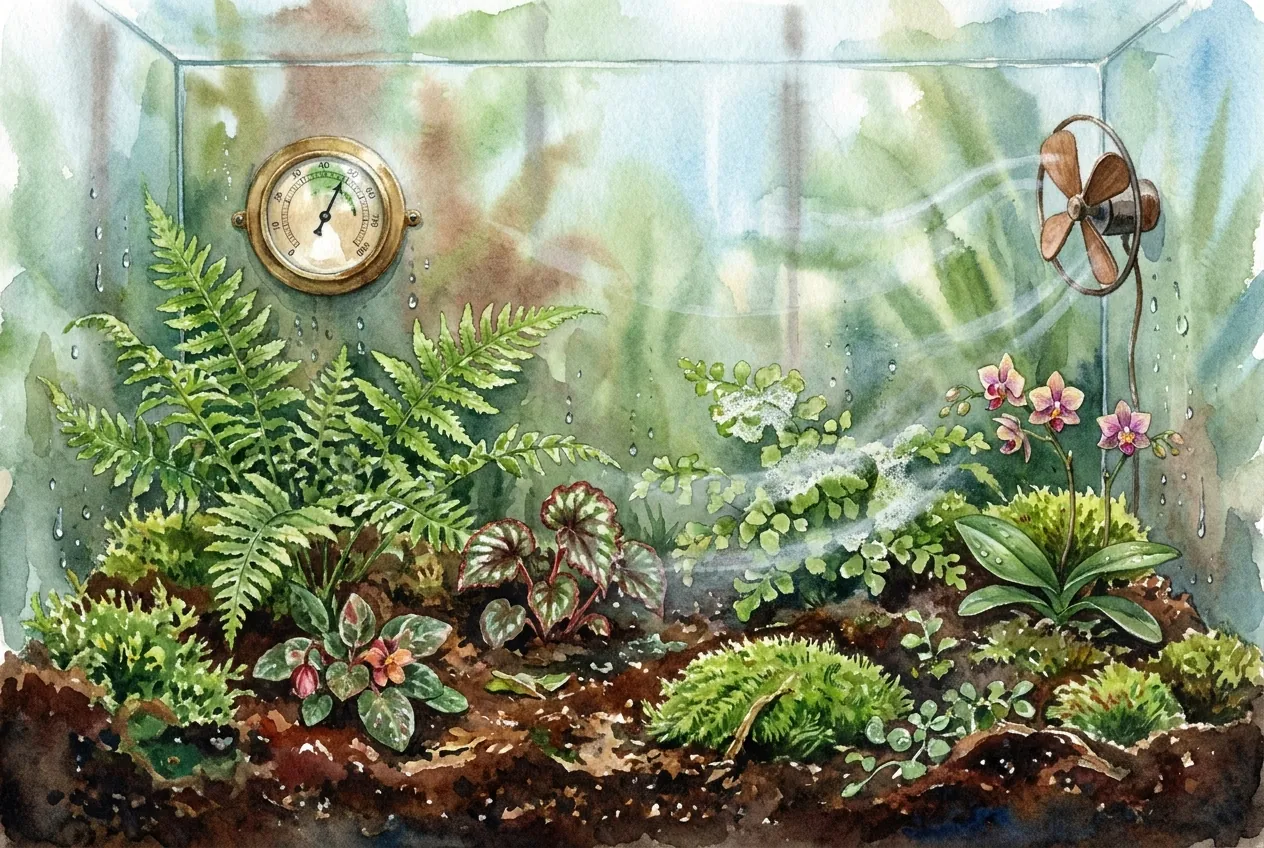
What should you buy first to stop a new-terrarium mold bloom?
Measure Before Buying More Control
If there is no visible standing water or active plant rot to fix physically first, a hygrometer is a sensible early purchase. Follow it with gentle airflow, drainage, and then biology as the build requires.
The most useful early purchase is information. A thermo-hygrometer turns a vague panic into a number you can track, because moisture is the main driver of mold and you cannot manage what you do not measure.
A hygrometer reads bulk air, though, not the wetter surface film where mold actually lives, so treat it as a trend tool rather than a direct mold-risk meter.
A practical stack is a layered system, not one product. The variables you can influence include surface moisture, air movement, substrate oxygen, and biological grazing pressure, and beyond them the mold outcome also depends on the spore source, the plant hosts, temperature, substrate composition, and how long surfaces stay wet.
No single purchase covers all of these.
I number four points covering a wood-substrate junction, moss-glass contact, lowest-airflow corner, and the center, then photograph and gently blot each one before changing equipment. Four contrasting points capture local wetness without turning the check into a full enclosure survey. A center hygrometer can look normal while one contact point stays wet enough to keep blooming.
After one ventilation or misting change, I recheck the marked points. When only one junction remains wet, I correct that piece of hardscape or drainage instead of drying the entire enclosure to solve a local problem.
What is the order of operations, and what makes a good ongoing fix?
A reasonable working order is measure, ventilate, drain, then seed biology, adjusted to what your build actually needs.
A reproducing cleanup crew is attractive as an ongoing tool because biology can build with the mold while a chemical is consumed and must be re-applied, but whether biology, airflow, or drainage matters most depends on whether the growth is a harmless transient saprotroph, a plant pathogen, growth on inaccessible hardscape, or a symptom of saturation.
The EPA frames home mold prevention around one idea, that controlling moisture controls mold.
Its residential target is RH below 60%, ideally 30 to 50%, with wet materials dried within 24 to 48 hours.
Those numbers are for houses and water-damaged building materials, not a setpoint for a deliberately humid planted vessel, so use the moisture-control principle rather than the specific percentages.
Much of the control therefore happens at the surface microclimate, not the bulk air, though water input, temperature, and organics matter too.
A hygrometer tracks the bulk-air trend, a fan thins the surface boundary layer, a drainage layer de-waterlogs the substrate, and a springtail-plus-isopod crew grazes fungus and reworks its food source.
If you keep an established build and want the deeper mechanism, our vivarium mold control explainer walks the same three levers in detail.
Which fixes are theater for a sealed humid build?
A fungicide spray alone, a hydrogen-peroxide drench, and a UV gadget share the same weakness. On their own they do not change the moisture, airflow, or oxygen conditions that produced the bloom, so the growth tends to return if those conditions persist.
A contact fungicide is consumed as it works and knocks back mainly the visible fungus, so the surface can re-bloom while conditions stay favorable.
Systemic, residual, and selective products behave differently, but many broad-spectrum treatments also harm the cleanup crew, so pairing chemicals with a live crew is often self-defeating.
Hydrogen peroxide can decompose quickly in substrates rich in organic matter and manganese, and how fast depends on concentration, catalysts, and the matrix, giving a brief oxygen pulse rather than a durable control system.
A germicidal UV gadget is line-of-sight and can damage plants, animals, and eyes. It cannot reach shadowed surfaces, substrate interiors, or shielded spores, so much of the fungal habitat in a planted enclosure goes untreated.
A Brief Guide to Mold, Moisture and Your Home. US EPA
Mold Course Chapter 2. US EPA
Mechanisms of hydrogen peroxide decomposition in soils. Petigara, Blough and Mignerey, Environ. Sci. Technol. 2002
Why does terrarium mold bloom in the first place?
Start With Surface Moisture
Mold blooms because filamentous fungi mainly need available surface water and a food source, and a humid build often supplies both.
A useful concept here is water activity, the free usable water in a material on a 0 to 1 scale.
Water activity is a property of the material, and it equals the relative humidity of the air only once that air and surface have reached equilibrium, which a dynamic terrarium rarely does, so an ordinary lid hygrometer is not a direct water-activity reading.
In food science, very little microbial growth occurs below water activity of about 0.60, molds tend to dominate the 0.61 to 0.85 intermediate-moisture band where bacterial competition drops off, and many hydrophilic molds prefer above 0.90.
That band comes from stored foods, not from a measured terrarium fungal community, so treat it as background rather than a terrarium control target.
Many builds do run wet enough that surfaces are mold-permissive, but open, vented, dry, and seasonal builds vary, and the surface is one lever among several, not the only one.
Influence of Water Activity on Growth of Yeasts and Molds. Beuchat, J. Food Protection 1983
Temperature versus Relative Humidity for Indoor Mold Prevention. Wu and Wong, Int. J. Environ. Res. Public Health 2022
Why does mold spread when the hygrometer reads fine?
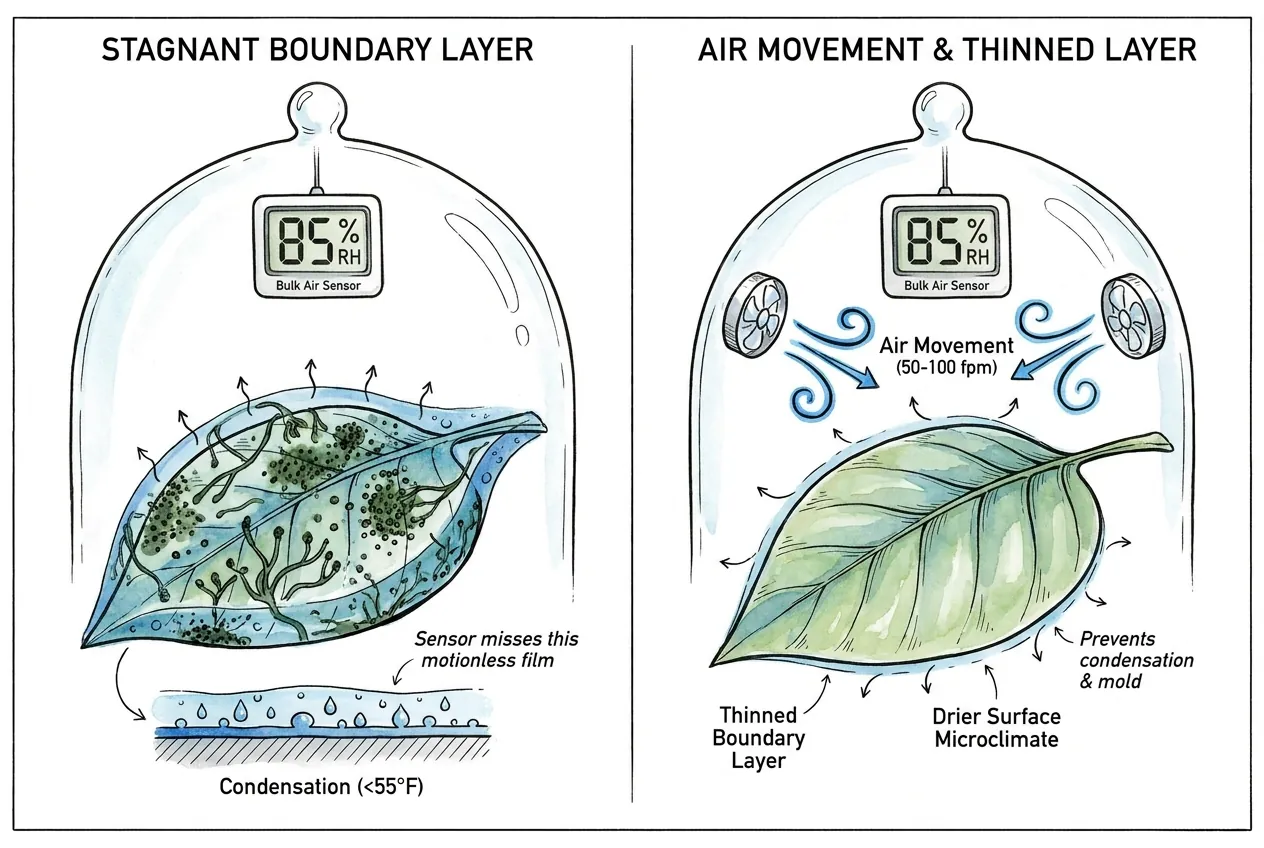
A humid, slow-moving boundary layer tends to sit against surfaces even when the bulk sensor reads a typical humid number.
The substrate and leaves evaporate moisture into that still film. Condensation forms once a surface drops below the dew point, which for air at about 85% RH and 60 degrees Fahrenheit means a leaf falling below roughly 55 degrees.
Air movement of roughly 50 to 100 feet per minute is the value greenhouse guidance uses to mix that layer and reduce the surface-air moisture difference. It lowers the risk of a persistent wet film rather than guaranteeing a dry surface.
A sealed jar can read a comfortable 85% on the lid hygrometer while mold spreads below it, because the sensor samples bulk air while the growth lives in the slower film.
Reducing Humidity in the Greenhouse. UMass Extension
The Boundary Layer and Its Importance. Runkle, Michigan State University Extension
Why does a brand-new build bloom and then clear on its own?
Fresh substrate and unseasoned wood release a pulse of easily decomposed carbon, and saprotrophic fungi are common first responders to that food.
Such a bloom is often transient, tending to fade once the easy organics are used up, though how strongly and how long depends on the materials and species involved.
Soil-science priming studies show that fresh labile-carbon input can drive a temporary spike of decomposer activity that subsides as the carbon is exhausted.
Those studies used soil-carbon additions rather than cork-bark mold, so treat the new-build bloom as a plausible analogy, not a measured timeline.
Pre-soaking wood before sealing the build can leach out some water-soluble compounds outside the enclosure, which may reduce the early food pulse.
Priming effects on labile and stable soil organic carbon decomposition. Zhang et al., PLOS ONE 2017
Influence of Water Activity on Growth of Yeasts and Molds. Beuchat, J. Food Protection 1983
Why does waterlogged substrate make everything worse?
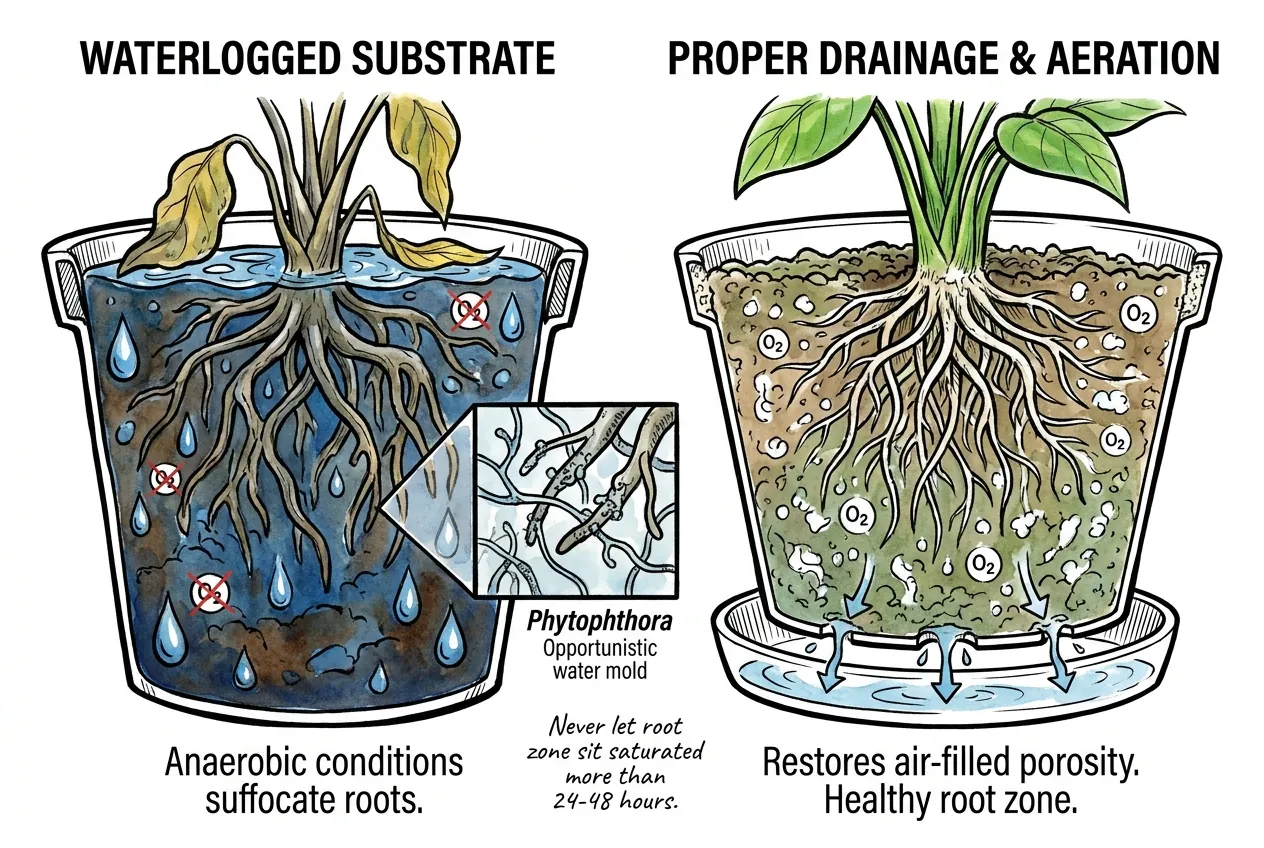
When substrate sits in standing water, the air pores fill, oxygen is consumed faster than it diffuses back in, and the zone can go anaerobic.
Low-oxygen conditions both stress roots and can favor opportunistic root pathogens.
Phytophthora, an oomycete rather than a true fungus, causes root and crown rot that UC IPM reports can develop in as little as 4 to 8 hours of saturation, with the exact risk varying by pathogen, host, temperature, and inoculum.
That short window is the reason to avoid prolonged saturation at all. Restoring air-filled porosity through drainage removes the wet conditions these organisms exploit.
Aim to keep the root zone from sitting saturated, rather than treating any fixed number of hours as safe.
Phytophthora Root and Crown Rot. UC Statewide IPM Program
Drying Up Root and Crown Rot Pathogens. Clemson HGIC
Do springtails and isopods actually eat terrarium mold?
Use Biology for Grazing and Litter Work
Springtails graze fungal hyphae and spores, while detritivorous isopods shred and rework decaying organics.
Unlike a chemical, a crew can reproduce and build with the bloom instead of being consumed in one pass, though the size of the effect depends on the species, densities, and available food.
Springtails are documented fungivores, not a folk remedy. In a controlled grazing study, mycelial extension rate and hyphal coverage of cord-forming fungi decreased as grazing intensity rose, with one fungus reduced to a few major cords.
Outcomes like these are specific to the springtail and fungus species tested, so read them as evidence that grazing can suppress fungi rather than a guarantee for any given terrarium mold.
Grazing by Folsomia candida differentially affects mycelial morphology of cord-forming fungi. Tordoff, Boddy and Jones, Mycological Research 2006
Density-dependent regulation of arbuscular mycorrhiza by collembola. Bakonyi et al., Soil Biology and Biochemistry 2002
Why do springtails target exactly the mold a new build grows?
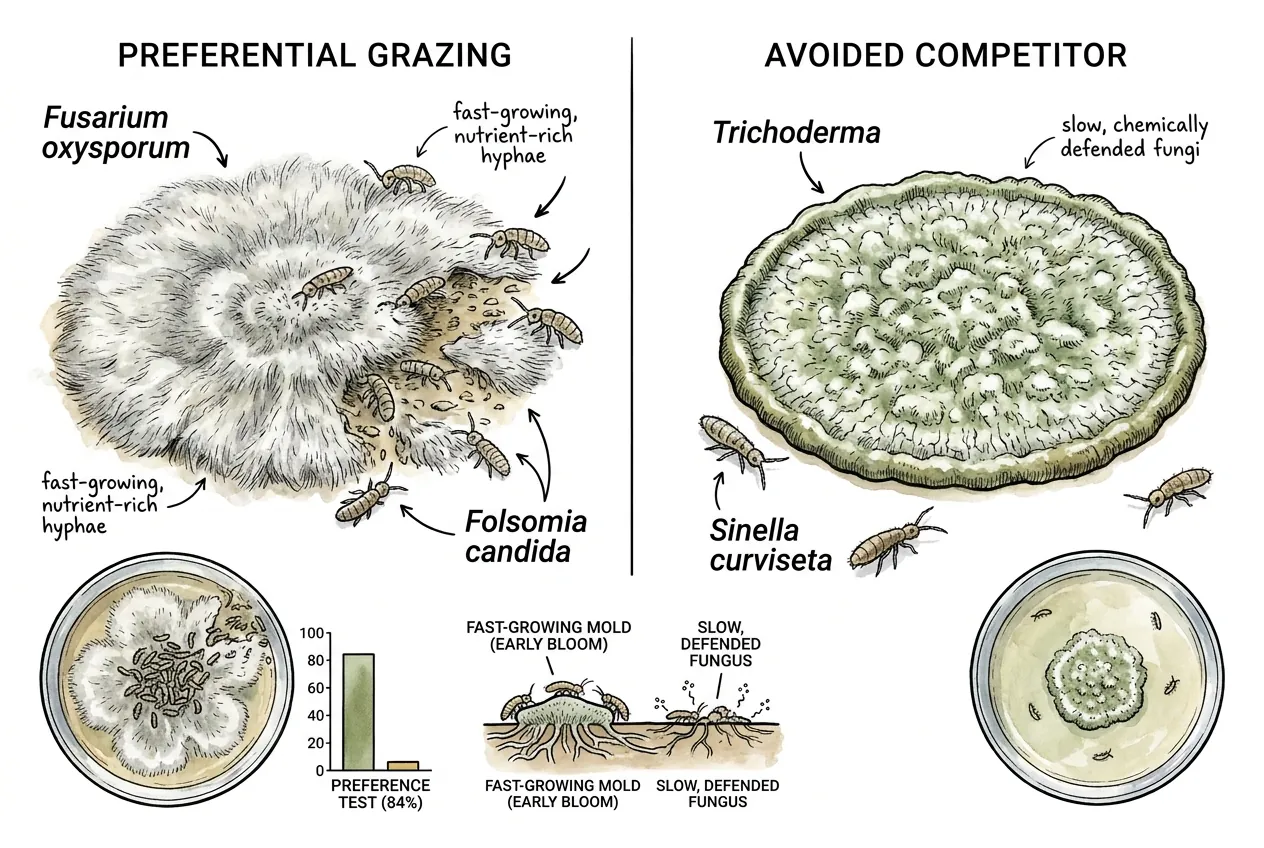
In laboratory tests, springtails often prefer some fungi over others, which suggests they may favor certain early-colonizing molds, though which fungi appear in a given new build is not something these studies identify.
Laboratory studies show that springtail grazing varies with the springtail, fungus, and growing conditions. Use them as part of moisture and organic-matter control, not as a guaranteed cure for every mold bloom.
Soil Allies. Folsomia candida and Trichoderma against Fusarium oxysporum. Santos-Barbosa et al., Environmental Microbiology Reports 2025
Fungivorous nematode and collembola alleviate damping-off by Pythium ultimum. Plant and Soil 2022
Why run isopods too if springtails already eat mold?
Isopods are detritivores rather than dedicated fungivores, but they do ingest fungi along with the microbially colonized litter they eat, so it is not accurate to say they never touch mold.
Their main role in a build is reworking decaying leaf litter and organics, which complements what springtails do.
Terrestrial isopods can process a large share of leaf litter, and they do not selectively graze fungi the way springtails do.
Their effect on fungi is mixed rather than simple removal. Fragmenting litter and depositing feces can create fresh colonizable surface and speed microbial turnover, and the Porcellio scaber study cited below actually found higher fungal abundance in isopod-worked soil.
So a two-part crew is best framed as useful husbandry, with springtails grazing fungus and isopods reworking litter, rather than one animal starving the other's food.
There is no controlled terrarium trial here showing the pair beats springtails alone.
The soil isopod Porcellio scaber stimulates methane-driven bacterial and fungal interaction. Heffner et al., ISME Communications 2023
Effects of terrestrial isopods on leaf litter decomposition processes. Abd El-Wakeil, J. Basic and Applied Zoology 2015
Which two live cultures should you actually buy?
A temperate springtail culture and a dwarf white isopod culture are the usual live pair. Both need a moist, undisturbed, chemical-free substrate and typically a few weeks to establish, with the exact timing varying by conditions.
Because these ship live, check the weather forecast for the delivery window, inspect the culture on arrival for a viable count, and quarantine briefly to watch for pests. Never release non-native cultures outdoors.
The Josh's Frogs springtails suit a moist, undisturbed terrarium where you want a small fungivore crew. Add them directly to the substrate and give the population time to establish. They are not a same-day mold treatment.
Skip springtails for dry or desert builds and for substrate recently treated with fungicide or peroxide, which can harm the crew. Inspect any live culture on arrival and do not release it outdoors.
Ordinary Feed dwarf white isopods suit a moist build that needs help reworking leaf litter and decaying matter. They stay small and mostly hidden, so choose them for that job rather than as a visible display animal.
Skip them for fully aquatic setups, seedling-only boxes, or any build where they could disturb tender growth. Provide an appropriate calcium source and check the selected culture variant before buying.
The influence of fungal food quality on growth and fecundity of Folsomia candida. Booth and Anderson, Oecologia 1979
Effects of terrestrial isopods on the decomposition of woodland leaf litter. Hassall, Turner and Rands, Oecologia 1987
How much airflow does a sealed terrarium actually need?
Favor Gentle Internal Circulation
Gentle circulation helps more than whole-tank ventilation on most humid builds. The 50 to 100 feet per minute figure often cited comes from greenhouse horizontal-airflow guidance, where it mixes the boundary layer and reduces the surface-air moisture difference. It is not a validated setpoint for a sealed jar, so use it as a rough reference and confirm the effect on your build rather than a precise target.
Wind speed strongly influences boundary-layer thickness. Moving air replaces the humid film against a surface with better-mixed bulk air, which reduces the surface-air moisture difference and lowers condensation risk.
It does not guarantee a surface stays above its dew point, since cold glass and night temperature cycles can still condense moisture in a high-RH vessel.
The EPA and ASHRAE put the house mold line at below 60% RH. A terrarium runs wetter on purpose, so the practical lever is surface air movement rather than that bulk-air number.
The Boundary Layer and Its Importance. Runkle, Michigan State University Extension
Mold Course Chapter 2. US EPA
Why does an oversized fan ruin a small sealed jar?
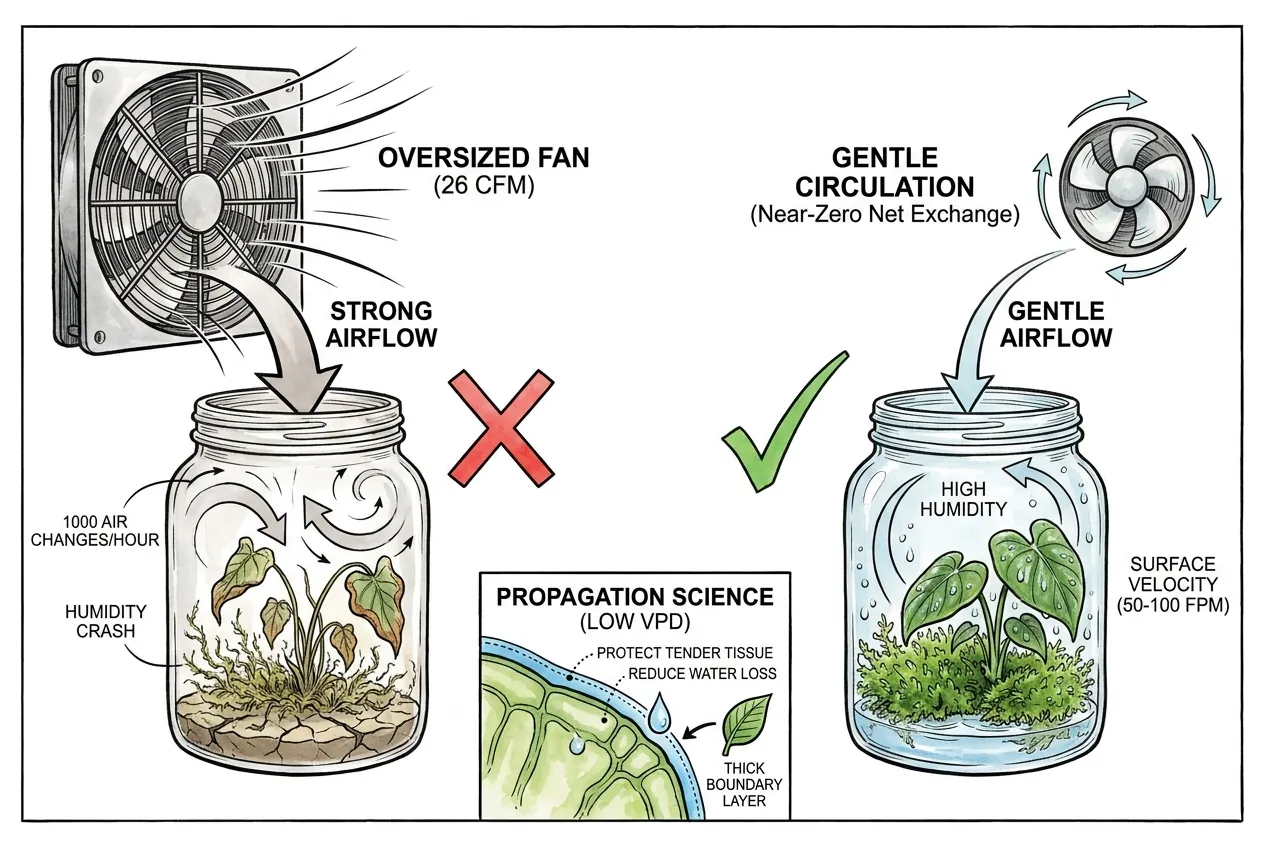
A strong fan set to exchange air on a small build can crash the humidity and dry out moss and delicate aroids.
As a rough illustration, a 12x12x18 inch build holds only about 1.5 cubic feet of air, so a 26 CFM fan whose full rated flow became net throughflow would work out to on the order of 1,000 air changes per hour.
That figure only applies to net exchange. It does not describe internal recirculation, and it uses an example CFM rather than the recommended products.
For a humid build the goal is usually internal circulation with little net air exchange, so RH stays high while surfaces stay better mixed.
Because CFM does not convert directly into surface velocity, dial the fan by observation, checking whether condensation clears and moss stays healthy, rather than trusting a number.
Propagation practice illustrates the opposite failure mode. During the first days of rooting, growers often keep humidity high and fans off to reduce water loss, holding a low vapor-pressure-deficit floor around 0.3 kPa to protect tender cuttings.
That is a rooting-stage, species-specific guideline, not a universal terrarium rule, but it shows why over-drying delicate tissue is a real risk.
For balancing airflow against misting on delicate builds, our paludarium airflow and misting science piece covers the tradeoff in depth.
Why greenhouse growers should pay attention to vapor-pressure deficit. MSU Extension
Reducing Humidity in the Greenhouse. UMass Extension
Which circulation fan matches your build size?
Pick the smallest fan that can produce a barely perceptible breeze, and treat CFM as a ceiling, not a setpoint. Variable speed matters more than raw airflow.
Note an important safety limit first. AC Infinity lists both fans below with an official operating-humidity range of 35 to 85% RH, and they are AV/electronics cooling fans with no water resistance or IP rating.
That is below the humidity inside a near-saturated enclosure, so if you use one, prefer mounting it outside the enclosure blowing across a vent, keep it on an isolated low-voltage supply with a GFCI outlet and a cable drip loop, add a splash barrier, and clean it regularly.
Condensation on an unrated fan inside a wet build is an electrical and corrosion risk.
The AC Infinity Multifan S3 suits a larger planted, open-top, or screen-lid build. Run it only hard enough to break stagnation, aiming the air above the canopy rather than at moss.
Skip it for a tiny near-saturated sealed jar. It is not wet-rated, so mount it outside the enclosure across a vent rather than exposing it to condensation.
For a small build, the variable-speed AC Infinity Multifan S2 gives more control over a gentle airflow. Start at its lowest setting and adjust only after you see how the moss and condensation respond.
Skip it for a fully closed bottle terrarium that only needs passive venting. It has the same humidity and water-exposure limits, so keep it on the dry side of the enclosure.
Horizontal Air Flow Systems. University of Connecticut IPM
Why greenhouse growers should pay attention to vapor-pressure deficit. MSU Extension
How does a drainage layer keep substrate oxygen up?
Keep the Root Zone Above Standing Water
A drainage layer aims to keep the substrate from sitting in standing water so the root zone stays better oxygenated, and oxygen is a major factor in root health.
As a media guideline, container mixes generally want at least 10% air-filled porosity, below which root respiration is impaired. That is a property you measure in the mix, not something a drainage layer alone guarantees.
A false bottom can help because the void below the substrate acts as a reservoir, and water tends not to drain down into a coarse layer until the medium above is near saturation, so the wettest zone can sit lower.
In a closed vessel, though, there is no external drain, and LECA is semi-porous and can wick, so this only works with attention to the water level, a non-wicking barrier, and a way to remove or monitor pooled water.
It is not automatic.
Once a substrate is waterlogged, redox potential can fall into the anaerobic range tied to root rot.
Keeping the saturated zone below the rooting substrate helps preserve oxygen, but how well depends on substrate texture, depth, the barrier, reservoir height, and watering.
Soil Mixes Part 3. How much air and water? UC ANR, Tjosvold 2019
Effect of drainage layers on water retention of potting media. Rowe, PLoS One 2025
What does horticultural charcoal really do, and what does it not do?
Charcoal can adsorb dissolved organics and odors, with a finite capacity. It is not a fungicide, and it will not stop an active mold colony.
It is worth separating the materials here, because they differ by orders of magnitude. Chemically activated biochar reaches a very high internal surface area and, in lab tests, can adsorb substantial amounts of specific compounds. One cited study measured that on airborne acetone and toluene vapor using chemically activated biochar.
Natural horticultural charcoal like the product below is not that activated sorbent, and no test here measures how much dissolved terrarium organic matter it holds or how quickly it saturates, so specific capacity or saturation-time numbers would be guesses.
Treat it as an optional consumable that may help buffer the fresh-build organics flush while the crew establishes, without a measured performance figure.
It does nothing for mold already growing on hardscape.
Production of Activated Biochar for Adsorption of Volatile Organic Compounds. David, Materials 2022
Which drainage media should you buy?
A lightweight LECA false bottom with a thin layer of horticultural charcoal above it is a common recipe.
A roughly 1.5 to 2 inch LECA layer under a mesh barrier with 3 to 4 inches of substrate is one starting point, but scale it to your enclosure height, media, and water level rather than treating those numbers as fixed.
The Hydroton Original Clay Pebbles suit a false bottom when you have enough height to keep the saturated reservoir below the rooting substrate. Rinse off dust and use a barrier, but do not assume the layer alone prevents waterlogging.
Skip LECA in a shallow moss or carpet dish, where it takes too much vertical space and can wick water upward.
Legigo Horticultural Charcoal can be an optional buffer layer above LECA. It may help with fresh-build organics, but it is not a fungicide or a cure for visible mold.
Replace buried charcoal only at a full rebuild because you cannot see when it is spent. Skip it as a standalone mold-control strategy.
Phytophthora Root and Crown Rot. UC Statewide IPM Program
Redox potential and pH as drivers of soil-plant-microorganism systems. Husson, Plant and Soil 2013
How do the five product roles compare on measurable specs?
Match Each Spec to Its Job
Each role lists a product spec alongside the condition it is meant to address. Some of these mappings are approximate. Fan CFM is not a measured surface velocity, air RH is not surface water activity, and the fans exceed their 85% RH operating limit inside a wet build.
Match the spec to your build and read the tradeoff column before buying.
| Role | Product and spec | Threshold it satisfies | Honest tradeoff |
|---|---|---|---|
| Springtails (fungivore) | Josh’s Frogs temperate springtail culture | Grazes fungi in a moist, undisturbed substrate | Needs time to establish and will not cure every bloom |
| Isopods (detritivore) | Live dwarf white isopods | Reworks decaying leaf litter and organics | Hidden, slow workers that need suitable food and calcium |
| Circulation fan | AC Infinity MULTIFAN S3 or variable-speed S2 | Creates gentle circulation above the canopy | Not wet-rated. Excess airflow can dry moss |
| Thermo-hygrometer | Govee H5075 | Tracks humidity trends after you change airflow or misting | It reads bulk air, not the moisture on a surface |
| Drainage and charcoal | Hydroton LECA with optional horticultural charcoal | Keeps the reservoir below the substrate and may buffer fresh organics | LECA can wick. Charcoal is finite and not a fungicide |
Why is a plus/minus 3% hygrometer good enough, and which one fits?
A plus/minus 3% RH instrument is adequate for watching trends, and a hobby unit claiming plus/minus 1% is usually optimistic.
But be honest about what it cannot do. With plus/minus 3% uncertainty, a reading close to a reference line such as 60% could sit on either side of it, so the device does not reliably tell you which side you are on near a threshold.
Treat the reading with a guard band, and remember there is no single well-sourced surface-RH mold cutoff for terraria, since that depends on the organism, material, temperature, and time.
The Govee H5075 suits this role when you want a simple trend log while you adjust airflow or misting.
It measures local air rather than leaf wetness, substrate oxygen, or water level, so use it to compare changes instead of treating it as a mold-risk verdict. Keep it away from splash and condensation, and place it near the problem area.
A Brief Guide to Mold, Moisture and Your Home. US EPA
Selective foraging of fungi by collembolans in soil. PMC1626218
What is the correct build order so the products work together?
Build From Drainage to Monitoring
Build in dependency order. Drainage media, then a mesh barrier, then substrate, then seasoned hardscape, then the seeded crew, then a fan, with the hygrometer placed early enough to give you a baseline before you start tuning the fan against it.
Read the two together. Get a sensor reading first, make an airflow change, then recheck. Do not treat the sensor as an afterthought installed last.
Drainage goes first because the textural interface influences where water saturates. A coarse layer under finer substrate tends to keep the wettest zone toward the bottom, leaving the upper substrate more aerated.
It precedes biology because a crew cannot rescue a waterlogged substrate. Roots are oxygen-sensitive, and wet, low-oxygen conditions favor root pathogens such as Phytophthora, which UC reports can take hold within as little as 4 to 8 hours of saturation depending on host, pathogen, temperature, and inoculum.
How should you seed the crew and tune the airflow?
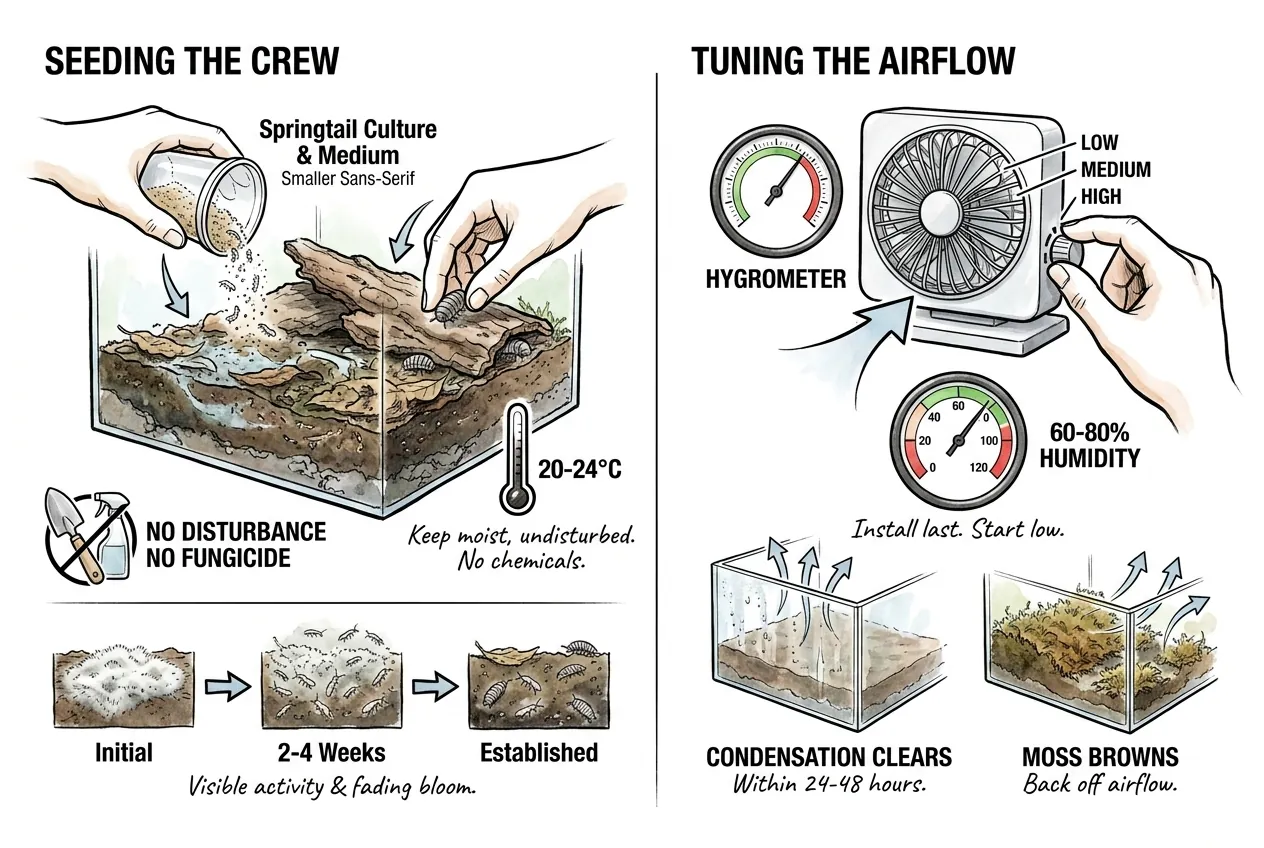
Seed the crew into moist, undisturbed substrate and leave it alone to reproduce, then adjust airflow while watching the hygrometer.
Following the vendor's method, sprinkle the springtail culture, charcoal medium and all, onto the substrate and litter, and tuck isopods under seasoned bark.
Avoid heavy disturbance or chemical treatment after seeding, since fungicide residue in particular stalls establishment. A light misting or gentle transfer is fine, so the point is not a strict ban on ever touching the substrate.
Keep it evenly moist, around 20 to 24 degrees Celsius which suits Folsomia candida, with leaf litter as food, and expect springtail activity to build and a transient bloom to fade over a few weeks, with timing depending on conditions.
Bring airflow in last, starting on the smallest fan at its lowest speed. If condensation lingers, nudge it up, if moss browns, back off.
Note that condensation clearing is an observation, not proof the substrate oxygen or mold problem is resolved.
Managing Soil Tilth. Texture, Structure, and Pore Space. Colorado State University Extension
Heteromurus nitidus grazes Zymoseptoria tritici. Bourgeois et al., Pest Management Science 2024
Food Choice and Fitness of Folsomia candida. Bellini et al., Frontiers in Environmental Science 2019
What are the failure modes, and who should skip each product?
Skip Tools That Conflict With the Build
Every product has a condition where it is the wrong choice. Skip the crew on a dry or just-fungicided build, skip the strong fan on a tiny saturated jar, and skip a deep drainage layer under a thin moss dish.
A reproducing crew can renew itself while charcoal and fungicide are consumed, but that does not mean biology gives indefinite control. It still needs food, moisture, and management.
A dry desert build sits below the mold band already, so a crew has neither the moisture to survive nor much fungus to eat.
On a just-treated substrate the culture often fails, because Collembola are among the most pesticide-sensitive soil fauna and many fungicides depress their reproduction. How much depends on the active ingredient, dose, and persistence.
For escalation questions, our terrarium mushrooms guide distinguishes a harmless transient bloom from a persistent problem worth worrying about.
Will springtails or isopods harm my plants, pets, or me?
Springtails are essentially harmless to people and pets. Multiple extension sources state they do not bite or sting, are harmless to people and animals, and do little damage to plants. They feed on fungi, algae, decaying matter, and bacteria.
Those sources cover springtails specifically rather than certifying every isopod as harmless too.
Springtails scrape fungi and dead organic matter and do not pierce skin. Isopods, though, have chewing mouthparts and can graze living plant tissue when population, food, or conditions push them to, so they are not guaranteed harmless to plants. Watch new soft growth and seedlings.
A keeper watching springtails work a moldy cork branch is seeing them do the job they were bought for.
Springtails. UC Statewide IPM Program
Springtails. Colorado State University Extension
Can I just use a fungicide instead of a cleanup crew?
Usually not if you also want a live crew, because many fungicides work against it. A meta-analysis reports that Collembola are among the most fungicide-sensitive soil fauna, with a large standardized effect size (about 7.0) for reproduction relative to other groups. That is a comparative sensitivity measure, not an absolute kill rate for a specific product.
The practical takeaway is that spraying the substrate often harms the springtails that help prevent re-blooming.
A contact fungicide is also consumed as it works and treats the symptom rather than the cause, so mold can return while moisture and organics remain.
If you have already treated a build and want to seed a crew, wait out the product's residual period rather than assuming a fixed delay, and be aware that flushing may not remove sorbed residues and can spread them. The right recovery depends on the active ingredient, formulation, label rate, and persistence.
Collembola Among the Most Pesticide-Sensitive Soil Fauna. A Meta-Analysis. Joimel et al., Environ. Toxicol. Chem. 2022
Pesticides and Soil Invertebrates. A Hazard Assessment. Gunstone et al., Frontiers in Environmental Science 2021
Is the white mold dangerous to me or my pets?
Color alone does not tell you a mold is safe, since it does not identify the species, allergenicity, or any toxins, so do not conclude a white bloom is harmless just because it is white or temporary.
Triage instead on the source, location, extent, odor, any plant symptoms, and your own exposure.
For most healthy people a small transient bloom is a low-grade irritant, but the CDC notes mold can cause a stuffy nose, sore throat, coughing, or eye, skin, and throat irritation even in otherwise healthy people, and the risk is higher for allergic, asthmatic, and immune-compromised people and those with chronic lung disease.
People with asthma or mold allergy may react more strongly, and immune-compromised people can develop lung infections.
The durable approach is moisture control rather than repeated chemical knockdowns, which is the broad principle the EPA endorses (the EPA does not endorse this specific product stack).
Around an active bloom, avoid stirring up spores. Do not aim a fan straight at visible mold before cleaning it, since that can aerosolize spores.
Anyone in the home with asthma or immune suppression should minimize handling, wear gloves and a mask, keep affected people out of the room during cleanup, and seek medical or professional advice if symptoms or the growth are significant.
Mold (Health). CDC
A Brief Guide to Mold, Moisture and Your Home. US EPA
What is the maintenance cadence for each component?
Biology is fairly low-maintenance but not hands-off. A reproducing crew still needs food and moisture, a permanent calcium source for isopod molting, occasional feeding or re-seeding, and a check that populations and plants are doing well.
Clean dust off the fan blades to keep its rated airflow, and treat low-voltage USB fans as consumables.
If you want to check the hygrometer, a 75.3% saturated-salt test is the usual method (temperature- and equilibration-dependent). Capacitive sensors can drift over time, so re-check periodically rather than trusting a fixed drift rate.
Because the buried charcoal layer's saturation cannot be observed, plan to replace it at a full rebuild rather than on a set schedule.
It adsorbs to a finite capacity and does not regenerate on its own. There is no measured breakthrough time for this natural product, so avoid stating a specific replacement interval.
Monitoring by Control Technique. Activated Carbon Adsorber. US EPA
Soil Mixes Part 3. How much air and water? UC ANR, Tjosvold 2019
Affiliate Disclosure
This article contains Amazon affiliate links. As an Amazon Associate I earn from qualifying purchases. If you use these links, the site may earn a commission at no extra cost to you. Product availability, price, and specifications can change. Check the current listing before buying.