
Terrarium Mold Control: A Scientific Bioactive Guide
A practical, evidence-checked look at terrarium mold: the moisture and airflow that drive it, how heat-treating substrate actually works, what springtails and charcoal can and can't do, and why common home remedies are unproven.
Samuel Reed · Published 2025-12-03 · 15 min read
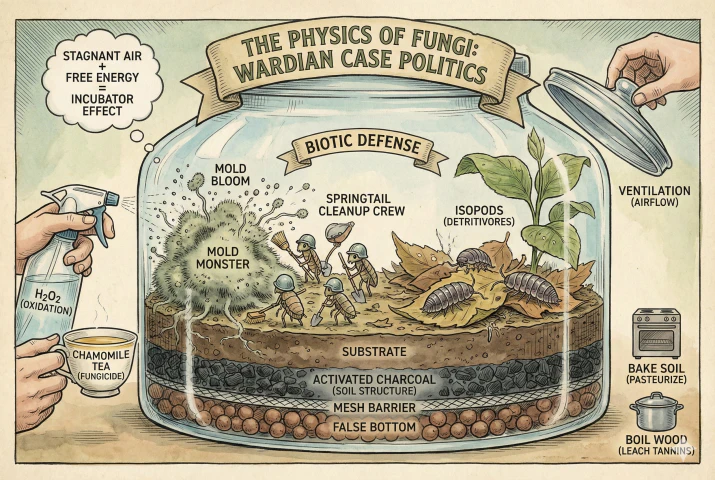
Key Takeaways
- Prolonged surface wetness and trapped, humid air are the conditions most molds need. Persistent heavy condensation, standing water in the reservoir, and decaying debris are useful warning signs, but confirm by checking the substrate and roots, not the fog alone.
- To heat-treat or pasteurize moist substrate, the commonly cited target is about 140 °F (60 °C) held for 30 minutes. Measure at the coolest part of the medium once it reaches temperature. Higher temperatures kill more, including weed seeds around 180 °F, but raise the risk of releasing phytotoxic manganese, ammonium, and salts, so treat 180 °F as an upper limit rather than the default.
- Springtails (Collembola) are useful fungal and detritus grazers and a reasonable optional addition to a bioactive setup. They are not a guaranteed or permanent cure. Isopods also interact with fungi, and controlled tests have not established that only springtails clear mold.
- Activated charcoal has a finite adsorption capacity and stops adsorbing once saturated. Buried in a terrarium it cannot easily be replaced. Whether spent carbon still helps as a soil amendment depends on the material, placement, and dose.
- The first response to visible mold is to identify it, correct the moisture source, and remove affected material by hand. Treat home natural fungicide remedies such as peroxide, cinnamon, and chamomile as unproven and potentially harmful to plants and cleanup fauna. See the cautions below before using any of them.
Control Mold Without Disrupting the Terrarium
A sealed terrarium recycles much of its water, so condensation forms on the glass and returns to the soil. It is not maintenance-free. Light, plant growth, moisture, and occasional adjustment still determine whether the system stays balanced.
I trace the visible edge on a removable clear sheet held outside the glass and add the date before cleaning or changing airflow. White growth can look larger simply because it becomes denser, while the traced boundary shows whether it is actually spreading.
After changing one condition, I repeat the outline and photograph the substrate moisture nearby. The record stops me from escalating treatments when an old patch is fading inside the same boundary.
What Mold Means in a Terrarium
The same warm, humid, organic-rich conditions that let tropical plants flourish can also favor some molds.
Most of the fuzzy growth seen in terrariums is saprotrophic fungi that decompose dead organic matter.
These are normal decomposers and a functional part of soil biology, not an enemy by definition. The goal is to identify and manage growth that is excessive or is actually harming plants, not to sterilize the system.
Control mold by correcting the conditions that let it persist, not by trying to sterilize every surface.
Find the Moisture and Airflow Problem
Read Condensation With the Substrate
Unlike a potted plant that loses water to the room, a sealed terrarium retains most of it.
Temperature matters because warmer air can hold much more water vapor before it saturates (a useful shorthand for the rise in saturation vapor pressure with temperature).
How much water is actually present also depends on how much you added, the substrate’s moisture, light, and how tightly the vessel is sealed.
Condensation forms when a surface, usually the glass, cools below the interior air’s dew point, which is why fog often appears as the room cools at night.
This makes condensation a useful thing to watch, but not a stand-alone diagnosis. The amount of fog also depends on glass temperature, the room and light cycle, and the container’s shape.
To judge whether the substrate is waterlogged, look at the root zone and reservoir directly rather than inferring it from the glass alone.
A little morning condensation is normal. Persistent heavy fog that never clears, together with standing water in the reservoir, is a stronger sign of excess moisture (the kind of sustained surface wetness many molds need).
Let Surfaces Dry When They Need To
One difference between a terrarium and a forest is airflow. In the wild, wind dries surfaces, though it also carries spores, so more airflow does not automatically mean fewer fungi.
A sealed jar has much less air movement, though temperature differences can still drive some gentle convection inside, so it is not perfectly still.
At the microscopic level, a thin layer of relatively still air, the boundary layer, clings to leaves and other surfaces, and air movement makes it thinner.
A thicker boundary layer can slow drying at a surface. Whether fungal spores actually germinate, though, depends on the species and on temperature, free water, humidity, and available nutrients, not on the boundary layer alone.
Ventilation does more than thin these boundary layers. Opening the vessel also changes the interior humidity and temperature and lets moisture escape, which is usually the larger effect.
Start With Clean, Suitable Materials
Choose a Clean Starting Medium
The soil is one possible source of soilborne pathogens, but it is not the only one. Airborne spores, infected plants, wood, tools, water, and even your hands can all introduce fungi.
Garden soil or reused mix can carry dormant spores or insect larvae, so many growers prefer a clean, commercial soilless mix (these are typically produced to be largely pathogen-free) or heat-treat their own substrate before planting.
Heat-Treat Substrate Only When It Solves a Real Problem
Heat treatment reduces pathogens, insects, and weed seeds in growing media. It is sanitation, not complete sterilization, and treated media can be recontaminated afterward.
According to UC Davis nursery guidance, the standard target for moist medium is about 140 °F (60 °C) held for 30 minutes, which is enough to kill most pathogenic fungi, bacteria, and viruses (listed around 145 °F).
Higher temperatures kill more. Soil insects around 160 °F and weed seeds around 180 °F. Temperature should be measured with a thermometer at the coolest part of the medium, and the 30-minute clock starts only once that point reaches target, not when the oven dial does.
Going hotter is a trade-off, not a bonus. The same guidance warns that above roughly 180 °F the risk of phytotoxicity rises, because heat can release exchangeable manganese, ammonium, and soluble salts (a bigger concern in mixes rich in compost, manure, or leaf mold), which can cause leaf burn and root damage.
So treat about 180 °F as an upper limit, not the default, and choose the lowest temperature that addresses your specific problem, for example, 140 °F for general pathogens, higher only if you need to kill insects or weed seeds.
A few practical cautions for doing this at home. Warm, moist substrate produces a strong earthy smell. Containers and steam are hot enough to scald, so use oven mitts and let things cool before handling, and because you are heating soil that may harbor microbes, keep it away from food and consider using dedicated (non-food) trays or a covered container.
Heat Treatment (UC Davis AIR Nursery)
2.2 Hardscape Hygiene
Wood is a plausible substrate for fungi because it is rich in cellulose. Before adding it, it helps to clean it physically, choose sound wood, and soak or simmer it.
Boiling or soaking leaches out soluble colored extractives such as tannins and other polyphenolic compounds, along with resins and oils, which is what tints terrarium water brown. The brown color is not caused by tannins alone, and tannins are not simply organic acids.
How deeply heat kills fungi inside a piece of wood depends on its thickness, species, and the core temperature actually reached over time, so treat boiling as a cleaning and leaching step rather than a guaranteed deep sterilization.
Whichever method you use, dry the wood fully and watch it afterward. Handle boiling water and hot wood carefully to avoid scalds.
New wood often grows a white, fuzzy film as microbes consume residual surface sugars. This early biofilm is frequently transient and harmless.
Not every white bloom is harmless, though. Persistent growth, growth on living plant tissue, foul odor, or plant symptoms are worth identifying rather than assuming a cleanup crew will simply remove it.
Use Charcoal With Realistic Expectations
Treat Charcoal as a Finite Filter
A layer of horticultural charcoal between the drainage layer and the soil is a common, traditional practice (extension guides mention it), but it is not required for every terrarium, and many drainage-free planted designs work without it.
The idea is adsorption. Activated carbon is riddled with pores that adhere certain impurities and odor compounds to their surfaces.
Note that this is adsorption (sticking to a surface), not absorption like a sponge soaking up liquid, even though the sponge image is a handy way to picture the pores filling.
The important, useful point is that adsorption capacity is finite and depends on the specific contaminant, its concentration, contact time, and load. Carbon does not bind everything indiscriminately, and once its usable pore surface is occupied it stops adsorbing.
In engineered water treatment, spent carbon is replaced or regenerated (the monthly-change routine in aquariums is one example, though the right interval there depends on load and flow, not the calendar).
Buried in a terrarium, it can’t easily be swapped out.
Whether spent charcoal still provides useful benefits afterward is less certain than it is often stated.
Its lightweight, porous structure may help resist compaction and offer surface area for microbes, but that benefit depends on the specific product, how much you use, and whether it is mixed in or left as a continuous layer. It is not automatically a proven permanent soil conditioner.
Use a Cleanup Crew as Support
Build a Diverse Cleanup Crew
A bioactive terrarium relies on a community of decomposers, microbes and small invertebrates, to process dead material.
Adding detritivores such as springtails is an optional strategy that many keepers find helps keep decomposing organic matter in check.
It is not a guarantee. Harmless and beneficial fungi are a normal part of that community too, and the fungi that actually harm plants are a specific subset, not simply whatever fills an empty niche.
4.1 Springtails (Collembola) (Useful Fungal Grazers)
Springtails graze some fungal growth and decaying material, so they can help limit light surface mold. Add them at planting time or later if the enclosure suits them, but do not expect a cleanup crew to cure excess moisture or prevent every outbreak.
A temperate springtail culture is a widely used option for bioactive setups and can be seeded straight into the substrate. The species most commonly sold for this is Folsomia candida, a temperate springtail that tolerates a wide range of conditions, but the supplier should identify the species so you can match its care to your enclosure. Compare viable arrival, care requirements, and suitability for the setup rather than assuming any one source is best.
A springtail culture contains live animals, so shipping temperature and time affect how many arrive alive. Adults can die in transit while the eggs survive, and those eggs may take a few weeks to hatch, so plan for a few weeks and a viable starting population before the colony visibly establishes, and treat sustained activity and reproduction as better evidence of establishment than any fixed waiting period. Do not release cultured springtails outdoors.
Springtails consume some surface fungi and detritus, but they do not correct a chronically waterlogged tank. Persistent excess water needs venting, controlled removal of standing water when present, and a check of the roots.
Soil Allies. Exploring the Combined Potential of Folsomia candida and Trichoderma against Fusarium oxysporum
4.2 Isopods (The Misconception)
Isopods (roly-polys) are often paired with springtails, but their main role is different. They are detritivores that mostly process softer decaying wood and leaf litter.
That makes them valuable for breaking down larger debris.
It would be an overstatement to say isopods have nothing to do with fungi. Studies show isopods do interact with and consume fungi and microbially colonized litter, and some species can lower fungal abundance. The effects vary by species and substrate.
There is no controlled head-to-head terrarium test showing that only springtails clear a fuzzy outbreak while isopods do not, so treat the two as complementary cleanup organisms rather than framing one as the primary mold defense.
Treat Home Remedies With Caution
Correct the Environment First
Before reaching for any chemical, do the reliable things first. Identify what the growth actually is, correct the moisture source, remove affected material and debris by hand, and isolate a badly affected plant if you can.
Only then consider a treatment. Natural does not mean safe or effective. The home remedies below are widely repeated, but the supporting evidence for them in a planted, animal-inhabited terrarium is thin, and each carries real risks to plants and to the cleanup fauna.
General Cautions for Any Treatment
Wear gloves and eye protection, work in a ventilated area, spot-test on a small area first, keep the products away from children and pets, and remove or protect any animals in the enclosure.
Do not mix chemicals. Rinse and observe treated plants afterward, and stop if you see damage.
5.1 Hydrogen Peroxide (H₂O₂)
Household 3% hydrogen peroxide is an oxidizer. It can damage fungi, but it can also damage plant tissue, beneficial microbes, and small invertebrates. The visible bubbling does not make it safe for a living enclosure.
Because of that, applying undiluted 3% peroxide directly to a living terrarium is not something to do casually.
There is no reliable, plant-specific protocol here for contact time, rinsing, or species tolerance, so the safer course is to follow a plant or product label, or a controlled source, rather than dabbing it on by feel.
If you use it at all, treat it as a targeted spot treatment on the affected spot only, never a drench, and expect that it can harm springtails and bleach sensitive mosses.
5.2 Cinnamon
Cinnamon compounds can show antifungal activity in laboratory formulations, but kitchen cinnamon powder varies too much to provide a reliable terrarium treatment. It can also harm roots, so do not treat it as harmless.
A thick layer of dry powder can also repel water and slow it from reaching the soil. In short, there is no validated protocol for cinnamon as a universal stem sealant or soil duster, and standard plant-wound guidance generally does not recommend arbitrary wound dressings, if you use it, keep it to a light dab and watch the plant.
5.3 Chamomile Tea
Brewed chamomile tea is not a proven treatment for damping-off or terrarium mold. It does not act as a systemic cure, and adding tea can add organic matter and surface wetness.
University disease guidance (for example Cornell, UMass, and UMN) manages damping-off mainly through clean, pathogen-free medium and containers, careful watering, suitable temperature and airflow, and labeled treatments. It does not classify chamomile as a preferred or systemic seedling fungicide.
Misting tea can also add organic matter and surface wetness, which is counterproductive if it does not work. Prioritize the environmental controls instead.
Monitor the Conditions That Matter
Read Moisture From Several Signals
Once the terrarium is built, ongoing care is mostly about watching moisture and responding to it.
Condensation is one readout, but read it as a range rather than a rule. Some fine condensation that appears in the cooler parts of the day and clears when it warms up is common.
Because the amount of fog depends on glass temperature, your room and light schedule, and the vessel’s shape, the exact pattern that looks healthy will differ between setups, so don’t diagnose from the glass alone.
Stronger signs that a system is holding too much water are heavy droplets running down the glass around the clock, fog that never clears, and, most tellingly, standing water pooling in the drainage layer.
When you see these, respond in steps. Open the lid to vent, wipe down excessive condensation, and, if there is a lot of standing water, remove it in a controlled way (siphon or wick it out) rather than only waiting for it to evaporate.
Then check the root zone, and re-check after a day or two, since the right amount of airing depends on your vessel, the ambient humidity, and the plants and fauna involved.
Some growers also briefly open a closed terrarium periodically. Penn State Extension, for instance, presents a weekly 15-minute airing as something some experts suggest rather than a universal requirement.
Brief opening freshens the air and can momentarily thin the boundary layers. Just treat it as an optional habit rather than a proven, fixed prescription for preventing mold, and watch that it does not dry out a small or low-humidity setup.
Because the human eye can’t read humidity as a number, a small digital hygrometer/thermometer is a handy way to spot-check the air temperature and relative-humidity trend inside.
Be clear about what it does not do, though. It measures air RH, not substrate moisture, leaf wetness, reservoir depth, or what kind of mold you have, so use it alongside a direct look at the soil and roots, not as a stand-in for it.
Use a Hygrometer as a Trend Tool
A low-cost digital hygrometer-thermometer can track room or enclosure trends, but check the exact specification before placing one in a near-condensing jar. Many indoor units lose accuracy near saturation and have no logging, calibration control, or water-resistance rating. Keep a dry-rated sensor out of drip and mist.
Treat an uncalibrated reading as a trend, and compare it with a second sensor whenever a small RH difference would change your decision. A humidity reading alone also does not measure leaf wetness or confirm that condensation is absent.
When to Act (and When to Escalate)
Match the Response to the Signal
Use the following decision path to match the response to what you observe.
- A little white fuzz on new wood or debris, plants healthy. Often a transient, harmless decomposition bloom. Correct any excess moisture, remove the affected material by hand if it bothers you, and watch. It frequently fades on its own.
- Persistent or spreading growth. Reduce moisture (vent, remove standing water, check the roots), remove affected material, and identify the growth before treating. If it keeps returning, the underlying cause is usually too much water or poor airflow, not a missing chemical.
- Mold on living plant tissue, plant symptoms (wilting, rot, seedling collapse), or foul odor. This is more likely a plant disease than a harmless bloom. Isolate the plant, remove badly affected parts, and rely on clean medium, watering, and airflow control rather than home remedies.
- When to rebuild or seek expert help. If the substrate is chronically waterlogged or sour-smelling, roots are rotting, or the problem recurs despite moisture correction, it is often faster to remove the affected material and rebuild the layers. For a valued plant or a possible animal-health issue, consult a local extension service or a knowledgeable specialist.