
Bioactive Terrarium Design: Mold, Springtails & Hardscape
A science-based bioactive terrarium guide. Ventilation versus mold, springtail cleanup crews, safe rock acid-testing, baking versus boiling wood, moss prep, and the right tools.
Samuel Reed · Published 2025-12-03 · 16 min read
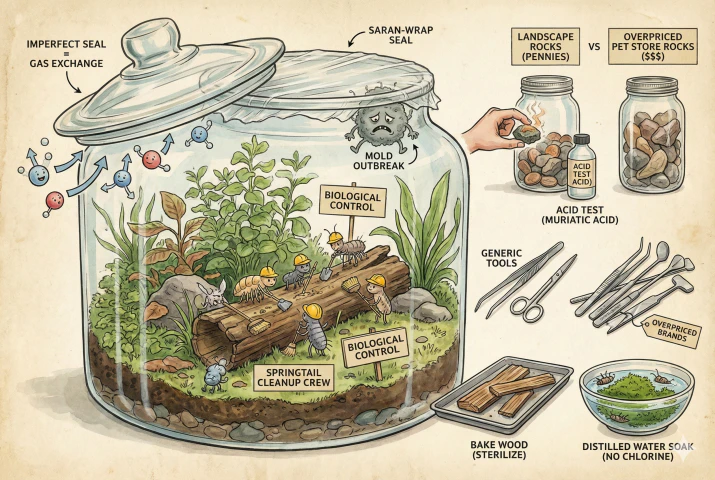
Key Takeaways
- A new terrarium can release extra CO₂ and moisture as fresh organic matter breaks down, so early venting should be guided by the actual substrate and glass conditions. A well-built airtight terrarium can also succeed.
- Springtails are a useful cleanup organism, not a permanent mold fix. Their effect depends on the mold, population, and moisture, and they cannot rescue a chronically wet tank.
- Landscape-yard rock can be cheaper than boutique aquascaping stone, but an acid test only screens for carbonate. Source, cleaning, sizing, and possible contamination still need separate checks.
- Wood and rock treatments reduce some risks without guaranteeing sterilization or rot resistance. Heat and boiling water also introduce fracture, scald, and fire hazards.
- Soaking moss in distilled or RO water reduces chlorine and mineral exposure but does not drown every pest or spore. Adjust venting by checking substrate moisture and glass temperature, not condensation alone.
Build a Terrarium as a Living System
A modern terrarium combines design, horticulture, and enclosed-ecosystem management. These microcosms in glass aren’t just decorative assemblies of plants and stones. They’re small systems shaped by gas exchange, moisture, temperature, and the microbes that break down organic matter.
The setups below range from plant-only terrariums to animal-holding vivariums. If you keep reptiles, amphibians, or invertebrates, every chemical, wood, substrate, and humidity choice should follow guidance for that species, and animals should be moved out during any treatment.
Start with the conditions plants and cleanup organisms actually experience. Safe materials, a workable moisture level, and regular observation matter more than making the enclosure look sealed on day one.
I decide which wood and stone must remain removable before applying foam, silicone, or plants. At least one route to the drainage layer and each mechanical component stays accessible without cutting through living roots.
With gloves on, I rehearse removing those service pieces. A background that can be serviced only with bare fingertips is not accessible enough once mold, sharp edges, or an animal emergency changes the situation.
Manage Moisture and Air Before Mold Starts
Give a New Build Time to Settle
A well-built closed terrarium can work, but a fresh build often has extra moisture and decomposing organic matter. A slightly imperfect lid or brief early venting can help a plant-only build settle. Check the substrate and glass rather than assuming every jar needs the same opening schedule.
Fresh, wet substrate can support a temporary bloom of microbes and fungi. If the substrate smells foul, looks waterlogged, or leaves roots without air, remove excess water and correct the cause. Condensation alone can result from cool glass and does not prove the substrate is too wet.
For an animal enclosure, use the care requirements of that species. Keep openings brief enough to prevent escapes and harmful drying.
Read Mold as a Moisture Signal
| Ventilation Type | Gas Exchange Rate | Humidity Retention | Mold Risk Profile | Maintenance Requirement |
|---|---|---|---|---|
| Hermetic Seal | Near Zero | Very high | Higher if waterlogged | Low (if established). High (if crashing) |
| Passive Vent (Loose Lid) | Low | High | Moderate | Low to Moderate (Occasional misting) |
| Active Vent (Fans) | High | Variable (Requires monitoring) | Lower | Higher (more frequent watering) |
Mold is common in new terrariums and usually follows a persistently wet surface, available organic matter, and favorable temperature. Poor airflow can keep a surface wetter for longer, but it is not the only cause.
Open or vent the enclosure only as much as the plants and surface moisture require. A loose lid can help drying, but it can also dry moss and foliage. Check the substrate surface, reservoir level, roots, and odor before changing ventilation.
Use Springtails as a Cleanup Crew
Ventilation is a physical control. A bioactive cleanup crew is a biological one. Introducing Collembola (springtails) is a widely used preventive step for closed systems, and it works alongside, not instead of, moisture control, sanitation, and material choice.
Springtails eat decaying material and some fungal growth, so they can help with light surface mold. They do not eat every mold or correct a chronically wet enclosure.
A springtail-free build can still be maintained through moisture control and sanitation. A dead leaf isn’t an automatic collapse. In a bioactive tank it becomes food and recycled nutrients, and in a cleaner tank it’s simply litter to remove.
Seed a springtail culture into the substrate during construction (they’re usually sold on charcoal or soil).
The population rises and falls with temperature, moisture, food, predation, and any chemical treatment, so it can crash if the substrate goes too dry or too wet. It isn’t a self-balancing switch that tracks mold on its own.
Choose a Suitable Springtail Culture
A live temperate springtail culture can be seeded into a suitable substrate during construction. Ask the supplier to identify the species, culture medium, and introduction method.
Let the Population Establish
Springtails need time to multiply, so add them early and keep a backup culture when practical. Container volume includes culture medium and does not tell you how many animals are alive. Follow the supplier’s directions and look for springtails in several parts of the substrate before depending on them.
They will not fix a waterlogged tank. If mold persists, match the mold-control approach to the cause instead of relying on a cleanup crew alone.
Soil Allies. Exploring the Combined Potential of Folsomia candida and Trichoderma against Fusarium oxysporum
Treat Hydrogen Peroxide as a Last Resort
Some growers reach for hydrogen peroxide (H₂O₂) when physical and biological controls haven’t kept up. It is worth being clear about what it is and isn’t.
H₂O₂ is a non-selective oxidizer. It does react with fungal tissue, but it can also damage moss, roots, beneficial microbes, and animals such as springtails and isopods.
The fact that it breaks down into water and oxygen does not make it safe to handle or safe for whatever it touches during the exposure itself.
There is no reliable universal peroxide recipe for a live planted or animal enclosure. Remove moldy material and fix moisture first. If you consider peroxide, take animals out, protect your eyes and skin, ventilate, and avoid repeated use that can harm moss, roots, springtails, and beneficial microbes.
Choose and Prepare Hardscape Safely
The hardscape, rock and wood, is the skeleton of the terrarium, and sourcing it well is a major chance to save money if you understand the materials.
Compare Material, Not Just Price
Basalt sold as aquascaping stone in a pet store is often the same mineral as crushed basalt at a landscape yard, and the landscape version is usually cheaper.
Matching mineral names do not make two products identical. Grain size, shape, how well it’s washed, and any oil, pesticide, or metal contamination and source traceability can differ, so treat the price gap as an opportunity that comes with more vetting rather than a guaranteed identical swap.
Landscape yards typically sell by the cubic yard or ton, with small quantities by the bucket or bag. Pet stores sell by the pound.
Actual prices vary widely by region, time, unit, and how selected the stone is, so compare local quotes for the same quantity rather than relying on a fixed markup figure.
For a drainage layer, which needs bulk volume more than specific looks, inexpensive pea gravel or 3/8-inch river pebbles from a landscape supplier is one sensible option. LECA or a false bottom are reasonable alternatives, and the right pick depends on weight, pore size, and how the coarse layer meets the fine substrate above it.
Use an Acid Test Only for Carbonate
Landscape rocks aren’t pre-screened for terrarium use. Carbonate leaching is one chemical concern (calcium carbonate (CaCO₃) can raise soil pH and water hardness) but it isn’t the only one. Pesticide or oil residues, salts, metals or sulfides, and unstable or sharp pieces matter too, especially where animals might ingest debris.
Many tropical plants, ferns, and mosses come from acidic environments and can suffer as pH rises. Acidic water slowly dissolves limestone, marble, and some sandstones.
That said, decide by your target water and media chemistry first. Carbonate rock is a poor fit for acid-loving setups but can be used deliberately for calcicole plants, hard-water animals, or a specific biotope.
An acid test screens for carbonate. It does not confirm a rock’s full identity or safety. Place a drop of acid on a clean, freshly scratched surface. Vigorous fizzing indicates carbonate (limestone/marble), which is unsuitable where you want low pH.
No reaction does not prove the rock is a safe silicate. Dolomite and mixed rock can fizz only weakly (a false negative), and the test says nothing about heavy metals, sulfides, salts, coatings, or pesticides.
Field geology tests normally use a small amount of dilute hydrochloric acid on a fresh or powdered surface.
Consumer muriatic acid is strong, so if you use it, dilute it, control drips (work outdoors over a tray), have eyewash and neutralizer on hand, wear gloves and eye protection, and label and dispose of it properly. Never use it near bleach, and never bring bleach into contact with acid-wetted rock, containers, or tools (residual acid plus hypochlorite can release chlorine gas) so keep separate tools, a separate location, and rinse and dry fully between them.
If you’d rather not handle a strong acid, vinegar catches the most reactive limestones and is a safer screen. Just treat a non-reaction as no obvious carbonate rather than proof the material is safe.
Do Not Bake Rock
Porous or cracked rock can hold water and fracture when heated quickly. Baking is usually unnecessary and adds avoidable risk, especially with waterlogged river stone. A thorough rinse and physical cleaning are usually enough.
One common method is to set rocks in a bucket and pour boiling water over them to thermally shock surface bacteria and algae.
It is not automatically the safest option. A cold or cracked stone can fracture from the thermal shock, and boiling water carries a real scald and splash risk.
Let cold rock warm first, pour carefully, and note that this doesn’t sterilize to any verified contact time.
A dilute bleach soak is another option, but only with the full procedure. Check the product’s concentration (household bleach ranges roughly 5–9%), mix a fresh solution, ventilate, wear PPE, give a defined wet contact time, then rinse thoroughly and confirm no chlorine residual before anything goes back into a live enclosure.
Keep bleach entirely separate from any acid step (see the acid-versus-bleach warning above).
Avoid Coated Decorative Stone
Some decorative landscape pebbles are coated with mineral oil or wax to give a wet look in the bag, and in a closed terrarium such coatings could leach into the substrate and harm microfauna.
How common this is, and how toxic, isn’t well documented, so the surest step is to check the seller’s disclosure or product label, or simply choose uncoated stone.
Water beading on dry rock is not a reliable oil test on its own. Surface roughness, dust, or a natural film can do the same.
If you do degrease, note that dish-soap residue can itself bother microfauna, so rinse very thoroughly. The absence of visible suds doesn’t guarantee zero surfactant residue.
For an animal enclosure, a product-safe cleaner or unused, known-clean stone is preferable.
Source Wood With Animal and Plant Safety in Mind
Wood adds verticality, texture, and a carbon source for the cleanup crew. Collecting it from nature can be cheap, but the first priority isn’t cost (it’s legality and biosecurity).
Check that collection is permitted (avoid protected land and species), avoid wood from roadsides or industrial areas that may carry pesticides or pollutants, don’t transport pests or disease, and identify the species and its condition before use.
Choose Known, Seasoned Wood
Not all wood suits every enclosure, and the answer depends on the wood’s state and on which (if any) animals you keep.
Well-seasoned oak (Quercus) heartwood is a common, reasonable choice, but durability varies by species, and sapwood, decayed pieces, or pesticide-exposed wood behave differently.
Be cautious with coniferous softwood shavings (pine, cedar in particular). Their aromatic oils are a documented respiratory and neurologic risk in reptile bedding, which is why keepers avoid them.
Whether that risk carries over to a seasoned whole branch in a plant-only terrarium, or to fir and spruce specifically, is a different exposure and less established, so treat conifers conservatively, but recognize the evidence is strongest for cedar/pine shavings around animals.
Woods commonly treated as safer include oak, maple, sycamore, ash, beech, manzanita, and ghostwood. Commonly avoided are pine and cedar shavings, eucalyptus, and walnut (its juglone is a plant-growth inhibitor).
Take this as a starting guide, not an absolute rule. The right call also depends on the animal species, the wood tissue and seasoning, and any chemical exposure.
Juglone content, for instance, varies with tissue and decay, and walnut products have been used as reptile substrate in some contexts.
Grape wood is often reported to mold and rot in humid setups. Avoid it when long-term structural wood is important.
Dry Wood Carefully, but Do Not Expect Sterilization
A low-temperature oven bake can dry found wood and reduce some pests, but it cannot guarantee that every insect or spore deep inside is killed. Watch for scorching, odor, warping, and fire risk, and cool the wood fully before it goes near animals.
Neither baking nor boiling makes wood permanently rot-proof. Boiling can remove tannins and surface debris, but expect possible cracking and leachate. Dry and cure wood before use.
Prepare Moss for the Conditions It Will Face
Moss is a signature terrarium plant and often one of the first to struggle. Handling and sourcing are common culprits, but so are light, species choice, substrate, temperature, and water chemistry, so diagnose the cause rather than assuming it’s always prep.
Estimate Moss by Coverage Area
Moss is highly compressible, so a volume measure is unreliable. A quart can hold very different amounts of moss depending on hydration and packing.
Many suppliers sell by square-foot coverage instead, which is more useful for planning, though species, thickness, and hydration still affect how much biomass a given area actually represents.
As a rough starting estimate, a 1-gallon jar might take on the order of half a square foot to a square foot of sheet moss for ground coverage. The actual amount depends heavily on the jar’s geometry, planting density, and moss species.
Rinse Moss and Watch Its Response
Moss absorbs much of its water through its surface, so water chemistry can matter. Species vary, but dechlorinated, distilled, or RO water is a sensible precaution for chemistry-sensitive mosses and for avoiding mineral deposits.
Wild moss can also carry biosecurity hitchhikers such as nematode eggs, snail hatchlings, and mold spores.
If you collect it yourself, follow local collection rules and land access.
Prepare moss before planting. Mechanically remove pine needles, dead leaves, and soil, then rinse or soak it in distilled or RO water for 15–20 minutes, swirling to dislodge debris.
Be clear that a short soak doesn’t reliably drown eggs, nematodes, mites, or spores. Many invertebrate stages survive it.
Staging the moss in a quarantine container helps you spot emerging pests, but a single week is short relative to some pest life cycles, so keep watching after planting.
Desiccation tolerance in bryophytes relates to elasticity but is independent of cell wall thickness and photosynthesis
Build for Safe Maintenance
Test the Vessel Before Planting
Before adding substrate, check the vessel, especially for vintage glass or DIY tanks. Set the empty vessel on dry paper, fill with water, and leave it for 24 hours.
Filling only to the intended substrate line is a quick check but won’t stress the upper seams or the full working load, so it’s a first pass rather than a structural validation.
Moisture on the paper can signal a micro-leak in a seam, though condensation or a spill can look the same, so confirm the source.
For an animal-holding tank, also go by the manufacturer’s water rating, confirm the surface is level and supported, inspect the seams, and let any resealing cure fully before retesting.
Make the Substrate Stack Work for the Vessel
A common layered build uses inorganic drainage aggregate (lava rock, LECA, river pebbles) as a reservoir, a synthetic mesh barrier (window screen) to stop soil sifting down, and a substrate mix (charcoal, sphagnum, soil) on top.
A 1–2 inch reservoir is a typical range rather than a universal depth. In a shallow vessel a coarse-over-fine interface can hold a perched, saturated zone, so let vessel height, the medium’s pore structure, how you’ll monitor and remove excess water, and the actual water level guide the depth.
Charcoal is a useful component but not an unlimited toxin filter, and particle size, nutrients, pH, and any burrowing animals matter for the substrate mix.
Choose Tools That Reach the Work
Terrarium work happens through narrow openings, so tools help. Long bent-tip tweezers are handy, the angled tip lets you grasp a stem, insert it vertically, and release it without your hand blocking the view, though straight tweezers, forceps, or even chopsticks can work depending on the vessel and plant.
Long curved scissors make it easier to trim carpeting plants parallel to the ground. Straight scissors can still do it at an angle.
You don’t need a premium aquascaping brand for basic work. For trimming soft moss a budget set is usually fine, provided you dry it after use to limit corrosion.
Steel grade, hinge quality, blade alignment, edge retention, and corrosion resistance can differ between a generic and a high-end set. These listings often say stainless without stating a 304 or 430 grade, so good enough for moss is a conditional judgment rather than proof they’re functionally identical to a $50 set.
Budget aquascape tool set
A budget aquascaping kit is handy for basic planting and trimming. These sets are commonly sold as a five-piece bundle. Four metal tools, straight and curved tweezers, curved scissors, and a substrate spatula, usually with a pack of pH strips thrown in. Check the tweezer reach, scissor shape, and spatula or scraper against your enclosure before buying, and don’t expect a kit like this to cover every build task, such as cutting wire or scraping algae.
Tool set notes
Steel grade, heat treatment, hinge quality, and edge geometry vary, and many listings disclose only stainless. Inspect the selected tools for flex and burrs, wash and dry them after use, and disinfect them between enclosures. Handle the blades and points carefully.
Maintain the Conditions You Built
Check Moisture Before Watering or Venting
Overwatering is a common cause of failure. In a closed system, water largely recirculates.
All-day condensation doesn’t by itself prove the substrate is waterlogged (it can also come from the glass being cooler than the room at high humidity) so before venting, check the substrate moisture, the reservoir level, and any root or odor issues.
If it is genuinely too wet, cracking the lid to vent helps, but judge the duration by how the tank responds rather than defaulting to a full day, which can over-dry a small jar or stress some species.
In an open system, moss needs consistent moisture. If it turns pale or crispy, that may be dryness, so mist with distilled water while also ruling out excess light, heat, dormancy, dead tissue, or water quality.
Remove Diseased Growth and Manage Litter
Remove diseased or excess dead leaves promptly. In a bioactive tank, some leaf litter is normal food for the cleanup crew, so the goal is managing excess and disease rather than eliminating all detritus.
Prune plants that press against the glass, since sustained leaf-on-glass wetness can encourage rot (driven by how long the surface stays wet more than by contact alone).
Keep Observing and Adjusting
Use springtails, careful material choices, and modest early venting as parts of a routine, not as a promise of a hands-off ecosystem. Check light, plant growth, moisture, pests, disease, and animal welfare regularly, then adjust one condition at a time.