
Monstera Yellow Leaves Checklist: Diagnose & Fix Fast
Diagnose Monstera yellow leaves by checking roots, soil moisture, pests, leaf position, nutrients, and light, then match each confirmed cause to the right fix.
Elena Vargas · Published 2025-12-10 · 15 min read
Key Takeaways
- Yellow leaves are a non-specific symptom with many possible causes. Where the yellowing appears, lower or upper leaves, is a first-pass clue, not a diagnosis.
- Waterlogged, poorly drained soil is a serious risk factor. It starves roots of oxygen and favors root-rot pathogens, so confirm by inspecting the roots rather than assuming.
- A chunky, well-draining aroid mix lowers the risk of oxygen-starved roots. It does not prevent pests, nutrient problems, cold, low light, or leaf disease.
- For thrips, start with the gentlest label-approved options. Escalate only when the diagnosis and product conditions fit, because a soil-applied neonicotinoid can harm pollinators and often performs poorly on thrips.
- Interveinal chlorosis can point to a nutrient shortfall, but several stresses look the same. Check pH, watering, and root health before reaching for fertilizer.
Yellow leaves on a Monstera deliciosa are a non-specific symptom. They can mean anything from harmless aging to underwatering, a nutrient shortfall, thrips, spider mites, low or excessive light, cold, or root rot.
Where the yellowing appears (lower vs. Upper leaves) and the state of the roots and soil are useful first clues, but several causes can produce the same pattern, so treat this as a process of narrowing down rather than a single definitive test.
Start with conditions that can quickly destroy roots or spread to nearby plants, then move to water, nutrients, light, and normal leaf aging.
Triage Yellowing by Urgency
Sort by Risk, Not Color
Rather than a single number, sort what you see into one of four action levels. These levels indicate how quickly to act, not a diagnosis. More than one can apply at once, and a mild-looking case can still hide an early infection or pest problem, so confirm with direct root, leaf, and pest evidence.
- Act now (isolate and inspect). Soft, dark, mushy roots or stem base. Spreading dark leaf lesions. Visible insects, or fine webbing and stippling. Separate the plant from others and check the roots.
- Check within a day or two. Soil that is waterlogged or, conversely, bone-dry and pulling away from the pot. A sudden change in light. Recent yellowing spreading over several leaves.
- Watch and adjust. Interveinal yellowing or slow, patchy yellowing with no pest signs and healthy new growth (likely an environment or nutrient issue to correct gradually).
- Likely normal. A single old, lower leaf slowly yellowing while new growth and roots look healthy (probably natural aging).
To place a case, look at watering history and how wet the soil actually is, drainage and substrate, where the yellowing sits (lower vs. Upper), any frass, insects, webbing or stippling, light exposure, and time since the last feeding.
I freeze the starting point with a numbered whole-plant photo and count only leaves that begin yellowing after the intervention. Existing yellow tissue continuing to fade does not mean the cause is still active.
Each new case is logged by location and speed. A stopped count after drainage correction is more meaningful than a prettier photograph of the same damaged leaf.
A card beside the pot lists the one change and date. It prevents another caretaker or my future self from adding water, feed, or spray before the first response can be read.
Match the Symptom to the Cause
Act Now (Root Rot or a Heavy Thrips Infestation)
These cases warrant separating the plant from your others and acting quickly. The two most urgent are root rot and a heavy thrips infestation. Direct root and insect evidence distinguishes them.
Root Rot
Root rot is a disease in which pathogens damage the root system, and it is closely tied to how much oxygen the roots can get.
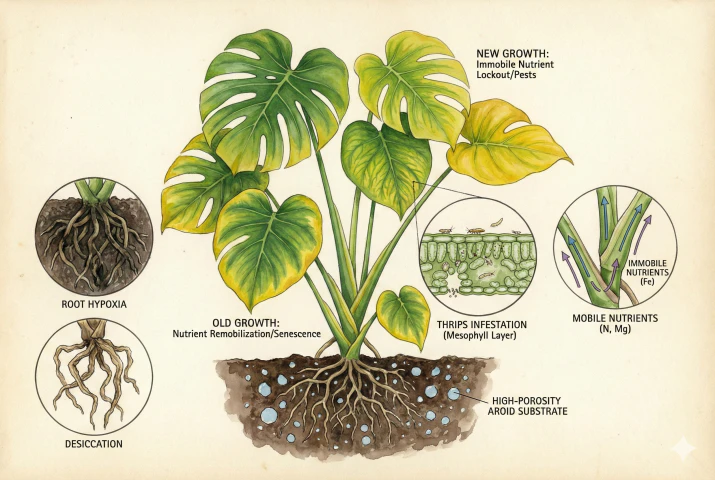
Monstera roots need oxygen. When the substrate stays too dense or waterlogged, water displaces the air in the pores and the low-oxygen conditions injure the roots and favor water-mold pathogens such as Pythium and Phytophthora, which can infect living, weakened roots.
So waterlogging is a major risk factor, but it is not the same thing as the disease itself, and confirming which pathogen is involved generally needs a diagnostic lab.
A rotten-egg smell usually signals hydrogen sulfide from anaerobic microbes in the soil. A sign of decay, not proof of a specific pathogen.
What to look for at the roots and stem base. Soft, dark brown or black, mushy roots, sometimes with the outer layer slipping off the core, and a mushy stem base. Often alongside wilting and yellowing even while the soil is wet.
Dark leaf spots with a yellow halo are worth noting, but they are not specific to root rot (bacterial or fungal leaf spot, edema, and sun or chemical injury can look similar), so judge rot mainly by the roots.
If you find rot, the priorities are to isolate the plant, remove it from the soggy media, and trim clearly rotten tissue back to firm root with clean, sterilized tools (cutting no more than you need to, since aggressive cutting adds transplant shock).
Discard the contaminated media and any drain water, repot into fresh, well-draining mix in a clean pot, and watch for recovery.
In severe cases it is often more reliable to take a healthy cutting to propagate, or to discard the plant, than to try to save a badly rotted root system.
There is no well-established houseplant protocol for a diluted hydrogen-peroxide root soak, and pouring an oxidizer over freshly cut roots risks further damage, so sanitation, clean media, and reduced watering are the safer path.
Improving drainage and air-filled porosity in the mix lowers the risk of oxygen-starved roots, which helps with this one cause.
It will not, on its own, address pests, nutrient problems, cold, light, or leaf disease. The Monstera watering routine explains how to combine pot weight, substrate checks, and full drainage after repotting.
Gardenera aroid potting mix is a convenient small-batch, soil-free option for replacing contaminated media around a compact Monstera.
Choose it when its listed bark-and-perlite style ingredients suit your watering habits, not as a product that guarantees rot prevention. Skip it for a large pot, a custom mix, or when you need measured pH, EC, porosity, or water-retention data.
Buy It When
You need a small premixed batch to replace contaminated media around a compact Monstera and the listed ingredients fit your watering habits.
Skip It When
You have a large pot, want to tune each component, or need published pH, EC, porosity, or water-retention specifications. A chunkier mix can dry faster than peat-heavy soil, so choose the quantity and watering routine for the actual pot.
Thrips
Thrips (order Thysanoptera) are tiny, slender insects that insert eggs into leaf tissue, which shields the eggs from contact sprays.
The larvae puncture cells and feed on the contents, leaving silvery scarring. They pupate before emerging as small winged adults.
Depending on the species they may pupate in the soil, on the leaves, or in leaf litter, so do not assume they all drop to the pot.
The most reliable signs are the insects themselves and their tiny black tar-like frass dots. Inspect leaf undersides and new growth, and a hand lens helps.
Curled or browning new leaves and mottled yellowing are suggestive symptoms, but nutrient issues, mites, and water or chemical damage can cause the same look, so confirm with the insects or frass before treating for thrips.
Start with the gentlest options and escalate only if needed. Mechanical and low-toxicity control comes first. Isolate the plant, rinse the foliage, and wipe the leaves.
An insecticidal soap or horticultural oil can be a low-toxicity next step, but follow that product’s own label for the listed host, concentration, spray interval, and temperature or light limits, and test on a few leaves first. A fixed interval of 5–7 days is not right for every product and can cause leaf damage.
Biological Control
It is a possibility rather than a routine second step. Some predatory mites eat young thrips, but they can be unsuitable in an average home’s lower humidity, are sold in bulk, can be costly and perishable, and usually need repeated releases even in an enclosed grow space, and a contact spray can kill them, so their timing has to be coordinated with any oil or soap.
Only pursue them if you can match the mite species, humidity, release rate, and cost to your situation.
Bonide Systemic Houseplant Granules are a last-resort imidacloprid option for label-listed pests on non-edible container plants.
They are not a dependable treatment for confirmed thrips or spider mites, so do not use them merely because yellowing is present.
Buy It When
You have identified a susceptible, label-listed pest such as aphids, whiteflies, scale, or mealybugs on a non-edible indoor container plant and can follow every handling, dosage, and disposal restriction.
Skip It When
The diagnosis is thrips or spider mites, the plant is edible, pollinators can visit its flowers, or children and pets cannot be kept away during application. Imidacloprid is highly toxic to bees and aquatic invertebrates, so keep granules and drain water out of the environment. Verify the exact product and current label before buying.
Repeated oil or soap, done carefully, resolves many houseplant thrips problems, but there is no reliable success rate for a home Monstera, and a heavily infested plant is sometimes cheaper and safer to discard than to treat.
Thrips in Home Gardens (University of Maryland Extension)
Check Soon (Underwatering or Spider Mites)
These are usually less immediately dangerous than root rot, but they still need attention, and severe or prolonged cases can cause lasting tissue damage, so how reversible they are depends on the plant, not on any score.
Hydrophobic Soil and Chronic Underwatering
Drought and root rot can overlap (both can droop, yellow the lower leaves, and cause necrosis) so no single symptom separates them cleanly.
Instead of relying on one row of a table, weigh several things together, and remember these are pointers rather than a diagnosis.
| What to check | Leans toward underwatering | Leans toward root rot |
|---|---|---|
| Watering history | Missed waterings. Pot feels light | Frequently wet. Poor drainage. Pot feels heavy |
| Soil moisture | Bone-dry, may pull away from the pot | Wet or slow to dry (though the surface can look dry) |
| Roots (inspect) | Dry but firm and light-colored | Soft, dark, mushy. Outer layer may slip off |
| Leaf edges | Crisp, paper-thin, tan | Soft. Wilting even while soil is wet |
Dark leaf spots with a yellow halo are sometimes listed as a rot sign, but they are not specific to it. Bacterial or fungal leaf spot, edema, and sun or chemical injury can all look similar, and need to be considered separately.
When the roots are firm but leaf lesions keep spreading, use the aroid leaf-disease checks to document the pattern and decide whether diagnostic testing is warranted.
Peat-based mixes can become hydrophobic when they dry out fully, so water may channel down the gap between the shrunken soil and the pot without wetting the root ball.
How often this actually happens depends on the mix, any wetting agent, and how dry it got, so check for it rather than assuming it is the cause.
As a plant loses turgor from drought, its stomata close and photosynthesis stalls, leading to drooping and then necrotic leaf edges. How far it recovers depends on how severe the stress was and on root health.
The fix for hydrophobic soil is a bottom soak. Stand the pot in water and let it wick moisture up until the root ball is rewetted, then drain fully.
Roughly halfway up the pot for 30–45 minutes is a starting point, but the time depends on pot size, mix, root mass, and how dry it was, so check that the whole root ball is actually wet rather than trusting a fixed number.
Soak each plant in its own clean container of fresh water. Shared soak water can carry pests or pathogens between plants.
XLUX T10 moisture meter can help you compare moisture deeper in a conventional soil mix, but it cannot diagnose roots or replace checking the pot by weight and touch.
Do not rely on it in a very chunky bark mix, where poor probe contact makes the reading misleading.
Buy It When
You grow in conventional soil that contacts the probe and want a quick relative 1–10 trend across repeat measurements in the same pot.
Skip It When
Your Monstera is in a very chunky bark mix, you need a calibrated water percentage, or you want a sensor that stays in the pot. Pair any reading with pot weight, touch, and a wooden skewer. Do not use it in water or leave it inserted between readings.
Spider Mites
Spider mites pierce cells and feed on the contents, leaving a fine stippled speckling and, in heavy infestations, general chlorosis. Some species are favored by hot, dry conditions.
Look on the leaf undersides for the mites, fine webbing, and stippling. Tapping a leaf over white paper can reveal moving specks, and a hand lens helps confirm.
To manage them, isolate the plant, rinse and wipe the leaves, and use a label-approved insecticidal soap, horticultural oil, or miticide, following that product’s directions and covering the leaf undersides.
Raising humidity may discourage some mite species but will not clear an established infestation on its own, and too much indoor humidity brings its own condensation and mold risks.
Repeat inspection and treatment as the label allows, since a single pass rarely breaks the cycle.
Watch and Adjust (Nutrients or Light)
When yellowing is interveinal (yellow tissue with green veins) and there are no pest signs, a nutrient shortfall is one plausible cause, but root damage, high pH, cold, watering problems, and disease can produce the same look, so read the leaf-age pattern as a starting clue, not a verdict.
Nutrient Mobility and Leaf Age
As a first-pass heuristic, deficiencies of more-mobile nutrients tend to appear first on older, lower leaves, and deficiencies of less-mobile nutrients on newer, upper growth.
Treat this as a rough guide with exceptions. Mobility varies by nutrient and species (sulfur, for example, is classed anywhere from immobile to fairly mobile depending on the source, and boron mobility varies too).
| Mobility (general) | Examples | Where it tends to show | Typical look |
|---|---|---|---|
| More mobile | Nitrogen, Magnesium, Potassium, Phosphorus | Older / lower leaves | Nitrogen tends toward uniform pale-green yellowing. Magnesium toward interveinal yellowing on older leaves. |
| Less mobile | Iron, Calcium, and many micronutrients | Newer / upper leaves | Newer growth is affected first. Iron shows classic interveinal chlorosis on new leaves. |
Plants can move mobile nutrients from older leaves toward new growth, so the leaf-age pattern narrows the possibilities, but it does not confirm a specific nutrient.
Visual symptoms overlap between deficiencies and with water, pest, and disease stress, and several nutrients can be short at once, so a tissue, media, pH, or EC test is what actually pins it down.
- More-mobile nutrients (N, P, K, Mg) Shortfalls often appear first on older, lower leaves. The pattern still varies. Phosphorus deficiency often causes purpling, while potassium deficiency can scorch leaf margins rather than simply yellowing lower leaves.
- Less-mobile nutrients (Ca, Fe, and many micros). Shortfalls often show first on younger, upper leaves. Iron deficiency’s interveinal chlorosis on new leaves is the classic example, but high pH, cold, overwatering, or root damage blocking iron uptake can look the same.
Before adding fertilizer, check the substrate pH and EC, the root condition, and your feeding history, and test tissue or media if the cause is unclear. High pH or root problems can block uptake even when the nutrient is present, and feeding more into that only adds salt stress.
Where a real deficiency is likely and the environment is sound, a complete liquid fertilizer with macro- and micronutrients is a reasonable choice.
SUPERthrive Foliage-Pro fertilizer is a complete liquid fertilizer for a likely nutrient shortfall after the roots, pH, and feeding history point in that direction.
Skip it while yellowing is unexplained, roots are rotting, pH is blocking uptake, or EC is already high. More fertilizer can add salt stress without correcting the cause. Follow the current label and adjust for season, light, and watering.
Light Levels
Too little light can cause etiolation, stretching and pale growth as the plant’s upkeep costs outrun its photosynthesis, while a sudden move into intense direct sun can cause photoinhibition and bleached patches.
A well-lit spot with mostly bright, indirect light suits most Monsteras, but an acclimated plant can tolerate some direct sun depending on the season and window.
What matters is intensity and duration and moving the plant gradually rather than abruptly, so it can adjust.
Identifying Nutrient Deficiencies in Ornamental Plants (University of Delaware Extension)
Likely Normal (Leaf Aging)
Some yellowing is simply an old leaf being retired, but a healthy-looking case is not proof that nothing else is wrong. An early infection or a light pest problem can still be present, so glance at the roots, new growth, and leaf undersides before concluding it is benign.
Leaf Senescence (Natural Aging)
It’s normal for a maturing Monstera to retire its oldest leaves, moving their nutrients into new growth (typically a slow yellowing that starts at a single lower leaf).
This is the likely explanation only when the rest of the plant looks healthy. New growth is normal, the roots are firm, and there are no pest or disease signs.
In that case there’s no need to react by adding water or fertilizer. You can let the leaf finish yellowing before removing it.
But if the yellowing is spreading, several leaves are affected, or you find lesions or pests, don’t wait (isolate the plant and address the cause).
Confirm the Cause Before Treating
Use Multiple Signals
Yellow leaves are a distress signal that only makes sense in context. Read the location of the yellowing and, most importantly, check the state of the roots, and you can usually tell harmless aging from problems like root rot or pests that need prompt action.
No single upgrade fixes everything. A well-draining aroid mix lowers the risk of oxygen-starved roots, but it will not prevent pests, nutrient shortfalls, cold, low light, or leaf disease.
The dependable habits are correct watering for your pot and mix, appropriate light, regular checks of the leaf undersides and roots, and starting with the gentlest pest controls before escalating, and seeking a firmer diagnosis when a case does not fit or does not respond.
Affiliate Disclosure
This article contains Amazon affiliate links. As an Amazon Associate I earn from qualifying purchases. If you use these links, the site may earn a commission at no extra cost to you. Product availability, price, and specifications can change. Check the current listing before buying.