
Monstera Yellow Leaves: Causes, Diagnosis & Fixes
Diagnose Monstera yellow leaves by pattern and leaf age. Check watering, root rot, light, nutrients, pests, temperature, and pH before choosing a fix.
Priya Patel · Published 2025-12-11 · 16 min read
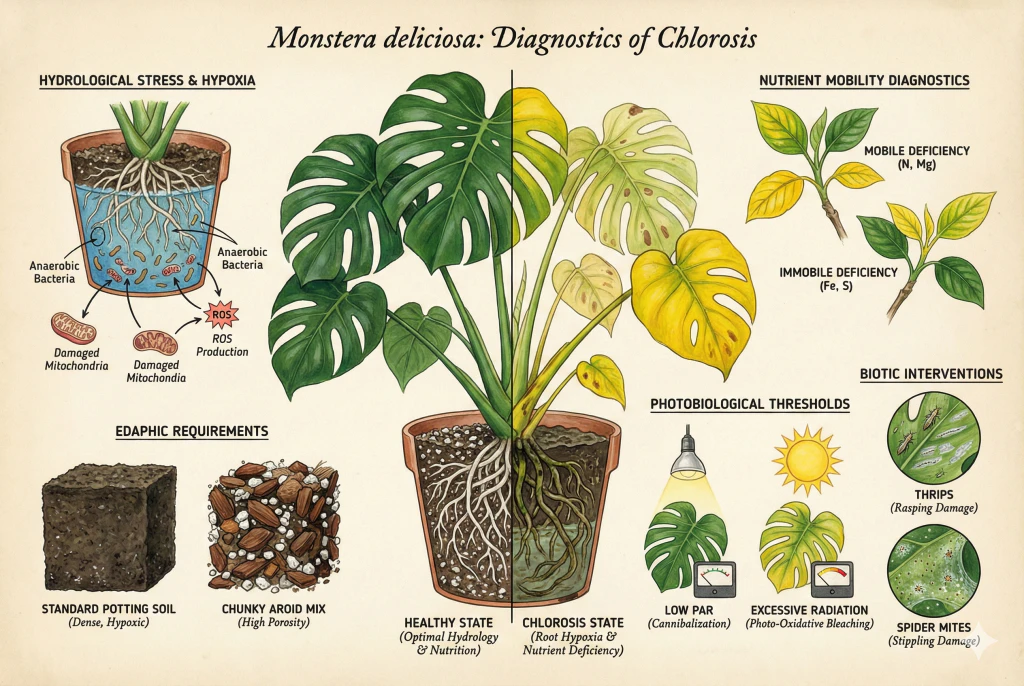
Key Takeaways
- Yellow leaves are a symptom, not a diagnosis. Common causes include watering problems, light, nutrients, pests, temperature, disease, salts, and ordinary leaf aging, so identify the cause before you act rather than reflexively watering.
- Overwatering can starve roots of oxygen and often yellows lower leaves first. A moisture meter and a chunky, airy aroid mix can help you investigate, but neither one proves a diagnosis on its own.
- Leaf age and the pattern of yellowing are useful first clues. Older leaves can point toward mobile nutrients such as nitrogen or magnesium, while new leaves can point toward immobile nutrients such as iron. Confirm with root, substrate pH or EC, and if needed media or tissue testing before dosing.
- Light can cause yellowing when it is either too weak or changed too suddenly. Bright, indirect light suits most Monstera, while acclimated direct sun may be tolerated depending on season and window.
- Pest damage has recognizable patterns, but treatment still starts with identification and isolation. Rinse and remove pests physically before using a pesticide, and follow the exact product label for indoor use, rate, and interval.
A yellow leaf on a Monstera deliciosa is chlorosis, a visible symptom of reduced chlorophyll rather than a diagnosis by itself.
Possible causes include a watering or root-oxygen problem, too little or too much light, a nutrient issue, pests, cold or draft, disease, salt buildup, or normal aging. Infection can cause chlorosis too, so describing yellowing as a symptom does not rule out a pathogen.
Diagnosing it well comes down to reading where and how the yellowing appears, checking recent history (watering, a move, feeding, a cold event), and (where the pattern is ambiguous) confirming with a look at the roots or a simple test, rather than reflexively watering. Use the quick Monstera yellow-leaf checklist when you need a shorter triage sequence.
1. The Plant Behind the Problem
Monstera is a Neotropical hemiepiphyte, which means it can start in soil and later climb toward the canopy.
Indoors it adapts to a very different setting, so yellow leaves provide feedback about pot drainage, the potting medium, watering habits, light, and air movement rather than proof of one single problem.
I number leaves from oldest to newest and mark where yellowing began within each blade. One old lower leaf fading evenly is different from interveinal yellowing in new growth or scattered leaves declining together.
Those dates also carry watering, feeding, repotting, temperature, and pest observations. The sequence is often diagnostic before any single color becomes distinctive.
Stable remaining leaves and healthy new growth are how I judge a correction, not whether a fully yellow leaf recovers. This prevents repeated fertilizer or watering changes aimed at tissue that has already senesced.
2. Water and Root Oxygen
Watering problems are among the most common contributors to yellowing, but simply reducing water can oversimplify the problem.
What usually matters is the interaction between soil physics and root respiration. Extension guidance notes that overwatering contributes to houseplant root disease more often than drought, though that is not the same as being the single cause of every yellow leaf.
2.1 The Mechanism of Hypoxia and Root Suffocation
Roots need both water and air. When a pot stays saturated, water fills the air spaces and roots struggle to take up water and nutrients even though the mix is wet.
A heavy, wet pot with yellowing leaves is a reason to inspect the roots and drainage before adding more water.
Root Oxygen Is the Immediate Constraint
Sustained low oxygen at the roots can impair their function and contribute to yellowing, most often in the older, lower leaves first.
If the pot is staying wet but the roots are not yet visibly rotten, the Monstera watering guide gives a pot-weight, skewer, and drainage routine for deciding when to water again.
2.2 Signs That Point Toward Overwatering
A few patterns are consistent with overwatering, though none confirms it on its own. Yellowing that begins at the base (oldest, lowest leaves first) can reflect root distress, but the same pattern also comes from normal aging, nitrogen or magnesium deficiency, low light, or cold, so treat it as a clue, not a verdict. Edema (small blisters or bumps) can appear when roots take up water faster than the leaves transpire it. It suggests high moisture and low transpiration but is not a Monstera-specific proof of overwatering and does not always occur.
If you suspect a root problem, the reliable check is to look at the roots and the moisture of the medium.
Do not read leaf spots as a root-rot pathogen. Brown leaf spots ringed by a yellow halo are more often a separate issue, bacterial or fungal leaf spot, or sun or chemical injury, and need their own diagnosis. Use the Monstera black-spots guide when discrete lesions, rather than whole-leaf chlorosis, are the main symptom.
Root rots from water molds such as Pythium or Phytophthora typically show up as stunting, general yellowing, wilting, and dark, soft roots when you inspect them, rather than as haloed spots on the leaves.
2.3 Checking Soil Moisture
In a deep pot, the surface can dry while the lower mix stays wet, so a finger poke near the top can mislead you. Check deeper with a wooden skewer and compare that result with the pot’s weight. A cheap analog meter is optional, not a diagnosis on its own.
XLUX Plant Soil Moisture Meter
XLUX Plant Soil Moisture Meter can be useful when you need another clue about moisture deeper in a fine, evenly packed mix. It is a poor fit for loose, chunky aroid media, where the probe may not touch enough material to read consistently.
Use it at several depths and compare the trend with pot weight or a wooden skewer. Remove it after checking rather than leaving it in the soil, and never let a single reading overrule a wet, heavy pot or damaged roots.
2.4 Root Rot (The Advanced Stage)
When decay is advanced, leaves droop despite wet soil, the medium can smell sour, and roots feel dark and mushy.
These signs are consistent with serious root decay but do not by themselves distinguish a pathogen from anaerobic breakdown or physical root death, and healthy roots are not always pure white. They can be tan or stained by the mix.
Follow published root-rot guidance, which emphasizes correcting the moisture problem, sanitation, and saving what roots you can.
Unpot the plant, gently remove enough medium to see the roots, and trim away clearly dead, soft, blackened roots with clean tools, keeping handling and cutting to the minimum needed.
Repot into fresh, well-draining aroid mix in a pot with drainage, and then water more conservatively.
Extension root-rot advice does not present a fixed hydrogen-peroxide soak as a standard home treatment. A peroxide dip adds oxidative stress to already-stressed roots, so it is not a reliable routine step and is best avoided unless a source you trust specifies a tested method for your situation.
2.5 Underwatering and Hydrophobia
The opposite extreme can also yellow leaves. Severe under-watering collapses turgor, closes stomata, and slows photosynthesis, and may produce yellowing with crispy brown edges and inward-curling leaves.
Keep in mind that crispy edges and curling also overlap with salt buildup, low humidity, heat, and root damage, so check watering history and the roots before concluding it is simply drought.
When peat-based mix dries out completely it can turn water-repellent, so water may run around the root ball instead of soaking in. Bottom-watering (standing the pot in a tub) can help it re-wet. Afterward let it drain fully, confirm the pot has working drainage, and check the roots before returning to a normal watering routine.
3. Substrate and Aeration
A dense, water-retentive mix can hold too much water and too little air, but not every peat-based mix does this.
Judge the mix by how it behaves in your pot. If it stays soggy and compacts, add a coarse component or repot into a mix with more room for drainage and air.
Coarse Bark for Aroid Mixes
Better-Gro Orchid Bark
Better-Gro Orchid Bark is useful as the coarse, airy part of a Monstera mix when the current soil stays wet too long. It is not a complete stand-alone medium for a plant that needs steady moisture and nutrition.
Blend it with moisture-holding material, then repot when the mix is breaking down or roots are struggling rather than following a fixed calendar.
Mixing in bark and perlite can improve aeration in a dense soil. It is one option among several coarse materials, not the only one.
Reported preferred pH for Monstera varies by source, from slightly acidic up to roughly 6–8, so treat 5.5–7.0 as a rough guide rather than a hard rule.
Keep irrigation-water pH and alkalinity separate from the pH of the substrate itself. Alkalinity is the water’s capacity to raise substrate pH over time, while high substrate pH can make iron less available and trigger iron chlorosis.
Before adding sulfur or lime, sample the substrate properly and, ideally, get a media or lab recommendation. The right amount depends on the medium, its buffering, any starter lime charge, and the product’s rate, so a single meter reading is not enough to dose safely.
4. Light
Monstera has large leaves suited to bright, dappled forest light, and it generally does best in bright, indirect light rather than deep shade.
4.1 Why Low Light Can Cause Yellowing
Plants run on a carbon budget. A leaf in deep shade may photosynthesize less than it costs to maintain. The plant can then recover mobile nutrients from that older leaf before it yellows and drops.
This is also part of normal leaf aging, so basal yellowing alone does not confirm low light.
Signs that are consistent with too little light include slow growth, long internodes, and small, unfenestrated leaves, but age, support, cultivar, and nutrition or root stress also affect growth and fenestration, so read them as clues rather than a definitive verdict.
4.2 Sudden Strong Sun
Too much sudden light can also damage leaves. Intense direct sun can generate more energy than the chlorophyll can process, and the resulting bleached white or pale-yellow patches on sun-facing leaves are dead tissue that will not recover.
The key variables are intensity, duration, season, and window direction, and whether the plant has been acclimated.
A Monstera that is gradually acclimated can tolerate some direct sun depending on season and exposure, so this is a warning about sudden, unacclimated strong sun, not a blanket ban on any direct light.
When increasing light, step it up gradually.
4.3 Aiming for the Right Light Level
Give the plant bright, indirect light and watch its response. A dim location can slow growth and yellow older leaves, while sudden strong sun can bleach exposed areas.
Move it gradually toward a brighter window or add a full-spectrum white LED if the room remains too dim.
SANSI 36W Grow Light
SANSI 36W Grow Light suits a single Monstera that needs a daylight supplement near a dim window. It is not a substitute for careful placement. Usable light falls off away from the bulb, so change height and daily run time gradually while watching the leaves.
Use a fixture rated for the bulb and avoid a tightly enclosed fitting that traps heat. Move the light back if the leaf surface warms or begins to bleach.
5. Nutrient Deficiency Patterns
Once watering and light are in a reasonable range, yellowing can point to a nutrient deficiency.
Where on the plant it appears is a useful first clue based on nutrient mobility, but it narrows the field rather than naming the exact element. Water and root damage, pH, salinity, cold, and combined deficiencies can all produce similar patterns, so confirm with substrate pH/EC and, if needed, media or tissue testing before dosing.
5.1 Mobile Nutrients (Old Leaves Tend to Yellow First)
The plant can move mobile nutrients out of old leaves to support new growth, so deficiency often shows there first.
Nitrogen deficiency tends to cause fairly uniform yellowing of older leaves with slowed growth. Magnesium deficiency tends to cause interveinal chlorosis on older leaves (green veins, yellow tissue).
A V-shaped green patch at the leaf base is sometimes described for magnesium but is not guaranteed in every plant, so use these as hypotheses to confirm, not certainties.
5.2 Immobile Nutrients (New Leaves Tend to Yellow First)
Immobile nutrients can’t be relocated easily, so their deficiency tends to show in new growth.
Iron deficiency commonly produces interveinal chlorosis on new leaves, bright yellow to near-white with green veins, and is frequently linked to high pH rather than a true absence of iron.
The sharpness of the vein pattern varies, so confirm with pH and, where possible, testing before treating.
Identifying Nutrient Deficiencies in Ornamental Plants (University of Delaware Cooperative Extension)
5.3 Fertilizer Protocol
Potted plants eventually draw down nutrients and need feeding, but a pot is not a closed system. Water and fertilizer go in, while drainage, gases, and plant growth take things out.
How fast nutrients run low depends on starter fertilizer, growth rate, light, watering, leaching, and the medium, so no universal feeding interval applies.
A complete liquid fertilizer with calcium, magnesium, and iron is a reasonable single product for foliage plants, though a complete bottle does not prevent pH, EC, or nutrient lockout problems by itself.
Dyna-Gro Foliage-Pro
Dyna-Gro Foliage-Pro is a practical single-bottle option when testing or the plant’s growth pattern points to routine feeding rather than a root or light problem. Follow the current label dilution and reduce or pause feeding when growth is slow or the mix is already salty.
Do not use fertilizer to compensate for a heavy, wet pot. Overfeeding can add salts and make yellowing or brown tips worse.
6. Pests
Some pests feed on leaf cells and can cause yellowing. Two common ones on Monstera leave fairly distinct signatures.
Thrips
Thrips are tiny slender insects (about 1–2 mm) that rasp the surface and suck out cell contents, and can lay eggs inside leaf tissue, which shields them from contact sprays.
Their feeding leaves silvery or bronze patches plus tiny black fecal dots. Heavily infested leaves yellow and die.
Spider mites
Spider mites favor hot, dry air, leaving fine stippling (many pale dots) and, in heavier infestations, a dull gray-yellow cast, sometimes with webbing, though not all mites produce visible webs.
Pesticide Selection
Work from the least aggressive measures up, and treat any pesticide as a last resort. First, isolate the affected plant so pests don’t spread, and inspect it closely, including leaf undersides.
Rinse or shower the plant to knock off exposed adults. This is a low-risk step, though it won’t remove eggs inside leaves or stages hidden in the soil, so inspect and repeat over the following weeks.
Remove what you can by hand or with a damp cloth.
If you decide to use a pesticide, the single most important rule is to follow that exact product’s label, including whether it is approved for indoor use, which plants and pests it lists, the correct rate, and the correct interval.
Using a product in a way its label does not allow is not permitted. Do not apply a generic schedule in place of the label, and do not assume a low-toxicity active ingredient means no precautions. Wear any protective equipment the label specifies, keep people and pets away during application and drying, and dispose of leftover spray as directed.
Captain Jack’s Deadbug
Captain Jack's Deadbug is a spinosad product, but its ready-to-use version is labeled for outdoor residential use only and is not appropriate for treating a houseplant indoors.
Spinosad has relatively low toxicity to mammals, but it is highly toxic to bees before it dries and poses risks to aquatic invertebrates, so it still requires careful, label-compliant use.
If you want to use spinosad, choose a product whose label covers indoor houseplant use and your target pest, then follow that label’s interval rather than a generic every-few-days schedule.
A soil-applied systemic such as imidacloprid is not a good fallback here. Extension sources report that it can fail to control thrips, may increase spider-mite reproduction, and carries pollinator and aquatic risks, so consider it only when the product label matches the plant, pest, and indoor setting.
Thrips in Home Gardens (University of Maryland Extension)
7. Environmental Factors (Temperature and Humidity)
Monstera is a warm-climate plant and is sensitive to cold. Freezing ruptures cells and is clearly damaging, while sources differ on exact thresholds. A common comfortable range is roughly 60–85 °F (16–29 °C), with growth slowing at cooler temperatures and prolonged exposure in the mid-40s to low-50s °F flagged as risky, so treat these as guidelines rather than precise cliffs.
Yellowing that quickly turns black or mushy after a draft from an open winter window or an AC vent is consistent with cold, but on its own it is not proof.
Dry indoor air can pull water from leaves faster than the roots replace it and show up as brown, crispy edges.
A yellow halo can precede that browning, but it can also come from salts, root damage, or leaf disease, so it is not specific to low humidity.
A humidifier is one option, not the only one. You can also move the plant away from vents and drafts, group plants together, use an enclosure or cloche, and keep watering and temperature steady.
Misting is not an effective humidity fix (its effect lasts only minutes) but the claim that misting automatically causes fungal disease is conditional and depends on how long leaves stay wet.
If you do run a humidifier, track the level with a hygrometer, clean the tank regularly, and don’t raise indoor humidity so high that you get window condensation, mold, or dust mites. On cold days even 30–40% may be as high as a home can safely hold.
8. Putting It Together
Rather than always working the variables in a fixed order, triage by what you observe and what recently changed.
If you see any sign of pests or a spreading leaf spot, isolate the plant and inspect it right away. Don’t leave contagious problems for last.
Otherwise, check the factors most likely given the history, including recent watering and the pot’s drainage, a move or change in light, feeding or salt buildup, a cold or draft event, and the leaf pattern by age.
Look at the roots and the moisture of the medium when a root problem is plausible.
Yellowing rarely reverses instantly. Necrotic (dead) tissue and heavily aged leaves usually won’t re-green, though early chlorosis caught soon after correcting the cause can partly recover in some cases, depending on the cause and plant.
Either way, the clearest measure of success is healthy new growth once you’ve restored balance.
9. Conclusion
A yellow Monstera leaf is a useful signal about its environment, often flagging an issue with water, light, nutrition, pests, temperature, or simply an aging leaf.
The instinct to do something (usually water) can make things worse, so it’s worth identifying the cause before acting.
Check the leaf pattern, recent changes, pot moisture, and roots before choosing a fix. Do not water, fertilize, or spray simply because a leaf has yellowed.
Use an airy substrate, measured watering, appropriate light, and modest feeding once the likely cause is clear. The plant-nutrient guide can help when the pattern still points to a deficiency after roots, water, and light have been checked.
Affiliate Disclosure
This article contains Amazon affiliate links. As an Amazon Associate I earn from qualifying purchases. If you use these links, the site may earn a commission at no extra cost to you. Product availability, price, and specifications can change. Check the current listing before buying.