
Variegated Leaves Turning Yellow: Causes & Expert Fixes
Diagnose yellowing on variegated plants by separating normal pattern and ageing from chlorosis, then checking leaf age, light, roots, watering, salts, pests, and disease before treating.
Priya Patel · Published 2025-12-12 · 10 min read
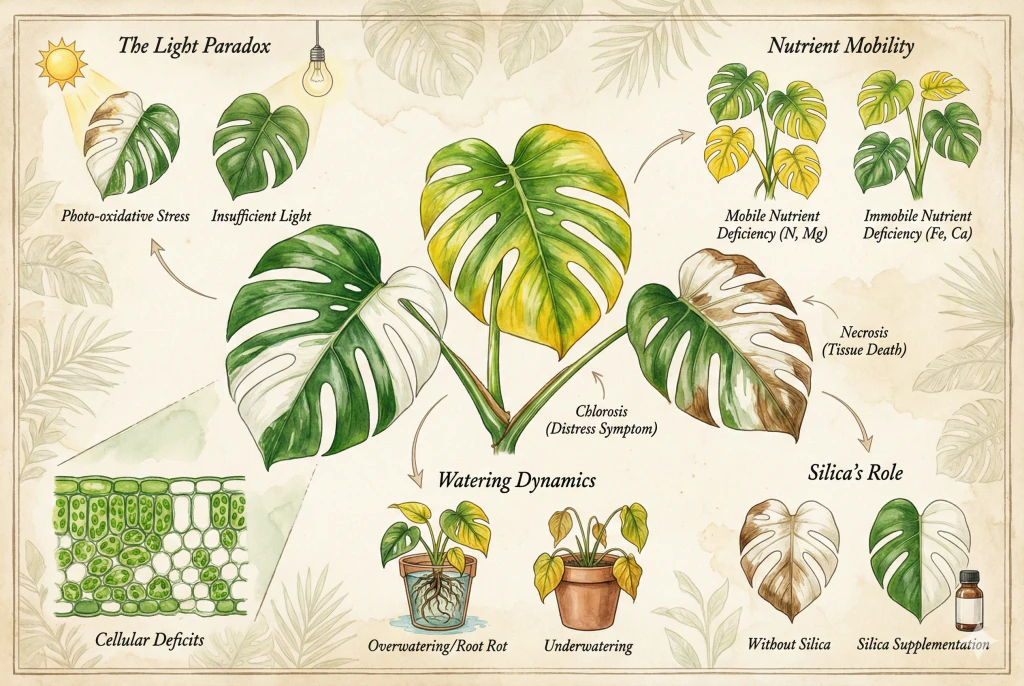
Key Takeaways
- Separate normal variegation from chlorosis. Colour is a starting clue, not a diagnosis, because ageing, watering, roots, salts, temperature, pests, disease, and physical injury can look similar.
- White or pale sectors often photosynthesise less and can scorch in sudden strong light. Reversion is common in chimeras, but low light alone has not been shown to cause it.
- Use leaf age as one screening clue. Mobile nutrient shortages tend to show on older leaves first, while less-mobile nutrients often affect new growth. Patterns overlap, so confirm with roots, watering history, and testing where needed.
- Some variegated plants use water slowly, so watch for overwatering and root hypoxia. Match watering, airy media, and complete feeding to the plant, pot, and season.
- Silica is optional and unproven for variegated aroid white sectors. Follow the product label if you use it, and isolate and lab-confirm a suspect virus before destroying a valuable plant.
A yellowing variegated leaf can mean several different things. Many ornamental variegated plants are selections maintained by growers, and because part of each leaf carries little or no chlorophyll, they often have less green area to work with, so when conditions slip they can yellow, brown, or revert to solid green.
The first step is to separate normal variegation and natural leaf ageing from true chlorosis, then read where the change is happening, but treat that as narrowing the list of causes, not confirming one.
I. Tell Normal Variegation from New Yellowing
Many variegated houseplants have pale and green tissue on the same leaf. The pale areas usually contribute less energy, so the plant has less margin for problems with light, roots, water, or nutrition.
Some plants also produce all-green shoots. Reversion can be part of how a cultivar grows, and low light alone is not a proven cause. Remove reverted growth only if you want to preserve the pattern, not because it confirms a diagnosis.
I photograph where yellowing crosses from white tissue into green tissue and mark the boundary by date. White sectors aging first can be expected, while a moving pattern through green tissue demands a broader check.
Newest and oldest leaves are compared separately. One highly white leaf declining does not establish a whole-plant nutrient deficiency.
Pot weight, root condition, pH, EC, fertilizer, and recent light or temperature changes are recorded before I add supplements. Variegated plants still suffer ordinary root and salt problems, and extra feed can worsen both.
Variegation Versus Chlorosis
Variegation is tissue that developed with little or no pigment, while chlorosis is chlorophyll breaking down in tissue that should be green.
Browning of pale sectors or yellowing of green tissue each has several possible causes, senescence, water stress, temperature, salts, disease, pests, or physical damage among them, so colour and location narrow the list rather than confirm a cause.
II. Use Yellowing as a Clue, Not a Nutrient Diagnosis
Chlorosis means green tissue is losing chlorophyll. Nutrient shortage is one possible cause, but root damage, unsuitable pH, salts, temperature, pests, and ageing can look similar.
One contributor worth checking is medium pH. Watering repeatedly with high-alkalinity tap water can gradually raise potting-mix pH. Note that it is a water’s alkalinity, more than its pH reading, that drives this, and buffering and species sensitivity vary.
When the potting mix becomes too alkaline, some nutrients can become harder for roots to use. Test the water and medium rather than reading one tap-water pH value as the answer.
Wet, airless roots can also cause yellowing. Check roots promptly when a plant stays wet or declines, because root damage and nutrient problems can look alike from the leaves.
III. The Light Paradox
Light involves a real trade-off. With less pigmented area, a variegated plant may need adequate light to gain enough carbon, yet its pale sectors can be more sensitive to sudden strong light or heat.
Pale sectors can brown after sudden strong light, heat, dry air, root stress, salts, pests, or normal ageing. Do not assume that every brown edge is sunburn or that every pale sector has no protective pigments.
Rather than relying on labels like bright indirect, it helps to think in terms of measured intensity at the leaf.
Useful targets depend on the cultivar, photoperiod, and how gradually the plant was acclimated, so introduce brighter light slowly and watch how each plant responds rather than assuming a fixed number is safe.
A full-spectrum white LED gives even, consistent light and makes it easy to judge true leaf colour. Red/blue blurple fixtures can work too, so this is a convenience choice as much as a performance one.
SANSI 36W Grow Light
SANSI 36W Grow Light can suit a plant that needs a compact screw-in supplement and can be acclimated gradually. Measure or observe light at leaf level rather than fixing one hanging height. Do not use it in an enclosed fixture, and leave clearance for its heat sink.
IV. Nutritional Diagnosis. Read the Leaf Age
Nutrient mobility is one useful clue, not a diagnosis on its own. Mobile nutrients can be moved from old leaves to new growth, so their deficiencies tend to show on older leaves first. Poorly mobile ones can’t be relocated as easily, so their deficiencies tend to hit new growth.
Mobility is relative, and the pattern shifts with species, growth stage, and severity.
Mobile Nutrient Clues
Nitrogen shortage often gives uniform yellowing of whole older leaves (a washed-out look that flattens the green–white contrast). Magnesium often gives interveinal chlorosis on older leaves, and potassium often gives yellow margins on older leaves that crisp into brown edges.
These overlap with each other and with water or salt stress, so use them to shorten the list, not to settle it.
Less-Mobile Nutrient Clues
Iron shortage often gives interveinal chlorosis on new leaves, with pale new growth and green veins, frequently linked to high medium pH. Calcium issues can distort new growth and injure tips.
Blackened or melting tips and pale sectors are not specific to calcium. Manganese, root damage, cold, salts, and bacterial or fungal leaf spot can look similar, so confirm before treating.
Aim for balance rather than extremes. Nitrogen starvation can cause systemic chlorosis, and heavy over-fertilizing brings its own problems. There is no direct evidence that high nitrogen causes chimera reversion, so treat both high N causes reversion and it’s a myth as unproven.
A complete fertilizer that includes calcium and magnesium (which some basic feeds omit) covers more bases than an NPK-only product.
Dyna-Gro Foliage-Pro
Dyna-Gro Foliage-Pro can suit a plant that needs a complete foliage fertilizer. Check the current label and use its rate only after you have ruled out root damage, unsuitable pH, and salt buildup. More fertilizer will not solve nutrient lockout.
V. Water Relations and Substrate
A leaf with less green area may photosynthesise and transpire less, so some variegated plants drink slowly.
How fast any given plant uses water depends on its size, leaf area, light, temperature, humidity, and root and medium condition, so judge watering by the pot’s actual dry-down rather than assuming a variegated plant is always prone to overwatering.
Standing in dense, wet substrate can drive the hypoxia and stress that yellow lower leaves. A pattern of yellow halos around mushy brown spots is not specific to root hypoxia (it also appears with bacterial or fungal leaf lesions and oedema) so check the roots rather than reading it off the leaves alone.
The goal is a substrate that drains freely and holds air. A chunky aroid mix, for example a blend of potting soil, orchid bark, coarse perlite, and a little charcoal, helps oxygen reach the roots after watering, but there is no single universal recipe. Adjust the proportions and particle size to your pot size, climate, watering habits, and the plant’s roots.
Rather than relying on the surface feeling dry, it helps to check moisture deeper in the pot at a few points before watering.
XLUX Soil Moisture Meter
XLUX Soil Moisture Meter can help flag a wet root zone hiding under a dry surface. Treat it as a rough trend, not a calibrated value. It may read poorly in loose, bark-heavy, or gritty mixes, so cross-check with pot weight, a wooden skewer, and the look of the medium. Do not water from one reading alone.
VI. Treat Silica as Optional
Some growers use silica when pale sectors brown while green tissue stays healthy. It may support some crops under stress, but it has not been shown to protect white variegation on aroids.
Use silica only as an optional supplement, not as the fix for browning variegation. First correct light, heat, water, roots, salts, and pests.
Growth Technology GT Silica
Growth Technology GT Silica is a potassium-silicate additive for someone who has already chosen to use silica. Follow its current label, add it in the stated order, and check the final pH. Do not assume another silica product mixes the same way. Wear the protection named in its safety information.
VII. Biotic Stress (Pests and Viral Mimics)
Sometimes yellowing is about what’s present, not what’s missing. Sap-suckers can cause chlorosis that mimics deficiency. Spider mites (which favour hot, dry air) leave fine yellow stippling that merges into a bronzed, washed-out look, while thrips leave silvery scraped patches with tiny black frass that yellow and necrose.
Confirm the pest before treating (use a hand lens, check leaf undersides for webbing, and tap foliage over white paper) because symptoms alone don’t confirm a culprit any more than they confirm a nutrient.
For spider mites, isolate the plant, wash the foliage, and apply a labelled insecticidal soap, horticultural oil, or miticide with thorough underside coverage, repeating on the interval the label gives.
Adequate watering and humidity can lower mite pressure but won’t eradicate them, and consistently wet foliage or very high humidity can encourage other diseases.
Predatory mites are an option. Note that spinosad is aimed at thrips (check the label for indoor use), is not a first-line spider-mite treatment, and can harm predatory mites, so don’t combine the two without checking compatibility.
Test any product on a small area first for phytotoxicity.
Be aware of viral mimics too. Mosaic viruses can cause irregular, blotchy, feathered yellow mottling, sometimes with bumpy texture and stunted growth.
This can resemble sectorial genetic variegation, but it can also overlap with pests, nutrients, and chemical injury, so appearance alone can’t rule it in or out.
There’s no cure for plant viruses. If you suspect one, isolate the plant right away and send photos, history, and a sample to a diagnostic lab. Do not destroy a valuable specimen on suspicion alone.
Only after confirmation, dispose of it following local guidance (bag it, sanitise tools, hands, and pots, and control any insect vectors) to protect the rest of the collection.
VIII. Genus-Specific Notes
Monstera
Albo and Thai Constellation are thick-stemmed climbing vines that do well in bright light and a freely draining mix. If a cutting’s stem turns mushy, cut back to firm tissue.
A moss pole supports climbing and tends to correlate with larger, more mature leaves.
Philodendron
‘Pink Princess’ and ‘White Princess’ also climb and benefit from support. Whether pink anthocyanin sectors are more light-tolerant than pure white hasn’t been shown for these cultivars, so don’t count on it.
Alocasia
Variegates grow from corms. Depending on the species and how cool and dry conditions get, they may slow or die back and need much less water in winter. Keep the corm barely moist so it can resprout, and watch for spider mites.
Syngonium
It grows fast, prefers warmth and higher humidity, and can revert. Remove all-green vines if you want to keep the variegation, but the exact humidity threshold and how readily it reverts vary.
IX. Conclusion
Start by separating normal variegation and ageing from new yellowing, then check leaf age, light, root health, watering, salts, pests, and disease before treating.
Acclimate light gradually and keep roots airy, but treat nutrient patterns only as clues until you confirm the cause. Silica remains an optional extra whose benefit for white variegation is unproven.
Affiliate Disclosure
This article contains Amazon affiliate links. As an Amazon Associate I earn from qualifying purchases. If you use these links, the site may earn a commission at no extra cost to you. Product availability, price, and specifications can change. Check the current listing before buying.