
Pale Leaves on Plants: Diagnose & Fix Chlorosis
Why your plant’s leaves are pale and how to fix chlorosis: diagnose by leaf position, rule out root rot, correct iron and pH lockout, and avoid the myths that make it worse.
Samuel Reed · Published 2025-12-14 · 11 min read
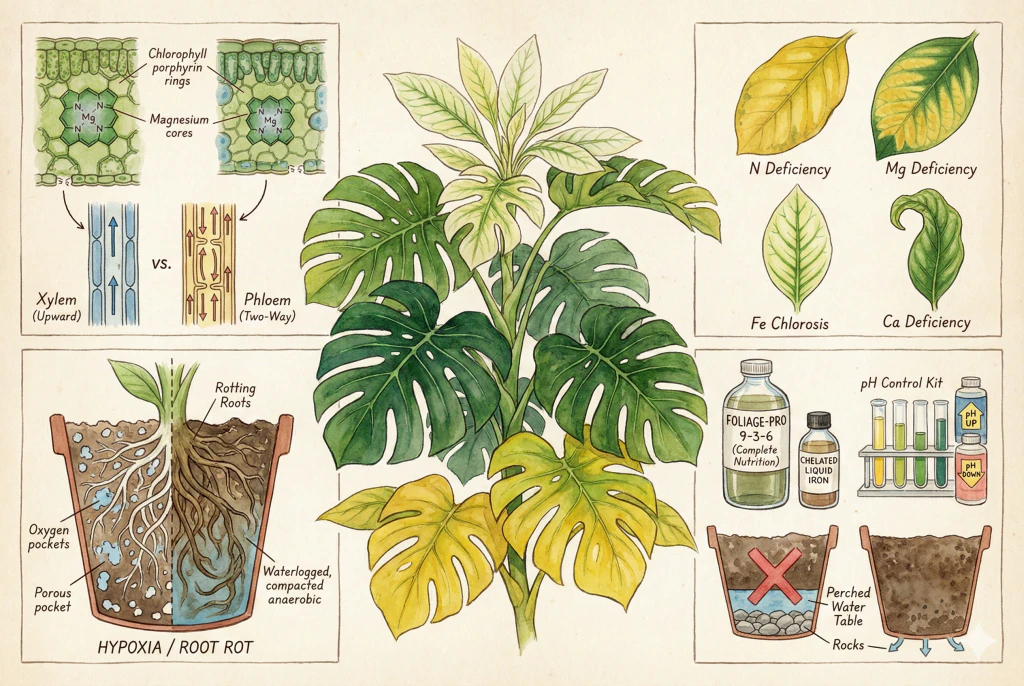
Key Takeaways
- Pale leaves (chlorosis) usually mean reduced chlorophyll, but the cause can be nutrient deficiency, root or water problems, pH, light, disease, or normal aging. Diagnose before reflexively watering or feeding, which can make some of those worse.
- Use leaf position as a clue, not a verdict. Yellowing on old/lower leaves often points to more phloem-mobile nutrients (nitrogen, magnesium, potassium). Yellowing on new growth often points to low-mobility ones (iron, calcium) or a root-zone pH problem. Symptoms overlap, so confirm with a media/water/tissue test.
- Check roots and watering early. Yellowing and wilting in wet soil can mean oxygen-starved roots, but underwatering, salts, and disease look similar, so inspect rather than assume.
- A high root-zone pH can reduce iron and other micronutrient availability. Test both your water and your medium (and its alkalinity) rather than acidifying by water pH alone. Chelated iron can help true iron chlorosis.
- Not every pale or brown leaf is a deficiency. Dracaenas, spider plants, and prayer plants are sensitive to tap-water fluoride (one of several tip-burn causes), and be skeptical of bottom-of-pot gravel and misting as fixes.
When a plant’s foliage turns pale or yellow, it’s often a sign worth reading, though not always a problem, since normal aging, variegation, and seasonal color changes can look similar.
When it does signal trouble, it is usually chlorosis, meaning reduced chlorophyll in the magnesium-centered pigment that drives photosynthesis.
Reflexively adding water or generic plant food can make some causes worse. A waterlogged plant can rot faster with more water, and feeding does little if the real problem is root damage or a root-zone pH that limits nutrient availability.
So it’s worth diagnosing before you treat.
1. The Science (How Chlorophyll Works)
How Chlorophyll Loss Appears
Chlorophyll is the green pigment plants use to capture light. It can decline because of nutrient shortage, root or water stress, high pH, excess light or heat, disease, or normal aging.
Leaf position is a useful first clue. Yellowing on old leaves can point to nutrients the plant can move into new growth, while pale or distorted new leaves can point to iron, calcium, or a root-zone pH problem.
Use that pattern to decide what to test next, not to diagnose a nutrient from color alone.
I label the oldest, middle, and newest leaves and photograph each against the same background, including the veins. Mobile and less-mobile nutrient problems often begin in different generations, while camera exposure can flatten the pattern.
The log captures whether each leaf emerged pale or lost color later. Those are different timelines even when the final shade looks identical.
Roots, pH, EC, moisture, and recent fertilizer are checked before I add iron or another micronutrient. A nutrient can be present but unavailable, and adding more may increase salts without correcting uptake.
2. A Protocol for Diagnosis and Remediation
Start With Environment and Roots
Work from physical and environmental factors toward specific chemistry, and remember this list is not exhaustive.
Light, temperature, watering interval, fertilizer salts (EC), pests, and disease all contribute and should be considered alongside the steps below.
Step 1. Check Watering and Roots Early
Overwatering is a common problem. Saturated soil displaces the oxygen roots need to respire, which can injure roots and favors water-mold pathogens such as Pythium and Phytophthora.
It’s worth distinguishing plain oxygen stress (hypoxia) from an actual root-rot disease caused by pathogens. Wet media favors the disease but is not the same as it, and yellowing with wilting can also come from underwatering, salt buildup, temperature stress, or root binding, so inspect rather than assume.
Smell and touch give supporting clues (a foul, swampy odor and soft, mushy roots suggest decay, while firm roots are a good sign) but healthy root color and smell vary by species and substrate, so these signs alone don’t confirm a pathogen.
If roots are clearly rotting, trim away the dead tissue with clean tools and repot into a fresher, more porous, well-draining substrate.
The standard extension advice for houseplant root rot emphasizes reducing moisture, improving drainage, using clean media, sanitizing tools, and discarding severely affected plants, not a household hydrogen-peroxide drench, which is an oxidizer that can also damage healthy root tissue and beneficial microbes and has no established safe dose here.
If you suspect a specific disease, a local extension diagnostic service is the safer next step.
Step 2. Note the Pattern, Then Narrow It Down
Once roots look healthy, use leaf position as a starting point. Yellowing on old/lower leaves leans toward more phloem-mobile nutrients (N, Mg, K), while pale, white, or distorted new growth leans toward low-mobility ones (Fe, Ca) and can also involve S, Mn, Zn, or B. Because these patterns overlap and can mimic environmental problems, confirm with a soil/media, water, or tissue test before committing to a treatment.
Step 3. Feed Confirmed Deficiencies
Nitrate nitrogen is directly available for uptake, which is one reason a complete, nitrate-containing fertilizer is a convenient choice.
Urea is also usable by plants. Roots and leaves can take up intact urea, and plant tissues carry their own urease to convert it, so urea-containing fertilizers are not unusable in containers. The practical balance of ammonium, nitrate, and urea depends on substrate, temperature, pH, and dose.
A urea-free, complete formula does have the advantage of including calcium and magnesium that some cheaper blends leave out.
Note that the three numbers on a fertilizer label are the percentages of N, P₂O₅, and K₂O by weight, not a direct readout of leaf-tissue N, P, and K. A ratio like 3-1-2 is a practical feeding guideline for many foliage plants, not a measurement of tissue composition. Actual requirements vary by species, water, substrate, and growth stage.
SUPERthrive Foliage-Pro is a complete fertilizer for a confirmed or strongly supported nutrient shortfall.
Do not use it as a cure-all for pale foliage. Correct root rot or a root-zone pH problem first, then follow the current label and adjust feeding to the plant, media, and season.
Step 4. Correct Confirmed Iron Chlorosis
For true iron chlorosis (stark interveinal yellowing on new leaves), iron in a chelated form stays soluble instead of binding with soil phosphates or precipitating at high pH.
Different chelators (for example EDTA, DTPA, EDDHA) hold iron across different pH ranges, so the right choice depends partly on your medium’s pH.
A chelated liquid iron can be applied as a soil drench or as a foliar spray. A foliar spray can green up some chlorotic leaves, but the response varies with coverage, species, chelate chemistry, and light, and too high a concentration can burn foliage, so it is not a guaranteed or instant fix.
Southern Ag Chelated Liquid Iron fits a likely iron problem after the root-zone pH and root health have been checked.
Its label is written for ornamentals and turf, not as a ready-made indoor-pot or vivarium recipe, so test a small area and follow the current label rather than guessing a dilution. Wear gloves and eye protection, keep it off surfaces it can stain, and correct the underlying pH problem as well or the chlorosis can return.
Step 5. Check Root-Zone pH
As medium pH climbs above about 7.0, iron, manganese, and zinc become less available to roots, which can drive interveinal chlorosis.
Availability changes gradually with pH, species, medium, and chelate chemistry rather than switching off at a single value, and appropriate chelated iron or foliar feeding can still help even in higher-pH conditions.
What matters is the pH your roots actually sit in, so test the medium as well as the water.
Water pH and alkalinity are not the same thing. PH is the momentary acidity, while alkalinity is the water’s capacity to neutralize acid, mostly from bicarbonates and carbonates. Alkalinity, together with container volume, leaching, and fertilizer acidity, mostly drives long-term medium pH.
High-pH but low-alkalinity water may have little effect on medium pH, so measuring water pH alone can mislead.
Where possible, look at both source-water pH and medium pH, and consider a lab alkalinity/EC test.
RO or rainwater is not automatically ready to use either. Its low mineral content can let fertilizer and pH swing more easily, and collected rainwater needs clean handling.
GH pH Control Kit is useful when you need to measure and make a small, deliberate adjustment to a hydroponic reservoir.
It does not measure alkalinity or diagnose a potting medium, so do not use it to chase the pH of every watering. The adjustment products are corrosive. Wear eye and skin protection, work with ventilation, add only small increments, re-test after mixing, and never combine the concentrates.
Water Quality. pH and Alkalinity (UMass Extension Greenhouse & Floriculture)
3. Advanced Diagnostics
Compare Similar Deficiencies
A few distinctions help separate look-alike problems, though the patterns overlap by species and severity, so treat them as clues to confirm with testing rather than a diagnostic key. Nitrogen vs. Magnesium. Both tend to hit old leaves, but nitrogen deficiency is often a uniform fade (plus stunting), while magnesium is more interveinal (green veins, yellow tissue, often a green triangle at the leaf base). Iron vs. Manganese. Both can cause interveinal chlorosis on new leaves, but iron often goes stark near-white with fine green veins, while manganese is more mottled and sometimes speckled with necrotic spots. Calcium deficiency often isn’t just yellowing (it shows as structural failure (distorted, hooked, or glued new leaves)).
Because calcium moves with the transpiration stream, very high humidity can slow its delivery to fast-growing tissue, so improving air circulation can help in some terrarium cases.
But it isn’t a universal cure. Root-zone calcium, water supply, salinity, competing ions, growth rate, and species all matter, excessive airflow can dry out foliage and substrate, and tissue that is already necrotic or distorted won’t recover.
Separate Fluoride Injury From Other Tip Burn
Not every pale or brown leaf is a deficiency. Dracaenas, spider plants, prayer plants, and Calatheas are among the plants sensitive to fluoride in tap water, which can accumulate in leaf tips and cause bright yellow or brown tips.
Fluoride is only one cause of tip burn. Low humidity, inconsistent watering, and fertilizer-salt buildup produce similar symptoms, so brown tips on their own aren’t proof the plant is poisoned by fluoride.
Letting water sit out won’t remove fluoride, which is a non-volatile salt. It can let some free chlorine dissipate, but many municipal systems use chloramine instead, and chloramine does not off-gas quickly by standing or boiling.
If fluoride sensitivity is the issue, distilled, RO, or clean rainwater avoids it.
4. The Rhizosphere (Why Feeding Isn’t Always Enough)
Two Root-Zone Controls
Why Fertilizer Can Miss the Root Zone
Fertilizer can miss the mark when the roots are damaged, the medium is too wet, or the root-zone pH makes a nutrient difficult to take up. Different media and water sources buffer and retain nutrients differently, so a label ratio cannot tell you what the roots can use.
Check roots, medium pH, EC, and watering before changing fertilizer chemistry. Do not use high-ammonium fertilizer as a shortcut to force iron uptake, because it can create new root-zone problems.
5. Myth-Busting
Myth. Rocks at the Bottom Improve Drainage
This generally doesn’t help and can hurt. A coarse layer under a finer medium creates a pore-size discontinuity that holds a perched, saturated zone higher in the pot, so water tends to sit where the roots are rather than draining freely.
(The exact behavior depends on particle sizes and container shape, and a bottom layer is no substitute for a drainage hole.)
Amending the medium throughout with perlite, pumice, or bark is usually a better way to add air space (matched to the particle size, amendment rate, and the plant’s moisture needs).
Myth. Misting Sustains Humidity
Misting raises humidity only briefly, and prolonged leaf wetness in stagnant air can favor fungal and bacterial disease.
A humidifier is the most reliable way to hold a target humidity. A pebble tray gives only a small, local effect, so check with a hygrometer rather than assuming either method sustains room humidity.
Myth. Yellow Leaves Always Re-Green
A fully senesced leaf that has disassembled its chloroplasts and reclaimed its nitrogen generally won’t rebuild.
But chlorosis caught early can be reversible for more causes than iron alone if the underlying problem is corrected quickly.
Whether to remove a yellowing leaf is a judgment call based on disease sanitation, how much of the leaf is still functional, the plant’s overall leaf area, and appearance. There isn’t a firm rule that a leaf should be removed once more than half is yellow, and a partly yellow leaf can still contribute some photosynthesis and nutrient reclamation, so removing it doesn’t automatically redirect energy to new growth.
6. Conclusion
Read the Pattern Before Treating
Recovering pale foliage is mostly about reading the plant’s clues and then confirming them.
Yellowing on old leaves can mean the plant is remobilizing mobile nutrients, which may point to feeding, but first rule out normal aging, low light, root or water problems, and salt stress before you reach for fertilizer.
Yellowing on new growth can point to low-mobility nutrients (iron, calcium) or a root-zone pH problem, so check the chemistry, and consider manganese, sulfur, zinc, boron, temperature, and disease too.
A whole plant wilting and yellowing warrants inspecting the roots and reviewing your watering. If the soil is saturated, easing off water makes sense, but if it’s actually underwatered, the opposite is true, so check before you act.
Rather than guessing, inspect the roots, test the water and medium (including alkalinity and EC where you can), review light and watering history, and treat the underlying cause rather than the symptom.
Affiliate Disclosure
This article contains Amazon affiliate links. As an Amazon Associate I earn from qualifying purchases. If you use these links, the site may earn a commission at no extra cost to you. Product availability, price, and specifications can change. Check the current listing before buying.