
Indoor Plant Trends 2025: Health, Tech & Rare Plants
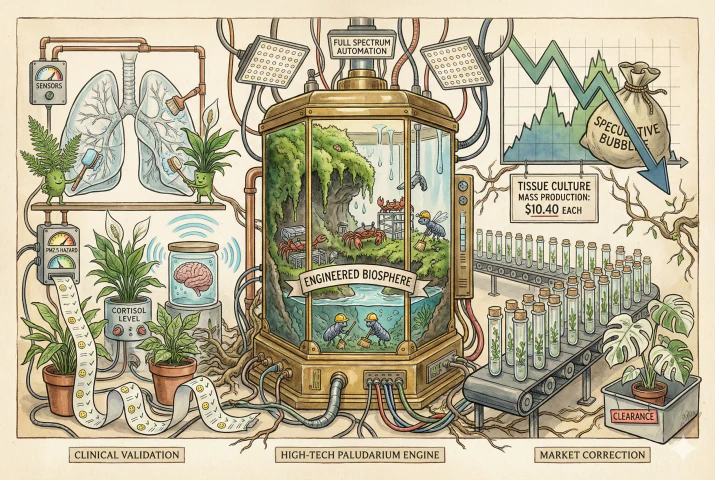
The 2025 indoor plant landscape: what UK indoor-air research (INGENIOUS) and new plant-health networks actually measured, high-tech paludariums and ecospheres, and the tissue-culture correction in rare aroid prices.
Jordan Cole · Published 2025-12-04 · 15 min read
Key Takeaways
- The UK INGENIOUS project measured real-home PM2.5 in about 310 Bradford homes and found daily levels exceeded the WHO 24-hour guideline on about 41% of monitored days. Cooking was a major peak source. It measured the hazard and its sources, not houseplants as a treatment, while the separately funded GREENIN network is only beginning to study whether and how plants affect indoor air, humidity, and comfort.
- One small randomized study of 24 healthy young men found a modest short-term stress signal from transplanting a plant versus a computer task. The trial did not measure cortisol and does not generalize to the wider population.
- Sealed ecospheres and paludariums are aesthetic builds, not automatically self-sustaining systems. Long-term stability and animal welfare depend heavily on husbandry.
- Rare-aroid prices have fallen as tissue culture increased the supply of small plants. Anecdotal reports put Monstera White Monster well below its 2023–2024 peak, though comparable, dated transaction data is scarce.
- High-end interest has shifted toward dark, velvety, often seed-grown Anthurium hybrids. Seed-grown plants are typically genetically distinct, though standouts can later be cloned.
Indoor-plant conversations now mix health claims, elaborate enclosed builds, and the changing rare-plant market. The useful distinction is simple. Keep plants for enjoyment and design, build enclosures as systems that need care, and treat fast-moving price claims with caution.
Indoor Air and Well-Being
What the Health Projects Measured
Two large UK research initiatives are shaping the conversation about indoor plants and health. The INGENIOUS project measured the sources and levels of indoor air pollution, while the newly funded GREENIN network is beginning to study whether plants can help.
It is worth keeping the two straight. INGENIOUS characterized the hazard, while GREENIN is set up to investigate a question that does not yet have an answer.
Before buying a trend plant, I leave it on a dated wish list for thirty days and price the mature space, lighting, substrate, pest isolation, and replacement risk. Novelty often fades before the care burden does.
If I still want it, I buy for the verified species or cultivar and condition rather than the social-media label. I save the listing because market names and provenance claims can change after purchase.
For sensors and automated care, I write down what the system does after power, Wi-Fi, or a probe fails. I prefer a safe off state and a manual recovery route over a feature list that assumes perfect connectivity.
1.1 The INGENIOUS Project (Quantifying the Indoor Hazard)
INGENIOUS, led by researchers at the University of York, set out to measure indoor air pollution in real homes rather than in isolated chamber tests (a useful complement to the common estimate that people spend the majority of their time indoors).
It monitored air quality in roughly 310 homes of families in the Born in Bradford longitudinal study, a multiethnic and relatively deprived cohort in one city, so the sample reflects that context rather than all UK homes.
Measured Indoor PM Findings
Across about 309 homes, daily mean PM2.5 was around 20.2 µg/m³, and levels exceeded the World Health Organization 24-hour guideline on roughly 41% of monitored days. Seasonal median daily PM2.5 was about 7.8 µg/m³ in summer and 16.4 µg/m³ in winter, with daily peaks frequently above 150 µg/m³ often driven by cooking.
PM2.5 consists of microscopic particles small enough to reach deep into the lungs and enter the bloodstream, and population studies link long-term exposure to cardiovascular disease, stroke, and respiratory illness.
Notably, the related inequality analysis did not find a clear association between PM metrics and two-week asthma-related symptoms.
The project identified the main household sources associated with higher levels.
- Cooking emissions. High-temperature cooking, especially frying, generates PM2.5 and volatile organic compounds and was a major source of the observed peaks. Exact contribution varies with the appliance, food, oil, hood, and ventilation, so peak sources and daily-average composition are not the same thing.
- Ventilation and airtightness. Lower ventilation can retain indoor emissions. The authors were cautious here. The link between building age or airtightness and indoor PM was not clear, and a tight, energy-efficient home does not necessarily trap pollutants if it has correctly designed and operated mechanical ventilation.
- Socioeconomic associations. Homes that were more deprived, rented, South Asian, or had gas stoves or smoking were associated with higher exposure. These are associations the study observed, not causes it directly established, for example, the idea that renters have less control over ventilation is a plausible hypothesis the sensor data did not itself measure.
GREENIN began studying whether plants affect indoor air, humidity, and comfort, but it had not yet produced results. Existing evidence does not support treating a few potted plants as an air-cleaning system.
For lower indoor PM2.5, use source control, ventilation, and appropriate filtration rather than relying on houseplants.
New research explores how indoor plants can improve human health
Plants May Support Comfort, Not Medical Treatment
A small study found a modest short-term stress signal when healthy young adults repotted a plant rather than completed a computer task. It did not establish a lasting health benefit or show that looking at foliage has the same effect.
Gardening can be a pleasant, calming activity for many people. Enjoy that benefit, but do not treat plants as medical or occupational equipment.
Greenery is used in some hospital and classroom settings, and many people enjoy it. On the current evidence it is best understood as something that can aid comfort and possibly short-term well-being (closer to a welcome amenity than to essential medical or occupational equipment).
Interaction with indoor plants may reduce psychological and physiological stress by suppressing autonomic nervous system activity in young adults
2. Enclosed Ecosystems (The Tech-Driven Trend)
Why Closed Systems Need Husbandry
The second theme is closed-ecosystem design. Beyond simple potted plants, some hobbyists build small enclosed worlds behind glass, in two broad styles. The long-sealed ecosphere and the more elaborate paludarium.
2.1 The Sealed Ecosphere (Biology in a Jar)
Some online channels document jars reportedly sealed for years, with figures of 5.5 to 7 years circulating. Without the specific builds, seal history, volume, organisms, or measurements, these are anecdotes rather than evidence.
A sealed jar is closed to matter but not to energy. Light still enters and heat still leaves, so self-sustaining means internal nutrient recycling, not independence from outside energy or observation.
The underlying biology is real. Plants and algae photosynthesize (consuming CO₂, producing O₂) while fauna and bacteria respire (the reverse). Ammonia from waste is processed by nitrifying bacteria, first to nitrite, then to nitrate, and water evaporates, condenses on the glass, and returns.
But these processes are not automatically in balance. Photosynthesis and respiration produce daily O₂ and CO₂ swings. Nitrification depends on oxygen, and nitrate, dissolved organics, and salts can accumulate over time.
In closed or low-exchange systems, nitrate can build to high levels, and pH and nutrients can drift.
Watching a jar shift from an early chaotic state, with algal blooms and bursts of fast-breeding ostracods, toward something quieter is genuinely interesting.
Long persistence does not prove a stable climax community or lasting homeostasis. A tiny system has little redundancy and is vulnerable to population crashes and imbalances that may be impossible to reverse.
If a jar contains animals, it needs an honest welfare plan with success and failure criteria and a humane response if things go wrong. A plant-only jar avoids that animal-welfare risk.
If you collect mud, water, or organisms from the wild, check local rules, avoid moving pathogens or invasive species, and never release the contents.
2.2 High-Concept Paludariums (The Dripping Jungle Aesthetic)
Paludariums, enclosures with both land and water, are the more elaborate style. One popular look is a dripping moss jungle cliff, with steep, constantly irrigated cliffs and overhangs planted with semi-aquatic species.
It is a striking aesthetic, but the constant irrigation is a design tradeoff, not a free feature, and both the hardware and any animals need real husbandry.
2.2.1 Engineering the Vertical Wetland
The design centers on verticality, and one widely shared technique deserves a serious caution.
Cyanoacrylate, or super glue, is used in aquascaping to tack small pieces of stone or wood together.
Combining cyanoacrylate with cotton or similar fiber is a known hazard because the reaction with cellulose can be rapid and strongly exothermic, generating enough heat to cause burns or ignition.
Glue and fiber do not make a heavy Seiryu or Dragon-stone arch structurally stable. A stone arch over a glass tank and potentially over animals is a load-bearing joint carrying weight, shear, and impact risk, so it needs mechanical support. Use a frame, pins, or an epoxy system rated for the load, account for the center of gravity, include a safety factor, and add a secondary catch so a failed rock cannot fall on livestock or crack the glass.
Treat adhesive as a spot tack rather than the structural support.
A dripping wall then defines the build. A hidden pump lifts water to the top of the hardscape so it trickles down through mosses.
A hidden pump is still mains equipment near water, so it needs a GFCI or RCD outlet, a drip loop, protected connectors, and an overflow and drainage plan, plus protection against running dry and easy access for cleaning.
Fully saturated is not a universal plant target. Bucephalandra and Anubias tolerate splash zones but their roots still need oxygen and flow, and species vary in how much submersion they take, so match the water to the plant rather than soaking everything.
Seiryu stone can release carbonates that raise GH, KH, and pH, which matters for whatever animals share the water.
For small tacking jobs, a thick cyanoacrylate gel stays put on vertical surfaces better than a liquid formula, but check what the label actually rates it for before relying on it here.
A general-purpose cyanoacrylate gel is not automatically rated for outdoor use, gap filling, continuous immersion, or livestock contact. Check the exact label rather than inferring compatibility from the adhesive chemistry.
Cyanoacrylate bonds are also brittle under shear, so they are a poor fit for bridging gaps or holding a load-bearing stone arch.
Keep an unverified product to tiny dry-surface tacks, never combine cyanoacrylate with cotton, work with eye protection and ventilation, and rely on mechanical support for anything structural. For a continuously wet build, choose an aquarium-safe adhesive matched to the joint and water contact.
Letting an unsuitable product cure and rinsing it is not a substitute for documented immersion and livestock suitability.
2.2.2 Biota Trends (The Micro-Jungle)
Plant and animal choices can make a small footprint read as a larger landscape. Hobbyists favor micro-epiphytes such as Bucephalandra and shingling vines such as Marcgravia that climb flat against rock and glass to form green walls. The animals are living things first and décor second.
Vampire crabs are not one animal but the genus Geosesarma, which contains many species that differ in size and needs, so identify the actual species and buy captive-bred stock where possible.
They are semi-terrestrial, not aquatic. The Los Angeles Zoo notes adult G. dennerle spend roughly 80–95% of their time on land and burrow, so a 70/30 land-to-water ratio is a rough starting point, not a rule. The enclosure also needs deep substrate, easy water exits, hides, cycled and tested fresh water, suitable diet and calcium, molting space, compatible grouping, and an escape-proof lid.
Captive breeding is possible but not necessarily easy or reliable, and the LA Zoo flags wild overcollection for the pet trade as a conservation concern. Prioritize welfare and captive-bred sourcing over an illusion of a vast landscape.
A bioactive land section with springtails and isopods can reduce maintenance, but it is a support rather than a substitute for care and is not required for every enclosure. A quarantine or medical-observation setup may be better on plain substrate.
Springtails do graze some fungi and consume fine detritus, but they do not guarantee a mold-free or self-cleaning enclosure. Whether they control a given mold depends on the fungal species and substrate, and they will not replace inspecting for and removing animal waste and uneaten food.
Springtail Culture Care and Legal Limits
Starter springtail cultures are sold in different media and container sizes, which do not disclose a reliable live count. Confirm the species rather than assuming every temperate culture is Folsomia candida, and follow its care instructions.
Establishment depends on temperature, food, starting density, enclosure conditions, and predation, so look for visible activity and reproduction instead of waiting a fixed number of weeks.
Pair springtails with isopods for larger leaf litter if you like, but choose the isopod species deliberately and match its humidity, temperature, calcium, and food.
In the US, some land invertebrates can fall under USDA APHIS PPQ 526 or state restrictions. Check whether the species is legal to keep where you live, buy from a documented supplier, prevent escapes, and never release them outdoors.
2.3 Technological Integration
Consumer hardware makes elaborate builds easier to run. App-controlled LED units can program sunrise and sunset ramps and tune the spectrum to highlight plant color.
Tuning the spectrum does not selectively suppress algae. Plants and algae both use the same light, so algae control depends on total light, intensity and daily light integral, nutrients, CO₂, water flow, and grazing managed together.
Automated dosing pumps and misters can help only if you know exactly what and how much is being dosed and keep it within safe limits for animals, with calibration and a maximum-dose failsafe. A miscalibrated or leaking pump can harm livestock.
Automation does not remove the essentials. With animals present, daily health checks, feeding, water-quality monitoring, and equipment and leak inspection still matter.
3. Economics (Rare Aroids & Market Correction)
What the Price Correction Can Show
The third theme is a price correction in the rare-plant market. After the pandemic-era boom sent some houseplant prices soaring, prices for several once-scarce aroids have fallen through 2025, especially for certain Monstera and Anthurium.
How dramatic and how broad the correction is depends on the plant, and reliable transaction data is thinner than the confident headlines suggest.
3.1 White Monster and Tissue-Culture Economics
Price Comparison Limits
The most-cited example is Monstera deliciosa White Monster, known for minty variegation and slow growth.
Anecdotally, prices have dropped sharply from a 2023–2024 peak to a fraction of that by late 2025. Be cautious with the exact figures. A clean before-and-after comparison would need the same plant size, root status, and grade, in the same market and currency, with dated transactions. A rooted cutting is not directly comparable to a tiny tissue-culture plantlet.
The direction toward lower prices is well supported. The precise span from thousands to tens is not something dated sales data clearly establishes.
How Tissue Culture Changes Supply
Tissue culture, also called micropropagation, can rapidly increase the supply of small plants and pull their prices down.
Stable variegation can propagate more predictably than the chimeral Albo, whose variegation can shift during propagation. Saying that Albo reverts when cloned oversimplifies a meristem and chimera issue. Tissue culture can also produce somaclonal variation and off-types, so claims about millions of identical plants need careful evidence.
Reports of labs in Thailand and China flooding the market with millions of plantlets are plausible in direction but lack production or import figures to back the specific number.
Buyer Confidence and Market Data
Some buyers, having watched rapid devaluations before, including the earlier Thai Constellation slide, are now wary of paying large premiums for plants they expect to be mass-cloned soon.
That is a reasonable psychology to observe, but there is no buyer survey or auction dataset here to quantify market-wide investor fatigue.
3.2 The Rise of Designer Anthuriums (Hybrids and Texture)
Cultivar Clones and Seed-Grown Plants
As variegated plants become more common, interest among high-end collectors appears to have shifted toward dark, velvety Anthurium morphology and texture. Delta Force is a selected cultivar clone from an A. clarinervium × A. pedatoradiatum cross, maintained as a named cultivar and prized for its stiff, triangular leaves. It differs from diverse seed-grown crosses involving A. dressleri and A. papillilaminum that are grown for near-black velvet leaves and red or purple new growth.
The scale of this shift is a read on the community, not something backed here by sales or auction data.
Seed-grown plants are typically genetically distinct, so no two are identical, and part of the appeal is hunting for the darkest or most veined individual.
A standout seedling can later be divided or tissue-cultured, so its distinct origin is not a permanent guarantee against cloning.
Care and Sourcing Questions
Strappy anthuriums such as A. vittarifolium and A. pallidiflorum and velvet giants such as A. warocqueanum also appear in dark, maximalist interiors.
If you are considering any of these, the practical questions are their mature size, how demanding they are to grow, and whether stock is legally and sustainably sourced. Those details matter more for a real buying decision than the interior-style framing.
3.3 New Botanical Discoveries (Fueling the Jungle Narrative)
Conservation Context for New Species
New species are still being described, which keeps interest in botanical rarity alive. A well-documented recent example is Ovicula biradiata, nicknamed the woolly devil, described in 2025 as a new genus and species from Big Bend National Park, Texas. It was reported as the first new plant genus found in a US national park in roughly 50 years.
Malaysia has also yielded newly described Thismia, often called fairy lanterns. These myco-heterotrophs depend on specific fungi and are extremely difficult to grow outside their habitat, so they belong to conservation rather than the plant trade.
These are wild discoveries, and connecting them to a collector rare-plant fantasy risks encouraging collection pressure that small populations cannot bear. The responsible framing is no wild collection, habitat protection, and legal sourcing.
Any specific Thismia species or rare Hawaiian lobeliads would need exact names, papers, and conservation status before they could support a trend claim.
Some collectors do emphasize conservation and responsible sourcing, which is worth encouraging, though there isn’t survey data here to show that this ethic is growing, so treat it as an aspiration to recommend rather than a measured trend.
What We Know, and Don’t
The three themes lead to different practical conclusions across health, ecosystems, and the plant market.
Health
INGENIOUS clearly measured that indoor PM2.5 in these Bradford homes often exceeded WHO guidelines, with cooking a major source.
It did not show that houseplants fix this, and GREENIN is only now starting to study whether they help.
The stress evidence rests on small studies. Enjoy plants for how they make a space feel, but don’t treat a peace lily as air-cleaning or medical equipment.
For indoor air, source control, ventilation, and filtration do the real work.
Ecosystems
Sealed jars and paludariums are engaging to build, and tissue culture has made more plants available.
Calling small closed systems self-sustaining or permanent oversells what they actually do, and any build with animals is a husbandry commitment rather than just a display.
Market
Prices for several once-scarce aroids have come down as supply rose. Whether that adds up to a mature and stable market is more than the available data can say, so it is best read as a plausible direction rather than a settled conclusion.