
Indoor Botany 2025: Trends, Health & Ecosystems
Use indoor plants and bioactive enclosures for the right reasons. Learn the limits of air-quality and wellbeing claims, choose rare plants by provenance and care needs, and build safe, maintainable vivariums.
Samuel Reed · Published 2025-12-16 · 8 min read
Key Takeaways
- Use ventilation and filtration for air quality. Potted plants do not meaningfully remove fine particles or replace fresh-air exchange.
- Plants can make a room more enjoyable and caring for them may help some people relax. They are not a treatment for stress or a guaranteed cognitive benefit.
- Tissue culture can expand supply, but choose rare plants by the named plant’s provenance, condition, and care needs rather than an old scarcity story.
- Peat-free does not automatically mean lower impact. Verify the source of tree-fern fiber and choose a substrate that fits the plant and your watering conditions.
- Bioactive terrariums still need food, water changes, monitoring, and legal checks for live invertebrates. Automation and cleanup crews do not make an enclosure self-sustaining.
Indoor plants, rare-plant collecting, and bioactive enclosures can all be worthwhile hobbies. Keep the practical limits in view so a display remains safe, affordable, and manageable.
1. Use Plants for Enjoyment, Not Air Cleaning
Indoor plants are not a substitute for ventilation or filtration.
Before building a large green wall or indoor ecosystem, I rehearse one week of its maintenance on paper and block the real time on my calendar. I include filling, drainage, pruning, glass cleaning, pest inspection, and access setup rather than counting watering alone.
I price the consumables and replacement plants for a year before pricing decorative upgrades. If the routine does not fit the time and access I actually have, I reduce the living area while the design is still easy to change.
Air Quality Needs Ventilation and Filtration
Particulate Matter Needs Filtration
Cooking, outdoor infiltration, furniture, and cleaning products can all add pollutants indoors. A well-designed ventilation system helps manage them, while a HEPA purifier addresses fine particles.
Potted plants do very little for fine particulate matter. Use ventilation and HEPA filtration instead of foliage to manage it.
VOCs Have a Narrower Evidence Base
Plants can reduce some gaseous compounds in sealed test chambers, but a few pots cannot clean the air in a normal occupied room at the rate ventilation does.
Active Green Walls Need Engineering
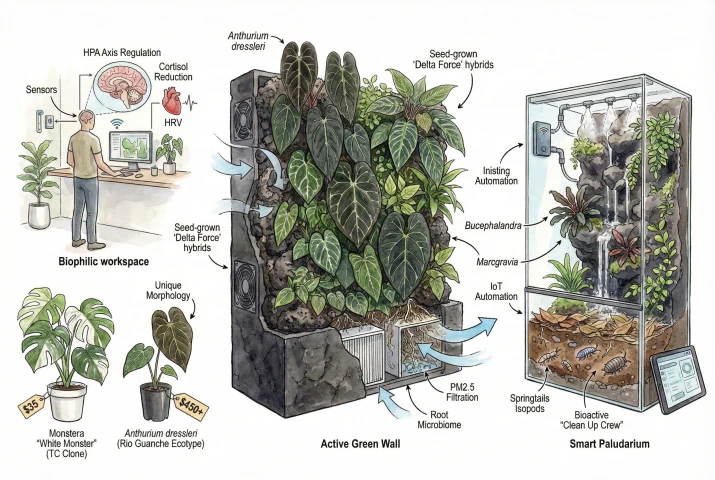
Active green walls force air through a planted filter, but they are engineered equipment with fans, flow requirements, and maintenance. They are not a stronger version of a shelf of houseplants.
Plants Can Be Enjoyable, Not Medical Treatment
Caring for plants or looking at a healthy display may feel calming or restorative. Small studies suggest a possible short-term benefit, but they do not show that plants lower stress for everyone or replace medical care.
Choose plants because you enjoy them. Do not buy them as a treatment for stress, concentration, or indoor-air problems.
2. Buy Rare Plants for the Plant, Not the Hype
Supply and Demand Can Change Quickly
More nurseries, ordinary propagation, and tissue culture can all increase the supply of a formerly scarce plant. A high price or collector story does not prove lasting rarity or investment value.
Tissue Culture Expands Supply
Tissue culture can produce many clones from a small plant sample. Retail plants still need acclimation, and their size, condition, and care needs can vary.
Buying a sterile flask does not bypass import law. Plant material may still require permits, phytosanitary documents, and other approvals based on the taxon and origin. Check the current rules before importing.
Seed-Grown Plants Vary Naturally
Each seed-grown Anthurium from a sexual cross is genetically distinct, so collectors may choose one for its color, texture, or leaf shape. A selected seedling can still be cloned later by division, cutting, or tissue culture.
Choose Substrate by Function and Source
Peat-free mixes can combine mineral drainage materials, coir, biochar, bark, or tree-fern fiber. They are not automatically lower-impact. Choose a mix that suits the plant and watering routine, then check the source of the materials rather than relying on a peat-free label.
Check Tree-Fern Provenance
Tree-fern fiber deserves particular caution. It comes from Cyatheaceae and Dicksoniaceae stems, several of which fall under CITES trade controls, so a sustainably harvested label means little without species, country of origin, permit, and certification.
If those aren’t verifiable, a synthetic or coir or bark alternative is the safer choice.
3. Build Bioactive Enclosures for Maintenance
Maintenance Still Has Inputs and Outputs
The third trend is the move from a pot of plants toward a more engineered enclosure. A paludarium or vivarium that blends horticulture and hardware.
These reduce some routine maintenance, but none of them are truly self-sustaining. Water, food, and minerals go in, and pruning, waste, and water changes come out.
Build the Paludarium Around Safe Access
Vertical Water Movement
A popular aesthetic is extreme verticality. Dripping wall builds that mimic the seepage faces of tropical cliffs, neither fully aquatic nor terrestrial.
A pump hidden in the base lifts water to the top of the hardscape and lets it trickle down through moss and rock.
Support Heavy Hardscape
Heavy stone arches should be supported mechanically with ledges, egg-crate, silicone to the base, or a load-bearing background, not held up by adhesive alone.
Cyanoacrylate glue is fine for small attachments, but it is not a structural bond for a heavy span, and a 2025 university safety alert warns that cyanoacrylate reacting with cotton or cellulose fiber can cure fast enough to become hot, smoke, or even ignite. Avoid glue-and-cotton-fiber composites as a way to hold up mass, and verify any adhesive is aquarium-safe and fully cured before immersion.
Test Water Chemistry Before Stocking
Seiryu stone is calcareous and can raise GH, KH, and pH depending on the stone and the water, which not all plants or animals tolerate. Test rather than assume, and choose stone to suit the intended inhabitants.
Protect Pumps and Electrics
Put the pump on a GFCI/RCD outlet, use a drip loop, and plan for overflow and dry-run protection.
Match Plants to the Waterline
A splash-and-seep zone can approximate rheophyte habitat, but conditions vary by species, flow, and temperature rather than following one constantly saturated prescription.
- Bucephalandra (a Bornean stream-rock rheophyte that anchors to rock). Individual species and cultivars differ in how much flow they want, so this isn’t a blanket high-flow rule.
- Marcgravia (a shingling climber that creeps flat against glass or rock by adventitious roots). It suits the wall aesthetically but is a climber, not a strict rheophyte, so don’t site it purely for a saturated splash zone.
- Anubias and Cryptocoryne near the waterline. Both can grow emersed or submersed, but tolerance, substrate, and the risk of melt during a transition are species-specific, so change their conditions gradually.
Use Cleanup Crews as Support
Nutrient Cycling Is Not Nutrient Removal
A common approach now is bioactivity, meaning a living clean-up crew that reduces routine cleanup. It does not close the nutrient loop.
In water, nitrifying bacteria convert ammonia through nitrite to nitrate, which plants can use, but that converts nitrogen rather than removing it, so nitrate still accumulates and water testing and changes remain necessary.
On land, springtails and isopods eat some fungi and detritus, which cuts maintenance but does not replace spot cleaning, waste removal, or health inspection, and their populations can crash without food and stable moisture.
Springtails
Folsomia candida springtails can graze some fungal growth in a humid build, but they do not cure mold. If mold appears, correct moisture and ventilation and remove affected material first. Use a mold-control approach that matches the cause before buying a product.
A starter Folsomia candida culture needs periodic feeding and steady moisture, so it is not a no-care colony. Container volume includes the culture medium and does not disclose a live count.
Seed it before an outbreak, then look for sustained activity and reproduction rather than assuming a fixed container size or waiting period guarantees establishment.
Isopods
Isopods handle larger decomposition. Designer morphs have their own collector sub-market. A common choice for cleanup is the dwarf white (Trichorhina tomentosa), a detritivore that burrows and processes waste.
It is generally kept alongside plants, though the degree of aeration and any effect on roots depend on the build.
A dwarf-white colony still needs food, calcium, leaf litter, a moisture gradient, and monitoring. It is not a set-and-forget default.
Check legality before acquiring live invertebrates. In the U.S., many isopod species can require a USDA APHIS PPQ 526 permit for possession or interstate movement, and rules vary by state. Check the rules for the species and your location, source it through a legal supplier, prevent escapes, and never release non-native invertebrates outdoors.
Dwarf whites stay hidden and won’t give the showy look of larger morphs. They are chosen for cleanup function, with the care and legal checks above.
Keep Rare Wild Plants Out of Trade
Rare wild plants are not a source of terrarium stock. Buy propagated plants with clear provenance, and do not collect or trade protected plants simply because they are unusual.
Use Automation With Manual Checks
Automation Needs Manual Checks
Automation can help, but it doesn’t remove the need to check on the enclosure. Misting systems deliver fine mist on timed or sensor-driven cycles, yet a wrong nozzle angle, an oversized cycle, or poor drainage can still saturate the substrate or flood the tank.
Feedback control needs care. RH sensors that get wet can read a false 99%, and lag as they dry, so a reliable setup wants correct sensor placement, a maximum-on cutoff, leak detection, and a manual fail-safe. Claims of weeks with minimal intervention overstate what a controller can do, especially with resident animals whose water, temperature, feeding, and health still need daily checks.
Programmable LEDs can ramp a simulated sunrise and sunset, which is a pleasant visual cue and may help align an animal’s circadian rhythm to its natural ecology.
The ramp itself, though, does not determine plant photosynthesis, that depends on light intensity (PPFD), spectrum, photoperiod, and total daily light (DLI), and a single full-spectrum LED does not supply the species-specific UVB, heat gradient, and dark refuge many reptiles and amphibians require. Design plant lighting and animal lighting separately.
Use Hygrometers as Checks
A cheap hygrometer/thermometer is still worth having to verify the actual humidity and temperature, since automation is only as good as your ability to check it.
Understand the Hygrometer Limits
A basic digital hygrometer/thermometer is useful for spot checks, but check its accuracy range, water resistance, and sensor placement before relying on it. One sensor cannot show every height or zone in a misted enclosure. Set humidity for the plants or animals you keep, then use a humidity-control kit only when its sensor and controls suit that job.
Keep the Hobby Useful and Manageable
Use plants for enjoyment, choose them by real care needs and provenance, and treat bioactive equipment as a maintenance tool rather than a self-running ecosystem.