
2025 Vivarium & Anthurium Trends: Aquascaping’s Future
A year-end look at 2025 in vivariums and aquascaping: the final Vivarium Rosmalen fair, Panta Rhei flow-control pumps, velvet Anthurium hybrid seedlings, AGAIAC-winning paludariums and biotopes, and what indoor-plant research does and doesn't yet show.
Samuel Reed · Published 2025-12-12 · 10 min read
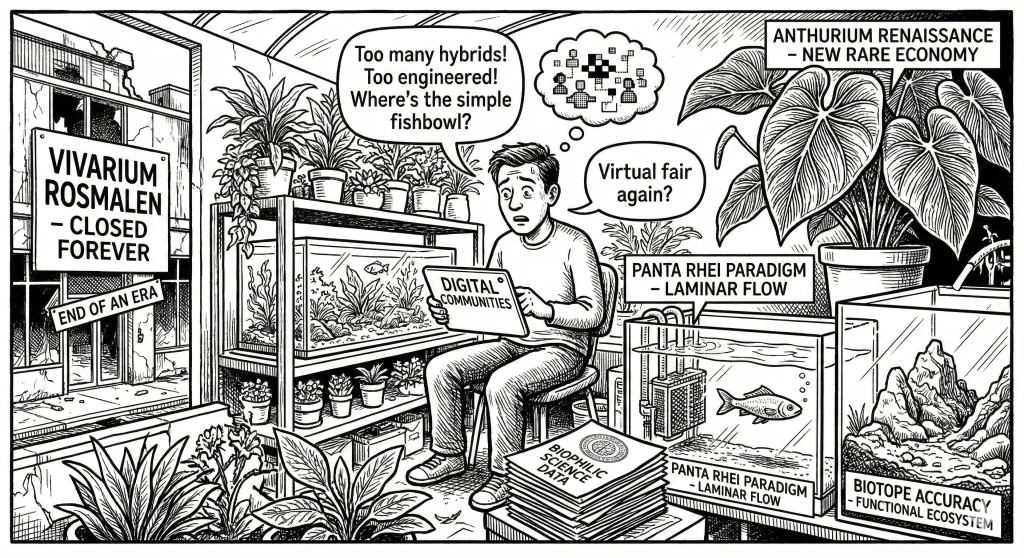
Key Takeaways
- Vivarium & MACE 2025 in Rosmalen was billed as its fifteenth and final edition. Online contests and breeder auctions exist, but one fair closing does not establish a broader shift away from in-person events.
- Panta Rhei markets flow-straightening river pumps and reversible tidal-simulation pumps. Those are the maker’s feature claims. How much they help specific fish has not been measured independently, and a natural river is normally turbulent, not laminar.
- Some collectors value hybrid seedlings because each sibling can develop differently. That collector interest does not establish an industry-wide shift away from tissue culture.
- The 2025 AGAIAC layouts show design choices that can inspire a build. Their visible results do not prove particular humidity or ecosystem mechanisms.
- The University of York announced research on indoor plants and wellbeing, not results. Treat health claims as open questions and use public-health humidity guidance when setting a room target.
What These 2025 Developments Mean
Three developments stand out in indoor horticulture and aquascaping. Vivarium Rosmalen held its final edition, some collectors favored variable Anthurium seedlings over identical clones, and contest layouts continued to raise the standard for paludariums and biotopes.
They are useful signals for hobbyists, not proof of a single industry direction. New indoor-plant research is also asking useful questions about humidity and wellbeing, but it has not yet supplied settled answers.
When a show build or collector trend catches my eye, I sketch its footprint inside my actual enclosure. I add the hidden service space for pumps, hoses, drainage, and pruning access. The visible layout may fit while the maintenance path does not.
I copy only the feature that solves a condition I can name. If I cannot explain how it improves flow, access, plant growth, or viewing in my setup, I keep it as inspiration rather than turning it into a purchase list.
The Final Vivarium Rosmalen, 2025
What the Final Edition Shows
Vivarium & MACE 2025, held at the Autotron in Rosmalen, Netherlands, on 8–9 November 2025, was billed by the organizers as Edition XV (its fifteenth and, they said, final edition).
For fifteen years it was a significant meeting point for the European hobby, linking manufacturers, researchers, and the public.
It is tempting to read the closure as pushing the community online, and digital aquascaping contests and online breeder auctions do exist.
But one large fair ending is not the same as the physical marketplace disappearing, and attendance, event-count, or transaction figures do not show a measured shift. Treat online migration as a possibility, not a documented trend.
Flow-Control Pumps from Panta Rhei
Panta Rhei markets pumps that aim a current more deliberately than a typical propeller pump. A focused jet can be useful, but it is not the same as recreating a natural river, where water also swirls around rocks, wood, and banks.
The Hydro Wizard uses fins after the impeller to reduce sideways swirl at the outlet. That can make the outgoing stream more directional, but hardscape and tank walls quickly change flow elsewhere in the aquarium.
Match Flow to the Animals
A more directed outlet may suit a large display or a species that uses steady current. It can be a poor fit for small tanks, weak swimmers, or animals with no sheltered area. Protect intakes, provide calm refuges behind hardscape, and observe whether livestock can feed and rest without struggling.
Current-loving fish such as hillstream loaches need moving, oxygen-rich water, but no fish benefits from one powerful stream across the entire tank. Build the flow around the target species’ natural microhabitat, with both moving-water areas and sheltered low-flow areas.
A companion Hydro Tube system integrates the pump into external plumbing and uses a reversible motor to change flow direction, which the maker describes as simulating river, tide, or surge cycles.
It’s a high-flow, low-pressure setup aimed at large systems. Expect it to be expensive and to potentially require tank drilling and pipe sizing, plus attention to intake safety for livestock and to maintenance.
Whether it induces spawning is a maker/anecdotal claim, not something the show reports establish with controls.
Vivarium 2025. The final edition with new gear, corals and aquascapes
Anthurium Hybrid Seedlings and the Collector Market
Read the Market Signal Carefully
In the high-end collector niche, interest has moved from simple color mutations toward complex genetic lineages, leaf shape, and texture. That niche is not the whole Anthurium market.
Tissue Culture and Seedlings
Tissue culture has lowered prices on some formerly rare plants, while hybrid seedlings attract collectors who enjoy variation. Seedlings from one cross can look quite different from each other. Tissue culture aims to reproduce a clone, although occasional variation can still occur. This is a collector preference, not evidence that tissue culture is disappearing.
This drives what collectors call phenotype hunting, the practice of growing out seedlings in the hope of finding a standout individual.
Why Velvet Leaves Look the Way They Do
Much of this interest centers on velvet-leaved aroids such as Anthurium warocqueanum, A. papillilaminum, and A. crystallinum hybrids. Their leaf surfaces and internal tissues scatter light in ways that make dark blades and pale veins stand out. The exact advantage to the plant is unsettled, so avoid treating a velvet finish as proof of exceptional low-light performance.
Light angle, pigmentation, and leaf thickness all change the contrast you see. The veins are living tissue, not empty reflective channels.
Hybridization
Breeders often try to combine vigor with a velvet finish, for example by crossing hardier species with more delicate ultra-dark lineages. Unless parentage is documented by the seller, treat named lineage claims as background rather than a guarantee of a seedling’s final form.
Crosses offered for sale include red-crystallinum × dark Black Velvet Eastern Panama lines, nigrolaminum Gigi × papillilaminum, and radicans × luxurians.
The listed plants exist, but marketed traits describe the parents’ hoped-for characteristics rather than a guarantee for every seedling, which is exactly the sibling variation described just above.
Radicans × luxurians is not a new 2025 cross. It has been grown and tissue-cultured for a long time, well before the 2020s, so it is not evidence of a fresh late-2025 wave.
Some nurseries release new hybrids frequently, but frequent releases are not the same as genetic stabilization. Stabilizing a complex multi-generation cross requires long-term evaluation of offspring, which I can’t confirm from release announcements alone.
The Enclosed Ecosystem (AGAIAC 2025 Layouts)
Take Inspiration Without Copying Assumptions
Competition aquascaping treats paludariums and biotopes as a design discipline. Three entries in the 2025 Aquatic Gardeners Association contest offer useful visual ideas, but a finished photograph cannot show the full maintenance routine behind it.
The Best in Show layout, Veins of Nature 2 by Muhammad Yusuf of Indonesia, uses Forest-style hardscape in a 120 × 50 × 50 cm tank. The large, darker wood placed forward and smaller, lighter pieces behind create its sense of depth. Use that scale relationship as inspiration, but size hardscape for your own tank rather than copying a large contest layout into a nano aquarium.
In the paludarium category, Koke No Yume, or Dream of Moss, by Karsten Dünne of Germany works the riparian edge, and the official entry is praised for its healthy moss and plant placement.
The contest page does not describe a measured self-regulating humidity gradient driven by capillary wicking from submerged zone to spray zone.
Capillary movement in mosses and hardscape is real in general terms, but without the maker’s watering or misting records and measurements of height, materials, and evaporation, the evidence supports visible moss placement rather than a self-regulating mechanism.
A theme in the biotope category is replicating a specific place from field data. Jungle stream in Karst Menoreh by Imanul Khakim of Indonesia, a Biotope runner-up, was based on 2015/2016 LIPI research on the Menoreh karst region plus the entrant’s own field observations, and one judge praised its high fidelity.
Accuracy here has a bounded meaning. The cited paper collected around 9 fish species, while the entry lists 17, so the additional species rest on the entrant’s personal observation rather than independently verified field data.
The official page also lists a single plant species, so a claim that plants and fish strictly match that stretch of river would overstate what is documented.
Another judge noted that Rasbora argyrotaenia and Barbodes binotatus grow to roughly 14 cm and 20 cm and may need more long-term swimming room. That welfare limit deserves attention alongside stock sourcing and conservation status.
Recreating these layouts, precise hardscape placement, trimming mosses along the fringe, is fiddly work through a tank opening, which is what long aquascaping tools help with.
A budget stainless aquascaping set, long tweezers, curved scissors, and a spatula, handles lighter work in smaller tanks. Measure the reach from the opening to the farthest working point, then compare it with the listed length of each tool. A deep or top-restricted vivarium can leave the far corners out of range. Stiffness, hinge quality, edge retention, and corrosion resistance matter as much as length, so dry the tools after use to prevent spotting.
Veins Of Nature 2 – AGAIAC
Biophilic Science (The Human Connection)
Treat the Research as an Open Question
In 2025, the University of York announced research into how indoor plants may affect air quality, temperature, humidity, and wellbeing. It describes planned research, not results, so it cannot prove a health benefit from a particular enclosure or roomful of plants.
Humidity and Indoor Air
Plants do transpire, and high-transpiration plants (like the large-leaved anthuriums above) release moisture into a room. That much is uncontroversial.
Plants release moisture, but ventilation, room size, light, watering, and plant number determine whether the room actually feels more humid. A dense plant collection is not a substitute for measuring the space or controlling a moisture problem. To limit mold, CDC guidance is to keep indoor humidity below 50 percent throughout the day. Watch for condensation on cold surfaces instead of treating one humidity number as universal.
Measure the room rather than relying on a feeling of dryness. An inexpensive hygrometer turns that impression into a number you can act on.
An inexpensive manual-display digital hygrometer works as a trend indicator, not a precise room-wide measurement. Check the exact model’s accuracy, refresh rate, logging, alarms, and operating-humidity and water-resistance ratings rather than assigning one product’s specifications to the budget category.
A single sensor in one spot cannot tell you a room average, condensation on cold surfaces, moisture inside wall cavities, or RH across a whole plant canopy.
Place it away from direct airflow. Verify health-related humidity conclusions across several locations and times, and by watching for condensation and mold.
Psychological Restoration
Keep the Psychological Claim Modest
Systematic reviews do find that nature exposure and indoor plants can have positive associations with some attention and physiological measures.
There is no direct evidence here that fern fractals, a paludarium’s ordered chaos, or fish movement each specifically trigger the parasympathetic nervous system.
Some researchers use Attention Restoration Theory to explain why natural scenes may feel less mentally demanding. That explanation does not mean every enclosure produces a measurable clinical benefit for every person.
The likely payoff is personal rather than neurological. Some people find these systems calming, while for others a high-cost, high-maintenance enclosure can be a source of stress rather than a reset.
New research explores how indoor plants can improve human health
Let Trends Guide Your Own Setup
Use Trends as Ideas, Not Instructions
In late 2025, a long-running European fair held what its organizers called its final edition. One manufacturer showed flow-shaping pumps, collectors continued to seek unusual Anthurium seedlings, and contest layouts advanced Forest, paludarium, and biotope design.
Use these trends to ask better questions about your own livestock, space, and maintenance capacity instead of treating them as a reason to copy a display. A technically impressive setup is only successful when its animals, plants, and owner can thrive with its daily demands.