
Caladium 2025: Sun-Tolerant Cultivars & Care Trends
Choose and care for Caladium by cultivar. Learn the limits of sun-tolerant types, manage rot and dormancy, and decide whether semi-hydro or supplemental light suits your setup.
Marcus Hale · Published 2025-12-20 · 9 min read
Key Takeaways
- The National Garden Bureau named Caladium its 2025 bulb-category plant in an annual marketing campaign. It is an industry promotion rather than a national quality certification, and it sits on top of decades of University of Florida breeding that improved sun tolerance in specific cultivars.
- Sun tolerance is a cultivar-specific rating, not a feature of every Caladium. Read the named cultivar’s plant tag and acclimate it gradually before placing it in strong sun.
- Wet substrate can cause Pythium root rot, while stored tubers can rot from Fusarium. Cure tubers, store them at the right temperature, and use clean, well-drained growing conditions.
- Do not choose a home grow light from a small tissue-culture experiment. Match light to your cultivar and its response in your own space.
- Semi-hydro with LECA or Lechuza PON can make moisture easier to manage but is not a proven cure for rot or fungus gnats. Match light to the cultivar and store dormant tubers around 55–65 °F rather than in the refrigerator.
The Caladium (the aroid sold as Angel Wings or Heart of Jesus) has long been grown as a shade-garden foliage plant. Striking but sensitive, prone to scorching in strong sun and going dormant as the season cools.
For 2025, the National Garden Bureau named Caladium its bulb-category plant, part of the Bureau's annual Year of marketing program.
That designation coincides with decades of University of Florida breeding that improved sun tolerance and disease resistance in specific cultivars.
Choose a Caladium by the named cultivar rather than by leaf color or a general promise of sun tolerance. Then match its light, moisture, and dormancy care to the place where you will grow it.
Choose Cultivars by Their Tested Performance
Modern Caladium cultivars are the product of decades of breeding aimed at two long-standing problems, sun scorch and root or tuber rot.
I set an infrared thermometer to 0.95 emissivity and work close enough to keep its spot entirely within each leaf. Within five minutes, I take three readings from one sun-facing leaf and one shaded leaf on the same plant, then compare their medians. The fixed setting, spot size, and time window prevent background surfaces or room drift from deciding the comparison.
I add 30% shade cloth for three days with direct sun during the original reading window, then repeat the paired readings at that hour. If the sun-facing median remains at least 3 °C warmer and fresh bleaching or crisp margins appear, I replace it with 50% cloth for three more qualifying days. I require both heat and new damage so ordinary leaf variation does not trigger a watering change.
I spread the numbered tubers in one layer at 20 to 24 °C in a shaded, ventilated place for seven days, turning them once on day four. On day seven, I photograph and inspect only tubers whose outer surface and remaining soil are dry and whose leaves are brittle, extending the same setup to day ten for any damp tuber. Anything still damp on day ten stays isolated and is checked daily for an enlarging soft area or foul odor instead of going into storage. The seven-day checkpoint follows Extension curing guidance, while the day-ten check catches slow surface drying before storage labels hide which tuber began damp or damaged.
Choose a Sun-Tolerant Cultivar by Name
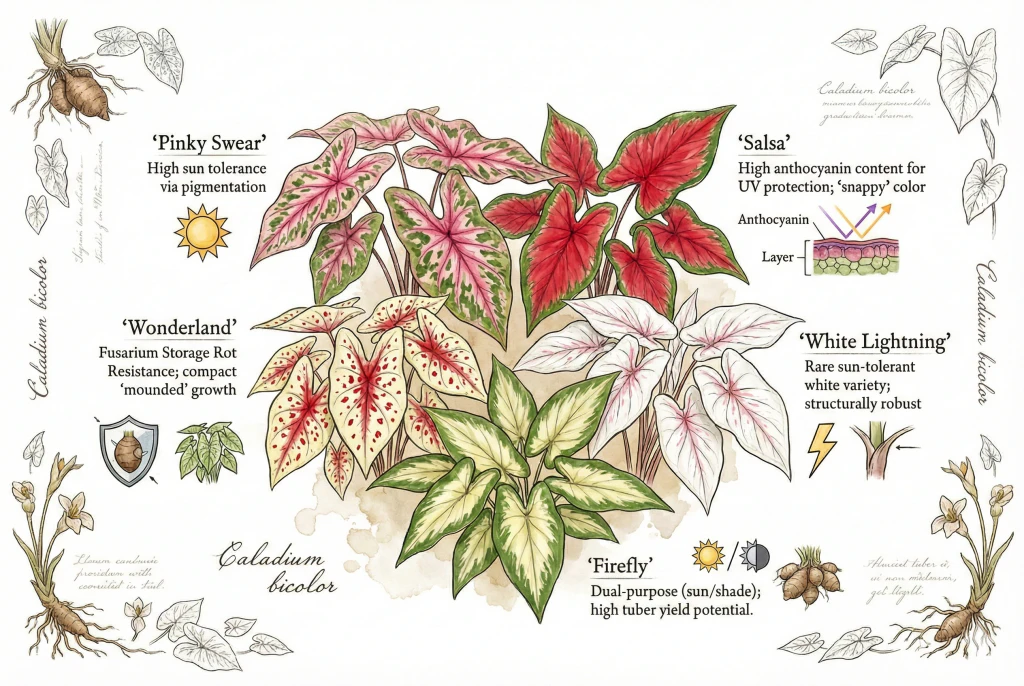
Traditional Caladium leaves can scorch in direct sun. University of Florida breeding has produced named cultivars with stronger sunburn tolerance, including Lava Glow, but that rating applies only to the tested cultivar.
Do not use leaf color, leaf shape, or the word Caladium as a shortcut for sun tolerance. Check the plant tag or breeder information for the exact cultivar, then acclimate it gradually with reliable watering.
Why a Plant Tag Matters More Than a Theory
Leaf structure, pigments, and water use can all affect how a plant copes with strong light. They have not been measured well enough in these cultivars to predict performance. Use the cultivar’s tested rating instead.
Lava Glow. A New Red Fancy-Leaved Caladium Cultivar
Protect Roots and Stored Tubers
Breeding can reduce disease risk in some cultivars, but it does not remove the need for clean handling, good drainage, proper curing, and storage.
Pythium root rot thrives in wet substrate and leaves roots brown and soft. Keep Caladium evenly moist but never constantly saturated.
Resistance cannot be predicted from white veins, leaf color, or leaf shape. Choose a named cultivar with a documented rating if disease resistance is important.
Fusarium tuber rot
Fusarium can rot a tuber after harvest and during storage. Some newer cultivars have shown moderate resistance, but it is relative rather than complete. Cure tubers, store them at the right temperature, and remove any rot promptly.
Tissue Culture Is Not a Home Lighting Recipe
A 2025 study developed a tissue-culture method for one Caladium bicolor cultivar and compared acclimatization under several light spectra. Blue and blue-red light supported some growth and root traits, but survival did not differ significantly between treatments.
That small laboratory result does not show that a blue-heavy lamp improves the survival of ordinary retail Caladiums. Acclimate tissue-cultured plants gradually and choose light for the cultivar in your own space.
Establishment of a refined somatic embryogenesis protocol and light-spectrum-based acclimatization in Caladium bicolor White
What the 2025 Designation Means
The National Garden Bureau chose Caladium for its 2025 bulb-category promotion. It is a marketing program that may make more cultivars visible, not a quality certification or a promise that every Caladium suits every garden.
Use the Plant Tag, Not the Promotion
Caladiums are sold for both patio containers and indoor display. Outdoor sun tolerance does not guarantee indoor performance or remove the plant’s dormancy needs. Use the named cultivar’s light and care information for your setting.
2.2 Branding (Heart to Heart)
Proven Winners’ Heart to Heart® series includes cultivars with different light tags. The series name does not guarantee sun tolerance. Read the tag for the individual cultivar, including its shade, sun, or sun-and-shade rating.
2.3 Supply Chain (From Field to Pot)
Storage is a key step after the season. Cure harvested tubers, then hold them dry around 55–65 °F. Resistance helps only at the margin. Temperature control, sanitation, and removing rot remain essential.
Indoor Care Options
Indoor conditions vary more than plant tags can capture. Use the following methods as options, then adjust based on your cultivar and the plant’s response.
3.1 The Semi-Hydroponics Approach
Semi-hydro can make watering more consistent by holding a plant above a nutrient-water reservoir. It is optional. A well-drained peat or coir mix can also work well for Caladium.
Use semi-hydro only if you can monitor the water level, nutrients, temperature, and root condition. A reservoir can still develop rot, algae, biofilm, or fungus gnats. Reducing organic material may reduce gnat risk, but it does not eliminate it.
Lechuza PON
Lechuza PON suits growers who want a ready-made mineral substrate for a reservoir setup. Check whether the batch already contains fertilizer before adding nutrients, so you can manage the total feed level. It costs more than regular potting mix and still requires clean reservoirs and regular root checks.
LECA is a less expensive, chunkier alternative for the same kind of setup. It may wick less evenly than fine mineral substrate, so container design and the water line matter more.
LECA Clay Pebbles
LECA clay pebbles suit a budget-minded semi-hydro setup and can be reused after cleaning. Rinse them before use, flush mineral buildup periodically, and expect some loss of old soil roots during the transition. Monitor nutrients, the water line, and reservoir hygiene. LECA does not prevent root rot or fungus gnats.
3.2 The Dormancy Debate (To Lift or Not to Lift?)
Dormancy is a common point of debate. Caladiums are tuberous perennials whose foliage declines and goes dormant as the season cools. In cold zones the standard practice is to stop watering in autumn, let the leaves die back, and lift and store the tubers.
Extension sources note this is driven by daylength and temperature, and that even indoor Caladiums tend to enter dormancy after some months rather than staying evergreen indefinitely.
Some growers keep plants warm and lit year-round to extend the season, and this can delay dormancy.
There is no controlled comparison showing you can reliably skip dormancy for good, and forced plants can grow weak or leggy over time, so a controlled rest to recharge the tuber remains a reasonable option. It depends on your conditions and cultivar.
For storage there are two workable options. Leave the dry tuber in its pot in a cool spot, or cure the tubers and store them separately in dry medium.
Either way, cure the tubers first, inspect for damage, keep them dry at about 55–65 °F, and isolate any rotting tubers so problems do not spread.
One consistent recommendation. Do not store tubers in the refrigerator. Caladiums are tropical, and refrigerator temperatures (~40 °F) risk chilling injury. How much damage occurs depends on both temperature and how long the tubers are exposed, so a brief chill is not necessarily instantly fatal.
Aim for about 55–65 °F (commonly 60 °F or above).
3.3 The Lighting Reality Check
Indoor light needs depend on the cultivar and the window. If light is too low, Caladiums can stretch (go leggy) and lose color intensity.
But official sources recommend bright, indirect or filtered light rather than blanket high light, and some cultivars are shade-preferring, so a bright window is not automatically too weak.
Judge by the window's direction, glazing, season, and the plant's distance from the glass, and by how the plant actually responds.
A cultivar's outdoor sun tolerance (achieved with good irrigation in an outdoor climate) does not mean every indoor plant needs strong light.
If a given plant is stretching or fading in your space, a dedicated full-spectrum grow light can help, but it is not required for every setup.
SANSI 36W Grow Light
The SANSI 36W Grow Light is suitable when a Caladium has a clear indoor light shortfall and you can position a separate fixture safely. Its output can be too intense close to a shade-preferring cultivar, so start farther away, increase exposure gradually, and watch for heat or leaf stress. Confirm that the socket and fixture are rated for the bulb before use.
Choose the Caladium for Your Conditions
Choose by cultivar, then match light, moisture, and dormancy care to the setting where you grow it. Some Caladiums are bred for full sun with dependable watering, while others perform best in shade.
A sunny Florida border, a greenhouse, and a semi-hydro pot in an apartment can all work, but no single Caladium thrives equally in every one of them.
Affiliate Disclosure
This article contains Amazon affiliate links. As an Amazon Associate I earn from qualifying purchases. If you use these links, the site may earn a commission at no extra cost to you. Product availability, price, and specifications can change. Check the current listing before buying.