
Plant Cabinet Humidity Control Kit: Product Chooser
Choose a fan, humidifier, VPD sensor, and controller for a plant cabinet by the conditions they solve, their limitations, and the cabinet size they suit.
Marcus Hale · Published 2026-08-13 · 14 min read
Key Takeaways
- Control VPD, not humidity alone, since transpiration tracks humidity and temperature together.
- Buy in loop order: sensor, controller, humidifier, then fan.
- Target 0.6 to 0.8 kPa VPD, roughly 70% RH at 22 to 24°C, below saturation.
- A closed-loop humidistat beats open-loop misting that swings RH into condensation.
- Size the kit to the cabinet. A 6 L humidifier and 325 CFM fan overshoot a tiny box.
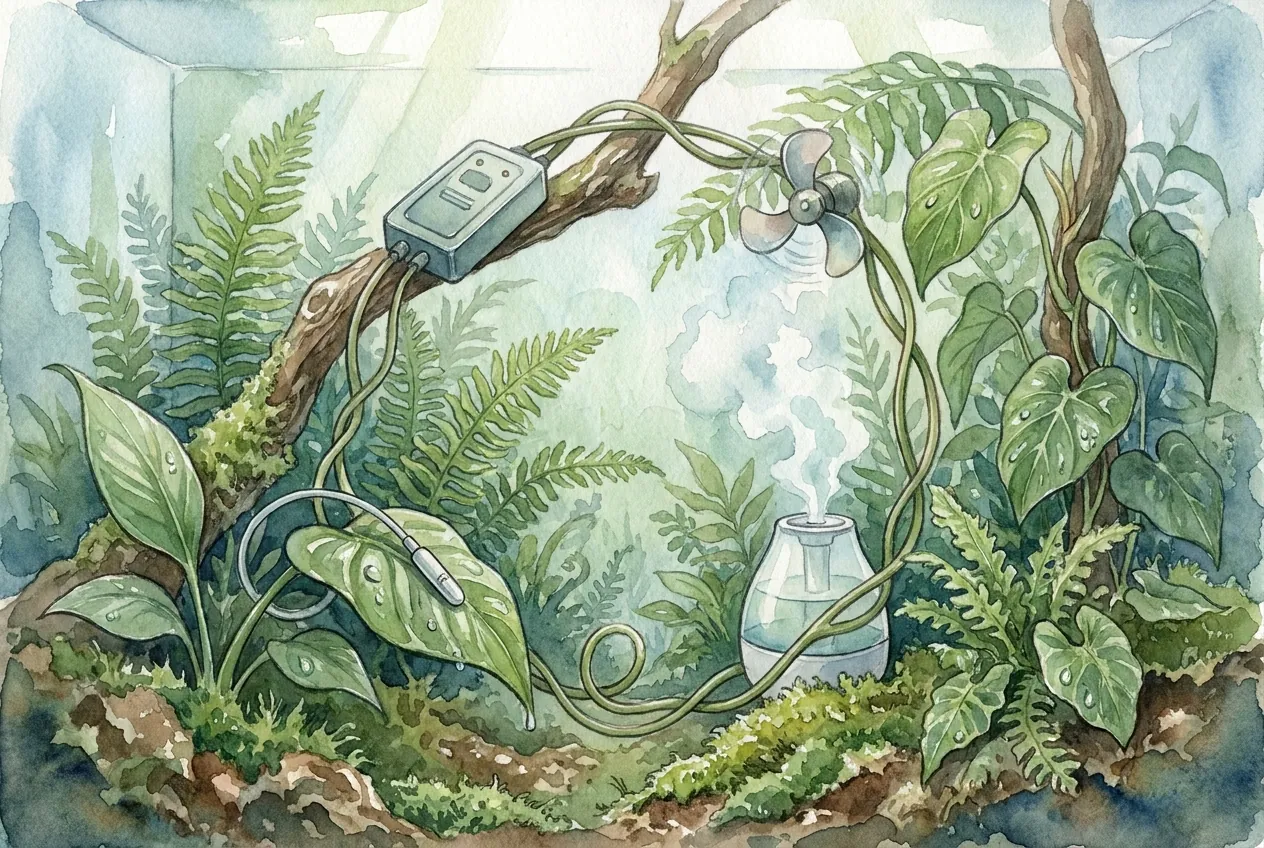
A converted glass cabinet holds stable humidity for aroids when four devices work as a loop.
You measure the air with a logging hygrometer and close the loop with a humidity controller.
You raise moisture with an ultrasonic humidifier and keep the air moving with a small fan.
Skip any one of them and the cabinet drifts toward dripping condensation or a dry, stressed canopy.
Start with measurement, then add only the device that addresses the condition you have measured. A tiny sealed cabinet can become wetter with a single mist burst, while a larger or leakier cabinet may need active control and circulation.
The buying verdict in one pass
Buy a logging hygrometer first, then a humidity controller, then an ultrasonic humidifier sized to the cabinet, and add a quiet circulation fan. That sequence matches how the loop actually works.
The sensor tells you the true air state and the controller decides when to add moisture.
The humidifier supplies it, and the fan spreads it evenly so no leaf sits in a saturated pocket.
The core reason you need all four is that relative humidity alone is not the plant-relevant number.
What governs how an aroid transpires is vapor pressure deficit, or VPD, which depends on both humidity and temperature.
You cannot control VPD by eyeballing a single RH dial, so you measure both variables and let a controller hold the setpoint.
A medium greenhouse-style cabinet may use all four devices, but not every cabinet needs them all. Add a device only when the logged conditions show a problem it can solve.
I log temperature and humidity in the empty cabinet through a full light cycle before adding a humidifier. Then I add shelves and pots without plants and repeat, which separates room leakage and light heat from moisture released by a full collection.
Active humidity equipment enters the plan only after the baseline shows the size and timing of the shortfall. This prevents a powerful humidifier from masking an airflow or sensor-placement problem that was present from the start.
Why VPD, not humidity, decides transpiration
VPD is the driving force for water loss from a leaf, so it is the number that predicts whether your aroids transpire comfortably.
Transpiration at the leaf is set by stomatal conductance and the leaf-to-air vapor pressure difference. That is Fick’s law of diffusion in plain terms, and relative humidity is only part of that difference.
A review of plant responses to rising VPD reports that stomatal conductance declines as VPD climbs.
Transpiration rises with VPD up to a species-specific threshold, after which the stomata close to protect the plant from hydraulic failure.
When water flux into the stem cannot meet leaf demand, guard cells lose turgor and the pores shut. Most plants operate well between roughly 0.5 and 0.95 kPa VPD.
Temperature enters the calculation directly. MSU Extension notes that the water-holding capacity of air roughly doubles with every 20°F rise.
The same RH reading therefore means different actual dryness at different temperatures. That is why your sensor must read both RH and temperature accurately.
Why steady control beats bursts of mist
Holding VPD steady preserves stomatal conductance better than letting it swing. A Frontiers in Plant Science study on lettuce compared a moderate VPD cycle against a drastic one.
The moderate cycle alternated 1.32 kPa at 55% RH with 0.86 kPa at 72% RH. The drastic cycle swung between 1.63 kPa at 42% RH and 0.63 kPa at 80% RH.
The moderate fluctuation caused no reduction in stomatal conductance or photosynthesis. The drastic fluctuation caused a gradual decline in conductance. Shoot dry weight and leaf area under the drastic cycle were 15% and 29% lower.
The authors conclude that VPD should be controlled by continuous regulation, not intermittent regulation. That single finding is the argument for a closed-loop controller over open-loop misting. Bursts of mist with no feedback create exactly the drastic swings that cost growth.
Target humidity and VPD ranges for a cabinet
Aim for roughly 0.6 to 0.8 kPa VPD, which for high-humidity aroids lands near 70% RH at 22 to 24°C. MSU Extension frames practical targets by stage.
Rooting cuttings do well near 0.3 kPa because it reduces drying of young plants. Finishing plants should stay above 0.5 kPa so they can transpire in an environment less friendly to disease.
The commonly cited greenhouse band runs about 0.45 to 1.25 kPa, with 0.8 to 0.95 kPa a frequent sweet spot for active growth. High-humidity foliage and propagation sit toward the low end.
Hobby guidance broadly recommends 60 to 80% RH for aroids such as Anthurium and many Philodendron. That range is target context, not a physiology source.
The ceiling matters as much as the target. Gray mold, or Botrytis, is favored by free moisture on tissue for roughly 8 to 12 continuous hours.
It also favors canopy RH above about 93% and cool temperatures near 55 to 65°F. Holding RH below saturation and keeping air moving breaks that chain.
Why moving air is part of humidity control
Air movement measurably lowers canopy humidity and prevents condensation. Greenhouse horizontal air flow guidance runs small fans continuously to circulate air in a loop. In comparison studies, that circulation held mean RH near 76.7% against nearly 99.9% for still air.
Adequate air movement is described as leaves that move slightly, not a gale. Mixing keeps the thin layer of air along each leaf from cooling to its dew point.
Moisture then does not condense on the leaf, and less standing moisture means less Botrytis.
As a cabinet cools at night toward the dew point, condensation forms on the coolest surfaces. It then drips onto foliage and promotes fungal germination. Continuous gentle airflow interrupts that cycle.
Selection criteria by cabinet size
Match specs to cabinet volume rather than buying the largest of everything. The table below sets the measurable criterion for each role at three common cabinet sizes. It is drawn as a table on purpose, because spec grids drawn as images render unreliably.
| Cabinet volume | Fan | Humidifier | Sensor | Controller |
|---|---|---|---|---|
| Small sealed under 100 L | Small USB or clip on low, or none | Small unit or short duty cycles, 6 L overshoots | Logger, ±3% RH | Optional, manual cycling can suffice |
| Medium 100 to 250 L | Clip fan on low to mid, ~325 CFM headroom | 6 L, 300 mL/h cool mist | Logger, ±3% RH and ±0.3°C | Humidistat, differential ~5% RH |
| Large 250 to 400 L | Clip fan mid plus circulation | 6 L, 300 mL/h, refill more often | Logger, consider two sensors | Humidistat, differential 3 to 5% RH |
The pattern is simple. Bigger and leakier cabinets need more mist output and more airflow. Tiny sealed cabinets need restraint so a single burst of mist does not peg the air at saturation.
The circulation fan and why airflow comes with restraint
The fan’s job is continuous, adjustable, low-speed mixing, not maximum wind. Still air lets a saturated boundary layer sit on each leaf, which feeds fungal growth and uneven VPD across shelves.
Gentle movement breaks that layer and equalizes humidity and temperature between shelves. In a living space, keep noise near or below 35 dBA so the cabinet does not intrude.
AC Infinity CLOUDRAY S6 fan suits a medium or large cabinet where you need adjustable, continuous circulation and can keep the power connection out of splash and condensation.
Run it at the lowest setting that moves leaves slightly. It is too powerful for many small cabinets and can make a humidifier chase the airflow.
In a cabinet under about 100 L, a small USB fan on low may be enough.
Strong airflow in a low-tank setup can also drop RH faster than the humidifier recovers.
For a compact cabinet, the AC Infinity CLOUDRAY S4 fan is the smaller choice when the S6 would dominate the shelf space.
Skip strong circulation entirely in a tiny sealed cabinet unless you have confirmed a stagnant, wet pocket.
The ultrasonic humidifier sized to the cabinet
Raising RH is how you lower VPD into the aroid-friendly band, so mist output must replace what the cabinet loses to air exchange and condensation. Tank volume sets the refill interval.
Cool-mist ultrasonic output avoids heating a sealed cabinet the way a warm-mist unit would. An accessible auto-shutoff keeps the unit safe when the tank empties.
LEVOIT LV600HH humidifier suits a medium or large cabinet that genuinely loses moisture and needs a longer refill interval.
Use cool mist and control it from an in-cabinet humidistat, not its room-side auto sensor. Skip it for a tiny sealed cabinet, where its output can drive condensation quickly. Use distilled or RO water to avoid mineral dust on leaves and glass.
The hygrometer or VPD sensor you actually control by
You need a sensor that reads both RH and temperature accurately and logs the history. VPD depends on both variables, and you tune by watching the curve.
Consumer capacitive RH sensors also drift over time, so logging lets you catch drift and see whether the controller is holding.
Place the sensor inside the cabinet at leaf height, away from direct mist.
Govee H5179 WiFi hygrometer suits a cabinet where you need a temperature-and-humidity trend at leaf height, plus alerts when conditions drift.
It reports RH and temperature rather than VPD itself, and it is a hobby-grade monitor rather than a laboratory reference. Keep it out of direct mist, verify unusual readings, and skip WiFi features if an offline readout is all you need.
The humidity controller that closes the loop
A humidistat controller turns the humidifier on below a low threshold and off above a high one.
RH then oscillates in a controlled band instead of overshooting into condensation.
This is the direct implementation of the continuous-regulation finding from the physiology literature. The specs that matter are control range, adjustable switching differential, and load rating.
Inkbird IHC-200 controller suits a cabinet where open-loop misting has caused repeated humidity spikes or condensation.
Set a sensible switching band so the humidifier does not short-cycle, place the probe at leaf height away from mist, and confirm the appliance load is within the controller’s rating. It controls RH, not VPD, and is unnecessary when a small setup remains stable with measured manual adjustments.
The setup sequence that tunes the loop
Install in the order the loop reads, decides, acts, and mixes. Doing it out of order means you tune blind. The steps below assume the four devices already chosen above.
Step 1. Baseline the sensor
Place the Govee H5179 inside the cabinet at leaf height, away from direct mist, and let it log for a day.
This tells you the cabinet’s natural RH, temperature, and resulting VPD before you change anything.
Step 2. Set the target
Pick the RH setpoint that matches your target VPD at your cabinet temperature. Near 70% RH at 22 to 24°C corresponds to roughly 0.6 to 0.8 kPa, inside the transpiration-friendly band.
Step 3. Close the loop
Plug the LEVOIT LV600HH into the Inkbird IHC-200 in cool-mist mode. Set the setpoint and start with a differential near 5% RH so it cycles in a band rather than misting open-loop.
Step 4. Add circulation
Run the CLOUDRAY S6 or S4 continuously on low so leaves move slightly. This breaks the boundary layer and prevents dew-point condensation on glass and foliage.
Step 5. Observe and adjust
Watch the logged curve for two to three days. Tighten or widen the differential and adjust fan speed to remove RH spikes and any dripping.
Who should not buy each product class
Not every cabinet needs every device, and forcing gear on the wrong setup causes problems. Match the purchase to the failure it actually prevents.
A strong fan is the wrong buy for a tiny sealed cabinet. It drops RH faster than a small humidifier recovers and can dry leaves. A small USB fan on low, or nothing, is safer there.
A 6 L, 300 mL/h humidifier is the wrong buy for a small cabinet, where it overshoots into condensation. It is also unnecessary if your plants are not high-humidity types.
A logging sensor is skippable only if you want a single glance and do not care about computing VPD or catching drift. That is not recommended for a controlled cabinet.
A controller is skippable when the humidifier’s own accurate hygrostat holds the cabinet, or for small manual setups. It becomes necessary the moment open-loop misting overshoots.
Maintenance, failure modes, and replacement intervals
Each device has a predictable wear path, and keeping ahead of it protects the whole loop.
Scale, drift, dust, and relay wear are the four things to watch.
The ultrasonic humidifier disc fouls with scale, which drops output. Descale it every 1 to 2 weeks with hard water or monthly with distilled, using citric acid or vinegar per the manual.
Prefer distilled or RO water to cut mineral dust. The circulation fan’s bearings are rated near 67,000 hours, but dust on the blades raises noise and lowers airflow, so wipe them monthly.
The sensor’s capacitive RH element drifts over time. Recalibrate every few months with a saturated salt test near 75% RH, and clean off any mineral film. A drifting sensor makes the controller hold the wrong true RH.
The controller’s mechanical relay wears with each cycle, so a sensible differential that avoids short-cycling extends its life.
Re-check the setpoint after any cabinet change such as new plants, a new lid, or a seasonal shift.
Buyer questions answered
These are the objections that come up before purchase, answered with the mechanism behind each.
Do I need a controller, or can the humidifier’s own sensor do it?
The onboard sensor sits at the unit, not at leaf height in the cabinet, so it overshoots.
A controller with an in-cabinet probe closes the loop, which is the continuous-regulation approach the physiology supports.
Won’t a fan just dry my plants out?
On low, continuous airflow lowers canopy RH toward the 76% air-flow band and prevents dew-point condensation. That is what stops mold. Only oversized or high-speed airflow dries leaves.
Is the white dust dangerous?
It is mineral residue from tap water, not harmful, but it is unsightly and can foul the sensor. Distilled or RO water removes it.
Is ±3% RH accurate enough?
Yes for holding a VPD band. Treat it as a tuning tool, recalibrate for drift, and do not expect lab-instrument precision.
My cabinet still gets condensation. Why?
The usual cause is open-loop misting with no controller plus no air movement. Add differential-based control and continuous circulation to fix it.
Affiliate Disclosure
This article contains Amazon affiliate links. As an Amazon Associate I earn from qualifying purchases. If you use these links, the site may earn a commission at no extra cost to you. Product availability, price, and specifications can change. Check the current listing before buying.