
Moss Pole Product Chooser: Sphagnum, Coir & Stackable Poles
Choose sphagnum, coir, or stackable moss poles by the plant’s size, the attachment surface it needs, and the maintenance you can sustain.
Jordan Cole · Published 2026-08-11 · 16 min read
Key Takeaways
- Match pole class to your honest maintenance cadence. A reservoir shell suits weekly touch, exposed sphagnum needs misting every 2 to 3 days, and a plank depends on a humid room.
- Aerial roots only anchor to moist, textured surfaces. A dry pole is structure, not an attachment site.
- Extendability is non-negotiable for Monstera. Start near 60 cm with a path past 120 cm.
- Choose enough long-fiber sphagnum to fill the pole loosely and keep some for later repairs. Strand quality matters more than a claimed water-storage number.
- Use soft ties at least 10 mm wide for the multi-week anchorage window. Wire and nylon can girdle stems.
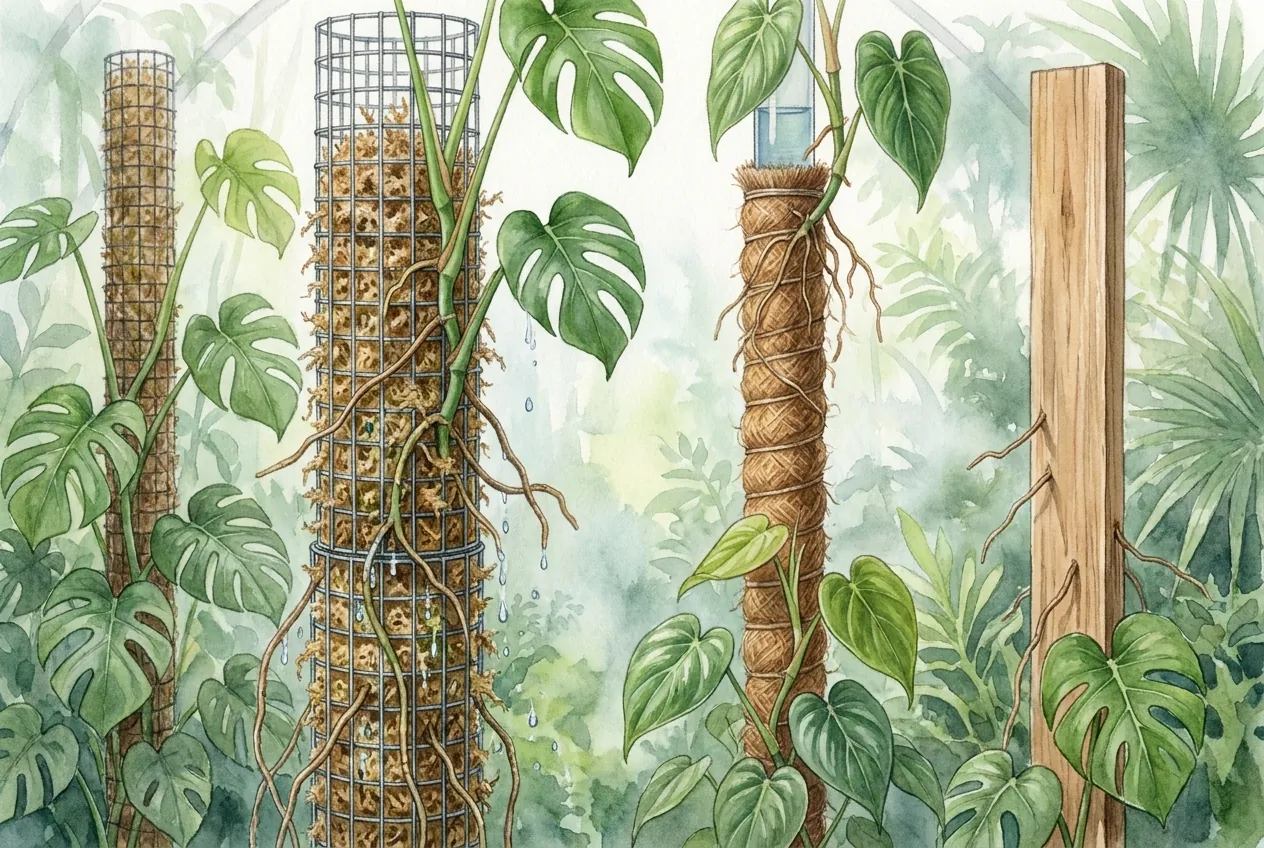
A moss pole gives a climbing aroid a support and, when kept moist, a surface its aerial roots can explore. Choose the pole class, fill medium, ties, and moisture routine together, because the most expensive pole still fails if its surface stays dry or the stem cannot be secured safely.
Which moss pole should you buy?
Match the Pole to Your Maintenance Cadence
Buy a stackable D-shaped self-watering pole plus long-fiber sphagnum if you own a growing Monstera and water on a weekly rhythm. Buy a pre-made exposed-sphagnum pole if you will genuinely mist every 2 to 3 days. Buy coir only for small plants where ties do the work, and buy a cedar plank only if your room or cabinet stays humid.
The logic is simple. Aerial roots attach to surfaces that stay moist and textured, so the pole class you choose is really a moisture-maintenance contract with yourself. University of Minnesota Extension puts the indoor misting rhythm at every 2 to 3 days, which is the workload the non-reservoir classes demand.
| Your situation | Pole class to buy | Why |
|---|---|---|
| Mature Monstera, dry home, weekly waterer | Stackable D-shell + sphagnum fill | Reservoir stretches the misting cadence |
| Any aroid, you enjoy daily plant time | Exposed sphagnum-surface pole | Most attachable surface, most misting duty |
| Pothos, Syngonium, young plants, tight budget | Stackable coir totem | Cheap structure. Ties carry the load |
| Humid room, grow cabinet, or humidifier | Cedar plank or any class | Ambient humidity does the moisture work |
Monstera deliciosa is not a small commitment. UF/IFAS documents vines exceeding 70 ft (21 m) unpruned, with stems 2 to 4 inches thick. Choose an extendable support so you can add height as the vine matures.
I weigh the assembled pole dry and again after fully wetting and draining it, then test the final weight in the intended pot before attaching the plant. A pole that feels stable in a product photo can become top-heavy once moss and water are added.
With the fully wet assembly on a level floor, I hook a luggage scale 10 cm below the pole top and pull horizontally for 10 seconds from four directions. I use 5 percent of the wet assembly weight, with a 100 g minimum and 500 g maximum, and pass the setup only when the pot base stays flat, the root ball does not shift, and the pole returns within 5 mm of its mark. The scaled load represents a minor maintenance knock without turning a houseplant check into a destructive strength test.
Why do aerial roots only attach to a moist, textured surface?
Understand the Attachment Sequence
Because attachment is an active biological process, not glue you can skip. Climbing aroids are root-climbing hemiepiphytes. Their aerial roots sense contact, grow toward the support, and anchor with root hairs that release a mucilaginous adhesive.
Research on Syngonium podophyllum shows attachment is a multi-step process. Root hairs explore the surface, secrete adhesive, and lock into micro-texture for durable anchorage. A bone-dry or slick surface fails the whole sequence, which is why a dry pole becomes a decorative stick.
The drive to climb is hard-wired. Strong and Ray showed Monstera seedlings grow toward the darkest sector of the horizon, toward tree trunks, a behavior they named skototropism.
Your sprawling, furniture-grabbing Monstera is not misbehaving. It is searching for a host.
The pole surface must offer three things at the same time. Contact with a node, graspable texture, and moisture. Remove any one and aerial roots pass it by.
Sphagnum holds moisture in its fibrous structure, which can keep the root contact zone humid longer than a thin coir wrap. The exact amount varies with the moss, packing, airflow, and watering, so check the pole by feel instead of relying on a storage calculation.
If your pole is already installed and roots still float free, the fix is usually moisture cadence, not a new pole. The diagnostic walkthrough in why Monstera aerial roots refuse to attach to the pole covers that failure tree in depth.
What specs actually matter when you compare poles?
Filter by Height and Moisture
Compare the support height, the root-contact surface, the moisture routine, the tie, and whether you can monitor conditions. Aesthetic details come after those basics.
| Spec | Minimum requirement | Why it matters |
|---|---|---|
| Usable height | Roughly 60 cm now, extendable past 120 cm | Monstera stems keep coming. A topped-out pole stalls training |
| Surface or fill | Long-fiber sphagnum at root height | A fibrous surface can stay moist long enough for roots to explore it |
| Moisture path | Reservoir, or your honest misting cadence | Attachment stalls when the surface dries |
| Tie width | At least 10 mm, soft and adjustable | Ties carry the stem for weeks. Wire and nylon damage stems |
| Monitoring | Optional hygrometer near ±3% RH accuracy | Confirms whether your room, not your pole, is the problem |
The tie rule comes straight from extension guidance. UF/IFAS warns against wire or nylon rope because they damage the vine stem as it grows. The height floor is a rule of thumb built from mature-plant scale data in the same publication.
Which pole core matches your plant and your patience?
Choose the Class You Will Maintain
Match the class to your maintenance honesty first, plant size second, and budget third. The examples below show the situations each type fits and the tradeoffs that should rule it out.
When is an exposed sphagnum-surface pole the right call?
Choose this class when maximum attachable surface matters and misting every 2 to 3 days is realistic for you. The whole pole is root-grabbable moss, so every node that touches it meets an attachable surface.
DUSPRO sphagnum pole suits a climbing aroid when you want an exposed moss surface and a support that can be extended as the stem grows.
Use it only if you can keep the moss evenly moist. Its exposed surface is good for root contact but dries faster than a reservoir-style pole.
Honest tradeoff
Exposed moss dries fastest of any class. Skip it if you travel often, or if your home sits under roughly 45% humidity without a humidifier.
Mossify Bendable Thin pole fits several mid-size climbers or a leaning stem that benefits from a flexible support.
Skip it for one heavy Monstera stem, where a thicker, more rigid column carries the load better. Check the current listing for the selected pack and size.
When does a stackable D-shaped self-watering pole win?
Choose this class when you want attachment with weekly-touch maintenance. A plastic D-shell packed with sphagnum shields the moss from airflow on most sides, and a top reservoir drips moisture into the column.
Jegu D-shell pole suits a grower who wants a stackable support with a covered moss column and a reservoir to reduce frequent rewetting.
It still needs hand-packed sphagnum and regular checks. Do not choose it solely for the reservoir, and skip it if you want a natural-looking or fully rigid support.
Honest tradeoff
You buy and hand-pack sphagnum separately, and the plastic stays visible. Skip it if you want a natural look, or a single rigid pole for a top-heavy specimen.
When is a coir totem enough?
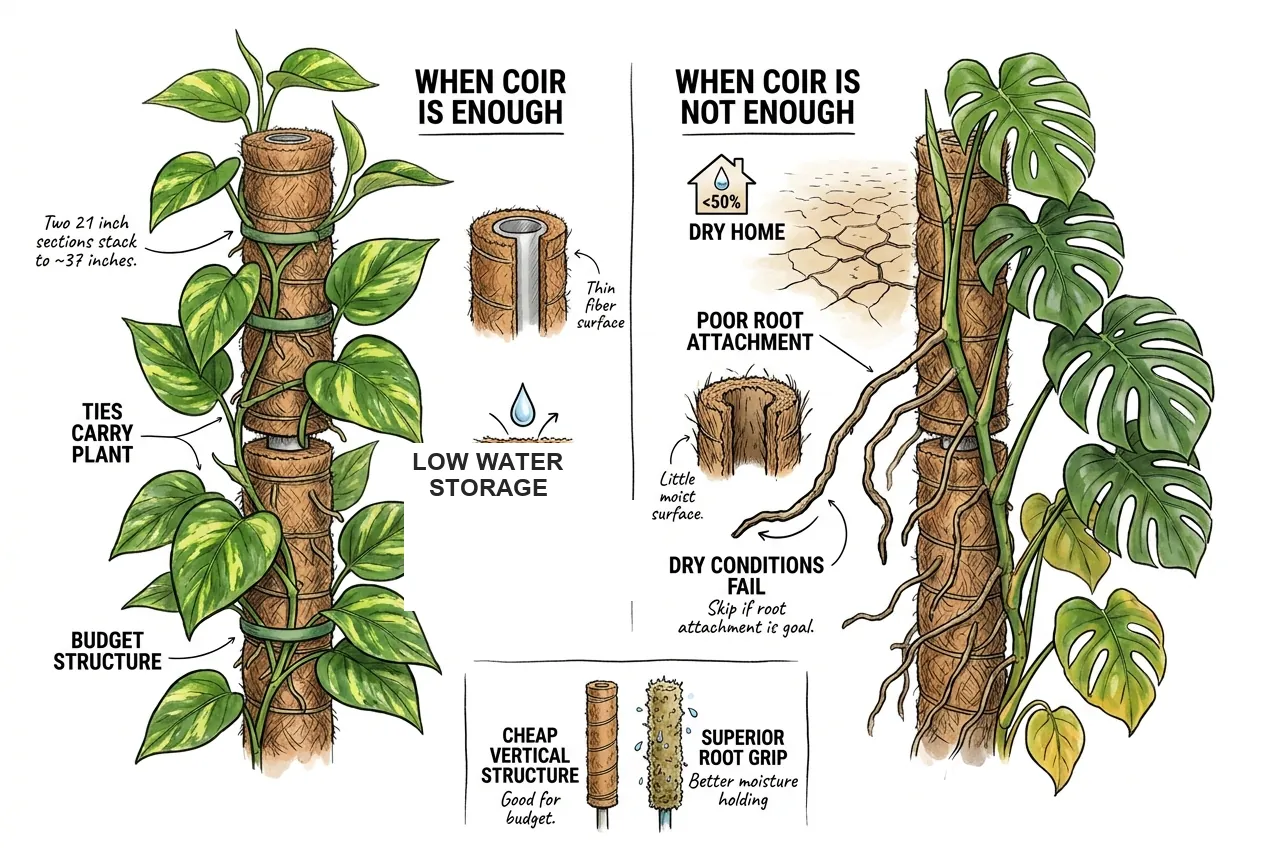
Choose coir when the tie, not the aerial root, will carry the plant. Coir gives cheap vertical structure with a thin fiber surface that dries fast and stores little water compared with sphagnum.
CHIAFFI coir totem is a budget-friendly structural support for pothos, Syngonium, or a young Monstera that you are willing to tie up.
Do not buy it expecting reliable aerial-root attachment in a dry home.
Honest tradeoff
Below roughly 50% humidity, the thin coir wrap gives large aerial roots little moist surface to grip. Skip it if root attachment is your actual goal in a dry home.
When should you choose a wood plank instead?
Choose a cedar plank when your environment supplies the humidity so the support does not have to. Treleaf, a plank maker, documents planks as low-maintenance with no misting routine when room humidity stays near 50% or higher.
The same maker rates cedar as its most moisture-resistant plank wood. Treat both points as manufacturer claims rather than independent measurements. Finished planks are best treated as a specialty or DIY purchase.
Plank spec guidance
Choose cedar, roughly 5 cm or wider. Cut it long enough to bury about a third in the pot for stability. If you grow inside a humidity-controlled cabinet, the plank pairs naturally with the environment you already built in the plant cabinet VPD product chooser.
Which sphagnum fill should you buy for a fillable pole?
Choose Long Fiber by Grade
Buy long-fiber New Zealand or Chilean sphagnum in a graded product. Grade is defined by strand length, and long strands pack into a coherent, slow-drying column. Short milled moss sifts out of mesh windows and dries in channels.
Besgrow grades its moss partly by strand length. For a pole, favor longer, cleaner strands that wrap continuously and stay in place rather than choosing by a grade label alone.
For pole fill, Classic length already works. The premium grades mainly pack easier and shed less.
Besgrow AAA sphagnum is a long-fiber option for filling a taller pole and keeping some moss for later repairs.
Buy it when you need enough material for a full build or more than one refresh. For a small pole, a smaller quantity may prevent needless leftover material.
Honest tradeoff
AAA length is wasted on craft topdressing. Skip this grade if you are not filling a pole or mounting plants.
Which ties and moisture tools complete the setup?
Support the Attachment Window
A pole also needs a soft tie, a way to wet the full moss column, and sometimes a hygrometer to troubleshoot a persistently dry room.
What tie spec prevents stem girdling?
Use a soft band at least 10 mm wide that you can loosen weekly. Aerial-root anchorage takes weeks, and the tie carries the stem load the entire time, which is why extension guidance bans wire and nylon line outright.
VELCRO ONE-WRAP ties are useful when you need to adjust a soft, broad tie as the stem thickens.
Check every tie for indentation and loosen it before it restricts the stem. Use smooth plant tape instead on velvet-leaved species that hook-and-loop material can snag.
Honest tradeoff
Hook-and-loop snags velvet-leaved species. Use smooth plant tape on plants like Philodendron melanochrysum.
If you pole-water a velvet-leaf climber, also watch substrate salts. The melanochrysum EC drift test documents how pole watering shifts root-zone EC over time.
What keeps the pole moist without daily effort?
A pressure sprayer large enough to drench the whole column in one fill, plus an honest look at your room humidity. Surface spritzing evaporates in minutes. The column must be wetted until it drips.
HARRIS pressure sprayer suits a tall pole that needs the whole moss column wetted without repeatedly refilling a small spray bottle.
It is unnecessary for one small coir pole, where a squeeze bottle is easier to store and use.
Honest tradeoff
It is oversized for one small coir pole, where a basic squeeze bottle does the job.
Govee H5075 hygrometer is useful when attachment stalls and you need to compare humidity and temperature trends near the plant.
Skip it if a monitored cabinet already gives you reliable readings, and cross-check surprising values rather than treating one sensor as exact.
How do you install a moss pole so roots actually attach?
Build From Node Contact
Install the pole against the stem so nodes touch it, then let ties do the holding for the first several weeks. Here is the sequence that satisfies the attachment mechanism.
- Put on gloves before handling dry sphagnum. CDC and state health departments document sporotrichosis, a fungal skin infection, from handling sphagnum. Health agencies recommend gloves and long sleeves for exactly this task.
- Rehydrate the moss fully, then squeeze to damp-sponge wetness.
- Pack shell poles firmly with strands vertical. Leave no air gaps, but do not compress the moss into a brick.
- Sink the pole to the pot bottom on the side the stem leans toward, behind the stem, so nodes face the moss.
- Tie at roughly every second node with the soft band in a figure-8, snug but not indenting.
- Drench the column until water drips from the base, then start your cadence.
The 1988 multistate outbreak tied to sphagnum reached 84 cases across 15 states, which is why the glove step leads the list. It is a one-glove fix for a documented risk, not a reason to fear the material.
Who should not buy each pole class?
Read the Anti-Buyer Cases
Every class has a legitimate anti-buyer. Read your row before spending.
| Class | Do not buy if | Reason |
|---|---|---|
| Exposed sphagnum surface | You travel often or skip misting days | Exposed moss dries fastest and attachment resets |
| Stackable D-shell reservoir | You hate visible plastic or need one rigid pole | Jointed plastic column, assembly required |
| Coir totem | Your goal is root attachment below roughly 50% RH | Thin fast-drying fiber offers little grip moisture |
| Cedar plank | Your room is dry with no humidifier or cabinet | No reservoir at all. Ambient RH does everything |
One caution saves real money here. Buy the pole for the plant you have, not the plant on the label. A Rhaphidophora tetrasperma climbing a 94 cm coir stack is fine for a year.
The tetrasperma’s leaf splitting depends on light, not pole class, as covered in the R. tetrasperma DLI floor guide.
What maintenance schedule keeps attachment going?
Keep the Moisture Cadence
Hold the moisture cadence, check ties monthly, and extend before the growing tip passes the pole. Those three habits prevent nearly every failure mode buyers report.
| Class | Moisture routine | Rough monthly effort |
|---|---|---|
| Exposed sphagnum surface | Mist or drench every 2 to 3 days | Roughly 60 to 90 minutes |
| Stackable D-shell reservoir | Top the cup about 1 to 2 times weekly | Roughly 15 to 30 minutes |
| Coir totem | Daily misting if attachment is the goal | Roughly 90 minutes or more |
| Cedar plank | None. Maintain room humidity | Near zero |
What are the failure modes to watch?
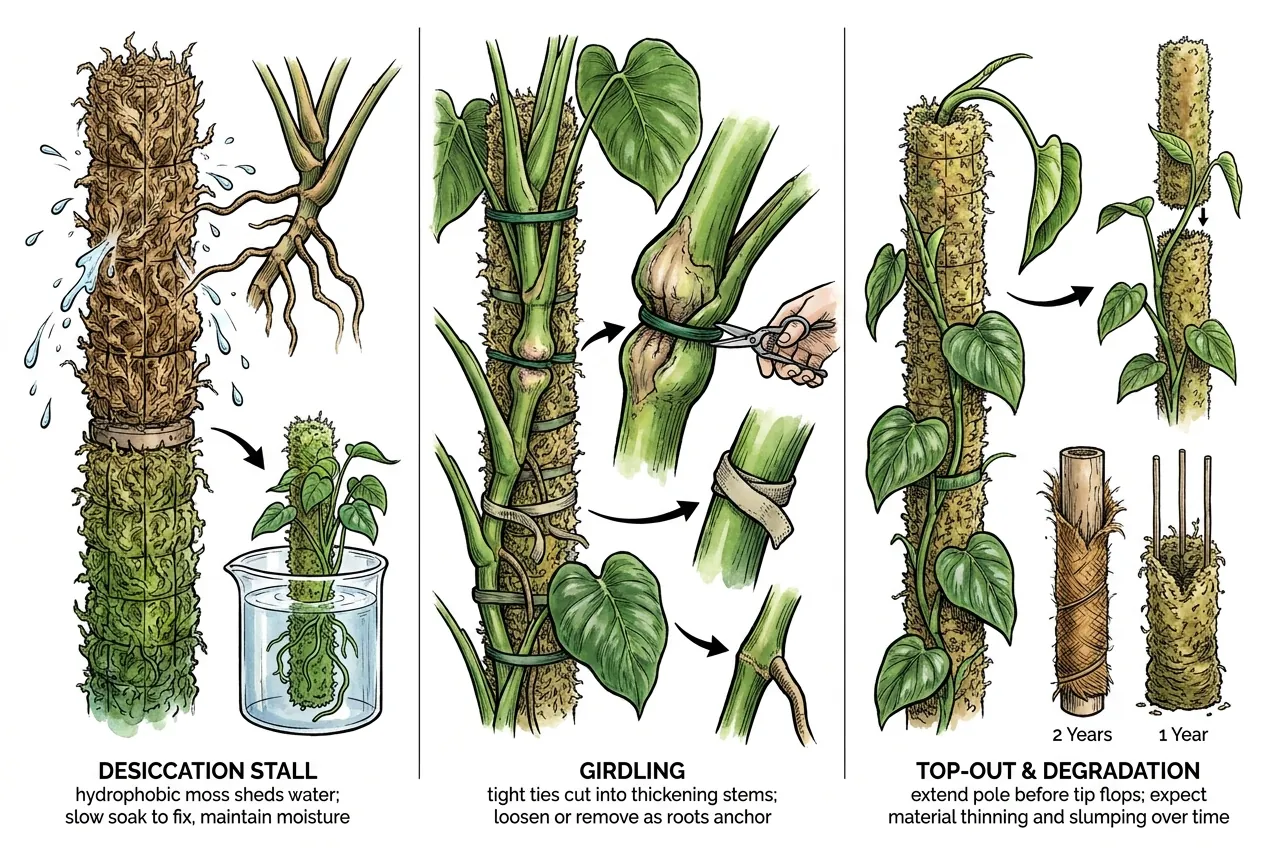
Desiccation stall is the big one. A pole that stays dry for days stops recruiting roots, and fully dried sphagnum turns hydrophobic, shedding water instead of absorbing it. Fix hydrophobic moss with a slow soak until it saturates, then never let it fully dry again.
Girdling is the silent one. Any tie left tight while the stem thickens cuts in, which is the exact damage extension guidance warns about with hard ties. Loosen anything that indents, and remove ties once a gentle tug on a root shows firm anchorage.
Top-out is the planning one. Extend the pole when the growing tip is within roughly 15 cm of the top, before the tip flops. Expect coir wraps to thin within a couple of years and sphagnum columns to slump and want repacking roughly yearly.
Moss pole FAQ (the objections buyers actually raise)
Does a dry moss pole do anything?
Yes for structure, no for attachment. A dry pole still holds the plant upright through ties. Aerial roots will not anchor to a dry surface, because adhesion needs moisture at the contact point.
If you never plan to moisten it, buy the cheaper coir class and rely on ties.
Is sphagnum really worth the upgrade over coir?
For root attachment in a typical home, yes. Sphagnum has measured saturated retention of roughly 19 to 44 times its dry weight. Coir pole makers publish no comparable figure, and the wrap dries noticeably faster.
In a humid cabinet the gap narrows, and coir or plank becomes defensible.
Do I need a hygrometer for a moss pole?
Only when attachment stalls and you cannot explain why. A logging unit near the plant shows whether heating cycles crash your humidity overnight. That single data point decides between buying a humidifier and simply misting more often.
Can I use zip ties or twine until proper ties arrive?
No. Thin, hard ties concentrate load on a narrow line of stem tissue. Extension guidance explicitly warns that wire and nylon damage the stem as it grows.
A strip of soft cloth beats a zip tie for the waiting week.
Affiliate Disclosure
This article contains Amazon affiliate links. As an Amazon Associate I earn from qualifying purchases. If you use these links, the site may earn a commission at no extra cost to you. Product availability, price, and specifications can change. Check the current listing before buying.