
Venus Flytrap Soil: The Peat & Perlite Mix Guide
Mix Venus flytrap soil with peat and perlite, avoid fertilizer and mineral-heavy water, choose a nonporous pot, and diagnose dormancy, rot and salt stress.
Marcus Hale · Published 2025-12-17 · 18 min read
Key Takeaways
- Venus flytraps need a lean, acidic medium because high-EC fertilizer or mineral-heavy water can raise salt concentration around the roots and cause osmotic stress.
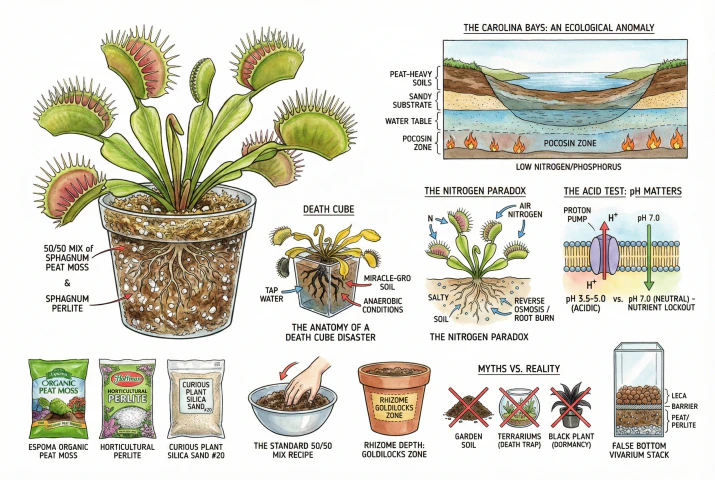
- A practical beginner mix is 50% plain sphagnum peat moss and 50% perlite or washed silica sand by volume, with no added fertilizer, lime, or wetting agents.
- Water quality matters because dissolved minerals accumulate over time, so distilled, properly maintained RO, or clean rainwater is safer than assuming hard tap water is suitable.
- The native habitat is acidic, commonly described around pH 3.5–5.0, but pot readings vary with peat, water, and measurement method, so treat the range as a guide rather than a fixed set point.
- Keep the medium wet but structurally open in a nonporous pot, use a shallow tray of low-mineral water in bright light, and expect a winter rest in temperate conditions.
Much of the usual houseplant advice works against a Venus flytrap. Rich potting soil, fertilizer, and mineral-heavy tap water, the things that help a typical houseplant, tend to harm it, sometimes over weeks to months depending on the plant, the dose, and your water.
Match the Habitat, Not Houseplant Routines
That’s because Dionaea muscipula is adapted to low-nutrient, acidic wetlands. Match the soil and water to that habitat and it is a hardy, straightforward plant. The habitat points to a practical peat-and-perlite recipe.
The Science (A Plant Adapted to Poor, Wet, Acidic Soil)
Most of this plant’s care follows from a long adaptation to a habitat that is wet, acidic, and very low in nutrients.
I rinse unfamiliar peat and aggregate with the same low-mineral water planned for the plant and compare the runoff with a water-only blank. A product labeled natural can still carry soluble minerals or fertilizer unsuitable for a flytrap.
Method and water volume stay consistent, and I treat the result as a screening comparison. An unexpected rise sends me back to the product label or a different material before potting.
Before planting, I pack a clear test pot to the same depth and firmness, set the tray water 2 cm deep, and mark the darkened moisture front after 1, 4, 8, and 24 hours. I continue every 24 hours until consecutive marks differ by no more than 5 mm. If the upper 2 cm remains dry, I raise the tray line by 5 mm and repeat. Starting low finds the minimum depth that wets the root zone without placing the crown in standing water.
The Native Habitat
Wet, Fire-Maintained Habitats Are Nutrient-Poor
The Venus flytrap has a limited native range, with scattered populations in the Coastal Plain and Sandhills of North and South Carolina.
It grows in wet, fire-maintained habitats such as longleaf-pine savannas, pocosin margins, and Carolina Bay rims.
The often-repeated claim that it occurs only near Wilmington understates the range because some populations sit well beyond that area, including in the Sandhills near Fort Liberty.
Carnivory Supplements Root Nutrition
These soils are typically sandy or peat-rich, seasonally wet, and low in nutrients, with periodic fire keeping woody competition down.
In that setting carnivory supplements the plant’s nutrition. Trapping insects is an additional source of nitrogen, on top of what the roots take up from the soil.
Roots Remain Functional
Published work describes the habitat as acidic and low in macronutrients (nitrogen, calcium, potassium, phosphorus), with the plant growing on a reduced root system.
Reduced does not mean non-functional (see the next section).
Avoid High-Salt Media
The roots are reduced compared with many plants, but they are not just anchors. Direct studies show flytrap roots actively take up nitrogen (as ammonium and amino acids such as glutamine), and root ammonium-transporter activity is high (root-derived nitrogen matters to the plant).
What the roots are not adapted to is a heavily fertilized, high-salt medium.
Osmotic Stress Depends on Dose and Exposure
The concern with rich or fertilized media is osmotic stress. When the dissolved-salt and ion concentration around the roots is high, the water potential outside the roots drops. Water becomes harder for the roots to draw in, and at high enough salinity this can injure root tissue.
This is a water-potential effect, not the pressure-driven process used by a reverse-osmosis filter.
How much damage occurs depends on salt dose, EC, ion composition, and exposure time, which is why a lean, low-mineral medium is the safe default rather than a claim that any nutrient is instantly fatal.
It’s a Question at the ‘Root’ of the Problem. Fungal Associations of Dionaea muscipula (Venus’ Flytrap) Roots in Its Native Habitat
Why Acidity Matters
Treat pH as an Approximate Range
The native habitat is strongly acidic. Reported soil pH values are commonly in the roughly 3.9–4.5 range, and growers typically target a mix around pH 3.5–5.0. Treat these as approximate. A pot reading depends on your peat, water, and measurement method (a slurry or probe reading, not a precise biological set point).
Acidity Shapes Nutrient Availability
Soil pH affects how available some nutrients are. As a general principle in plant nutrition, iron becomes less soluble as pH rises toward and past neutral, so near-neutral or limed media can make iron and some other nutrients harder for a plant to obtain, which can show up as yellowing. This is one reason growers keep the medium acidic. Measure your medium rather than assuming a sharp on/off threshold at any single pH.
Trap-Fluid pH Is Not Soil pH
The flytrap’s digestive fluid is acidic, measured at about pH 4.3 and dropping to roughly 3.4 during secretion. That figure describes the closed trap during digestion. It does not measure root-zone or whole-plant pH, so it only loosely supports the plant’s association with acidic conditions and should not be used to set a soil target.
The Protein Composition of the Digestive Fluid from the Venus Flytrap Sheds Light on Prey Digestion Mechanisms
Wet, But Breathing
Wetland Does Not Mean Submerged
Flytraps are terrestrial wetland plants, not aquatic plants. They grow in ground that stays wet, often near a seasonally fluctuating water table, but they are not submerged, and how wet the soil is varies with season and microtopography.
Avoid Reducing Conditions and Sulfide
Interestingly, flytrap roots are fairly well adapted to low-oxygen soils. Ecophysiology work reports that they remain metabolically active and tolerate periodic soil anoxia, in part through cyanide-resistant respiration.
So a wet medium is not automatically a problem. What you do want to avoid is a densely packed, decomposed medium that goes strongly reducing and starts producing sulfide (the rotten-egg smell), which is a sign of trouble.
Keep the Medium Open
In practice, keep the medium wet but structurally open. Perlite or sand is a useful way to keep the mix from compacting (a helpful structural aid, not the single thing standing between the plant and death).
Creating the Bog in a Pot
Balance Water Retention and Air Space
The goal is a medium that provides support, moisture, and acidity while staying low in fertilizer and dissolved minerals.
The recipe has two parts, an acidic water-holding base such as peat or sphagnum and a structural aggregate such as perlite or washed silica sand.
1. Sphagnum Peat Moss (the base)
Plain Peat Provides Acidity and Retention
This provides acidity and water retention. Use plain sphagnum peat moss, and read the label. Choose a product listed as sphagnum peat with no added fertilizer, lime, or wetting agents.
More decomposed peats (some sold as peat humus or sedge peat) hold less structure and pack down faster, so they are less suitable.
Peat with fertilizer or wetting agents can harm the plant over time, how quickly depends on the product and dose, so it is worth avoiding rather than treating any of it as an instant kill.
Choose a Responsible Low-Nutrient Source
Peat harvesting has a real climate and habitat cost, and it is not the only option.
Sustainably produced sphagnum moss and peat-free carnivorous-plant composts are increasingly available. The RHS, for example, recommends low-nutrient mixes including peat-free carnivorous compost.
These alternatives can perform well but vary by brand, so results are less standardized than the traditional peat mix.
Espoma’s peat is an easy hobbyist-size option. Its listed product is 100% sphagnum peat moss with no additives, which suits this use. It is one legitimate choice among several qualifying products.
Espoma Organic Peat Moss
Espoma Organic Peat Moss suits a small setup when you need a plainly labeled, additive-free peat source. Check every product for fertilizer or lime rather than relying on a brand name. Other plain peat and suitable peat-free alternatives can work as well.
2. Perlite (the aerator)
Perlite Preserves Air Space
Peat on its own tends to pack down over time, especially as it decomposes, which can reduce air space.
Perlite, a lightweight, roughly pH-neutral, expanded volcanic glass, opens up the mix, holding some water on its surface while leaving air pockets.
It is a useful structural aggregate. How much you need depends on your peat grade, pot, and watering.
Rinse Perlite for Dust and Fines
Rinse perlite before mixing, mainly to knock down dust and wash out loose fines. Use plain horticultural perlite with no added fertilizer.
(Some growers rinse in case of trace minerals. There is no flytrap-specific data showing a fluoride problem at these levels, so treat rinsing as a general dust-and-fines step rather than a proven fluoride remedy.)
Hoffman Horticultural Perlite
Hoffman Horticultural Perlite provides a fertilizer-free aggregate to keep the mix open. Any plain, reasonably graded horticultural perlite can serve the same role. Choose the amount that fits your potting volume and rinse off dust before mixing.
3. Silica Sand (optional structure)
Verify Sand Composition
For outdoor pots that need weight, washed silica or quartz sand is an alternative to perlite.
It behaves differently because it is denser and has different capillarity, so the same ratio does not make an identical medium.
What matters is composition. You want a high-quartz sand and want to avoid sands containing carbonate such as limestone, which can raise pH, or salt contamination.
Do not judge by the marketing name alone. Check the product’s composition or safety data sheet, and if in doubt, do a simple test. A few drops of vinegar or dilute acid on the dry sand should not fizz, and a rinse should not leave a high-mineral residue.
Control Silica Dust
A horticultural or pool-filter silica sand with a stated composition and grain size is the more reliable choice.
Note that dry silica sand can produce respirable crystalline-silica dust, which is a health hazard (see the safety note in the mixing steps below).
The Recipe (A Common 50/50 Mix)
This is a widely used, conservative beginner recipe measured by volume.
Sphagnum Peat Moss
Use 50% sphagnum peat moss by volume.
Perlite or Washed Silica Sand
Use 50% perlite or washed silica sand by volume.
This is one reasonable starting point, not the only proven mix (pure long-fiber sphagnum and peat-free blends also grow flytraps well).
Because peat volume varies with brand, particle grade, and how hydrated it is, note your own ratio and adjust to your pot size, tray depth, light, and climate.
Mixing Safety
Dry peat, perlite, and especially silica sand create fine dust. Crystalline-silica dust is a respiratory hazard.
Work outdoors or in a well-ventilated area, wet the materials down before handling to keep dust low, and wear a well-fitting particulate respirator, sealed eye protection, and gloves. Avoid dry sieving or pouring these materials indoors.
Preparation
- Hydrate the peat with clean, low-mineral water. Dry peat is hydrophobic and initially resists wetting, so add water gradually and let it soak in. Warm water can help it absorb. Work it until it is evenly moist, at a wrung-out-sponge consistency (dark and clumpy, not soupy). Mix gently rather than kneading it hard, since heavy kneading can break the fibers down and create fines.
- Rinse the perlite in a strainer to reduce dust and wash out loose fines. Runoff clearing up is a sign the dust is gone. It is not proof that salts or fluoride have been removed. Do this outdoors or over a sink, and keep the perlite damp so it doesn’t throw dust.
- Mix peat and aggregate into a uniform blend while tracking the volume ratio. Use a squeeze test as a rough check. A handful should release a few drops and hold its shape briefly before crumbling. A tight ball suggests the mix is too wet or dense. A handful that falls apart instantly may be too dry or coarse. Treat this as an observation rather than a substitute for measuring the ratio.
- Pot loosely. Don’t compact it. Let watering settle it so air pockets survive. An adult flytrap has a short rhizome with a few adventitious roots growing from it (not a long taproot), so spread the roots gently downward without forcing them straight, and set the plant so the growth point (crown) sits right at the medium surface. Buried too deep it can rot, left too high it can dry out. Deeper pots (about 4–6 inches) mainly help with root room, drainage, and buffering moisture and temperature. Re-check the crown height after the medium settles.
Expert-Level Insights
Water Quality (The Invisible Killer)
Use TDS as a Screen, Not a Diagnosis
Even a good mix can be undermined by mineral-heavy water. A common grower guideline is to keep watering below roughly 50 ppm TDS (total dissolved solids) as a conservative screening value.
Bear in mind that a cheap TDS meter reports an estimate converted from electrical conductivity. It doesn’t tell you which ions are present, and it doesn’t measure alkalinity or pH.
Use it as a rough screen, and if your water is borderline, check your local water report or have a sample tested.
Minerals Accumulate Gradually
Over time, dissolved minerals from watering can accumulate in a container medium. That is a gradual process, and its pace depends on your water, medium, pot, and how often you flush, so watch for trends such as declining vigor or changes in the medium rather than expecting a fixed point at which the plant suddenly dies.
Choose a Low-Mineral Source
Practical low-mineral sources are distilled water, properly maintained reverse-osmosis water, and clean rainwater.
If you want to use tap water, check its actual TDS and, ideally, a current local water report before relying on it. Many municipal supplies are well above the level growers aim for. Compare source-water trade-offs in the houseplant water guide.
For RO, keep the membrane in good condition. For rainwater, mind the collection surface, first flush, and storage to avoid contamination.
Long-Fiber Sphagnum (An Alternative Medium)
Long-fiber sphagnum
Whole dried strands, not ground peat, are an alternative to peat and perlite that some growers prefer, including for struggling plants or hot climates.
Its large pores give high water- and air-holding capacity and a low EC, and quality grades keep their structure for a few years.
Those are genuine advantages, but claims that it is impossible to overwater, antiseptic, or a cure for a sick plant go beyond what the specifications support. Depending on packing, decomposition, pot shape, and winter water level, sphagnum can still hold too much water.
If a plant is unwell, inspect the crown and roots and correct the growing conditions first, rather than assuming a substrate swap alone will fix it.
Use it as a thin top dressing on peat pots, or pot the whole plant in it. Choose clean, well-graded sphagnum. Cheaper moss can contain more sticks and debris.
Sphagnum Handling Safety
Sphagnum moss can carry Sporothrix, which can cause a skin infection (sporotrichosis) if it enters through a cut or scrape.
Wear gloves and long sleeves, cover any cuts, and wash your hands afterward. If you are immunocompromised and develop a skin lesion after handling moss, seek medical advice.
Besgrow Premier New Zealand Sphagnum Moss
Besgrow sphagnum moss is a long-fiber alternative when you want a more open, water-retentive medium. It costs more and breaks down over time, so use it for structure rather than as a cure for a struggling plant, and follow normal sphagnum handling precautions.
Choosing a Pot
Nonporous Pots Avoid Mineral Uncertainty
A conservative default is to avoid unglazed terracotta and other porous, mineral-uncertain pots.
Because they are porous, water evaporates through the walls and can leave mineral deposits, and depending on the clay there is a risk of alkaline minerals entering the acidic medium.
If you already have a favorite terracotta pot, you could test it, but nonporous options avoid the question.
Control Pot Heat and Mineral Contact
Nonporous plastic, fully glazed ceramic, and resin pots are all reasonable. They differ mainly in moisture, salt handling, and temperature.
Dark plastic in full summer sun can heat the root zone significantly, potentially hotter than the surrounding air, so favor light-colored or opaque pots in hot, sunny spots. Consider shading the pot side, pot-in-pot insulation, or keeping the tray water cool.
Deeper pots, about 4–6 inches, give the roots room and buffer moisture and temperature. An adult flytrap has a few adventitious roots from a short rhizome, not a long taproot.
Reading the Rhizome and Roots
Read Several Root Signs Together
If you unpot a flytrap to check it, use several signs together rather than a single one. A healthy rhizome is firm and pale (creamy white to pink).
Healthy flytrap roots can be dark, even blackish, and still be firm. Dark color alone is normal and is not by itself a sign of salt injury.
So look at firmness, color, smell, whether tissue slips off, and the plant’s recent watering and medium condition together.
Mushy Rhizomes Suggest Rot
A mushy, brown, foul-smelling rhizome is a serious sign of rot. Rot can follow packed, oxygen-poor, decomposed medium, but also cold or heat damage, crown injury, or pathogens, so consider the whole picture.
Improving aeration (a looser mix or long-fiber sphagnum), keeping the plant out of deep standing water during dormancy, and removing clearly dead tissue can help. There is no single ratio that guarantees a fix.
Sloughing Roots Suggest Serious Damage
Roots that slough off or disintegrate indicate serious root damage, with possible causes including rot, physical damage, and salt injury when water or medium is high in minerals.
Before repotting, check the medium’s condition and, if possible, its EC. If minerals are the likely cause, flushing the pot with several pot-volumes of low-mineral water can help. If the medium is broken down or the roots are badly affected, repot into fresh mix.
Avoid repeatedly unpotting a stressed plant, and use clean tools.
Repotting and Regional Tweaks
Let Medium Condition Set Repotting Time
Late winter or early spring, as the plant wakes from dormancy, is a convenient time to repot.
Rather than a fixed interval, let the medium’s condition decide. Refresh it when the peat has broken down, drains poorly, smells sour, or has accumulated minerals.
You can also nudge the ratio to your conditions. In hot, high-evaporation settings a slightly higher peat fraction (and a light-colored surface) can help hold moisture, while in low-light, low-evaporation spots more perlite or long-fiber sphagnum reduces the risk of staying soggy.
Base these tweaks on your measured heat, humidity, light, and how fast pots dry, not on a state-wide rule.
Troubleshooting (Q&A) (Myths vs. Reality)
Can I use garden soil for a Venus flytrap?
No. It’s a poor choice. Typical garden and potting soils contain compost, manure, and added minerals, and are usually near-neutral in pH. The high nutrient load and pH are what flytraps are not adapted to, which is why growers use a lean, acidic mix instead.
(This is about avoiding a rich, mineral-heavy medium, not because the plant can use no minerals at all. Its roots do take up some nitrogen.)
Does a Venus flytrap need a terrarium?
Not necessarily, and a poorly run one is risky. Flytraps tolerate ordinary humidity and generally do best with good airflow and strong light. A sealed, dim, or waterlogged container can breed mold and go stagnant, and a closed glass container in direct sun can overheat and cook the plant (from trapped solar heat and low airflow, not because glass acts as a lens). The closed-terrarium science guide explains the heat, gas-exchange and moisture trade-offs.
An open tray in bright light is the simplest beginner setup, but flytraps can also be grown well in an open, ventilated terrarium with adequate LED light and temperature monitoring. If you need an artificial fixture, start with the plant grow-light guide.
Is a Venus flytrap dead when it turns black in winter?
Often it is dormant, not dead. Flytraps are temperate and usually take a cooler winter rest, during which traps can blacken and die back.
But blackening can also come from old-trap turnover, stress, rot, or cold damage, so check the season, the central growth point, and whether the rhizome is still firm before concluding it is dormant.
For the rest, keep the plant cooler and less waterlogged than in active growth. A cool windowsill, unheated room, or garage can work in a temperate climate.
Refrigerator dormancy is a more involved technique that needs its own setup, controlled temperature, clean handling, the right moisture, ventilation, and periodic checks, so do not put a plant in the fridge without following a proper protocol.
Approaches to dormancy differ with your climate and whether the plant grows indoors or out, so follow a method suited to your situation.
Match Soil and Water to Its Habitat
Growing a Venus flytrap isn’t hard (it’s mostly counterintuitive). Don’t feed the soil (no fertilizer), don’t lime it or add unchecked sand, keep the medium open enough to hold air (perlite or silica sand), and water with a low-mineral source such as distilled, RO, or clean rainwater.
Mix the 50/50 peat-and-perlite medium by volume, set the pot in a shallow tray of low-mineral water, and give it bright light. Use the PPFD and DLI guide if you want to measure an indoor setup rather than judge brightness by eye.
If your plant is coming from a store display, increase its light over a week or two rather than moving it straight into intense full sun.
Match the soil and water to its wet, acidic, low-nutrient habitat and it should grow steadily and reliably.
Affiliate Disclosure
This article contains Amazon affiliate links. As an Amazon Associate I earn from qualifying purchases. If you use these links, the site may earn a commission at no extra cost to you. Product availability, price, and specifications can change. Check the current listing before buying.