
Closed Terrarium Science: Bioactive Ecosystems Guide
The science of closed terrariums: how to build the drainage and substrate layers, choose humidity-loving plants, clean an empty vessel safely, and maintain a low-input planted, bioactive ecosystem.
Samuel Reed · Published 2025-12-02 · 18 min read
Key Takeaways
- A sealed terrarium is for plants and optional microfauna only. Do not keep frogs or other amphibians in a sealed jar. They need species-specific temperature and humidity, a ventilated enclosure, water quality management, and veterinary care that a sealed vessel cannot provide.
- A closed terrarium runs a small, partial water cycle that you still manage. It is not a self-contained biosphere and still needs light, occasional venting, pruning, and watering. Aim to guide a living process rather than freeze a perfect scene.
- Build an airy, compaction-resistant, well-draining substrate. A coarse drainage layer such as LECA with a barrier mesh can reduce the perched water table, but it does not cure overwatering. Heavy garden soil packs down and stays wet in a jar with no drainage holes.
- Separate cleaning, disinfecting, and sterilizing. Clean an empty vessel, keep every chemical away from plants and animals, follow the product's dilution and contact time, and rinse and dry thoroughly. Never mix bleach with ammonia or acids.
- Choose tropical understory plants that tolerate high humidity and keep the root zone moist but not waterlogged. Arid plants are a poor fit. Note that Selaginella kraussiana is invasive in several regions, so contain it and dispose of trimmings responsibly.
- Springtails are optional decomposers, not a cure-all. Give the terrarium bright indirect light, avoid direct sun, and read condensation alongside soil feel, reservoir level, and plant condition.
Start With the Limits of a Sealed Terrarium
A sealed terrarium recycles some water through evaporation and condensation, but it is not self-sustaining. Light and heat cross the glass, nutrients decline, and you still need to water, prune, and vent it when conditions call for it.
I seal and weigh the finished vessel 24 hours after its last watering, then use the same scale at the same hour every seven days for four weeks. I investigate the seal only after two consecutive week-to-week losses greater than three times the scale’s displayed resolution. The delay excludes free drainage, while repeated losses separate a leak from scale noise.
A matching photograph captures the water level and condensation at the same time of day. Weight, visible water, and plant condition together are more useful than fog alone for deciding whether the closed cycle is actually losing moisture.
Let the Design Change Over Time
The Nature Aquarium style pioneered by the late Takashi Amano was widely influential in naturalistic aquascaping, and its emphasis on transience and imperfection resonates with the Wabi-Sabi worldview.
Many terrarium designers draw on a similar aesthetic, though the direct genealogy from aquascaping to terrarium design is more of an affinity than a documented lineage.
In practice, that aesthetic means the hardscape and plants need not strive for artificial symmetry. A moss-covered stone or a wandering creeper can look more natural than manicured perfection.
A slightly weathered piece of wood can work too, but choose it deliberately. Heavy fungal load, tannin staining, or structural rot are maintenance problems, not just character.
This framing matters for beginners because it relieves the anxiety of perfectionism. A terrarium is a living process to guide, not a moment to freeze.
Choose and Prepare the Vessel
The vessel is both the atmosphere and the boundary of the system, so its selection and preparation define light transmission, thermal behavior, and chemical safety.
Choose Glass or Acrylic for Your Space
Both glass and acrylic (PMMA) are used for closed systems, and each has tradeoffs. Silicate glass is hard (about 5.5–7 on the Mohs scale) and scratch- and chemical-resistant, so it resists the micro-scratches that cleaning tools can leave on softer plastics.
Acrylic, on the other hand, is much lighter and far more impact-resistant. The better choice depends on the specific grade, wall thickness, enclosure size, and how it interacts with your adhesives and cleaners.
Glass is chemically stable and easy to keep clean. Acrylic is not automatically a problem here. Unlike flexible PVC, cast PMMA does not rely on plasticizers, so blanket claims that plastic leaches plasticizers don't apply to it. Check the specific product's data if you're unsure.
The main thermal issue with any transparent vessel is overheating in sun. Sunlight (mostly visible and shortwave) passes in and warms the interior, and the enclosure limits how quickly that heat escapes.
Manage that with placement (see the light section below) rather than assuming one material stays cooler than another.
Clean an Empty Vessel Safely
It helps to separate three things. cleaning (removing dirt and residue), disinfecting (reducing most microbes), and sterilizing (killing essentially everything, including bacterial spores).
Do all of it on an empty vessel, keep chemicals away from any plants, moss, or animals, and rinse and dry thoroughly before replanting.
Leaf cuticles and (if you ever set up a separate, properly ventilated animal enclosure) permeable amphibian skin are sensitive to residue, so surfactants and disinfectants should never contact living tissue.
Bleach can disinfect empty equipment when used at the product’s labeled concentration and contact time, followed by a thorough rinse and complete drying.
Never expose plants or animals to bleach, and never mix bleach with ammonia or acids such as vinegar.
70% isopropyl alcohol
It is a useful disinfectant that kills many bacteria and fungi, but it is not a sterilant. It does not destroy bacterial spores, penetrates organic soil poorly, and evaporates so fast that maintaining a proper wet contact time is difficult.
It is also flammable and can craze or degrade some plastics, adhesives, and seals. Use it on clean, empty surfaces, keep it away from ignition sources, and don't treat evaporates fast as proof of sterility.
White vinegar
For hard-water stains (calcium carbonate), white vinegar dissolves the deposits into water-soluble calcium acetate that rinses away, restoring clarity without abrasion.
Note that 10% cleaning vinegar is more irritating than 5% food-grade vinegar. Ventilate the area, keep it off plants and animals, rinse well afterward, and never combine it with bleach.
Remove Label Glue Before Planting
Repurposed bottles often have water-resistant label glue, so soaking may remove the paper but not the residue. A thin layer of cooking oil can loosen some glues. If it does not, use a method approved for the vessel material.
Cooking oil is the simplest option (soak the bottle in hot soapy water to lift the paper, rub on a thin layer of oil, wait a while, then wipe and wash).
(Peanut butter is sometimes suggested, but its solids, sugar, and lipids can leave residue that feeds mold and microfauna, and it introduces a food allergen for no real benefit. Plain oil avoids all of that.)
Whatever you use, wash the glass thoroughly afterward and dry it, since leftover lipids change how condensation wets the glass later.
Build a Light, Airy Soil Layer
A closed terrarium is best filled with a light, well-draining medium rather than heavy garden or top soil, which is dense and stays wet in a small container.
In the open ground, water drains away through a deep soil profile. In a jar with no drainage holes, water collects at the bottom and a perched water table can keep the lower soil saturated.
(This is about container hydrology and particle structure, not just gravity. A coarse layer under fine soil does not, by itself, drain the soil above it.)
Note that not all bagged mixes are bad. A sterile, lightweight, soilless terrarium or potting medium is commonly recommended and behaves very differently from dense garden soil.
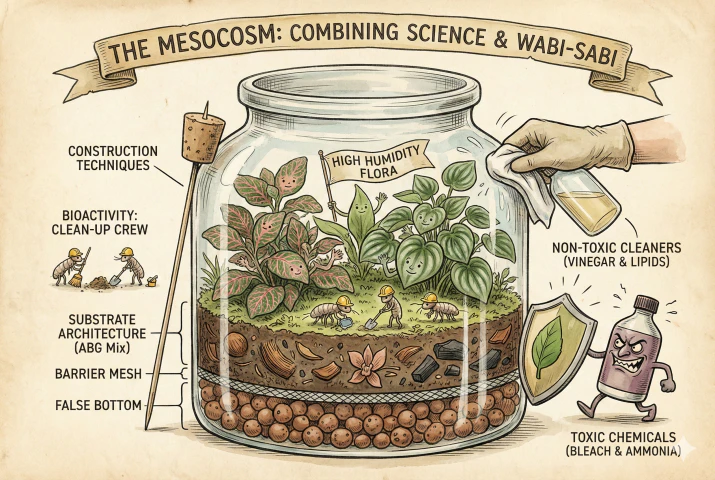
Many keepers add a coarse false bottom reservoir to help. To work as intended it needs a barrier mesh separating the reservoir from the soil, a maximum water level kept well below the soil, and a way to check and siphon it.
It reduces standing water against the roots, but it does not cure overwatering, and stagnant water at the bottom is not a source of oxygen.
Add a Small, Separated Reservoir
The bottom layer is a reservoir that holds standing water below the soil where roots live.
Lightweight Expanded Clay Aggregate (LECA) is a popular choice. Kiln-fired clay balls that are inert and porous, creating void space for water (gravel is a heavier, less porous alternative).
For this to keep the soil out of the water, place a barrier mesh over the LECA before adding substrate. Otherwise fine soil sifts down into the voids and defeats the purpose.
There's no single correct depth (it depends on vessel geometry, root depth, particle size, and how you water).
Guides often suggest something on the order of a couple of inches in a larger build, less in a small jar.
In a small container, a large reservoir can eat up most of the root zone, so keep it modest and check the water level as you go rather than following a fixed percentage.
LECA as a Lightweight Reservoir Layer
Horticultural or hydroponic fired-clay pebbles are one convenient way to build this reservoir because they are light, reusable, and leave large voids between particles. Products differ in particle size, dust, soluble salts, pH effect, strength, and suitability for plant or animal enclosures, so do not assume that every fired-clay material is interchangeable. Check the intended use, rinse it, and test questionable material before adding it to a living build.
LECA floats when first wetted and usually costs more than gravel, but it's far lighter for a large build and can be rinsed and reused (clean and sanitize it before reuse).
Rinse it before first use to wash out clay dust. On its own it doesn't stabilize humidity or prevent overwatering (that depends on the mesh, water level, and how you water).
Use Charcoal Only as an Optional Component
Above the drainage layer, many recipes include activated charcoal. Carbon with a high internal surface area that can adsorb some dissolved organic compounds.
How much it removes, and for how long, depends on the type of carbon, the specific compounds, pH, moisture, and contact time. Its capacity is finite and it eventually reaches breakthrough.
A thin horticultural-charcoal layer is an optional component, not a filter that continuously strips all organics, tannins, or phytotoxins.
Its binding sites fill over time. Spent charcoal can still host biofilm on its surface, but don't count on a waterlogged lower layer as a reliable home for nitrifying bacteria or springtails. Nitrification needs oxygen and alkalinity, and springtails live on moist, aerated substrate surfaces where there is food and air.
Ordinary horticultural charcoal is not a dependable safety net against ammonia spikes. Removing ammonia depends on the carbon type, ion exchange, and the system's chemistry, and a plant-only jar has no meaningful ammonia source in the first place.
If you ever keep animals, charcoal is no substitute for water testing and a properly ventilated, aerobic biofilter.
Choose a Substrate That Resists Compaction
| Component | Function | Relative Porosity | Relative Decay Rate | Typical pH Tendency |
|---|---|---|---|---|
| Coco Coir | Moisture Retention | High | Slow | Near-neutral (often ~6.0–6.8) |
| Sphagnum Moss | Moisture & Acidity | Very High | Slow | Acidic (often ~3.5–4.5) |
| Orchid Bark | Aeration & Structure | High | Medium | Slightly acidic |
| LECA | Drainage / reservoir | High | Very slow | Near-neutral |
| Charcoal | Some adsorption | High | Very slow | Often slightly alkaline |
| Worm Castings | Nutrition | Low | Variable | Near-neutral |
Use a Light, Airy Substrate
A dense, heavy potting mix can compact and hold too much water in a jar. Aim for a substrate that stays airy and compaction-resistant. A sterile, lightweight, soilless terrarium medium can meet that goal too, so a custom blend is not required.
The ABG Mix (Atlanta Botanical Garden) is a widely used bioactive substrate. The classic formula is roughly 2 parts tree fern fiber, 2 parts fir/orchid bark, 1 part peat, 1 part sphagnum moss, and 1 part charcoal.
A common variation swaps in coco coir, for example coir (2 parts) for water retention, orchid bark or tree fern fiber (2 parts) for the macropores that let roots breathe and springtails travel, charcoal (1 part), and sphagnum moss (1 part).
Coir avoids peat harvesting, but it isn't a no-strings replacement. It can carry salts and varies in EC and pH by batch, so rinse and check it and match it to your plants.
Choose Plants for Humid, Still Air
Choose Plants for Moisture Without Saturation
Plant choice is a key biological decision because a closed terrarium tends toward high humidity and low air movement. Internal humidity varies with light, temperature, the seal, and how much plant mass is inside, so it is not a fixed 90–100%. Aim for a root zone that is moist but not waterlogged because even tropical plants suffer root hypoxia and rot in saturated substrate.
Arid plants such as cacti are a poor fit for a humid sealed jar. The right candidates are tropical understory plants from the rainforest floor, where light is dappled and the air stays humid.
4.1 Fittonia albivenis (The Nerve Plant)
Fittonia, native to southern tropical America (its range includes Peru), is a classic terrarium plant.
Its thin, broad leaves lose water readily, which is why it wilts dramatically in a dry room but holds turgor easily inside a terrarium, where the low vapor pressure deficit slows water loss.
Its reticulated red, pink, or white veins contrast beautifully with moss. As a creeping herb, it benefits from occasional pinching. Removing the growing tip disrupts auxin flow and pushes lateral buds to sprout, creating a dense mound instead of a leggy weed.
4.2 Peperomia caperata Rosso (The Emerald Ripple)
Small Peperomia can do well in a terrarium, and Rosso tolerates steady moisture better than the semi-succulent types when the mix remains well aerated. It is still prone to root rot if the substrate stays soggy or water pools around it, so keep it moist rather than wet. Its deeply corrugated leaves and red underside are attractive features, but the idea that the red pigment boosts photosynthesis remains a hypothesis for this cultivar.
4.3 Selaginella spp. (Spike Mosses)
Despite the common name, Selaginella is not a moss. It is an ancient lycophyte, a distinct lineage of vascular plants with tiny leaves. S. kraussiana is a fast, resilient ground cover that can overgrow slower plants and is invasive in several regions, so contain it and bin trimmings rather than releasing them. S. uncinata shows blue iridescence created by thin-film interference, although its role as a low-light adaptation remains uncertain.
4.4 Ficus pumila (Creeping Fig)
A vigorous liana that serves as the terrarium's wallpaper, producing adhesive aerial roots that cling to glass and hardscape.
Left unchecked it will cover the walls and block light, so it needs regular pruning and is best in larger vessels where it can climb a driftwood centerpiece.
Plant Without Compacting the Substrate
Working through a narrow bottle neck calls for specific techniques and improvised tools.
5.1 Propagule Selection (Cuttings vs. Root Balls)
For bottle terrariums, fresh cuttings and established plants each have their place. Nursery soil can carry fungus-gnat larvae and fertilizer salts, so a clean cutting removes that vector, but cuttings can also carry mites, scale, fungus, or virus, so inspect them, rinse the roots or wash cuttings, and quarantine new material where you can.
An established root ball has the advantage of already being rooted.
A slender cutting slips through a bottleneck easily, whereas a root ball has to be compressed (which can damage roots).
The high humidity inside helps cuttings by lowering water loss, so many will root without hormone, but timing and success vary by species (Peperomia, Ficus, Fittonia, and Selaginella all differ), and constantly wet, low-oxygen substrate can rot stems instead.
It's a helpful propagation environment, not a guaranteed one.
5.2 The Ship in a Bottle Toolkit
When your hand can't fit inside, use long-handled tools. Taping a teaspoon to a chopstick makes a serviceable long shovel.
For pruning, use long-handled terrarium scissors or tongs rather than taping a loose razor blade to a stick. An improvised blade can slip off inside the vessel and cause cuts or crack the glass.
A wine cork on a bamboo stick makes a handy tamper. After setting a plant in its hole, gently firm the soil around the base for good root-to-substrate contact.
Don't pack it hard, though. The point of an airy mix is to keep pore space, and heavy compaction reduces oxygen and drainage.
And a funnel rolled from paper directs drainage media and soil to the center without dirtying the glass walls.
Manage Light, Heat, and Moisture
Light is the main energy input for a sealed terrarium, and managing it is one part of keeping the system healthy (alongside water, temperature, and the balance of organisms inside).
Give Plants Bright, Indirect Light
Measure Light at the Plant Surface
Terrarium plants are often called shade plants, but they still need bright indirect light. As a rough starting point, many do well around 800–2,000 foot-candles, or roughly 8,600–21,500 lux. The right level depends on the plant, its distance from the light, and the photoperiod, so watch each plant and adjust rather than aiming for one universal number.
With artificial light, a daylight-white LED (around 6500 K) is a common, easy choice. Correlated color temperature (CCT) is not a full spec, though. Two lights at the same CCT can differ in spectrum and photon output, and stretching (etiolation) is driven by the blue fraction, red-to-far-red ratio, total light delivered per day (DLI), temperature, and species, not by CCT alone.
Warm-white light does not automatically cause leggy growth.
Direct sunlight is the main hazard. Sunlight (mostly visible and shortwave) passes through the glass and warms the interior, and the enclosure slows how fast that heat escapes, so a terrarium in direct sun can overheat quickly. Check it with a thermometer rather than assuming an exact figure.
Sustained high temperatures stress and can kill the plants. Keep it in bright indirect light.
LEDs run cooler than the sun but are not heat-free, so leave some distance between the fixture and the vessel.
6.2 The Hydrological Cycle (Reading the Condensation)
Condensation is one useful signal, but not a moisture meter on its own. Dew on the glass depends on the difference between inside and outside temperature and the glass surface temperature, not just how wet the terrarium is. A common healthy pattern is mostly clear glass during the warm part of the day and light fog or droplets in the cooler evening and morning. That pattern varies with the room, season, and lighting, so read it alongside other signs.
If the glass stays fully fogged for days, it may be too wet, but check the soil feel and color, the reservoir level, and whether any plants are wilting or rotting before acting. Venting the lid for a while can help.
(Persistent fog doesn't necessarily mean gas exchange is blocked.) If the substrate looks dry and no dew forms, confirm it's actually dry, then mist lightly.
It's generally safer to add water in small increments than to try to remove excess.
Maintain the Living Substrate
A bioactive terrarium adds microfauna to help build a working decomposition cycle in the substrate.
7.1 The Clean-Up Crew. Springtails (Collembola)
Springtails are small, optional decomposers. A plant-only closed terrarium can be maintained without them.
They eat decaying material and some fungi, but they are not a treatment for mold or plant disease. Laboratory work on one springtail species does not establish that they prevent problems in a sealed terrarium.
Springtails Are Not an Immune System
In a humid terrarium, a saprophytic mold bloom on new wood is common early on, and springtails will graze some of it. How much mold appears depends on substrate freshness, moisture, air, and temperature, and not every white growth is harmless. Springtails do not remove every pathogen.
Seeding a starter springtail (Collembola) culture at setup can shorten the time to establishment.
The population is shaped by moisture, oxygen, temperature, mites, and the viability of the starter. It doesn't simply self-regulate to the food supply, and you may need to top it up from a separate mother culture.
The vessel also can't be fully airtight, since the colony needs some gas exchange.
Choose a Live Culture With Clear Arrival Terms
A temperate springtail culture may contain Folsomia candida, but confirm the species with the supplier. Because it ships live, quality depends on weather, transit time, culture medium, and arrival condition. Seed early, provide the food and moisture specified for that culture, and confirm that the population is established rather than relying on a calendar. Springtails do not correct a chronically waterlogged jar.
Soil Allies. Exploring the Combined Potential of Folsomia candida and Trichoderma against Fusarium oxysporum
7.2 The Fungal Bloom
New keepers often worry about white fuzz (mycelium) on wood or soil in the first weeks. This is frequently harmless saprophytic fungus feeding on sugars in fresh substrate.
Colour alone doesn't confirm that, though. Check whether nearby plant tissue is symptomatic, whether it smells off, and whether it's spreading, since white growth can also be a plant pathogen, an oomycete, or decaying tissue.
A minor bloom can usually be left alone. Springtails and normal competition tend to bring it back into balance.
First fix the conditions that feed it. Remove the decaying material, correct excess moisture and temperature, and improve air movement. Reach for a chemical only if you've identified the problem.
Be cautious with hydrogen peroxide. Even household 3% is an oxidizer that is not fungus-selective, so it can damage plant tissue, moss, beneficial fungi, and microfauna, and one study found a single 3% root dip caused a minor setback in orchid root health.
If you use it at all, keep it off living plants and springtails, follow a peroxide product's label directions, and don't assume it breaks down into water and oxygen makes it harmless on contact.
Use Observations to Make Small Adjustments
| Symptom | Possible causes (more than one) | What to check | Low-risk first steps |
|---|---|---|---|
| Yellowing leaves | Overwatering / root rot, but also low light, nutrient issues, pests, or normal old-leaf senescence | Soil wetness and smell, reservoir level, roots, light level | Stop watering. Vent to dry out, if roots are rotting, remove the plant and trim. Don't assume one cause. |
| Leggy growth | Too little light. Can also relate to spectrum (R. FR), temperature, and cultivar | Distance to light, photoperiod, plant type | Increase light gradually or move closer. Pinch tips to encourage lateral growth. |
| Mold bloom | Fresh sugars in new substrate, excess moisture, poor air movement, or poor sanitation | Whether it's spreading, plant symptoms, moisture, airflow | Remove decaying material. Correct moisture and airflow. Leave a minor bloom to competition. Use peroxide only cautiously and only after identifying the problem. |
| Glass algae | Too much light or nutrients. Also excess moisture | Light intensity and photoperiod, direct sun, substrate richness | Reduce photoperiod. Wipe the glass. Move out of direct sun. |
| Brown / crispy leaves | Low humidity, but also heat, salt buildup, or root damage that stops water uptake | Seal, temperature near the glass, roots (rot can also dry the leaf tips) | Check the seal and roots first. Mist lightly only if the air is genuinely dry. Heavy misting can worsen a waterlogged jar. |
Use the plants, soil, reservoir, and condensation together to decide whether to water, vent, prune, or change the light. Small adjustments are safer than trying to correct a sealed terrarium all at once.
A good terrarium is allowed to change. Plants grow, compete, and settle into niches, moss creeps over stone, and creeping fig traces the glass.
Through the lens of Wabi-Sabi, that gradual change is part of the appeal rather than a mess to tidy, while still keeping an eye out for disease or invasive overgrowth that call for actual maintenance.