
Anthurium 2025: Genomics, Market & Conservation Report
The 2025 state of Anthurium: the first amnicola reference genome and what it can and can't yet do for blight, the tissue-culture market shift and designer hybrids, and conservation concerns around wild-collected velvet species.
Marcus Hale · Published 2025-12-07 · 15 min read
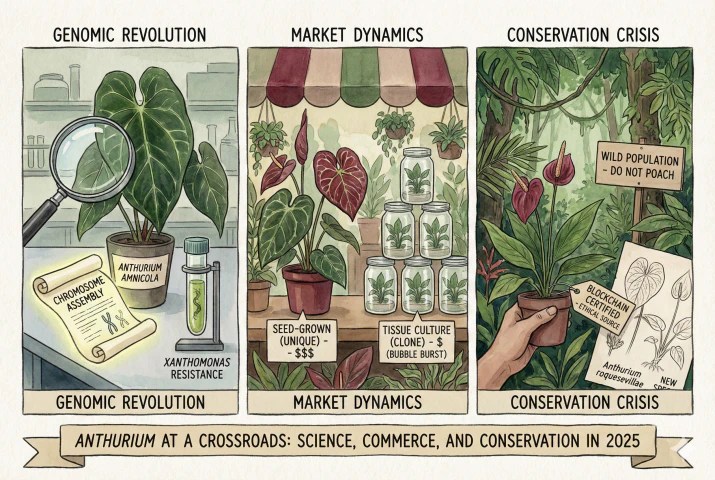
Key Takeaways
- 2025’s landmark science is the chromosome-level Anthurium amnicola genome (~4.79 Gb, ~78% repetitive DNA) (the first reference genome for the genus). The published paper reports the assembly, annotation (~20,380 coding genes), repeats, and phylogeny. It does not itself deliver blight-resistance markers, but it lays a foundation future mapping work can build on.
- Bacterial blight (Xanthomonas) is widely cited as the most serious pathogen in Anthurium production. A reference genome is a prerequisite for eventually developing marker-assisted selection, but that still requires mapping populations, validated resistance-linked markers, and independent replication (none of which the genome paper reports).
- Disease management is best framed as integrated. Pathogen-free stock, sanitation, water/leaf-wetness control, resistant cultivars, and both chemical and biological measures belong together. Root symbionts are one biological tool under study, not a replacement for the rest.
- Tissue culture has visibly lowered prices for some formerly rare aroids. The clearest documented case is Philodendron spiritus-sancti (a Philodendron, not an Anthurium), which fell from very high asking prices to small plants selling for tens of dollars. That shifted collector attention toward seed-grown hybrids, designer breeder lines, and hard-to-clone variegation.
- There is a genuine conservation concern behind the trade. Rare-plant demand can drive wild collection of velvet species such as A. papillilaminum and A. dressleri. Specific claims of population extinction or CITES laundering below are disputed or unverified, and are flagged as such.
The genus Anthurium, the largest in the Araceae family, with roughly 1,459 accepted species (Kew, POWO), drew attention on three fronts in 2025. These were the first chromosome-level reference genome for the genus, a collector market reshaped by social media and high-value designer hybrids, and rising concern about wild collection of rare foliage species.
The discussion separates those developments and identifies claims that rest on a single Reddit thread, a commercial market estimate, or a grower’s observation rather than a peer-reviewed source or official assessment.
What Genomics Can and Cannot Change Yet
Why the Reference Genome Matters
Anthurium breeding has long been guided largely by phenotype (crossing plants on visible traits and waiting years for results).
Molecular resources such as nuclear and chloroplast sequences, markers, linkage maps, and transcriptomes existed before 2025, but the genus lacked a reference genome, in part because of its large, highly repetitive genome.
The 2025 assembly adds that missing reference, moving one part of Anthurium science closer to genome-guided methods.
1.1 The Anthurium amnicola Genome Assembly
The chromosome-level genome assembly of Anthurium amnicola is described as the first reference genome for the neotropical genus Anthurium. Earlier molecular resources included markers, linkage maps, and transcriptomes but no genome of this kind.
A. amnicola (the tulip anthurium) was chosen for its close relationship to commercial cut-flower relatives, its known genome size and chromosome number, and practical traits such as abundant stems and flowers (a diploid in section Calomystrium (n=15, 2n=30)).
Sequencing a clean diploid rather than a hybrid of uncertain lineage gives a baseline reference for the genus.
The effort combined PacBio HiFi long reads with Hi-C chromatin capture, suited to the genome’s scale and repetitiveness.
The assembly is roughly 4.79 gigabases, larger than the human genome (~3.2 Gb) and far larger than Arabidopsis (~0.135 Gb).
Much of that size comes from repetitive DNA. About 78.5% of the genome is repetitive elements, predominantly LTR retrotransposons, the kind of long, near-identical stretches that are difficult for short reads to bridge.
Long reads spanned those regions, and Hi-C anchored about 98.5% of the assembly onto the 15 chromosomes (BUSCO completeness 99.2%).
The annotation contains roughly 20,380 protein-coding genes, the first comprehensive gene set for an Anthurium.
Genome sequencing of Anthurium amnicola
1.2 Bacterial Blight and What a Genome Can (and Cannot Yet) Do
One motivation cited for the genome project is bacterial blight, caused by Xanthomonas phaseoli pv. dieffenbachiae (the name X. axonopodis pv. dieffenbachiae is a synonym you will still see in older literature).
It is one of the most serious pathogens in Anthurium production, and industry sources have long described it as a leading limiting factor.
Xanthomonas is a systemic vascular pathogen entering through hydathodes or wounds and colonizing the xylem. Symptoms include water-soaked lesions, yellowing, vascular browning, and death.
It can lurk asymptomatically for a time and is hard to eradicate once established in a greenhouse, and severe outbreaks can force destruction of affected crops.
Plant immune receptors of the NBS-LRR (Nucleotide-Binding Site Leucine-Rich Repeat) family detect pathogen effectors and trigger a defensive (often cell-death) response.
These genes are commonly clustered in plant genomes, so a reference genome makes it possible to catalogue them.
Importantly, the A. amnicola paper does not report an NBS-LRR resistance-island analysis, a blight-resistance QTL, or any phenotype-linked marker. Those are not part of its published results.
The reference genome is a starting point, not a working blight test. Breeders still need to link DNA markers to proven disease resistance and validate them in independent populations. Do not treat leaf testing or seedling screening as an available blight-control tool yet.
1.3 The Microbiome Frontier (Biological Control and Symbiosis)
Alongside genetics, beneficial root microbes are one area of research into Anthurium health.
In practice, disease management is integrated rather than a swap of chemistry for biology. Pathogen-free stock, sanitation, water and leaf-wetness management, resistant cultivars, diagnostics, and both chemical and biological measures are used together.
One study found that a particular beneficial root fungus improved growth and resistance responses in Anthurium. It tested bacterial wilt, not Xanthomonas blight, so it does not prove protection against the common blight problem.
Other bacterial biocontrols (various Bacillus and Pseudomonas strains) can suppress plant pathogens by competing for resources and producing antimicrobial compounds, but efficacy depends on the specific strain, formulation, crop, and trial conditions.
For a home or small-scale grower, P. indica is not sold off the shelf. A commercial mycorrhizal inoculant may seem like a practical substitute, but a different fungal species or formulation does not reproduce the Anthurium study above. Before buying one, check the fungal species, viable-propagule disclosure, storage requirements, crop directions, and expiry date. Propagule counts and application rates vary, so follow the label on the product you actually have rather than a number borrowed from another formula.
Keep the Product Limits in View
A general mycorrhizal inoculant is a root-establishment aid, not a blight treatment. R. intraradices is a different organism from the S. indica in the Anthurium study above, so that research does not transfer to every commercial formulation.
Published work has inoculated micropropagated Anthurium plantlets with Glomus intraradices, the older name used for R. intraradices, during ex-vitro acclimatization. In that trial, mycorrhization did not promote growth as strongly as NPK fertilization. It did not test a retail formulation or blight prevention, and results still depend on host colonization, propagule viability, substrate, phosphorus level, and any fungicides present.
Treat a commercial product as an optional inoculation trial at transplanting, not as blight protection or proof that a particular formulation will reproduce a research result.
Mycorrhization and fertilization of micropropagated Anthurium plantlets
The broader picture is that integrating a reference genome with microbiome research gives future breeding and disease-management programs more tools to work with. It does not yet turn Anthurium into a solved system.
2. The Horticultural Renaissance (Breeding, Market Dynamics, and the Designer Plant)
What the Market Data Measures
While researchers work on disease resistance, the market runs on aesthetics, branding, and the economics of rarity.
One commercial market report puts the 2025 global Anthurium market at roughly $0.32 billion, with a seedlings segment near $0.14 billion (about 44%).
The report’s methodology is not public and its figures were updated after publication. Its seedlings category means young plants and propagation supply for commercial growers and B2B distributors, not the sexually seed-grown, genetically unique collector hybrids discussed later.
The separate claim that a velvet-foliage trend has displaced flowering Anthurium is a collector-scene observation, not something those market segments document.
2.1 The Rise of Designer Anthuriums
The modern market features celebrity breeders who have branded their genetic lines for the collector demographic that prizes unique leaf texture, dark color, and emergent venation.
The DocBlock program (Dr. Jeff Block) is known for long-term selection of dark Anthurium magnificum-based lines. Its Michelle line is described as having purple-to-burgundy emergent leaves with contrasting veins.
Jay Vannini has made crosses such as A. luxurians × A. dressleri, and near-black coloration is reported to appear rarely in dressleri lines.
Beyond that, describing the dark-velvet trait as simply recessive, with a bullate-and-black hybrid requiring hundreds of seedlings and extensive culling, goes past what the breeder has documented. It presents an observation as a fixed Mendelian rule and workload, which no published locus or segregation data supports here.
Tezula Plants has publicly shared its Dreamweaver × Necromancer cross and the story of selling its Necromancer plant.
A formal lineage-code system and a breeder-buyer feedback loop have not been documented for the Tezula program.
The origin, germplasm resources, and breeding of Anthurium andraeanum. An overview
2.2 The Disruption of Tissue Culture (TC)
Why Tissue Culture Changes Pricing
A recurring theme in the collector scene is seed-grown uniqueness versus tissue-culture abundance, as TC clones become more widely available.
The most commonly cited example is Philodendron spiritus-sancti (often abbreviated PSS). This is a Philodendron, not an Anthurium, so it illustrates a Philodendron-market pattern rather than proving anything specific about the Anthurium market.
Native to Espírito Santo, Brazil, it was one of the most expensive collector plants, changing hands at very high asking prices around 2021. After labs established it in tissue culture, supply rose and small plants became available for tens of dollars.
That direction is well documented. Precise claims of $10,000–$20,000 before 2022 or tens of dollars in 2025 are less reliable because they mix asking and sold prices across different plant sizes, rooting states, sellers, and countries. The Veblen-good label, where a higher price itself raises demand, is asserted rather than demonstrated.
This lowered PSS’s status as an investment plant while widening its reach as a houseplant, and collector attention shifted toward things harder to clone. Complex hybrids and variegated mutations.
How much of that shift is TC versus post-pandemic demand normalization, imports, or competition is not something the available data separates out.
A premium is often attached to seed-grown plants. A TC plant is a clone of a selected genotype, while a seedling is genetically unique. It is worth keeping three things apart.
Value is a market judgment. Genetic uniqueness is real for seedlings but comes with segregation and variable phenotypes.
Biological vigor and acclimatization survival are a separate question, and they depend heavily on flask conditions, lab protocol, shipping, plantlet size, substrate, and hardening, not on TC-versus-seed alone.
Many collectors believe seed-grown plants are hardier, but there is no controlled comparison establishing that. Treat it as belief, not fact.
Some 2025 listings differentiate the two, with seed-grown often priced higher, though scale and geography vary.
What Acclimatization Actually Controls
Acclimatization, moving a plantlet from sterile flask to pot, is where a lot of loss happens, and humidity is one important variable to manage, alongside sterility and contamination control, leaf temperature, light, substrate water/air balance, root condition, and gradual venting.
It is not the single controlling factor.
A simple digital hygrometer/thermometer in the acclimatization box or cabinet helps you track conditions while a plantlet establishes.
A budget digital hygrometer/thermometer measures conditions but does not control them. Accuracy and refresh rate vary by model, and many indoor sensors perform poorly near saturation. Choose one whose stated operating range and water-resistance rating cover the propagation enclosure rather than assuming a dry-room sensor will tolerate condensation.
Pair it with gradual hardening-off, vent humidity down over time, watch for condensation and stagnant air, and treat an uncalibrated unit’s readings as a trend rather than an absolute.
2.3 Emerging Trends (Variegation and Intersectional Breeding)
Two frontiers are driving the high end. With standard Philodendron PSS now more common, variegated PSS is sought after and carries very high asking prices, again for a Philodendron rather than an Anthurium.
Whether those asking prices translate into completed sales is not clear, and variegation stability varies by mutation type and chimera structure. Some lines are hard to reproduce in tissue culture without reversion, but that is not a universal rule.
Breeders are also pursuing complex intersectional hybrids, crossing species from different sections to combine, say, the velvet texture of one with the hardiness or color of another.
Crossability, fertility, and how large a market frontier this represents are not yet established.
3. Biodiversity and Ethics (The Conservation Crisis)
Why Demand Creates Conservation Pressure
Rare-plant demand can create pressure to collect wild plants, and collectors’ interest in specific forms of certain velvet species in the Neotropics (notably in Panama and Colombia) is a genuine concern.
How systematic or large-scale that collection is, however, is not documented in primary sources, so the descriptions below should be read as reported concern rather than confirmed fact.
3.1 The Anthurium papillilaminum Crisis
Anthurium papillilaminum is often cited in discussions of the aroid boom. Collectors distinguish named forms associated with specific localities, including Lago Gatún as a bullate type, Fort Sherman or Canal Zone as elongated triangular leaves, and Guna Yala as very dark and velvety.
These labels are used in the cultivated trade. The wild provenance of some of them, especially the Guna Yala attribution, is disputed.
Some collector accounts from 2022–2025 describe heavy poaching of a Guna Yala population. It is worth being cautious here. These accounts have no named report, surveyor, coordinates, population census, or herbarium voucher, and in the same public Reddit discussion that circulates the story, other participants say no papillilaminum population has been formally documented from Guna Yala and dispute the photographic and location evidence.
Kew’s accepted distribution for the species is Panama, and Panama’s 2016 national list places the species as Vulnerable (VU), but none of these sources confirms a functionally extinct Guna Yala population.
This is best treated as a collector-market provenance claim of disputed origin.
Read the CITES Claim Against the Current Framework
A search of the official CITES checklist returns no listing for the genus Anthurium or for A. papillilaminum, so describing exports as artificially propagated to bypass CITES rules does not match the current CITES framework for these plants.
Any illegality would fall under national collection, export, or phytosanitary law rather than CITES, and the available evidence does not establish which specific law, permit, or seizure applies.
Because there is no independent field survey or voucher behind the extinction claim, statements that the ecotype is now functionally extinct or that its ecological role and natural evolution have ended are not supported and are omitted here.
3.2 Anthurium dressleri (On the Brink)
Anthurium dressleri is prized for its deep black-purple velvet foliage. Localities such as Río Guanche and Cerro Bruja are known from specimens and cultivated lines, but Kew’s current accepted range for the species runs from Panama into northwestern Colombia, so describing it as endemic to a few restricted Panamanian sites overstates what the accepted distribution supports.
Its formal conservation status is limited. Colombia’s catalogue lists it as Not Evaluated, and Kew’s machine-assisted model gives only a low-confidence predicted-threatened flag. There is no official Data Deficient or Critically Endangered assessment, and no assessing body, criteria, or population count is named here.
The species is reported to be difficult in cultivation with high seedling mortality, and an experienced grower (Jay Vannini) has warned that wild-collection pressure is a real concern.
That warning is worth taking seriously, but it is not a formal endangerment assessment or a quantified transit-mortality or repeat-poaching figure. Claims of annihilation or critical endangerment go beyond the evidence.
3.3 New Discoveries in a Vanishing World
Exploration continues in this large genus, with roughly 1,459 accepted species consistent with older estimates of 1,000–1,500 or more.
Recently described species include Anthurium roquesevillae (described in 2025 from Mashpi, northwestern Pichincha, Ecuador) and Anthurium anomalum (described in 2024, section Urospadix, notable for thick, leathery leaves with observed short-term drought tolerance in cultivation, unusual in the genus).
3.4 Ethical Solutions (Traceability and Provenance)
The community is discussing ethical-sourcing frameworks. The concept of provenance, borrowed from other trades, is one idea. Some projects explore QR-code, database, or blockchain traceability that records a plant batch and its ownership transfers, so a buyer could in principle check that a plant came from a nursery rather than a forest.
Traceability is worth exploring, but it is only a record-integrity layer, not a solution to laundering on its own. A ledger cannot verify that the original mother plant or seed was legally collected, and it can make a false entry hard to change afterward.
Verifying the source itself, permits, nursery audits, plant identity, and voucher or genetic provenance, has to come first.
No specific rare-Anthurium certification program, standard, or adoption data is presented here, so the framing of traceability as the most promising answer remains speculative.
Separately, the International Aroid Society does fund research and conservation grants, and among many collectors wild-collected status has increasingly become a stigma rather than a selling point.
A frequently raised concern is that plants receive less attention than animals in wildlife-crime enforcement, a pattern sometimes called plant blindness.
How a given case is charged and penalized depends on jurisdiction, protected-species status, protected-area trespass, and export or customs offenses. No specific case, charge, or penalty is cited here, so the claim that poaching 10,000 anthuriums is treated as a minor infraction is presented without supporting evidence.
Growth promotion and disease resistance induced in Anthurium colonized by the beneficial root endophyte Piriformospora indica
Before buying a rare Anthurium, I save the seller’s plant photo, parent names, propagation method, source statement, and invoice together. Listings change and social posts disappear, so a plant tag alone is not enough provenance years later.
I keep seller claims separate from facts supported by permits, nursery records, or a documented breeding line. If I later divide or sell the plant, I pass along the original wording instead of upgrading a vague cultivated claim into a certainty.
Buy and Grow With the Limits in Mind
A genome, a tissue-cultured clone, or a traceability record does not replace disease testing, responsible nursery practice, or protection of wild habitat.
Choose documented nursery stock, ask for provenance when a plant is rare, and avoid treating market trends or new breeding tools as evidence that wild-collection pressure has disappeared.