
Why Are My Pothos Leaves Getting Smaller? The Climb Signal
Why are my pothos leaves getting smaller? Hanging strands lose the climb signal. Check light, feeding and roots, then train a strand up for bigger leaves.
Marcus Hale · Published 2026-11-15 · 15 min read
Key Takeaways
- Hanging pothos strands lack the climb signal of contact plus upward growth, so new leaves often shrink.
- Climbing alone is not enough. In a pothos trial, only climbers in high light grew much larger leaves.
- UF/IFAS links smaller new leaves to low light, low magnesium, or too little fertilizer.
- Compare a hanging strand with a rim strand and take a lux reading at each growing tip.
- Train one strand up a pole with nodes touching, and expect bigger leaves, not canopy giants.
If your pothos makes each new leaf a little smaller than the last, the plant is usually reading its situation correctly.
A strand that spills down from a shelf, with nothing to climb, is running the vine’s unsupported growth program.
Low light, thin feeding, and a crowded pot can shrink leaves too, and they often stack on top of the hanging effect.
The cause leaves a pattern you can read with a ruler and a phone. Small leaves on a hanging pothos are a growth mode, not a death spiral, and the fix depends on which signal is missing.
Small Leaves Are the Pothos Default, Not a Health Grade
Pothos (Epipremnum aureum) changes its leaves as it moves through its habitat. Knowing which form your plant is in tells you what size is realistic before you start fixing anything.
Juvenile and Adult Leaves Are Two Different Programs
The heart-shaped leaves on a typical houseplant pothos are juvenile leaves. Wisconsin Horticulture describes them as smooth-edged and up to several inches long. Mature leaves on a climbing plant can reach 3 feet, with divided blades and holes along the midrib.
NC State Extension notes that a container pothos generally keeps its juvenile leaf shape. Given a support to climb and adequate light, the plant begins to produce large, mature leaves. Botanists call this kind of stage-linked change in leaf form heteroblasty.
Across the aroid family, botanist Thomas Ray described successive leaves growing larger as the stem thickens.
Some genera also switch form abruptly when a shoot gains or loses contact with a surface. That contact-driven switch is the climb signal.
Indoors, full adult leaves are rare. A pole-trained pothos can make noticeably bigger leaves, but deeply split, fenestrated leaves usually need far more height and light than a living room offers. Aim for new leaves that stop shrinking and grow back toward the size of your best older leaves, not for jungle-canopy foliage.
Bigger Leaves Do Not Mean Flowers Are Coming
A team led from North Carolina Central University grew pothos side by side in a shaded University of Florida greenhouse, trained either vertically or horizontally.
They treated the vertical, large-leaved plants as adults and the small-leaved horizontal plants as juveniles. The vertical plants eventually made leaves about 9.5 times the size of the horizontal plants’ leaves.
Both forms lacked transcripts of a key gibberellin-making gene, and bioactive gibberellin levels were low or undetectable. An applied gibberellin treatment triggered flowering in both forms. The authors tie that shortage to the shy flowering of pothos, which is why a flowering pothos is so rarely reported.
For a home grower, the useful lesson is narrower. Leaf size responds to growing conditions, and no hormone product is needed or advised to restore it.
What a Hanging Strand Is Telling the Plant
A strand that spills over a pot rim sends a different set of cues than one pressed against a trunk.
Two lines of research explain why the leaves along that strand often shrink.
Descending Shoots Run the Climbing Program in Reverse
Ray measured shoot segments of wild climbing aroids in the field. Philodendron scandens, now classified as Philodendron hederaceum, is the heartleaf philodendron, a climbing aroid with a habit much like pothos.
Its free-hanging shoots, descending from trees, roughly reversed the climbing pathway, with each stem segment thinner than the last.
He also found that, at a given stem thickness, longer internodes went with smaller leaves. An internode is the bare stretch of stem between two leaves. A thin hanging strand with long gaps between small leaves therefore fits a shoot in search mode rather than build mode.
Juvenile climbing aroids are built to search. Seedlings of Monstera gigantea, now treated as Monstera tenuis, grow toward the darkest direction, which in a forest usually means a tree trunk to climb.
These mechanisms come from wild relatives of pothos, so treat them as the likely logic rather than pothos-specific proof.
Basket Pothos Makes Smaller Leaves Than Supported Pothos
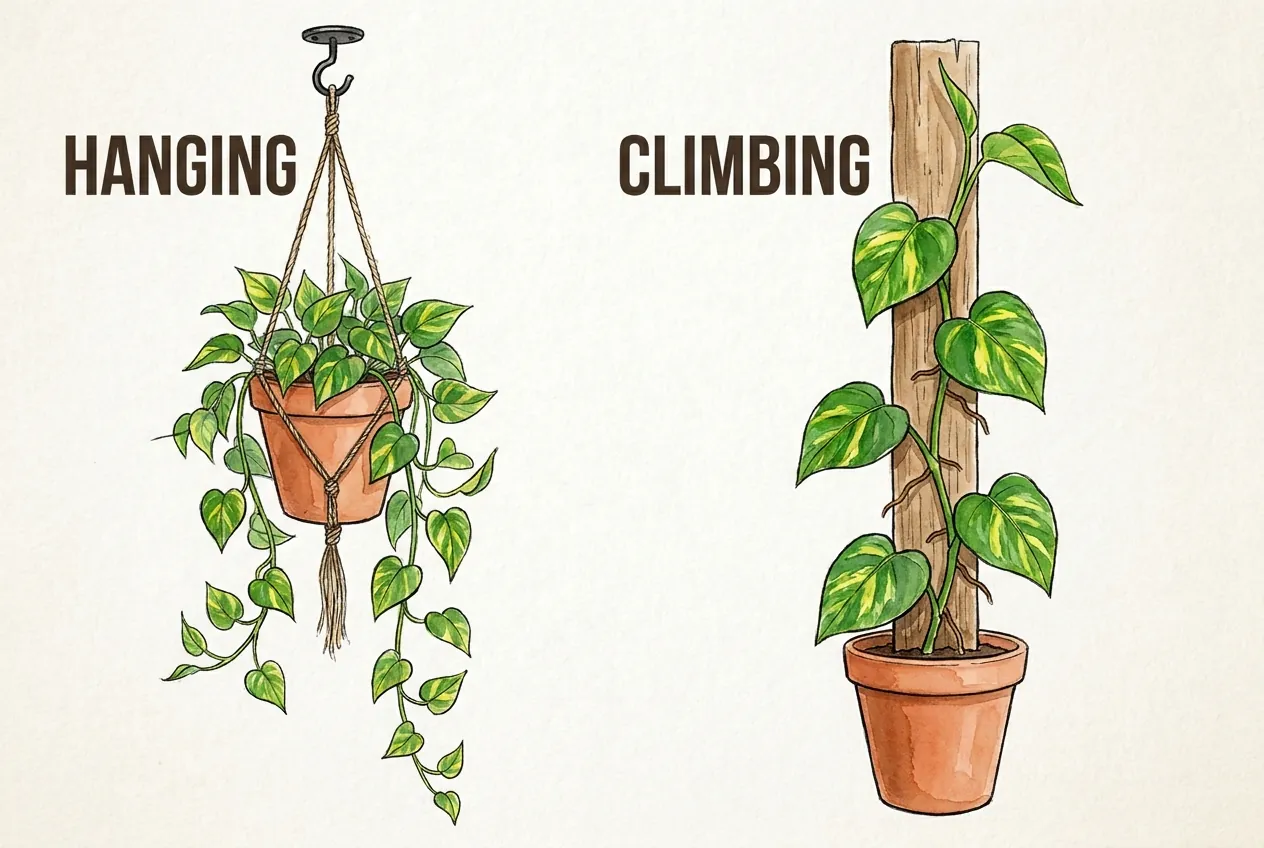
Researchers in Argentina grew rooted pothos cuttings three ways. Some climbed an upright wooden board, some crept along a greenhouse bench, and some hung from baskets.
Their paper starts from earlier findings that climbing pothos develops larger leaves than unsupported, hanging plants.
They also cite commercial work in which pot plants given vertical support grew significantly larger leaves than basket-hanging plants. Part of the effect is a touch response. The authors propose that gravity plays a role too, because auxin transport is known to be weaker in stems that run horizontal or hang down.
Auxin is a growth hormone that normally moves from the shoot tip toward the roots. A hanging strand is missing both the contact and the upward direction that tell a pothos to build bigger leaves.
The Climb Signal Has Three Parts
Contact, upward direction, and light work together. Pothos research suggests that removing any one of them weakens the leaf-size response.
Contact Matters More Than Being Vertical
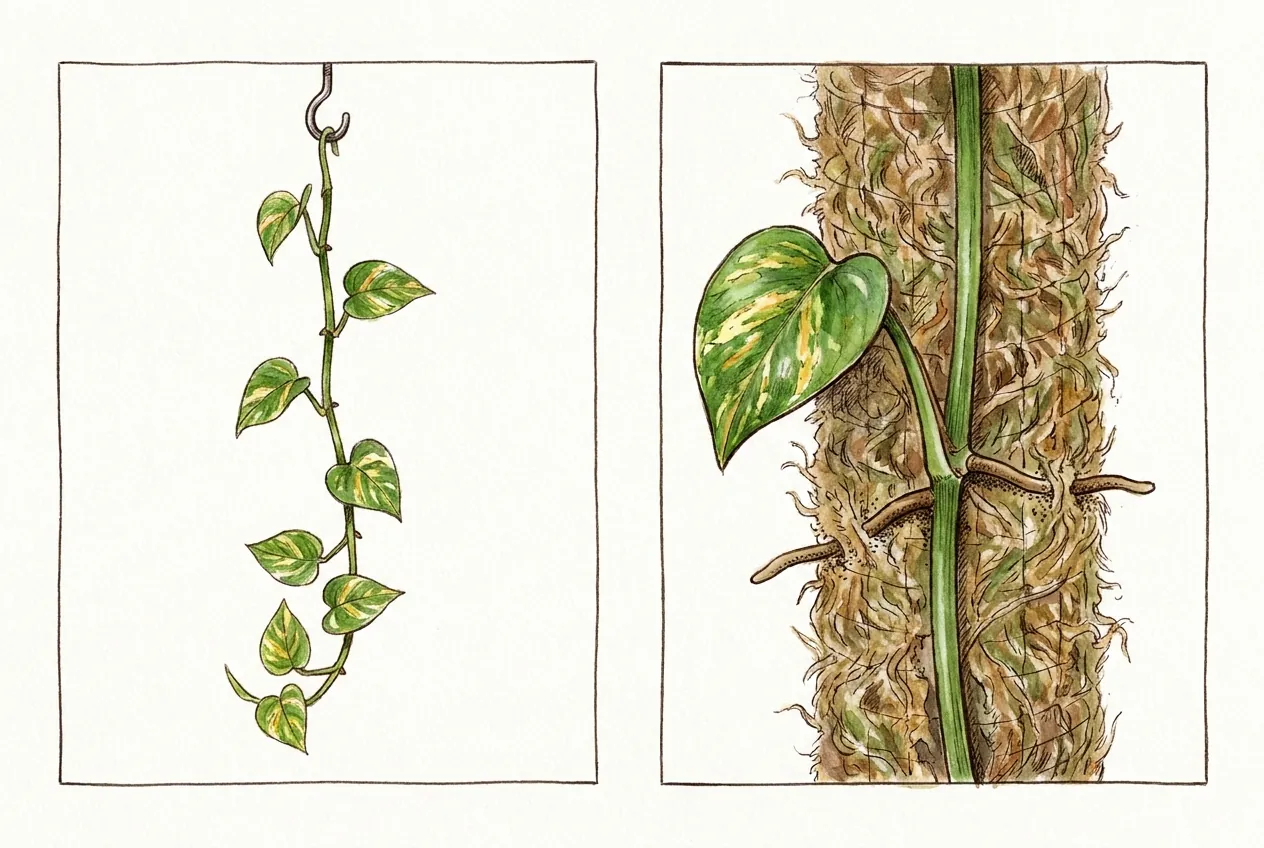
In a 1987 study, plant physiologists compared pothos that climbed a support with pothos kept upright without touching anything.
The unsupported plants hung from a hook at the youngest leaf, so their stems stayed straight and vertical.
The climbing plants still made larger leaves, shorter internodes, and better-developed aerial roots.
A follow-up study found that young, soft pothos stems hang straight down until they meet a surface they can climb. Only upward-growing vines responded to touch. A vine resting against a wall while pointing down is therefore not receiving the same message as one climbing up it.
Pin the nodes against a surface and point the growing tip up, because neither vertical growth alone nor downward contact gives the full signal.
Light Has to Pay for the Bigger Leaf
The clearest pothos trial on this question ran for 10 months in a botanical-garden greenhouse in Rio de Janeiro.
Cuttings either crept horizontally or had their stem nodes fixed to a vertical support. Each growth direction ran under low light, peaking near 26 µmol/m²/s, and under high light, peaking near 622 µmol/m²/s.
PPFD, the measure behind those numbers, counts the light particles plants can use that land on one square meter each second.
Only the plants that climbed in high light enlarged dramatically. Their newest leaves measured from 900 to more than 1,370 cm², which was 9 to 13 times larger than any other group.
Horizontal plants made leaves of about 60 cm² in low light and about 115 cm² in high light. Climbing in low light did not produce the enlargement. In the forest, the same authors note, big canopy leaves sit in light near 1,000 µmol/m²/s, while small understory leaves sit near 100.
A pole in a dim corner will not grow big leaves, because climbing only pays off when the leaves get enough light to fund them.
Rule Out the Causes That Shrink Every Leaf
The hanging effect shows up along the strands that hang. Light, feeding, and root space problems affect the whole plant, and they deserve a check before you buy a pole.
Light Too Low, Feeding Too Thin, or Magnesium Short
The UF/IFAS production guide for pothos describes this exact symptom. It traces new leaves that are smaller than older ones, and that lose variegation, to low light, magnesium deficiency, or low fertilizer rates.
The Light Floor and the Autumn Drop
The same guide says indoor pothos tolerates light as low as 50 foot-candles, but new leaves will be small and variegated types fade.
At 150 foot-candles or more, the plant maintains its color and leaf size. A foot-candle is an older unit of brightness as the human eye sees it.
Window light also shrinks through autumn. Virginia Cooperative Extension charts outdoor daily light falling from about 40 to 45 mol/m²/day in July to about 15 to 20 in December across Virginia.
A pothos that held its leaf size in summer can start shrinking in October with no change in care.
The aroid grow light hours guide for autumn low light covers that seasonal drop in more depth.
A Lux Check Where the New Leaf Forms
Foot-candles convert to lux at about 10.76 lux per foot-candle. That puts the guide’s 150 foot-candle floor near 1,600 lux and its 50 foot-candle minimum near 540 lux.
My floor check uses a phone light-meter app or a basic lux meter held at the growing tip of the shrinking strand.
The sensor faces the main window or lamp, the way the newest leaf faces. Around midday on a bright overcast day, which is closer to the light the leaf usually gets, I take three readings and keep the lowest.
If that lowest reading falls under about 1,600 lux, I fix light before anything else.
One day’s reading can mislead, so I call it a pass only after a second bright overcast day also clears about 1,600 lux.
Virginia Cooperative Extension does not recommend lux or foot-candles for measuring plant light, and phone sensors are approximate.
Treat the number as a floor check, not a light prescription. If no brighter spot is available, the aroid grow light product chooser explains how to pick and verify a light by PPFD and DLI.
Feeding and Magnesium
The UF/IFAS guide advises against feeding plants for about four weeks after they are moved indoors.
It also says not to fertilize when soil salts already run high. For a home plant, that points to a houseplant fertilizer mixed at the label rate during active growth, rather than heavy doses to force size.
A complete fertilizer that lists magnesium covers the deficiency the guide names.
A Crowded Pot Caps Leaf Size
Roots set a ceiling too. A meta-analysis of 65 plant studies found that doubling pot size increased plant biomass by 43% on average.
Plants in small pots grew less mainly because each unit of leaf area photosynthesized less, not because leaf shape changed.
That research covered many species, not pothos specifically. Still, repotting makes sense when roots pack the pot, the mix dries much faster than it used to, and every strand shrinks.
Move up to the next pot size rather than a much larger one, so the mix does not stay wet for long stretches.
Read the Pattern Before You Change Anything
The causes above leave different fingerprints on the plant. A ruler and the lux check are enough to tell them apart.
Measure Two Strands From the Same Pot
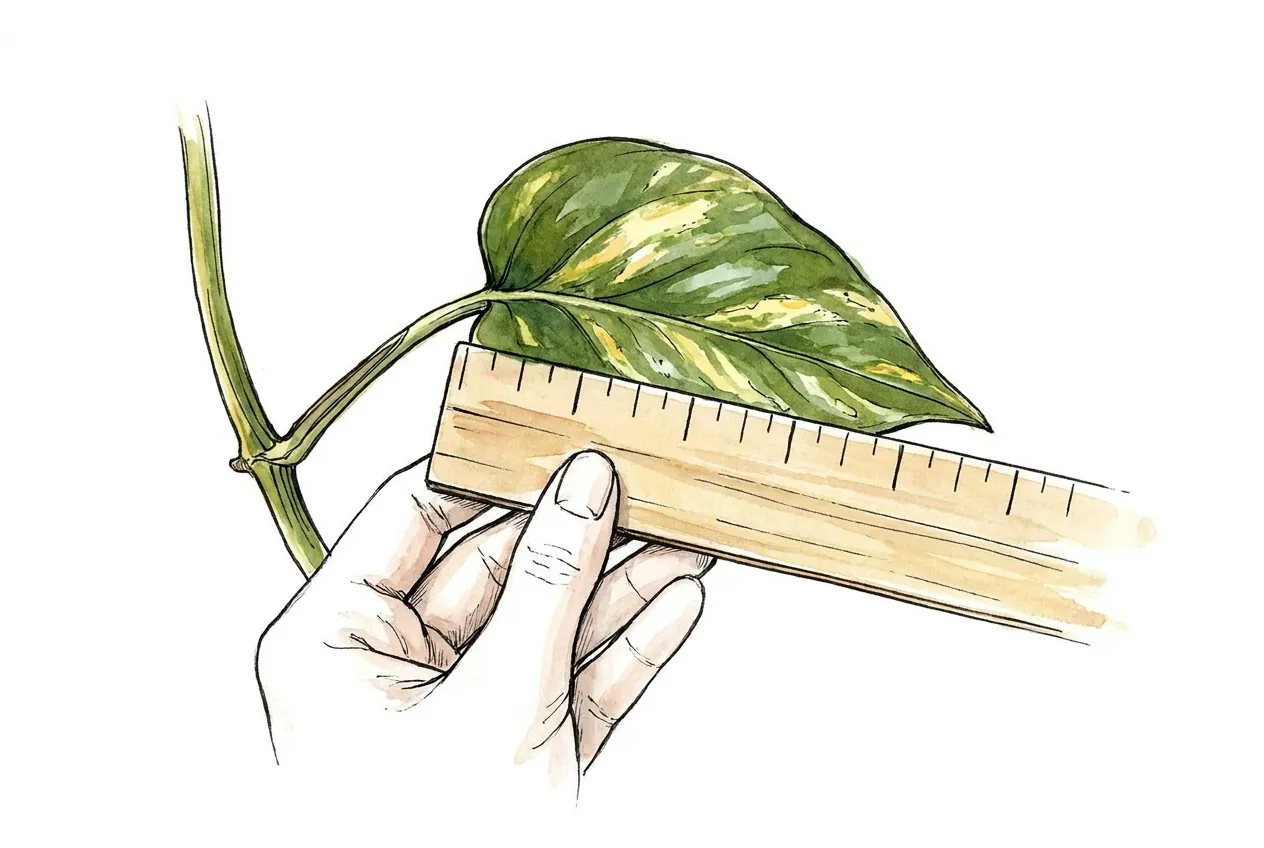
The comparison I trust most happens inside one pot. I pick the longest hanging strand and a short strand whose tip still sits at or above the rim.
On each, I measure the five newest fully unfurled leaf blades in centimeters, from the petiole junction to the tip.
Both strands share the same roots, soil, water, and window, so orientation and the light at each tip are what differ. That is why the lux reading at both tips comes first.
My working rule is that a hanging-strand average at least 25% shorter than the rim-strand average points to the hanging effect, provided both tips clear the lux floor.
That cutoff is my own margin, chosen to stay clear of normal leaf-to-leaf scatter, and it is not a published standard.
If the gap is smaller than that, the cause is more likely light, feeding, or roots.
The measurement gets repeated after two more leaves unfurl on each strand, because one odd leaf can mislead a single session.
Match the Pattern to the Cause
Work down the table in order and stop at the first row that fits. Light comes first because the other fixes do little for leaf size while light is short.
Read the lux at the tip of every shrinking strand. A strand hanging below a shelf can sit in much dimmer light than the rim.
| What you find | Most likely cause | First action |
|---|---|---|
| Any shrinking strand reads under about 1,600 lux at its tip | Light below the floor | Move the plant closer to a window or add a grow light |
| Hanging-strand average at least 25% shorter than the rim-strand average, all tips pass the lux check | Missing climb signal | Train one strand upward with nodes touching a support |
| All strands shrinking, light passes, no fertilizer this growing season | Thin feeding or low magnesium | Resume a complete fertilizer at the label rate during active growth |
| All strands shrinking, light passes, fed regularly, roots packed against the pot wall | Root space | Move up to the next pot size |
If no row fits, slide the plant out of its pot and check the roots for rot or damage before changing anything else.
How to Grow Bigger Leaves Again
Once you know which signal is missing, the fix is usually simple. These steps assume the light check has already passed.
Train One Strand Upward With Nodes Touching
Choose a healthy strand with several nodes and a growing tip. A node is the bump where a leaf and an aerial root emerge. Set a moss pole, coir pole, or plain wooden board in the pot and lead the strand up it with the tip pointing up.
Press each node against the support so the aerial root bumps touch it. Use soft, wide ties rather than wire, and leave room for the stem to thicken. In the trials above, researchers produced the climbing effect by fixing nodes to a plain vertical support or board, so an elaborate pole is optional.
A moist moss surface can help aerial roots grip, while a dry board still holds the stem in place.
The choice between sphagnum, coir, and stackable poles mostly comes down to the upkeep you can sustain, and the moss pole product chooser compares them.
A Split-Strand Test for the Climb Signal
To confirm the diagnosis, I train one strand upward and leave a sibling strand from the same pot hanging, without moving the pot.
Each time a new leaf fully unfurls on either strand, its blade length goes into a notebook.
The third and fourth new leaves on each strand are the comparison point, since the first one or two may have started forming before the move.
If the climbing strand’s third and fourth new leaves average at least one quarter longer than the hanging strand’s, training continues and more strands go up.
If the gap is smaller, light is the more likely limit even when it clears the floor.
That matches the Rio de Janeiro trial, where low-light climbers stayed small.
That one-quarter margin is my working threshold for a single-plant comparison, not a published standard. Expect the test to take several weeks to a few months, depending on how fast the plant is growing.
Prune Leggy Strands and Restart From the Tip
Leaves stop growing once they mature, so a long run of small leaves on an old strand will stay small.
Pruning those strands sends the plant’s effort into new growth instead. Trim just above a node with clean scissors.
The UF/IFAS guide notes that growers who want larger-leaved cuttings for totem poles grow their stock plants on a pole and take tip cuttings.
If one strand has already enlarged on your support, its tip is the best material for new plants.
Pothos sap contains insoluble calcium oxalate crystals. The ASPCA lists golden pothos as toxic to dogs and cats. Signs include mouth irritation, drooling, vomiting, and difficulty swallowing.
Wash your hands after pruning and keep cuttings away from pets and small children. If a pet chews the plant, call your veterinarian or the ASPCA Animal Poison Control Center at (888) 426-4435, where a consultation fee may apply.
What to Change First
Start with the cheapest test and the most common limit. Check the light at the tip of the shrinking strand first. If the light passes and only the hanging strands are shrinking, the plant is most likely responding to a missing climb signal.
One strand trained up a support will show whether that is true within a few new leaves.
If every strand shrinks in good light, move on to feeding and then root space.
The hanging basket does not have to go. You can keep the trailing look and train one or two strands upward as a source of larger leaves and better cuttings.