
Aroid Grow Light Hours for Autumn Low Light
When autumn window light falls off, your aroids can drop below their light floor. Here is the short calculation to reset supplemental grow-light hours.
Marcus Hale · Published 2026-08-26 · 19 min read
Key Takeaways
- Autumn usually lowers the daily total through shorter days and weaker clear-sky light, but window direction can offset part of the loss.
- Track one fixed window spot, and use a one-third drop as the trigger to measure the daily total again.
- Calculate fixture delivery as PPFD times 0.0036 per hour, then divide the measured DLI gap by that value.
- Keep the entire window-plus-lamp light span near 14 hours, then raise measured intensity instead of lengthening the day.
- Confirm with the window DLI and new internode length before blaming water or cold.
Your Monstera cruised all summer on window light plus a modest fixture. Then September arrived, growth stalled, and nothing about your watering changed.
The culprit is usually not you. It is the sun dropping lower in the sky and taking your window’s light budget down with it.
This is the autumn DLI cliff. The fix is not vibes, it is a short calculation you can do at your own windowsill.
Why Autumn Window Light Changes Faster Than the Shorter Day Suggests
The autumn slump often combines a shorter day with weaker clear-sky intensity. Window direction, roof overhangs, and outdoor shade can either deepen that loss or partially offset it, which is why the measurement at the leaf matters.
Daily Light Integral, or DLI, is intensity multiplied by time. When both the peak intensity and the number of daylight hours drop together, the daily total collapses faster than the clock alone implies.
The sun sits lower, so each ray is weaker
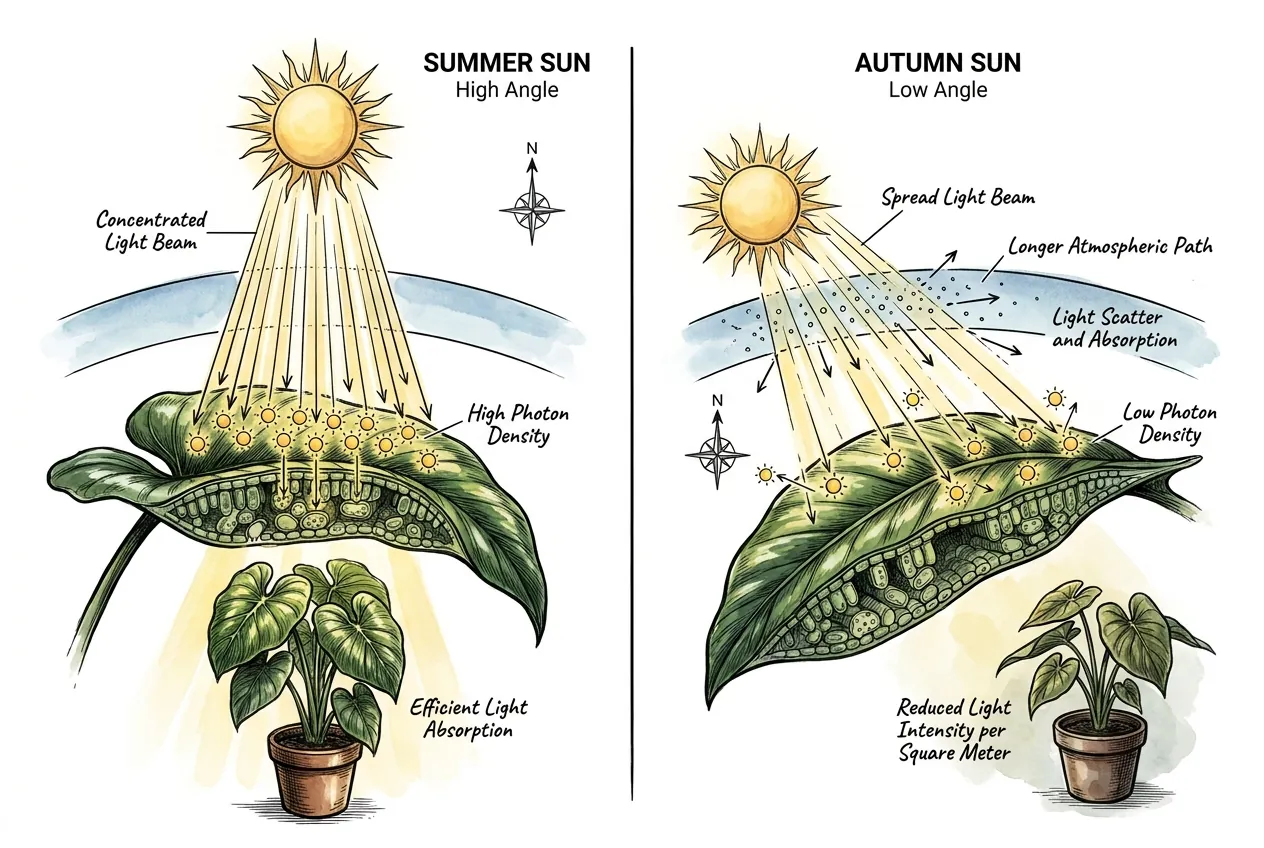
The sun’s noon height falls steadily from summer into winter. Its maximum elevation is about (90 minus your latitude) degrees at the equinoxes. The summer solstice adds roughly 23 degrees to that, and the winter solstice takes about 23 away.
At 40 degrees north, that means a noon sun near 73 degrees in June and only about 27 degrees in December.
On a horizontal surface, the lower beam spreads over more area, so each square meter collects fewer photons.
There is a second penalty. A low sun sends its light on a longer slanted path through the atmosphere. That extra path scatters and absorbs more of it before it ever reaches your glass.
A low autumn sun gives a horizontal surface less clear-sky light per square meter, but the result behind a window still depends on its direction and obstructions.
Window direction and coatings change the result
A low sun does not penalize every vertical window in the same way. Close to an unobstructed equator-facing window, the lower autumn and winter sun can enter more directly and reach farther into the room.
A pole-facing window may lose direct sun altogether, while east and west windows shift with the seasonal path.
Double glazing, low-emissivity coatings, screens, blinds, roof overhangs, and grime then change what survives the trip indoors.
Cleaning the glass and opening the blinds can recover some light, but orientation and outdoor obstructions still make each window its own case.
What DLI Actually Means and the Numbers Aroids Want
DLI is the total dose of usable light a leaf receives in a day, measured in moles per square meter per day.
PPFD is the same light counted per second, in micromoles per square meter per second.
Think of PPFD as the flow rate from a tap and DLI as how much water ends up in the bucket by nightfall.
A gentle flow over many hours can fill the same bucket as a strong flow over a few.
The one formula that ties them together
DLI equals PPFD multiplied by the number of light hours multiplied by 0.0036. That constant is pure unit conversion, turning per-second micromoles into per-day moles.
For example, take 200 micromoles per square meter per second running for 16 hours. That is 200 times 16 times 0.0036, or about 11.5 moles per square meter per day.
The same formula, rearranged, is what sizes your grow-light hours once you know your shortfall.
Target bands for common aroids
Most indoor aroids are held or grown well in a low-to-medium light band rather than at one magic number.
Extension guidance groups indoor plants into a Low Light band of about 3 to 6 moles per square meter per day.
The next step up is a Medium Light band of about 6 to 10.
Shade-tolerant aroids like Scindapsus and many dark, velvety Anthuriums sit comfortably at the low end for maintenance.
Faster growers like many Monstera and Philodendron reward the medium band with larger, more fenestrated leaves.
Treat these as ranges to test, not fixed requirements. Aim near 4 to 6 moles per square meter per day just to hold a shade-tolerant aroid. Push toward 6 to 10 when you want active growth.
Pick a maintenance target in the low band and a growth target in the medium band, then let new leaves confirm your choice.
Measure the Autumn Shortfall at Your Own Window
Before you change anything, get a number. The whole point of the cliff is that it is invisible to your eyes, which adapt to brightness and hide the drop.
You have three ways to measure, from best to roughest. A calibrated quantum PAR meter reads PPFD directly.
A single spot PPFD reading multiplied by its hours and 0.0036 works for a grow light whose output stays nearly constant. Daylight is different because PPFD rises and falls across the day, so a window DLI needs a logger or a series of timed readings.
A phone lux app is the roughest option and belongs in a special category.
Why a phone lux app can only be a relative index
A lux reading is calibrated to human vision, not to plant photosynthesis, so it is not a true PPFD. The conversion between them depends heavily on the light’s spectrum.
The same lux reading maps to a lower PPFD under a typical white LED than under sunlight, because the two spectra are weighted differently.
A lux meter therefore systematically misreads PPFD unless it is matched to the spectrum. Even dedicated handheld meters vary, with one comparison finding a root-mean-square error near 18.7 micromoles per square meter per second across five LED spectra.
So never quote a phone-lux number as if it were real PPFD, especially under a mix of daylight and grow light.
The same-spot ratio that rescues a cheap sensor
Here is the trick that makes even an uncalibrated sensor useful as a change alarm. Using the same sensor at the same coordinate keeps its scale error and geometry comparable, so a ratio is more useful than its absolute lux or PPFD claim.
Seasonal spectrum changes do not cancel, which is why the ratio only triggers a real DLI measurement rather than replacing one.
A leaf tag is not my reference because a growing leaf changes height, rotation, and sensor angle. I choose an unobstructed point beside the canopy, put a tape cross on the shelf directly below it, and write the sensor height on that tape.
On a clear day near solar noon, I switch the fixture off, center the sensor over the cross on the same small stand, set its diffuser level at the recorded height, and log the window-only reading. I repeat every two to three weeks without moving the pot, stand, or sensor orientation.
When the clear-day noon reading falls to about two-thirds of my summer baseline, I treat the window as materially weakened.
That is a drop of roughly a third, and it tells me to measure the daily total again before I change the timer.
The one-third figure is my own working trigger, not a published cutoff. I chose it because a fall that large is both physically real and easy to read off a simple sensor.
If you have no summer baseline, use your earliest autumn reading as the reference and watch for the same proportional drop.
The ratio remains useful as a change detector even when the absolute number is not accurate, but it is not a substitute for a window DLI.
Track the window as a percentage change at one fixed spot, and a one-third drop is your signal to remeasure the daily total.
Turn the Shortfall Into Supplemental Hours
For the cleanest window measurement, keep the grow light off and leave a logging quantum sensor centered over the tape cross at the recorded height for three consecutive days, then use the median daily total.
Without a logger, take PPFD readings every 30 minutes from sunrise to sunset at that same coordinate on a day that matches the clear-sky condition used for the ratio check.
For each interval, average the two readings, multiply by 1,800 seconds, divide by 1,000,000, and add the intervals together. That trapezoidal sum is the clear-day window DLI.
The 30 minute interval is a practical compromise. It is short enough to follow the daylight curve and passing cloud changes, but still possible to complete by hand.
Repeat the same sequence on a representative overcast day if you want a second, cloud-day timer setting instead of one fixed schedule.
Once you know your target DLI, the measured window DLI, and your fixture’s PPFD at the leaf, the hours fall out of one rearranged formula.
Required hours equal the gap in DLI divided by what your fixture adds per hour.
Your fixture adds PPFD multiplied by 0.0036 moles per hour. A fixture measured at 150 micromoles per square meter per second at the canopy therefore contributes about 0.54 moles each hour it runs.
A worked October example
Picture a Monstera you want held at a 6 mole per square meter per day target.
The three-day logger median, or the 30 minute sum above, shows that its late-October window now supplies 3.3 moles.
The gap you must fill is 6 minus 3.3, which is 2.7 moles. The noon ratio may have told you when to run this measurement, but it did not supply the 3.3 mole value.
Say your fixture reads 150 micromoles per square meter per second at the leaf. It adds 0.54 moles per hour, so you need 2.7 divided by 0.54, which is 5 hours.
If the same fixture only reaches 100 micromoles, it adds 0.36 moles per hour. The same gap now demands 2.7 divided by 0.36, or 7.5 hours.
| Fixture PPFD at the leaf | Moles added per hour | Hours to close a 2.7 mole gap |
|---|---|---|
| 100 micromoles per square meter per second | 0.36 | 7.5 |
| 150 micromoles per square meter per second | 0.54 | 5.0 |
| 200 micromoles per square meter per second | 0.72 | 3.75 |
Notice how a weaker fixture makes the hours balloon. That is your early warning to move the light closer rather than keep piling on time.
Add the Two DLI Sources Without Stretching the Total Day
If the window DLI was measured with the lamp off and the lamp PPFD was measured separately, their daily contributions can be added even when they overlap.
The photons do not need separate clock blocks for the gap formula to work.
Running every supplemental hour outside daylight can instead make the total light span too long. Every two weeks, I look up the earliest sunrise and latest sunset in the next 14 days and compare them with the timer.
For that block, the longest possible day starts at whichever comes first, earliest sunrise or lamp-on, and ends at whichever comes last, latest sunset or lamp-off.
I keep that first-light-to-last-light span at 14 hours or less. If the calculated lamp hours do not fit, I let the lamp overlap the dim morning and evening window hours, or raise measured PPFD, rather than extending farther into the dark period.
When Adding Hours Is the Wrong Lever
Extending the photoperiod only compensates a weak fixture up to a point. Past that point you are not adding useful light, you are adding stress.
The photoperiod ceiling
Beyond roughly 16 to 18 hours, many plants stop rewarding extra hours, and sensitive species can develop leaf injury.
In tomato, lighting longer than about 18 hours causes interveinal chlorosis and necrosis, and yield stops rising with further extension.
Removing the dark period entirely, with continuous light, can trigger that same chlorosis and necrosis in sensitive plants regardless of the total dose.
The daily dark stretch supports normal circadian rhythm and overnight sugar export, so it is protective rather than wasted time.
Raise intensity instead, and know your cap
DLI scales with PPFD and hours identically. So doubling intensity doubles the moles per hour, while adding hours only grows the total linearly and hits the ceiling.
Moving a fixture closer raises PPFD quickly, which makes intensity the more efficient lever once your hours climb.
I cap the entire light span for foliage aroids at about 14 hours a day, counting window daylight and the lamp from the first source on to the last source off.
When the DLI math cannot fit the required lamp hours inside that span, I stop extending and instead raise measured PPFD or move the plant to a brighter spot.
Extension guidance of 12 to 14 light hours a day sits below the long-photoperiod injury zone and leaves roughly 10 hours without either source.
That is why I apply the cap to the combined day rather than to the timer alone.
This is my working rule, not a universal standard. It also does not apply to photoperiod-sensitive flowering species, which read daylength to time their bloom and need their own limit.
Cap the combined window-plus-lamp day near 14 hours and switch to raising measured PPFD once the math wants more, but give daylength-sensitive bloomers their own schedule.
Fixture Placement, Because Distance Matters
Where you hang the light matters, but the exact change is fixture-specific. A point-like source measured far enough away can approach inverse-square falloff. A broad panel close to the canopy does not reliably lose three quarters of its PPFD when distance doubles.
Move, Measure, and Stop at the Fixture Limit
Mark the starting height, then lower the fixture by its smallest available mounting increment and remeasure PPFD at the target leaf and the dimmest corner after every move.
Stop at the first setting that reaches the calculated PPFD target or the manufacturer’s minimum clearance. The meter therefore defines the useful step instead of an unsupported universal distance.
Keep that final setting fixed until the next emerging leaf fully hardens before judging long-term growth. Restore the previous recorded height sooner if a new pale patch or upward edge curl appears on the upper leaves.
A hardened new leaf is the comparison endpoint because already-formed leaves cannot show whether the new setting improved subsequent growth.
Verify at the leaf, not on the box
The rated PPFD on a fixture’s box or chart applies to its stated distance and test layout.
Your shelf, mounting height, reflective walls, and crowded plants differ from that setup, so the result must be checked at the canopy.
So read PPFD at the actual leaf position that matters, then adjust height to hit the moles per hour your calculation needs.
On a wide shelf, measure the dimmest corner and size your hours to that plant. Raising one light to cover the edges lowers the peak intensity in the center, so a second fixture often beats one high one.
Choosing the fixture itself
Once you know the PPFD and coverage you need, matching a fixture becomes a specs problem rather than a guess.
You want a light whose verified canopy PPFD can hit your target DLI within a sane photoperiod, over the footprint your plants occupy.
If you are at the point of picking hardware, the site’s aroid grow-light chooser matches PPFD, coverage, and spectrum to your setup.
For the underlying targets, the PPFD and DLI reference for houseplants lays out the chart behind the bands used here.
Setting the Timer and Keeping a Dark Period
For foliage aroids the total daily dose matters more than the exact clock time the lamp runs.
A simple timer holding a steady photoperiod is all the hardware you need.
Place the supplemental hours inside the combined 14 hour window, using the dim morning and evening shoulders first.
Keep the lamp timer fixed for each two-week block, then recalculate against the next block’s earliest sunrise and latest sunset so the seasonal change never quietly shortens the dark period below roughly 10 hours.
Splitting the hours into two blocks or running them as one is largely a wash for foliage, as long as a real dark period remains.
Interrupted-light tricks matter mainly for manipulating bloom in photoperiod-sensitive species, not for holding foliage DLI.
Fit the calculated lamp hours inside a 14 hour window-plus-lamp span, use the dim shoulders first, and never erase the dark period.
Confirming It Really Is the Light
Slowed growth alone does not prove a light problem, because overwatering and cold can mimic it.
Confirm the cause before you change the watering can or move the plant off a cold sill.
What under-light looks like on an aroid
The signature of a DLI shortfall is etiolation, meaning long internodes, smaller pale leaves, and stems leaning toward the window.
New leaves emerge smaller and, in Monstera, with fewer of the holes and splits that only high light funds.
For Monstera, spacing between the newest leaves above about 10 centimeters is a common reference for etiolation, against a healthier 5 to 8 centimeters.
Treat that as a guide rather than a hard line, and compare against your own plant’s summer spacing where you can.
I make the summer baseline from the center-to-center length of three consecutive, hardened internodes and use their median. Once a month through autumn, I average the next two hardened internodes from the same vine.
If that average reaches 125 percent of the summer baseline, I treat it as etiolation and raise the DLI rather than waiting for leaf drop.
The 25 percent increase is my working threshold, not a species standard. Two new intervals keep one odd leaf from deciding the result, and a quarter longer is large enough to clear ordinary ruler-placement error.
Rule out water and cold, then fix the light
Check soil moisture behavior and root health alongside your same-spot light ratio. If moisture and roots look normal but the light has dropped a third or more, measure the window DLI and compare the new internodes before changing the watering routine.
One hard truth about etiolated growth. Already-stretched stems will not un-stretch, so recovery shows only in new, better-lit growth. A very leggy plant is best pruned and propagated for a compact form.
If soil and roots are fine but your same-spot reading fell a third, confirm the daily total and new internode length before correcting the light.
Key Takeaways
- Autumn usually lowers the daily total, but window direction can offset part of the seasonal loss.
- Track one fixed spot, and use a one-third drop as the trigger to measure the daily total again.
- Calculate fixture delivery as PPFD times 0.0036 per hour, then divide the measured DLI gap by that value.
- Keep the combined window-plus-lamp span near 14 hours, then raise measured intensity instead of lengthening the day.
- Confirm with the window DLI and new internode length before blaming water or cold.