
Cryptocoryne Melt After a Cold Water Change: Checks and Recovery
Check replacement-water temperature and chemistry, track Cryptocoryne recovery without disturbing the crown, and prevent repeat water-change stress.
Samuel Reed · Published 2026-08-31 · 7 min read
Key Takeaways
- Cold replacement water is a plausible stressor, not a diagnosis established by melted leaves.
- Measure prepared replacement water immediately before use, even when the tap felt normal last week.
- Matching KH does not establish matching chemistry or prove a temperature cause.
- Remove disintegrating leaves and track new central growth without repeatedly squeezing or uprooting the crown.
A Cryptocoryne stand that collapses after a water change needs a check of the replacement water and the plant's recent conditions.
Temperature is easy to overlook as the season changes, but fertilizer, CO2, lighting, relocation, and water chemistry can also matter.
Correct a measured temperature mismatch without treating it as the only possible cause. A good record lets you prevent another avoidable change while leaving the surviving crown undisturbed.
Leaf melt does not tell you whether the crown survived
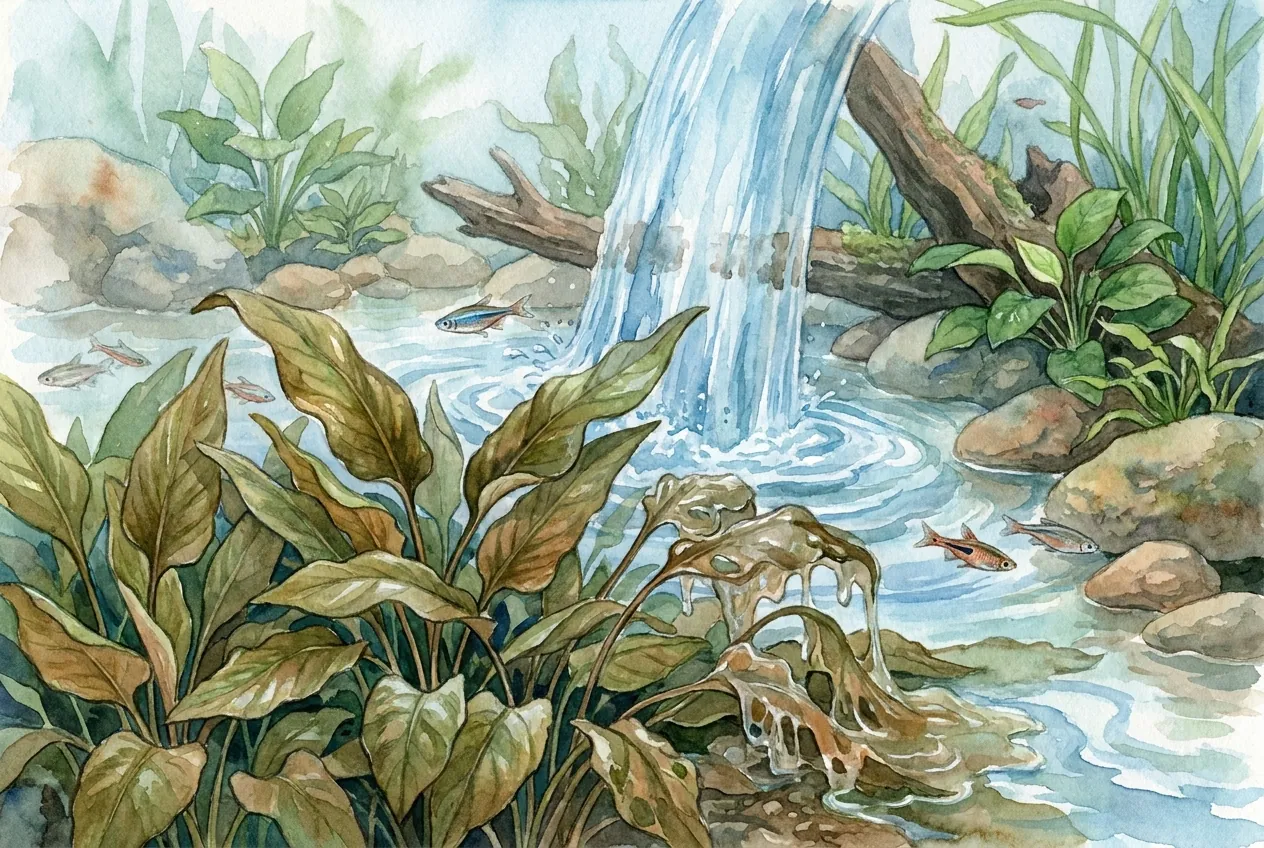
Crypt melt describes foliage becoming translucent and breaking down. Florida Aquatic Nurseries documents this response after environmental changes and shows plants recovering from surviving underground rhizomes once conditions settle.
That does not mean every disintegrating plant is safely dormant. Inspect the visible crown for continuing loss of tissue and watch for new central growth. Avoid burying it more deeply while removing debris.
Estimate the mixed temperature, then measure the real event
For equal amounts removed and replaced, a simple mixing estimate is the starting tank temperature minus the replacement fraction multiplied by the tank-to-bucket temperature gap.
Use actual water volume, allowing for substrate, rock, and an unfilled rim, rather than the tank's advertised capacity.
For example, assume 78 °F tank water and 53 °F replacement water. These are illustrative inputs, not a claim about every autumn tap.
| Water replaced | Calculated mixed temperature | Calculated fall |
|---|---|---|
| 10 percent | 75.5 °F | 2.5 °F |
| 25 percent | 71.75 °F | 6.25 °F |
| 50 percent | 65.5 °F | 12.5 °F |
This calculation assumes complete mixing and ignores heat exchange with the room, glass, substrate, and heater.
Water entering beside a plant can differ from that final average. A thermometer on the opposite wall may miss the local exposure.
Quick check in tank, bucket, then tank again
I use the same clean aquarium thermometer for the tank and the prepared bucket so that two devices' offsets do not masquerade as a water difference.
With a probe that reads in 0.1 °C steps, I wait for its specified response time and two readings 30 seconds apart that differ by no more than 0.1 °C.
After stirring the bucket and measuring it, I return the probe to the tank. If that second tank reading has shifted by more than 0.2 °C, I repeat the comparison rather than working from the stale first reading. If the probe will not settle, the comparison is inconclusive.
I aim to match the displayed tank temperature and repeat the check if the remaining gap exceeds 0.5 °C, about 1 °F, in either direction.
This is my practical matching tolerance, not a Cryptocoryne injury threshold. The narrow target discourages relying on the tank heater to correct an avoidable bucket mismatch. Use a thermometer with documented accuracy around aquarium temperatures, since small display increments alone do not establish accuracy.
Warm the replacement water separately using equipment approved for its container and follow the heater's immersion, unplugging, and cooling instructions. Recheck after warming and before every bucket is poured. Treat the final replacement volume for chlorine or chloramine according to the conditioner label. Temperature matching does not replace water treatment.
Keep chemistry in the record
Equal KH readings mean the samples gave similar alkalinity results at that kit's resolution. They do not establish equal GH, dissolved salts, pH, or disinfectant treatment. Dissolved CO2 can also change pH without a corresponding change in KH.
Compare prepared replacement water with tank water using the same test procedure. Record the measured values rather than writing that they match. A one-drop difference in a titration test should be repeated before treating it as a trend, and a surprise pH result deserves a fresh sample or meter check before any adjustment.
A large temperature gap makes temperature worth correcting. It does not allow chemistry to be dismissed, and matching chemistry does not identify a species-specific cold limit.
Systematic check at the refill point
For recurrent melt, I record the next three necessary water changes using properly prepared water. I do not repeat a cold refill to see whether the plant melts again.
- Before the first change, put two aquarium probes side by side in circulating tank water. Wait for both to settle, then record three paired readings one minute apart. If their difference varies beyond their stated precision, check the instruments before interpreting small spatial differences.
- Fix one probe beside the crypts near substrate height without touching the leaves or gravel. Put the other in midwater away from the incoming stream and heater. Record each probe's own pre-change reading.
- Record both readings every minute during refilling and for five minutes afterward, with circulation restored as the equipment instructions allow. Note the lowest reading at each position and how far it fell from that probe's starting value.
- Log the replacement volume, bucket temperature, refill location, conditioner use, and before-change tank and prepared-water KH and GH. Keep lighting, CO2, fertilizer, and planting positions unchanged unless care requires an intervention.
If the probe beside the crypts reads cooler than the midwater probe at the same moment by more than the sum of their accuracy limits, I pause the refill, recheck the bucket, and redirect properly matched water away from the crowns.
For two probes rated ±0.5 °C, I require a gap greater than 1 °C before counting it as a clear spatial difference. A 0.3 °C gap is inconclusive. Compare simultaneous readings, not the two lowest readings taken at different times.
The five-minute extension catches a delayed reading after refilling, while three changes show whether the same placement problem recurs. These are my recording intervals, not biological limits. Slow probes and one-minute sampling can miss brief plumes, so a flat trace does not prove there was no local temperature change.
If measured temperatures stay matched but melt continues, review the chemistry and recent lighting, CO2, planting, or fertilizer changes.
Keep the record even when no single cause becomes clear. It is more useful than assigning every future melt to the season.
Track recovery without testing the crown by touch
Cut away leaves that are already disintegrating, taking care not to cut the central growing point, and siphon out loose debris. Retain intact leaves. Removing every leaf is not required, and pulling the crown up for a weekly inspection adds disturbance.
Take a photograph through the same pane once a week with the lights at the same point in their schedule.
Pick up to three crowns and mark their positions on the outside glass. Record new central leaf tips and whether the visible base is losing tissue. Do not pinch, twist, or tug the plant to create a firmness score.
Use week four as a review of conditions if no new growth appears, not a disposal deadline. Regrowth depends on species, starting condition, and environment. An intact crown without progressive collapse can remain planted beyond six weeks. Tissue visibly disintegrating at the crown needs closer assessment and removal of decayed material.
During heavy melt, check ammonia and nitrite rather than assuming plant decay is harmless. UF/IFAS notes that decaying organic matter contributes ammonia. Rapid breathing, surface gasping, or loss of balance in livestock needs immediate attention to aeration, temperature, and water quality. Do not wait for the plant observation period to end.
Keep essential water changes and check the heater
Smaller changes reduce the calculated temperature step, but they are not a substitute for prepared water or adequate waste removal.
Do not postpone a water-quality correction merely to keep a recovery log undisturbed.
Also check the tank before lights-on during a cold spell. If the baseline temperature is falling between water changes, use the autumn aquarium heater sizing guide to investigate capacity and control.
Match the temperature to the plants and livestock actually present rather than a universal crypt setting.
The next useful sign is an intact new leaf from an undisturbed crown. A repeatable bucket check and a record of conditions make that recovery easier to support without repeatedly resetting the tank.