
Semi-Hydro Conversion Kit Chooser: LECA, Pon, Meters
Choose LECA or Pon for passive semi-hydro, match the pot, nutrient, and meters to the level of control you want, and avoid the shallow-reservoir and salt-buildup mistakes that cause failed conversions.
Marcus Hale · Published 2026-08-08 · 12 min read
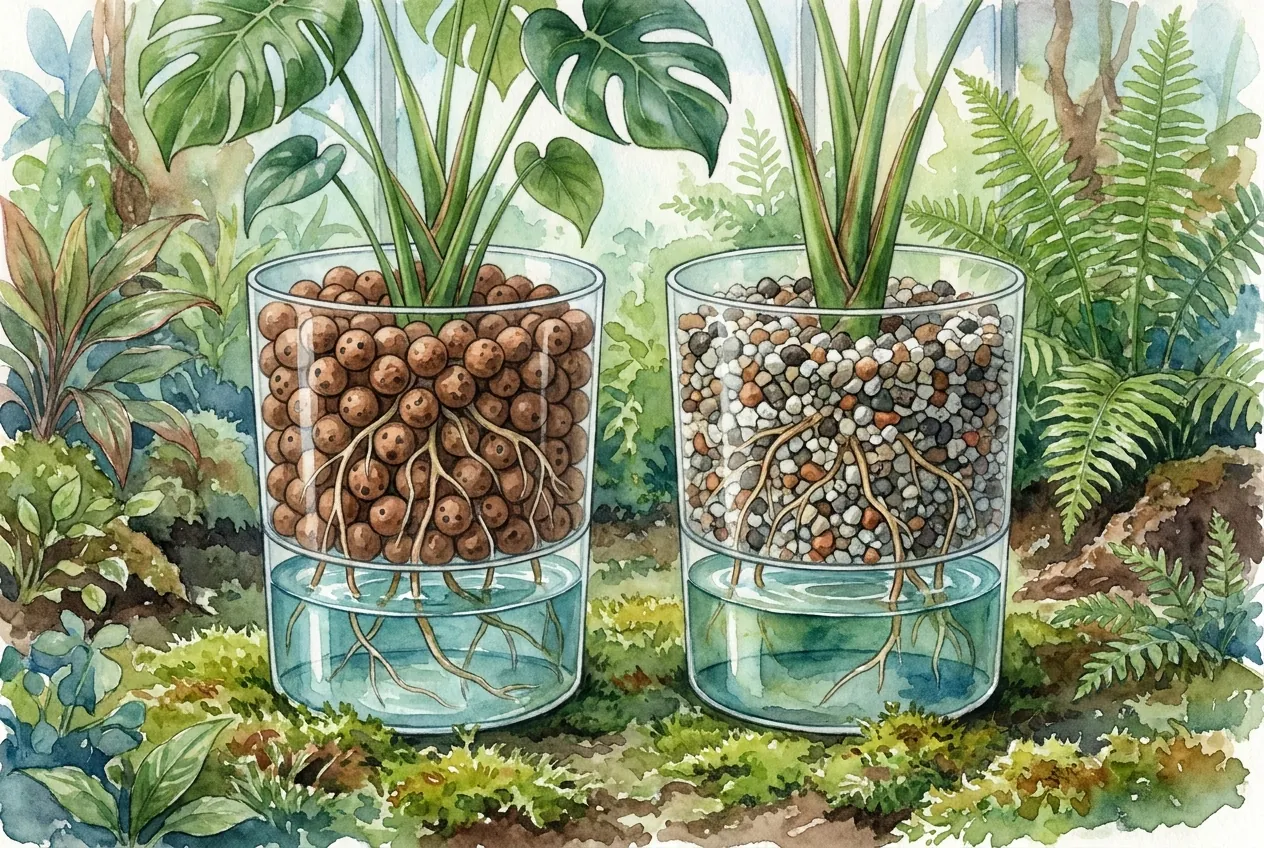
Key Takeaways
- LECA gives control, while Pon is lower-maintenance because it is pre-buffered. The physics is similar, but nutrient delivery differs.
- Fill the reservoir to only one-quarter to one-third of the medium height. A higher waterline drowns roots and is the most common conversion failure.
- Inert media have no buffering, so measure EC at 0.8–1.4 mS/cm and pH at 5.5–6.5. A meter keeps the solution inside a usable range.
- Use a complete urea-free nutrient with calcium and magnesium. Inert media supply no nutrition on their own.
- Rinse and pH-flush LECA, then bare-root the plant before transplanting. Removing dust and leftover soil reduces early rot risk.
The 30-Second Buying Verdict
For a first soil-to-semi-hydro conversion, choose a coarse medium, a pot that lets you see a shallow reservoir, and a complete nutrient plan. LECA gives you more control but asks you to mix and monitor feed. Pon is more convenient at first because it includes a slow-release fertilizer.
Keep the reservoir shallow and keep the upper roots in airy medium. The medium cannot supply a complete diet by itself, so use an appropriate nutrient plan and adjust it only with measurements you understand.
Choose Pon when you prefer simpler early care and are willing to flush it periodically. Choose LECA when you want to control the nutrient solution and can monitor how the plant responds.
I assemble the exact vessel, wick, and medium without a plant. For an opaque vessel, I use a clear liner of the same diameter and depth. After filling to the proposed line, I mark the moisture front at 1, 4, 8, and 24 hours, then every 24 hours until consecutive marks differ by no more than 5 mm. Those intervals capture both the initial wick and delayed saturation that a product diagram cannot show for my particle size and wick arrangement.
Before the test, I mark the planned crown and the lowest original root on the liner. I keep a fill line only when the settled moisture front reaches the lowest third of that root span while remaining at least 20 mm below the crown. The lower-third target proves that the wick reaches roots, and the 20 mm gap preserves a visible air buffer. If neither line meets both conditions, I change the wick or medium instead of choosing between two poor marks.
The Two Failure Modes
Reservoir-drown root rot occurs when the water table sits too high and roots suffocate. Unbuffered-medium nutrient problems occur when salts and pH drift without measurement. Both are avoidable with the right purchases and target numbers.
How Semi-Hydro Keeps Roots Healthy
Semi-hydro works when the lower medium can wick water while the upper roots still have access to air. The practical controls are the coarseness of the medium, the reservoir height, and the strength and pH of any nutrient solution.
Keep Air Around the Upper Roots
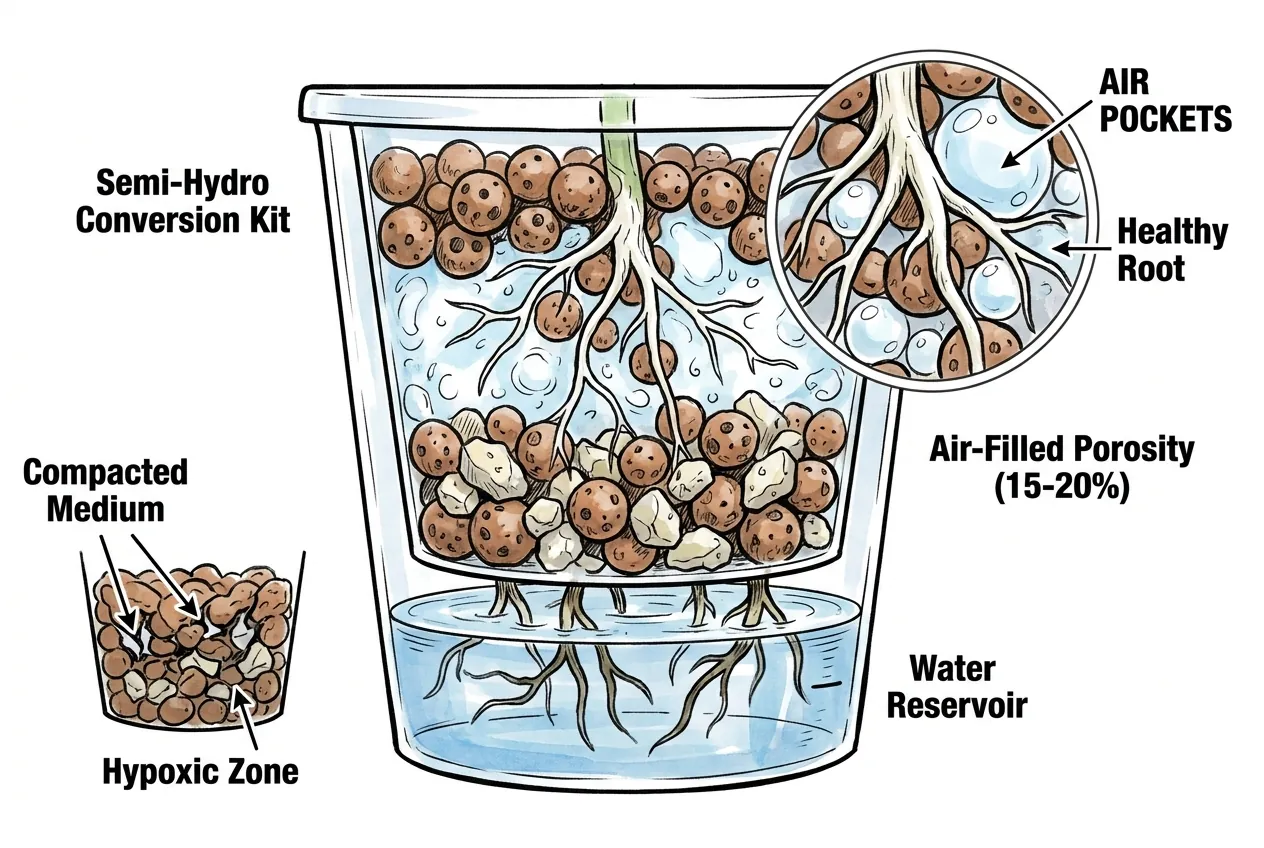
Roots need both moisture and air. Coarse LECA or Pon leaves gaps between particles, while a dense, constantly flooded medium does not. If the upper root zone remains saturated, lower the reservoir before changing products.
Keep the Reservoir Low
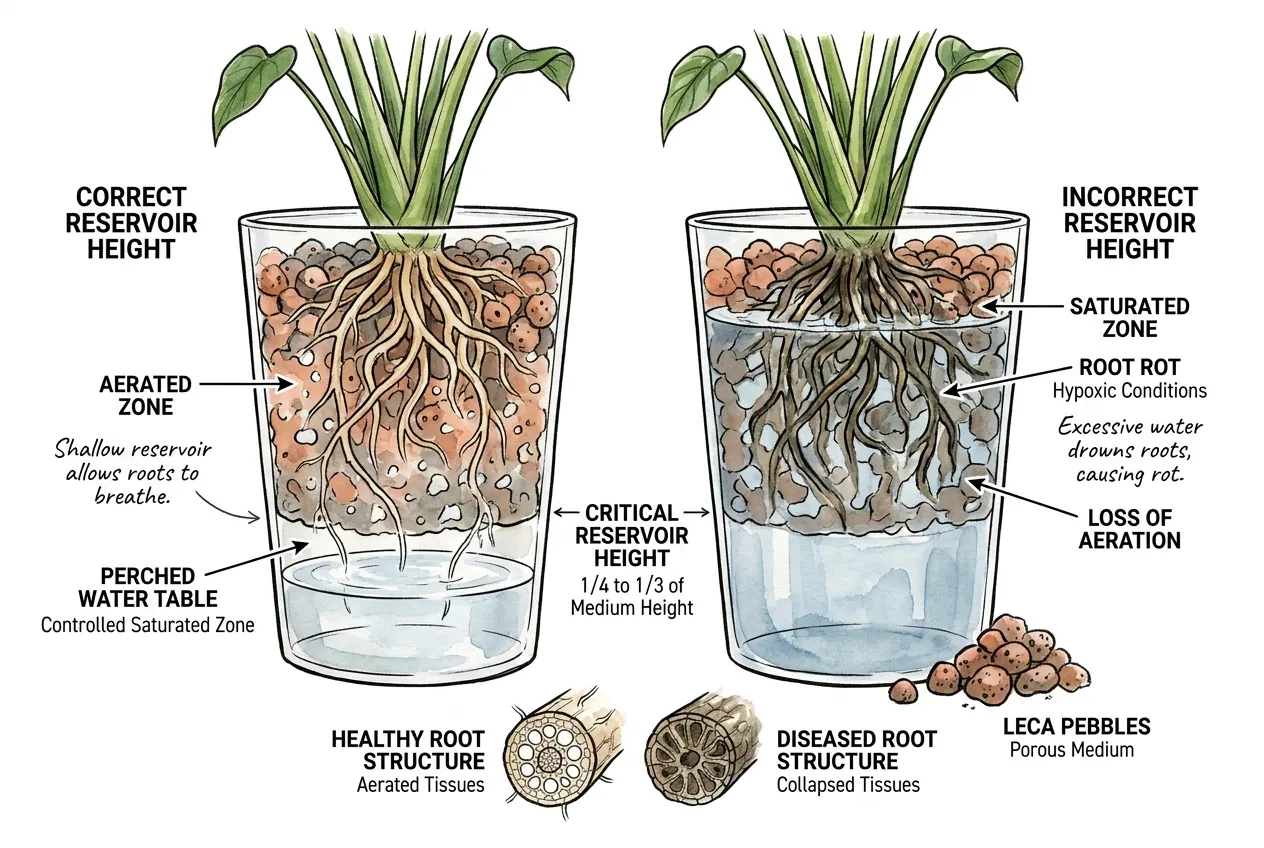
In a passive system, the reservoir supplies the wet zone at the bottom. Start by filling only about one-quarter to one-third of the medium height so roots above it can stay airy.
If roots stay wet or turn soft, lower the reservoir first. A deeper waterline can push saturation into the root ball even when the pebbles themselves are coarse.
EC and pH (why an inert medium forces you to measure)
EC Target
EC measures how concentrated the nutrient solution is. Too little can slow growth, while too much can damage roots. For many foliage aroids and Hoya, 0.8–1.4 mS/cm is a conservative starting range, not a universal target.
pH Target
pH affects whether nutrients remain available. A slightly acidic solution around pH 5.5–6.5 is a common starting range for hydroponic houseplants. Adjust only when your water, nutrient label, and plant response give you a reason.
LECA changes water chemistry less than soil, so a pH and EC meter is useful whenever you mix liquid feed. With pre-charged Pon, you can start more simply but still need to watch for salt buildup and feed changes over time.
| Parameter | Target for foliage aroids / Hoya | Why it matters |
|---|---|---|
| Upper-root air space | Coarse medium with a shallow reservoir | Prevents the root ball from staying flooded |
| Reservoir fill height | ~1/4–1/3 of medium height | Keeps most roots above the wet zone |
| Working solution EC | Start around 0.8–1.4 mS/cm for many foliage plants | Helps avoid an overly weak or strong feed |
| Solution pH | Start around pH 5.5–6.5 | Keeps a broad range of nutrients available |
Choose Each Part by Its Job
Match the medium, pot, nutrient, and meter to the amount of control you want. Product specifications are useful only when they show whether the part can do that job in your setup.
| Role | Measurable spec to check | Common-case pick | Low-maintenance pick |
|---|---|---|---|
| Medium | Coarse, stable particles and either inert or pre-charged feeding | LECA after rinsing | Pon with its included feed |
| Pot + reservoir | Inner pot, watertight outer pot, and a visible fill level | Clear inner pot | Same |
| Nutrient | Complete plant nutrients appropriate for semi-hydro | Single-bottle liquid feed | Pon’s initial slow-release feed |
| Meter | Can be calibrated and read the solution you mix | pH and EC meters | Still useful when troubleshooting |
LECA vs Pon (same physics, different nutrient delivery)
LECA (expanded clay, 4–16 mm)
LECA is a coarse, reusable medium that provides structure but little nutrition. Rinse it before use, add a complete nutrient solution, and use meters if you want to manage the solution precisely.
Choose it when you want maximum control.
Pon
Pon is a mineral mix with a slow-release fertilizer, so it can make the first months simpler than LECA. It still needs flushing and eventual feeding, and its built-in nutrients make exact EC control less straightforward.
Choose LECA for Control
If you want precise feeding and are willing to own a meter, choose LECA plus a liquid urea-free nutrient.
Choose Pon for Convenience
If you dislike weekly dosing, choose Pon. Both media use the same air-filled-porosity and shallow-reservoir physics. The difference is nutrient delivery and buffering, not one being magic.
What to Buy for Each Role
Each product below is matched to the measurable specs in the scorecard. The notes explain when the product fits the use case and when to skip it.
Medium (LECA)
GROW!T Clay Pebbles suit a grower who wants a coarse, reusable medium and control over every feed. Rinse them thoroughly and pair them with a complete nutrient plan. They are a poor fit if you want the medium itself to provide nutrition or prefer not to monitor liquid feed.
Medium (Pon)
LECHUZA-PON mineral substrate suits someone who wants a pre-fed mineral medium and less frequent liquid dosing at the start. It is less suitable when you need to set an exact nutrient strength because its built-in fertilizer is already part of the water chemistry. Flush periodically and begin feeding again only after its initial charge is spent.
Vessel + Reservoir
Wavyleaf Planter
Wavyleaf Planter suits a small-to-medium conversion where seeing the water level helps prevent overfilling. Its size is not appropriate for a large Monstera or any root ball that needs a larger net-pot-and-cache-pot setup. Keep the waterline low regardless of which vessel you choose.
Nutrient (the urea-free workhorse)
Dyna-Gro Foliage-Pro fertilizer can fit LECA-grown foliage plants when you want a single-bottle, complete liquid feed. Mix it according to its label, begin conservatively, then check EC and pH if you are using it as the plant’s main nutrient source. Choose a different formula if your plant or growing goal needs a different label profile.
Nutrient (the adjustable alternative)
General Hydroponics FloraSeries fits a grower who wants to adjust a multi-part nutrient blend by growth stage. It requires more measuring and record-keeping than a single-bottle feed, and it is not the choice when a strictly urea-free formula is essential. Use the current label and measure the finished solution rather than copying another grower’s ratio.
Meter (EC/TDS)
HM Digital COM-100 meter fits LECA users who need to compare feed strength with the water returning from the pot. It measures EC and TDS, not pH, so it is only one part of the monitoring setup. It is less necessary for a Pon setup that does not use liquid feed, though it can still help identify salt buildup.
Meter (pH)
Apera PH60S suits a grower who mixes nutrient solution and wants a calibratable pH reading. It costs more than a basic liquid pH pen, so choose it when its calibration workflow and probe style match how you test. A cheaper calibratable pH pen can be sufficient for solution-only checks.
Apera AI1113 Buffers
Apera AI1113 Buffers are for replacing used calibration solution. Do not buy a second kit if your new meter already includes usable buffers. EC meters need their own compatible conductivity standard for calibration.
The Conversion Protocol, Step by Step
Work through these steps in order and pause if the plant has extensive root damage.
1. Rinse and pH-Flush the LECA
Rinse LECA until the runoff is mostly clear to remove dust. Follow the medium manufacturer’s preparation instructions before adding nutrient solution. For Pon, rinse loose fines gently without stripping away the medium’s intended use.
2. Bare-Root the Plant
Remove as much loose soil as you can without tearing healthy roots. Trim only roots that are clearly mushy or rotted with clean tools. Soil left in the reservoir can stay wet and decay, but a rough bare-rooting can also set the plant back.
3. Set the Net Pot Inside the Cache Pot
Seat the slotted inner pot in the watertight outer pot, add a base layer of medium, position the plant, and backfill so roots are supported and the crown stays above the intended waterline.
4. Fill the Reservoir Shallow
Fill the outer reservoir to only about one-quarter to one-third of the medium height. This is the single most important step for preventing rot.
5. Apply the First Feed
Mix a complete nutrient according to its label and start gently while the plant adapts. If you use liquid feed, measure EC and pH instead of assuming the starting mix stays correct. New water-adapted roots can take days or weeks to form, so avoid frequent changes and watch for rot.
Who Should NOT Buy Each Class of Product
Skip LECA When You Will Not Measure
If you do not want to rinse, flush, and monitor liquid feed, LECA is likely to become frustrating. Pon may be the simpler starting medium.
Skip Pon When You Need Precise EC Control
Its buffering can hide the numbers needed to troubleshoot a sick plant or tune exact feeding.
Skip the Small Pot for Large Specimens
Size the vessel to the root ball.
Skip Multi-Part Nutrients When You Want Simplicity
A single-bottle 9-3-6 feed is easier to keep strictly urea-free.
Skip the Meter Only for Pre-Charged Pon
This exception applies only if you never mix liquid feed. On LECA, the meter is the difference between control and guessing.
Maintenance, Failure Modes, and Flush Intervals
Semi-hydro is low-effort, not no-effort. Refresh the reservoir and flush the system when EC climbs, white crust appears, leaf tips burn, or the nutrient label calls for it. Plant size, evaporation, water quality, and fertilizer strength determine the interval, so do not treat one calendar schedule as universal.
On Pon, check when its slow-release feed is expected to run out, then begin a suitable feeding plan and keep flushing periodically.
Lower a Too-Deep Reservoir
A waterline that sits too high suffocates roots. Lower the fill line and let it draw down before refilling.
Flush to Control Salts
Salts can build up without obvious symptoms. Measure EC when you use liquid feed, and flush when the readings or plant show a problem.
Use a Urea-Free Feed
Use a complete fertilizer that is labelled for your hydroponic or semi-hydro use. A urea-free formula can simplify a fully inert setup, but the complete label, measured solution, and plant response matter more than one nitrogen source alone.
Remove Leftover Soil
Soil left on the roots can rot in the reservoir. Bare-root fully before transplanting.
Frequently Asked Questions
Is LECA better than Pon?
Neither is universally better. LECA gives you more control and usually calls for liquid-feed monitoring. Pon is simpler at first because it is pre-fed, but its built-in nutrients make exact EC control less direct. Pick by how hands-on you want to be.
Do I really need a pH and EC meter?
For LECA with liquid feed, both meters make troubleshooting much more reliable. If you use only pre-charged Pon at first, you can defer them, but they become useful when you start mixing feed or need to investigate salt buildup.
How high should the water reservoir be?
Start at about one-quarter to one-third of the medium height, then lower it if the root ball stays wet. A higher waterline can keep too much of the root zone saturated.
Can I skip nutrients?
LECA provides little to no nutrition, so it needs a complete feed plan. Pon comes pre-charged, but its fertilizer does not last indefinitely. Check the product label and begin feeding when that initial charge is spent.
What EC and pH should the solution be?
For many foliage aroids and Hoya, EC 0.8–1.4 mS/cm and pH 5.5–6.5 are cautious starting ranges. Adjust only after checking the nutrient label, source water, and plant response.
How often do I flush the system?
Flush when you see salt crust, rising EC, tip burn, or a label-directed interval. The right timing depends on water quality, fertilizer strength, plant size, and evaporation.
Choose LECA or Pon, Then Measure
Choose LECA for hands-on feed control or Pon for a simpler start, then keep the reservoir shallow and roots airy.
Use the nutrient label, measured EC and pH when you mix feed, and the plant’s root condition to guide adjustments. Do not rely on fixed schedules or a product alone to prevent rot.
Affiliate Disclosure
This article contains Amazon affiliate links. As an Amazon Associate I earn from qualifying purchases. If you use these links, the site may earn a commission at no extra cost to you. Product availability, price, and specifications can change. Check the current listing before buying.