
Thrips Spray Schedule in Summer Heat: Measure, Confirm, and Use the Label
Warmth speeds up thrips development, so a fixed weekly spray can fall behind. Here is how to measure canopy temperature, confirm the pest, and set intervals from your product’s actual label.
Jordan Cole · Published 2026-07-07 · 16 min read
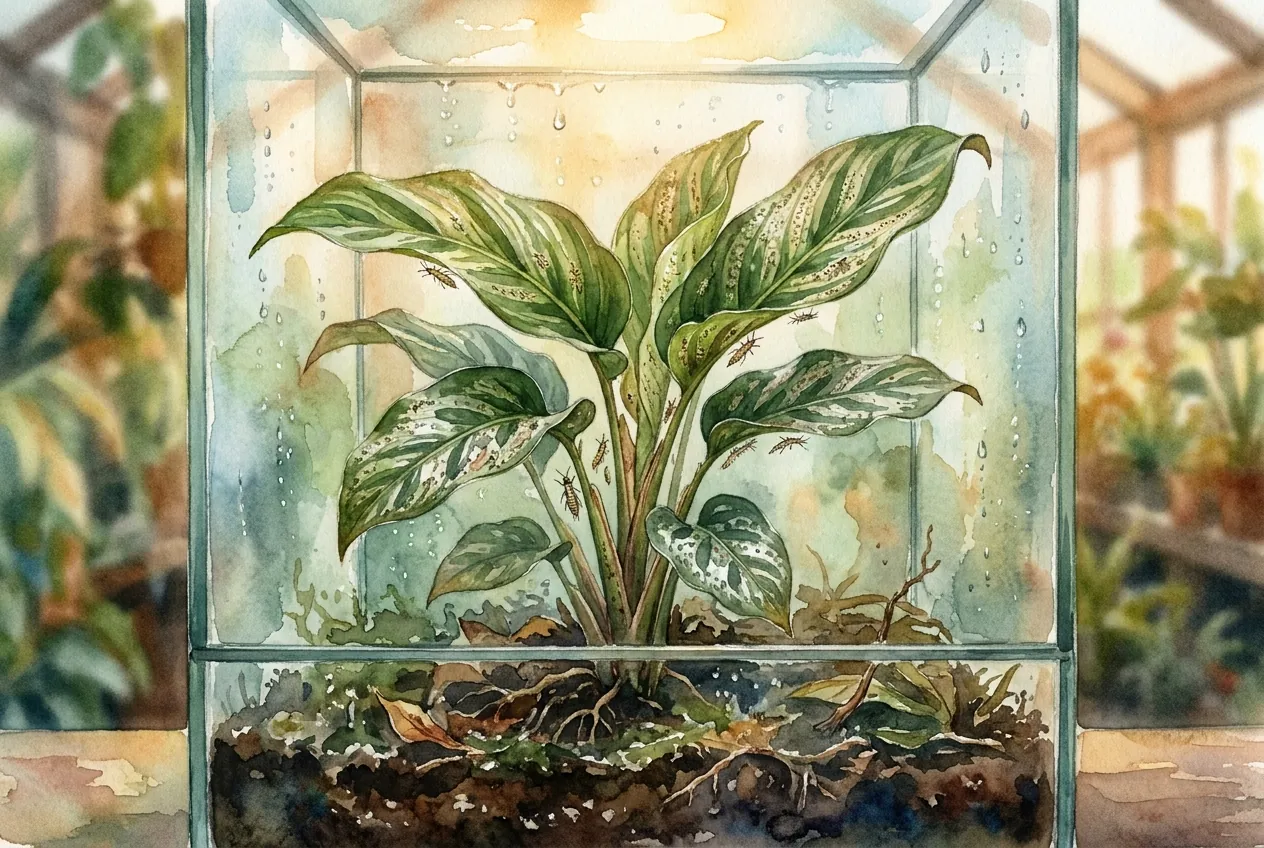
Key Takeaways
- Warmth shortens thrips generation time, so a fixed weekly spray can fall behind. Reported development figures vary by study, host, and whether temperature is constant or fluctuating.
- An enclosure’s canopy is often warmer than the room. Measure canopy temperature directly with a min/max thermometer rather than assuming a fixed offset.
- Set spray intervals from your product’s current label and a local extension program, not from a fixed calendar. Rotate mode-of-action groups to slow resistance.
- The two common spinosad products here are labeled for outdoor residential use only and carry bee and aquatic-invertebrate hazards. Do not treat them as verified-safe for inhabited bioactive enclosures.
- Soil-dwelling predatory mites can target the pupal stage in the substrate. They also eat springtails, so plan for a backup cleanup-crew culture.
A spray interval you set in spring can fall behind in summer. Warmth speeds up thrips
development. Under controlled conditions, Frankliniella occidentalis has been reported to
complete its egg-to-adult cycle in roughly 10 to 12 days near 30 °C, versus about three weeks in
cooler conditions.
Exact figures vary by study, host plant, and whether the temperature is held
constant or fluctuates, so treat any single number as an estimate, not a
guarantee.
Contact and short-residual insecticides also give you only a limited window of protection between
sprays.
If new adults are emerging faster than your interval, a fixed weekly schedule can leave gaps.
Measure the canopy microclimate, confirm the pest, then set any repeat treatment within your product’s current label and local extension guidance.
Why Does Temperature Control Thrips Speed?
How Does the Thrips Life Cycle Work?
Thrips lay eggs inside leaf tissue. The feeding larvae cause silver streaking and black frass, while prepupae and pupae often shelter in the substrate, leaf folds, or spent flowers. Adults then emerge and start the cycle again. This is why one foliar spray can miss part of the population.
Warmth speeds this cycle up. In controlled studies, development took about a month near 15 °C and about 10 to 12 days near 30 °C. The exact timing changes with the study, host plant, and daily temperature swings, so use the numbers to understand the direction of change rather than to predict an exact hatch date.
Effect of temperature on development of the Western Flower Thrips Frankliniella occidentalis
I place minimum and maximum temperature, treatment dates, and observations of larvae, adults, and new feeding scars on one calendar. Summer heat can compress development, but the legal application interval still comes from the product label.
The stage record helps me decide whether apparent return is hatch-out, missed coverage, or movement from another plant. I never shorten a label interval simply because the room is hot.
Flowers and folded new leaves serve as separate sentinel zones. Sticky cards show flying adults, while larvae can remain hidden where a card cannot sample them.
What Is the Degree-Day Clock and Why Does It Matter?
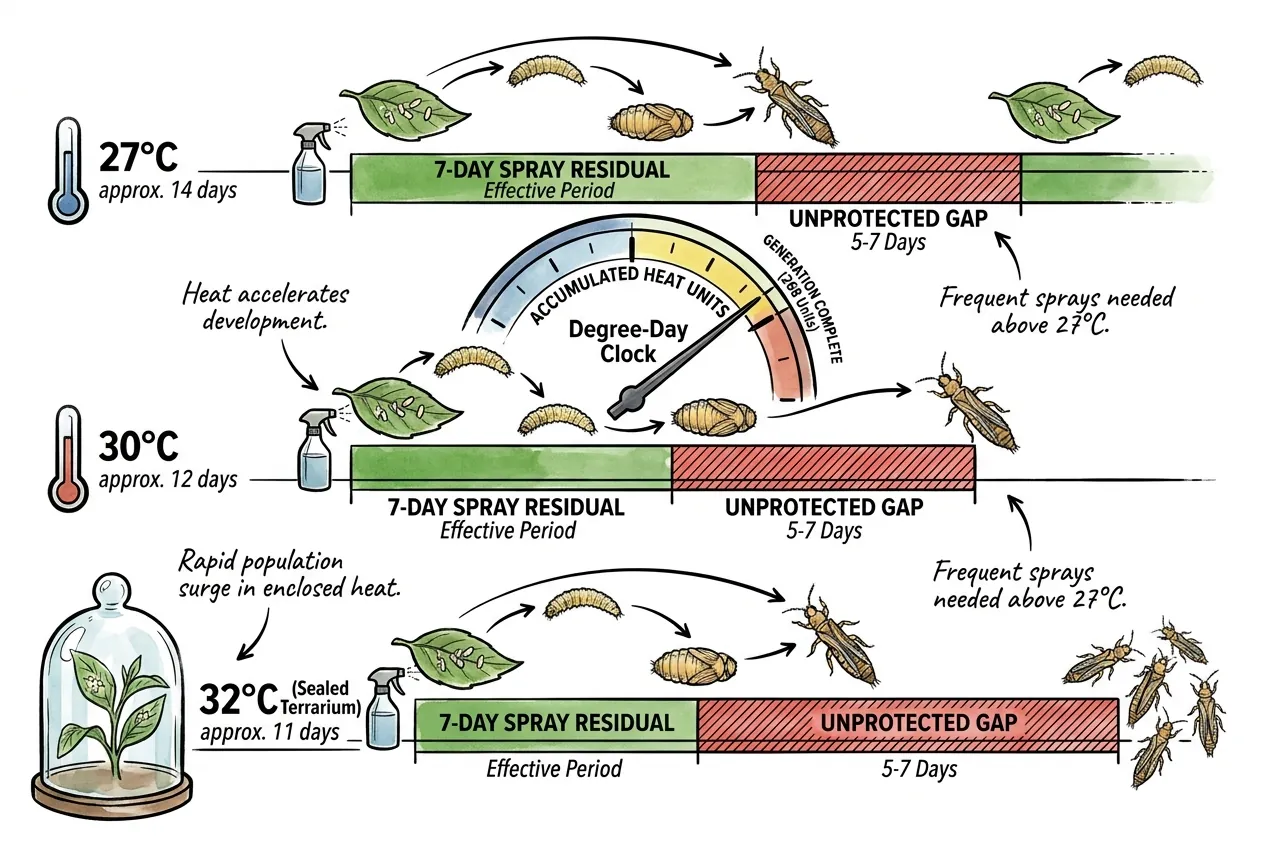
Degree days are simply a research tool for adding up warmth instead of treating every calendar day as equal. You do not need to calculate them to manage thrips. They explain why a hot enclosure can move through life stages sooner than a cool room, while extreme heat does not keep making development faster forever.
As the canopy warms, generations shorten, so a spray interval that worked in cooler conditions may need tightening.
Use your measured canopy temperature, the product’s label, and trap counts rather than a fixed formula.
Effect of Temperature on Development and Oviposition of Western Flower Thrips Frankliniella occidentalis
Why Can Thrips Rebound Faster in Warm Conditions?
Why Warmth Changes the Pressure
In warm conditions, thrips can move from egg to feeding larva and then to adult sooner. That means a small population can recover quickly when eggs inside leaf tissue, pupae in the substrate, or missed insects survive a treatment.
No fixed multiplication rate applies to a home collection. Growth also depends on the host plant, coverage, humidity, and whether new thrips arrive. Research suggests the increase can peak around the high 20s °C and fall at still higher temperatures, so hotter is not automatically worse.
Watch the trend instead. Check new growth and sticky traps after treatment. Rising counts or fresh damage mean it is time to check coverage, reinfestation, and the product’s labeled interval. They do not by themselves justify adding extra applications.
Temperature-Mediated Relationship Between Western Flower Thrips and Chrysanthemum
Life History Characteristics of Frankliniella occidentalis and Frankliniella intonsa in Constant and Fluctuating Temperatures
Is Your Growing Space Hotter Than the Thermostat Shows?
Why Does the Room Thermostat Give the Wrong Reading?
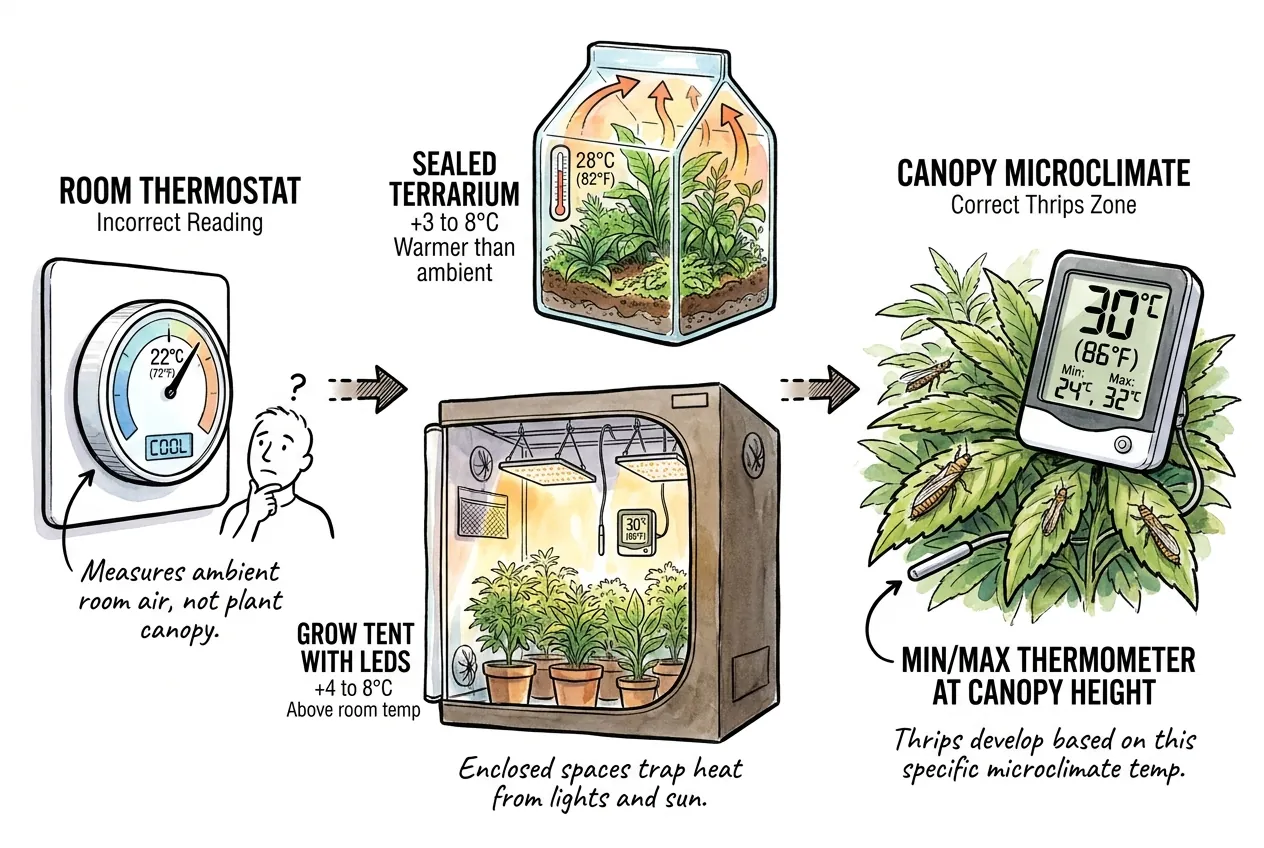
The temperature that drives thrips development is the canopy-level microclimate inside the
growing space, which can differ from what a room thermostat reads.
Sealed enclosures and grow tents
under lights often trap heat and run warmer at the canopy than the surrounding room.
Light, ventilation, enclosure size, evaporation, water heaters, and room airflow all affect the canopy,
so there is no reliable temperature offset to add to a room reading.
Place a min/max thermometer at canopy
height and record the daily low and high. If possible, compare readings with the lights on and off. The useful
number is the temperature where the thrips are feeding.
LED Grow Light Heat Output Managing Temperature for Optimal Growth
What Temperature Differential Should I Expect for My Setup?
A fixed temperature difference would mislead. An open shelf often stays close to room temperature, while a sealed, brightly lit space often runs warmer. Evaporation and airflow can change either result, so use this table to decide where to measure rather than to estimate a number.
| Setup (tends warmer toward the bottom) | What to measure |
|---|---|
| Open shelf, no supplemental light | Canopy min/mean/max. Usually near room temperature |
| Open shelf with LED strip or grow light | Canopy temperature with lights on versus off |
| Enclosed terrarium or grow tent under lights | Canopy temperature and humidity. Check ventilation effect |
| Paludarium with a water heating element | Canopy temperature near the heater and at plant level |
So if a room thermostat reads 24 °C, a sealed, lit enclosure may well be warmer at the canopy. Warmer is not the same as a specific 27 to 32 °C. Measure it before you assume you are in any particular range.
How Do You Spot Thrips Damage Before It Gets Ahead of You?
What Does Thrips Damage Look Like on Monstera, Philodendron, and Alocasia?
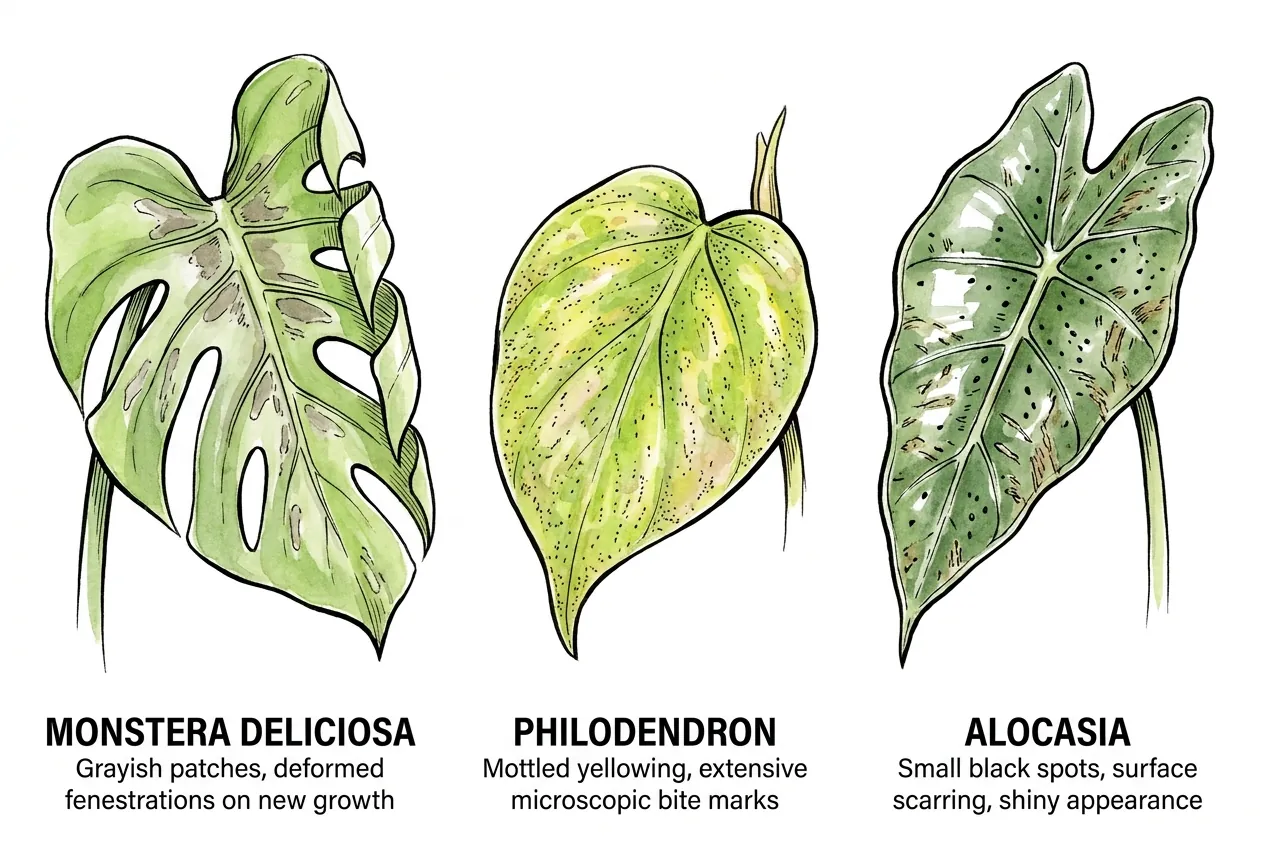
New growth is a useful inspection target. Thrips tend to lay eggs into soft, actively growing tissue,
and larvae feeding inside a furling leaf can leave lasting distortion once it expands.
So it is worth
inspecting new leaves closely, but bear in mind eggs and larvae are not confined to one spot.
On aroids, new leaves may unfurl with gray patches, mottling, small dark specks, surface scarring, or a shiny look. None of these signs confirms thrips. Spider mites, edema, nutrient problems, injury, and disease can look similar. Treat the damage as a reason to inspect more closely, then confirm by finding the insect.
How Do Black Frass Dots Confirm Thrips vs. Spider Mites?
Black frass dots alongside silver stippling point toward thrips, but they do not by themselves confirm
thrips or rule out spider mites. Other pests and abiotic injury can look similar, and UC IPM
advises confirming the actual insect before treating.
As a rough guide, spider mite damage tends toward
fine, uniform stippling with fine webbing on the leaf underside, whereas thrips damage often shows more
directional streaking with frass collecting in leaf depressions and folds.
These are helpful clues, not
a two-way diagnosis.
The reliable confirmation is finding the insect. Hold a white sheet under a suspicious leaf and tap it
gently. Tiny slender insects (roughly 0.5 to 2 mm, pale as nymphs and darker as adults, with color and
size varying by stage and species) support a thrips call.
A 10x loupe on the interior of unfurling leaves
helps you spot translucent first-instar larvae.
If you are unsure, comparing against a reference photo of
adult thrips, larvae, and frass will do more than symptom appearance alone.
What Does Thrips Damage Look Like on Houseplants growtropicals.com
What Spray Schedule Actually Works at Summer Temperatures?
How Should You Adjust an Interval in Warm Conditions?
Extension guidance for greenhouses and outdoor crops sometimes uses repeated applications a few days apart. Those examples do not create an indoor schedule or replace the interval, maximum number of applications, and other restrictions on the exact product label.
A temperature-by-temperature spray table would imply more certainty than the evidence supports and could encourage off-label use.
Instead, treat warmer canopy readings as a reason to move toward the shorter end of your product’s labeled
reapplication range, keep same-mode-of-action use within label limits, and let trap counts and inspections
tell you whether the interval is keeping pace.
Thrips Floriculture and Ornamental Nurseries UC IPM
Why Repeat Applications May Be Needed
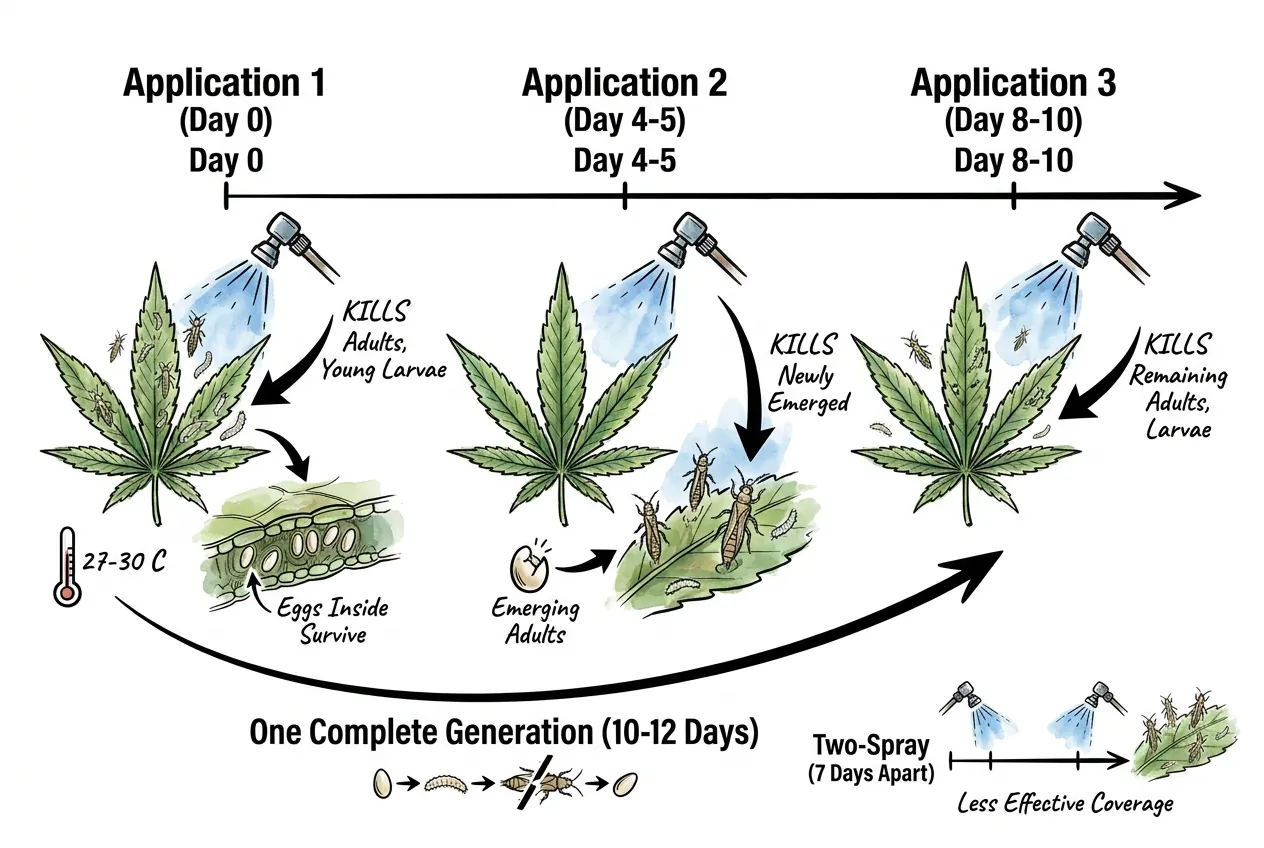
Eggs inside leaf tissue and pupae in the substrate can survive a foliar spray. When a product label calls for repeat treatment, the goal is to reach newly hatched or newly exposed thrips, not to follow a universal three-spray recipe.
Do not build a Day 0, Day 4, and Day 8 schedule from the life cycle. The label for your exact product sets the interval, maximum number of applications, and resistance-management limits.
Western Flower Thrips Factsheet UConn Extension
Which Products to Use and in What Order
Spinosad (Monterey, Bonide) (Read the Label Before You Assume It Fits)
Monterey Garden Insect Spray 8 oz concentrate and Bonide Captain Jack’s Deadbug Brew are 0.5 percent spinosad products. They can be useful against thrips only when the exact label lists the pest, plant, and treatment site.
The deciding question is the site, not the product’s reputation. These labels are for outdoor residential or home-garden use. They do not authorize spraying inside an inhabited bioactive enclosure, and avoiding the substrate or flowers does not remove the animal-exposure concern.
What to Check First
Before using either product, confirm the formulation, the listed pest, the site, the reapplication interval, and the maximum number of applications on the bottle you have. Both labels include bee and aquatic-invertebrate hazards.
Tradeoff
Spinosad is an IRAC Group 5 insecticide, so Monterey and Bonide do not count as different rotation groups. If you use a labeled spinosad treatment, keep consecutive same-group use within label limits. For an enclosure with animals, treat plants outside the enclosure only where the label allows and get species-specific guidance before any in-enclosure use.
Neem Oil (Safer) (A Separate Label-Based Option)
Safer Brand Neem Oil Concentrate contains clarified hydrophobic extract of neem oil, not azadirachtin. It does not have a fixed numbered IRAC rotation group, so do not assume that using it automatically creates a named-group rotation.
Neem oil can be a slower, contact-based option when its label fits the plant and pest. Follow the bottle’s mixing and interval directions, do not add liquid soap or another adjuvant when the label says not to, and patch-test tender, stressed, or newly transplanted tissue. It is not verified-safe for an enclosure’s animals or cleanup crew.
Tradeoff
Neem oil is usually a poorer choice when you need a rapid knockdown. Use it only when the label fits the situation, then judge the result from plant inspections and trap trends rather than treating on a perpetual calendar.
Why Does Resistance Develop Faster in Summer?
How Does Repeated Use Build Resistance?
Warmth can shorten the time between generations. When the same mode of action is used repeatedly, survivors with resistance are more likely to make up a larger share of the next generation.
That is a risk to manage, not a percentage to calculate. Resistance can persist in some populations and decline in others, depending on the product, treatment history, and management.
Rotate mode-of-action groups between treatment windows and keep consecutive same-group use within the product label’s limits.
Western flower thrips resistance to insecticides USDA ARS
Management Strategies for Western Flower Thrips USDA ARS
How Do You Apply Spinosad Safely in a Bioactive Terrarium?
What Makes Bioactive Terrariums Different from a Potted Plant?
Bioactive terrariums depend on springtails, isopods, microbes, and sometimes reptiles or amphibians. A spray that controls thrips can also affect parts of that system. No label or controlled test cited here shows that spinosad is safe inside an inhabited bioactive enclosure.
An anecdote from an uninhabited setup with only springtails and isopods is not enough to establish safety for a terrarium with animals. It cannot tell you the dose, exposure, survival, or long-term effects for your own species.
Do not treat spinosad as verified-safe inside an inhabited enclosure. Where the label allows it, remove and treat a potted plant outside the enclosure. For any in-enclosure decision involving animals, get guidance for the species you keep.
Spinosad can be toxic to predatory mites shortly after application, so separate a labeled spinosad application from a mite release. The safe interval depends on the product label and residue conditions.
Indoor Vivarium and Terrarium Horticulture Nutrients and Pest Control NEHERP
What to Do in an Enclosure
Inside an inhabited enclosure, put inspection, isolation, and non-chemical steps first. The options below target different life stages, but they do not make an outdoor-labeled spray safe for use around animals.
Foliar spray (adults and larvae) (treat only outside the enclosure where labeled)
Do not spray an inhabited enclosure. If the label allows treatment, remove the affected potted plant and follow the exact label outside the enclosure. Treating around the substrate or moving animals aside does not turn an off-label indoor application into a safe one.
Substrate handling (pupae) (targeted, not wholesale)
On an affected potted plant you can lift, refreshing a small amount of the upper potting mix may remove some pupae. It will not remove every pupa and can damage roots if done aggressively. Do not strip the floor of an established enclosure.
Soil predatory mites (pupae) (helpful, with a trade-off)
Soil predatory mites such as Stratiolaelaps scimitus can reach pupae that foliar sprays miss. Use the supplier’s release rate and moisture guidance. They also eat springtails, so keep a backup culture, and do not assume their safety around reptiles or amphibians has been established.
Monitoring
Place blue sticky traps at canopy height in a consistent position and keep them out of reach of animals. Read the count with direct plant inspection. A rising count calls for a check of reinfestation, coverage, or newly hatched thrips. It is not an automatic reason to switch chemicals.
Bioactive Enclosure Plant Pests Identification and Treatment Zen Habitats
When Can Biological Controls Help?
When Does Amblyseius cucumeris Work and When Does It Fail?
Amblyseius cucumeris feeds on first-instar thrips larvae and works best as a preventive release, not a last-minute rescue. Warm canopies around 24 to 29 °C can suit it when humidity is high. Very hot, dry conditions reduce performance.
Use the supplier’s sachet rate, replacement schedule, and humidity guidance for your setup. Separate a predator release from an insecticide application because residues can harm the mites. Soil predatory mites are covered above because they serve a different role by reaching pupae.
How Do You Prevent Thrips Before They Establish?
How Long Should You Quarantine a New Plant?
Even a clean-looking new plant can carry eggs inside leaf tissue or young larvae that are easy to miss. Keep it separate so those stages have time to become visible before the plant joins the collection.
Set Quarantine by Development, Not a Fixed Calendar
Set the quarantine length by your room and canopy temperature. In a cool room, four weeks may not cover two full generations, so a longer window is safer. Keep separate airflow and trays, and inspect the plant more than once during quarantine.
Do not spray a new plant preventively with an outdoor-labeled insecticide on a fixed Day 0 and Day 14
schedule when no pest has been confirmed.
That runs counter to the labels’ pest-present
condition and to resistance stewardship, and it adds unnecessary exposure.
Use the quarantine window for
careful observation and trapping, and treat only if you confirm thrips.
How Do Blue Sticky Traps Provide Early Warning?
Blue or yellow sticky traps at canopy height can reveal adult thrips before leaf damage is obvious. Keep their position and size consistent so counts are comparable, and protect animals from the sticky surface.
Read trap counts with direct plant inspection. A rising count signals reinfestation or missed stages, while a falling count supports improvement. Traps monitor adults only. They do not control the infestation or show what is happening to eggs and pupae.
Blue vs Yellow Sticky Traps for Thrips Monitoring UC IPM
Affiliate Disclosure
This article contains Amazon affiliate links. As an Amazon Associate I earn from qualifying purchases. If you use these links, the site may earn a commission at no extra cost to you. Product availability, price, and specifications can change. Check the current listing before buying.