
Java Moss vs Christmas Moss: July Algae Fix Without Reset
Java Moss vs Christmas Moss algae fix for July: ID the 5 algae types, rehab or replace the carpet, swap species without resetting the tank.
Priya Patel · Published 2026-06-11 · 27 min read
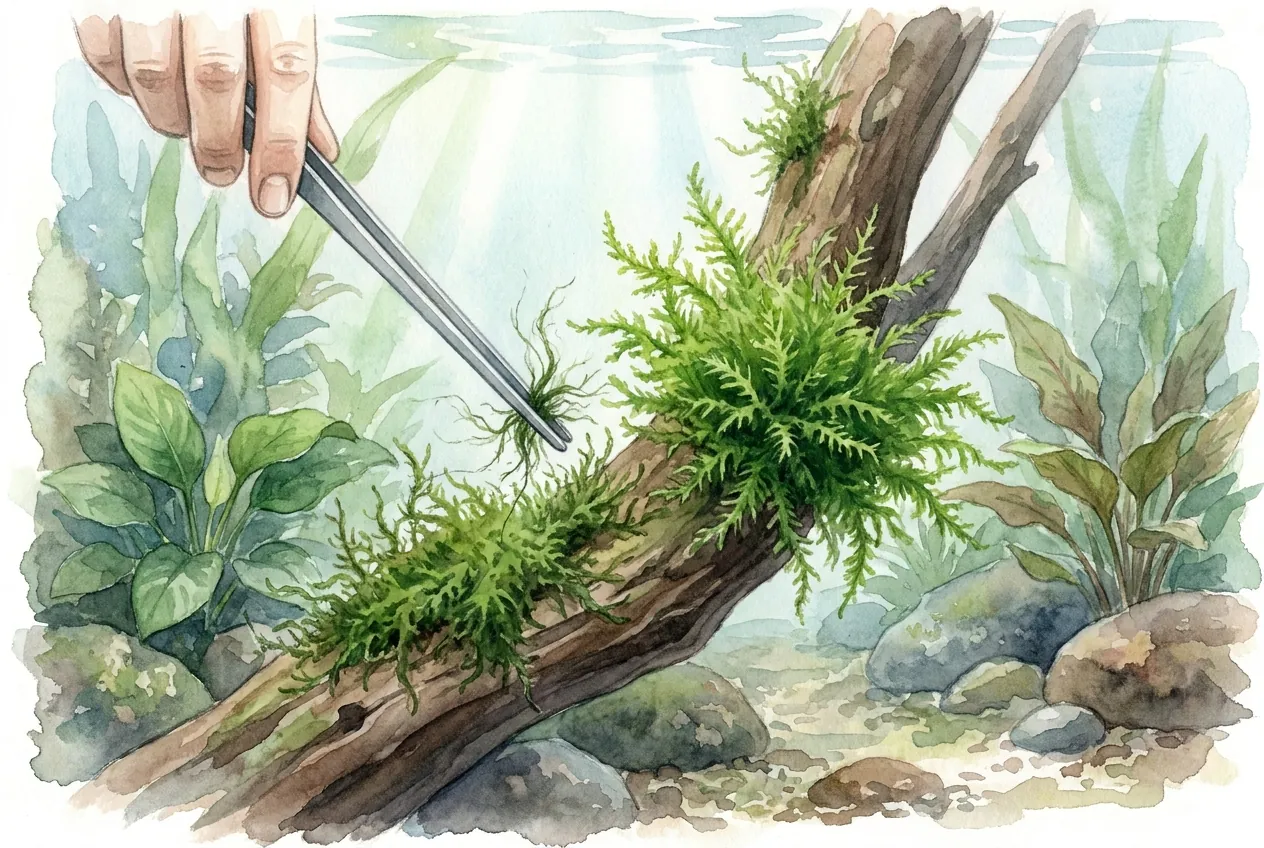
- Java moss is generally the more heat-tolerant of the two. Christmas moss tends to slow first in a hot summer room, but exact cutoffs depend on stock, acclimation, light, and water chemistry.
- Visual algae identification is only a first screen. Correct the underlying nutrient, light, flow, and CO2 conditions rather than reaching for one fix per type.
- Judge rehabilitation versus replacement by the moss's condition, attachment, and livestock risk. Do not use a fixed coverage percentage as the decision rule.
- Chemical spot treatments carry real risk to shrimp, the biofilter, and the aquarist. Verify any reference against the product label and a small test rather than treating it as a universal recipe.
- You can often swap a moss carpet without a full recycle. The established filter and substrate biofilm carry much of the nitrification, but monitor ammonia and nitrite after the disturbance.
Summer heat is a common trigger for moss-carpet trouble. When a warm room pushes the tank into the high 20s°C, dissolved oxygen falls, moss growth slows, and opportunistic algae get an opening.
How fast that happens depends on your room, hemisphere, and setup, so treat July as a risk window rather than a guarantee.
First protect livestock and correct heat, light, flow, CO2, and nutrient problems. Then decide whether the carpet is healthy enough to rehabilitate or should be replaced. Do not rush high-risk chemical steps.
Why does July specifically break moss carpets?
Aquarium lighting can add heat above room ambient, though the actual rise depends on the fixture, wattage, distance, lid, tank volume, and airflow (log it with a thermometer rather than assuming a fixed number).
On top of that, a warm summer room can push the tank several degrees higher and stress the whole system at once.
Warmer water holds less dissolved oxygen at saturation, so a hot tank tends to carry less oxygen than the same tank when cooler. Actual DO also depends on aeration, photosynthesis, respiration, and organic load.
Higher temperature also increases metabolic oxygen demand, and the fraction of ammonia present as toxic NH3 rises with both temperature and pH, so watch total ammonia, pH, and oxygen together rather than temperature alone.
Moss growth tends to slow as temperature climbs, and in most hobby experience Christmas moss (Vesicularia montagnei) slows before Java moss (Taxiphyllum barbieri).
A 2025 study that compared the two only tested combined temperature-and-light conditions and did not pin down a precise optimum, so treat any exact cutoff as approximate.
When new growth stalls, the carpet stops shading out competitors and algae can gain a foothold.
How quickly that shows up depends on the algae type, spore load, light, and nutrient and CO2 conditions, so there is no single universal timeline.
I wring two clean paper towels until no drops fall, blot each moss between them for 30 seconds, weigh two grams, and spread it across a neighboring five-centimeter square mesh. The fixed blot, wet mass, mesh area, light, flow, and maintenance make the comparison more useful than judging moss grown in different tanks.
Clean new tips and algae-covered area are photographed separately. A moss can gain biomass while becoming harder to maintain, so total green area alone does not decide which one works better.
Each removable square is swished in its own container of tank water so I can compare the released detritus. The mat that looks cleaner from the front may be trapping more debris underneath.
Are Java moss and Christmas moss actually the same plant?
No. They are in two different genera. Java moss is Taxiphyllum barbieri. Christmas moss is Vesicularia montagnei.
They are commonly mislabeled under each other's common names in the trade because both produce green tangled mats on hardscape.
Their temperature tolerance, light demand, and growth geometry differ.
The difference tends to matter most in summer. Hobby care sheets generally place Java moss around 20-30°C with better growth toward the lower end. Sustained high temperatures slow growth and can increase die-back.
Treat these as reported comfort ranges tied to the growers' conditions, not fixed thresholds.
Christmas moss is usually reported to grow best around 20-25°C, with growth slowing when tanks are held warmer.
In a warm summer room the two mosses can behave quite differently, but the exact temperature at which each stalls depends on your stock, acclimation, light, and water chemistry.
How do I tell which moss I have?
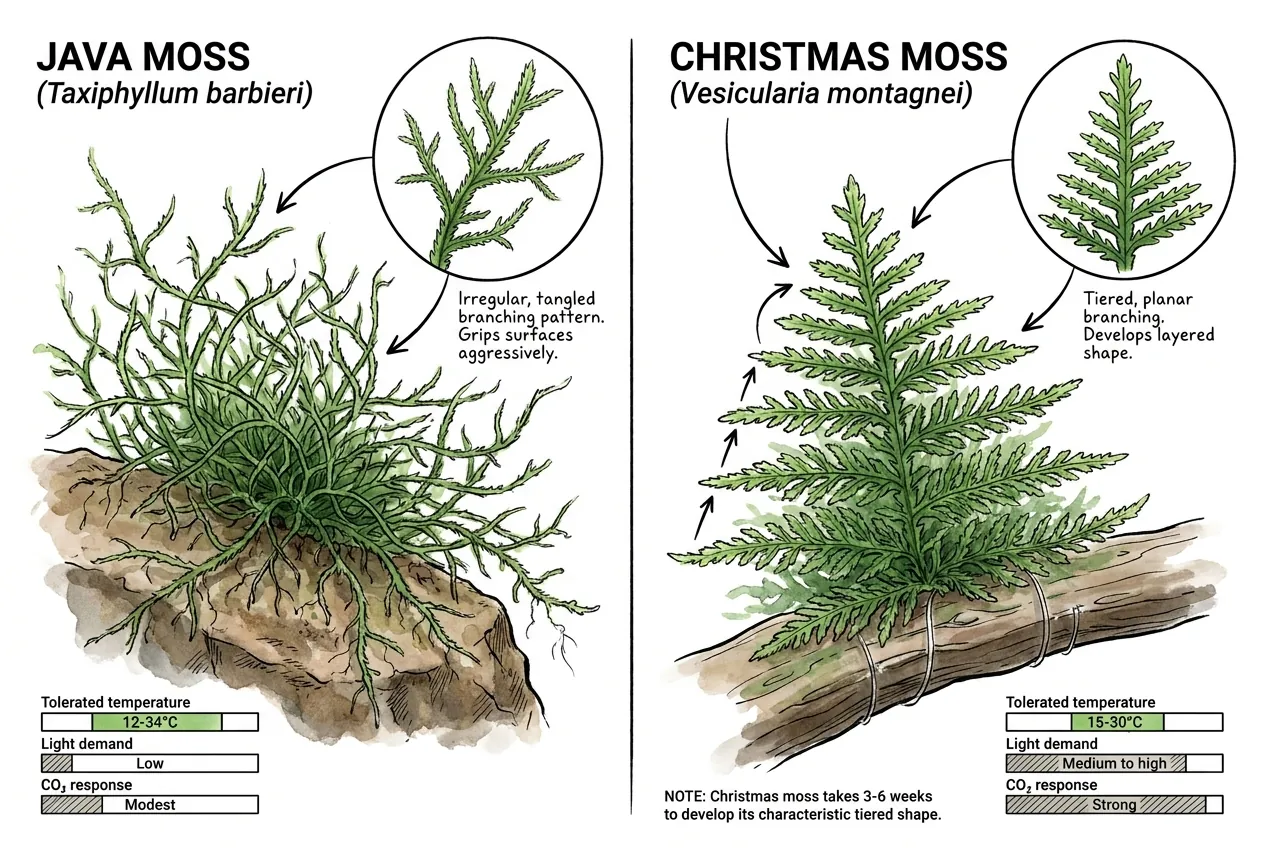
Look at the branching pattern. Java moss tends to branch irregularly. A messy tangle that grips rough surfaces via rhizoids.
This is a useful clue, but growth conditions change the look, so a single glance is not a definitive identification.
Christmas moss more often shows flatter, planar tiers that produce the namesake Christmas-tree silhouette and a more layered look. It can vary with growth conditions too.
Young or recently planted moss can resemble either type before its mature form develops, and this can take several weeks.
If you are unsure, ask the seller for the Latin binomial on the invoice rather than relying on shape alone.
| Trait | Java moss (T. barbieri) | Christmas moss (V. montagnei) |
|---|---|---|
| Reported comfort range | ~20-30°C (better toward the low end) | ~20-25°C (tends to slow when held warmer) |
| Relative heat tolerance | Generally the more heat-tolerant | Tends to slow first in a hot room |
| Light demand | Low | Medium to high |
| CO2 response | Grows without injected CO2. May benefit from it | Grows without injected CO2. May benefit from it |
| Anchoring speed | Fast (self-grips) | Slow (needs mesh 3-6 weeks) |
| Frond shape | Irregular tangle | Tiered planar |
The comfort ranges above are drawn from hobby care sheets tied to each grower's own conditions, not from controlled physiology studies, so use them as rough guidance rather than fixed limits.
Java Moss (Taxiphyllum barbieri) Care Sheet
Which algae is actually on my moss carpet?
A handful of algae and cyanobacteria types cover most moss-carpet trouble in summer, and they respond to different conditions.
Other green and red algae, diatoms, and bacterial or fungal films are also possible, so start by narrowing the look, but treat visual sorting as a first screen, not a confirmed diagnosis.
Misidentification is a common reason a treatment runs for weeks with no progress.
How do I tell black beard algae from hair algae?
Black beard algae (BBA) usually shows as dark bristly tufts, while hair algae shows as green strands.
These outward differences help with an initial screen, but growth stage and mixed infestations blur them.
Use Visual Labels as a Starting Point
BBA is a red alga whose group can appear black or dark green. Several red-algal taxa can look similar, so treat BBA as a visual category rather than one confirmed species. It often takes hold along higher-flow edges, though flow is only one factor among several.
Hair algae trails like fine green strands through the carpet body, and can cover more than one taxon.
A squeeze test can compare texture as a rough screen. It is not a taxonomic test, so protect livestock and your skin and pull a small sample aside rather than crushing algae on the plants.
BBA tends to feel bristly and stiff. Hair algae is often either tough and wiry (as with Cladophora) or slimy (as with Spirogyra).
These are typical tendencies with a lot of overlap, so confirm with a closer look at cell and branching structure before acting on the ID.
What is the green slime that smells like mud?

This may be cyanobacteria (a prokaryote rather than a true alga). Some cyanobacteria fix atmospheric nitrogen, but not all do, so low NO3 and stagnant flow are possible contributing conditions rather than a guaranteed cause.
An earthy, muddy smell can come from geosmin and 2-methylisoborneol, compounds produced by some (not all) cyanobacterial strains.
Odor sensitivity and which strains produce these vary, so an earthy smell is a supporting clue, not proof of cyanobacteria or of harmlessness.
A mat that lifts off the moss in sheets is another useful clue. Even so, appearance and smell alone cannot confirm the species or whether it produces toxins, so handle it cautiously.
Because visual and odor cues are limited, start with the lower-risk, non-chemical corrections. Check nitrate, flow, and organic load, siphon off the mat, and consider a short blackout while watching oxygen, temperature, and livestock.
Do not dose an aquarium-wide antibiotic without a confirmed diagnosis, a label that covers the use, and professional guidance. It can harm the biofilter and wider microbiome and contributes to antimicrobial resistance.
Why does it matter which type it is?
Because they tend to be associated with different conditions, even if no single driver fully explains any one type.
BBA is often linked with unstable CO2. Filamentous green algae (such as Cladophora or Spirogyra) with a combination of light and nutrient conditions.
In practice CO2, light, nutrients, organic load, grazing, and physical disturbance all interact.
Cyanobacterial mats are frequently seen alongside low NO3, low flow, and organic load, but these are correlations rather than exclusive causes.
Aiming a treatment at the wrong condition wastes time, so look at the actual measurements before committing.
| Type (visual category) | Possible visual clue | Conditions often associated | Things to try first (non-chemical, then verify) |
|---|---|---|---|
| BBA (dark bristly tufts) | Black or dark-green bristly tufts, often on higher-flow edges | Often linked with unstable CO2, among other factors | Stabilize CO2. Manual/mechanical removal. Spot oxidants only with the cautions below |
| Cladophora (wiry green) | Wiry, tough, branching green strands attached at one end | Light and nutrient conditions. Hard to peel from moss | Manual removal. Review light and nutrients |
| Spirogyra (slimy green) | Slimy, soft green strands | Light and organic load | Manual removal. A short blackout may help (watch oxygen/temperature) |
| Cyanobacteria (sheet-like mat) | Liftable sheets, sometimes an earthy smell | Often seen with low NO3, low flow, organic load | Siphon off the mat. Improve NO3, flow, and organic load. See antibiotic caution above |
| Green dust/spot | Fine coating on glass and moss tips | Often linked with high light | Review photoperiod and intensity against measured light |
Black Beard Algae – Why It's in Your Tank and How to Actually Get Rid of It
How to control cyanobacteria (Blue-green algae) in an aquarium
How do you diagnose the actual driver behind the algae?
Algae on moss is usually downstream of nutrient, CO2, light, or flow conditions. Spot treatment without addressing those often buys a short window of clean carpet before the same algae returns. How long depends on what you changed.
The four axes to audit are below.
Is your NO3 (PO4 ratio out of balance?)
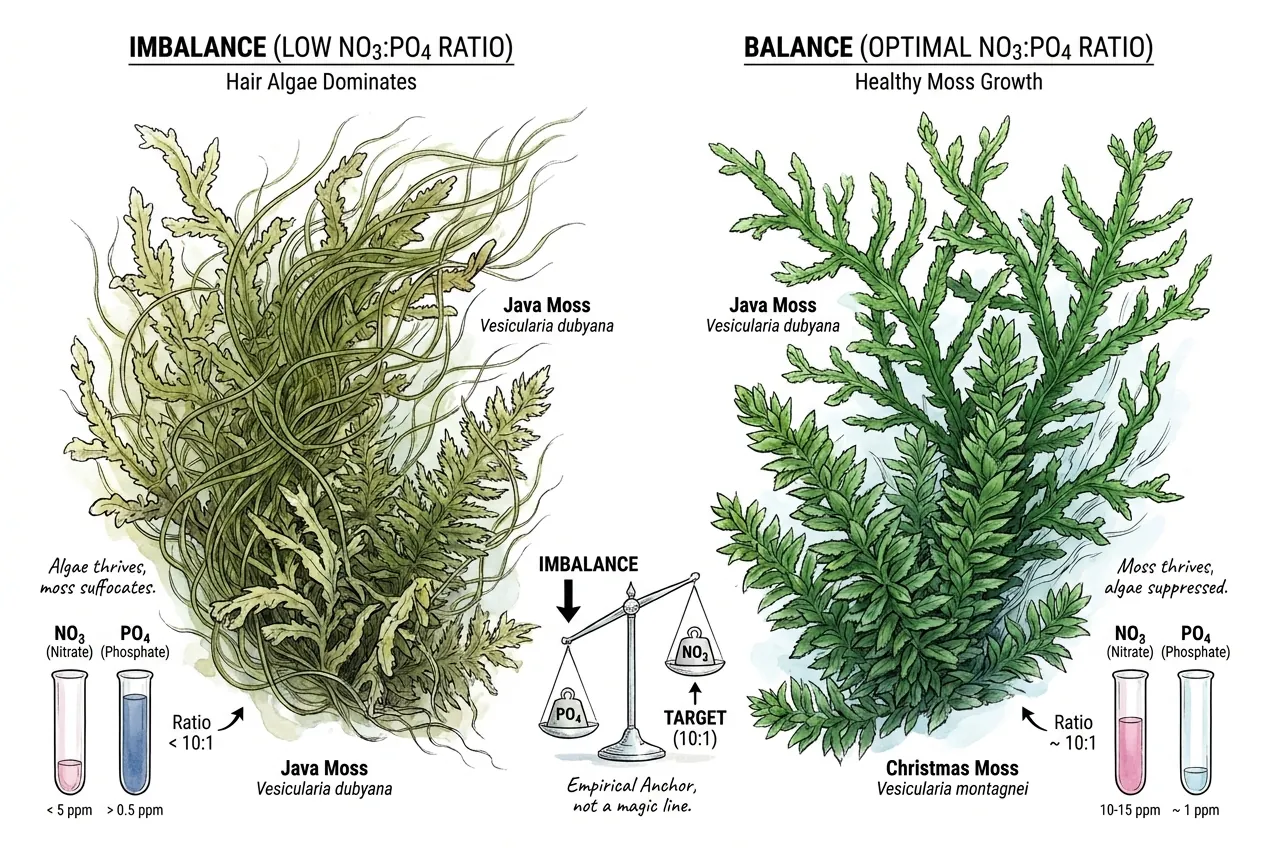
You will see the NO3. PO4 ratio discussed a lot, but there is no validated ratio that reliably predicts hair algae in a planted tank.
The often-quoted 10/1 comes from the marine Redfield ratio, which describes average plankton composition, not an aquarium disease cutoff, so do not treat any single ratio as a trigger.
Test with a hobby kit (Salifert, JBL, or API) and read the results as trends, keeping in mind hobby kits carry real uncertainty.
More useful than a ratio. Keep NO3 and PO4 each within a sensible range for your plants and livestock, and watch how they trend over time rather than chasing a target number.
If nitrate is running very low, addressing that is reasonable, but do it by first confirming the reading and the cause rather than pre-dosing a fixed amount ahead of any treatment.
Is your CO2 stable across the day?
For BBA, keepers commonly find that CO2 stability matters, though this is a general association rather than a proven mechanism tied to any exact level.
A drop checker that reads green at noon but blue at lights-on suggests the CO2 is swinging during the day.
One proposed idea is that plants reduce carbon uptake when CO2 dips, leaving carbon available to algae during the recovery window.
Treat that as a plausible explanation rather than a measured fact.
Many keepers start CO2 30-60 minutes before lights-on and stop it 30-60 minutes before lights-off.
A drop checker lags behind the actual water CO2 and depends on the solution, air gap, position, and how you read the color, so use it to watch the general trend across the photoperiod, not to confirm an exact swing at a precise minute.
Is the light at the substrate too intense?
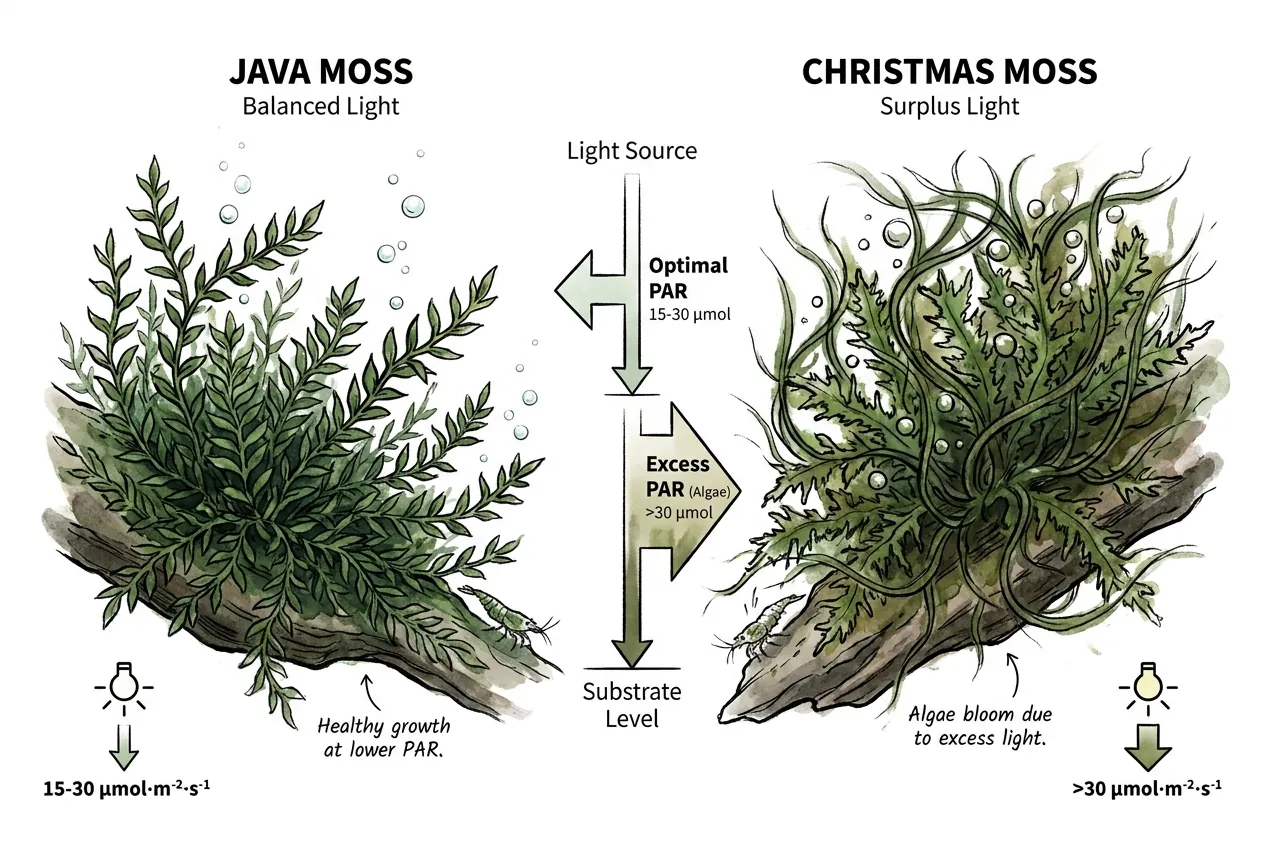
Moss generally does well at relatively low light and does not need an intense fixture. There is no published PPFD number that marks a clean line between what helps moss and what favors algae, so instead of chasing a specific figure, aim for modest light and watch how the carpet and algae respond.
If you can, estimate light at the same spot over time with a PAR meter or a consistent proxy, and track it alongside photoperiod (DLI) and your CO2 and nutrient status.
If hair algae shows up mainly at the moss canopy, the practical levers are to reduce the light. Raise the fixture, dim it, or shorten the photoperiod.
(Lowering the fixture usually increases light at the substrate, so avoid that if the goal is less light.)
Is there flow at the substrate?
The common 5-10× tank-volume-per-hour guideline describes whole-system turnover through the filter, not the local velocity down at the substrate.
What actually reaches the back corner where the moss meets the glass is usually much less, and the two are not the same measurement.
Low-flow dead zones, together with organic buildup, can be one factor in where cyanobacterial mats develop, not a single guaranteed cause.
Checking for a dead zone
Watching how a food pellet moves at the back corner is a rough, imperfect cue. Wetting, density, and animals all affect it, so it is not an accurate flow tracer.
If a corner clearly stays stagnant, a small powerhead aimed across the substrate can help, but adding one can also increase CO2 loss, stir up substrate, and stress animals, so introduce it gently and watch the response.
How to control filamentous green algae
What works for spot-treating algae on moss without bleaching the carpet?
People commonly reach for three interventions in a shrimp-containing moss carpet, hydrogen peroxide, liquid carbon, and a short blackout, but none of them is a universal choice, and identifying the algae and correcting the underlying conditions should come first.
In a carpet with shrimp, the safety margins are genuinely narrow.
Because those margins are narrow, do not treat a general amount as a tank-wide recipe. Confirm the exact product concentration on its label, protect or remove sensitive livestock, test a small patch first, and set clear stop criteria before you dose anything.
How much hydrogen peroxide is safe with shrimp?
Hydrogen peroxide is sometimes used to spot-treat algae, but the safe amount is not a fixed number.
For scale, 3% H2O2 at 0.7 mL per liter works out to roughly 21 mg/L of peroxide in the whole tank (a meaningful dose, and one that research links to effects on nitrifying bacteria and the biofilter at similar concentrations).
The right amount for any given tank depends on the shrimp species, organic load, the actual product, contact time, and aeration, so there is no species-specific safe dose to publish here.
If you choose to use it, treat it as a high-risk step. Work from the product's stated concentration, calculate the total nominal mg/L you are adding, keep sensitive shrimp out of direct contact (ideally removed), aerate well, protect your eyes and skin, and stop if animals show distress.
Spot application into a mat is more localized than tank dosing but still exposes nearby livestock and biofilm.
A note on the biofilter
Hydrogen peroxide is an oxidant, not a targeted algaecide. Its effect depends on concentration, contact time, organic load, and the organism, and it can affect nitrification.
Some keepers briefly pause the filter so peroxide reacts locally rather than circulating through the media, but there is no controlled evidence that a short pause reliably protects the cycle, so watch ammonia and nitrite afterward regardless.
If shrimp pale after contact, treat that as a stress sign rather than a harmless quirk. Stop the exposure, increase aeration, and observe them closely.
Why is liquid carbon a problem for moss carpets?
Manufacturers of liquid-carbon supplements note that a high dose can damage Vallisneria and that Anacharis is especially sensitive. Some keepers also report moss damage. The exact mechanism in moss is not confirmed, so treat these products cautiously and do not use them as a default algae cure for a moss carpet.
Carbon spec for the reader
An organic carbon supplement can help higher plants compete with algae in some low-tech tanks, but it is a bioavailable carbon source, not injected CO2, and it does not guarantee algae control.
It is also not the right tool for a moss carpet under stress.
A liquid-carbon supplement is one option in this category, but formulation, concentration, initial-use directions, maintenance schedule, and sensitive-plant warnings vary by product. Use the exact label dose rather than directions written for another formula. If the label distinguishes an initial rate from a maintenance rate, do not carry the higher initial amount into routine dosing.
Where liquid carbon does and does not fit
Manufacturers document Vallisneria sensitivity at high doses, and keepers add Anacharis, some mosses, and delicate ferns to the watch list.
Whether a full label dose browns a Java or Christmas moss carpet is not universal, plant response varies with species, exposure, and formulation, so test cautiously rather than assuming it will or won't.
Given that uncertainty, this is not the product to reach for during an active moss-carpet rescue.
If you use it at all, keep it to non-moss higher plants in a separate tank, or spot-treatment of hardscape outside the display, and watch sensitive plants closely.
When does a blackout work?
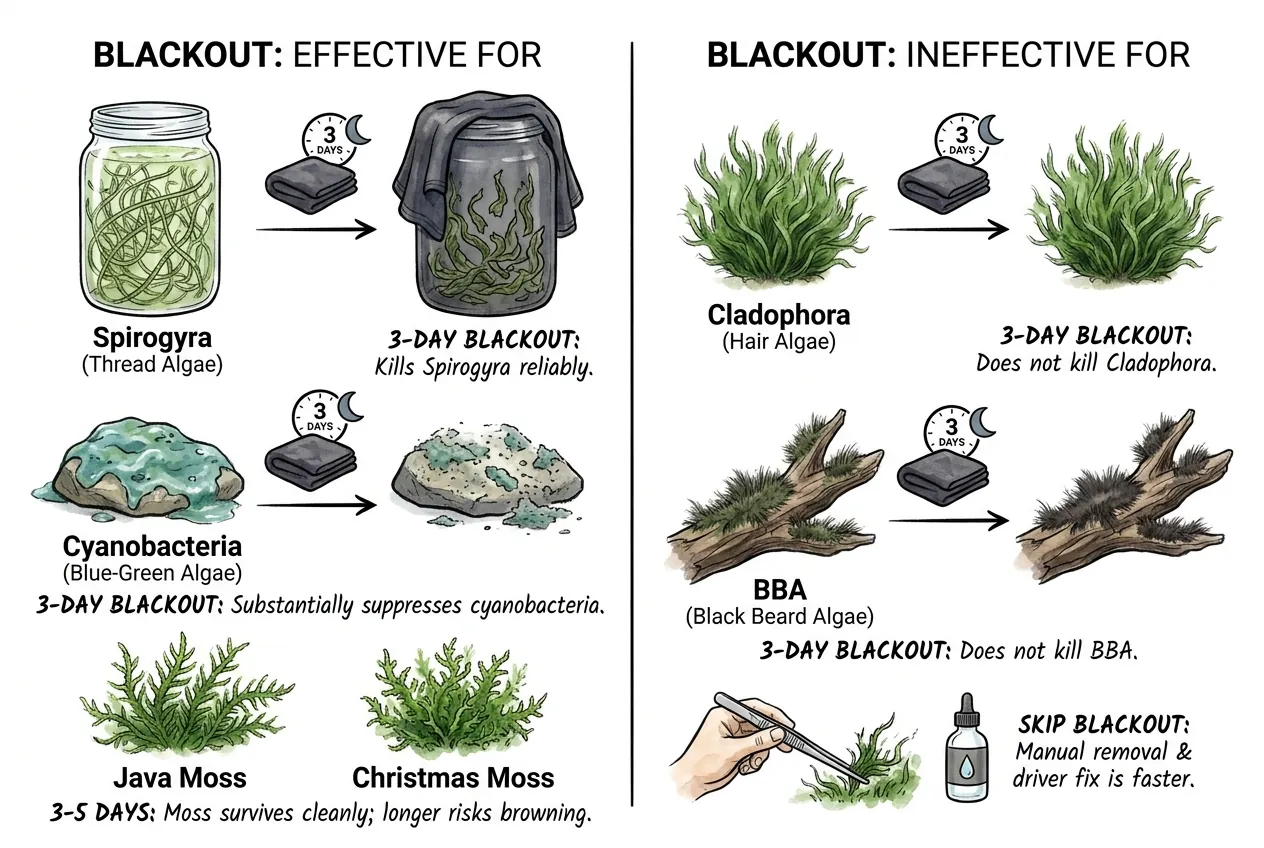
A short blackout (lights off, tank covered) is often more effective against Spirogyra and cyanobacteria than against Cladophora or BBA, but there is no controlled comparison proving it reliably kills one and spares another.
Treat it as a tool that tends to help with soft, slimy growth rather than a guaranteed kill.
Moss generally tolerates a few days of darkness better than a longer one, and extended blackouts risk browning, but the exact safe duration depends on temperature, the moss's stored reserves, species, and starting health.
In summer, watch that covering the tank does not trap heat or reduce oxygen.
As a rough heuristic, a blackout is worth trying for soft hair algae or cyanobacteria, while BBA and Cladophora usually respond better to manual removal plus correcting the underlying conditions.
Because visual ID is uncertain, keep observing and be ready to combine approaches. Throughout, keep aeration up and stop the blackout if livestock show stress.
When should you replace the carpet vs spot-treat?
Decide before you treat, but base the decision on the moss's actual condition rather than a fixed coverage percentage.
Lighter algae coverage on otherwise healthy, well-attached moss generally favors rehab.
Heavier coverage, or moss that is thin, detaching, or clearly dying underneath, tilts toward replacement.
Rather than assuming the base is anaerobic from coverage alone, check the moss directly (tissue viability, attachment, and where the algae keeps coming back matter more than a single number).
If you suspect oxygen problems at the base, confirm it rather than inferring it from color or smell.
What about Cladophora specifically?
Cladophora is often the hardest case for rehab because its wiry, branching filaments tangle tightly into the moss, so pulling the algae out tends to pull moss with it.
When Cladophora is thoroughly woven through a carpet, replacement is frequently more practical than trying to separate the two, but this is a judgment call on that carpet, not an automatic rule, and it does not guarantee the algae won't return.
The squeeze test (wiry, tough, branching, attached at one end) is only a rough screen, so use it to raise your suspicion rather than to lock in a replace decision.
When in doubt, look more closely before committing.
Should I swap species while I'm in there?
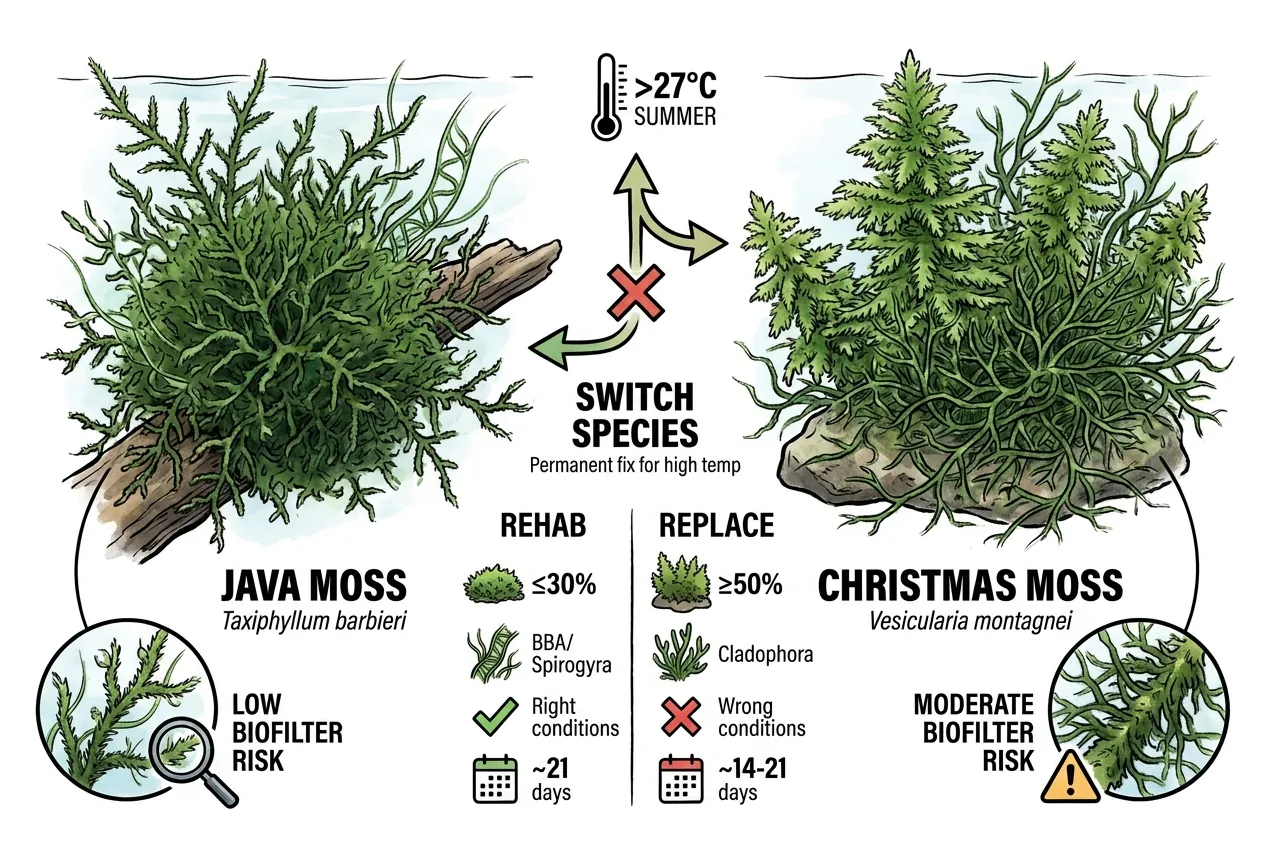
Possibly. If your tank consistently runs warm through summer and Christmas moss keeps struggling there, moving to the more heat-tolerant Java moss is a reasonable long-term change.
But before treating it as the wrong species, consider whether you can realistically cool the tank, how long the hot spell lasts, and how your specific moss is actually doing (animal welfare and achievable, stable conditions come first).
The reverse (Java to Christmas) mainly makes sense if you can reliably hold cooler, stable conditions and want the tiered Christmas-tree look. Treat that as an aesthetic preference secondary to keeping conditions the plant can handle.
| Decision factor | Rehab | Replace |
|---|---|---|
| Algae coverage | Lighter | Heavier |
| Moss condition underneath | Healthy, well-attached | Thin, detaching, or dying |
| Algae type | BBA, Spirogyra, cyanobacteria (removable) | Cladophora woven through the moss |
| Moss suits the conditions | Yes | No (chronically wrong for the tank) |
| Biofilter risk | Low | Moderate but manageable |
| Livestock disturbance | None | Moderate |
Read this as a way to weigh factors, not a clinical decision chart. Treat each row as one input and judge the specific carpet in front of you.
How to control filamentous green algae
How do I replace the carpet without resetting the tank?
The cycle usually does not need to restart, because filter media, sponge, and substrate hold most of the nitrifying biofilm and the moss itself carries only a small share.
Removing the moss is not risk-free, though, so plan to monitor ammonia and nitrite after the disturbance rather than assuming zero impact.
The core steps are straightforward. Keep the biofilter running, hold livestock safely during the swap, dip the new moss carefully, and anchor it with a method suited to your flow.
How do I move the shrimp without crashing them?
Move the shrimp into a clean, appropriately sized container, for a small tank a clean bucket works. Scale the volume to your stocking and tank size. Net them or use a shrimp trap.
Note that the saved tank water mainly protects the shrimp from a sudden water-quality change. The water itself is not the main reservoir of your cycle bacteria, which live on the filter and substrate.
Aerate the container with a battery-powered air pump, keep it covered and at a stable temperature, and keep the hold as short as you can.
How long the shrimp can stay depends on temperature, how many there are, and container size, so watch them rather than relying on a fixed time.
When you refill, use water that matches your tank's target chemistry (dechlorinate any tap water and check that temperature, pH, GH, KH, and TDS line up before returning livestock).
Return shrimp last, after the new carpet is anchored, the tank is back at temperature, and they have been acclimated to the refilled water.
What's the bleach-dip protocol for incoming moss?
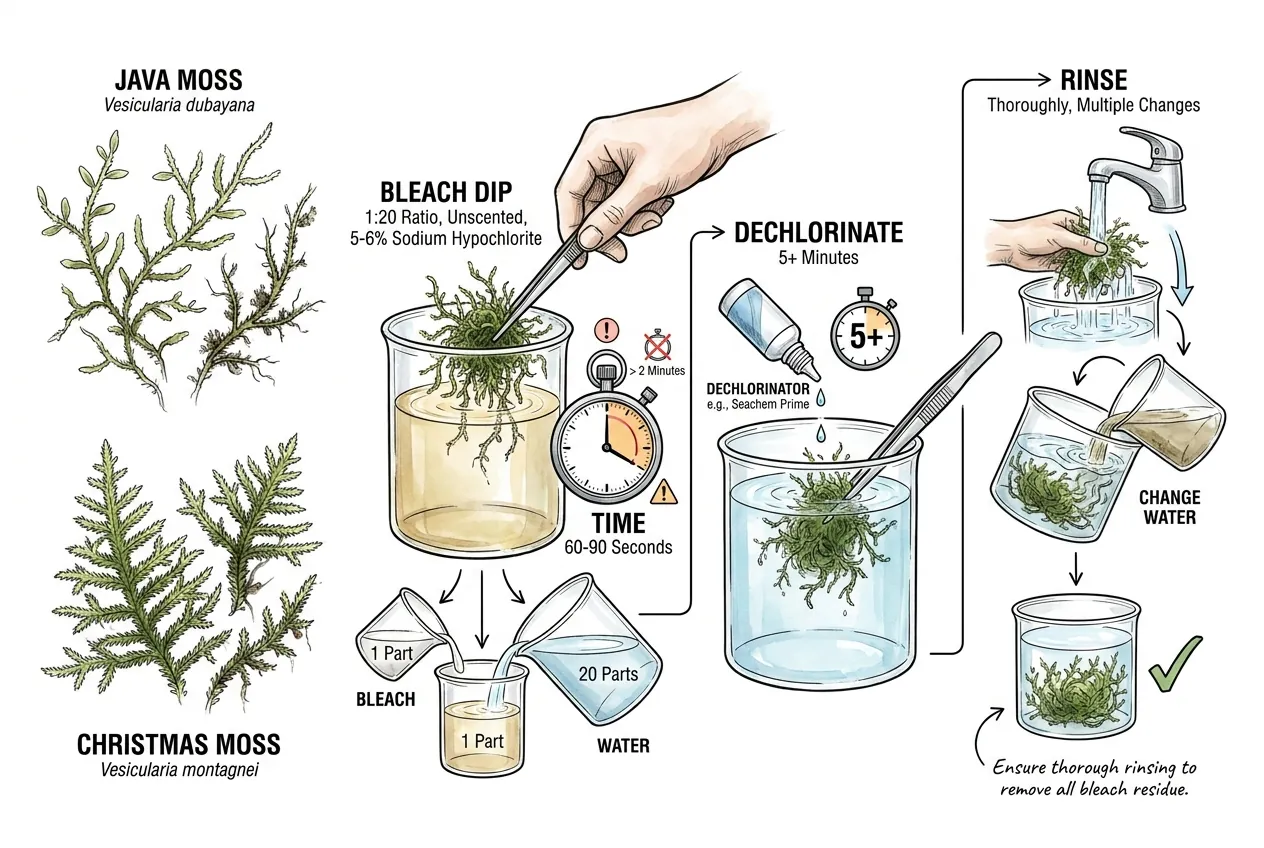
Some hobbyists dip incoming moss in dilute bleach to reduce algae before adding it, but this is a harsh, hazardous step that can injure or kill the carpet. Do not infer a dilution or contact time from another bleach product. Use only plain, unscented bleach when its label supports the intended use, and do not proceed if you cannot verify the concentration.
Work in a well-ventilated area, wear gloves and eye protection, and never mix bleach with other cleaners, acids, or anything containing ammonia. A moss dip has no universally safe contact time, so stop rather than trying to maximize the effect.
Rinse thoroughly in several changes of dechlorinated water and use a dechlorinator as part of the rinse. Check for residual chlorine before the moss goes near the tank, quarantine it, and dispose of used solution responsibly.
What anchor method survives the first month?
Cotton thread breaks down over roughly a few weeks, which often lines up with moss attaching to driftwood or stone, though the exact timing varies with species, flow, and surface.
Stainless steel mesh holds well in higher-flow setups, and cyanoacrylate (super glue) gel works on hardscape but not on soft substrate.
Match the material to your setup and check it is aquarium-safe for your livestock.
Christmas moss often does well tied with cotton thread on rough driftwood, and Java moss tends to grip faster on its own, so thread or a hairnet over a stone is usually enough.
Rather than assuming a fixed grip date, watch attachment progress and adjust if it is slipping.
Heater notes for the recovery period
Stable water temperature helps during recovery, so a heater with tight temperature control, correctly sized for the tank, is worth having.
Keep in mind a heater only warms water when it is below the set point. It does not cool a tank that is overheating in summer, so for heat waves you still need thermometers, alarms, fans or a chiller, and management of the surrounding heat.
A submersible aquarium heater sized to the tank is worth having here. Review the exact model’s stated volume range, controllable temperature range, regulation tolerance, minimum water level, and installation orientation. Read regulation tolerance for what it is, which is how tightly that heater holds its set point under the maker’s test conditions, not how quickly a cold tank will recover.
Sizing and safety
Size the heater from the tank volume, cover, flow, room’s coldest temperature, and the temperature rise you need. Use the manufacturer’s sizing chart and installation limits because a wattage-to-volume rule from another heater may not apply.
Install it safely. Observe the selected model’s minimum water level and submersion requirement, use a drip loop, and plug into a GFCI/RCD-protected outlet.
No heater is fail-proof, and any thermostat can stick, so a separate temperature controller acting as a hard cutoff is a reasonable safeguard.
Be aware, though, that a component-style PID controller needs a suitable relay or SSR, an enclosure, proper mains wiring, grounding, and correct probe placement. It is not a plug-and-play aquarium cutoff for beginners, and a qualified electrician should handle the wiring.
A plug-in aquarium thermostat controller (a different type of product) is the plug-and-play option if you want one.
Pricing and availability change over time, so check the current listing rather than a fixed figure.
And no controller prevents a fish kill regardless (the probe, relay, controller, power, and setup can all fail) so it reduces risk rather than guaranteeing safety.
6 Easy Steps to Bleach Dip Aquarium Plants
5 Easy Methods for Cooling Aquarium Water During a Heat Wave
Manage Recovery by Conditions, Not a Calendar
The first few weeks after a swap are the most fragile stretch. The new moss is unanchored and the biofilm is settling.
Let ammonia, nitrite, oxygen, feeding load, and the moss’s condition decide each next step instead of following fixed dates.
What do you do in the first few days?
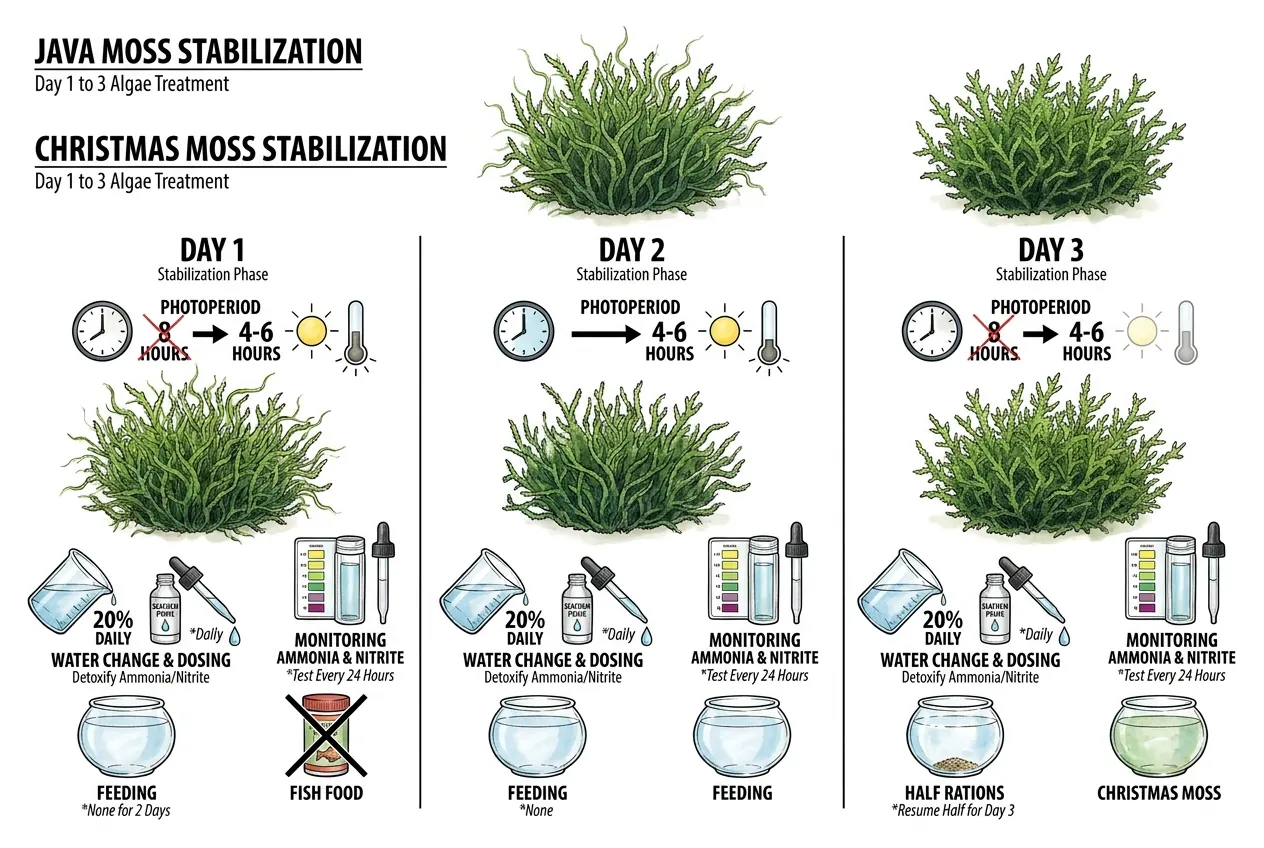
A shorter photoperiod (for example, dropping from 8 hours toward 4-6) and modest daily water changes are a reasonable starting point, but adjust them to your light level, source water, and how the animals respond rather than treating them as fixed.
Ease off feeding for the first couple of days and keep it light after that, watching the animals' condition.
If you use a dechlorinator/ammonia binder, base it on measured ammonia rather than dosing daily by default. A binder is not a substitute for finding and fixing the cause.
Test ammonia and nitrite regularly, and ideally take a baseline before the disturbance so you can watch the trend, tracking pH and temperature alongside them.
What about the middle stretch?
A moderate photoperiod and less frequent water changes are typical here (something like a 6-hour photoperiod and a couple of 25% changes a week) but set them from measured nutrients, waste, source water, and the animals' behavior rather than a fixed rule.
Resume feeding lightly. If you want algae grazers, Amano shrimp can help, but add livestock as animals you are committing to care for, not as disposable cleanup.
Before adding any, check compatibility, the tank's bioload and oxygen, and whether you can meet their long-term needs, and stock conservatively.
How do you ramp back up?
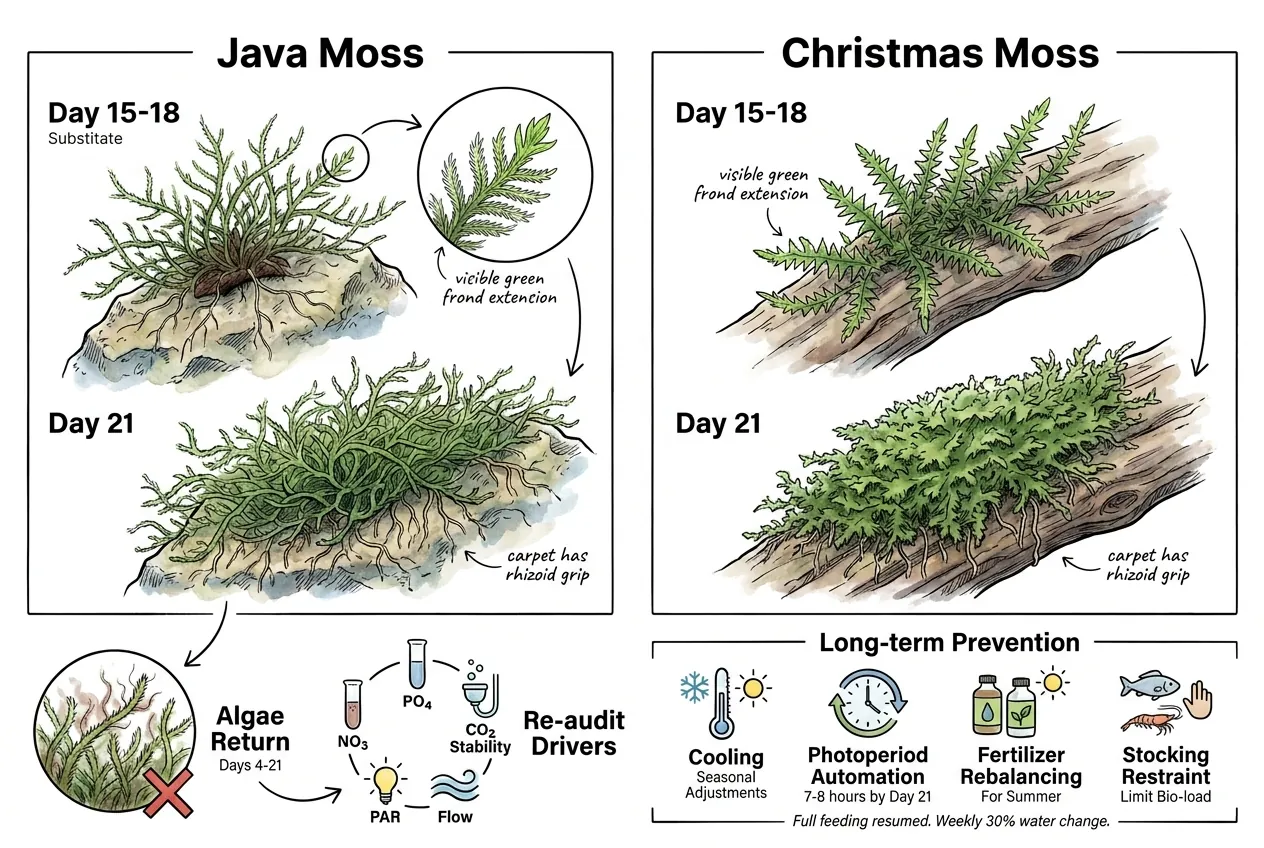
As the moss recovers, gradually lengthen the photoperiod again and space out water changes, but change one variable at a time and let the moss's growth and the algae trend, not the calendar, tell you when to step up.
Return to normal feeding once the tank is stable. Healthy moss will start putting out fresh green shoots and branches (mosses grow shoots rather than the fronds of vascular plants), though when that happens varies with conditions.
Over these weeks the carpet gradually grips its anchors, with the timing depending on the attachment method, species, health, flow, and surface.
If algae returns at any point during recovery, treat it as a sign a driver is still off and re-check NO3, PO4, CO2 stability, light, and flow.
How do I prevent the next July takeover?
A few habits help over the long term. Managing summer heat, keeping the photoperiod consistent, adjusting fertilizer to actual growth, and keeping stocking sensible.
These reduce risk rather than guaranteeing an algae-free tank, and other factors still matter.
Keep the fertilizer and stocking decisions tied to measured conditions so they do not contradict the ranges discussed earlier.
How much do clip fans actually drop tank temperature?
A USB clip fan aimed across the water surface can cool the tank by evaporation. How much depends on humidity, room temperature, airflow, surface area, the lid, and the heat load, so there is no universal drop or fan-per-volume formula. Start with one fan, measure the temperature and humidity, and add more only if needed.
The trade-off is faster evaporation, which raises maintenance. As water evaporates, most minerals stay behind, so continually topping up with tap water can push GH, KH, and TDS upward.
Replace evaporation with water matched to your target chemistry (often RO/DI or distilled for top-off) and use an auto-top-off with a fail-safe rather than guessing a daily volume.
What photoperiod schedule prevents algae?
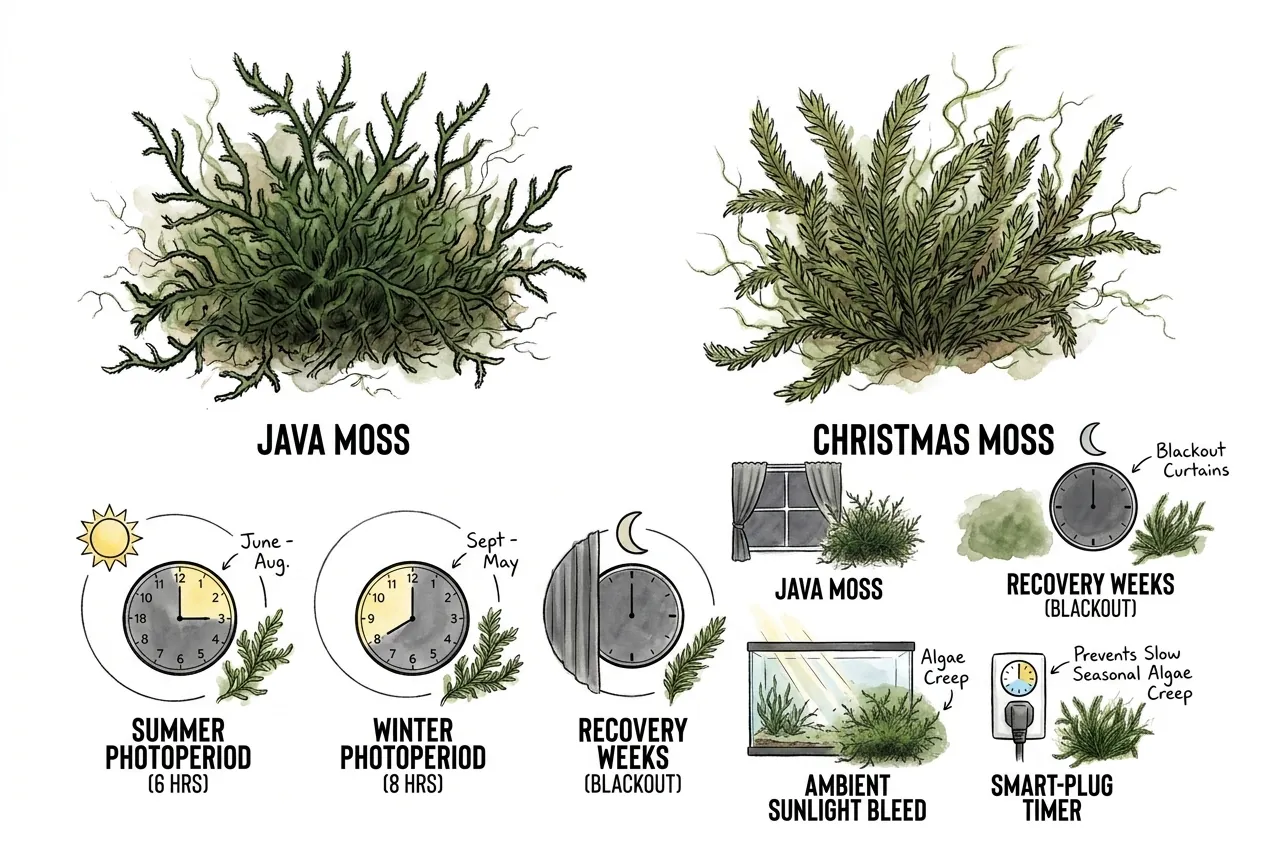
A shorter photoperiod in the hottest months, lengthening again the rest of the year, is a reasonable starting point, but the right length depends on your latitude, hemisphere, room light, and the actual light dose (PPFD/DLI), so tune it to how the tank responds rather than the calendar alone.
A smart-plug timer makes a consistent photoperiod easy to keep, which helps. Forgetting to shorten it in summer can contribute to slow algae creep, though it is one factor among several rather than the single cause.
If your room gets strong afternoon sun, drawing curtains during that window can ease heat and light spikes.
That is about limiting outside light reaching the tank, different from covering the tank for a full blackout, so keep ventilation going and do not seal the tank up for weeks.
Do Amano shrimp actually eat hair algae?
Amano shrimp (Caridina multidentata) do graze a range of algae and biofilm and are often more willing to work on tougher filamentous algae than Neocaridina (cherry, blue dream).
That is a tendency, not an absolute. Neocaridina also eat algae, and how much any shrimp consumes depends on the species and the algae, so they are not a guaranteed fix for hair, thread, or staghorn.
You will see stocking guidelines like 1 Amano per 10-15 liters, but treat that as a loose starting point rather than a rule. Algae load and competition vary.
Their larvae need brackish or saline water to develop, so they generally will not breed and overrun a freshwater tank, but that also means you are keeping adults whose compatibility, space, and long-term care you should plan for.
Watch for the escape risk
Amanos can climb out, especially through gaps, and escape risk varies with water conditions, openings, and how well they are acclimated. A loose lid can mean a shrimp on the floor.
A well-fitting glass or mesh lid is strongly recommended if you keep them. Seal or cover cable and cord openings while still allowing gas exchange and feeding access.