
Aquarium Algae Control Product Chooser: UV, Carbon & GFO
An aquarium algae control chooser matching phosphate media, liquid carbon, a UV sterilizer, or a scraper to your exact algae by measurable spec.
Samuel Reed · Published 2026-08-10 · 13 min read
Key Takeaways
- Match the algae to the mechanism, not the product label. Each algae type needs a different control route.
- Use phosphate media only after a test confirms surplus phosphate. Al-oxide and GFO can starve plants when they are oversized.
- Liquid carbon can spot-treat BBA and hair algae, but it is risky in sensitive plant or shrimp tanks. Under-dose or skip it when the livestock is vulnerable.
- UV fixes free-floating green water rather than attached algae. Delivered dose depends on wattage and dwell time, so flow matters as much as lamp power.
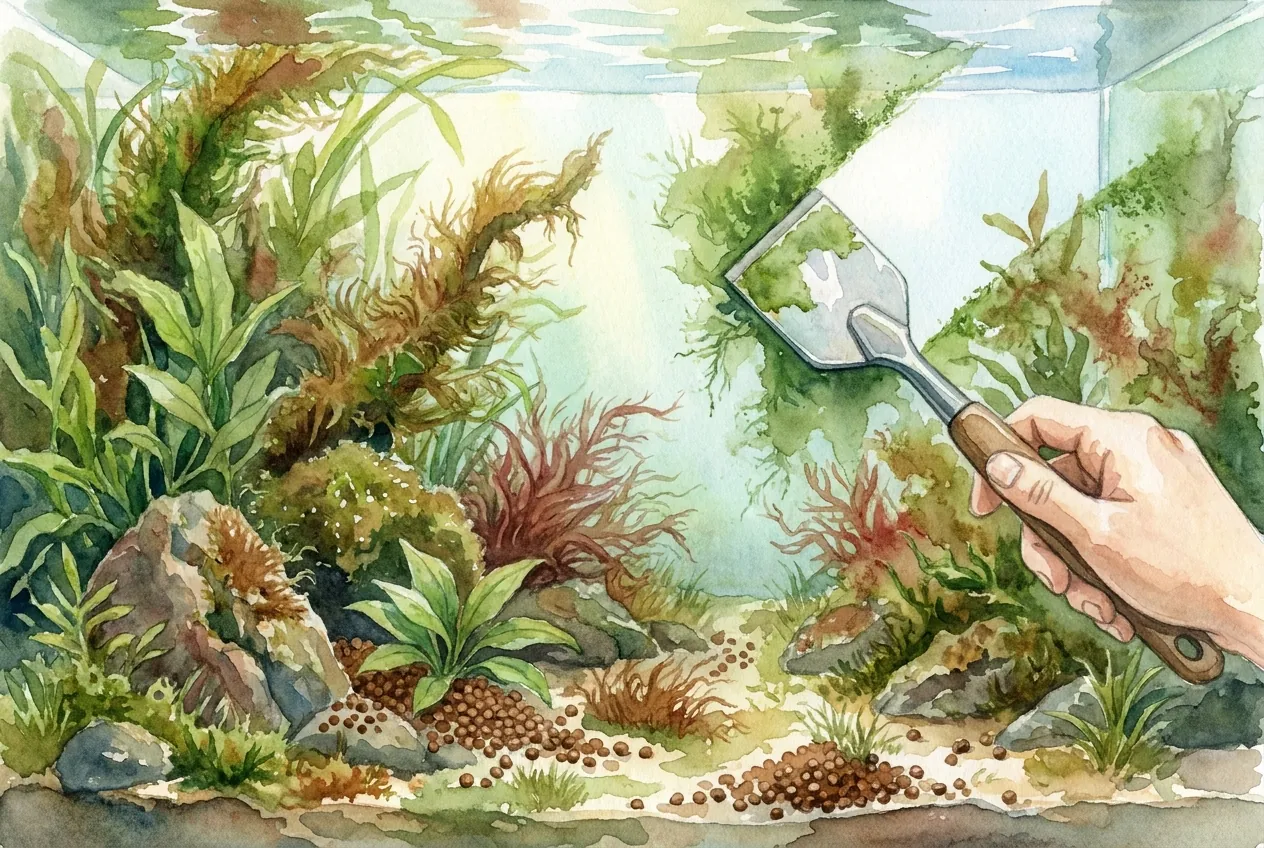
- A scraper is the immediate fix for hardened green spot on glass. Use an acrylic-safe blade on acrylic rather than steel.
Algae is not one problem, so no single algae killer fixes all of it. Identify the algae and the condition feeding it before you buy a treatment.
Which algae-control product should you actually buy?
Choose from what you can see, then confirm the likely cause before buying. Each section explains when the product fits, when it does not, and its limits.
| What you see | Start with | Do not buy it for |
|---|---|---|
| Green water, green dust, or hair algae with confirmed surplus phosphate | Phosphate-remover media | Green spot or already-low phosphate |
| Black beard algae (BBA), staghorn, or hair algae | Liquid-carbon spot algaecide | Tanks heavy with Vallisneria, mosses, or sensitive Caridina shrimp |
| Pea-soup green water | UV sterilizer | Attached BBA, green spot, or other film algae |
| Hardened green spot or green-dust film on glass | Manual magnetic or blade scraper | The underlying nutrient, light, or carbon imbalance |
There is also a non-product route. Nerite snails and Amano shrimp graze some algae. They work slowly and only on certain types, so treat them as a supplement rather than a replacement for targeted control.
Before buying a control, I photograph the front glass, hardscape, slow leaves, fast leaves, and open water separately. Free-floating green water, a removable glass film, and attached tufts require different tools even when a shop shelf calls all of them algae control.
For seven consecutive days, I record light hours, scheduled maintenance, phosphate, nitrate, and where new growth appears without making an extra correction. Seven days captures a full weekly maintenance interval, while urgent livestock or water-quality problems still take priority. A product enters the plan only after I can name the algae location and the mechanism it should change.
What actually feeds algae, and what mechanism removes it?
Algae is controlled by removing whatever is feeding it, and there are four independent levers. Excess phosphate and nitrate, carbon limitation, free-floating cells you can irradiate, and light itself.
How does nutrient limitation and the Redfield ratio control algae?
Excess nutrients can feed a bloom, but the useful question is whether your own phosphate and nitrate readings are high for the tank. Use a phosphate remover only after a test confirms a surplus.
Green spot algae can worsen when phosphate is too low. Do not strip phosphate to treat it, and retest any tank using phosphate media so plants are not starved.
Why does liquid carbon shift the balance to plants?
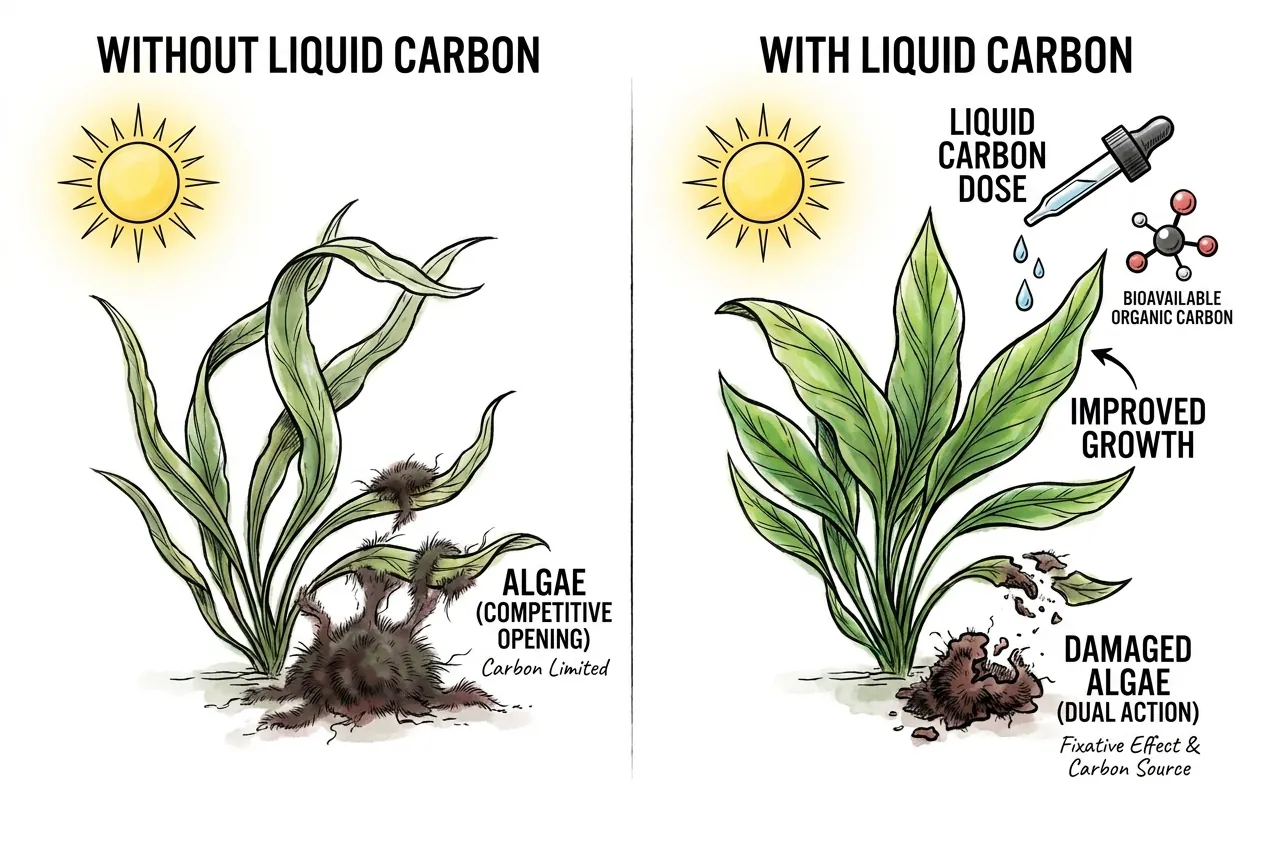
Under bright light, higher plants often run out of carbon before they run out of light, and that carbon limitation is a competitive opening for algae.
A source of bioavailable organic carbon relieves the limitation for plants, and because the active compound is a glutaraldehyde-class fixative, it also damages soft algae on direct contact.
That dual action is why liquid carbon both feeds plants and spot-kills BBA.
How does UV-C dose–response work on free-floating algae?
UV-C works only on cells that pass through its chamber, so it can clear free-floating green water but not algae attached to glass or plants. Match the unit and flow to the manufacturer’s green-water instructions instead of choosing by wattage alone.
How do photoperiod and PAR act as the free lever?
Algal photosynthesis rises with light until a saturation point, beyond which extra light and longer photoperiod simply hand surplus energy to algae.
Capping the photoperiod to roughly six to eight hours and matching intensity to your plants is a free, root-cause control that no product replaces.
What specs separate the product classes?
Match your algae to the row that fits, then buy any product that meets that row’s measurable spec.
| Product class | Treats which algae | Mechanism | Key measurable spec | Confirm with |
|---|---|---|---|---|
| Phosphate media (Al-oxide) | Nutrient-driven green water, green dust, hair | Binds excess PO4 to force P-limitation | ~0.87 mg PO4 per g. Retest at 4 days | Phosphate test kit |
| Phosphate media (ferric oxide / GFO) | Heavier phosphate loads | Higher-capacity PO4 + silicate binding | High binding capacity. High-flow placement | Phosphate test kit |
| Liquid carbon / spot algaecide | BBA, staghorn, hair | Relieves carbon limit + contact algaecide | 5 mL per 40 L initial, 5 mL per 200 L daily | Algae turns pink/white in days |
| UV sterilizer / clarifier | Green water only (free-floating) | UV-C inactivation of suspended cells | Watt matched to volume AND slow flow for ~30,000 µW·s/cm² | Water clears in days |
| Manual scraper (magnet/blade) | Green spot, green dust on glass | Physical removal of adherent film | Magnet rated to glass thickness. Acrylic-safe blade option | Glass clears immediately |
Choose from algae type, likely cause, whether it is free-floating or attached, and how sensitive your plants and shrimp are. If you have not confirmed nutrients yet, the water test kit chooser explains what to use for phosphate and nitrate.
Which phosphate-remover media should you buy?
Use phosphate media only when a test confirms surplus phosphate behind green water, green dust, or hair algae. Put it in a high-flow part of the filter and replace it according to follow-up tests.
Seachem PhosGuard
The Seachem PhosGuard 250 mL is a quick, lower-cost option for a mild confirmed phosphate surplus. Test after the label’s initial interval rather than leaving it in until it is forgotten.
When to buy
A phosphate test should confirm a mild surplus and you should want a quick, low-cost knockdown in a high-flow filter bag.
When to skip
Skip it when phosphate is already low, green spot is the main algae, or the tank is very soft and acidic where trace aluminium is a concern. Confirm the selected container size on the current listing.
Tradeoff
Its low per-gram capacity means a heavy phosphate load exhausts it quickly, and it can strip silicate you may not want gone.
Seachem PhosNet
The Seachem PhosNet 250 g suits a heavier or persistent confirmed phosphate surplus when you need the media to last longer between changes.
When to buy
Choose it when testing shows a heavy or persistent phosphate load and you want fewer media changes than a lower-capacity alumina medium.
When to skip
Skip it when phosphate is already low or you cannot retest during use. Too much can pull phosphate down far enough to favor green spot. Use it in high flow and verify the selected size before checkout.
Tradeoff
It costs more per bag and can over-strip phosphate, so a phosphate test is mandatory here, not optional.
Which liquid-carbon spot algaecide should you buy?
Buy a liquid carbon when your problem is black beard algae, staghorn, or hair algae in a tank without large stands of Vallisneria or delicate mosses.
The role spec is a labelled organic-carbon active, a stated per-volume daily dose, and a defined spot-dose method for tough algae.
Seachem Flourish Excel
Seachem Flourish Excel is a label-directed organic-carbon treatment for BBA, staghorn, or hair algae. Direct contact can turn BBA pink or white before it breaks down, but sensitive plants can react when the dose is too high.
When to buy
Use it when BBA, staghorn, or hair algae is the target and the tank does not contain large stands of sensitive Vallisneria or moss.
When to skip
Skip it when the tank contains sensitive Caridina shrimp, stressed livestock, or plants already reacting to liquid carbon. The manufacturer notes that Vallisneria can melt at double dose.
Follow the current label, calculate actual water volume, and do not exceed the stated dose.
Tradeoff
It is a treatment, not a cure for the surplus nutrients or excess light behind the algae, so pair it with a root-cause control.
Which UV sterilizer should you buy?
Buy a UV sterilizer only when you have green water, a free-floating unicellular bloom that turns the whole tank pea-soup green. The role spec is UV-C wattage matched to tank volume.
Pair it with a flow rate slow enough to deliver the algae-lethal dose near 30,000 microwatt-seconds per square centimetre. Dwell time, not wattage alone, sets the kill.
AA Green Killing Machine GKM9W
The AA Green Killing Machine GKM9W is an internal UV-C option for free-floating green water in an appropriately sized tank. It only affects cells that pass through the chamber, so it cannot clear algae attached to glass, plants, or hardscape.
When to buy
Use it when an active free-floating green-water bloom has made a tank at or below the rated volume visibly cloudy and you want an internal, self-powered unit.
When to skip
Skip it when the algae is attached BBA, green spot, or film. Those cells never enter the UV chamber. Also skip it if the tank cannot safely accommodate the internal unit and protected power connection.
Use a GFCI outlet and a drip loop, and confirm the actual operating flow and the label’s tank rating before purchase.
Tradeoff
UV-C photo-degrades chelated iron and light-sensitive medications passing through it and kills free-floating microfauna.
Run it only during the bloom, dose ferts or meds with the unit off, and plan a bulb replacement because output can fall by up to 40 percent within six months.
Which manual scraper should you buy?
Buy a manual scraper when hardened green-spot or green-dust film is on the glass, because physical removal is the only immediate fix for adherent algae.
The role spec is a magnet strength rated to your glass thickness, or an acrylic-safe plastic blade for acrylic tanks, never steel on acrylic.
Flipper Standard Magnetic Cleaner
Flipper Standard magnetic cleaner fits a compatible glass or acrylic pane when you want to switch between a pad and a blade without putting a hand in the tank. Use its plastic blade on acrylic and keep grit out of the pad to avoid scratches.
When to buy
Use it when hardened green spot or dust film is on a compatible pane and you want to switch between a cleaning pad and blade without putting a hand in the tank.
When to skip
Skip it when the pane is outside the stated thickness range, or you cannot keep substrate grit away from the pad. Never use the steel blade on acrylic. Use the ABS blade there.
Measure the pane and confirm Standard rather than Nano or Max before checkout.
Tradeoff
Scraping is a symptom fix only. Without a root-cause control the film returns. Green spot specifically calls for steady modest phosphate rather than more phosphate media.
In what order do you buy and deploy?
Deploy in a fixed order that treats the cause before the symptom, so you do not spend on the wrong tool first.
- Test and read the tank. Measure phosphate and nitrate, then count your photoperiod hours. Those readings decide which product class you actually need.
- Fix the free levers. Trim the photoperiod toward six to eight hours and correct feeding and water changes before buying anything.
- Buy the root-cause product. Choose phosphate media for a confirmed nutrient surplus, liquid carbon for BBA and hair algae, or a UV unit for green water.
- Add the immediate tool only when needed. Use a scraper for hardened glass film that the root-cause control cannot remove quickly.
- Confirm the result and back off. Retest phosphate after four days on media, watch green water clear within days on UV, and stop or reduce treatment once the algae recedes.
Who should NOT buy each product class?
Skip the product that fights your tank, because buying against your algae type wastes money and can harm plants or shrimp.
| Product class | Do NOT buy if | Because |
|---|---|---|
| Phosphate media | You have green-spot algae or already-low phosphate | Green spot is a low-phosphate symptom, and stripping more starves plants |
| Liquid carbon | Your tank is heavy with Vallisneria, mosses, or sensitive shrimp | The glutaraldehyde-class active melts Val at double dose and stresses Caridina |
| UV sterilizer | Your algae is BBA, green spot, or any attached film | Attached algae never passes through the chamber, so UV does nothing |
| Manual scraper (steel blade) | You have an acrylic tank | A steel blade scratches acrylic. Use the acrylic-safe ABS blade only |
Unstable carbon and flow can contribute to BBA. See the black beard algae removal guide for a focused response.
What maintenance and replacement does each product class need?
Each product class fails in a predictable way, and knowing the failure mode tells you the maintenance it needs.
When does phosphate media saturate?
Phosphate media is a consumable that stops working once its binding sites are full. Retest phosphate about four days after installing, and replace the media when phosphate stops falling or begins to rise again rather than on a fixed calendar.
Is liquid carbon a recurring dose or a permanent fix?
Liquid carbon works only while you keep dosing, and stopping lets carbon-limited conditions and algae return. The failure mode is plant melt from overdosing.
So hold the daily dose at 5 millilitres per 200 litres and back off at the first sign of Vallisneria or moss damage.
How fast do UV lamps fade?
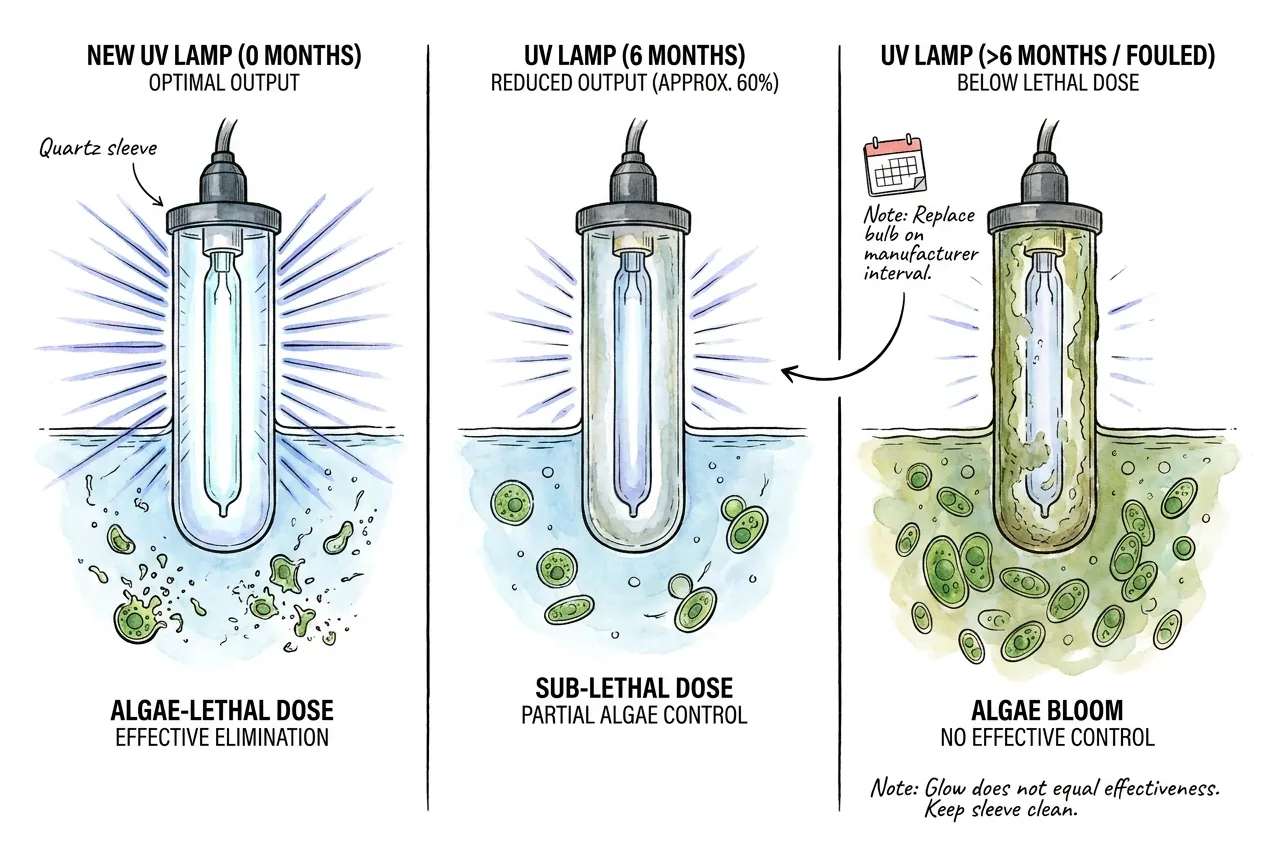
A UV lamp loses output steadily and can drop up to 40 percent within six months even while it still glows.
Replace the bulb on the manufacturer interval and keep the quartz sleeve clean, because a dim or fouled lamp silently falls below the algae-lethal dose.
How do scrapers trap grit and scratch glass?
A magnetic scraper’s failure mode is scratched glass from a grain of substrate caught under the pad.
Rinse the pad, keep the magnet above the sand line, and replace a worn blade before it drags.
Frequently asked buyer questions
Which algae does UV actually fix?
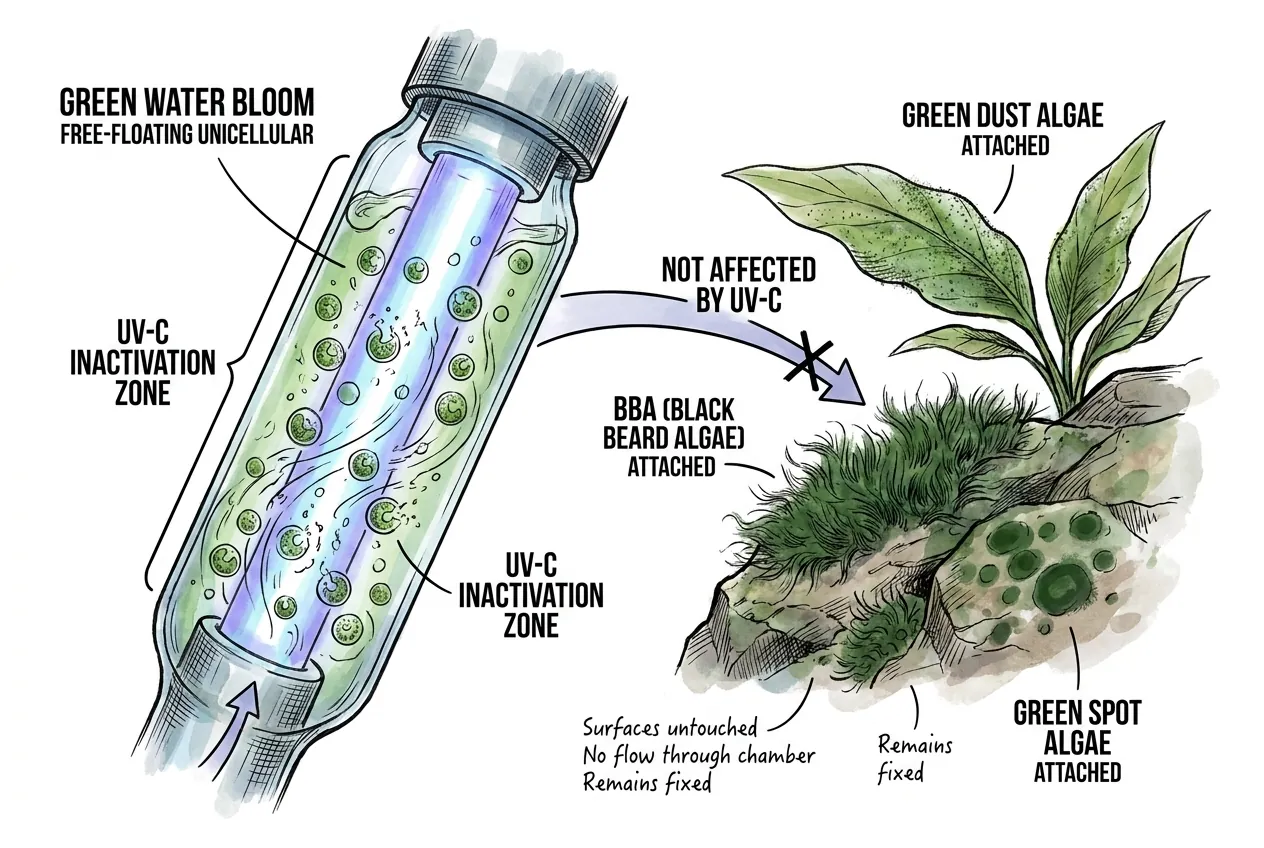
Only green water, the free-floating unicellular bloom. UV-C inactivates cells passing through its chamber, so it never touches attached BBA, green spot, or green dust.
Will phosphate media hurt my plants?
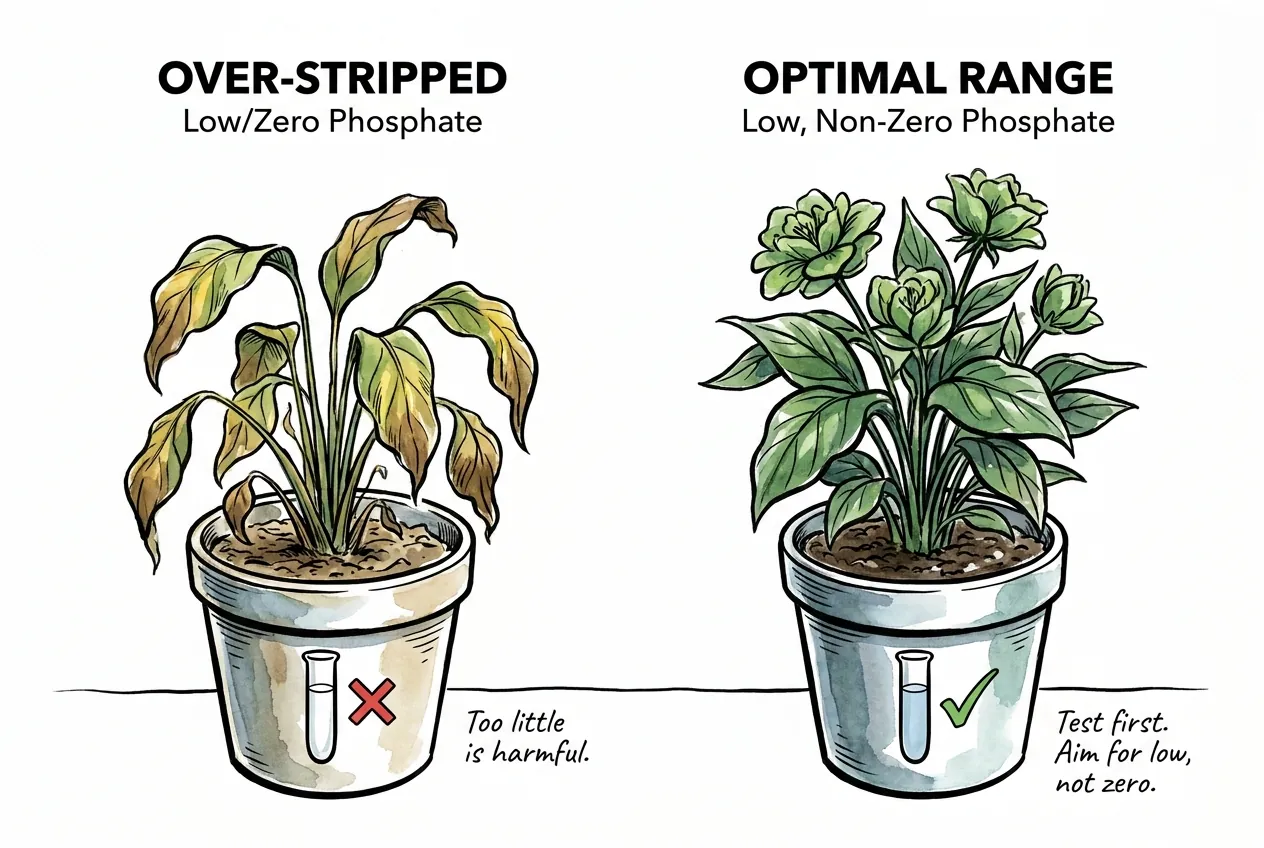
It can if you over-strip. Plants need some phosphate, so confirm a surplus with a test first and stop when the reading falls into a low but non-zero range.
Is liquid carbon safe for shrimp and Vallisneria?
Only at or below the labelled dose. The manufacturer notes Vallisneria can melt at double dose, and sensitive Caridina shrimp are at risk when overdosed, so under-dose or skip it in those tanks.
Can snails or shrimp replace these products?
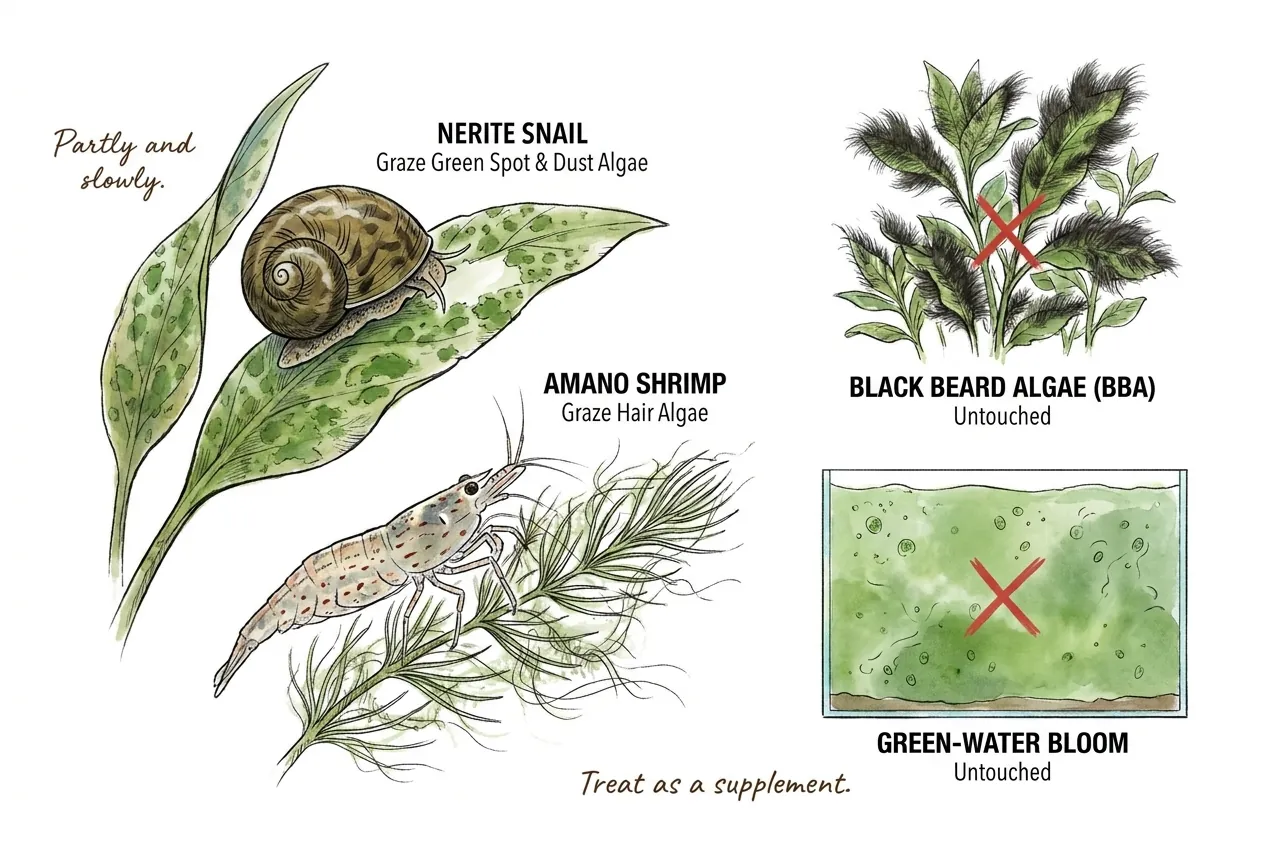
Partly and slowly. Nerite snails graze green spot and dust and Amano shrimp graze hair algae, but neither touches BBA or a green-water bloom, so treat them as a supplement.
Do I need a scraper if I run the other products?
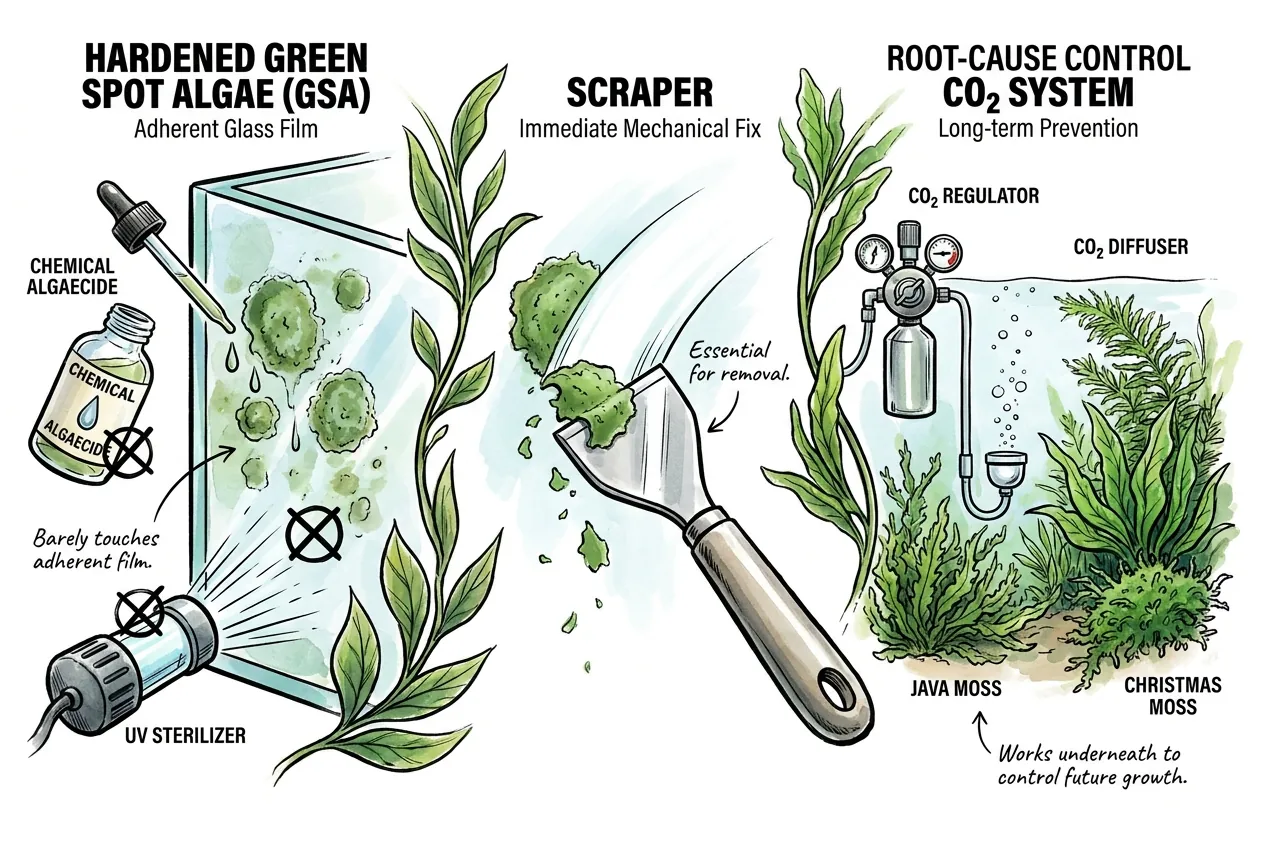
Usually yes for hardened green spot. Chemical and UV routes barely touch adherent glass film, so a scraper is the only immediate fix while a root-cause control works underneath.
If you are also dialling in carbon for your plants, the CO2 system chooser matches a regulator and diffuser to the same tank.
The Java moss versus Christmas moss comparison covers which mosses tolerate liquid carbon.
Affiliate Disclosure
This article contains Amazon affiliate links. As an Amazon Associate I earn from qualifying purchases. If you use these links, the site may earn a commission at no extra cost to you. Product availability, price, and specifications can change. Check the current listing before buying.