
Monstera, Acidic Tap Water, and pH: What the Evidence Actually Supports
Water pH alone rarely tells you whether a Monstera is at risk. Measure substrate pH and EC, check your water report for alkalinity and ions, and buffer only when the data calls for it.
Jordan Cole · Published 2026-05-30 · 21 min read
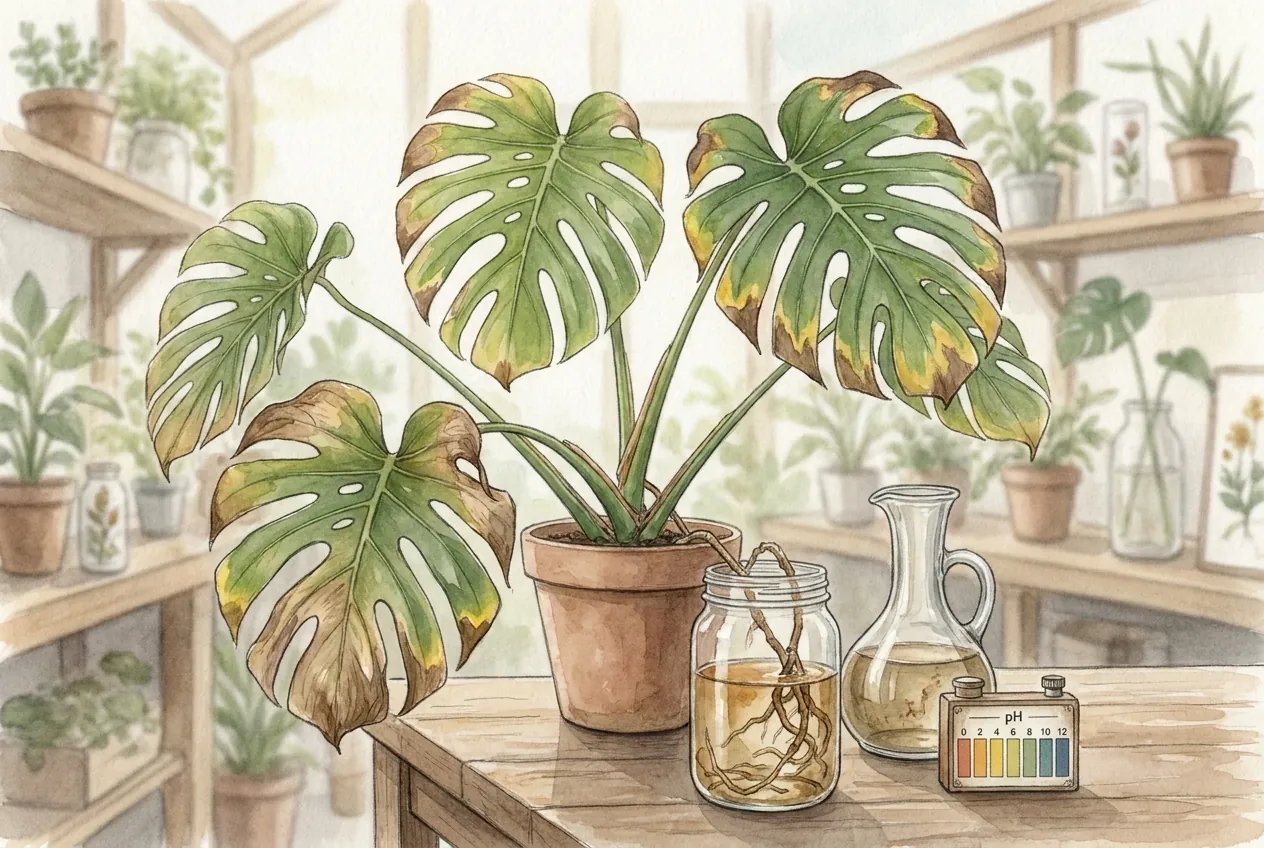
Key Takeaways
- Water pH alone is a weak predictor of root-zone trouble. Alkalinity, EC, and specific ions tell you how much chemical load reaches the pot.
- A low pH reading is not the same as a strong acid dose. Low-alkalinity water can read acidic while carrying little acid reserve.
- Measure the substrate as well as the source water. A pour-through or consistent slurry trend is more useful than one tap-water reading.
- Buffer or remineralize only after a measurement shows a need. Repeated bicarbonate or salt additions change potassium, alkalinity, hardness, and EC.
- There is no Monstera-specific damage threshold established by the available studies. Use the evidence to choose what to measure, not to invent a single cutoff.
What does acid water actually do to a Monstera root?
The honest answer is that irrigation-water pH by itself is a poor predictor of root-zone trouble.
What matters is how much acid a water actually carries, which is set by its alkalinity (its acid-neutralizing capacity), not by the pH number alone.
Two waters can read the same pH and deliver very different acid loads to a pot. Master Plant-Prod puts it plainly. Irrigation-water pH has very little direct impact on growing-media pH, because alkalinity does most of the work.
A Penn State irrigation guide takes the same view. Many plants tolerate water in the pH 5.0 to 7.0 range, and a low-pH concern is usually only worth acting on when low pH coincides with low alkalinity.
Very acidic conditions can stress roots and change nutrient availability. A tap-water pH reading alone cannot show that this is happening in a soilless Monstera pot.
Aluminum toxicity is chiefly a concern in acidic mineral soils, not a conclusion to draw from ordinary potting mix and a low water-pH reading. Test the growing medium before treating either problem.
Acid can also displace base cations, calcium, magnesium, potassium, from exchange sites so they leach with drainage.
How much this matters in a given pot depends on the mix's cation-exchange capacity, any lime reserve, the fertilizer, and the leaching fraction, so it is not something a single water-pH number settles.
When magnesium does run low, older leaves can show interveinal yellowing and brown margins, because magnesium is mobile and the plant moves it to newer growth.
That pattern is a clue, not a fingerprint. The same look shows up with other mobile-nutrient deficiencies and with root stress, so it points you toward testing rather than toward a diagnosis on its own.
Adaptation of Active Proton Pumping and Plasmalemma ATPase Activity of Corn Roots to Low Root Medium pH
I measure pH separately in source water, finished fertilizer solution, and a standardized root-zone sample. The pH leaving the tap is not necessarily the pH roots experience after alkalinity, fertilizer, and substrate buffering interact.
Conductivity and the sampling method stay beside each pH result. A changing extraction ratio can create a dramatic number without any real change in the pot.
Matched plants or one section of the collection make the first transition while fertilizer stays unchanged. If water source and nutrient formula change together, I cannot tell which corrected or caused the burn.
Why Research pH Values Do Not Set a Home-Watering Target
A small Monstera experiment found lower pigment readings after harsh sulfuric-acid treatments. Its design was too limited to establish a safe or damaging irrigation pH for a houseplant.
Different Acid Studies Answer Different Questions
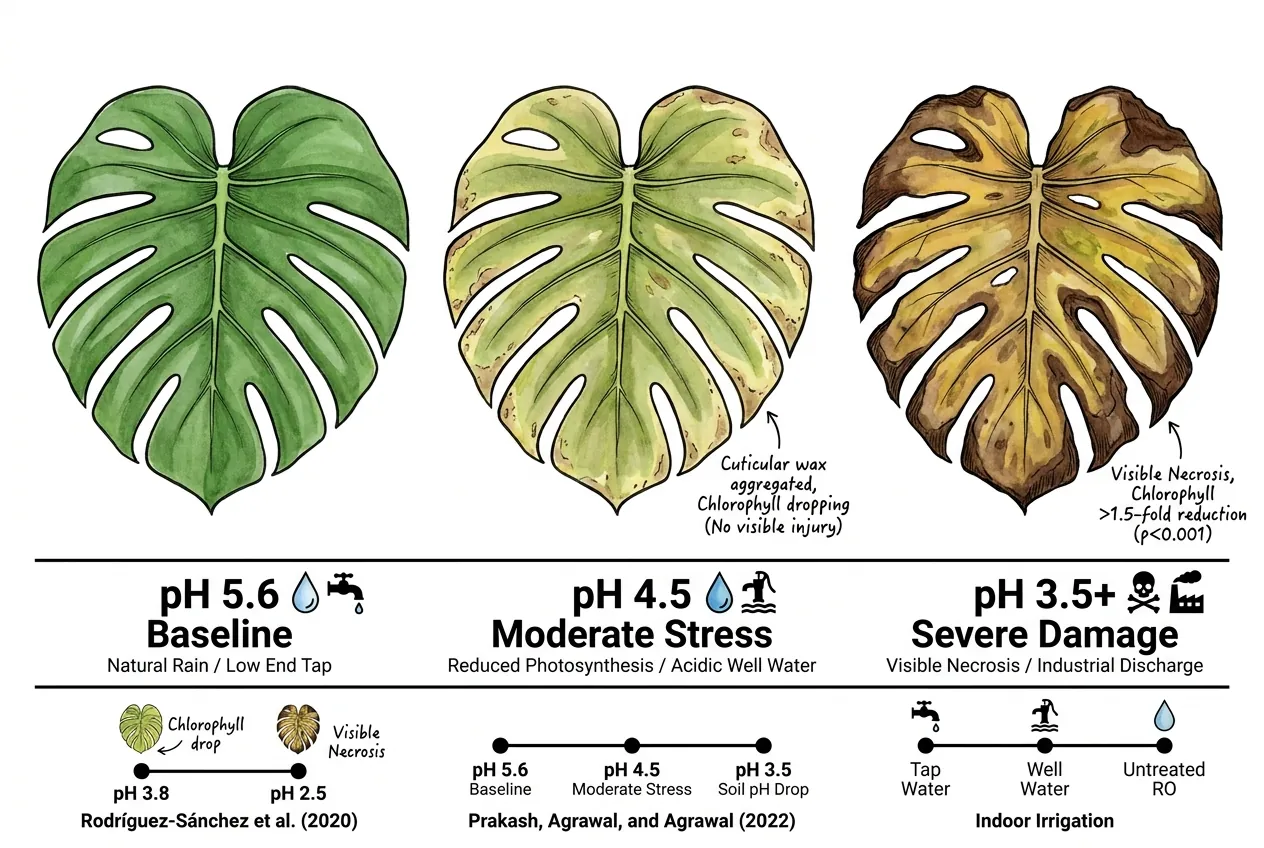
These studies do not converge on a clean set of indoor-irrigation thresholds. They differ in what was exposed to acid (leaves versus roots), in the acid used, and in the species and substrate, so they should be read separately rather than stacked onto one scale.
Acid-rain studies expose leaves of different species to much stronger, different acid treatments. They cannot tell you what a particular well-water or RO-water reading will do in a Monstera root zone.
The Practical Point
Pigment loss can begin before you see obvious leaf damage, so early stress is possible without visible burn.
But how far ahead that runs, and whether it is happening in your pot, is exactly what a measurement is for. It is not something these studies pin down for a Monstera.
Measure rather than assume.
Ramos et al. 2023. Impact of Acid Rain with Different pH Values in Monstera deliciosa Plants (MDPI Medical Sciences Forum)
What does US tap water actually look like for indoor plants?
US tap-water pH varies, and it can legally fall outside the EPA’s pH guideline. The EPA’s Secondary Maximum Contaminant Level for pH is 6.5 to 8.5.
That standard is non-enforceable and exists for aesthetic reasons like taste and pipe corrosion, not to protect plants.
Low-pH water is flagged in the guidance for its bitter metallic taste and its corrosion of household plumbing.
The important caveat is that the EPA never setting a plant-safe range does not, by itself, mean out-of-range water harms a Monstera.
It just means drinking-water rules are the wrong tool for that question. Whether your water is a problem for a plant depends on its alkalinity, EC, and specific ions, which a water report or lab test can tell you.
The USGS Water Science School notes that the pH of precipitation and water bodies varies widely across the United States.
Unpolluted rainfall sits near pH 5.6 because dissolved atmospheric CO2 forms carbonic acid, but that is a baseline for rain, not an injury threshold, and rain pH is not the same measure as the acid load reaching a root zone.
Historical data from the worst industrial acid-rain decades showed eastern US precipitation around pH 4.0 to 4.3 and western precipitation around pH 5.0 to 5.5.
Many municipal systems adjust pH upward with lime. Private wells and softened-water systems may not, so if you are on one, check your own analysis rather than assuming either way.
Why does chloramine change the old let-water-sit-overnight advice?
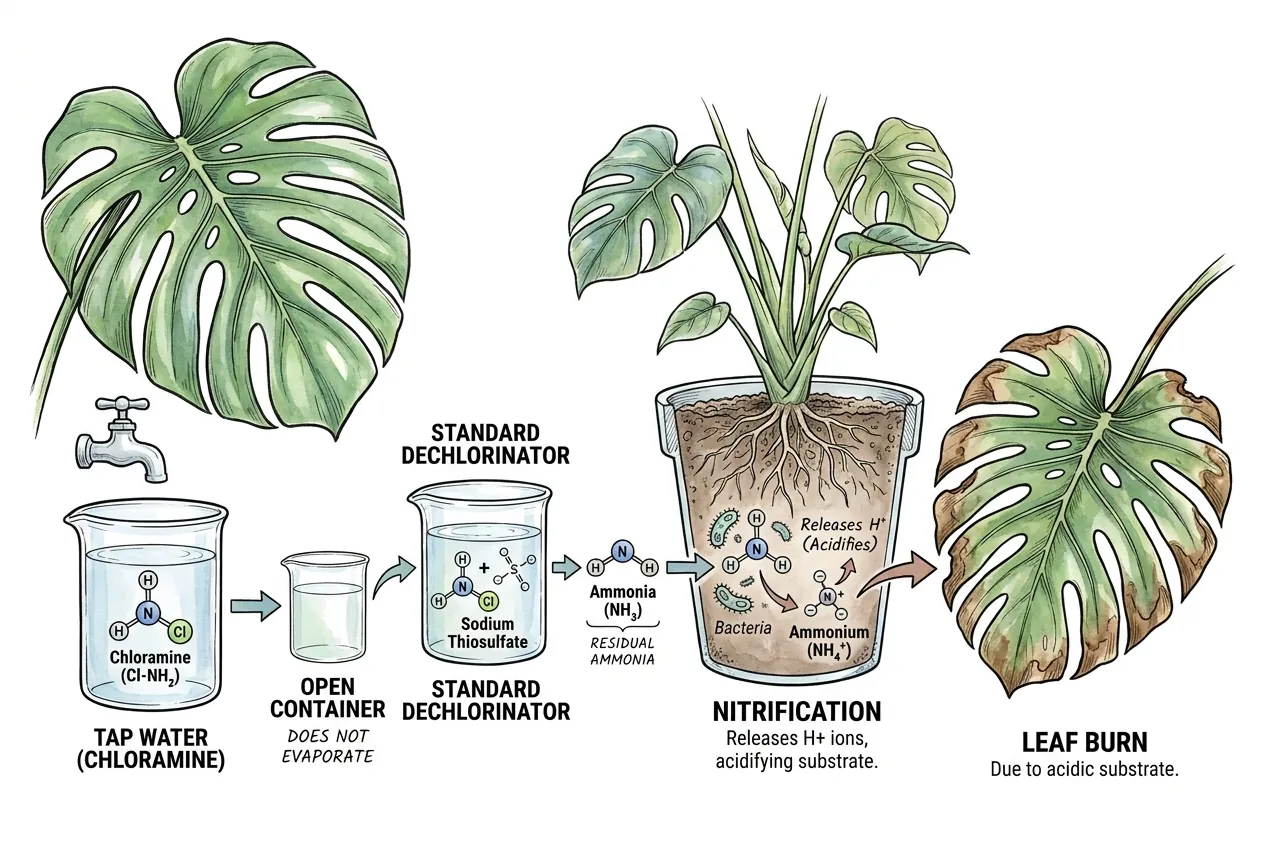
Chloramine breaks the old advice to leave water in an open container overnight. The EPA reports that more than one in five Americans are served chloraminated water.
Chloramine has been used since the 1930s because it lasts longer in distribution pipes than free chlorine.
Chlorine can off-gas over roughly 12 to 24 hours with aeration, depending on temperature and container. Chloramine is far more persistent and generally has to be chemically neutralized rather than left to dissipate.
Sodium-thiosulfate dechlorinators reduce chloramine, but the reaction can leave residual ammonia behind.
At municipal concentrations that ammonia is a small amount of nitrogen and not directly toxic.
In a pot, soil bacteria can nitrify ammonium, and nitrification does release H+, so in principle it contributes to acidification, but whether that adds up to a meaningful pH change depends on the actual residual, the mix’s alkalinity, your fertilizer, and microbial activity.
Nobody has shown that ordinary chloraminated tap water burns leaves through this path, so treat it as one input to watch, not a guaranteed cause.
If you want to remove it, use a dechlorinator rated for chloramine. Product-specific claims that a product locks ammonia for 24 hours are marketing, and ammonia/ammonium balance is really just a pH- and temperature-dependent equilibrium.
Can my substrate drift in pH on its own?
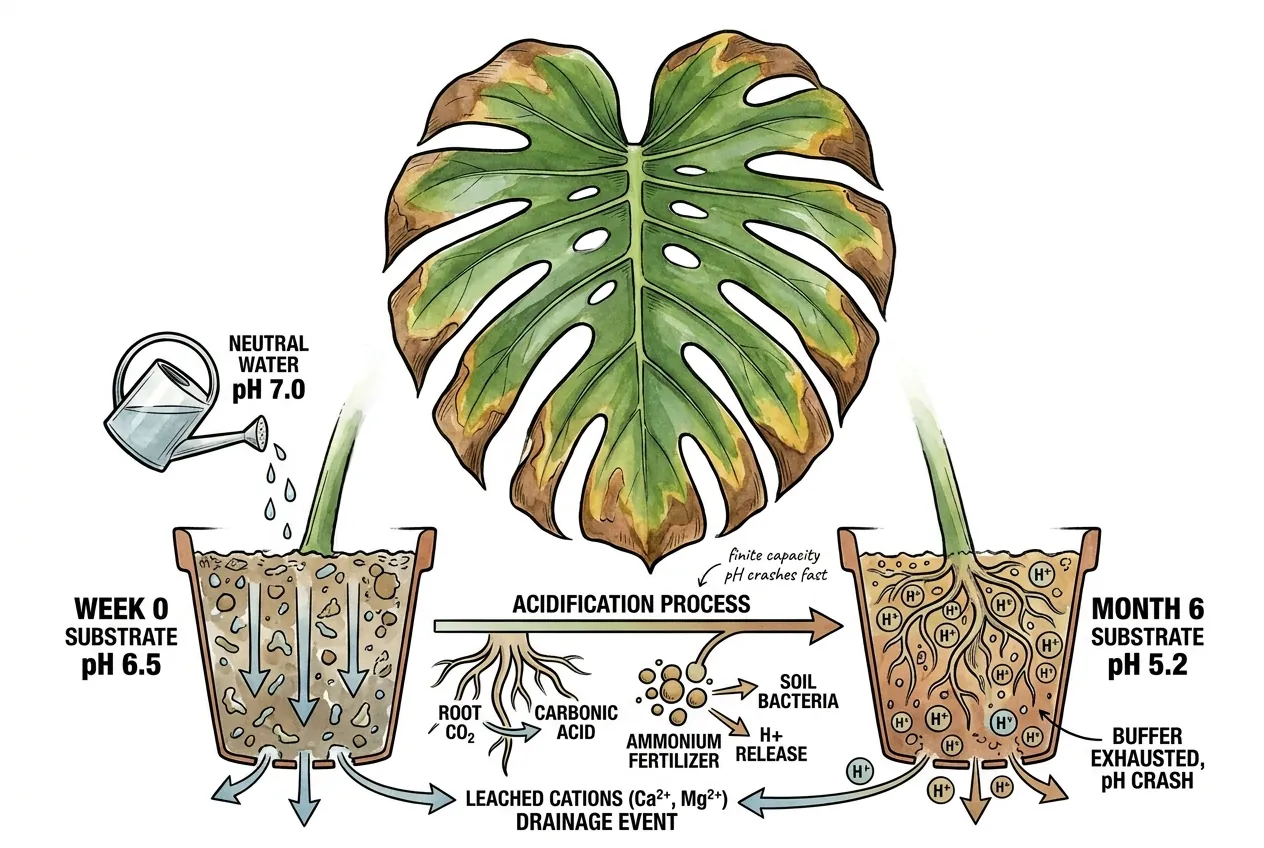
Yes, substrate pH can drift over time, and the direction is not always down. Several factors push it together. The nitrogen form in your fertilizer (ammonium-based feeds tend to acidify as bacteria nitrify them), the fertilizer’s overall potential acidity or basicity, plant uptake of cations and anions, the alkalinity of your irrigation water, any lime reserve in the mix, organic-matter breakdown, and leaching.
Root respiration adds some CO2 as carbonic acid, but that alone does not drive a steady collapse, and neutral input water does not guarantee acidification.
pH Trend Note
Because so many factors interact, a single water test tells you little about where a pot is headed.
What is useful is a trend. Retest the media pH periodically and watch which way it moves, rather than relying on one reading or on a fixed rule that it will crash by month six.
How do I measure the actual chemistry in my own pot?
A calibrated pH pen and an EC/TDS meter are genuinely useful for narrowing down an irrigation problem, but treat them as a starting point, not a five-minute diagnosis.
Two numbers cannot rule out root rot, disease, a nutrient-ratio issue, or watering and light problems.
And the reading you get depends heavily on which method you use, so the method and its own target range have to travel together.
The 1/1 water-slurry method (for example UF/IFAS SS665, and the University of Delaware routine soil-pH method) mixes equal parts sample and distilled water, stirs for at least 60 seconds, lets it settle for 15 to 30 minutes, and reads a calibrated pH probe in the supernatant.
These are field/mineral-soil laboratory methods, so they are a reasonable procedure but not a guaranteed lab-equivalent for a chunky soilless Monstera mix.
Delaware notes that different labs use 1/1, 1/2, or weak-salt methods and that the method itself changes how you interpret the result.
Delaware also says portable consumer pH pens can give reasonably accurate field-grade readings.
The pour-through (PourThru) method is a non-destructive on-pot alternative documented by UMass and NCSU.
Irrigate the plant thoroughly, wait about 30 minutes to 2 hours, pour distilled water on the surface, collect roughly 50 mL of leachate from the drain, and measure pH and EC in it.
A pour-through reading is an indirect window on the root zone, and it is a useful one, but a single runoff sample from one pot is not the whole rhizosphere.
NCSU and UMass recommend the same method and timing each time, averaging several pots where you can, and reading the trend against crop-specific ranges rather than trusting one number.
Target ranges, and why the method matters
General soilless-media guidance puts substrate pH in roughly the 5.6 to 6.4 range for many crops, and Monstera is usually kept in that broad band, but there is no Monstera-specific published target here, so use it as a guide, not a hard line.
EC targets are method-specific, and this is where mistakes happen. NCSU’s normal EC range for established crops is about 0.76 to 1.25 mS/cm by the 1/2 method but about 2.6 to 4.6 mS/cm by PourThru (different scales for the same pot).
So you cannot take a 1/2 number and apply it to a pour-through reading. If you measure by pour-through, compare against pour-through ranges, if you use a 1/2 slurry, compare against 1/2 ranges.
A low pH and a high EC are separate problems with separate fixes, but a high reading only means something once you know the method.
What instrument do I actually buy?
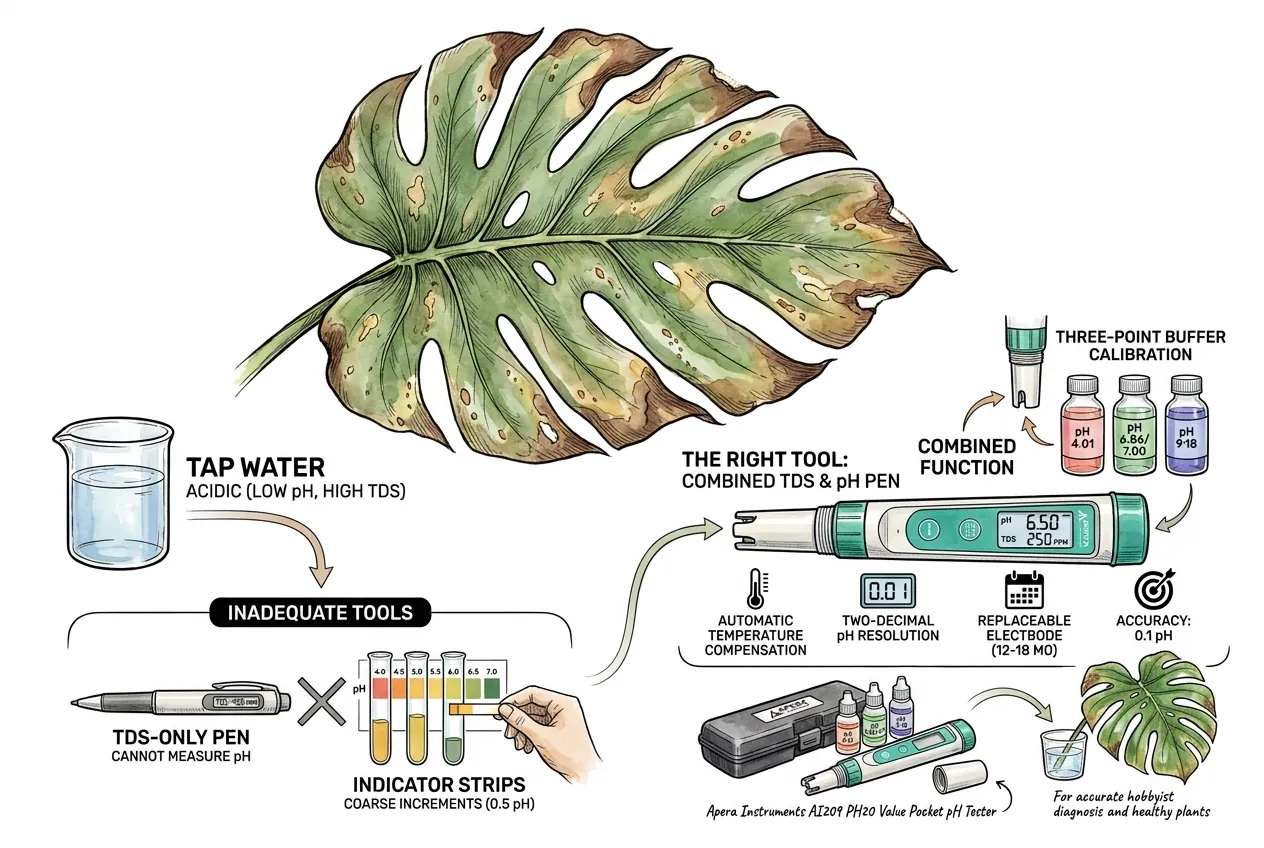
For most hobbyists, a decent pocket pH pen plus a separate TDS/EC pen covers the job. Useful features to look for in a pH pen are automatic temperature compensation, a resolution fine enough to tell 5.5 from 6.0, and the ability to calibrate against standard buffers.
A single combined pen that reads pH and TDS at once is nice-to-have, not essential, so do not over-index on it.
TDS-only pens cannot read pH. Cheap indicator strips typically read in 0.5 pH increments, which is too coarse to distinguish 5.5 from 6.0 with confidence.
The Apera Instruments AI209 PH20 Value Pocket pH Tester is a reasonable entry-level pH pen. Per Apera’s own specs, it is pH-only (it does not measure TDS or EC), reads to 0.1 pH resolution with about ±0.1 accuracy, supports 1- to 3-point automatic calibration with temperature compensation, and ships with pH 4.00 and 7.00 buffers.
Its electrode is not user-replaceable, and the electrode warranty is six months, so plan on eventually replacing the pen rather than the probe.
The honest limits are straightforward. Because it is pH-only, pair it with an inexpensive TDS/EC pen for salt readings.
And on very pure water (RO or distilled) a regular pen like this reads slowly and can drift. Apera advises allowing 1 to 5 minutes to stabilize and using a pure-water electrode when accuracy matters.
If you only want a rough pH check on ordinary tap water and can live with strip-level precision, you may not need a pen at all.
For small buffer doses, the TOPINCN 100g Digital Pocket Scale can be useful for weighing a larger stock solution. Its displayed 0.01 g resolution does not make a 0.05 g direct dose reliable, so dissolve a measured amount in a known volume and dose the stock by volume instead.
Calibration Tip
Calibration matters more than the brand of pen. Recalibrate with fresh buffers on the schedule your meter’s manual suggests, whenever it drifts, and before any reading you plan to act on. Store the electrode in the storage solution the manufacturer specifies (many glass electrodes use a KCl solution).
Try not to let the electrode dry out, and check accuracy with a fresh buffer if it has been sitting. A drifting meter can mislead you, so confirm it reads a known buffer correctly before trusting a pot reading.
How do I actually fix acidic irrigation water?
First, confirm you actually have a problem worth fixing (low measured alkalinity and a low, well-measured pH, not just a low pH number).
If you do, potassium bicarbonate is a common hobbyist choice, partly because the potassium is a plant nutrient.
That is a reason to consider it, not proof it is a safe universal fix. Adding it repeatedly still raises potassium, alkalinity, and EC, so it should be dosed against a measurement.
Baking soda (sodium bicarbonate) works in a one-time pinch but builds up sodium with repeat use.
Crushed coral dissolves slowly, but how fast and how far it raises pH depends on the water’s CO2, its surface area, and the acid load, so it is not a set-and-forget buffer that automatically stops at a target.
Potassium carbonate and potassium bicarbonate are different materials. Do not reuse a carbonate dose for bicarbonate. Test small changes in a measured batch, let the water settle, and re-check pH, alkalinity, and EC before applying it to the plant.
Potassium Bicarbonate Option
Pure Original potassium bicarb is a single-ingredient option when testing shows that a small bicarbonate adjustment is warranted. It is not a validated Monstera recipe, so check the current package and purity, then dose only through measured water tests.
The practical caveat is that KHCO3 is hygroscopic (it absorbs moisture from humid air) so store it sealed and dry, ideally with a desiccant.
Note that potassium carbonate is not an identical substitute, if you already have a carbonate product, recalculate the dose for its formula rather than assuming a one-for-one swap.
What about reverse-osmosis water?
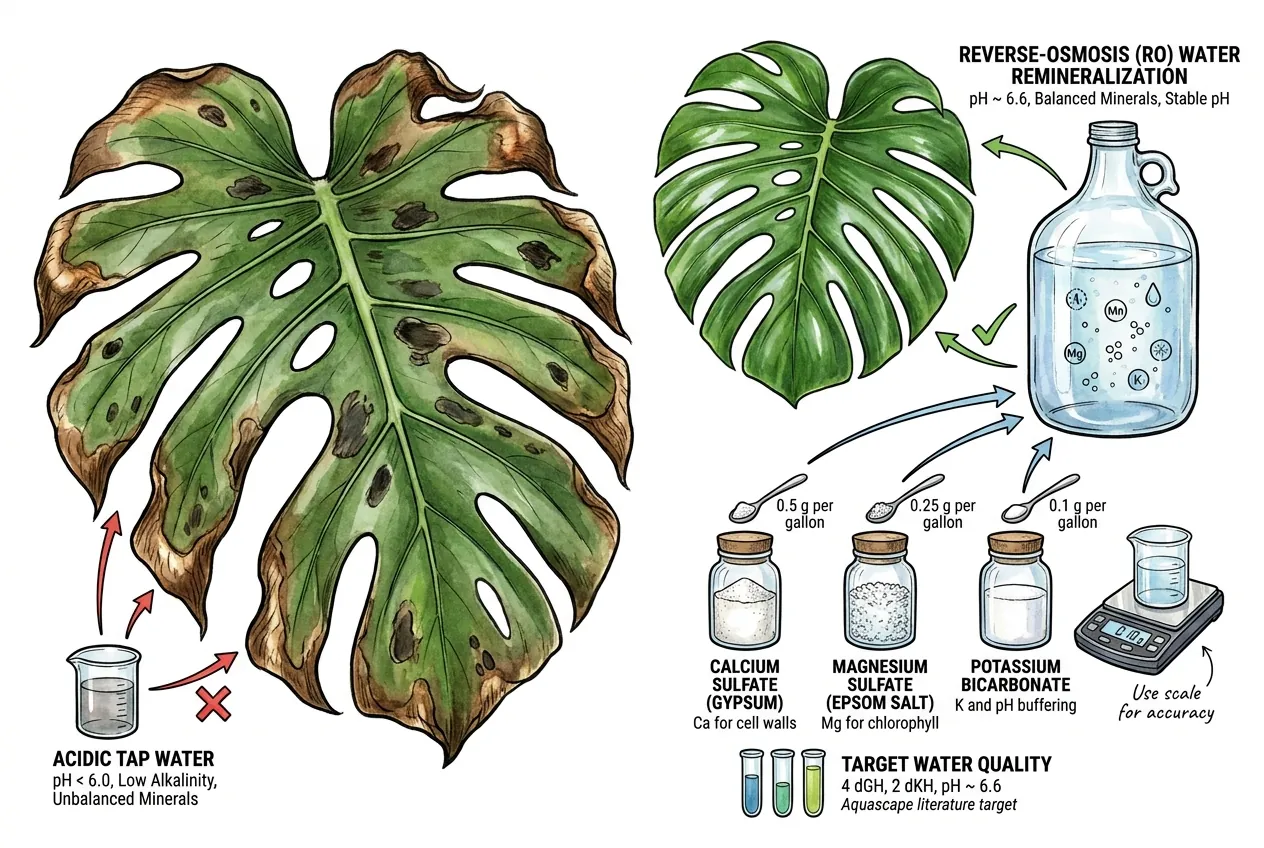
RO water has near-zero alkalinity, and its pH often reads somewhere around 5.0 to 6.5. The important nuance is that this low reading reflects a very small acid inventory, not strong acidity. Low-ionic-strength water like RO is genuinely hard to measure accurately (readings can be slow, noisy, and CO2-sensitive), so a low RO pH is not the same problem as acidic tap water.
RO is not automatically worse than dechlorinated tap. It is just unbuffered, so if you use it you generally want to add some alkalinity and minerals rather than pour it in bare.
Master Plant-Prod notes that RO and filtered water lack buffering capacity and can swing in pH, and suggests bicarbonate supplementation.
If your plant already gets a complete fertilizer and a mineral-containing substrate, you may not need a separate mineral recipe at all (decide based on a water test and your feeding program, not by default).
If you do want to remineralize RO water yourself, here is one worked example per gallon. These are ballpark figures for common hydrate forms, and they are not Monstera-specific targets (verify against your own measurements).
| Ingredient (hydrate form) | Mass per gallon | Provides |
|---|---|---|
| Calcium sulfate dihydrate (gypsum) | 0.5 g | Ca for cell walls |
| Magnesium sulfate heptahydrate (Epsom salt) | 0.25 g | Mg for chlorophyll |
| Potassium bicarbonate | 0.1 g | K and some alkalinity |
Using those hydrate forms, the gypsum and Epsom salt work out to roughly 5.8 dGH (about 100 mg/L hardness as CaCO3), and the 0.1 g of KHCO3 adds only about 0.7 dKH (roughly 13 mg/L alkalinity as CaCO3), not the often-quoted 4 dGH / 2 dKH, and different again if you use anhydrous salts.
These three masses alone do not fix a final pH, so do not treat any single pH figure as guaranteed.
Weigh small amounts carefully (or use a stock solution), and remember this is a starting example to measure from, not a validated prescription.
Or do I just stick with my tap water?
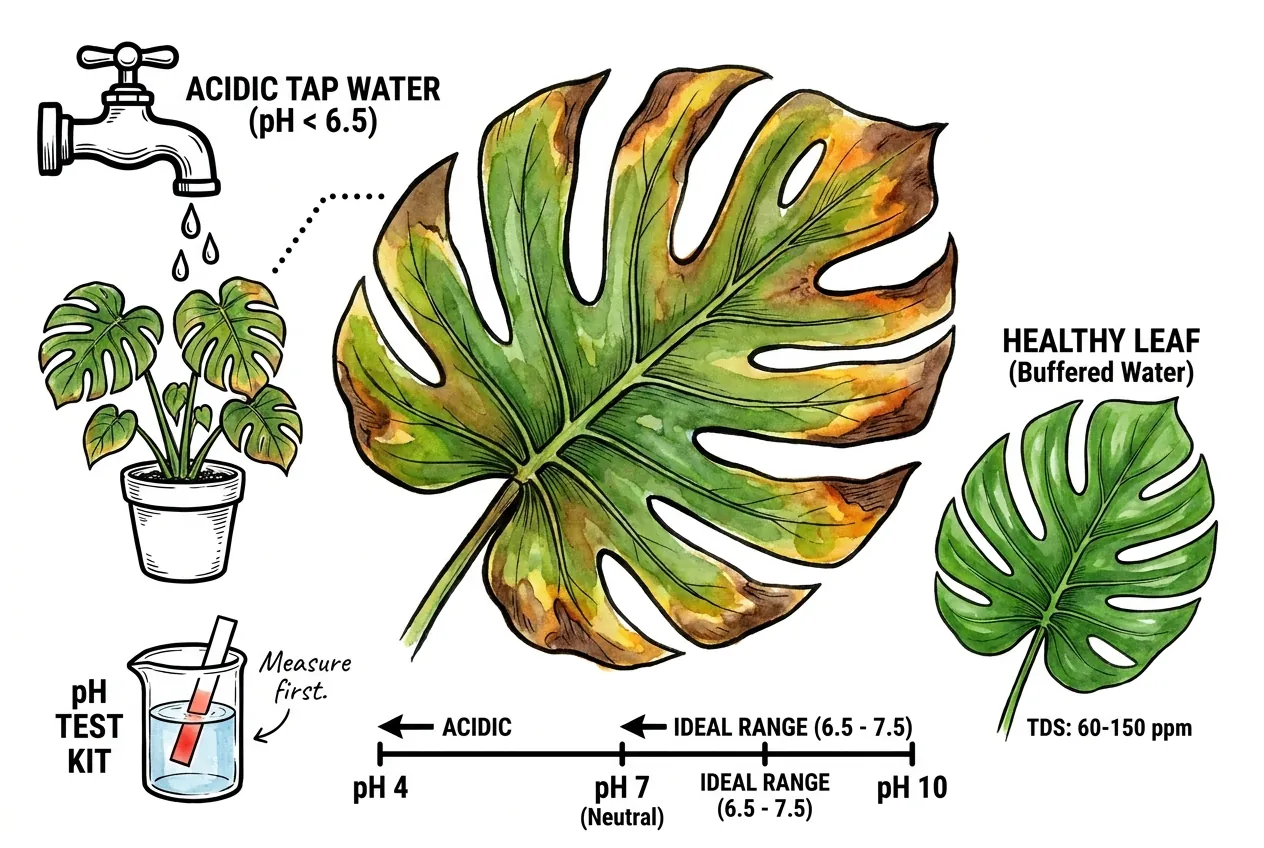
For many growers, ordinary tap water is fine, and the simplest routine is often the right one.
But there is no universal pH/TDS box that certifies water as good. A modest pH and TDS reading is reassuring, yet suitability also depends on alkalinity, sodium, chloride, and the calcium-to-magnesium balance. General greenhouse guidance spans a much wider range (roughly pH 5 to 7 and TDS from about 70 up into the hundreds of mg/L) and is crop- and context-dependent.
So use pH and TDS as a first look, and lean on your water report or a lab test for the ions two pens cannot see.
Switching to bare RO when your tap is already working can actually make things harder, because you trade a buffered, mineralized supply for an unbuffered, unmineralized one that then needs its own management.
On chlorine and chloramine. If your utility uses chloramine and you want to remove it, use a chloramine-rated dechlorinator, but there is no plant-specific evidence that ordinary chloraminated tap water must be treated for a Monstera, so this is optional rather than mandatory.
Measure First
Measure first, including alkalinity and key ions where you can. Change your water only when the data actually calls for it.
What if my Monstera already shows symptoms?
Diagnose before you act. Many causes produce overlapping brown-edge or yellowing symptoms, and they genuinely overlap. Visual patterns narrow the list but rarely confirm a single cause on their own.
How do I tell acid burn from salt burn from low humidity from a bacterial infection?
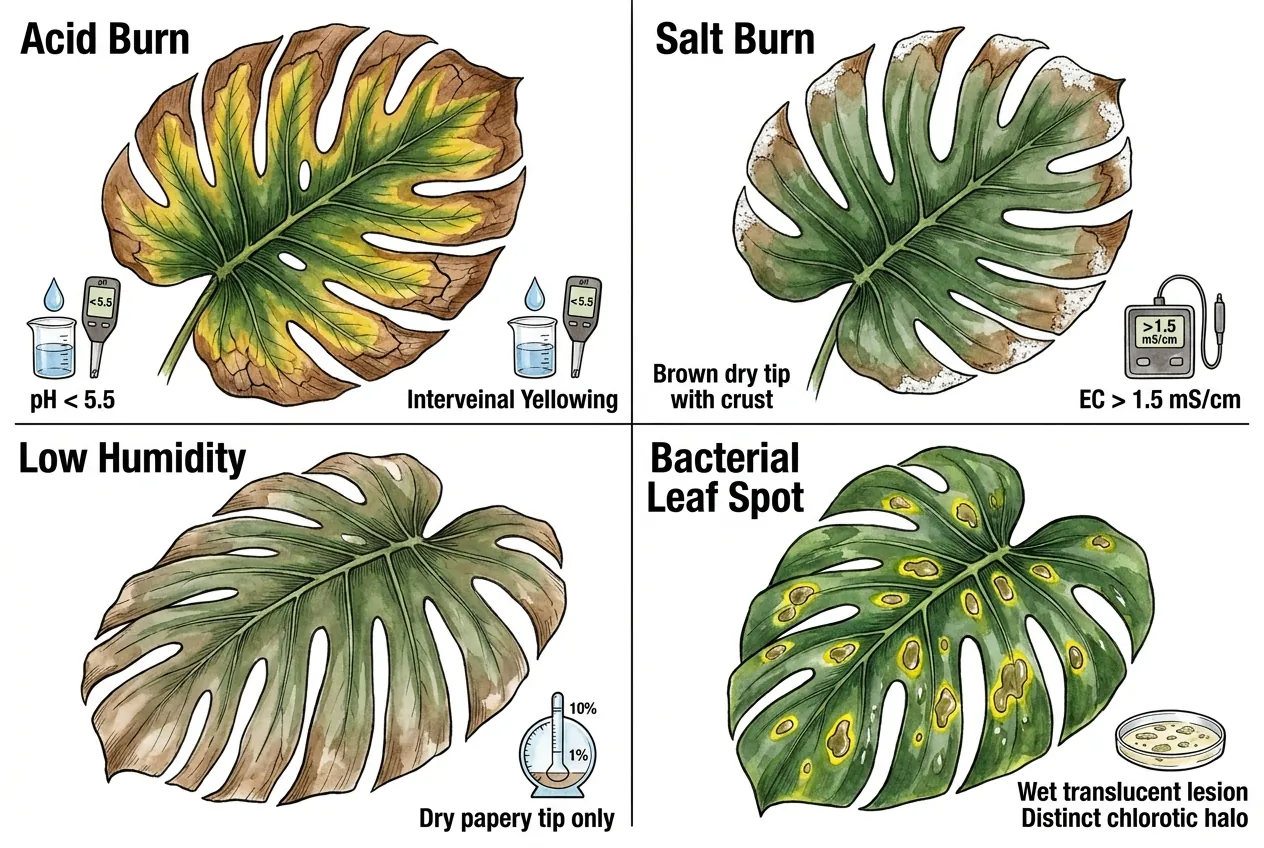
Use this as a differential checklist. A runoff pH and EC test (using a consistent method) plus a look at pattern and context helps narrow the possibilities, but it does not separate the causes cleanly, and more than these four can be at work (light and watering extremes, root damage, nutrient or pH issues, pests, and temperature all belong on the list).
| Cause | Pattern that leans this way (not exclusive) | What to check | Reasonable first response |
|---|---|---|---|
| Acid / low-pH stress | Often older leaves first, interveinal yellowing, brown margins | Runoff pH (with method). Water alkalinity | Confirm low pH, then buffer/flush/amend based on measurement |
| Salt / high-EC stress | Brown crispy tips, can affect many leaves | Runoff EC compared against the correct range for your method | Flush if EC is genuinely high. Review fertilizer rate |
| Low humidity / dry air | Dry papery tips, often on larger exposed leaves | Room humidity. Airflow and heat sources | Raise humidity. Move away from vents |
| Bacterial leaf spot | Water-soaked lesions, sometimes with a yellow halo. Can spread | Progression over days. Leaf wetness. A professional diagnosis if unsure | Sanitation, remove affected leaves, reduce leaf wetness and improve airflow |
| Also consider | Overlapping or atypical damage | Light extremes, over/underwatering, root health, nutrient balance, pests, temperature | Match the fix to what you actually find |
Bacterial leaf spot on Monstera is documented. Luiz et al. (2024) reported a first record of Pseudomonas cichorii causing bacterial leaf spot on Monstera adansonii in Hawai‘i, published in Plant Disease, the peer-reviewed journal of the American Phytopathological Society.
Common clues include water-soaked lesions, sometimes with a yellow halo, that can progress to darker spots. Lesions may be angular where leaf veins limit spread.
A foul smell or slimy texture points more toward a soft-rot organism such as Erwinia. These are clues, not exclusive signatures. Bacterial disease is best confirmed by watching progression, checking sanitation and conditions, and getting a professional or lab diagnosis when it matters.
Bacterial-Infection Caution
Bacterial infection does not respond to pH adjustment, so if you mistake it for acid burn and chase buffer chemistry, the infection can keep spreading.
If you do treat, note that a copper bactericide is only appropriate when the label lists your pathogen, host, and use setting. Copper can be phytotoxic, and indoor suitability and rates must be checked before use.
How do I recover an acid-damaged Monstera?
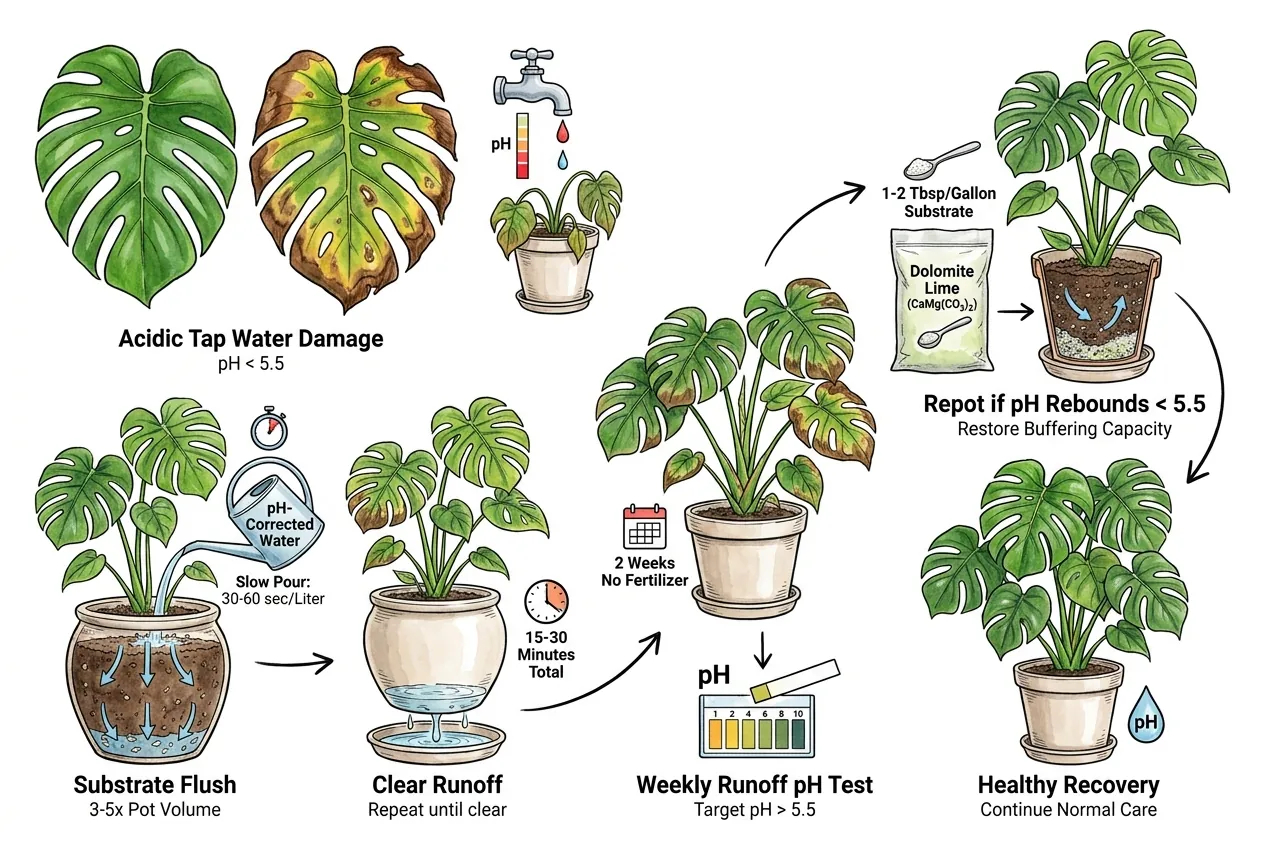
First, make sure a flush is the right move. Leaching is the standard response to a confirmed high EC (salt) problem, not something to do reflexively.
The cited Greenhouse Grower guidance applies roughly a 50% leaching fraction when EC is measured high, then re-checks EC and repeats if needed. It does not prescribe three to five pot volumes until runoff runs clear.
Runoff clarity is not an endpoint for dissolved salts or pH. The meter is.
When you do flush, pour slowly and let the pot drain between passes. Slow, even watering reduces channeling, whereas fast pouring can find preferential paths and bypass parts of the mix.
Be cautious with large volumes on an already-wet or poorly draining pot, because dumping gallons of water can cause waterlogging and root problems of its own.
Watch runoff EC (and pH) drop toward your target rather than counting gallons.
After correcting, re-measure the media over time rather than following a fixed calendar. If the media pH stays reasonable and new growth looks healthy, carry on. Hold or reduce fertilizer only if a test or the plant’s state suggests it, not on a set two-week timer.
If pH keeps returning low over repeated tests, that can signal the mix has little buffering left, but one four-week rebound alone does not prove it.
Before repotting or liming, get a media test and consider the mix’s existing lime charge. If a repot is warranted, dolomite (CaMg(CO3)2) supplies calcium, magnesium, and neutralizing value and releases it slowly, but the right rate depends on particle size, the mix, and a lab recommendation. An arbitrary dose risks over-liming, so do not just add a tablespoon-per-gallon by rule.
For prevention, the useful idea from UMass is the opposite of over-watering. Many growers over-leach, and traditional guidance is a modest leaching fraction (on the order of 10 to 15% of applied water draining through), not 15 to 20% more than container capacity.
Where salt buildup is a real, measured risk, occasional fertilizer-free waterings can help reduce it, but this is a response to measurement, not a fixed monthly ritual.
Final Takeaways
- Water pH by itself is a weak predictor of root-zone trouble. What carries acid to a pot is alkalinity (acid-neutralizing capacity), so judge water by alkalinity, EC, and key ions, not by a single pH number. The mechanisms behind acid stress are real, but no source establishes a Monstera-specific damage below pH 5.6 threshold.
- The EPA pH range of 6.5 to 8.5 is a non-enforceable, aesthetic drinking-water guideline. It does not set a plant-safe range, but the fact that it does not protect plants is not evidence that out-of-range water harms a Monstera. Check your own water report to decide.
- Measure substrate pH and EC as a starting point, using a consistent method and comparing against the range for that method (a 1/2 EC range is not a pour-through range). Two pens narrow a problem. They do not diagnose disease, roots, or nutrient ratios in five minutes.
- If a measurement shows low alkalinity and a genuinely low pH, buffer with potassium bicarbonate dialed in by testing, and note that carbonate and bicarbonate are not interchangeable by mass. With RO water, add minerals and alkalinity deliberately if your fertilizer and substrate do not already cover it.
- When symptoms appear, treat visual patterns as a differential checklist, not a confirmed diagnosis. Acid stress, salt stress, low humidity, disease, and several other causes overlap. Match the fix to what you actually measure and observe.
Affiliate Disclosure
This article contains Amazon affiliate links. As an Amazon Associate I earn from qualifying purchases. If you use these links, the site may earn a commission at no extra cost to you. Product availability, price, and specifications can change. Check the current listing before buying.