
Bucephalandra Tissue Culture Under Red/Blue LEDs (2025)
A 2025 Frontiers paper found a blue-red 70:30 LED gave the most shoots per Bucephalandra explant in vitro. Here is what it does and does not show for home growers.
Priya Patel · Published 2026-05-29 · 17 min read
Initial Acclimatization Substrate
Mountain Valley Perlite
Mountain Valley perlite gives the rooting vessel an airy, reusable base when a one-inch layer is enough for the container. It improves drainage, but the medium above it still controls most of the root-zone moisture.
Perlite is a sensible choice for early acclimatization because it keeps a rooting area airy. The research supports the material category, not this exact brand or tote setup. Adjust the depth and watering so it stays damp without becoming waterlogged.
One practical caveat is that light perlite tends to float when watered from above. Watering from below (setting the tote in a shallow tray) or mixing with vermiculite can reduce that, though a 1/1 vermiculite mix changes water retention and was not the single-substrate condition the study tested.
If you already have clean horticultural-grade perlite, there is no need to buy more. Other inert mineral media differ in porosity, capillarity, and pH, so they are not automatically interchangeable at a single particle size.
Prefer horticultural grade and check for additives rather than assuming all construction-grade perlite is contaminated.For lighting, run a dimmable B+R LED on a 10–12 hour timer at a low output, and measure at the plant rather than assuming a set μmol value.
Mist sparingly, and vent based on measured humidity and condensation rather than a fixed schedule, since mold risk depends on sanitation, temperature, airflow, and moisture, not a clock.Light spectrum effects on micropropagation and gene expression of Bucephalandra sp. In a temporary immersion system for sustainable production
After acclimation, I number 20 flask siblings, shuffle their labels, and assign ten to the red group and ten to the blue group for four weeks. I swap the whole tray positions once each week without changing spectrum or intensity. The four-week window follows the cited culture study, while ten plantlets per group keep one loss from dominating a home-scale comparison.
The comparison uses the same numbered plantlets and only leaves formed after acclimation. Agar-grown leaves are a poor endpoint for judging the light that followed deflasking.
Camera exposure and white balance stay locked, or I place a neutral card in frame. Colored LEDs can make healthy tissue look redder, paler, or darker without any biological pigment change.
What substrate actually works for acclimatization?
Perlite, vermiculite, and clean sand all gave strong survival in one acclimatization trial. For home use, choose the clean medium you can keep airy and evenly moist.
Do not assume every organic medium fails or every mineral medium succeeds. Packing and overwatering can still suffocate roots.
Why do three different mineral substrates tie at 100% survival?
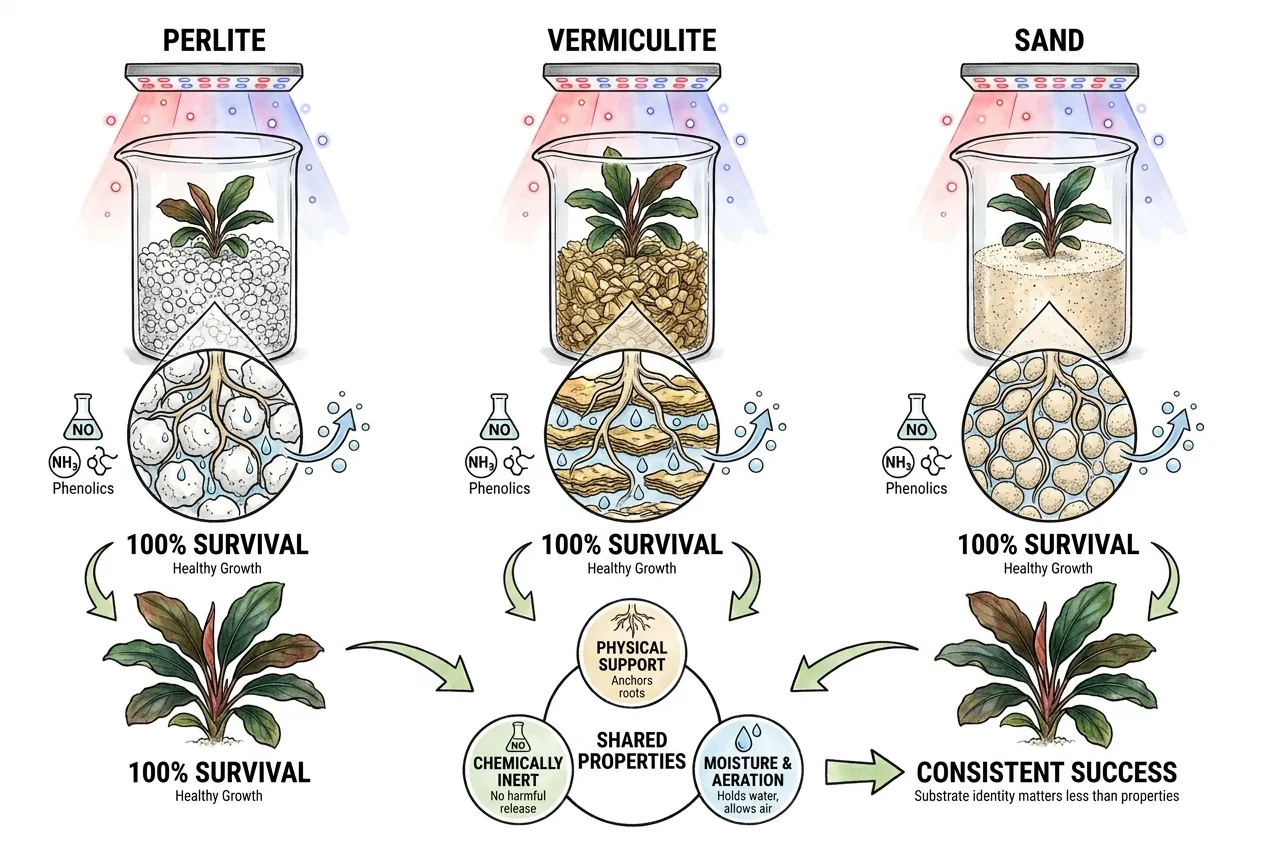
All three provide physical support and drainage for fragile new roots. It would be an overstatement to say they are all equally inert. Vermiculite has meaningful cation-exchange capacity and holds water and nutrients, and sand behavior depends on grain size, washing, and depth.
The study did not measure ammonia, phenolics, or oxygen levels in these media, so a claim that none release those compounds is an inference, not a finding.
The useful takeaway is that a substrate’s physical and chemical properties matter more than its brand name, but properties means water retention, air-filled porosity, pH, salts, and cleanliness together, not particle size alone.
Why did black rice husk fail?
The study observed lower survival, chlorosis, and limited roots on black rice husk and suggested excessive moisture, poor aeration, or microbial contamination as possible causes.
It did not run assays to confirm a mechanism.
Explanations sometimes given, that phenolics block iron uptake, that fine silica clogs roots, or that microbial decomposition depletes root-zone oxygen, are plausible hypotheses but were not measured here, so they should not be presented as the established cause.
Chlorosis alone does not prove an iron blockade.
Substrate comparison for Bucephalandra acclimatization
| Substrate | Survival | Mechanism | Hobbyist availability |
|---|---|---|---|
| Perlite | 100% | High aeration, inert | Garden center, Amazon |
| Vermiculite | 100% | High water retention, inert | Garden center, Amazon |
| Sand | 100% | Inert, dense, anchors | Hardware store |
| Black rice husk | Lower, with chlorosis | Cause not confirmed by the study | Did worse in this trial |
| Aqua soil (Amazonia, Stratum) | Not tested in this paper | Not compared here | No data either way for this stage |
Why aqua soil is a poor fit for this stage
Aqua soils such as ADA Amazonia and Fluval Stratum generally release nutrients into the water column over time and can lower pH, though behavior varies by product, batch, and water chemistry.
That can suit an established planted tank.
A freshly deflasked TC plantlet has immature roots and cuticle, so a nutrient-releasing, ammonia-active substrate is a plausible risk during early acclimatization, but this study did not test aqua soil, so ammonia burn or iron chelation on these plantlets is not something the data confirm.
A conservative approach is to acclimatize on a mineral substrate like perlite first and only move a well-established plant toward aqua soil later, managing early ammonia and water chemistry as you would in any new tank.
Light spectrum effects on micropropagation and gene expression of Bucephalandra sp. In a temporary immersion system for sustainable production
Enhancing Acclimatization Conditions for Vriesea splendens Fire. A Comparative Analysis of Substrate Effects on Growth and Survival
Optimization of Micropropagation and Metabolomic Analysis Under Different Light Qualities in Mussaenda pubescens Ait.f
What LED hardware actually meets the spec?
Most aquarium LED bars are sold on color appearance and total wattage, which do not tell you the PPFD or the spectral power distribution at the plant.
For emersed grow-out, a good buying rule is a dimmable LED with a published spectral chart showing distinct 450 nm and 660 nm peaks, plus a coverage/PPFD map for your distance.
Whether blue dominant is ideal for ex-vitro Bucephalandra is not established, so aim to measure and adjust rather than copy the culture ratio.
Because this plant’s light tolerance was not measured with a dose-response and fixtures vary widely, a specific 3–5x too much overshoot cannot be calculated.
The safe generalization is that many high-light planted-tank setups deliver more than a shade plant like this needs.
What should you look for on a fixture spec sheet?
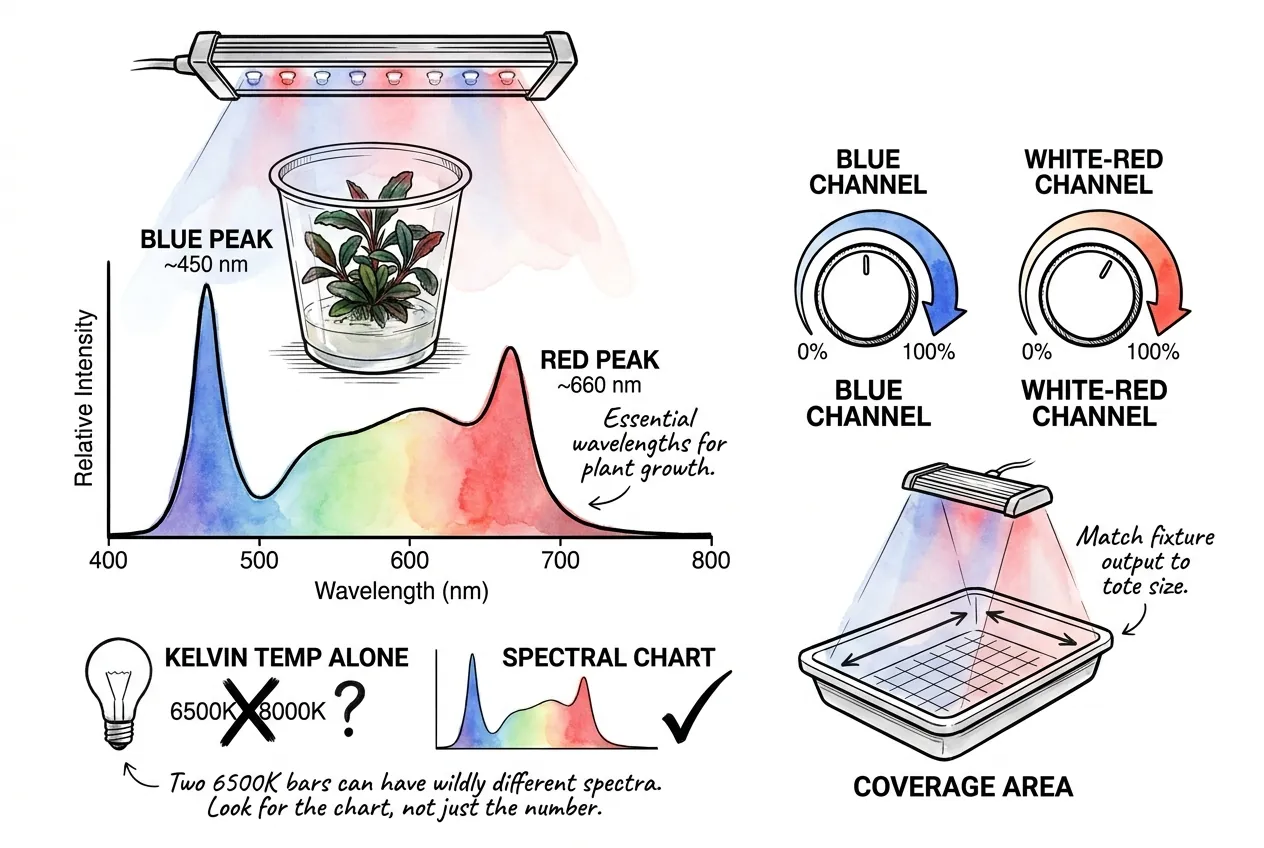
A spectral chart with a labeled wavelength axis, ideally showing peaks near 450 nm and 660 nm. A relative chart shows shape, not the actual PPFD at the plant, so it does not by itself prove a channel setting equals a given photon ratio.
Independent dimming for the channels, so you can set a low output and adjust the ratio, with dimming stable at low levels.
A coverage map at your mounting distance, since uniformity at the plant plane matters more than wattage or bar length.
Correlated color temperature (6500K, 8000K) tells you little about photon dose or detailed spectrum. Two bars at the same Kelvin can have very different spectra.
It is not useless for describing appearance, but it is not enough to judge plant response.
A full-spectrum label with no published chart or test data is marketing, not a spec.
Can a dimmable dual-channel aquarium fixture work for emersed Bucephalandra?
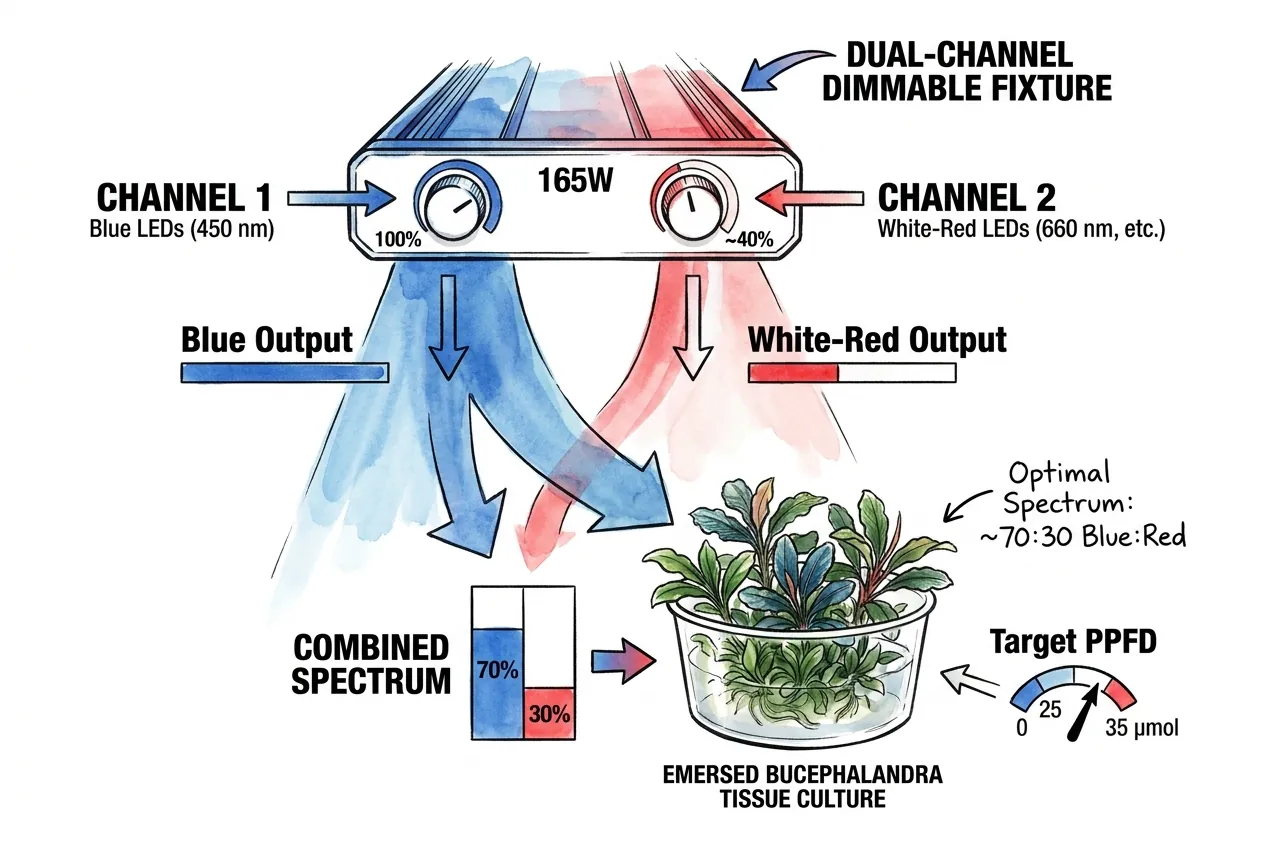
A fixture with independent, dimmable channels can, in principle, be adjusted toward a blue-biased output.
But a channel percentage is not a photon percentage. Channels differ in LED count, wavelength, drive current, and optics, so 100% blue + 40% white does not reliably equal a B. R 70/30 photon ratio, and there is no manufacturer PPFD map that puts a given knob setting at 25–35 μmol at a given height.
VIPARSPECTRA V165
The linked VIPARSPECTRA V165 is a powerful reef light with dimmable channels. It is too much for many small emersed totes unless you can measure the light and run it very low.
Keep any mains fixture clear of condensation, use a drip loop and GFCI/RCD protection, and verify its moisture rating. A lower-power dimmable strip is usually easier to position and cool for a small tote.
Lower-power B+R grow strips are often a better fit for a small tote on cost, heat, and geometry, but similar output only holds if you compare published spectrum, PPFD, and coverage.
Specific unnamed strips (for example generic 2 ft B+R strips) cannot be verified here without a model, SKU, spectral chart, and safety rating, so confirm those and the electrical safety before trusting any one product.
Plant Growth and Photosynthetic Characteristics of Mesembryanthemum crystallinum Grown Aeroponically under Different Blue- and Red-LEDs
How do you move a plant from TC cup to thriving emersed pad?
The high-risk moment is opening the TC cup. Plantlets have been growing in high humidity, near-sterile vessels under low light (the study’s LEDs ran at roughly 24–37 μmol) for weeks, so the main risks are moisture stress, contamination, and root damage, not humidity alone.
A sudden drop to dry room air and bright light can cause wilting, but certainty that a plant collapses within days is not something this study measured, and changing humidity and light at once makes cause hard to read.
The sensible fix is a gradual humidity step-down plus gentle removal of residual agar. Note one important difference from the source. The study fed weekly Hoagland from the start of acclimatization, so no fertilizer for two weeks is a hobby adaptation, not the study’s protocol.
What is the day-one protocol?
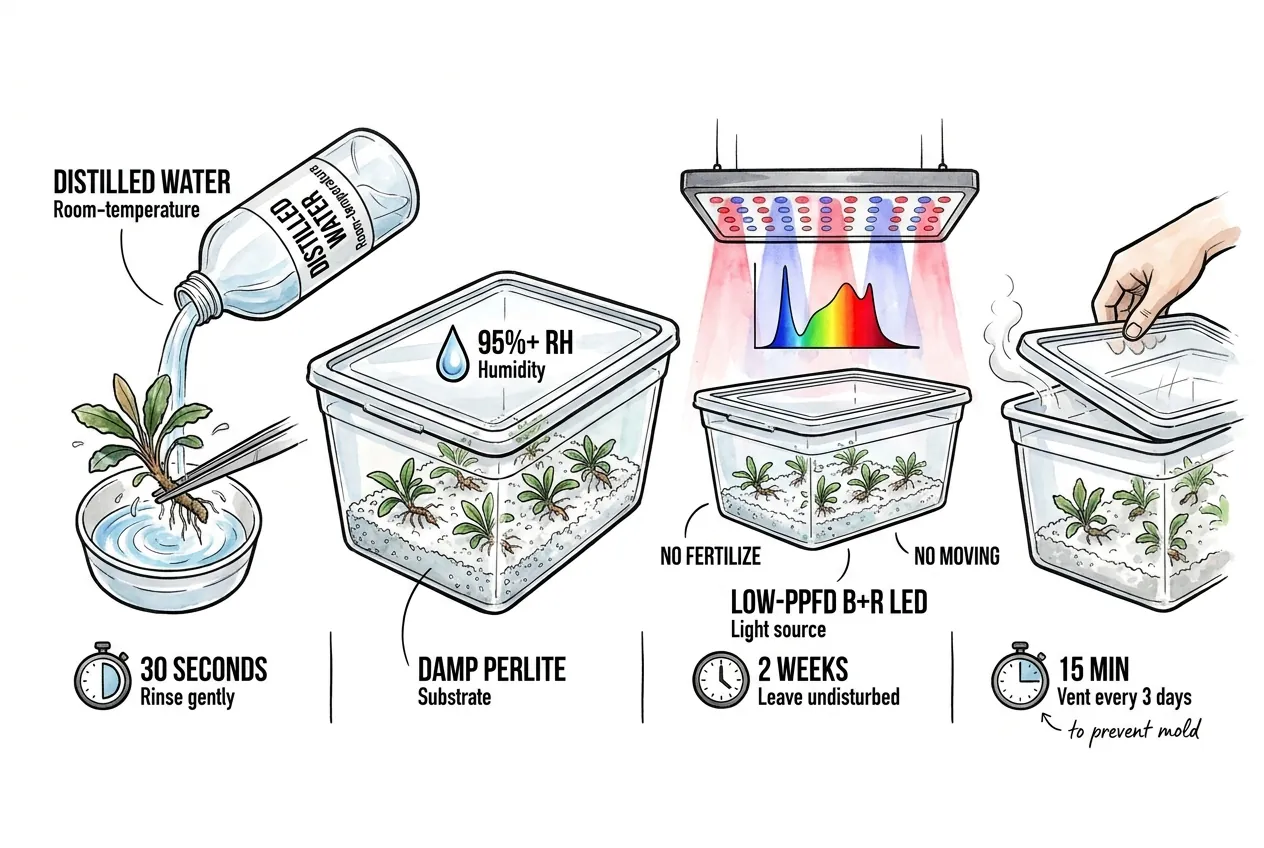
Gently rinse the rhizome to dislodge agar. The study used running water for this. Distilled water is a conservative alternative but a specific 30-second rinse is not a tested figure.
Lay plantlets on damp perlite in a sealed, high-humidity tote under low light and leave them largely undisturbed early on. Base venting on measured humidity and condensation rather than a fixed 15-minutes-every-3-days rule.
Water quality also matters. Tap water varies by region, and chlorine or hardness could stress sensitive tissue, but the study rinsed roots under running water, so a general claim that tap water shocks plantlets is not supported.
Distilled water reduces salts but is not proven superior here, and long-term mineral-free irrigation is not ideal either, so any week 4 switch point is arbitrary.
Judge water by your local chemistry and the plant’s response.
What is the humidity ramp?
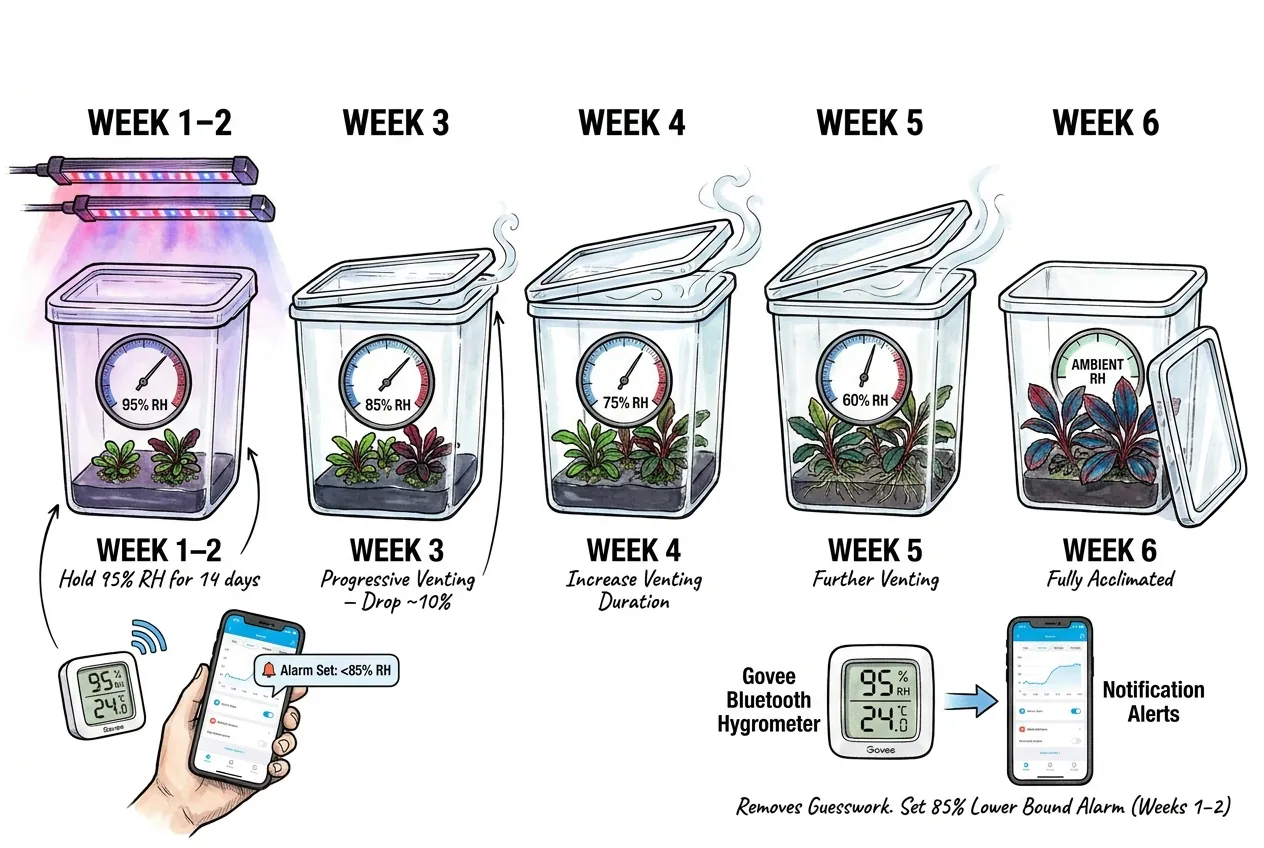
The principle is sound. Hold high humidity at first, then reduce it gradually by venting the tote a little longer over time.
The specific numbers here (start high, drop about 10 points per week toward ambient over roughly six weeks) are an example, not a validated Bucephalandra schedule. The study’s own acclimatization ran at 80–90% RH under about 60% shade for two months, so adjust the pace to your ambient conditions and the plant’s response rather than following fixed percentages.
An inexpensive hygrometer inside the tote makes the step-down measurable, though it does not remove judgment. Sensor placement and condensation can distort readings.
Govee H5074
The Govee H5074 can log humidity and temperature for a tote. It is useful when you need to see a trend or diagnose a failed batch, not as a substitute for watching the plants.
Keep the sensor out of direct spray and protect it from condensation unless its rating allows that environment. Set alerts to your current target rather than a generic humidity number.
When can you start fertilizing?
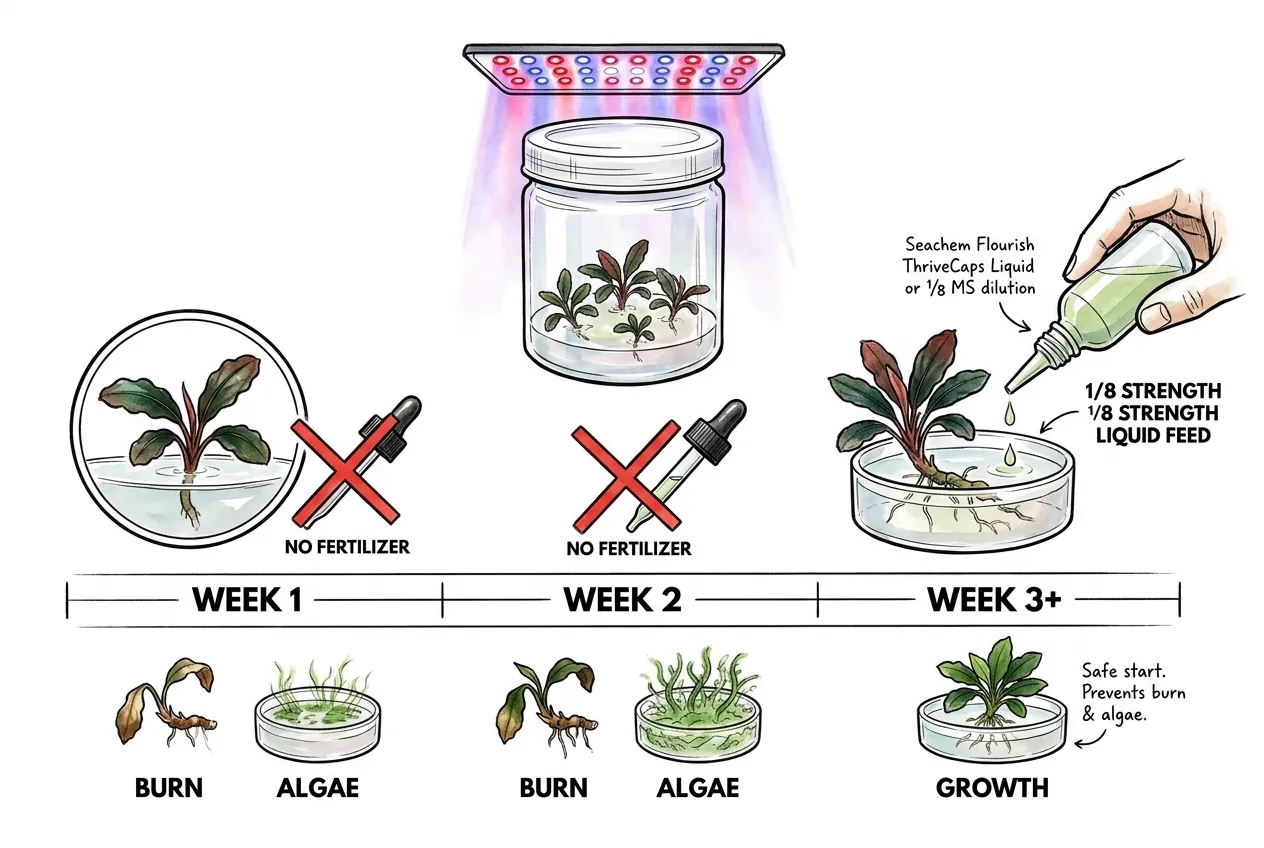
This is another place the hobby advice diverges from the source. The study fed weekly Hoagland solution from the beginning of acclimatization.
If you prefer to start with a dilute feed later, use a genuinely balanced nutrient source at low strength, such as a dilute complete nutrient solution (for example a fraction-strength MS or Hoagland mix).
Note that Seachem Flourish is a micronutrient/trace supplement without significant nitrogen or phosphorus, so it is not a balanced feed on its own, and there is no product called ThriveCaps Liquid. NilocG sells a liquid Thrive and separate ThriveCaps root capsules.
Heavy early feeding can raise salt injury and encourage algae or microbial growth, but a suitably dilute nutrient solution before week 3 is not shown to be harmful and would actually be closer to the study’s own regime.
What signals the plant accepted the conditions?
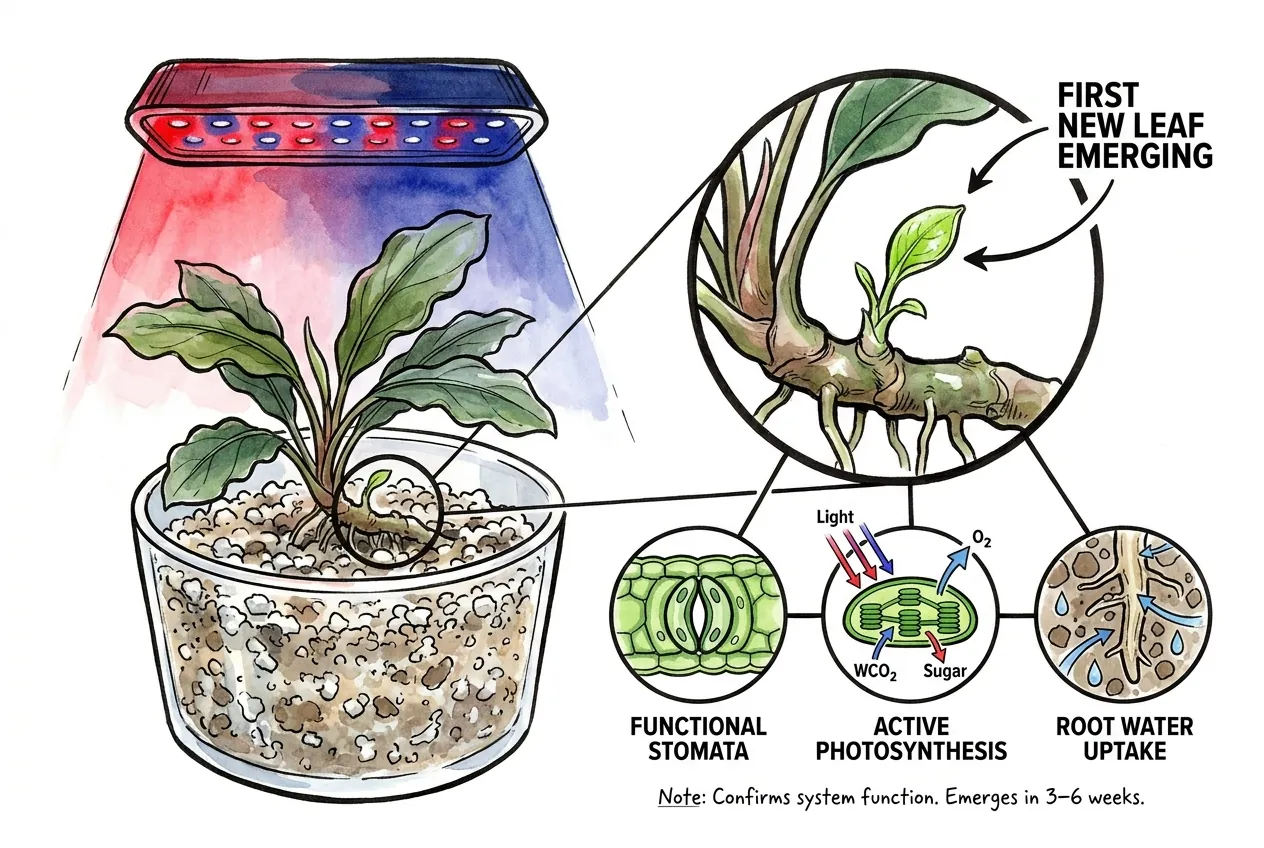
A first new leaf is a useful positive sign that establishment is underway. Timing varies with the clone, starting size, temperature, light, and nutrition, so a 3–6 week window is a rough expectation, not a guarantee.
A new leaf suggests the plant is growing, but it does not by itself confirm stomatal function, photosynthetic competence, and root uptake individually. Those would need direct measurement.
In stable conditions, it is reasonable to avoid changing several things at once, but act promptly if you see clear rot, drying, overheating, or contamination.
What do you do when growth stalls or melt starts?
A useful starting framework groups common emersed grow-out problems into light stress (too much PAR), spectrum-related etiolation, humidity/VPD stress, and rot.
But this is not a complete list, and it is not a substitute for differential diagnosis. Nutrient imbalance, temperature, contamination, salinity/pH, and mechanical or root injury can all contribute, and the symptoms below overlap.
Treat each symptom as a prompt to check several possible causes, not as a one-to-one diagnosis with a single fix.
What does bleaching at leaf edges mean?
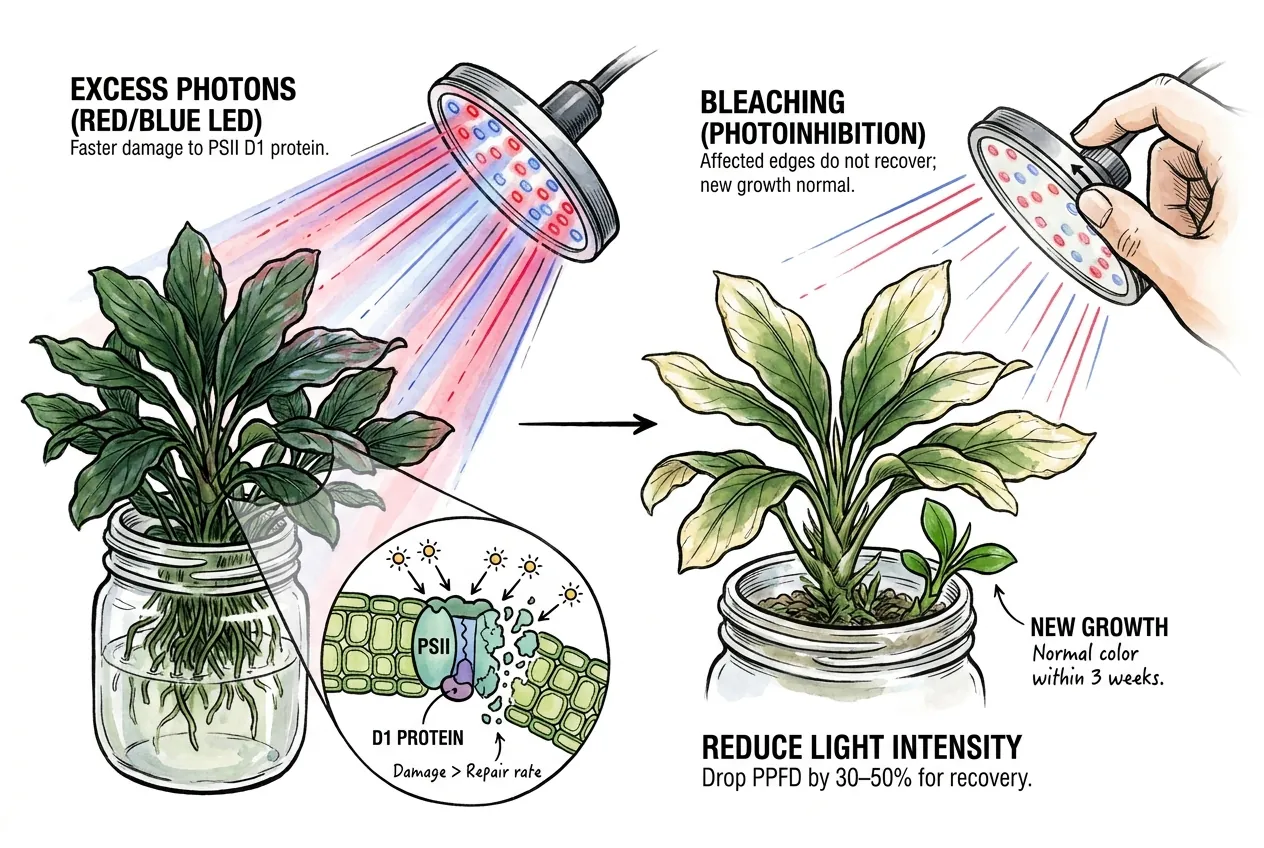
Excess light is one possible cause. Too many photons can damage the PSII D1 protein faster than it is repaired.
But bleaching can also come from nutrient deficiency, temperature, chemical injury, acclimation, or pathogens, and you cannot confirm photoinhibition by eye (that needs a measure like Fv/Fm).
If high light is the likely culprit, reduce it stepwise and watch new growth. Badly damaged leaves may not recover, and any specific recovery time is not established for this plant.
What does leggy growth with pale color mean?
Pale, elongated growth can come from low total light, insufficient blue, nutrition, temperature, or simply the plant’s own morphology, so treat spectrum as one candidate rather than the answer.
(Red light is sensed by phytochrome, not cryptochrome, and classic shade avoidance is driven mainly by a low red. Far-red ratio. In this study the pure-red shoots were not longer than others.)
Check total irradiance and nutrition first. If the mix is heavily red, adding some 450 nm blue is a reasonable adjustment, but 70/30 is not a proven universal target.
What does rapid leaf curl mean?
A sudden humidity drop (high VPD) is one likely cause, especially since young plantlets with immature cuticle and stomatal control can lose water quickly.
But curl can also reflect heat, excess light, salt, root injury, or pests, so it is not a one-to-one signal.
If acute drying is likely, restore humidity by re-sealing and mist lightly, avoiding standing leaf wetness.
Some wilting recovers quickly, but there is no basis to promise recovery within hours. If tissue stays limp or turns soft, look for another cause promptly.
What does a mushy, foul-smelling rhizome mean?
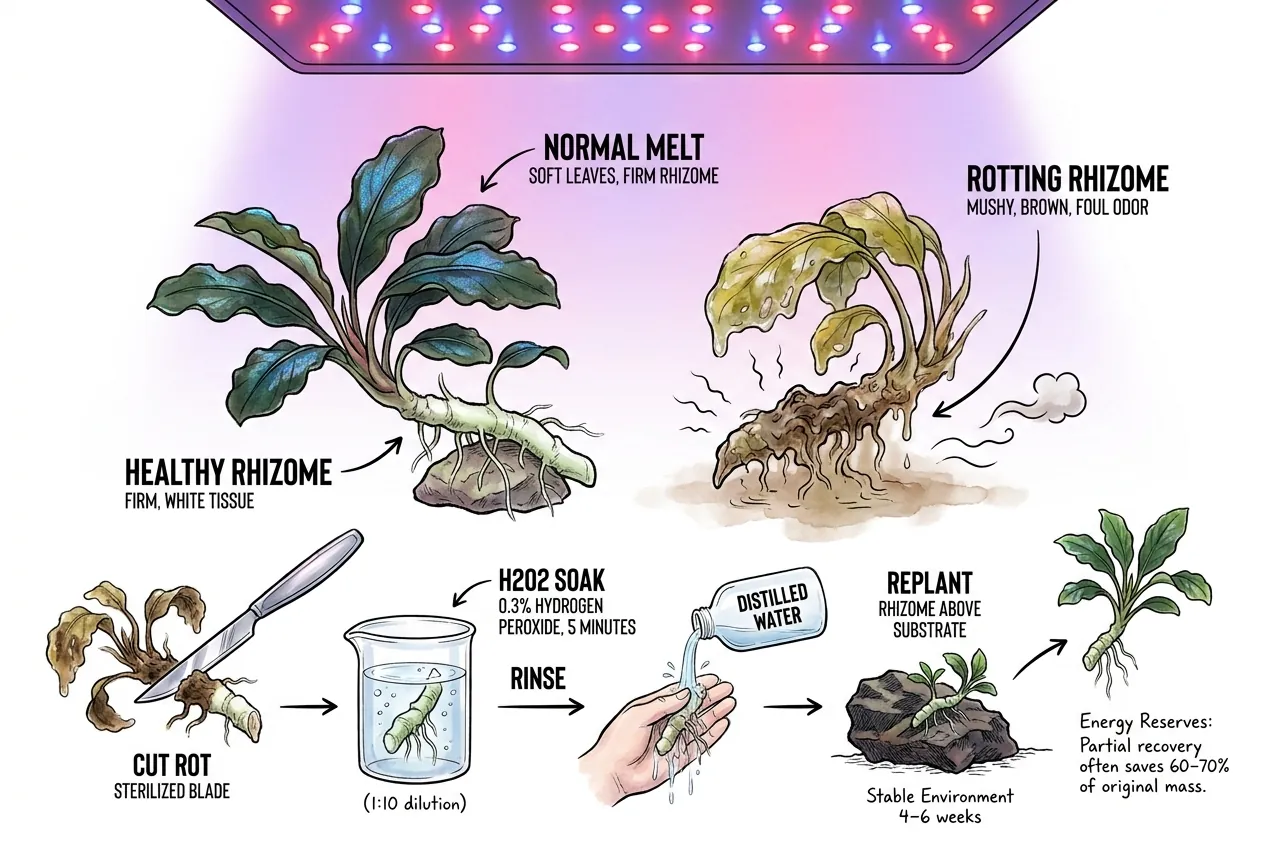
A mushy, foul-smelling rhizome is a strong sign of rot. Naming a specific pathogen is not something you can do by eye. Soft rot can involve several bacteria (for example Pectobacterium or Dickeya, the genera formerly grouped under Erwinia), and fungi, oomycetes, or non-infectious decay are not ruled out either.
Low-oxygen, waterlogged conditions are a risk factor, not a synonym for the cause.
It is worth distinguishing rot from normal melt. Normal melt is soft leaves on a firm, normally colored rhizome with viable growth points, whereas rot involves a soft, discolored rhizome, often with odor.
When rot is suspected, isolate the plant and sanitize tools before and after cutting.
A cautious salvage approach
- With a sterilized blade, cut back past the affected area to firm, healthy tissue
- Optionally rinse the cut tissue. Note that a hydrogen-peroxide dip (e.g. 0.3% for a few minutes) is not a validated treatment for Bucephalandra rhizomes and can be phytotoxic, so it is a hobbyist option, not a standard step
- Replant with the rhizome sitting on hardscape or above the substrate, not buried, keeping healthy roots in a suitable medium
- Quarantine and hold conditions stable while watching for regrowth or recurrence
A rhizome stores some energy reserves that can support regrowth after partial loss, but how much survives depends on the extent of rot, remaining growth points, roots, and environment.
There is no sourced 60–70% saved success rate, so do not treat that as an expected outcome.
What does 6+ weeks of no growth on a healthy rhizome mean?
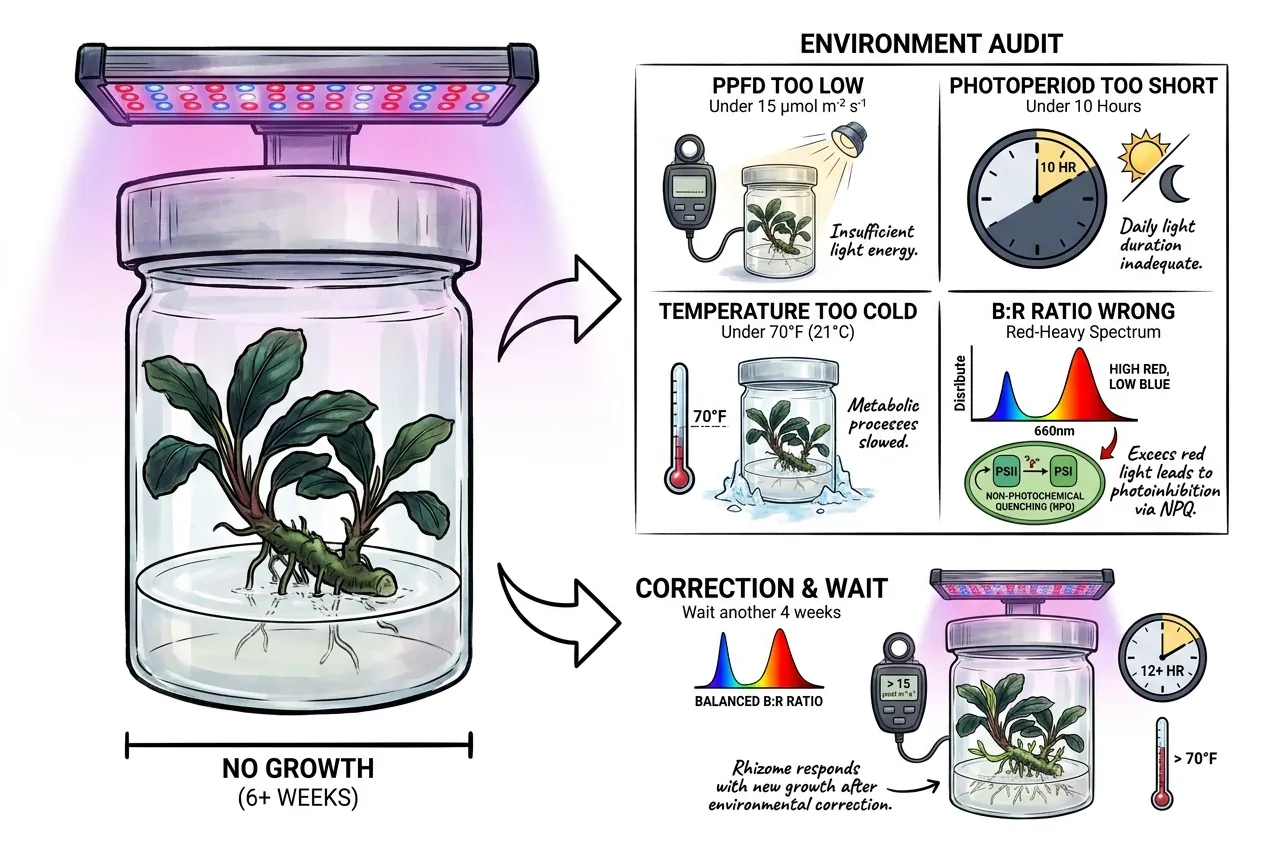
If a firm, healthy rhizome simply is not growing, review the environment. Low light, a short photoperiod, cool temperatures, and a heavily skewed spectrum are all worth checking, but the specific cutoffs sometimes given (under 15 μmol, under 10 hours, under 70°F, an unsuitable ratio) are examples, not thresholds this study established (its culture ran at 16 hours and 25±2°C).
Do not stop at those four. Also check humidity/VPD, roots, contamination, and water/nutrients.
Change one variable at a time, then give the plant time to respond.
Role of the Low-Molecular-Weight Subunits PetL, PetG, and PetN in Assembly, Stability, and Dimerization of the Cytochrome b6f Complex in Tobacco
How does this compare to existing aquascape advice?
Research on tissue culture does not establish a single home or submerged light target. Start low by aquarium standards and adjust from the light at the plant and the response of new leaves.
What is the practical difference?
It helps to contrast a typical setup with a study-informed one, keeping in mind the comparison is illustrative rather than a head-to-head trial.
A common setup
A 6500K aquarium LED, mounted normally, run at low to medium intensity. Kelvin and a verbal intensity do not tell you the actual photon dose or spectrum, and outcomes vary. Bucephalandra is in fact grown successfully under many full-spectrum aquarium lights, so slow growth, bleaching, algae, or melt are possible failure modes, not a guaranteed result.
A study-informed setup
A B+R LED run at low output with humidity-controlled emersed acclimatization on a mineral substrate like perlite, with light measured at the plant.
The study’s in-vitro 70/30 treatment averaged 14.40 shoots per explant over four weeks, but that is a TIS bioreactor result, not a home DSM yield.
There are no published home-grower trials to support a specific percentage of that figure, so treat expected home output as unknown rather than a fixed 30–50%.
Growth, photosynthetic function, and stomatal characteristics of Persian walnut explants in vitro under different light spectra
Key Takeaways
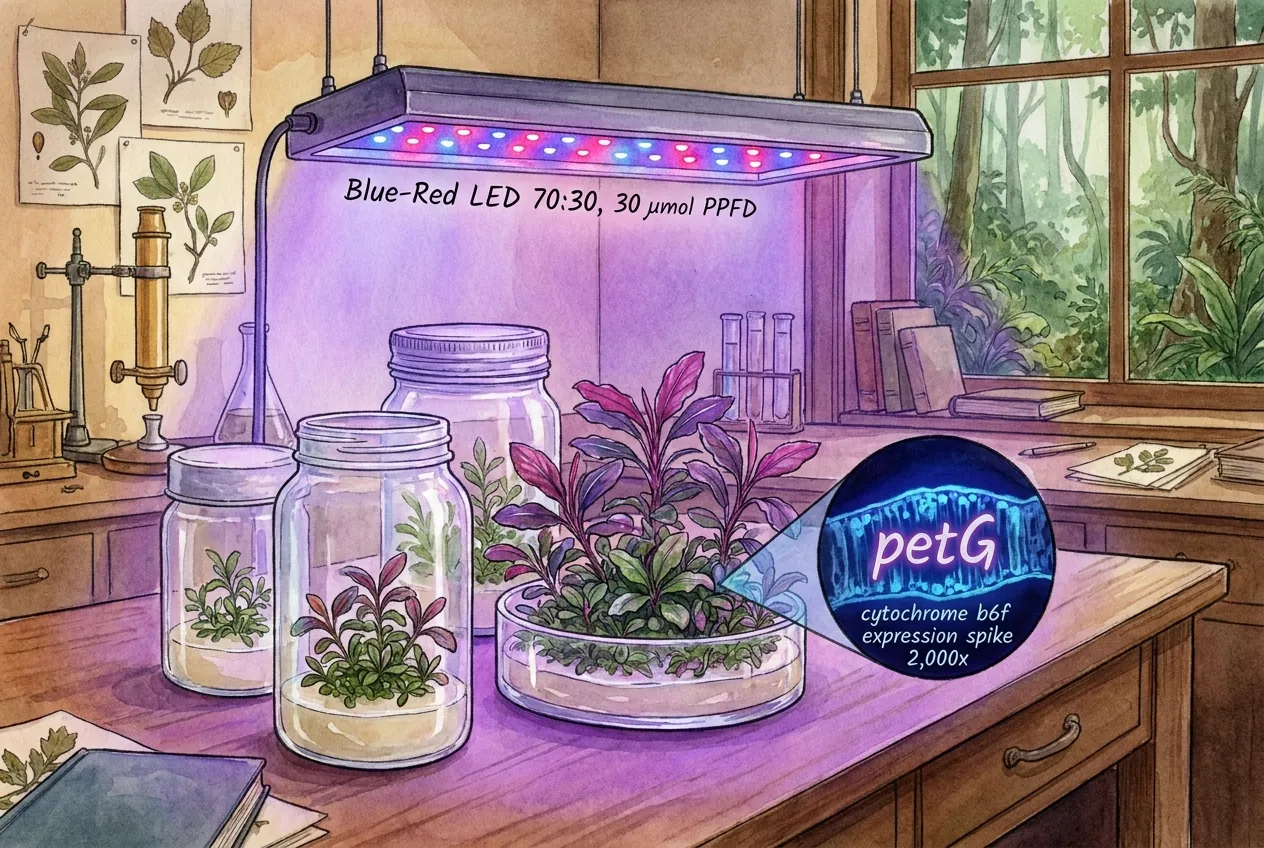
- In one in-vitro trial on a single commercial form, a blue-red 70/30 LED (30.19 μmol PPFD) gave the most shoots. Spectrum and intensity were confounded, so this is not a validated 25–35 μmol optimum.
- petG and five other plastid genes showed higher relative transcript levels under 70/30 by qRT-PCR. That is one measured response, not protein amount, complex assembly, or a health signature.
- Perlite, vermiculite, and sand each reached 100% survival in the two-month acclimatization experiment. Black rice husk did worse with chlorosis, and aqua soil was not tested.
- Bucephalandra is a low-light plant, but no aquarium PPFD requirement can be derived from this in-vitro study. Start low and measure at the plant.
- A sealed-tote dry-start setup shares the humid, low-light environment of tissue culture but is not a temporary immersion system.
- Step humidity down gradually for TC cup transfers. The exact weekly schedule here is an untested adaptation, and the study itself used 80–90% RH over two months with weekly feeding.
Affiliate Disclosure
This article contains Amazon affiliate links. As an Amazon Associate I earn from qualifying purchases. If you use these links, the site may earn a commission at no extra cost to you. Product availability, price, and specifications can change. Check the current listing before buying.