
Marcgravia Species for Bioactive Terrariums: A Guide
Choose Marcgravia for a bioactive terrarium by plant scale and verified identity, establish or propagate it with humid airflow, and diagnose translucent or melting leaves before treating.
Elena Vargas · Published 2026-02-17 · 13 min read
Key Takeaways
- Marcgravia is a shingling vine whose juvenile shoots press flat against hardscape, while mature shoots carry larger hanging leaves. Any humidity or microfauna benefit from the overlapping cover remains a plausible side effect rather than a proven function.
- Marcgravia rectiflora is a reasonable starting species because it is widely traded and often described as forgiving, although species comparisons are based on grower experience rather than published trials.
- Match plant scale to the tank because larger-leaved forms such as M. umbellata need more vertical space, while trade names such as El Coca and Azrael are informal labels rather than confirmed identities.
- Propagate cuttings in a ventilated humidity dome or prop box with moist sphagnum, a grow light, and regular checks for condensation and rot instead of sealing the box permanently.
- Translucent leaves can result from low humidity, overwatering, temperature stress, or disease, so diagnose the cause before sealing a possibly rotting cutting under a dome.
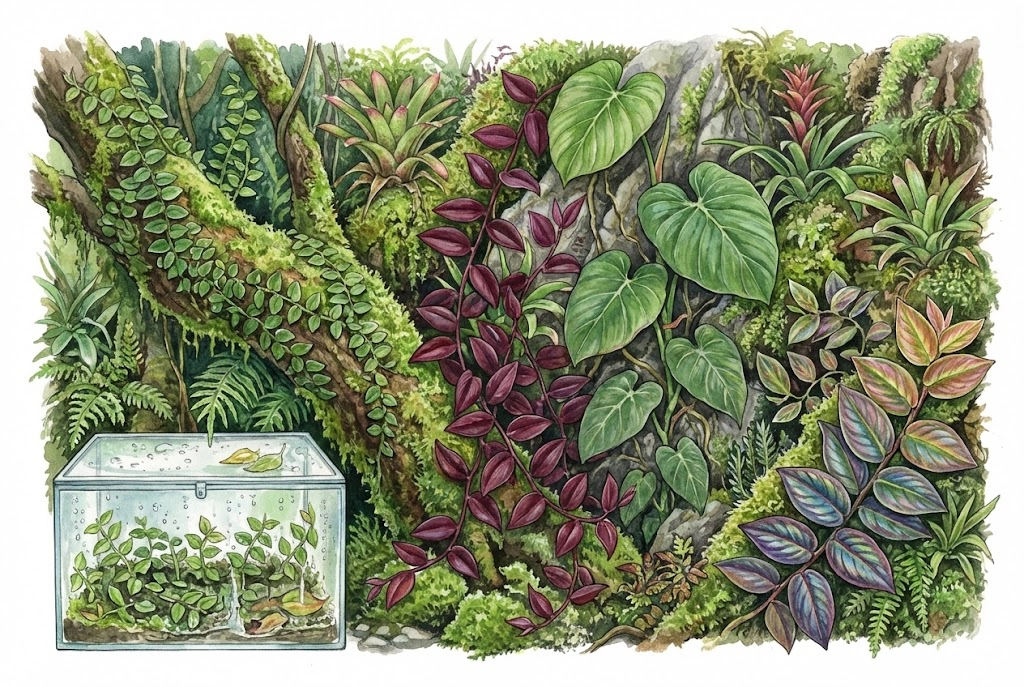
Marcgravia is popular for its juvenile shoots, which press flat against hardscape and make a distinctive overlapping background cover.
Why is Marcgravia popular for bioactive vivariums?
What Shingling Changes
Juvenile Shoots Cling to Supports
It works well as a decorative background cover.
Marcgravia is a shingling root-climber. Juvenile shoots attach to a support and lie flat against it, while mature shoots can carry larger hanging leaves. Give it a surface to climb and enough access for pruning.
Coverage Is Not Proven Habitat Function
Because the juvenile foliage overlaps closely against the background material (cork, tree fern, or wood), it can create a covered surface.
Whether that meaningfully stabilizes humidity or supports moss and microfauna like springtails and isopods hasn’t been measured for Marcgravia specifically, so treat those as possible side effects rather than established functions.
I number vine sections on a weekly photograph and mark where each aerial root first touches the background. This shows which surface and humidity pocket actually encourages attachment instead of judging the whole wall by the fastest tip.
Whenever possible, one short section stays on a removable panel. If the permanent background later fails or the plant needs isolation, I still have rooted material that can move without stripping the entire vine.
How might it help dart frogs?
Foliage Adds Cover, Not a Proven Breeding Site
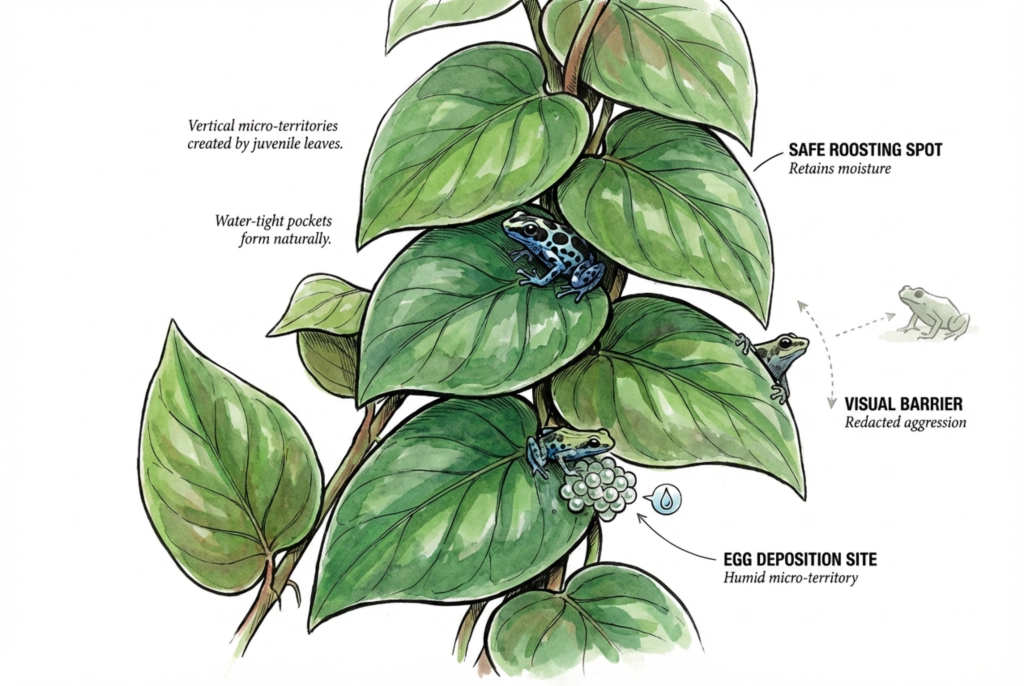
Like other dense foliage, it can add vertical structure and visual cover.
Dense foliage can add visual cover, but do not treat it as a proven breeding site or an automatic behavior solution for dart frogs. Follow husbandry guidance for the exact animal species when reproduction or welfare is the goal.
Which Marcgravia species is best for beginners?
Rectiflora Is a Practical Starting Point
Marcgravia rectiflora is a common choice for new hobbyists. It is an accepted species with a broad native range from Central America to Peru and the Caribbean, and it is widely available in the trade.
Start with a Known, Commonly Grown Species
Marcgravia rectiflora is widely traded and often easier to source than rarer forms. Give it high humidity, bright filtered light, a climbable background, and time to acclimate rather than assuming a seller’s difficulty rating is universal.
Expect Leaf Loss After Import
If you are establishing your first bioactive tank, rectiflora gives you the classic shingling look from a plant that is generally described as forgiving during acclimation. Expect some leaf loss on any newly imported cutting.
What are the key differences between M. rectiflora and M. sintenisii?
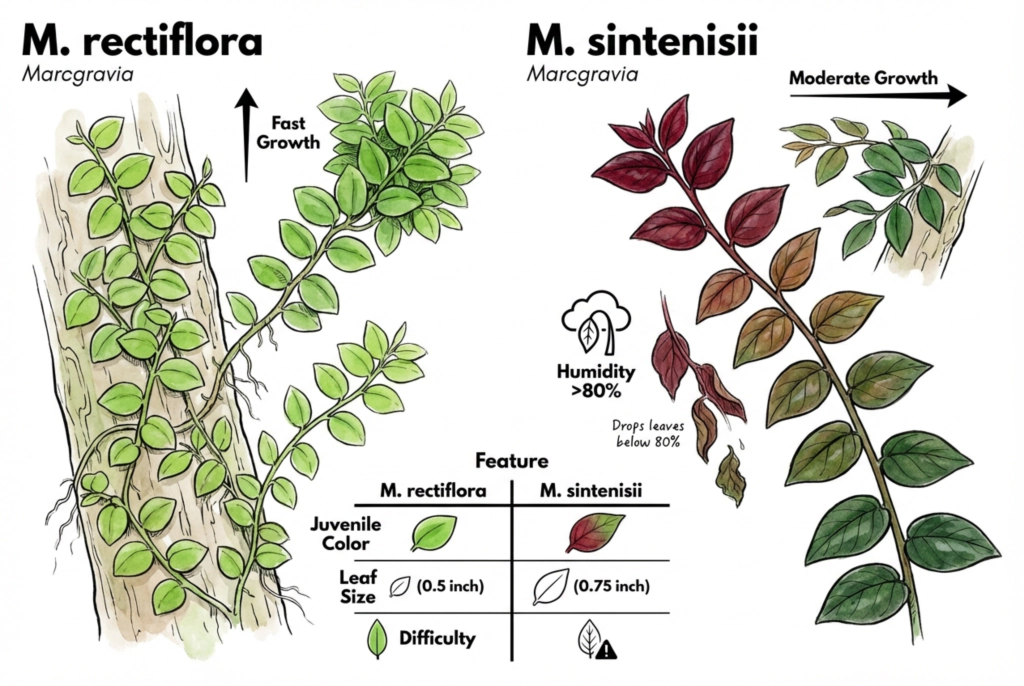
| Feature | Marcgravia rectiflora | Marcgravia sintenisii | Marcgravia umbellata |
|---|---|---|---|
| Juvenile color | Bright green | Reddish, fading toward green | Green with pale veins |
| Juvenile leaf size | Small | Usually very small | Larger |
| Typical terrarium use | A sensible first named species | Choose for reddish juvenile foliage | Choose only where it has more room |
M. sintenisii is often grown for its reddish juvenile foliage, though whether that color is more attractive is a matter of taste.
Juvenile Color Changes With Age
Juvenile leaves often emerge reddish and become greener with age. The plant is sometimes sold as Red Marcgravia, but light and conditions change how much red you actually see.
Keep Humidity Stable During Establishment
Some keepers find sintenisii slower to root and more sensitive to low humidity. There is no source for an exact 80% threshold or for leaves dropping immediately below it, so keep humidity high and stable during establishment and watch the plant rather than a single number.
Can you grow Marcgravia umbellata in a standard terrarium?
Umbellata Needs Vertical Space
Yes, though its larger foliage is easier to manage when you have some vertical space.
Juvenile and Mature Leaves Differ
M. umbellata is among the larger-leaved forms in the trade. Note that Marcgravia is strongly heterophyllous, so leaf size depends heavily on whether a shoot is in its juvenile appressed phase or its larger-leaved mature phase. A single 2-inch figure does not capture that variation.
Tank Height Is a Design Choice
Taller tanks give it room to anchor the hardscape without dominating the scene, but an over-24-inch guideline is a design preference, not a biological minimum.
Prune to the Available Space
In smaller tanks it may need more frequent pruning, though growth rate depends on lighting, nutrients, support, and starting size rather than tank height alone.
Designing with Marcgravia
Use the Vine as a Texture Layer
Coverage Is a Compositional Tool
A well-planted background is not just about coverage. It is about composition.
Aesthetic Suggestions Are Not Rules
Used thoughtfully, Marcgravia can add a sense of depth to a layout. The following are aesthetic suggestions, not rules.
How do you create depth and perspective?
Use Leaf Size for Forced Perspective
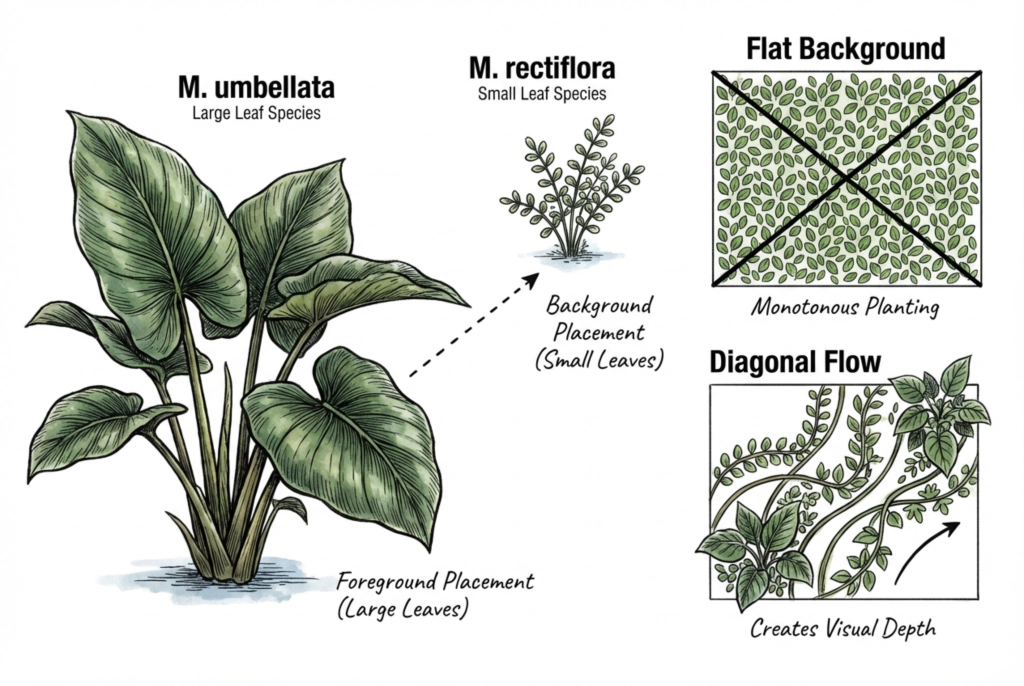
One common technique is forced perspective. Place larger-leaved forms (like M. umbellata) toward the foreground or lower sections and smaller-leaved forms (like M. rectiflora) higher up and toward the back.
Plan Around Growth Direction
This can suggest visual recession, making the tank read as deeper than it is, though the effect also depends on viewing angle and hardscape lines.
Keep in mind Marcgravia grows by climbing a support, so plan placement around its growth direction, light, and access for maintenance.
Diagonal Trailing Adds Movement
A single species repeated across the whole background can look uniform, which is fine or not depending on your taste.
Trailing the vines diagonally across the hardscape is one way to add movement.
What are the best companion plants?
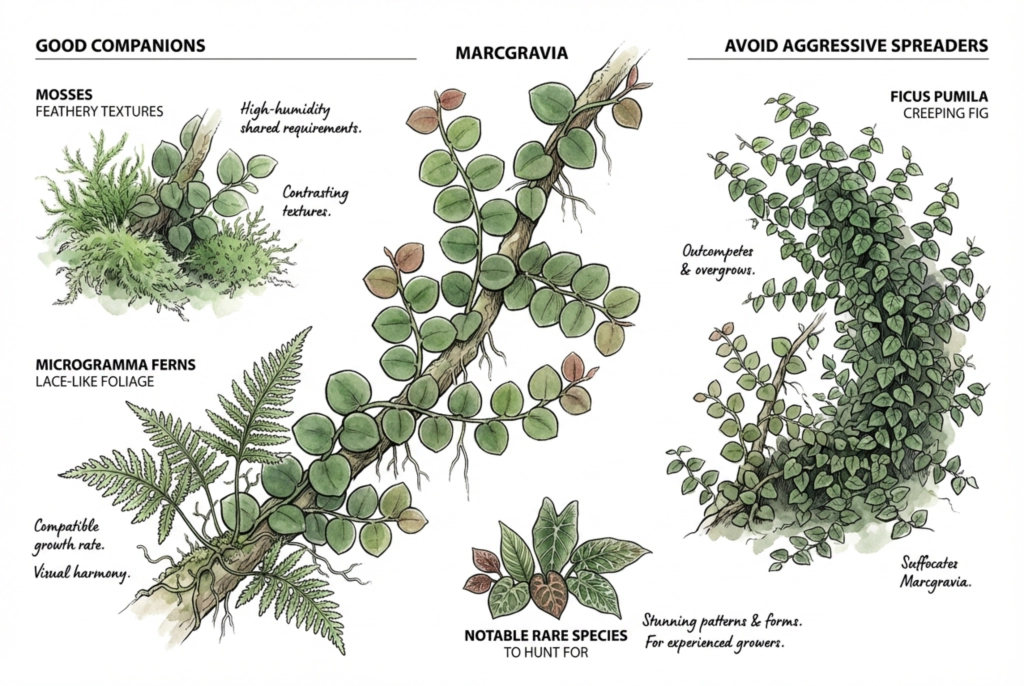
Pair Shingling Foliage With Contrasting Texture
Marcgravia generally does best alongside plants that share its high-humidity preference but offer contrasting textures.
Transition Aquarium Moss Before Use
For contrast, you might pair the flat, geometric leaves of Marcgravia with the soft texture of mosses like Java moss or Christmas moss, or the lace-like foliage of Microgramma ferns.
Note that aquarium mosses need an emersed (above-water) transition to grow in a terrarium, and the linked article compares the mosses themselves rather than their compatibility with Marcgravia.
Prune Vigorous Root-Climbers
Be cautious with vigorous root-climbers like Ficus pumila (Creeping Fig). Left unpruned, it can overgrow slower Marcgravia. With regular pruning and enough space this isn’t inevitable.
Beyond the basics (other trade forms)
Treat Trade Names as Unverified
Trade Labels Are Not Botanical Identities
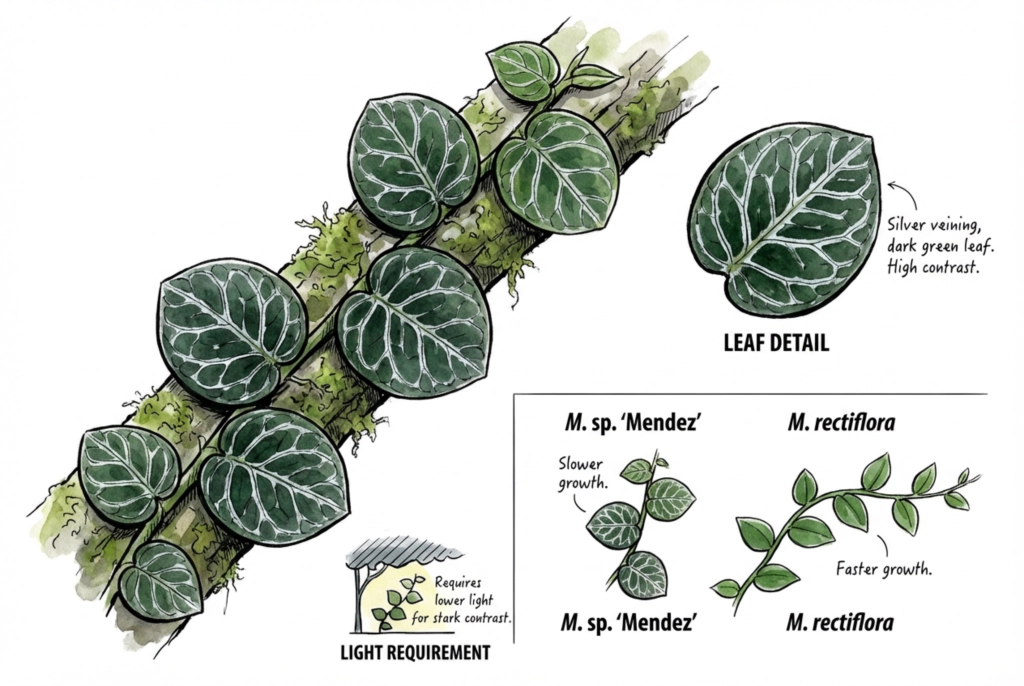
Hobbyists trade patterned forms under informal labels such as Mendez or Suriname. Treat these as seller labels rather than confirmed species or cultivars. Ask for the plant’s provenance and buy only when you are comfortable with uncertainty about its final size and care.
Marcgravia sp. ‘Mendez’
Mendez Traits Are Trade Lore
‘Mendez’ is usually a locality or collector name. It is often described as having silver or white veining on a dark green leaf, but there is no source documenting a consistent trait for this label.
Do Not Infer Care From a Trade Name
Sellers may describe ‘Mendez’ as slow-growing or strongly patterned, but those traits are not reliable care instructions. Start with moderate, filtered light and adjust from the actual plant response.
Marcgravia sp. ‘Suriname’
Locality Labels Do Not Settle Identity
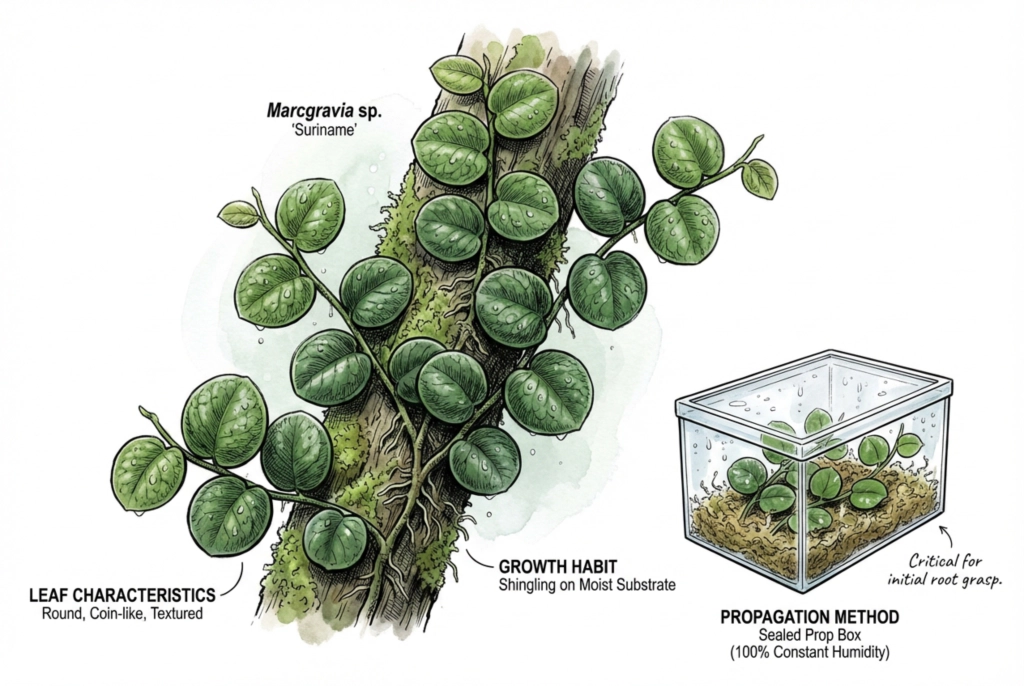
‘Suriname’ is a country-of-origin label and is sometimes described as having rounder, coin-like leaves.
A locality label doesn’t make it an undescribed species. It may be an as-yet-unidentified plant among Marcgravia’s already-accepted species, and leaf shape alone can’t settle its identity.
Use Stable Humidity Without a Fixed Threshold
Keep humidity high and stable during establishment, but do not chase an unsupported fixed threshold. Include gentle air exchange and watch for condensation, rot, or dry edges.
How do you propagate Marcgravia?
Propagation Needs Humidity and Air Exchange
A humidity dome or prop box is a common and effective way to root these cuttings, though it isn’t the only option (mist benches, domes, and direct mounting on a background also work).
Acclimate Unrooted Cuttings Gradually
Unrooted cuttings can stress when moved into a display tank with fluctuating humidity, so raising humidity around the cutting helps reduce water loss while it roots.
Keep the Chamber Ventilated
The goal is high, steady humidity with some air exchange, not a permanently sealed, saturated box.
Fully sealed, condensation-soaked chambers favor rot and fungal or bacterial infection, which is why extension guidance recommends a perforated or slitted cover rather than an airtight one.
Step-by-step propagation guide
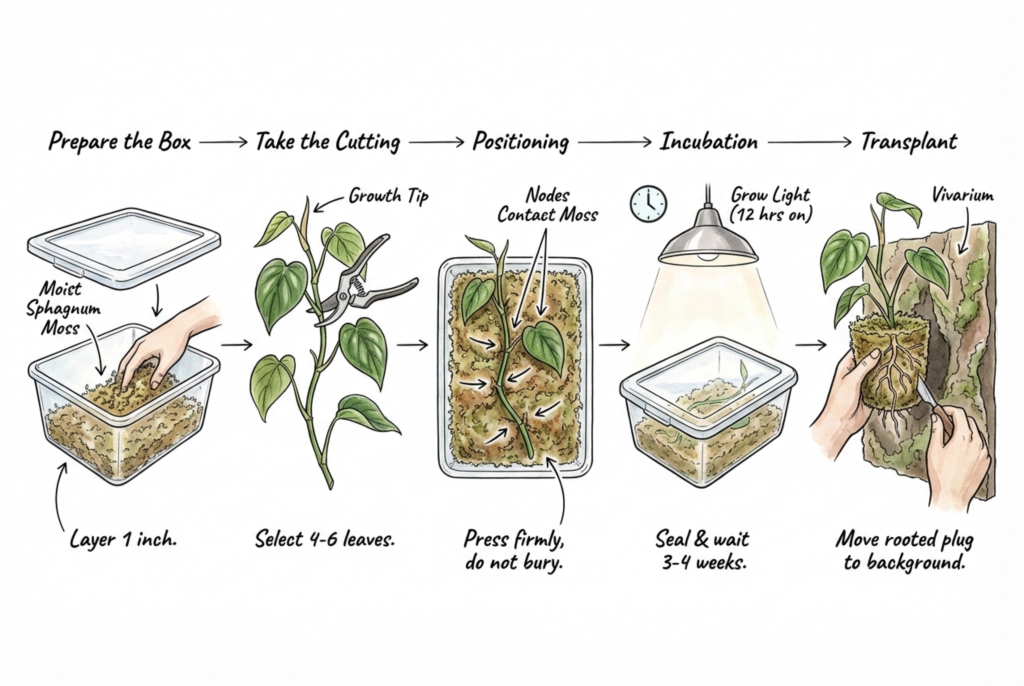
Prepare the box
Sterilite 6 Quart Storage Box can serve as a simple prop box when washed and fitted with a few ventilation holes. It is a household container, so check the lid and ventilation rather than treating it as a sealed horticultural system.
NZ sphagnum moss suits cuttings that need steady surface moisture. Keep it moist and airy, not packed or waterlogged, and discard it if decay spreads through the box.
Take the cutting
Use clean, disinfected tools and select a healthy stem with a few leaves. A growth tip helps but mid-stem cuttings can also root. There’s no fixed leaf count that guarantees success.
Positioning
Lay the cutting flat so the nodes (the points where roots emerge) rest against the damp moss. Press gently. Don’t bury the stem or crush a delicate juvenile shoot.
Incubation
Cover the box with a perforated or slitted lid and place it under a SANSI 36W Grow Light or another suitable open-fixture light. Keep the bulb stable, clear of water and plastic, and out of a tightly enclosed fixture because it runs warm. Check for condensation and rot regularly rather than waiting for a fixed rooting date.
Transplant
Once the cutting has anchored with roots, cut the moss around them and move the whole plug onto your background, then reduce humidity gradually to harden the plant off.
What about the rarest Marcgravia trade forms?
Rarity Does Not Confirm Identity
El Coca and Azrael are two more informal trade labels sometimes sold as rare shinglers. As with ‘Mendez’ and ‘Suriname’, these are seller names, not confirmed species or cultivars, and there are no vouchered specimens to verify their identity.
El Coca Appearance Depends on Viewing
El Coca is often described as having an iridescent, almost metallic surface that shifts with viewing angle.
Whether a leaf looks iridescent depends heavily on light and viewing geometry, so this is best judged in person against a known specimen.
Azrael Color Is Subjective
Azrael is described as dark-leaved, holding a chocolate-bronze tone as it matures (a subjective impression, without a documented time series to confirm it).
Price Is Not a Hardiness Measure
Rare trade material is often priced higher, but rarity is not the same as quality or hardiness, and current price or loss-rate data are not available for a meaningful comparison. Don’t read scarcity as proof of either.
Do these trade forms need different care?
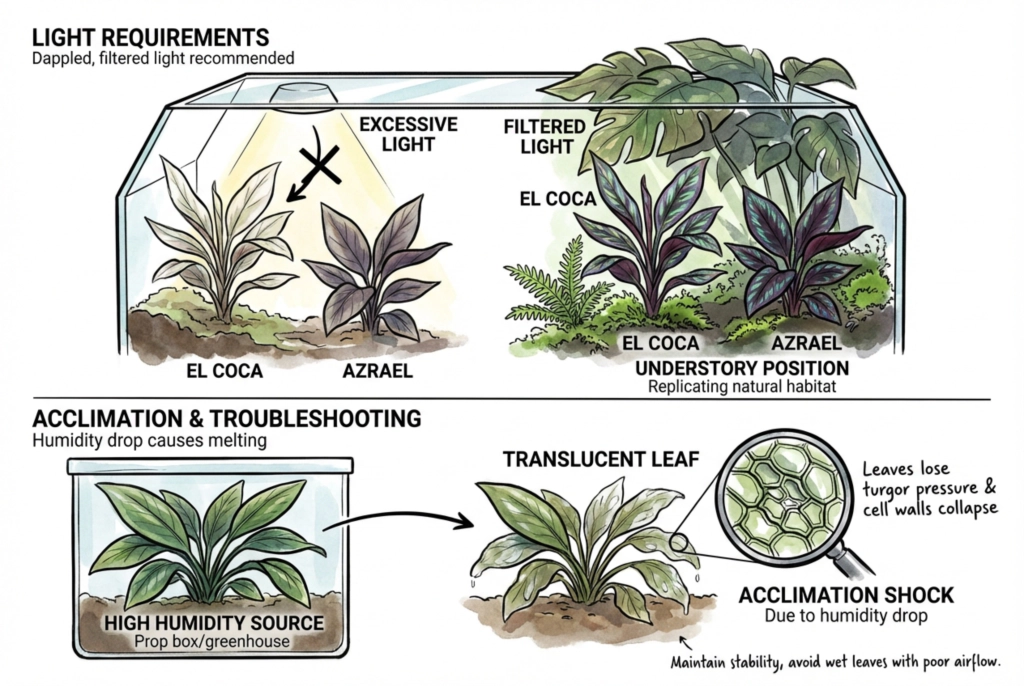
Stabilize Conditions During Establishment
Keepers often report that these forms do better with stable conditions during establishment, though there is no comparison showing that every informal clone needs the same care.
Separate Pigment Fade From Iridescence
Strong light can shift pigment and fade some patterns, but the point at which that happens depends on intensity, duration, and leaf age.
Color fade is also different from apparent iridescence, which changes with viewing angle.
Start With Filtered Light
Placing them lower or mid-tank in dappled, filtered light is a reasonable starting point. Because we don’t know these informal forms’ exact native positions, treat this as a practical placement, not a recreation of a specific understory niche, and check light levels at that spot.
Why is my Marcgravia turning transparent and melting?
Translucency Has Several Possible Causes
Translucent, mushy leaves can come from several causes, so diagnose before you treat. Low humidity after a move can stress a cutting, but so can overwatering and edema, temperature stress (chilling or heat), and bacterial or fungal disease or rot.
Persistently wet leaves with poor airflow raise disease risk too.
Read Translucency Before Treating
Dry air can pull water out faster than roots take it up, which lowers turgor, but that first shows as wilting and limpness rather than collapsed cell walls.
Translucent, water-soaked tissue more often points to overwatering, temperature injury, or disease, so do not assume humidity shock on sight.
How do you save a struggling plant?
Narrow Down the Cause First
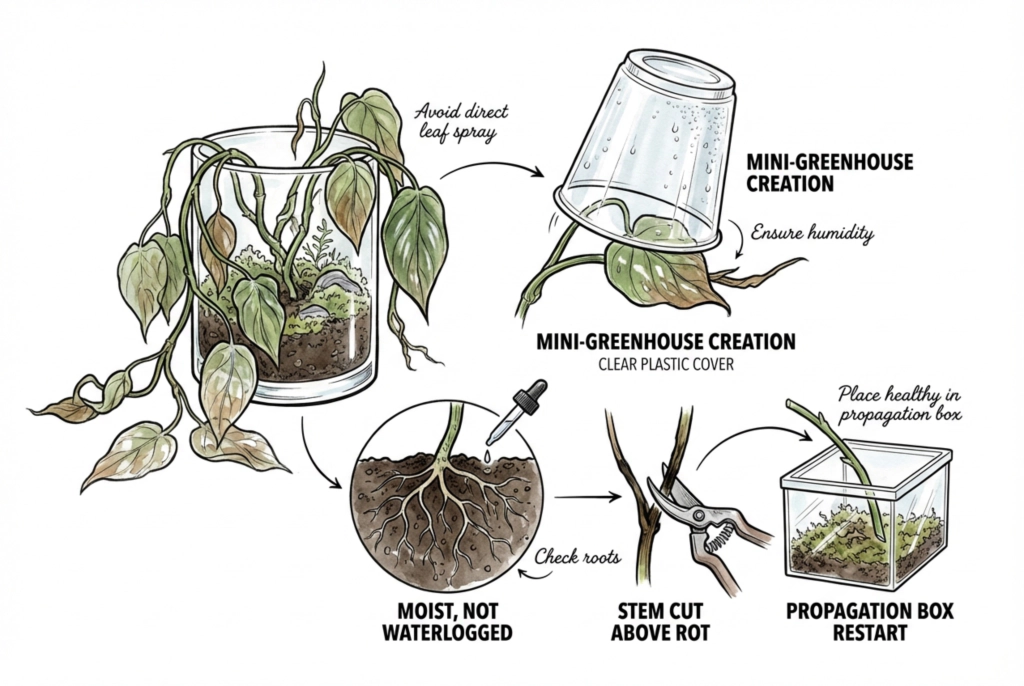
First narrow down the cause. Check whether the substrate is dry or waterlogged, look for spreading water-soaked lesions or a foul smell, and note any recent temperature swings or pests.
Use Vented Humidity for Dehydration
If the medium is dry, the cutting is wilted, and there are no signs of rot, raise local humidity with a vented clear cup or bag and ease off direct leaf spraying.
Give it airflow and check daily. If animals share the tank, make sure loose plastic can’t trap or be ingested by them.
Isolate and Cut Back Rot
If instead you see rot or spreading lesions, don’t just seal it up. That can make condensation and rot worse.
Isolate the cutting, cut back to healthy tissue with a disinfected tool, move it to fresh medium with ventilation, and discard badly rotted material rather than reusing contaminated moss.
Keep Roots Moist, Not Waterlogged
Either way, keep the roots moist but not waterlogged. If the diagnosis is unclear or a disease is spreading, consult a horticultural diagnostician, and follow animal-safe guidance for any enclosure with livestock.
Affiliate Disclosure
This article contains Amazon affiliate links. As an Amazon Associate I earn from qualifying purchases. If you use these links, the site may earn a commission at no extra cost to you. Product availability, price, and specifications can change. Check the current listing before buying.