
Best Micro Orchids for High-Humidity Paludariums
Choose micro orchids for humid terrariums and paludariums. Compare Lepanthes, Platystele, and Haraella care, airflow, mounting, light, and mold control.
Samuel Reed · Published 2026-02-06 · 13 min read
Key Takeaways
- Choose small epiphytes that need steady root moisture and high humidity. Lepanthes telipogoniflora and Platystele suit shaded, wet mounts, while Gastrochilus retrocallus is a brighter, fragrant monopodial orchid with different growth habits.
- Use gentle, steady airflow to shorten the time leaves and mounts stay wet. Air movement is one useful control, not a cure for nutrient or disease problems, so check the actual leaf surface.
- Mounts and small pots can both work when they provide oxygen, drainage, and a stable root-moisture balance. Cork bark, tree fern, coarse bark, or sphagnum are means to that end rather than requirements.
- Keep light low to moderate and measure it at the leaves. These understory orchids respond better to a measured canopy reading than to a fixture label, and bleaching, chlorosis, or heat are stronger warning signs than color alone.
- Springtails can graze some fungi and detritus, but they only support sanitation. Correct the wet or decaying conditions that allow mold to start.
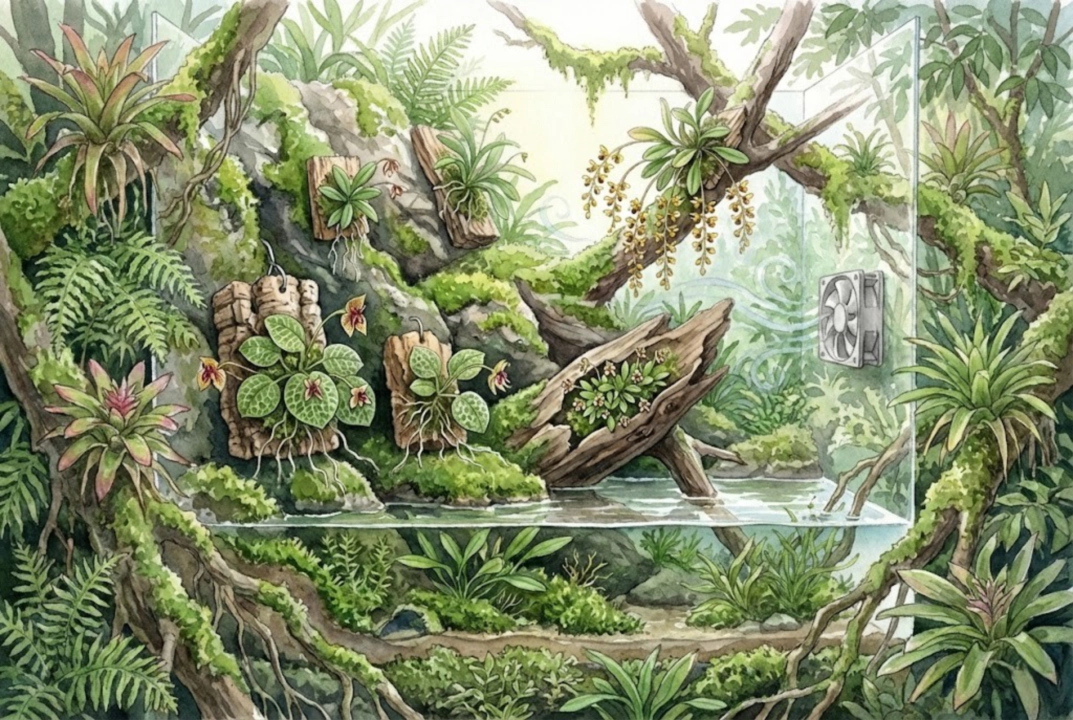
Micro orchids work in high-humidity paludariums when you can keep their roots moist while giving leaves and mounts enough airflow to dry between wetting events. The enclosure raises humidity, but it does not remove the need to manage light, temperature, water quality, and sanitation.
Paludarium Conditions Micro Orchids Need
A paludarium is a type of enclosure that combines aquatic and terrestrial areas. The water feature and enclosed space tend to raise humidity, but the actual relative humidity depends on ventilation, water and air temperature, water surface area, the lid, and room conditions, so it is not fixed at a single number. Measure it rather than assume it.
If you are still designing the enclosure, start with the bioactive terrarium and paludarium guide for drainage, substrate, cycling, and cleanup-crew fundamentals before selecting orchids.
I mist an empty candidate mount and a nearby leaf-shaped strip, then time how long visible water remains at morning and evening. The enclosure can report high humidity while one pocket keeps surfaces wet for most of the day.
I place an orchid only when three morning and three evening trials give drying times within 30 minutes of their matching trials. That tolerance exposes an unstable wet pocket without expecting morning and evening conditions to match each other. The test restarts after plants fill in because their leaves can block the original airflow.
Treat the Enclosure as an Approximation
This kind of enclosure can loosely evoke the riparian zones of tropical rainforests and suit non-pseudobulbous orchids like Lepanthes, which dry out quickly in ordinary room humidity.
It does not fully reproduce natural light, rainfall and drying cycles, airflow, or water chemistry, so it is an approximation rather than a perfect copy.
Persistently wet, warm, still conditions can also favor fungal and bacterial problems if leaf wetness and hygiene are not managed, so those problems still need to be diagnosed on their own rather than assumed.
Gentle Airflow Shortens Leaf Wetness
What Airflow Changes
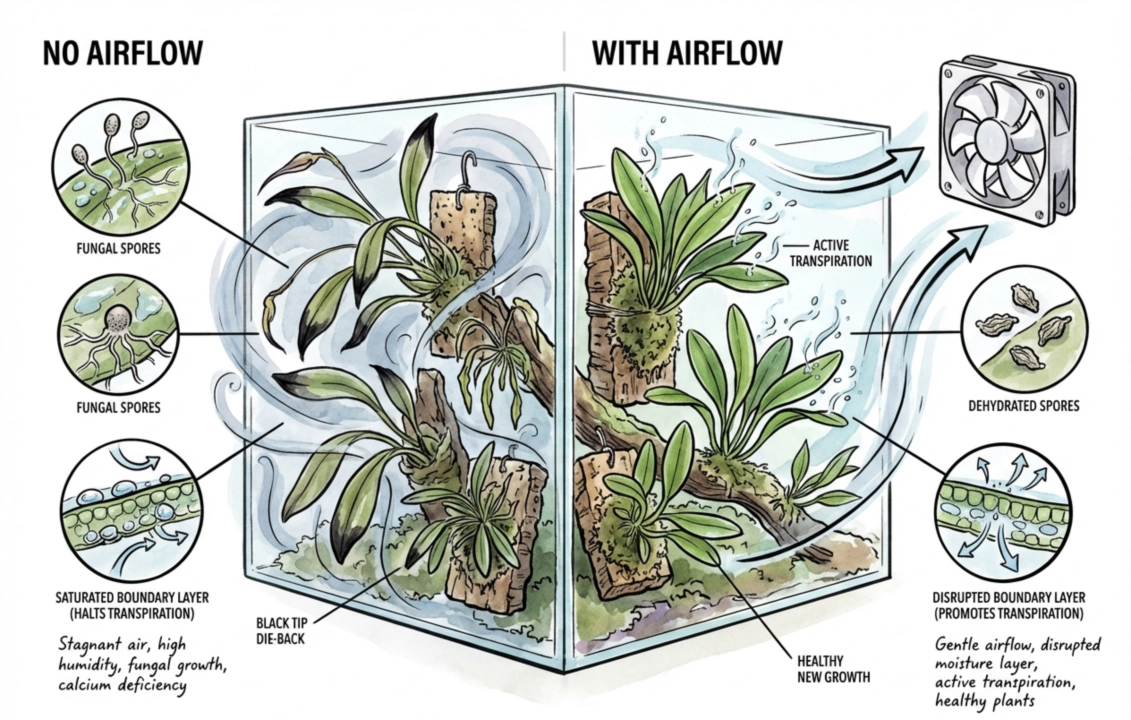
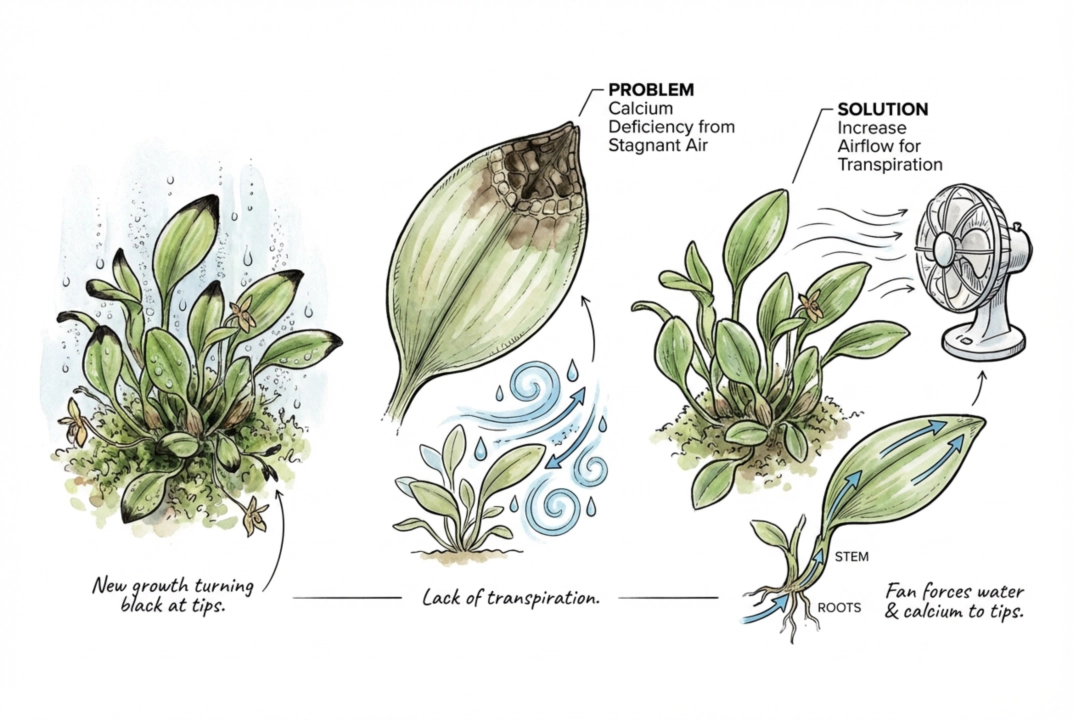
Air movement is an important management variable in a closed, humid enclosure. It reduces how long leaf surfaces stay wet and can lower condensation, which helps limit conditions that favor fungal growth.
With little air movement, the boundary layer around a leaf holds more moisture and transpiration can slow, although it does not stop entirely because leaf temperature, stomata, vapor-pressure deficit, and light all keep playing a role.
Airflow and Calcium Movement
Reduced transpiration can, in some cases, contribute to calcium moving less readily to new growth, which is one possible cause of black-tip die-back, but it is not the only cause. Separate nutrient movement from salt buildup, root damage, and spreading infection before changing the fan.
Use a Fan Safely
A quiet, low-speed fan can supply this gentle movement without drying the mounts out. If you place any fan near a high-humidity, condensation-prone enclosure, choose a unit rated for damp conditions, keep the power supply outside the enclosure, and use a GFCI outlet and a drip loop.
Small USB circulation fans
A small speed-controlled USB circulation fan lets you start with gentle airflow without placing the fan inside the wet zone. The dual 80 mm unit cited below is one manufacturer-documented example, not the specification for all compact fans. Compare the exact unit’s dimensions and airflow with the cabinet and vent path. It suits a dry compartment or external ventilation path, but it is not a humidity controller or a substitute for fresh-air exchange.
When External Placement Fits
External placement fits when you need a dry ventilation path, cabinet exterior, or separate equipment compartment.
When This Fan Does Not Fit
The example fan below is rated by its manufacturer for 35–85% RH. That model does not belong inside an enclosure that regularly exceeds its stated range or exposes it to mist, splashing, or condensation. Check every other fan’s own operating range and water-resistance limits because those ratings do not transfer between models.
The paludarium climate-control guide explains how to tune ventilation, misting, drainage, and dry-down together instead of treating fan speed as an isolated setting.
AC Infinity MULTIFAN S5 Manufacturer Specifications
Calcium in Plants. Why It Is Immobile and Transpiration-Driven
Micro Orchids That Fit Humid Enclosures
Choose by Moisture Strategy
Good candidates for these conditions include small epiphytes that lack water-storage organs and want steady moisture. Lepanthes and Platystele are epiphytic Pleurothallids, while Gastrochilus retrocallus (syn. Haraella retrocalla) is a different lineage with a monopodial growth habit and somewhat succulent leaves. Its inclusion reflects the humid-enclosure fit rather than a shared moisture strategy, and lacking pseudobulbs alone does not settle any species’ exact watering needs.
Lepanthes telipogoniflora Suits Shaded Wet Mounts
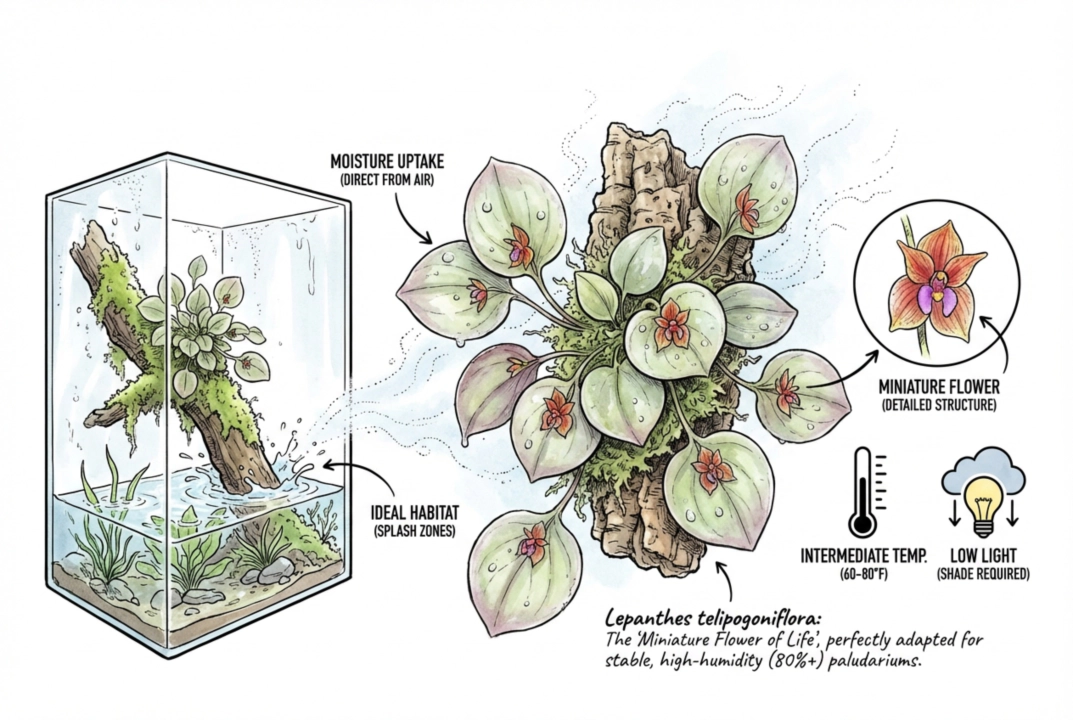
Lepanthes telipogoniflora is a good candidate for a stable, high-humidity paludarium. It is a wet-tropical epiphyte (accepted name confirmed in Kew POWO) from Colombia that grows in cool-to-intermediate conditions with constant root moisture.
It benefits from high humidity, though the exact figure depends on your enclosure rather than a fixed 80% target.
Its thin leaves and fine roots need to stay moist, but direct water uptake through leaves is a conditional process that depends on a liquid film, water-potential gradients, and surface structure, so do not rely on air moisture alone to hydrate it.
Keep humidity and root moisture high, but avoid positioning it where leaves and crown are constantly hit by splashing water, which can spread pathogens and keep foliage wet.
It does best in low light or shade. Use the PPFD and DLI measurement guide to translate that description into a canopy reading and photoperiod. Many growers keep Lepanthes in the roughly 60–80°F range, but treat that as a broad guide and confirm your species’ day and night temperatures from a species-specific source.
Platystele Fits Tight Hardscape Crevices
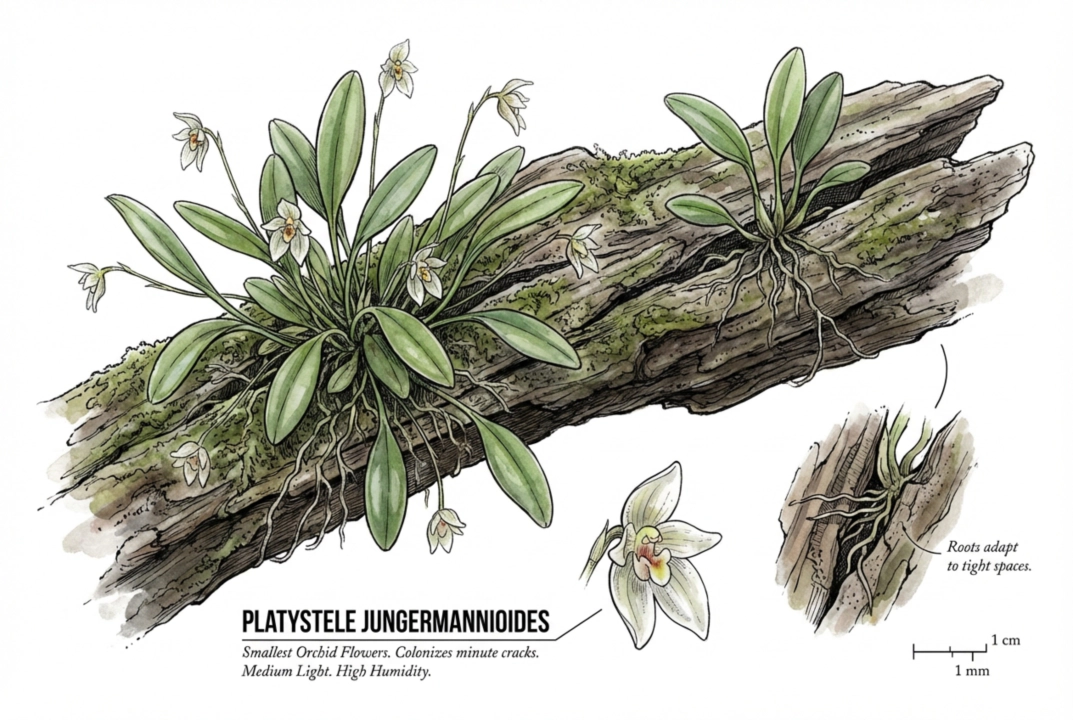
Platystele species, particularly Platystele jungermannioides, are often cited as among the smallest orchids in the world, with flowers around 2.5 mm and plants around 2.5 cm. Some accounts describe still smaller orchids, so the cautious description is among the smallest rather than a single record claim. Their small size lets them fit into minute cracks in hardscape or driftwood.
These are genuinely tiny plants that do well in medium light and moist microhabitats. Fitting them into small nooks is a placement idea. Pair it with attention to airflow, temperature, and how quickly those spots dry, since a damp crevice alone does not guarantee success.
Gastrochilus retrocallus Handles Brighter Spots
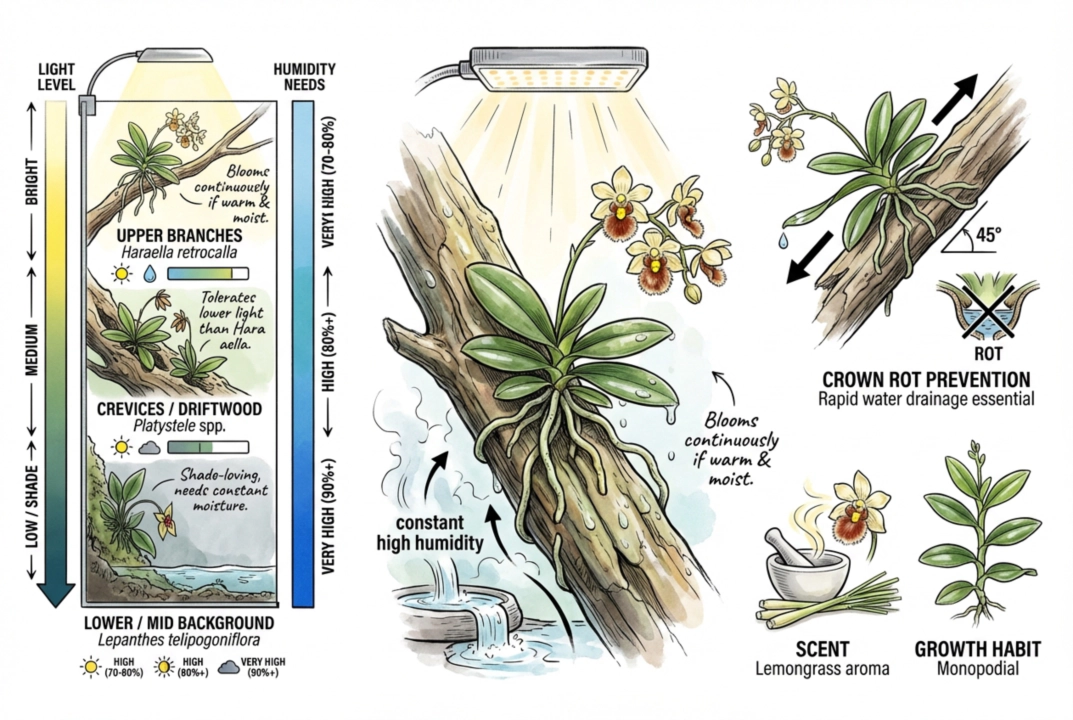
| Species | Humidity (approx.) | Light Level | Suggested Placement |
|---|---|---|---|
| Lepanthes telipogoniflora | High | Low/Shade | Lower/Mid Background |
| Platystele spp. | High | Medium | Crevices/Driftwood |
| Gastrochilus retrocallus (syn. Haraella retrocalla) | High | Medium/Bright | Upper Branches |
Read Placement Tables as Starting Points
The table values are approximate starting points, not measured requirements. Humidity and light targets vary with species, growth stage, day and night temperature, and where you measure.
Placement is a suggestion to test, since a spot near the top of the tank does not automatically supply the right light and humidity.
Growth Habit and Fragrance
Gastrochilus retrocallus (syn. Haraella retrocalla) is a monopodial species. It is an epiphyte from Taiwan and the Ryukyus, and its accepted name in Kew POWO is Gastrochilus retrocallus (Haraella retrocalla is a widely used horticultural synonym).
It is reported to have a lemon or lemongrass scent, though scent strength varies with the individual plant, time, and environment.
It can flower repeatedly under good conditions, but ‘almost continuously’ overstates a variable trait.
Mounting Angle and Drainage
Compared with the shade-loving Lepanthes, this species tolerates somewhat higher light and is often placed higher in the tank.
Mounting it so the crown can drain and dry between waterings helps prevent rot. A good drainage angle matters more than an exact 45 degrees, and either a slab mount or a small pot in a coarse, free-draining medium can work.
Mount for Oxygen, Moisture, and Drainage
Mounting Principles
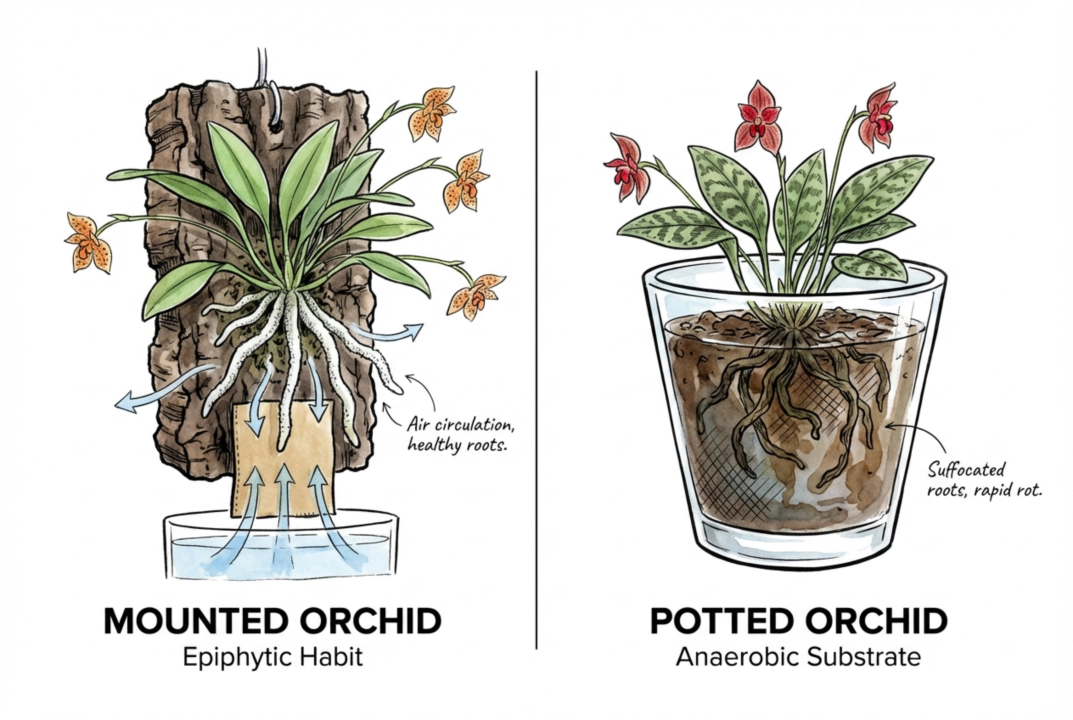
Mounting micro orchids on cork bark, tree fern fiber, or branches is a practical, popular option, and it suits these three species well.
It is not the only workable method. The American Orchid Society notes that Lepanthes, for example, can be grown either on a slab or in a small pot of fine, free-draining epiphyte mix, and Gastrochilus retrocallus can be potted as well as mounted.
What matters is oxygen at the roots, good drainage, and a steady root-moisture balance, not the container itself.
Mounting Is an Option, Not a Requirement
Why Mounts Work
Mounting follows the natural epiphytic habit of these plants, keeping roots well aerated. Root-zone oxygen depends on wetness, airflow, and the structure of the material more than on the humidity number itself, so aim for a mount or medium that stays moist but drains and re-aerates quickly.
What Actually Causes Root Rot
The real problem to avoid is a waterlogged, low-oxygen root zone, which stresses living root tissue and can lead to rapid rot. A free-draining small pot or basket avoids this just as a mount does. The failure case pictured is roots standing in water, not potting in general. Velamen is a layer of dead cells on the root surface that stores and protects, so low oxygen harms the living root tissue and its function rather than literally suffocating the velamen.
Use Wicking Materials Carefully
Cork bark is relatively rot-resistant and gives roots a textured surface to grip, while a synthetic wicking fabric such as Hygrolon can move water from the reservoir to keep moisture-loving species hydrated.
Match the water-delivery rate and mount size to the plant, and watch for salt buildup and biofilm over time.
Measure Light at the Leaves
Start With a Measured Range
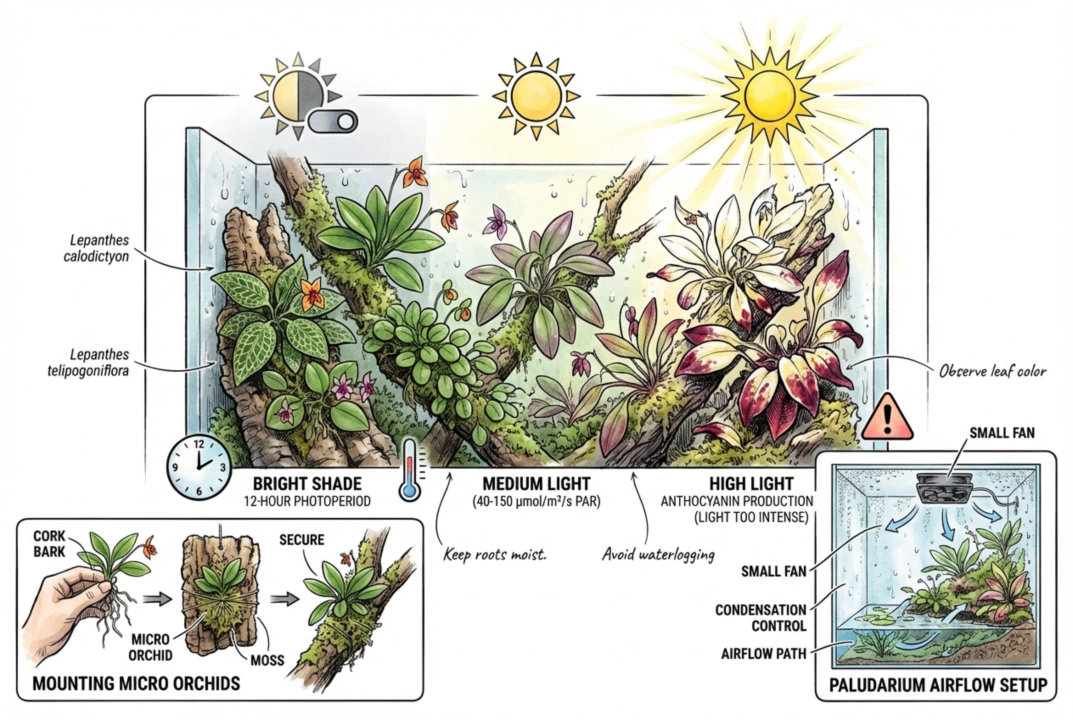
Most paludarium-suitable orchids are understory dwellers that do best in low to moderate light. Growers often cite a broad range on the order of 40–150 µmol/m²/s. This quantity is PPFD, a measure of light reaching the plant, although it is sometimes loosely called PAR. That span is nearly fourfold, so treat it as a starting range and confirm a per-species target, ideally as a daily light integral (DLI) over your photoperiod, rather than applying one figure to all three.
A fixture’s category does not tell you the light reaching the plant. High-output LEDs built for planted aquariums can deliver more light than these orchids want and may bleach Lepanthes, but water depth, distance, dimming, and optics all matter, so measure the actual light at the canopy and dim to suit.
Read the Plant Response
A 12-hour photoperiod at bright-shade levels is a reasonable starting point. Purple or red coloration reflects anthocyanin, which can indicate strong light, but it can also be normal coloration for the plant or a response to temperature, nutrition, or other stress, so confirm with actual bleaching, chlorosis, leaf temperature, or slowed growth before deciding the light is too intense.
Micro Orchid Troubleshooting
What causes black tips on leaves?
What to look for
Black or brown discoloration at the tip or margins can have several causes. Note whether it is on new or old growth, its color and how sharp the edge is, whether there is a clear halo or yellow band, whether spots are spreading, any crusty salt deposits, and how fast it progresses.
How to work through it
Black tips are not a single problem, so work through the clues in a consistent order. First note whether the damage is on new growth, which can point toward a calcium-supply issue, or whether it is spreading as lesions, which raises more concern about infection. Then check water quality, salt or hard-water buildup, the calcium, potassium, and magnesium balance in the fertilizer, and root health. Spreading damage can fit anthracnose, black rot, or another disease. The American Orchid Society describes how to separate calcium-deficiency blackening from salt, hard-water, and infection damage.
Match the Response to the Cause
If the problem stems from wet, stagnant conditions and poor calcium delivery, better airflow and careful watering can help because calcium moves largely with the transpiration stream. If salt has built up, flush the medium. If infection is spreading, remove affected tissue and improve hygiene. Airflow is one useful variable, not a cure, so raising a fan without a diagnosis can over-dry mounts and leave the real cause unaddressed.
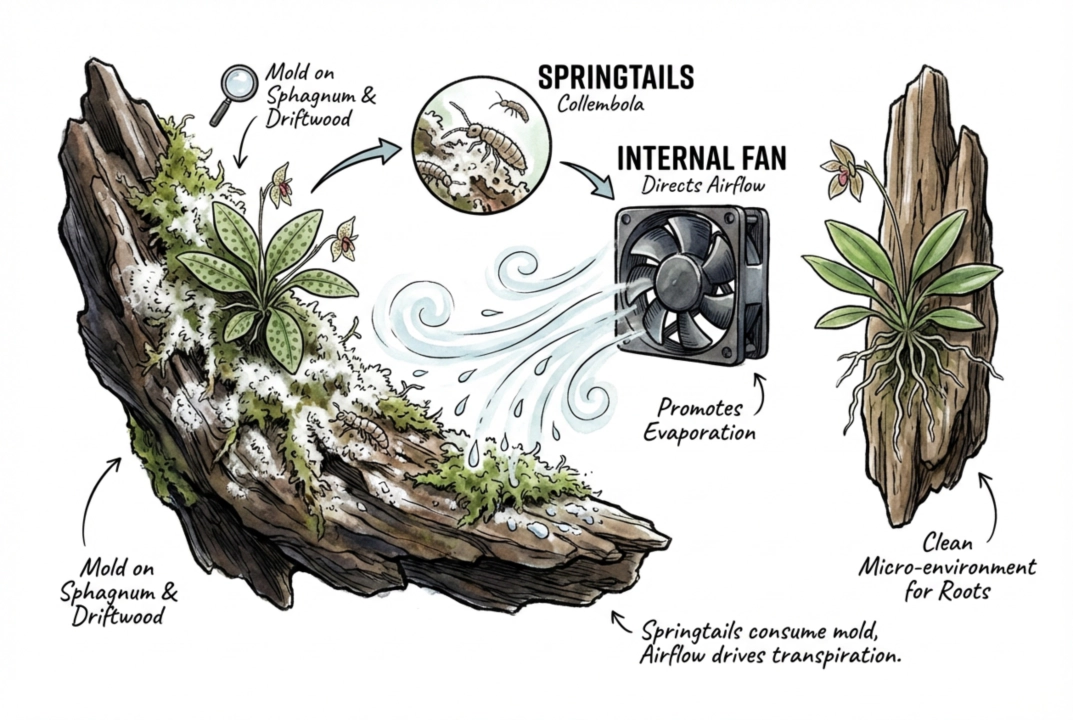
How do I stop mold on my mounts?
What to look for
White, fuzzy growth on sphagnum moss or driftwood. This is often a harmless saprophytic fungus, but a similar look can come from oomycetes, mineral deposits, or pests, so check whether it is actually invading plant tissue before treating.
How to reduce it
Fix the underlying cause first. Remove decaying material, correct excess wetness, and improve surface drying with gentle air movement. Adding springtails (Collembola) can help graze fungi and detritus as a supporting measure.
Use the terrarium mold-control guide to distinguish a temporary saprophytic bloom from a moisture, decay, or plant-tissue problem before applying any treatment.
What Springtails Can and Cannot Do
Springtails are detritivores that can eat fungi and decaying matter, helping keep the surface cleaner. Effectiveness varies with the fungal species and conditions, and they do not remove every mold or pathogen, so treat them as a supplement to hygiene, watering, and airflow, not a replacement.
Temperate springtail cultures
A temperate springtail culture supplies live springtails in a starter medium. The temperate species most often sold for bioactive enclosures is Folsomia candida, so ask the supplier to confirm the species and provide its care directions. Springtails consume some fungi and decaying material, so an established population can support a suitable moist, planted enclosure. It is not an immediate mold treatment and cannot replace removing decay, correcting excess wetness, or improving airflow.
When a Temperate Bioactive Setup Is a Fit
A culture fits when you are seeding a humid, temperate bioactive enclosure with suitable terrestrial substrate, food, and time for the population to establish. Choose the starting quantity from the supplier’s disclosed culture size, then judge success by observed establishment. A fixed enclosure count is not reliable.
When to Skip the Culture
Skip it when you have an orchid-only mount with no terrestrial habitat, an arid enclosure, or need an immediate mold cure. Because these are live animals, review the seller’s shipping range, weather hold policy, and live-arrival terms before ordering.
To match a control method to what you are actually seeing, use the terrarium mold control chooser to weigh springtails, airflow, and other options.