
Blueberry Growing Guide: pH, Nitrogen, Substrates, and Pruning
A practical blueberry guide: why aluminum sulfate is discouraged, the limits of pine-needle mulch for pH, soil-test-based acidification with elemental sulfur, ammonium nitrogen, pine-bark and coir substrates, first-year pruning, and what the research actually shows on erythritol for spotted wing drosophila.
Elena Vargas · Published 2026-01-14 · 18 min read
Key Takeaways
- Highbush blueberries generally prefer acidic soil around pH 4.5-5.5 and are adapted to take up ammonium nitrogen well. Confirm your target with a soil test and your regional Extension service, since ideal ranges vary by species and cultivar.
- Iowa State University Extension advises against aluminum sulfate for blueberries. It takes large amounts and carries a real risk of aluminum toxicity. Elemental sulfur, applied well ahead of planting at a soil-test-based rate, is the recommended way to lower pH.
- Pine needles are a good mulch but a weak pH tool. Fresh needles are acidic, but their acids largely break down during decomposition, so the net effect on soil pH tends to be small. Verify with a soil test rather than relying on mulch to acidify.
- Blueberry roots are fine and lack true root hairs, so they struggle in heavy, poorly aerated soil. Pine bark, peat, and coir mixes are common substrates. The right blend depends on cultivar, container size, and irrigation, so measure pH and EC rather than following a single recipe.
- Removing first-year flower buds is a well-supported Extension practice that helps the young plant establish. Erythritol is a promising area of research for spotted wing drosophila, but it is not a registered, ready-to-use control. See the caveats below before considering it.
Why Standard Soil Management Often Fails?
Start With the Root-Zone Conditions
A common assumption is that any garden soil can be adjusted for blueberries just by adding generic amendments.
Whether that works depends heavily on your starting soil pH, texture, and drainage, so begin with a soil test rather than a one-size-fits-all approach.
Aluminum Tolerance and Blueberry Growth
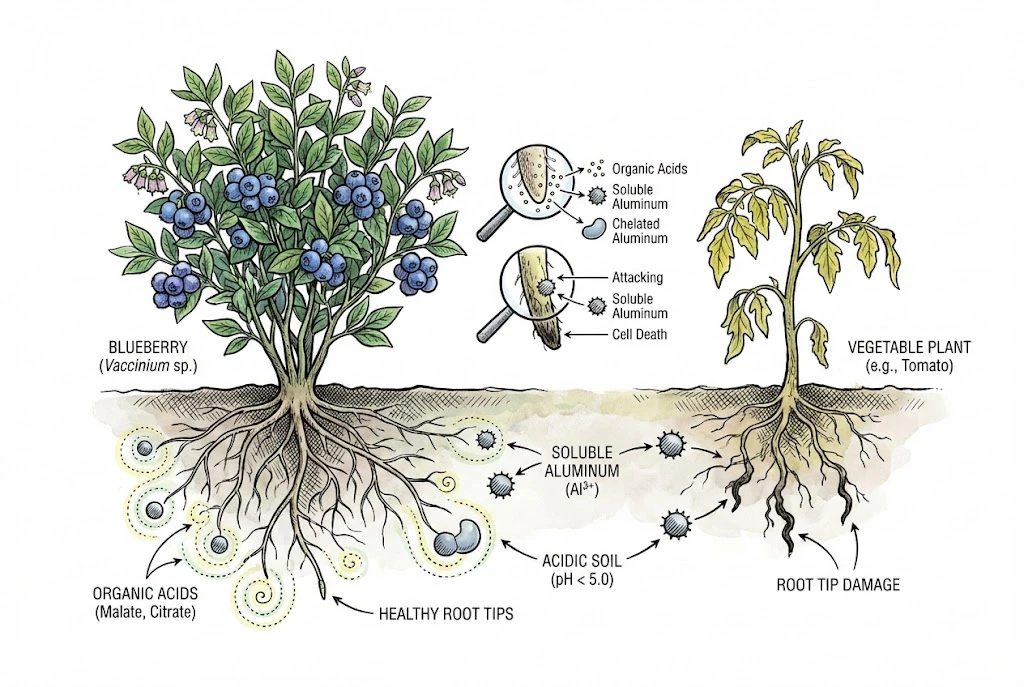
In much of agriculture, aluminum (Al) is treated as a limiting factor in strongly acidic soils.
When soil pH drops (often below about 5.0), aluminum can become more soluble and, at high enough levels, can damage root tips and inhibit cell division in sensitive plants.
How severe this is depends on the species, the soil mineralogy, and the concentration involved.
To manage this, growers often lime acidic soils to raise pH. Blueberries generally do best in acidic soils rather than limed ones, which is one reason their culture differs from typical vegetables.
Aluminum tolerance in blueberry is cultivar-specific rather than a single trait shared by all blueberries.
In one comparison of highbush cultivars, Star was relatively Al-sensitive while Camellia and Cargo were more resistant, so the response varies by variety.
Research on tolerant cultivars points to root organic-acid responses that can help bind aluminum through chelation, but the specifics differ by cultivar.
In one study of Camellia, the notable response was an increase in oxalate, alongside changes in ascorbate and TCA-cycle intermediates, rather than a simple, universal release of malate and citrate.
The Risks of Using Aluminum Sulfate
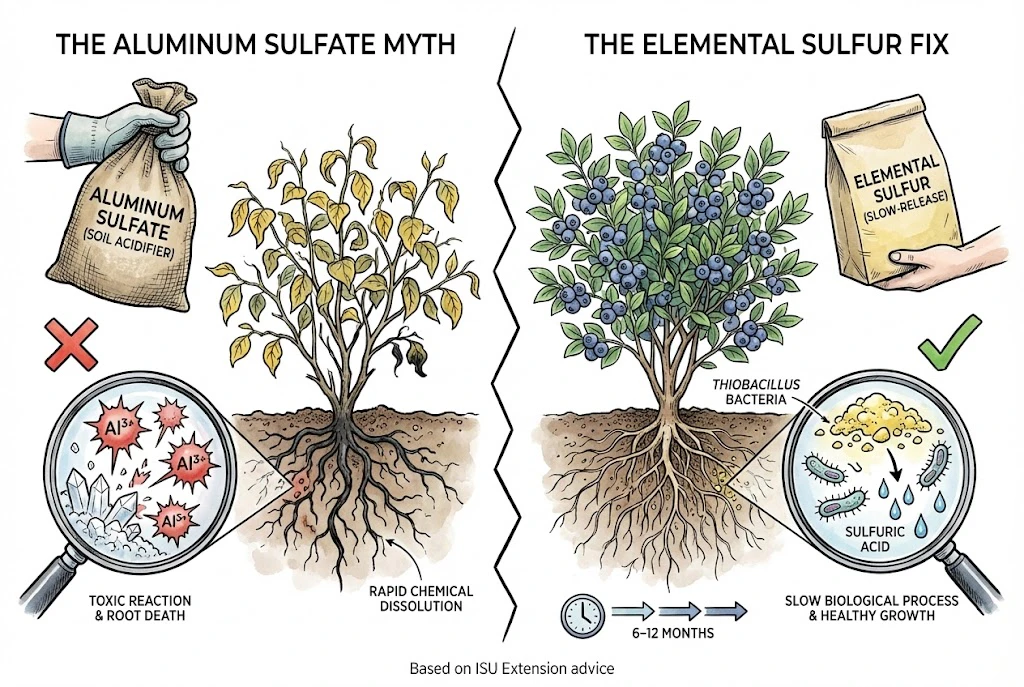
Although aluminum sulfate is sometimes suggested as a quick way to acidify soil, Iowa State University Extension advises against it for blueberries. It takes a large amount to meaningfully change pH, and it raises the risk of aluminum toxicity.
It is more commonly used to shift hydrangea flower color. For blueberries growing in already-acidic soil, the concern is that adding a concentrated aluminum salt increases soluble aluminum in the root zone.
At high enough levels, aluminum toxicity can cause stunted root development and reduced vigor, which is why elemental sulfur is generally preferred for lowering pH.
Biological Soil Acidification
The generally preferred way to lower soil pH is elemental sulfur. Rather than reacting instantly, elemental sulfur is oxidized by soil microbes over time, which is why it is worked in ahead of planting.
A range of soil bacteria (often grouped as sulfur oxidizers, including Acidithiobacillus and related genera) oxidize the sulfur, producing acidity as a result.
Because this is a biological process, it can take several months and depends on temperature, moisture, particle size, soil texture, and buffering capacity.
Iowa State suggests applying sulfur roughly six months to a year before planting. Because the amount needed varies with your starting pH and soil type, use a soil test and your regional Extension rate table to set the dose. Over-application can push the soil too acidic.
If you choose a pelletized soil acidifier, check the exact acidifying ingredient, sulfur percentage, binders or added minerals, labeled crop and site, and application rate. Do not assume that every pellet has the same composition or pH effect.
How Do I Lower the Soil pH for Blueberries? | Iowa State University Extension
Understanding Iron Chlorosis
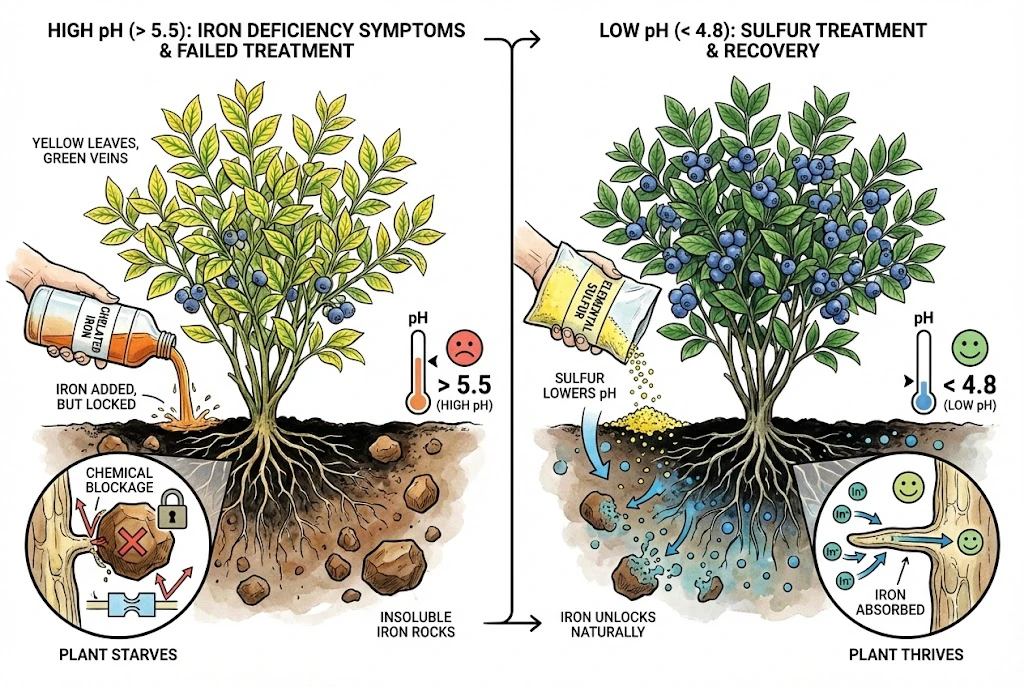
A frequent observation in blueberry patches is interveinal chlorosis (yellow leaves with distinct green veins).
It is often assumed to be a straightforward iron shortage, but the picture is usually more complex.
A common cause is high pH rather than a true lack of iron in the soil. As pH rises, iron becomes less available to the plant.
That said, similar symptoms can also come from root disease, poor drainage or root injury, and other nutrient imbalances or stress, so it is worth ruling those out.
Cultivated highbush blueberries have relatively low ferric-chelate-reductase activity compared with more pH-tolerant Vaccinium species, which makes them less efficient at taking up iron when pH is high.
It is a matter of lower activity, not a complete absence of the enzyme, and adding more iron usually will not help if the pH stays too high.
Corrective Measures
If high pH is confirmed as the cause, lowering it back into the acidic range generally improves iron availability.
This is not instant, and it will not fix chlorosis driven by root damage, disease, or other deficiencies, so confirm the cause with a soil and, ideally, tissue test before treating, and avoid pushing the pH too low.
The Impact of Pine Needles on Soil pH
Use Mulch for Moisture, Not Precise Acidification
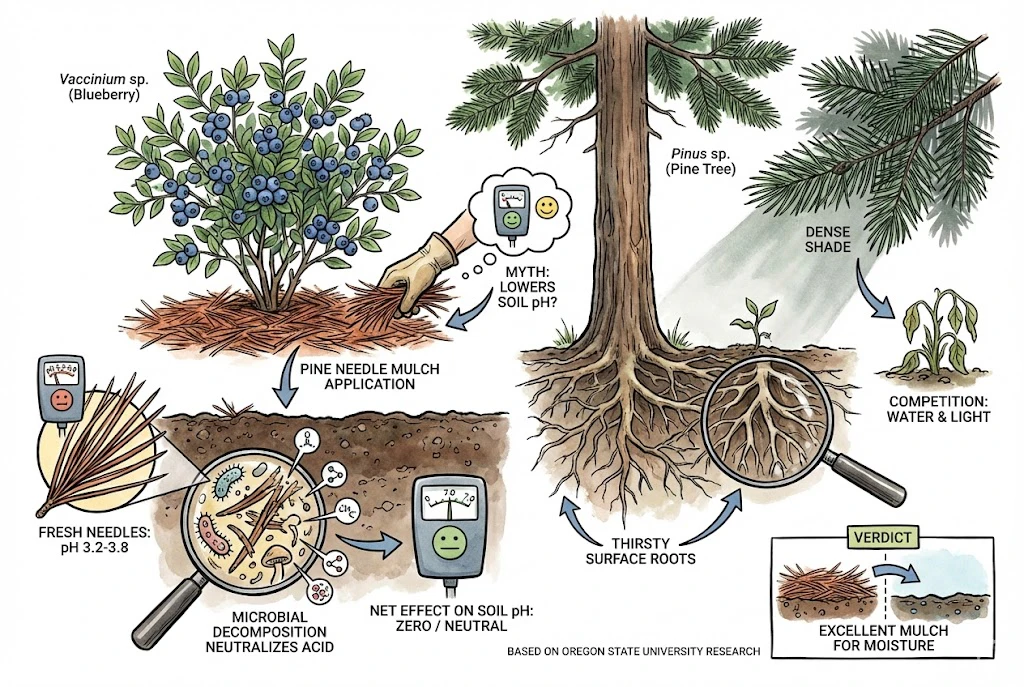
It is a common belief among gardeners that mulching with pine needles is sufficient to maintain the acidity required for blueberries.
Oregon State University Research on Acidic Mulch
The acidifying effect of pine needles is often overstated. Guidance from Oregon State University Extension notes that although fresh pine needles are acidic (roughly pH 3.2 to 3.8), their acids largely break down during decomposition, so their long-term effect on soil pH tends to be small.
As the needles decompose, soil microbes process these organic acids, so any change in soil pH is usually minor.
The exact effect still depends on your soil, how much mulch you apply, and over what period, so a soil test is the reliable check.
Vegetation suppression under pines
The lack of growth under pine trees is generally attributed to heavy shade and competition for water from the tree’s extensive surface roots rather than soil acidity.
Best Use Case
Pine needles are still a useful mulch for moisture retention and weed suppression where they are practical to source, but they should not be relied on as the primary tool for adjusting soil pH.
A similar caution applies to coffee grounds. Used (brewed) grounds are usually close to neutral and are not a dependable way to acidify soil.
The Shift to Soilless Substrates
Choose a Mix That Holds Air and Water
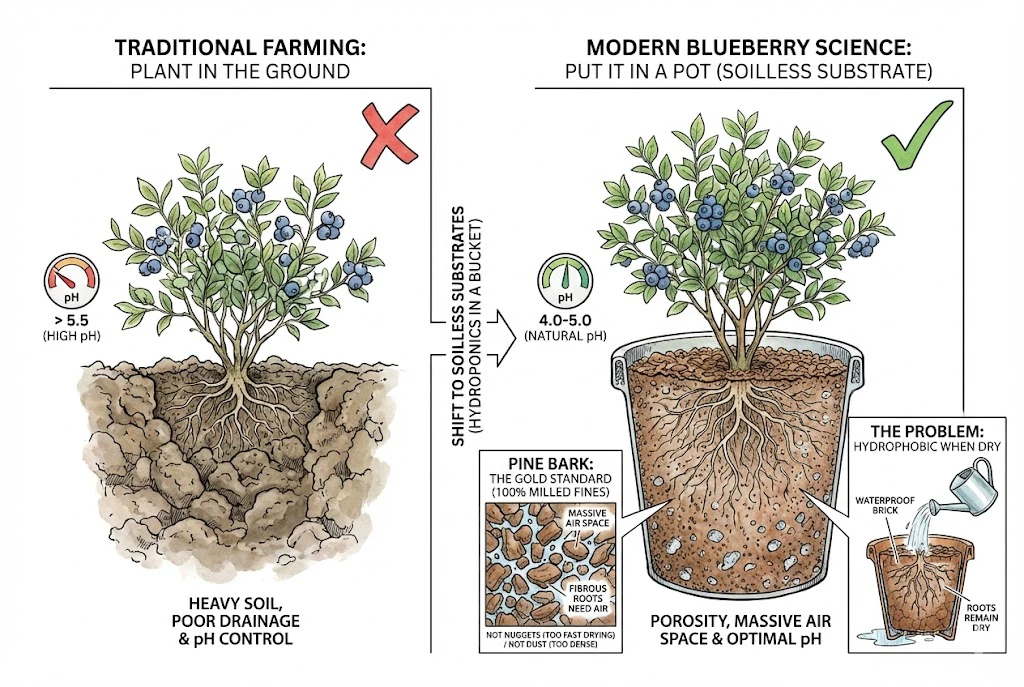
Alongside traditional field planting, some growers use container-based production with soilless substrates.
Field planting in suitable, well-drained acidic soil remains valid, so this is an additional option rather than a replacement for in-ground culture.
Because blueberries need specific drainage and pH conditions, some commercial operations (including research and farms in Florida and North Carolina) have adopted these more controlled container systems, though the scale varies by region and situation.
The Role of Pine Bark
Aged, milled pine bark is a common base for container mixes. It works best as fines rather than large nuggets or fine dust.
It is one good component, not a single universal standard. Oregon State Extension, for example, describes container mixes as a range (roughly 50-80% aged fine bark, 10-40% peat, and about 10% perlite or pumice), and notes that very high bark proportions are harder to keep watered and fed.
Advantages of Pine Bark
- Inherent Acidity. Pine bark typically maintains a pH between 4.0 and 5.0.
- Structural Aeration. Blueberry roots are fibrous and do not possess traditional root hairs, making them poor at penetrating dense soil. The high porosity of pine bark ensures the necessary oxygen reaches the root zone.
Management Challenges
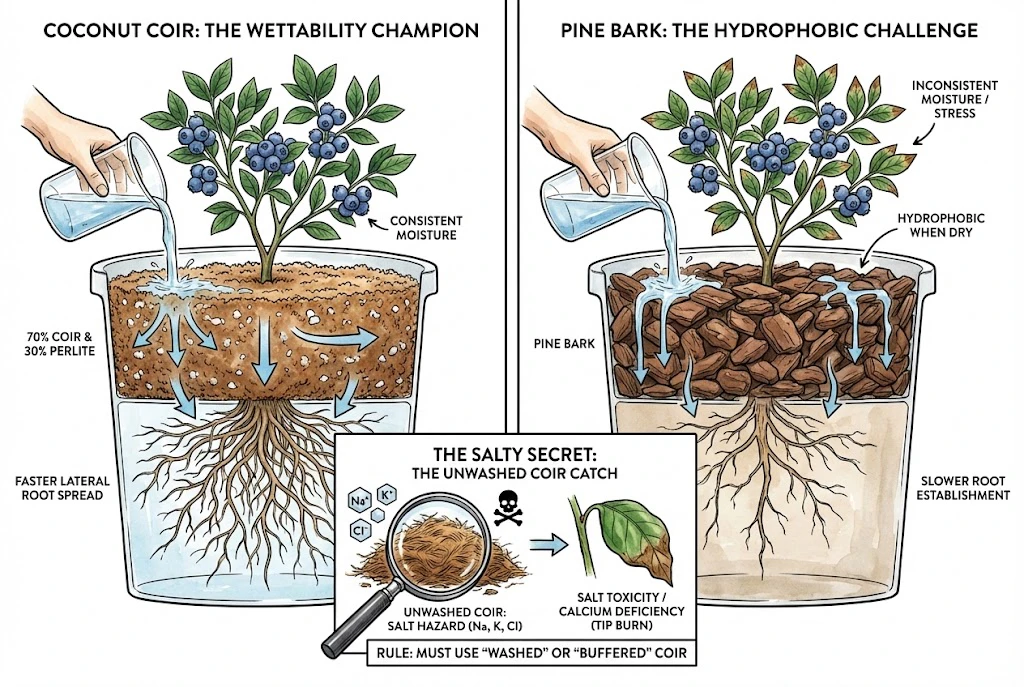
A significant drawback is that pine bark can become hydrophobic. If the substrate dries out completely, it repels water, which then tends to channel down the sides of the container rather than saturating the root ball.
Coconut Coir as an Alternative
Coconut Coir
It has been studied as an alternative or supplement to pine bark, including in USDA and university trials.
Benefits of Coir Integration
Coir is often used blended with perlite, but the results are cultivar- and mix-dependent rather than pointing to a single best ratio.
In peat- and coir-based media trials, for example, Jewel grew less well as perlite increased, while Liberty produced more dry weight with perlite at or below 10% and with more peat than coir.
A 2022 Florida study of several bark/coir/perlite combinations found no significant differences in yield across the range tested, so no single blend emerged as the winner.
- Re-wettability. Coir generally rewets more readily than bark that has dried out completely, which can buffer against irrigation swings. How well it performs still depends on the coir grade and how it was processed.
- Cultivar matters. Because growth and nutrition responses differ by cultivar, match the mix to the variety and confirm it with your own pH and EC measurements rather than assuming coir is always better.
Considerations Regarding Salinity
Depending on its source, processing, and buffering, coir can carry appreciable sodium (Na), potassium (K), and chloride (Cl−).
These vary by product, so a media test is more reliable than assuming any given batch is high or low in salts.
Blueberries are sensitive to salt, and a high potassium load can interfere with calcium and magnesium uptake depending on the balance of nutrients and your fertigation program.
Using washed or buffered coir, and managing irrigation water and EC, helps prevent tip burn and nutrient problems.
Because washing and buffering methods differ between products, check the supplier’s analysis where you can.
Science-Based Container Blend
| Component | Typical range | Function | Notes |
|---|---|---|---|
| Aged pine bark fines | 50-80% | Aeration & pH stability | Use aged/composted bark to avoid nitrogen immobilization. Very high proportions are harder to keep watered. |
| Sphagnum peat moss | 10-40% | Moisture & acidity | Adds water-holding and helps buffer toward acidic pH. |
| Perlite (or pumice) | ~10% | Drainage | Helps maintain structure. Keep low for cultivars sensitive to high perlite. |
These are starting-point ranges, not a fixed formula. The best proportions depend on the cultivar, container volume, and your irrigation and fertigation setup, so adjust based on measured pH, EC, and how the mix drains.
Containers and raised beds also differ in water volume and drainage, so a mix that works in one may need tweaking in the other.
Washed and buffered coir can substitute for part of the peat, but coir and peat differ in pH and salt content, so they are not a direct one-to-one swap.
Nitrogen Management (Ammonium vs. Nitrate)
Match Nitrogen to Blueberry Roots
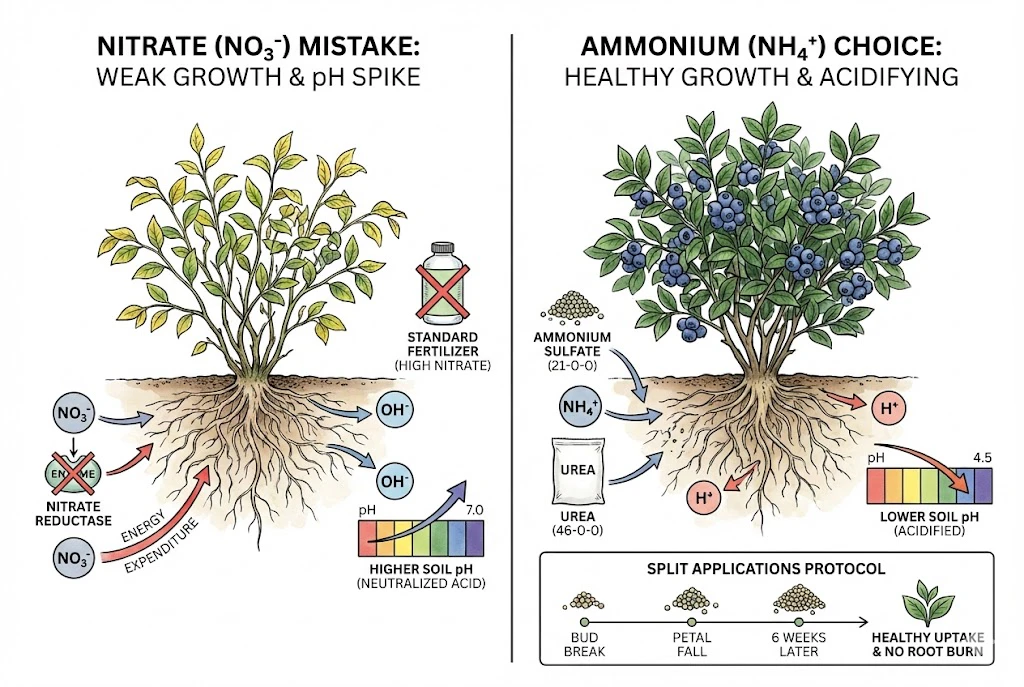
Matching the nitrogen form to blueberries’ biology is an important part of keeping them healthy.
Many crops readily use nitrate nitrogen, but blueberries are well adapted to take up ammonium.
This is a difference in preference and efficiency, not an absolute rule for every plant or condition.
Blueberries have relatively low nitrate reductase activity, so they use nitrate less efficiently (low activity rather than a complete inability to process it).
The Impact of Nitrate-Based Fertilizers
Using standard vegetable fertilizers high in nitrates can lead to two primary issues.
- Less efficient use. Reducing nitrate for use costs the plant energy, and because blueberries use nitrate poorly, relying on it can contribute to weaker growth, especially at the wrong pH or high nitrate levels.
- Root-zone pH. When roots take up nitrate, they tend to release hydroxide (OH−) ions to keep charge balance, which can nudge the root-zone pH upward. The net effect depends on the accompanying ions and soil processes, but it works against efforts to keep the soil acidic.
Recommended Fertilizer (Ammonium Sulfate)
Ammonium sulfate, a bagged 21-0-0 ammonium nitrogen source, can help acidify the blueberry root zone.
It is a suitable source rather than a proven best product for every situation. The right choice and rate depend on plant age, soil test, and tissue analysis.
- How it acidifies. As roots take up ammonium, they release hydrogen ions (H+), which can acidify the immediate root zone. Over the longer term, microbial nitrification of ammonium in the soil is a major driver of acidification, and how much the soil acidifies also depends on its texture, buffering, and organic matter.
- The urea alternative. Urea (46-0-0) converts to ammonium in the soil and has a milder effect on pH. MSU suggests urea can be a good choice where the soil pH is already low (below about 5.0).
Application Strategies
Ammonium sulfate has a high salt index and can cause root burn if over-applied, so the actual amount, spacing from the crown, and watering-in matter.
Set the total nitrogen rate from plant age, planting density, mulch, soil organic matter, and leaf or soil tests rather than from a generic bag recommendation.
Michigan State University describes nitrogen uptake picking up around bloom and petal fall, with applications generally made between budbreak and bloom.
On sandy soils, MSU suggests splitting the nitrogen, applying part around that window and the remainder in early-to-mid June, rather than a fixed three-way split.
Avoid late-season nitrogen, which can interfere with hardening off.
Pruning Strategies for Long-Term Yield
Build the Plant Before Chasing Fruit
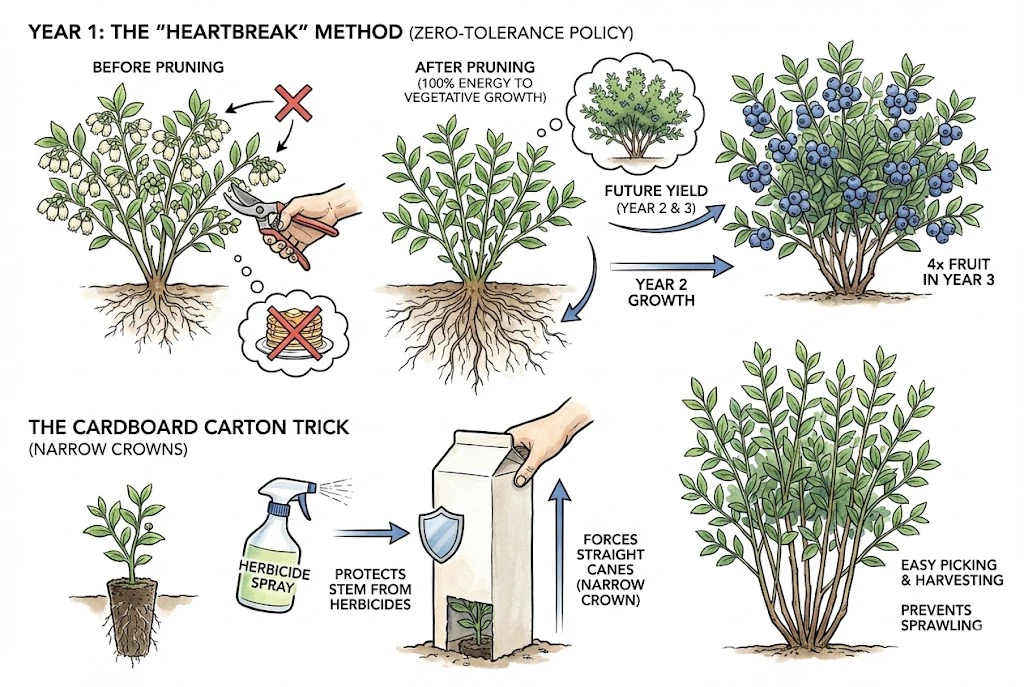
Extension guidance on pruning young blueberries emphasizes building plant structure in the early years rather than chasing an immediate harvest.
Year 1. Prioritizing Vegetative Development
It can be hard to prune a healthy, flowering young bush, but Extension guidance recommends it to help the plant establish before it carries a crop.
The Biological Rationale
Young blueberries put energy into either fruiting or into building roots and canes. Letting a plant fruit heavily in its first year can slow that early establishment, which is why removing the first-year flowers is recommended.
Removing first-year flower buds directs energy toward root and cane development, helping the plant establish for stronger cropping in later years.
The Southern Region Small Fruit Consortium describes a limited crop in year two and a more significant crop by year three. It does not report a specific yield multiple or a permanent cap on production.
Developing a Narrow Crown
Some commercial growers place physical guards or sleeves around young plants. A narrow crown itself is mainly the result of pruning and training, for example, removing shoots outside a roughly 12-to-18-inch crown and taking out low or crossing canes, rather than something a guard alone produces.
Functional Benefits
- Reducing spray contact. A guard can help limit accidental contact between spray and young green stems during maintenance. It does not replace following the herbicide label, wearing the required PPE, and avoiding drift, overspray, and runoff (always keep herbicide off green tissue and use products only as labeled for the site).
- Structure. Blueberries are trained to a manageable crown to suit hand and mechanical harvesting. Achieve this mainly through pruning. Treat any guard or sleeve as a supplement, not the cause of good structure.
Do Not Treat Erythritol as a DIY SWD Spray
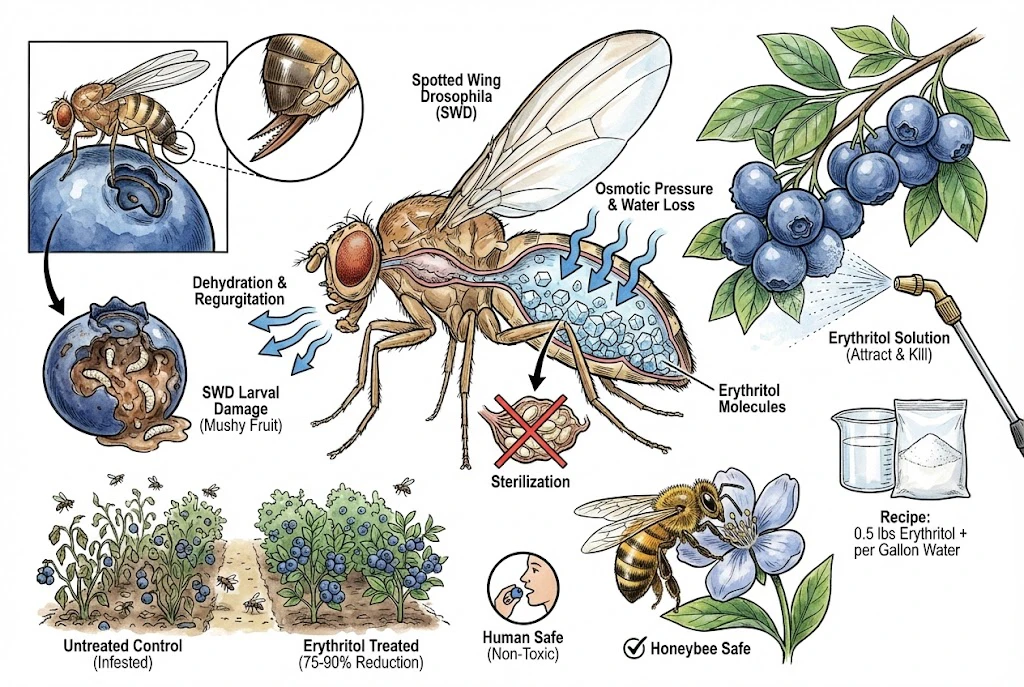
Important. The material below summarizes research. It is not a use recommendation. Erythritol is not described here as a registered pesticide for blueberries, and any substance applied to kill or deter a pest may be regulated. Do not mix or apply a homemade attract-and-kill spray on a food crop unless you have confirmed EPA and state registration, an approved crop use, the ingredients, application rate, and the label’s pre-harvest interval (PHI) and re-entry interval (REI).
Spotted Wing Drosophila (SWD)
It is a significant pest of blueberries and other soft fruit.
Unlike most fruit flies, SWD uses a serrated ovipositor to lay eggs inside intact, ripening fruit.
Depending on infestation level, temperature, and secondary pathogens, this can lead to spoilage.
Chemical controls are common but resistance is a concern, which is part of why researchers are studying alternatives. Erythritol, a sugar alcohol, is one such area of study, but it should be understood as promising research rather than a proven, ready-to-use control.
What the Research Can and Cannot Support
Laboratory and field research has explored erythritol against fruit flies, but it has not established a registered, ready-to-use blueberry treatment. The proposed mechanism remains uncertain, and reported field downsides include leaf spotting and more yellowjacket activity in some bait mixtures.
Researchers Find Sweetener Is a Safe Insecticide | Drexel University
Use Registered Controls Instead
It is important not to confuse food safety with pesticide safety. Erythritol being safe to eat as a sweetener does not establish that a spray applied to a crop is registered, residue-safe, or safe for non-target organisms. Calling something non-toxic sits awkwardly next to the goal of killing an insect.
On pollinators, USDA trials found honeybees did not prefer treated stations, which is not the same as proven harmlessness or residue safety. Yellowjacket visitation actually increased in some treatments.
There is also no basis to claim that a product has no pre-harvest interval. A PHI comes from a registered product’s label, and the absence of a label is not the same as a zero-day PHI.
Finally, a substance used to kill or deter a pest can fall under pesticide regulation. EPA’s minimum-risk exemption has specific conditions for allowed active and inert ingredients and labeling, and erythritol does not appear on that minimum-risk active-ingredient list.
Confirm EPA and state registration and an approved food-crop use before treating any crop you plan to eat or sell.
Cultivar Selection and Modern Genetics
Match Cultivar to Site and Use
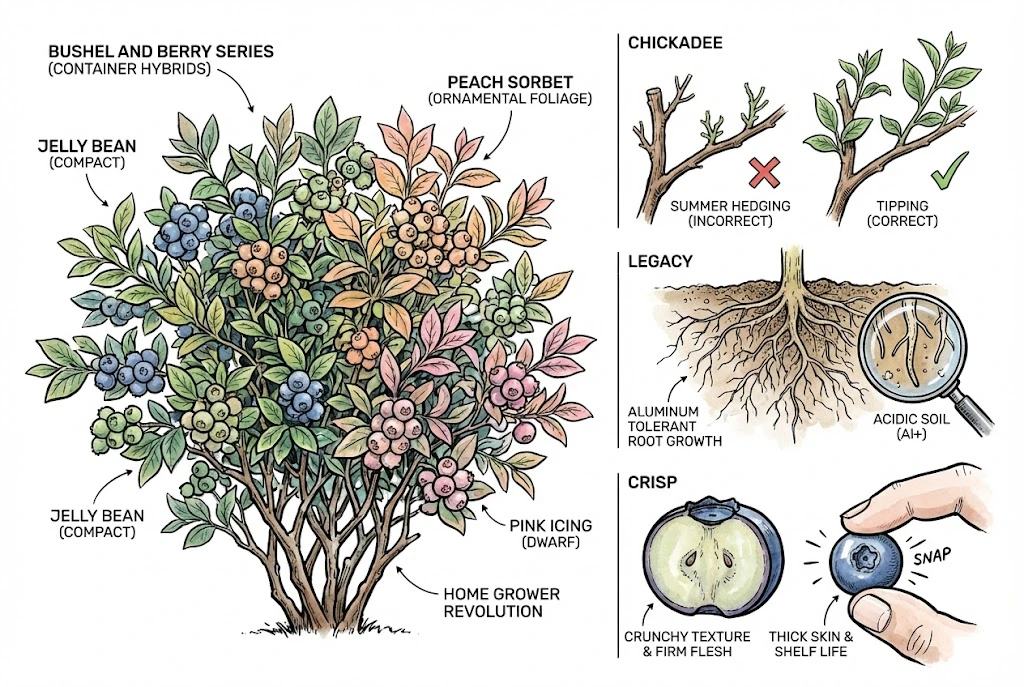
Modern breeding programs work toward varieties suited to specific climates, pests, and uses, though the goals differ from one selection to the next.
Dwarf and Ornamental Hybrids
For small-scale or container growing, Bushel and Berry is a brand that markets compact, patio-type blueberries.
Claims that a cultivar is highly productive are marketing claims. Actual performance depends on the specific cultivar, site, and conditions.
Cultivar and Trait Notes
- Chickadee (cultivar). UF/IFAS guidance cautions against heavy summer hedging for this variety, as it can regrow poorly. Timing and severity matter.
- Legacy (cultivar). In nutrient-solution comparisons, Legacy was more aluminum-resistant than Bluegold. That is evidence of relative tolerance under controlled conditions, not a guarantee it will outperform every cultivar in every aluminum-rich field soil.
- Crisp, as a texture trait rather than one cultivar. Breeders increasingly select for firmer skin and flesh to improve eating quality and shelf life. This is a breeding goal shared across varieties rather than the name of a single cultivar.
Summary of Best Practices
Keep the Routine Measurable
Growing blueberries well means adapting some habits from vegetable gardening to the plant’s particular needs, especially soil pH, aeration, and nitrogen form.
- Manage pH for the long term with a soil-test-based rate of elemental sulfur, or with acidic substrates such as pine bark. Do not rely on mulch alone to correct field pH.
- Favor ammonium-based nitrogen, since blueberries use it more efficiently than nitrate. Set the rate from plant age and soil or tissue tests.
- Remove first-year flower buds on vigorous young plants to help them establish before carrying a crop.
- Treat erythritol for SWD as research to watch, not a ready-to-use control. It is not a registered product for general use, and results and safety are still being worked out.
Matching your methods to the blueberry root system, acidic pH, good aeration, and the right nitrogen form, sets up healthier plants.
Overall results still depend on other factors too, including cultivar, chilling, pollination, water, and pest and disease pressure.
I sample the root zone near an emitter and again near the outer edge of the wetted area, then label the samples separately. One blended sample can hide an acidic wet pocket beside a drier, saltier edge, especially in containers and raised beds.
The same record includes irrigation-water pH and EC beside the root-zone readings, with another sample from each location after a management change. This helps me distinguish a drifting water source from a substrate problem before I add sulfur or fertilizer.
Key Data Summary Tables
Substrate Characteristics
These are typical ranges that vary by source and processing. Use them as starting points and confirm with measured pH and EC.
| Substrate | Typical pH | Water retention | Aeration | Notes |
|---|---|---|---|---|
| Milled pine bark fines | ~4.0-5.0 | Low-moderate | High | Common base component. Can turn hydrophobic if fully dried out. |
| Buffered coconut coir | ~5.5-6.5 | High | Moderate | Re-wets readily. Must be washed/buffered to manage salts. |
| Sphagnum peat moss | ~3.5-4.5 | High | Moderate | Strong acidity and good water-holding. Often blended with bark. |
Nitrogen Sources
A directional guide only (actual rate and timing depend on plant age, soil and tissue tests, and irrigation).
| Fertilizer | Formula | Effect on root-zone pH | Fit for blueberry |
|---|---|---|---|
| Ammonium sulfate | 21-0-0 | Acidifying | Suitable. High salt index, so watch the rate. |
| Urea | 46-0-0 | Mildly acidifying | Suitable, gentler on pH. |
| Calcium nitrate | 15.5-0-0 | Tends to raise pH | Generally avoided. |
| Potassium nitrate | 13-0-44 | Tends to raise pH | Generally avoided. |
Erythritol and SWD (Research Summary)
This is not a use recommendation. Effects differed sharply by setting, and trials also noted downsides.
| Setting (USDA 2023) | Reported effect |
|---|---|
| Field-cage oviposition | ~59-81% reduction |
| Greenhouse blueberry infestation | ~90% reduction |
| Open-field blueberry | ~49% reduction |
| Open-field cherry | ~57% reduction |
| Concentrations used | ~1.5-2.0 M (roughly 1.5-2.0 lb per US gallon, often with sucrose) |
| Non-target notes | Honeybees did not prefer treated stations. Yellowjacket visitation increased with added sucrose. Leaf spotting rose across trials |
| Regulatory status | Not shown here as a registered pesticide. Confirm EPA/state registration and label before any crop use |