
Precision Fermentation Byproducts as Organic Fertilizer
An emerging, research-stage look at spent microbial biomass from precision fermentation as a nitrogen source: what one field study actually measured, why composition varies by organism and process, and why any batch needs its own lab analysis before use.
Marcus Hale · Published 2026-01-30 · 10 min read
Key Points
- Spent microbial biomass, or SMB, is the inactivated microbial material left after a precision-fermentation product is recovered. It is not one standardized fertilizer. Composition depends on the organism, growth medium, target molecule, and how the product was recovered and the cells inactivated.
- Reusing SMB as a crop nitrogen source is a real but still research-stage idea. A 2017 field study by Sullivan et al. tested one heat-inactivated E. coli K-12 lot and measured roughly 11.8% N, 0.9% P, and 0.2% K on a dry-matter basis. That is not a universal N-P-K, and the authors supplemented P and K separately.
- Any real batch has to be tested for its own nutrient analysis, moisture, carbon-to-nitrogen ratio, salts such as sodium, chloride, and ammonia, pathogens, and heavy metals before use. Values, safety, and organic-certification eligibility all vary by product and jurisdiction.
- Do not apply SMB in a home garden without a product-specific guaranteed analysis, safety testing, and crop directions. Follow a product’s own label, a soil test, and your crop’s needs.
- The blood meal and mycorrhizal inoculant discussed below are separate, established options with their own labels and limits. They are not proven substitutes for SMB.
Spent microbial biomass from precision fermentation is an emerging nitrogen source, not a finished off-the-shelf fertilizer. Its composition and safety vary by batch, so do not apply it to soil, especially food-crop soil, without its own verified analysis.
Overview
Read the Material as a Variable Input
Spent microbial biomass is the material left over after a precision-fermentation product is recovered.
It can be protein-rich and therefore relatively high in nitrogen, but the actual nutrient content of any given batch depends on the organism, medium, and process. It is not a fixed N-P-K.
Fermentation is run under controlled (often aseptic) conditions, but a clean fermenter does not guarantee a clean final byproduct. Harvesting, inactivation, separation, drying, and storage can all reintroduce contamination, so safety has to be verified by lot testing rather than assumed.
Until a consumer product has a guaranteed analysis and crop directions, do not infer a home-garden application rate. If a tested product becomes available, follow its label, a soil or media test, and your crop’s nitrogen needs.
Foundation (What Is This Stuff?)
Identify the Process Inputs
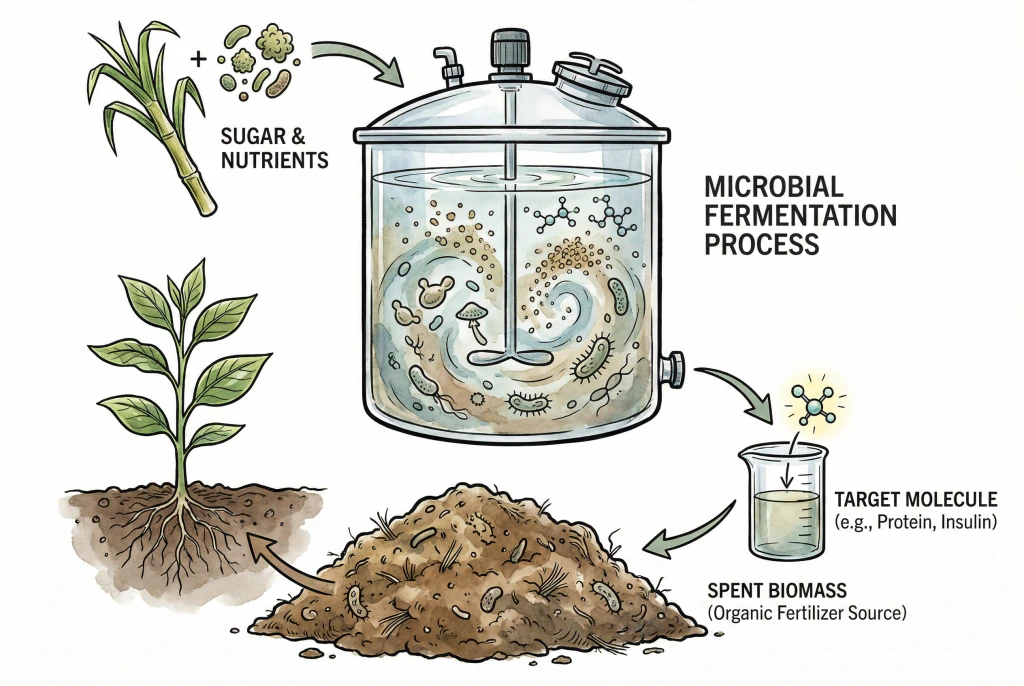
Precision fermentation is used to make products ranging from insulin to some animal-free milk proteins. Specific microbes are grown in a tank, fed sugar and nutrients, and they produce a target molecule.
The exact organism, medium, and recovery method differ from product to product.
Once that molecule is recovered, spent biomass, the cell walls and inner contents of the microorganisms, can be left behind.
How much remains, and its composition, depends heavily on the process. For example, whether the target molecule was secreted outside the cells (extracellular) or held inside them (intracellular) changes what is left in the biomass.
What’s in the Biomass
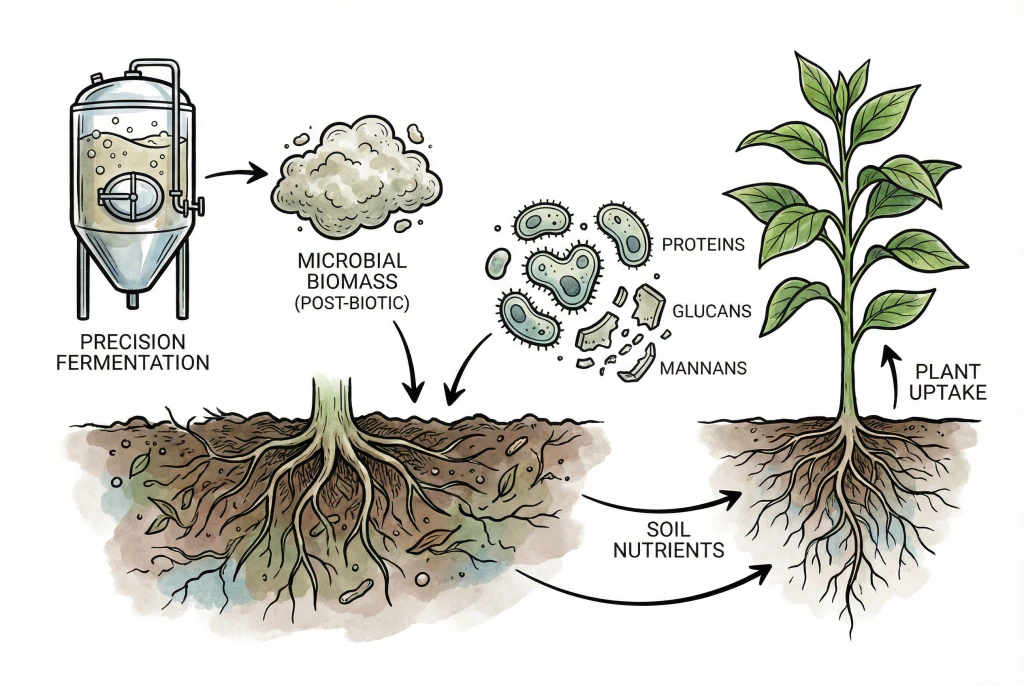
Think of this as high-protein leftovers. Depending on the organism, it can contain proteins, glucans, and mannans, along with nucleic acids, lipids, and ash. The proportions vary with species and processing, so it is a variable feedstock rather than a standardized product.
Adding it to soil is not the same as feeding plants directly. Plants take up mineral ions, so the proteins first have to be broken down (mineralized) by soil microbes. How much nitrogen actually becomes available, and how fast, depends on the material, C. N ratio, temperature, moisture, and time.
What One Field Study Measured
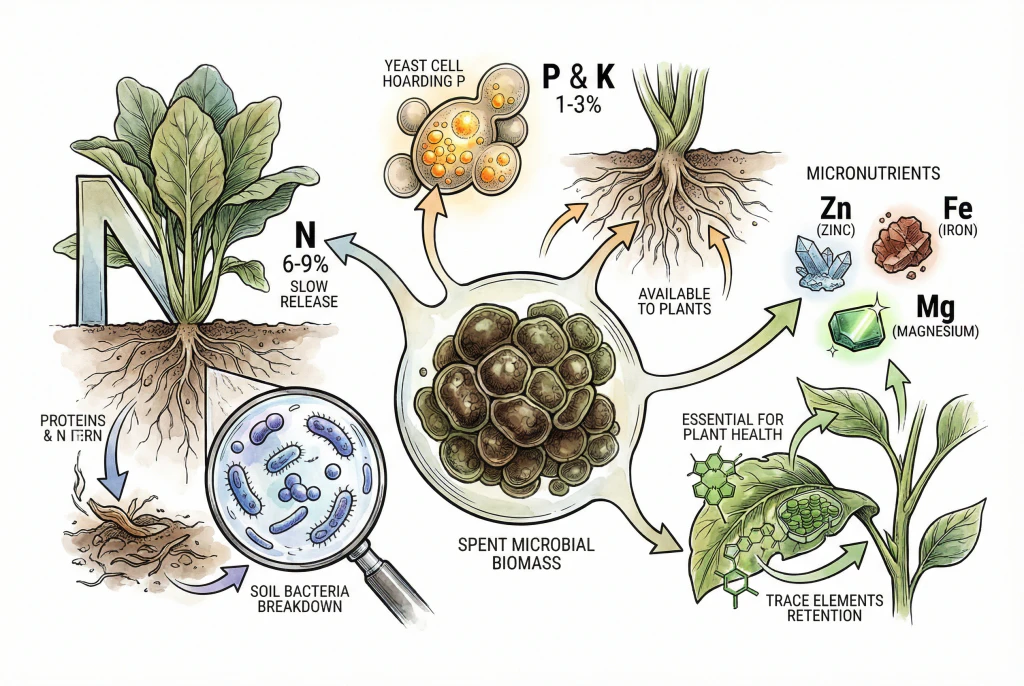
Because microbes are built largely from protein, and protein is rich in nitrogen, spent biomass can be a meaningful nitrogen source. But there is no single typical N-P-K for the whole category.
The most directly relevant evidence is a 2017 field study by Sullivan et al., which tested one heat-inactivated E. coli K-12 biomass, a byproduct of 1,3-propanediol production, as a crop nitrogen source.
That single lot measured roughly 11.8% nitrogen, 0.9% phosphorus, and 0.2% potassium on a dry-matter basis, so phosphorus and potassium were well below 1%, not the multi-percent levels sometimes claimed.
Total nitrogen is also not the same as plant-available nitrogen. The authors noted that mineralization rate and nutrient contribution needed further study, and they supplemented phosphorus and potassium separately based on soil tests.
Residual sodium, chloride, and ammonia were also detected, which is exactly why a batch cannot be assumed to be salt-free.
No consumer precision-fermentation fertilizer with a guaranteed analysis is currently available as a ready-to-use SMB product. Blood meal and mycorrhizal inoculants are established but separate inputs, not proven stand-ins for SMB.
One such high-nitrogen option is blood meal (12-0-0), an animal-derived, protein-bound nitrogen source that soil microbes mineralize over time.
Blood meal is a different material, not an SMB equivalent. Its guaranteed analysis varies, but it mainly supplies nitrogen rather than the microbial glucan and mannan fraction discussed here. It can also attract animals and produce odor.
Set the amount from the exact label, the crop’s nitrogen need, and a soil test. Do not transfer a teaspoon-per-volume rate between products. Even organic nitrogen sources can injure roots when overapplied.
Utilization of Spent Microbial Biomass as an Alternative Crop Nitrogen Source (Sullivan et al., 2017)
How It Would Be Applied
Match Dose to a Measured Analysis
Soil Drench vs Top Dressing
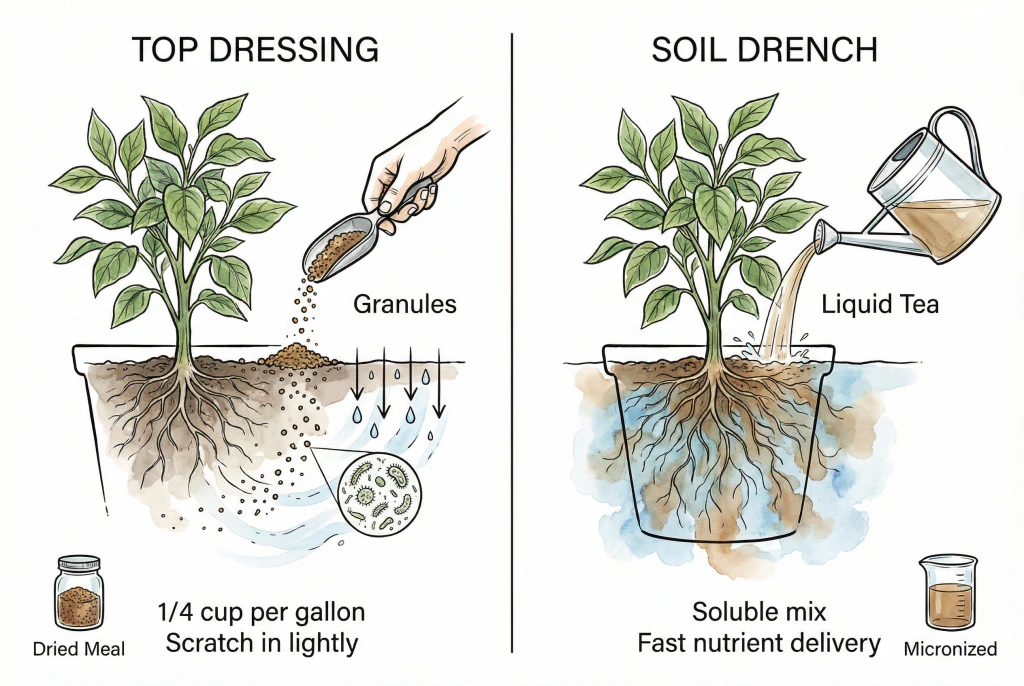
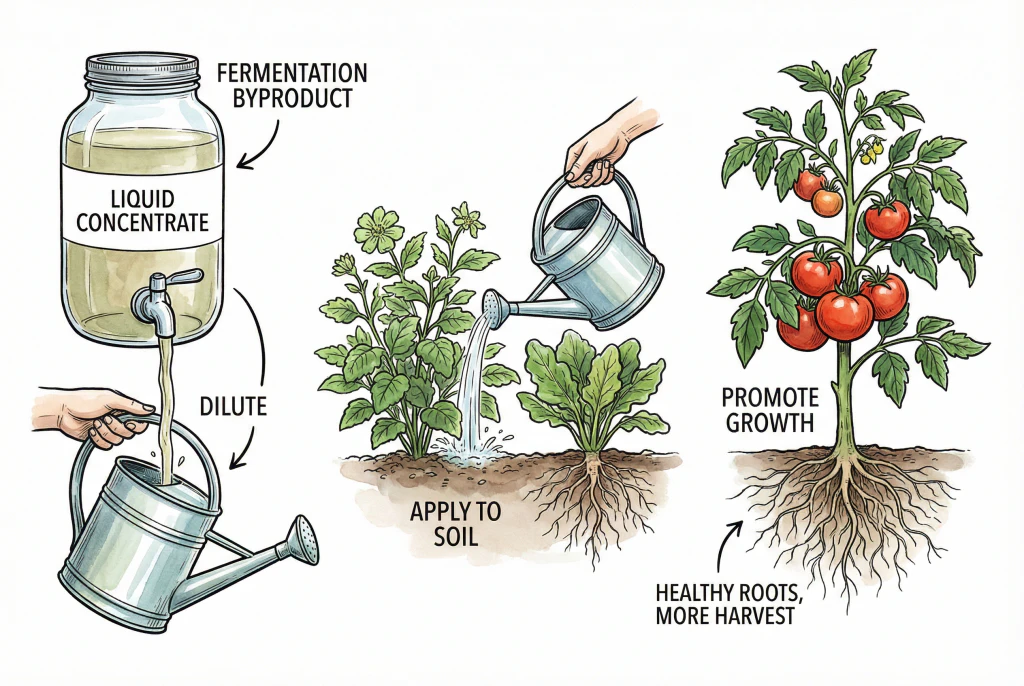
A labeled SMB product could arrive as a dried granule or meal for top dressing, or as a soluble product for a soil drench. Without the product’s guaranteed analysis and bulk density, any cup-per-gallon figure is guesswork and could easily over- or under-apply nitrogen.
Note that being organic does not make a soluble feed automatically safe. Once mineralized, the nutrients become the same ionic forms plants take up, and a concentrated organic drench can still raise EC, release ammonium, deplete oxygen in the root zone, and injure roots.
Any application should follow the product label, a soil or media test, and your crop’s nitrogen requirement, and, for food crops, be introduced gradually and monitored.
A Possible Soil-Structure Effect
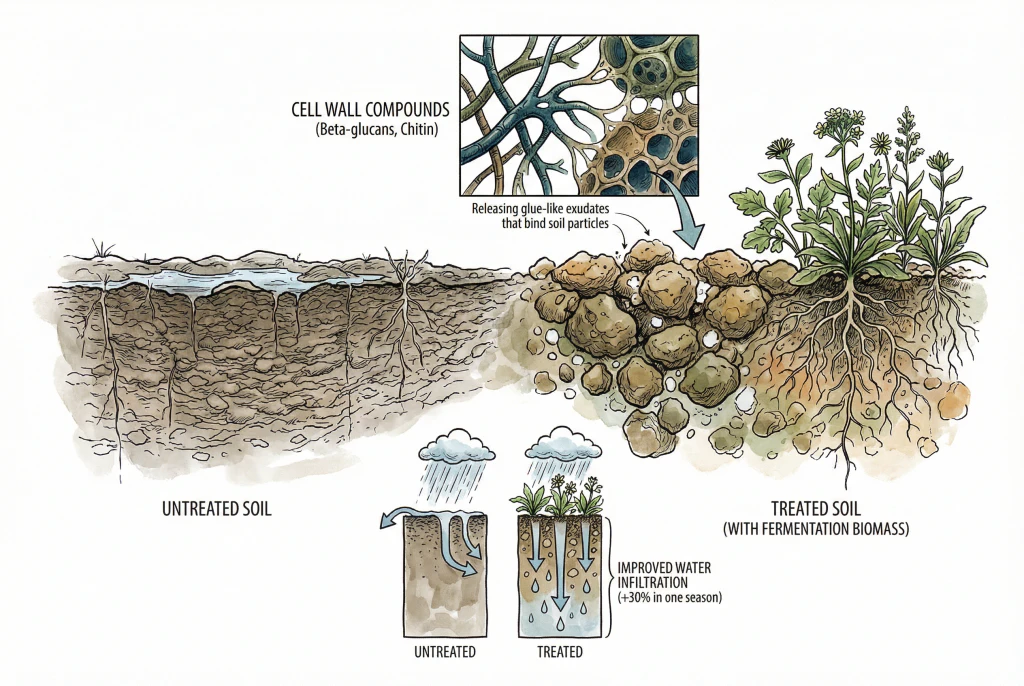
Yeast and fungal cell walls contain beta-glucans and some chitin. These polymers can serve as organic substrate that soil organisms break down, and organic matter and microbial activity can influence aggregate stability.
But a dead cell wall does not actively secrete anything on its own. That is different from the exudates living roots and fungi release, so any structural effect comes from decomposition rather than from the biomass gluing soil directly.
Whether that translates into better water retention and drainage depends on soil texture, dose, how far decomposition has progressed, compaction, and pore-size distribution.
There is no verified measurement of a specific infiltration gain for this material, so treat soil-structure benefits as plausible but unproven rather than guaranteed.
Some gardeners pair organic amendments with a live mycorrhizal inoculant, though whether that helps depends on the crop, the native soil community, and phosphorus status.
A single-species arbuscular mycorrhizal inoculant (for example, one based on Rhizophagus intraradices) works by forming a symbiosis with living host roots, so it needs direct root contact at planting. It is not a general decomposer that breaks biomass down.
It also will not help nonmycorrhizal crops such as brassicas (broccoli, cabbage, radish) or chenopods (spinach, chard), and responses can be muted where plants are already colonized or soil phosphorus is high.
Comparison to Traditional Fertilizers
How It Compares to Synthetic Fertilizers
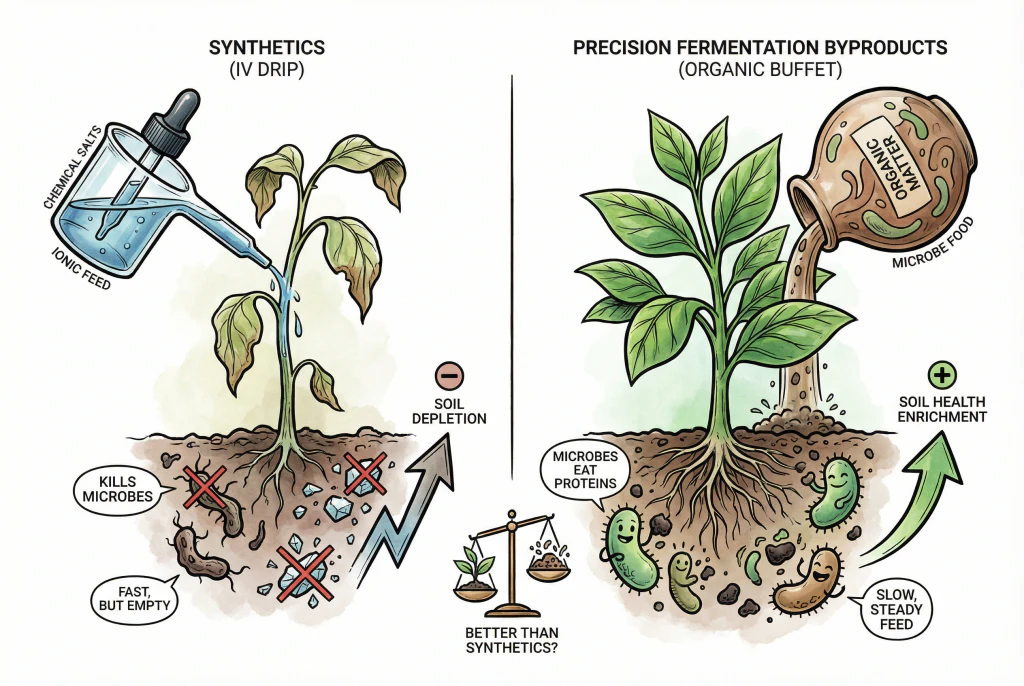
Synthetic or mineral fertilizers supply soluble ions that plants can take up quickly, and applying too much, at too high a concentration, or in the wrong place can cause salt injury.
It is not true that they do nothing for the soil or simply kill microbes. A review of 64 long-term trials found mineral fertilizer increased soil microbial biomass by about 15% on average, with negative effects mainly tied to soil acidification at low pH.
Outcomes depend on dose, pH, nutrient balance, and organic-matter management, not on whether the source is labeled synthetic or organic.
Organic amendments work differently. Their nitrogen is released as soil microbes mineralize the proteins, which can be slower and steadier.
That is a real difference, but it does not make them immune to problems. Organic nitrogen can also burn roots or cause ammonium and osmotic stress if overapplied, poorly decomposed, or placed in direct contact with roots.
What matters most is the measured analysis, dose, placement, and the plant’s actual demand.
Long-term effects of mineral fertilizers on soil microorganisms. A review (Geisseler & Scow, 2014)
How It Compares to Manure
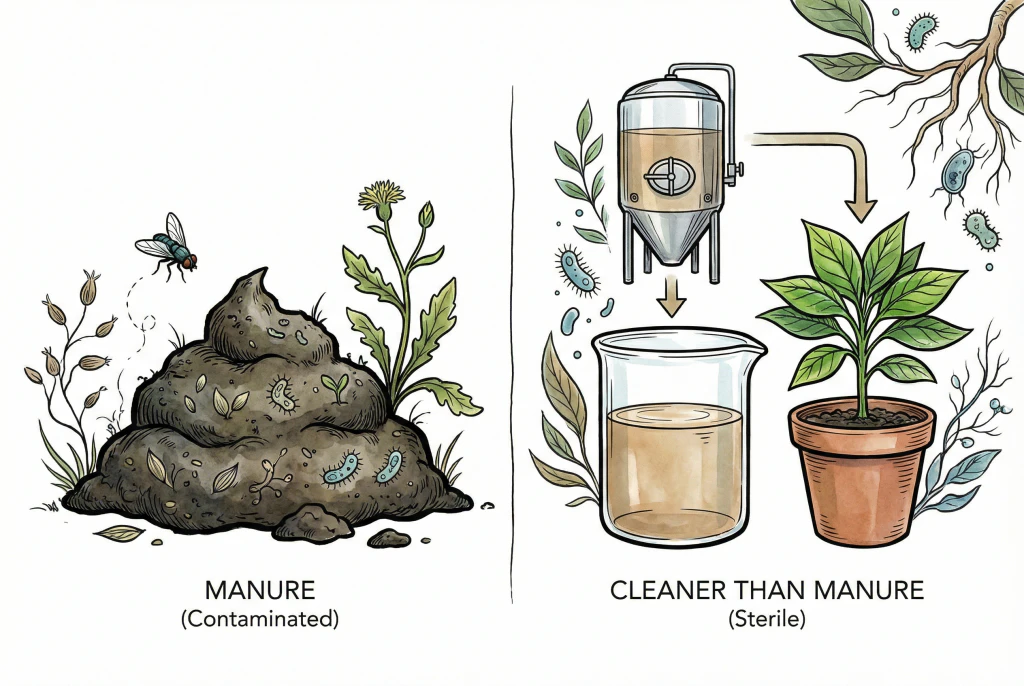
Raw manure can carry weed seeds, pathogens such as E. coli, antibiotic residues, and heavy metals, but the risk depends on the source and how it is handled.
Proper thermophilic (hot) composting substantially reduces weed seeds and pathogens, so aged or composted manure is not the same hazard as fresh manure.
A precision-fermentation byproduct is not automatically safer. Even if the fermenter is run aseptically, the final material can be recontaminated during harvest, inactivation, drying, and storage, and a 2017 study lot contained residual salts. Terms such as sterile, pasteurized, and zero pathogens can only be claimed for a specific product that has a validated kill step, a pathogen panel, and a lot certificate. They cannot be assumed for the category.
Compare manure and byproducts on the same basis. Compare tested material with tested material.
Troubleshooting
Diagnose the Whole Root Zone
Two things commonly surprise people. Neither has a one-size-fits-all answer (the right response depends on how much you applied, moisture, and whether the plant shows symptoms).
White Fuzz on the Surface
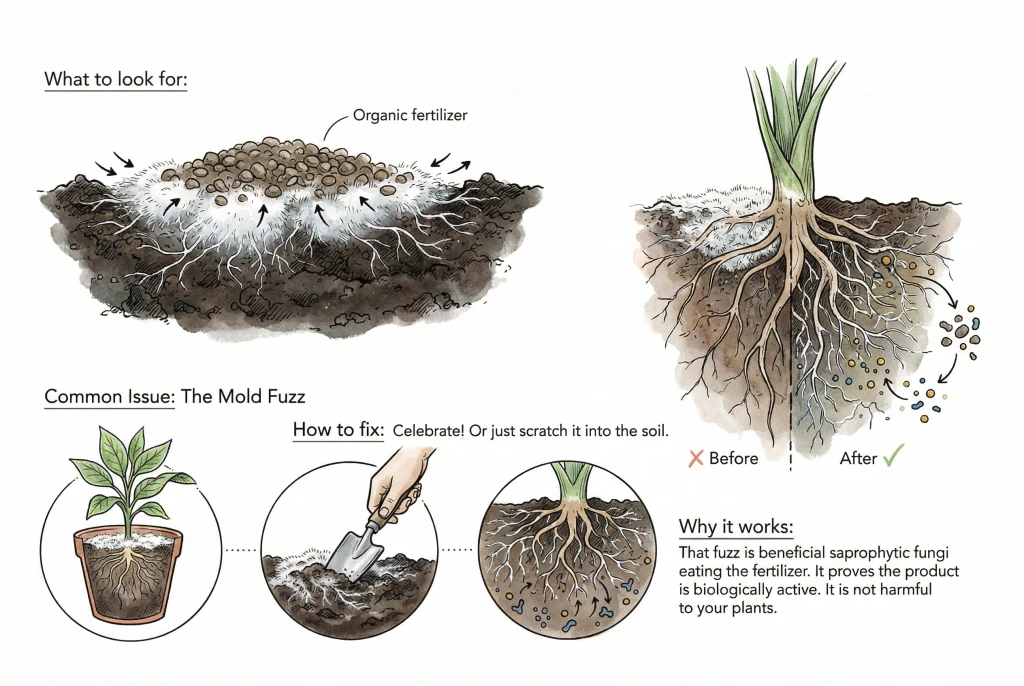
White fuzz on the soil surface a few days after applying an organic amendment is often harmless saprophytic fungus feeding on organic matter.
You cannot identify an organism, or rule out a problem, from color and texture alone, and it is not proof that a product is high-quality or working.
Before scratching it in, check the basics. Is the surface staying too wet, did you apply too much, is drainage poor, are fungus gnats appearing, and does the plant itself look healthy?
Persistently damp, organic-rich surfaces attract fungus gnats, whose larvae can feed on roots.
Odor
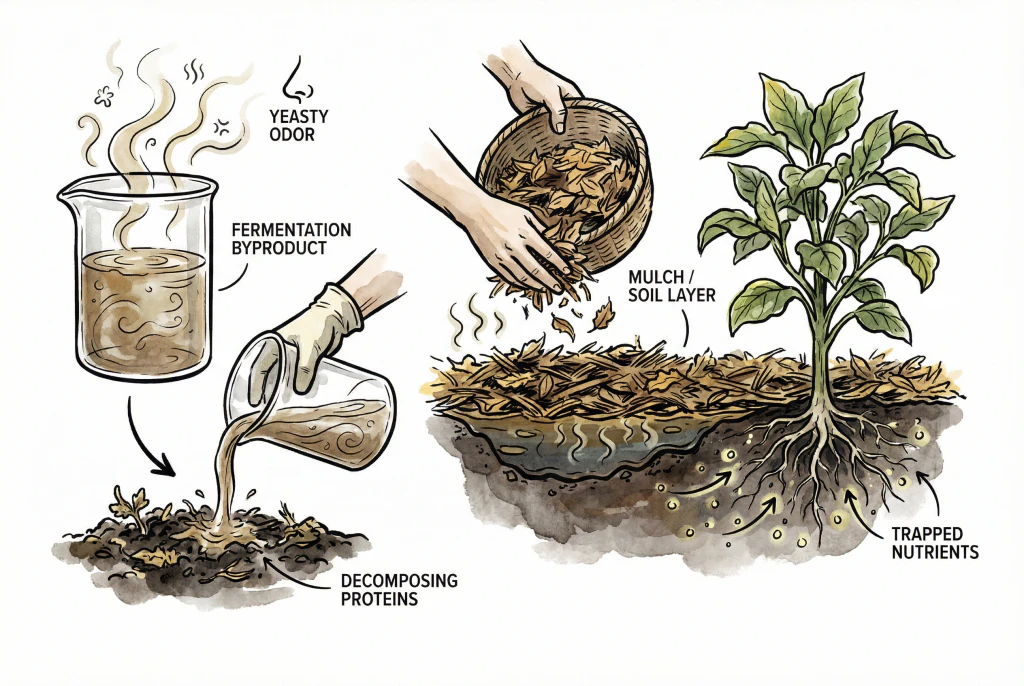
A faint product odor can be normal. But a strong yeasty, sour, or putrid smell can signal overwatering, anaerobic (oxygen-starved) decomposition, contamination, or overapplication.
Covering it with mulch may make it less noticeable to you, but if the cause is too much wet organic matter, burying it near the roots can worsen oxygen starvation and attract pests.
Address the cause first, reduce the amount, improve drainage and airflow, and check the plant, rather than only masking the smell.
Before You Buy
Buy Only a Verified Lot
Because no consumer precision-fermentation fertilizer with a verified label is available yet, there is nothing here to buy as a direct SMB product.
If one appears, buy it only when the label, a guaranteed analysis, a validated kill step, lot testing (pathogens, heavy metals, salts/EC), organic-certification eligibility for your jurisdiction, and crop-specific instructions all exist, and match your soil test and crop’s needs.
The blood meal and mycorrhizal inoculant discussed above are established options in their own right, but they are not substitutes for SMB. Blood meal is a high-nitrogen animal byproduct with its own label rate, and a mycorrhizal inoculant is a root-symbiotic product, not a biomass decomposer.
Choose either on its own merits, not as an SMB stand-in.
When a shipment arrives, I photograph the lot number and guaranteed analysis, record the received weight and odor, and keep a small sealed holdback exactly as the supplier directs. If a later bag smells or behaves differently, the original sample and lot record give the supplier or laboratory something concrete to compare.
No application rate carries from one batch to the next unless the analyses match. Fermentation feedstock, moisture, salt, and nutrient concentration can change, so each new lot starts as a separate input in my ledger rather than a refill of the previous product.