
Paludarium Driftwood Guide: Types, Tannins & Safety
Choose paludarium driftwood by density, tannins, buoyancy, and plant use. Compare mopani, spider wood, and cork, then soak, anchor, and cycle it safely.
Marcus Hale · Published 2025-12-18 · 17 min read
Key Takeaways
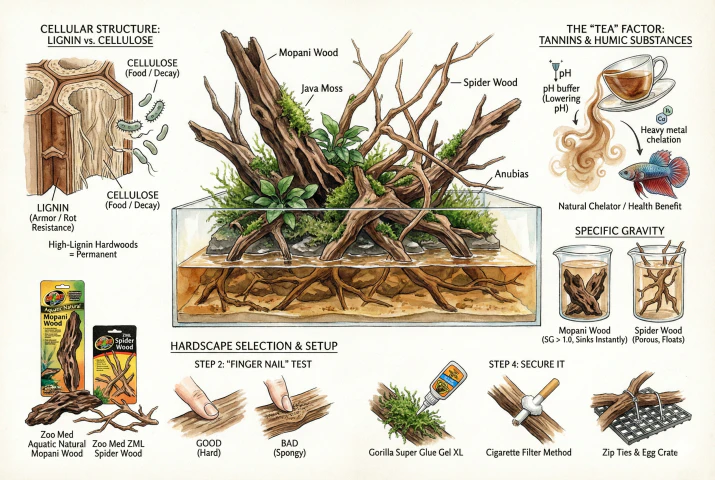
- Favor dense, durable wood sold for aquarium or paludarium use, such as mopani or Malaysian driftwood. Underwater behavior depends on species, heartwood extractives, density, and prior condition, not on a simple hardwood-equals-high-lignin rule.
- A fingernail test can reveal obvious softness or existing decay, but it cannot measure lignin, identify the species, or predict submerged lifespan. Treat it as one rough clue rather than a verdict.
- Tannins tint the water and can influence pH and metal chemistry, but the effect depends on the wood, dose, and source water. Test the water instead of treating tannin as a cure or guaranteed buffer.
- Light, porous wood can float for weeks. Soak it or anchor it mechanically, and never pack cotton or cigarette filters into cyanoacrylate joints because the rapid reaction can generate dangerous heat.
- Match wood to the zone and design role. Use mopani or Malaysian wood for heavy structure, spider wood or manzanita for fine root detail, and cork bark for emersed backgrounds and planter pockets. Keep soft, unknown wood above the waterline.
A paludarium is demanding on hardscape because you’re dealing with both submerged and emersed zones, including the waterline, where wood is exposed to air and water at once.
A soft or poorly sourced piece is more likely to break down, float, or foul the water, so it pays to choose carefully.
The practical approach is to weigh the material (how dense it is, how it behaves in water, whether it’s sold and sourced for aquarium use) before focusing on looks.
Color, shape, and plant compatibility matter only after the piece passes the durability, buoyancy, and safety checks.
Why Driftwood Sinks, Tints Water, or Decays
Wood is a biological material, so once it is submerged, microbes can begin to colonize and slowly break it down.
How quickly this happens depends on the species, any prior drying or decay, and how the piece was prepared.
I soak and drain the main wood, then rebuild the intended support on a tray outside the enclosure. Water changes its weight and balance, so a dry piece that stands beautifully may twist once saturated.
After soaking and rebuilding the support, I mark every contact point and pull the most exposed tip with a luggage scale for 10 seconds in each direction that a pump, animal, or maintenance hand could load it. I use the greater of 500 g or twice the heaviest animal’s body weight, and accept the anchor only when no contact mark moves more than 2 mm and no joint whitens, cracks, or lifts. The doubled animal load gives routine movement a margin, while the 500 g floor still screens an enclosure without livestock.
Durability Is More Than Lignin
Wood Components and Decay
Wood contains structural fibers and natural compounds that affect how quickly it breaks down. The species, density, heartwood, previous decay, and water conditions matter more than a single ingredient or a hardwood label.
Warm Water Accelerates Breakdown
A warm, humid paludarium does favor microbial activity, so a soft, easily degraded piece can foul faster than a dense, durable one.
But the outcome depends on the species, its extractives, how much wood you add, and your biofilter, not on cellulose content alone.
Hardwood and Softwood Are Not Durability Grades
Hardwood and softwood are botanical labels, not durability grades. Do not use either label alone to predict how long a piece will last. Choose known aquarium wood, inspect it for softness, and expect every submerged piece to change over time.
Syringyl-Rich Lignin Renders Poplars More Resistant to Degradation by Wood Decay Fungi
Tannins Change Color and Chemistry
Brown tint comes from tannins and other dissolved compounds in the wood. They can change water chemistry, but the effect depends on the wood, dose, and starting water. They do not detoxify contaminated water or hold pH at a guaranteed level. Test the water rather than relying on color, and use the driftwood blackwater guide for the full pH, tint, and biofilm workflow.
Blackwater Fish Compatibility
Some fish do well in soft, tannin-stained blackwater conditions, including many tetras, bettas, and rasboras with blackwater origins. Requirements vary by species and stock, so blackwater is not automatically safer for every fish. Whether it helps depends on matching water chemistry to the animals you keep.
Phenol-rich fulvic acid as a water additive enhances growth, reduces stress, and stimulates the immune system of fish in aquaculture
Density and Trapped Air Control Buoyancy
Dense Wood Sinks
Why does mopani usually sink while spider wood tends to float at first? A lot of it comes down to density and trapped air.
Porous Wood Needs Soaking
Water has a specific gravity of about 1.0. Dense woods like the mopani sold for aquariums typically sink right away, while lighter, porous spider wood often floats until water gradually displaces the air in its structure. The time required varies with the piece’s dry density, shape, and existing saturation, so treat any estimate of several weeks as a rough range. If you buy light wood, plan to soak or anchor it.
Choose and Prepare Paludarium Driftwood
Plan the Hardscape Before Buying
Before selecting an individual branch, use the paludarium hardscape guide to establish the load path, focal point, water flow, and stability plan for the whole layout.
Choose the Design Role
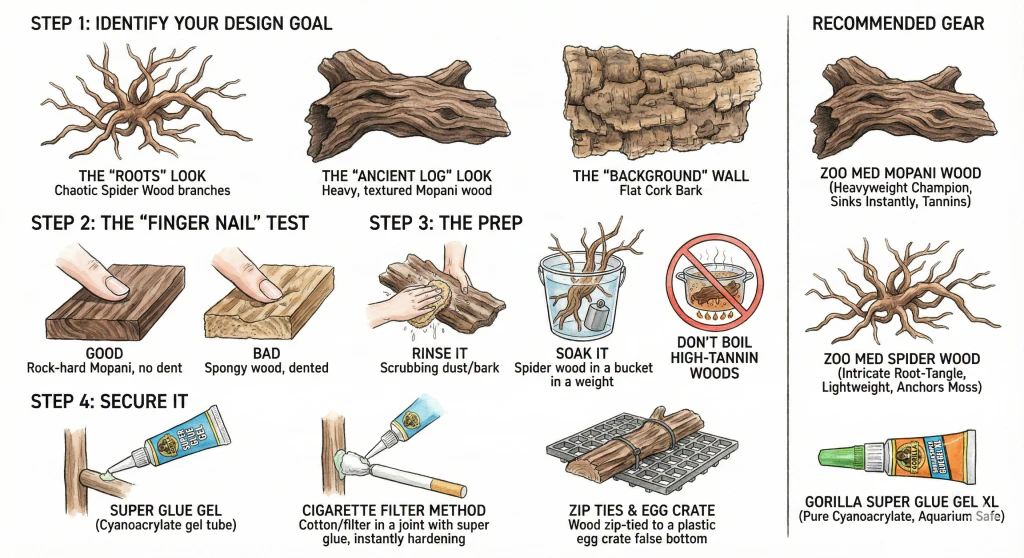
Don’t buy wood and then hunt for a spot. Pick the style. A branching roots look (spider wood, manzanita), a massive ancient log look (mopani, Malaysian), or a background wall with planting surface (cork bark).
Reject Soft or Decayed Pieces
In person, press a fingernail into the wood. If it feels hard and doesn’t dent easily, that’s a reasonable sign it isn’t already soft or partly decayed.
If your nail sinks in or the surface feels spongy, the piece is likely soft or breaking down, and it’s a poor structural choice.
Keep in mind this is only a rough firmness clue. It doesn’t measure lignin, identify the species, or tell you how long the piece will last submerged.
Rinse, Soak, and Inspect
Rinse and scrub off dust and loose bark, and inspect the piece for sharp edges or contamination from its source.
If it floats, soak it in a separate container of water, changing the water periodically, until it sinks. Spider wood can take a few weeks, but the exact time varies by piece.
Zoo Med, for example, recommends soaking its mopani in a separate container and changing the water.
Soak to Reduce Tannins
Boiling alone will not remove all the tannins from high-tannin woods like mopani, so soaking is the more practical route if you want to reduce the tint. There is no solid evidence that prolonged boiling automatically breaks fibers and makes wood rot faster. The outcome depends on temperature, time, species, and piece size, and soaking is usually easier and safer for large or dense pieces. Either embrace the tint or run a polishing resin.
Anchor the Hardscape Safely
Glue for Small Tacks
In a paludarium, an unstable hardscape can shift and injure animals or crack the glass, so secure it.
Cyanoacrylate gel super glue is popular in aquascaping for attaching small plants and tacking pieces together, but follow the product label. Manufacturers generally specify clean, dry surfaces and a full cure time (often up to 24 hours), and consumer super glues are not certified for continuous submersion or as fish- or amphibian-safe.
Bond above water where you can, let it cure fully, and check the label for your specific product.
Compare Joint Types
Compare cyanoacrylate gel, silicone, foam, and epoxy by joint type and cure conditions in the aquarium-safe adhesive guide before choosing a product.
Avoid Cotton in Cyanoacrylate Joints
Do not pack cotton or a cigarette filter into a joint and soak it with super glue. Cyanoacrylate reacts very rapidly with cotton and other cellulose, releasing enough heat to reach temperatures well above 90 °C. Documented cases include serious burns and fire, and cigarette filters are not verified clean material for an animal habitat. For a strong bond, use the adhesive as directed on clean, dry surfaces or rely on mechanical anchoring instead.
Mechanically Anchor Heavy Pieces
For big pieces, a mechanical anchor is safer and more reliable. Zip-tie or screw them to a rigid base such as buried slate or a plastic egg-crate grid so they can’t tip. Choose corrosion-resistant, aquarium-appropriate hardware, avoid sharp ends or gaps that could trap animals, and make sure the load path won’t press a hard point against the glass.
Zoo Med Mopani Wood
For a dense centerpiece that is likely to sink without a long soak, Zoo Med Mopani Wood is a practical choice. Use it when you want a heavy focal piece and can accept tannin tint and natural shape variation. It is not a permanent structural guarantee, so inspect each piece and anchor any load that could shift.
Buy it when
You want a heavy centerpiece, accept tannin release, and can choose a piece that fits the layout.
Skip it when
You need clear water immediately, exact dimensions, or a permanent structural guarantee. Check the seller’s current photos, listed size, and the actual piece before ordering.
Zoo Med Spider Wood
For an intricate root-tangle look, Zoo Med Spider Wood gives fine branching that can support moss attachment. It suits visual detail rather than heavy structure. Expect natural variation and plan to soak or anchor it because lighter pieces can float.
Buy it when
You want a small branching accent for visual depth or moss and can soak or mechanically anchor it before use.
Skip it when
You need a sink-on-contact, load-bearing piece, or an exact branch silhouette. Early white biofilm is common, but it does not replace cycling or water testing.
For small plant attachments or temporary positioning tacks, aquascapers often prefer cyanoacrylate gel over liquid because the gel is easier to control.
Fishing line remains a lower-risk alternative, and suppliers such as Tropica recommend tying Anubias rather than burying its rhizome.
Gorilla Super Glue Gel
Gorilla Super Glue Gel suits small, dry positioning tacks above or near the waterline. It is not a structural aquarium sealant. Do not use it for a load-bearing joint, a gap to fill, or a bond that must stay submerged.
Buy it when
You need a controllable gel for small, dry tacks and can allow the stated cure time.
Skip it when
The joint is load-bearing, gap-filling, wet during application, continuously submerged, or needs an adhesive explicitly suitable for aquarium or amphibian use. Apply only as directed, cure fully before flooding, and avoid soft plant tissue.
Zoo Med Mopani Wood Product Information
Zoo Med Spider Wood Product Information
Match Wood to the Design Zone
Your wood choice strongly influences the look of the tank.
For forced perspective and focal-point placement after the material is chosen, continue with the paludarium hardscape-shape guide.
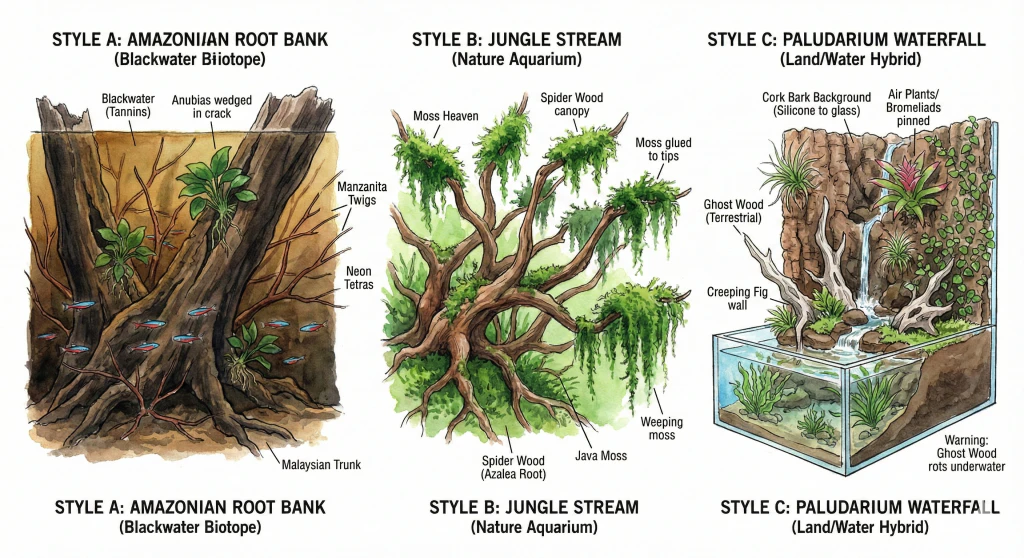
Style A (Amazon-Inspired Root Bank)
Use dark, tea-colored water with small tetras. Choose Malaysian driftwood for a heavy rugged trunk, then add small manzanita twigs radiating out to suggest fine roots. Note this mimics the look of an Amazon scene. A true geographic biotope also matches the region’s species and water chemistry, so choose fish (and their numbers and space) to suit your setup, not just the aesthetic.
Style B (Jungle Stream)
Use spider wood for its branching form, and attach small tufts of moss near the branch tips so it can grow downward into a green curtain. Branch tips dry out fastest above water, so pick a moss suited to emersed or misted conditions and make sure it gets enough moisture.
Style C (Paludarium Waterfall)
Build a cliff face trickling into a pool. Cork bark makes a good background, light and low-permeability, and can be attached to the back glass with an aquarium-safe silicone. Let the silicone cure fully, and check the load and drainage behind it. Air plants and bromeliads can be mounted in cork pockets or crevices. Avoid skewering the plant’s crown, and keep any fasteners clear of animals.
Accent the terrestrial section with ghost wood, which has a bleached, sun-dried look, and keep it above the waterline. Ghost wood is a trade name rather than a single defined species, so treat its underwater durability as unknown and do not submerge it as structure.
Paludarium Driftwood FAQ
What is the white fuzz on new driftwood?
A temporary white film on new wood is common and is often a harmless bacterial or fungal biofilm feeding on wood compounds, which some shrimp and snails will graze. You cannot confirm from appearance alone that it is harmless, and not everything white is benign. More importantly, a new tank can have ammonia and nitrite spikes, so do not add shrimp or snails to clean it until the tank is cycled and water tests read safe. If you dislike the look, you can gently remove some, but it often returns until the wood stabilizes.
Why does boiled driftwood still float?
Boiling does not drive out all the trapped air, so the piece may still need time to saturate. Rather than boil repeatedly, anchor the wood mechanically by screwing or zip-tying it to a flat rock or slate and burying the rock in substrate. Check that the hardware is aquarium-appropriate and will not trap animals.
Are tannins lowering the pH and harming the fish?
Buffering and pH
Tannic and other organic acids are weak, and if your tap water has meaningful carbonate hardness (KH), that alkalinity buffers a lot of the change.
Water with little or no buffering (such as pure RO) is much more vulnerable to swings.
Test Before Clearing Color
How much pH actually moves depends on how much wood you add, its extractives, your water volume, starting alkalinity, and your maintenance, so measure rather than assume a specific number.
Even Zoo Med notes that tannins can lower pH. If the water’s too dark for your taste, a polishing resin such as Seachem Purigen (a freshwater organic-scavenging resin) can help clear the color, but it isn’t a pH safeguard and doesn’t replace testing your pH, KH, ammonia, and nitrite.
Use the aquarium water-test kit guide to choose tests that cover those measurements rather than relying on color or smell.
How Wood Behaves in a Living Paludarium
Use the following limits to decide when wood is still suitable for a living paludarium.
Wood Composition and Decay
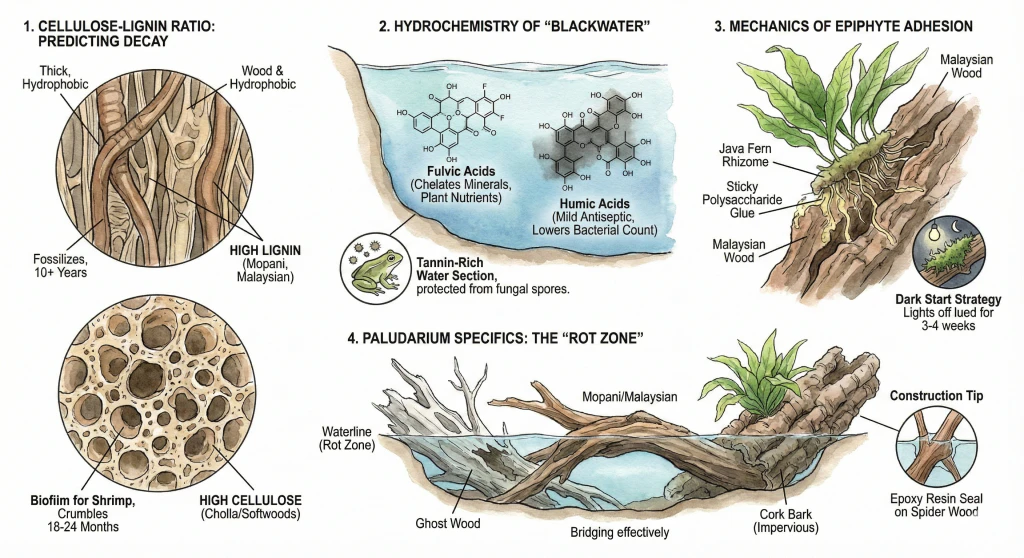
Underwater, wood is broken down by a range of organisms, including diverse fungi, bacteria, and oomycetes such as Saprolegnia, which is a water mold rather than a true fungus and only one of many decomposers. Dense, durable woods like the mopani and Malaysian driftwood sold for aquariums tend to resist breakdown longer, but no submerged wood is truly permanent. Cholla, a cactus skeleton, is porous and lightweight and grows biofilm readily, which can provide grazing in a shrimp tank, but it is not a load-bearing structure. Specific lifespans such as more than 10 years or 18–24 months are rough estimates without controlled comparisons, so treat them as approximate. Cholla skeleton is itself a lignified xylem network, so calling it simply low-lignin is not accurate.
The Chemistry of Blackwater
The tea color comes from a mix of dissolved organic compounds. Fulvic and humic fractions differ in size and solubility and can bind metals, which changes their availability. This can affect nutrient metals and potentially toxic ones, but the outcome depends on the water. Blackwater does not guarantee that iron stays available while every heavy metal is safely locked up. It is not sterile either. Even DOC-rich waters like the Rio Negro support diverse, active bacterial communities, so pathogen counts do not approach zero.
Be cautious with disease claims. There is no good evidence that a tannin-rich water section reliably protects frogs or newts from fungal infections, and reviews of chemical water treatments and amphibian disease report mixed results, including harm under some conditions.
Treat tannins as an aesthetic and water-chemistry choice, not as disease prevention, for a sick animal, seek diagnosis, quarantine, and veterinary care rather than relying on water color.
How Epiphytes Attach
Anubias and Java fern can establish on wood and rock using holdfast roots, and a rough surface gives those roots more to physically grip than a smooth one, which is why textured wood often holds them better.
Direct evidence is lacking for the claim that these plants’ root hairs secrete a special sticky glue that fails on smooth manzanita, so that proposed mechanism remains unconfirmed. In practice, attach them with a suitable cyanoacrylate gel or tie them on with fishing line. Suppliers like Tropica recommend line and note that the rhizome should not be buried.
Dark Start Is Not a Rooting Method
A conventional dark start cycles the hardscape, substrate, and filter without plants for a few weeks. It is not a way to root already-attached plants. If you have already glued or tied on Anubias, Java fern, or moss, keeping the lights off for weeks blocks photosynthesis and can harm the plants. Tropica instead suggests starting a newly planted tank with reduced lighting, around 6 hours a day, for the first few weeks.
Paludarium Specifics (The Waterline)
Where wood meets both air and water at the waterline, alternating wet and dry conditions can speed decay for some woods. The effect depends on the species, temperature, and how the piece is used, so the waterline is not a universal worst zone. Dense, durable woods like mopani tend to hold up better across this interface than soft, unknown pieces such as ghost wood. Cork bark is light and low-permeability, which makes it useful for backgrounds and planter pockets near the surface, but treat a cork assembly as water-resistant rather than truly impervious or rot-proof.
Compare Common Paludarium Woods
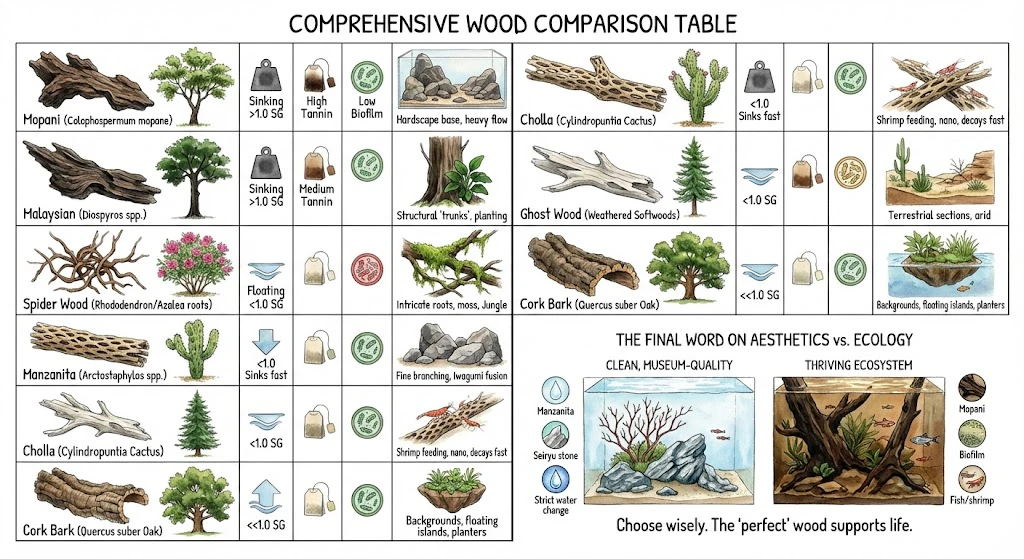
Read Trade Names as Broad Categories
The comparison provides general guidance rather than specifications for a particular piece. Trade names such as Malaysian, spider, and ghost wood can refer to different species depending on the seller, so the source-plant column is approximate, and density, tannin, and biofilm behavior vary from piece to piece.
| Wood Type | Source Plant | Density (S.G.) | Tannin Level | Biofilm Risk | Best Design Use |
|---|---|---|---|---|---|
| Mopani | Colophospermum mopane | >1.0 (Sinks) | High | Low | Hardscape base, heavy flow, caves |
| Malaysian | Trade name. Often ebony-family (Diospyros) wood, but varies by seller | >1.0 (Sinks) | Medium | Low | Structural trunks and planting surfaces |
| Spider Wood | Trade name. Often sold as rhododendron/azalea root, not guaranteed | <1.0 (Floats) | Low | High | Intricate roots, moss attachment, Jungle style |
| Manzanita | Arctostaphylos spp. | +/- 1.0 (Varies) | Low | Low | Fine branching, Iwagumi fusion, detail |
| Cholla | Cylindropuntia (Cactus skeleton) | Low density. Needs soaking/anchoring | Low | Low | Shrimp feeding, nano tanks (decays fast) |
| Ghost Wood | Trade name. Weathered wood, species not standardized | <1.0 (Floats) | Medium | Medium | Terrestrial sections, arid aesthetic |
| Cork Bark | Quercus suber (Oak) | <<1.0 (Floats) | Low | Low | Backgrounds, floating islands, planters |
Build for the Ecosystem, Not the Photo
Prioritize Stability and Animal Needs
Secure Before Filling
Choose known, sound wood for the water zone, anchor heavy pieces before filling, and match water chemistry and space to the animals before styling the tank.
Dense, aquarium-sold woods are dependable choices. Mopani for density, Malaysian driftwood for structure and planting, and spider wood for intricate detail.
Expect some tannin tint and a temporary biofilm on new wood, secure the hardscape mechanically before you fill the tank, and cycle the tank and test your water before adding animals.
Match Livestock First
The best piece is the one that supports the animals and plants you’re keeping, not just the one that looks good in a photo.
Choose your livestock first, then match the water chemistry, load, and layout to their needs.
Affiliate Disclosure
This article contains Amazon affiliate links. As an Amazon Associate I earn from qualifying purchases. If you use these links, the site may earn a commission at no extra cost to you. Product availability, price, and specifications can change. Check the current listing before buying.