
Leaf Shine and Dust: Why Heavy or Frequent Use Can Backfire, and How to Clean Leaves Safely
Why frequent or heavy leaf-shine use and kitchen hacks can interfere with a leaf’s stomata, how dust reduces the light reaching leaves, and a gentle, physical-first way to clean foliage.
Jordan Cole · Published 2025-12-15 · 14 min read
Key Takeaways
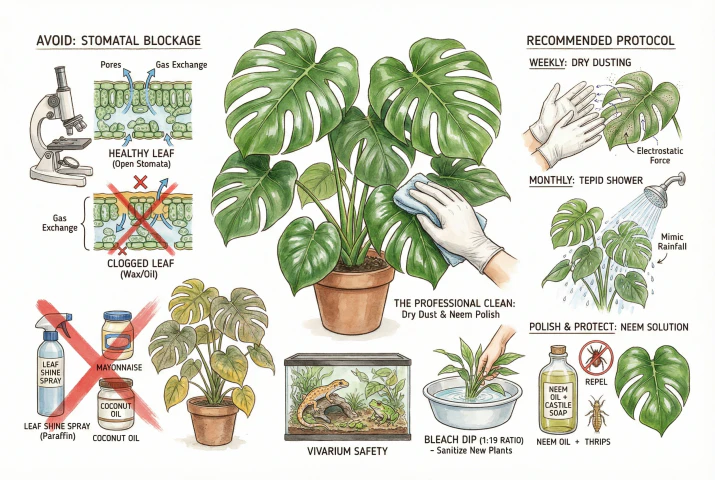
- A leaf exchanges gases through microscopic pores (stomata). CO₂ in, oxygen released as a photosynthesis byproduct, and water vapor out, with the evaporation helping to cool the leaf. Heavy or frequent leaf-shine application can leave a film that interferes with those pores, which is why university extension services suggest skipping these products and cleaning leaves physically instead.
- Dust isn’t only cosmetic. Studies (mostly on crops, under heavy experimental dust loads) show a dust layer can act like shade, lowering the light reaching the leaf, and fine particles can plug stomata. How much ordinary indoor dust matters depends on your light levels and how much accumulates.
- Kitchen hacks such as mayonnaise, milk, cooking oil, and beer have no demonstrated benefit and leave residues that are hard to remove, so it’s better to skip them.
- A gentle, physical-first routine works for most plants. Dust with a soft cloth or microfiber when dust is visible, and give sturdy plants an occasional lukewarm rinse. Adjust for leaf type (pubescent (hairy), glaucous, succulent, and wet-sensitive plants need different handling).
- For vivariums and terrariums housing reptiles or amphibians, avoid using unverified chemical residues on foliage, because amphibian skin is permeable. Follow an amphibian/reptile veterinarian or a recognized husbandry protocol rather than a general houseplant recipe.
Leaf-shine products can make foliage look glossy, but university extension services generally suggest skipping them. Heavy or frequent application can leave a film that clogs the pores a leaf uses to exchange gases, and the University of Minnesota and Iowa State extensions both recommend cleaning leaves with a damp cloth or a gentle shower instead.
The biology behind that advice also points to a gentle, physical way to clean foliage.
1. The Science (Stomata, Dust, and Respiration)
A leaf does three main jobs. It captures light for photosynthesis, exchanges gases through its pores, and loses water vapor that helps cool it.
Coating the surface can interfere with more than one of these, so it’s worth understanding how they work before reaching for a spray.
On a sturdy washable leaf, I clean one half with plain water and the recommended soft method while leaving the other half untouched for comparison. I photograph after the leaf dries, because wetness alone creates shine.
If both halves look the same after drying, I stop rather than escalating to oil or aerosol. The goal is removing residue, not manufacturing gloss.
I wipe a small upper and lower surface with separate white cloth sections. Sticky or colored residue on one side can reveal an old shine product, honeydew, or pest debris that a distant photo misses.
The Stomata (The Plant’s Mouths)
Leaf surfaces (mostly the underside, sometimes the top, depending on species) carry microscopic pores called stomata (each flanked by two guard cells that open and close the pore in response to light, humidity, CO₂, water status, and other cues).
Gases diffuse both ways through them, with the main flows listed below.
- CO₂ in (the carbon source for the sugars made in photosynthesis).
- Oxygen out (a byproduct of photosynthesis (leaves also take up oxygen for respiration, so the net direction depends on conditions)).
- Water vapor out (transpiration). The plant pulls water up from the roots and releases vapor through the stomata. This transpiration stream helps move mineral nutrients upward, and the evaporation contributes to cooling the leaf, though the amount varies with species, humidity, and how much water the roots can supply.
How Leaf Shine Can Interfere
Commercial leaf-shine sprays vary widely in formulation. Some are oil-based, some use waxes such as paraffin, and some are silicone-based and sold as non-oily.
Product labels and safety data sheets differ, so it’s worth reading the one you actually have rather than assuming.
That said, university extensions describe a few ways a coating can interfere, especially with heavy or repeated application.
- Clogging the pores. A film can settle over the stomata. Iowa State notes that large or frequent leaf-shine application can plug stomata and build up a sticky layer. When gas exchange is reduced, photosynthesis can be affected. This is a matter of degree, not an on/off switch.
- Reduced cooling. Because transpiration contributes to leaf cooling, reducing it can affect the leaf’s heat balance. Oils in general can also be phytotoxic under hot, bright, or drought-stressed conditions, so the risk depends on the product and the situation.
- Residue that catches dust. A sticky residue can attract dust and grime over time, which is harder to remove later. How tacky a residue is depends on the specific product.
Distinguish Pesticide Oils from Cosmetic Shine
Highly refined horticultural mineral oils are routinely applied to foliage as label-directed pesticides for scale, aphids, and mites.
Colorado State Extension explains that modern refined oils are far safer for growing-season use than the heavy oils of the past.
Oil on a leaf is not automatically fatal. The outcome depends on the formulation, dose, plant species, and conditions.
The practical takeaway from extension guidance is that routine cosmetic leaf-shine is usually unnecessary, and physical cleaning is the safer default.
Dust and Light
Dust is worth removing too, for a few physics-based reasons.
- Shading. A dust layer can act like a shade cloth. Research (below) shows that under heavy experimental dust loads, dust accumulation lowered the light reaching the leaf and reduced photosynthesis. How much this matters for an ordinary indoor plant depends on your light levels and how thick the dust gets. The studies used crop plants and heavy loads, not typical household dust.
- Stomatal plugging. Fine particles can settle into or over the pores, affecting the plant’s control of water loss and gas exchange, and dust can raise leaf temperature by absorbing radiation. In the 1995 study below, the effect was greatest when the stomata were open at the time of dust application and negligible when they were closed, and smaller particles had a larger effect.
- Chemical reactivity. Some dust isn’t inert. Cement or limestone dust can be alkaline, and in that case, combined with moisture, it could plausibly injure leaf tissue. This is more of a concern near construction than in an ordinary home, and it’s worth distinguishing from other causes of leaf spotting. Mineral deposits from hard water, powdery mildew, scale insects, or pesticide residue can all look similar.
The Takeaway
Removing dust helps light reach the leaf, and physical cleaning does that without adding a synthetic coating.
Similar effects as shade tolerance induced by dust accumulation and size penetration of particulates on cotton leaves
Physical effects of dust on leaf physiology of cucumber and kidney bean plants
2. A Gentle Cleaning Routine
Instead of shine products or kitchen hacks, clean leaves physically. There’s no fixed schedule that fits every plant. Clean when dust is visible, and let your light levels, room conditions, leaf type, and the plant’s response set the interval rather than a strict weekly or monthly calendar.
Over-handling can do its own harm.
Dry Dusting
Get loose debris off before wetting anything, since wiping a dusty leaf while wet can smear grit across the surface.
For delicate or hairy leaves, a soft brush may be gentler than wiping.
- Tool. A soft, clean cloth or microfiber. Microfiber’s split fibers tend to grab and hold dust rather than push it around, but keep the cloth or glove clean, and be careful on hairy or waxy leaves where fibers can catch.
- Technique. For large, firm leaves, support each leaf from underneath with one hand so you don’t snap the petiole, and wipe gently. Don’t wipe pubescent (hairy), very young, glaucous, or carnivorous leaves (dust those with a brush or leave them alone).
The Rinse
For sturdy medium-to-large plants (such as Monstera, Ficus, or palms) that are tedious to wipe leaf by leaf, a lukewarm rinse in the shower or sink is an efficient deep clean.
It suits firm-leaved plants. Avoid overhead water on plants with fuzzy foliage, dense crowns, or flowers that collect water, and on plants prone to disease when the foliage stays wet.
- Protect the soil. If you’re worried about the soil washing out, you can shield it with a plastic bag at the base, but note that fully covering the soil means you can’t flush it at the same time.
- Temperature. Use comfortable lukewarm water, not hot. Very cold water can stress the roots of tropical plants, and hot water can damage the surface. Keep it in a comfortable range and watch how sensitive species respond.
- Pressure. A gentle spray (enough to knock dust off, not so strong it damages delicate tissue).
- Drain fully before returning the plant to a decorative pot, and don’t let it sit in standing water. Separately, if you want to flush accumulated fertilizer salts, do that with the soil uncovered and enough water to drain through freely. It doesn’t need to happen every time you rinse the leaves.
A Note on Pests (Keep Cleaning and Treatment Separate)
It’s tempting to combine cleaning with pest prevention in one wipe, but the two are better kept separate.
Cosmetic cleaning is for healthy foliage. Pest control should be a deliberate response to a pest you’ve actually identified, using a product labeled for that pest and plant.
Routinely coating healthy leaves with any oil isn’t the same as spot-treating a confirmed infestation, and it carries its own phytotoxicity risk under heat, bright light, or stress.
Use Neem Only for a Confirmed Pest
Neem oil is not a minimum-risk (FIFRA 25(b)) exempt ingredient, and the EPA states that a neem product making pest-control claims must be registered as a pesticide.
Cold-pressed neem oil can contain azadirachtin, while the clarified hydrophobic extract sold for many products has had most azadirachtin removed. That clarified oil is itself a registered active ingredient against mites, aphids, whiteflies, and some fungal diseases, so it is not merely inert fat.
If you do have a pest to treat, use an EPA-registered neem, azadirachtin, or horticultural-oil product and follow its label for the rate, interval, protective equipment, pollinator and aquatic precautions, sensitive-plant list, and temperature and stress limits.
Extension guidance also notes that oils can be phytotoxic on sensitive plants and under hot or humid conditions.
Two common substitutes are worth flagging here (a raw cosmetic neem oil and a general-purpose Castile soap). Neither is a registered plant pesticide or a validated leaf-cleaning input, so treat them as background reference rather than a proven recipe.
A cold-pressed neem oil sold for skin, hair, and nails has a strong sulfur/garlic odor, but it is a cosmetic product. It does not carry a plant-pesticide label, an EPA registration number, an azadirachtin percentage, or directions for pests, dilution, or reapplication.
For actual pest control, choose a product labeled and registered for that use instead.
A genuine Castile soap is, unlike a synthetic dish detergent, free of synthetic detergents. However, its official uses are for body, hands, face, cleaning, and pet washing, not as an insecticidal soap for living plant tissue.
Colorado State Extension notes that registered insecticidal soaps (potassium salts of fatty acids) are tested for both efficacy and phytotoxicity, whereas household-soap recipes have inconsistent formulation and can injure plants with repeated use.
If you need an insecticidal soap, use a registered one and follow the label, testing a small area first.
Hard-Water Spots
White crusty spots that won’t wipe off are often mineral deposits from tap water, though white residue can also be fertilizer salts, powdery mildew, or scale insects, so identify what you’re looking at first.
The simplest fixes are prevention and gentleness. Use lower-mineral water where you can, wipe spills promptly, and gently damp-wipe deposits.
If you want to try a mild acid on true mineral deposits, dilute white vinegar or lemon juice heavily, test a small hidden area first, wipe with plain water afterward, and don’t leave acid to dry on the leaf.
Because lemon juice acidity varies and organic residue can linger, this isn’t an extension-validated recipe. Treat it as a spot-test option, not a routine.
3. Vivariums and Terrariums
If you’re housing plants with reptiles or amphibians, be cautious about any chemical residue on the foliage.
Amphibian skin is permeable and can absorb compounds from its environment, so unverified leaf-shine or cleaner residue can pose a serious exposure risk.
Rather than follow a general houseplant recipe, use plants prepared according to an amphibian or reptile veterinarian’s advice or a recognized husbandry protocol.
Reptiles and amphibians don’t share the same skin sensitivity, so match the guidance to your specific animal.
Preparing Plants for an Enclosure
Introducing plants to a bioactive enclosure means reducing hitchhikers (snails, aphids, fungi, nematodes), not just dust.
No single dip removes all of these, so treat the steps below as a general starting point and defer to a husbandry protocol for your species. Remove the animals before doing any cleaning near the enclosure.
- Consider bare-rooting the plant to remove nursery soil and reduce introduced fertilizer and pests, but weigh this against the root stress it causes, and check that the plant species itself is safe for your animal and that any substrate particle size is appropriate. Bare-rooting is hard on some species.
- Bleach dips are not a validated treatment for live foliage. Veterinary guidance (Merck) describes bleach for disinfecting equipment and housing materials, roughly 30 mL of bleach per liter of water for at least 30 minutes, then rinse and dry, not as a foliage dip. Household bleach is about 5–9% sodium hypochlorite, so a 1/19 dilution is only about 0.25–0.45% active chlorine, which is easy to misread. Because a short foliage dip has no validated efficacy or safety data for plants, and carries a real risk of tissue burn and retained chlorine, it’s better to skip it and disinfect equipment separately. If you ever use bleach, keep animals out of the room, use an unscented regular product, ventilate, wear gloves and eye protection, never mix it with vinegar, other acids, or ammonia, mix it fresh, and rinse completely.
- Rinse thoroughly with dechlorinated water. A rinse reduces surface residue but doesn’t guarantee zero retained oxidant, which is another reason to avoid bleaching live plants.
- Quarantine the plant separately so pests can reveal themselves before it goes into your setup. For a serious amphibian collection, follow a veterinarian or institutional protocol for isolation, tools, and observation.
Pruning for Health
Removing dead or diseased material is reasonable sanitation, especially in a humid enclosure.
In some bioactive setups leaf litter is intentional, so remove decaying material rather than clearing everything out.
- Cut, don’t pull fully dead or diseased leaves with a clean, disinfected tool. Pulling can damage the stem or uproot small plants. Distinguish natural leaf drop from disease.
- Clearing detritus. Removing loose dead material from dense ferns can improve airflow. Do this gently by hand. Turning a plant upside down and shaking it can damage delicate fronds, loosen the medium, or disturb a resident animal, so it isn’t a universal technique.
- In an enclosed system, keeping the glass clean helps light get in. Use an animal-safe cleaner, rinse and dry fully, and remove any resident animals first.
What About Natural Commercial Sprays?
Some newer sprays market themselves as natural, for example, neem plus essential-oil blends like lemon myrtle and eucalyptus, sometimes with a microbial additive.
Avoiding petroleum and silicone doesn’t by itself make a product safe, especially around animals.
Essential oils are not automatically pet-safe. The ASPCA lists eucalyptus (eucalyptol) as toxic to dogs, cats, and horses, and veterinary poison specialists note that concentrated essential oils can be absorbed through the skin, by ingestion, or by inhalation, with the risk depending on concentration and the animal. Terms such as breathable and degradable are not defined safety standards, and a product breaking down over time doesn’t remove the immediate exposure risk after application.
Don’t assume any spray is pet-safe based on its ingredient class. Check the specific product label and, in an enclosure, assess safety for your specific animal species before using it.
4. Kitchen Hacks to Skip
Several popular DIY shine tricks have no demonstrated benefit and leave residues that are hard to remove, so it’s better to skip them.
Mayonnaise or Milk
These leave fat and protein on the leaf that can go rancid and become sticky, and the residue can be difficult to remove cleanly. There’s no evidence they help the plant.
Coconut or Olive Oil
These oils stay on the surface and can attract dust over time, adding a coating without any benefit to the plant.
Garden-Center Aerosols
Being sold in a store doesn’t mean a product benefits the plant. Formulations vary, and some data sheets list flammable solvents (a reason to read the specific label).
Given that extension services suggest physical cleaning over shine products, there’s little reason to use them routinely.
Beer
Leaves don’t meaningfully absorb nutrients from a beer film, and the residual sugar can attract or feed microbes. There’s no benefit worth the mess.
5. Conclusion
A healthy leaf’s normal appearance varies by species. Some are naturally glossy, others are matte, hairy, or covered in a waxy bloom (glaucous).
A dull look isn’t automatically a problem, and natural wax or bloom shouldn’t be polished off with oil or soap, so before treating a leaf, check whether it’s actually dusty, short on water, or showing signs of pests.
The simplest, lowest-risk approach for most plants is physical. Remove dust with a soft cloth or microfiber when it’s visible, give sturdy plants an occasional lukewarm rinse, and adjust for leaf type.
Keep pest control separate. Treat a pest you’ve identified with a product labeled for it. That’s more reliable, and gentler, than any cosmetic coating.