
Rooting Hormone Science: Auxins, IBA, and Why DIY Fails
How rooting hormone works: auxin and adventitious roots, how IBA, IAA, and NAA differ, starting ppm ranges by tissue type, and what willow water, honey, and cinnamon actually do, with the caveats that depend on species and method.
Marcus Hale · Published 2025-12-14 · 19 min read
Key Takeaways
- Auxin can start a root and then inhibit its elongation, so dose and timing matter. A cutting roots when auxin builds up near the basal wound and reprograms competent cells into a root. Both a concentrated quick dip and a dilute soak are real methods, and the better choice depends on species, formulation, and label.
- IBA is the common commercial rooting auxin, while NAA is another synthetic option that can become phytotoxic at high doses. IBA is chemically stable and can be converted to active IAA in some plants. Both are used alone and in IBA plus NAA blends, so match the product to the species and follow the label.
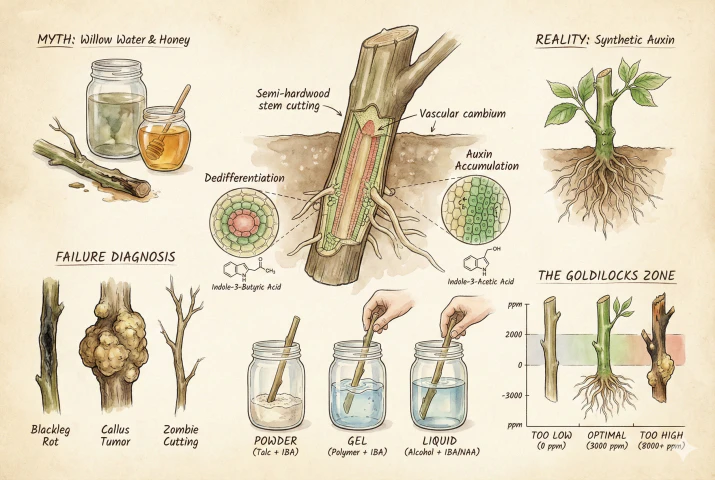
- Use ppm ranges only as a starting point and adjust them with the species, season, and a small trial. Roughly 500–1,000 ppm suits many soft cuttings, 1,000–3,000 ppm many semi-hardwood cuttings, and 3,000–8,000+ ppm difficult woody material. Excess callus is not proof of overdose.
- Willow water, honey, and cinnamon are variable home remedies rather than calibrated auxin products. Their effects differ by species and preparation, and recent trials show inconsistent rooting benefit. A plain-water control is a reasonable first option for easy-rooting cuttings.
- Hygiene and environment can matter as much as hormone. Use clean sharp tools, decant gel into a disposable cup, use an airy low-nutrient medium, and manage humidity and root-zone temperature to the species with ventilation to limit disease.
Start With a Clean, Species-Appropriate Cutting
Rooting success depends on healthy material, a clean cut, an airy moist medium, and an environment that limits drying and rot. A rooting hormone can help some cuttings, but it does not compensate for poor hygiene or the wrong conditions.
Use a small trial when the species is unfamiliar. That gives you a plain-water comparison and lets you adjust the product, dose, or environment without risking every cutting.
I label every cutting by source node and treatment before opening the rooting product. Similar cuttings become indistinguishable after dipping, which makes a later success rate meaningless.
When the plant material allows it, an untreated group stays under the same medium, humidity, temperature, and light. Root number, callus, rot, and survival stay as separate outcomes.
A small working amount goes into a separate clean cup and never returns to the original container. This keeps wet cuttings and plant pathogens from contaminating the whole product.
Why Dose and Timing Matter
Auxin is the plant signal that helps start new roots at the cut end. Too little may make no difference, while too much or too long an exposure can stall root growth or damage tender tissue.
Roots Start Near the Wound
New roots form from suitable cells near the cut. The exact response varies by species, cutting age, season, and the condition of the stock plant, which is why a product cannot promise the same result for every cutting.
Use the product label as the starting dose, then change only one variable at a time in a small trial.
Effects of Auxin (Indole-3-butyric Acid) on Adventitious Root Formation in Peach-Based Prunus Rootstocks
Choose the Auxin and Formulation for the Cutting
Commercial products usually use a stable synthetic auxin so the amount is more consistent than a home remedy. IBA is common. NAA is also used, either alone or in a blend, but it can be harsh on tissue at the wrong dose.
Indole-3-Acetic Acid (IAA) (The Natural Auxin)
IAA is the auxin the plant produces naturally, and it can induce adventitious rooting at appropriate concentrations. It is widely used in tissue culture.
Its practical drawback outside a controlled setting is stability. IAA can be degraded by light, oxidation, microbial activity, and the plant’s own enzymes, and how much this matters depends on solution pH, temperature, formulation, and exposure time.
That instability is one reason most commercial rooting products use a more stable synthetic auxin as the main active ingredient rather than raw IAA.
Indole-3-Butyric Acid (IBA) (The Common Choice)
IBA is the auxin most commonly found in commercial rooting products. Although it occurs naturally in some plants, the commercial version is synthetic and more chemically stable than IAA.
Plants can convert IBA into the active auxin IAA in some systems. That supports its use, but it does not prove that IBA is best for every species or that one percentage fits every formulation.
1-Naphthaleneacetic Acid (NAA) (The Other Synthetic Auxin)
NAA is a synthetic auxin. It is sometimes described as being resistant to breakdown, but that’s not quite accurate. Radiolabeled studies show plants do metabolize NAA, forming conjugates such as NAA-glucose and NAA-aspartate.
Its uptake, movement, and persistence depend on the tissue and concentration.
Where NAA Can Help
For some difficult woody cuttings, NAA alone or with IBA can improve rooting where IBA alone is less effective, though this varies by species and dose.
Why NAA Needs Caution
Like other auxins, NAA can cause phytotoxicity when the dose is too high for the tissue, including blackening, excessive callus, and stalled root elongation. It is used both on its own and blended with IBA. There is no single dose that is safe or toxic across all species, so follow the product label and, where possible, run a small trial.
Indole-3-butyric acid promotes adventitious rooting in Arabidopsis thaliana thin cell layers by conversion into indole-3-acetic acid and stimulation of anthranilate synthase activity
Blends Are Not Automatically Better
Some products combine IBA and NAA. A blend may suit a difficult cutting, but it is not an automatic upgrade over a single-auxin product. Match the label to the species and test a small group first.
2.4 The Callus Conundrum
Callus Is Not a Diagnosis
A common sight is callus, a bumpy mass of dividing cells at the cut end. Gardeners often read it as a sign that roots are imminent, but the relationship depends on the species.
In some plants, callus and roots form more or less independently, so callus alone doesn’t guarantee roots.
In others, rooting is indirect and callus tissue is actually the pathway the roots emerge from. So callus is not automatically good or bad.
Very heavy callus can, in some cases, get in the way of root emergence, but the amount of callus by itself does not diagnose a hormone overdose (genotype, cutting age, wounding, carbohydrate status, the medium, and infection all play a role).
If a cutting produces a lot of callus and no roots over a reasonable time, it’s worth checking the dose along with those other factors rather than assuming the concentration was too high.
2.5 The Role of Carbohydrates and Nitrogen
Stored Carbohydrates Support Rooting
Hormones are the architects, but stored sugar is the building material. A cutting with no leaves and little stored carbohydrate has less to work with when it tries to build roots, which is one reason the balance between carbohydrates and nitrogen in the donor plant can matter.
- Very high nitrogen tends to push soft, leafy growth and can be associated with poorer rooting in some crops.
- Adequate stored carbohydrate gives the cutting energy and carbon to draw on, though it isn’t sufficient on its own (light, hormone response, and a healthy sink all matter too).
For some crops, propagators adjust stock-plant nutrition before taking cuttings. The effect is species-specific, and reducing nitrogen too far can cause its own problems, so this is a variable to manage with the crop in mind rather than a rule that a lush, green cutting is doomed.
Tools of the Trade
Moving from theory to practice means picking the right formulation. The market offers powders, liquids, and gels, each with a devoted following.
3.1 Formulations (Powder vs. Gel vs. Liquid)
Talc Powders
IBA is mixed with inert talc. You dip a usually pre-wet stem and the powder sticks. If you tap out a working portion and discard the excess, you avoid contaminating the main container, but powder is not inherently more sanitary because dipping a cutting straight into the container contaminates it too.
Shelf life is not indefinite. Prepared talc formulations can lose potency over time, so follow the product’s label date and storage instructions.
The tradeoff is less consistent dosing. A rough or wet stem picks up more than a smooth or dry one.
Gels
IBA is suspended in a water-soluble polymer. Gels cling to the cut and are easy to apply. Claims that gels seal the cut against air embolisms or deliver an identical dose every time aren’t supported by the product label or independent comparisons, and how thickly you apply the gel still affects how much hormone is delivered.
Keep the Bottle Clean
Don’t dip a dirty cutting straight into the bottle. Decant a working amount into a disposable cup and discard the leftover.
Gels also tend to cost more and have a shorter shelf life than powders, which is worth considering for high-value indoor clones and hydroponics.
Liquid Concentrates
IBA (often with NAA) dissolved in alcohol or water. These let you dilute to a chosen concentration and use either a quick dip or a dilute soak.
Alcohol-based carriers can help penetrate woody stems, but the alcohol also poses tissue-injury and fire risks that depend on its concentration and how you dilute it.
Dilute correctly for the tissue, keep the concentrate away from ignition sources, and handle and dispose of it per the label.
A liquid concentrate is useful when you want to tune the concentration across different species.
3.2 Choosing a Product by Tissue Type
Read the Label Before Choosing Strength
Focus on the active ingredient and concentration on the label rather than the brand, and match it to a rough starting range for the tissue (then confirm with the label and a small trial for your species).
For many semi-hardwood and houseplant cuttings, a mid-strength gel around 0.31% IBA, which is 3,100 ppm rather than 3,000, is a reasonable middle-of-the-range choice.
Easy-rooting aroids like pothos and philodendron often root in plain water without any hormone, so a hormone isn’t always necessary, and these soft stems are not truly semi-hardwood.
Clonex Rooting Gel
Clonex Rooting Gel is a widely available product in this range. Decant a little into a disposable cup and don’t dip into the bottle.
Follow the label for application depth and for the human-safety and disposal notes (it is harmful if swallowed and should be kept off skin and eyes).
Gel costs more per use than powder and won’t last as long on the shelf. For a handful of high-value cuttings the convenience can be worth it, but for easy-rooting houseplants a plain-water start is a reasonable no-cost alternative.
For harder-to-root, moderately difficult material you need a higher dose. Hormex #8 is 0.80% IBA (8,000 ppm).
The current manufacturer guide places #8 in the semi-hardwood and moderately difficult band, and lists a higher grade #16 for genuinely difficult hardwood and tree cuttings. Choose the number from Hormex’s own species chart rather than assuming #8 is the hardwood option.
A high strength like this is more likely to injure a tender softwood cutting, so reserve it for material that needs it and follow the label for the correct strength by species and for removing excess powder.
Hormex Rooting Hormone #8
Hormex Rooting Hormone #8 is a high-strength powder that is inexpensive per use but easy to over-apply on tissue that doesn’t need it.
Match the Hormex number to the species chart rather than treating #8 as a default for all woody stems.
For easy-to-propagate plants, a low-strength 0.10% IBA (1,000 ppm) powder like Bontone II is a simple option, and the manufacturer markets it for easy-to-propagate plants.
Its only active ingredient is IBA, so it provides a small auxin nudge. It does not add antimicrobial protection at the cut. Follow the label rather than assuming it’s impossible to over-apply.
Bonide Bontone II Rooting Powder
Bonide Bontone II Rooting Powder is a mild powder that will not push difficult woody stems. For genuinely easy cuttings, keep in mind that many will root with little or no hormone at all.
If you want one bottle you can dilute for different species, a liquid IBA plus NAA concentrate like Dip N Grow at 1.0% IBA and 0.5% NAA can be diluted for soft stems or used stronger for wood.
Its US label is for ornamental use, and it specifies water dilutions by tissue, roughly 1/5 for hardwood, 1/10 for medium hardwood, and 1/20 for softwood or succulents, followed by a 3–5 second dip of the basal end.
Mix only what you’ll use, run a small trial first, and don’t return leftover to the bottle.
Safety Note
The concentrate is a flammable liquid. Its carrier is roughly 41% ethanol plus about 20.5% isopropanol (over 60% alcohol), with a flash point near 23 °C (73 °F).
Keep it away from heat, sparks, and flame. Avoid eye and skin contact (it can cause eye and mild skin irritation). Use a dedicated disposable container, not a drinking vessel, and dispose of it per the label.
Dip 'N Grow
Dip 'N Grow is a dilutable concentrate that is versatile and economical per cutting, but it demands accurate measuring and careful handling of the alcohol carrier.
Get the dilution wrong on soft tissue and it can injure the cutting.
3.3 The Protocol (A Step-by-Step Procedure)
Treat propagation like minor surgery. Clean hands, clean sharp tools, and no lingering plant debris.
The real risk isn’t rust itself but a dull or dirty tool spreading pathogens between plants. Clean and disinfect tools between cuttings, giving the disinfectant enough contact time to work.
This procedure describes a typical semi-hardwood houseplant cutting. Softwood, hardwood, and leaf/root cuttings follow their own variations, so adjust the steps to the material rather than treating one recipe as universal.
Step 1. Media
Use a clean, low-nutrient, airy mix. A 50/50 peat and perlite blend is one common example, holding water while draining fast. Rockwool cubes or peat plugs are alternatives.
Note that a mix you blend yourself is clean, not sterile, and the best medium depends on the crop, container, irrigation, and water quality.
Pre-moisten to wrung-out sponge damp, never sopping. Poke a hole with a pencil or dibber before inserting the cutting. Shoving a gel-coated stem into media just wipes the gel off.
Step 2. The Cut
For a semi-hardwood cutting, choose a healthy stem in the transition zone, where green growth is just firming up.
Softwood and hardwood cuttings are also standard methods with their own timing.
Cutting just below a node is a useful default for many stem cuttings, though not all roots emerge at nodes. Internodal rooting occurs too.
For some hard-to-root woody species, wounding the base (scraping a short strip of bark to expose the cambium) can help. Skip it on species where it isn’t needed, since extra wounding can also invite desiccation or infection.
Step 3. The Dip
Decant a small amount of hormone into a dedicated disposable container, not a cup or glass you’ll drink from, and don’t pour leftover back into the bottle.
For gel, coat the base to the depth the label specifies. For powder, dip the pre-wet stem if the label calls for it, then tap off the excess so only a light dusting remains.
For liquid, follow the product’s label. For a diluted concentrate like Dip N Grow, a 3–5 second dip of the basal end is typical, but other products and dilutions differ.
Step 4. Stick and Firm
Insert into the pre-made hole and gently firm the media for good contact. Aim for firm contact without air gaps, but don’t over-compact, since that reduces the oxygen the base needs.
Step 5. Environment
The cutting has no roots to drink but has leaves that lose water, so raise humidity with a dome or clear bag to slow transpiration.
Don’t seal it airtight, though. Allow some air exchange, because constant saturation and condensation encourage Botrytis and bacterial disease.
Vent periodically and gradually harden the cutting off as it roots.
Use gentle, indirect light. Direct sun overheats cuttings inside a dome. A warm root zone helps many species. A heat mat under the tray, set on a thermostat and checked against measured media temperature (often in the mid-70s °F / low-20s °C for warm-loving plants), can speed metabolism.
This isn’t universal. Cool-climate hardwoods and other species have different optima, and you want a cutoff so the medium never overheats.
Busting Myths and Optimizing Ratios
Propagation hacks range from harmless to counterproductive. Their usefulness depends on dose, hygiene, species, and the rooting environment.
4.1 The Willow Water Myth
The Claim
Soaking willow twigs makes a tea that roots almost anything.
What the Evidence Shows
Willows (Salix spp.) contain salicylates and various phenolic compounds, but the composition of home-made willow water is not well characterized.
- Salicylic acid is involved in plant defense signaling through systemic acquired resistance, but its effect on rooting is dose-dependent. Low concentrations may help and higher ones may inhibit, and defense signaling is not the same as reliably fighting rot on a cutting.
- Auxin content is uncertain and variable by species, tissue, and season. In one Salix extract analysis, IBA was not detected at all, and a winter extract increased root number but not root length in a test plant (showing how much preparation and season affect the result).
Practical Read on Willow Water
Willow water may help in some species and preparations, but there isn’t direct comparative evidence that it generally beats plain water or that it matches a labeled product.
It is variable and unmeasured rather than a calibrated dose.
Fine to experiment with. For high-value cuttings, a labeled product or a plain-water control is more predictable.
4.2 Honey and Cinnamon
The Claim
Both are natural rooting hormones.
What the Evidence Shows
Neither is a calibrated auxin product, and their effect on rooting is not consistent.
- Honey shows antimicrobial activity in lab tests, but that isn’t the same as protecting a cutting in practice. A 2025 factorial trial on rose, camellia, and magnolia found honey did not consistently raise rooting percentage. The results varied by species and interacted with IBA.
- Cinnamon extracts have inhibited some fungi in research settings. For example, a quantified cinnamon water filtrate suppressed Botrytis cinerea when repeatedly sprayed on tomato. That is not the same as dusting kitchen cinnamon on a cut, and it doesn’t make cinnamon a registered fungicide or damping-off a universal leading cause.
Practical Read on Honey and Cinnamon
Neither is an auxin substitute, and neither has been shown to reliably protect a cutting or improve rooting across species.
Treat them as folk remedies with uncertain, species-dependent effects.
4.3 Concentration Ranges
Starting Ranges by Tissue
Concentration matters, but it is one factor among several (species and cutting quality, season, media, sanitation, humidity, light, and temperature all shape the outcome, so no single number guarantees success).
Use tissue type only as a rough starting point, then adjust for your species and confirm with the product label and a small trial.
- Herbaceous / softwood. Roughly 500–1,000 ppm (0.05–0.1%) as a starting range. Some easy softwoods need no hormone at all.
- Semi-hardwood. Roughly 1,000–3,000 ppm (0.1–0.3%) for many species. Common gels such as Clonex sit near the top of this band (0.31% = 3,100 ppm).
- Difficult woody material. Often 3,000–8,000+ ppm (0.3–0.8%), using a high-strength powder or a concentrated dip. The upper end is species-specific. Check the manufacturer’s chart (for example, Hormex’s #8 vs. #16) rather than pushing every woody stem to 8,000 ppm.
5. Troubleshooting
When things go wrong, a controllable variable is often involved, though biological variation and hidden pathogens play a part too. Use the symptoms below to narrow the likely cause.
My Cuttings Turned to Black Mush at the Bottom
This is a soft-rot symptom, but appearance alone doesn’t identify the cause. Waterlogging and low oxygen, various fungi, water molds (oomycetes such as Pythium, which is an oomycete, not a bacterium), and bacterial soft-rot organisms (now largely reclassified into genera like Pectobacterium and Dickeya, once grouped under Erwinia) can all look similar.
Start with general measures. Improve drainage and aeration, use clean media and containers, clean and disinfect tools between cuttings, and decant your gel.
If it recurs, check the stock plant, water, and bench as possible sources, or use a diagnostic lab to identify the pathogen.
The Cutting Dropped Its Leaves Quickly
A common cause is desiccation (leaves losing water faster than the stem can supply it) so raise humidity, and for large-leaved species you can trim leaves to reduce surface area (this adds wounds, so don’t do it by default on small-leaved cuttings).
Leaf drop can also come from temperature stress, auxin injury, disease, or normal leaf aging, so check those before assuming it’s ethylene buildup. Venting the dome is still good practice.
Lots of Callus at the End, but No Roots
Don’t assume this is a hormone overdose. The amount of callus doesn’t diagnose the dose. Give it time (some species root slowly and some root through callus), and consider genotype, cutting age, and possible infection.
Avoid scraping the callus off. That can damage emerging root initials and living tissue and open an infection route.
If nothing develops, take a fresh cutting and reassess the dose and conditions.
The Stem Is Alive and Green but Weeks In with No Roots
Before concluding it has failed, check the species’ normal rooting time, tissue viability (is the base still firm and green inside?), the season, temperature, and medium.
Older, more lignified, or dormant material can simply be slow. A warmer root zone and, for hard-to-root species, wounding may help next time.
Can I Dip in Water, Then Powder, Then Water Again?
No. A second water dip washes the powder off. If the label calls for pre-wetting, dip in water, dip in powder, tap off the excess, stick it in the hole, and leave it alone.
(Some powders don’t require pre-wetting, so check the label.)
Is Expired Rooting Hormone Still Usable?
An expired or degraded product may simply be less effective, but don’t assume it’s harmless. Check the product date, how it was stored, and whether the container is intact, and follow the label’s storage and disposal guidance.
Appearance alone (clumping in a powder, or a color or odor change in a gel or liquid) can be a sign to discard it, but it doesn’t reliably tell you the potency or whether it’s contaminated. When in doubt, replace it.
6. Conclusion
Propagation isn’t magic. It’s working with the plant’s own signaling to coax a root from a stem, and for many easy cuttings, no added hormone is needed at all.
DIY Versus Commercial Products
The studies to date use different species, doses, and conditions, so there isn’t a clean head-to-head ranking.
A labeled synthetic auxin gives a known, repeatable concentration, while willow water, honey, and cinnamon are variable and inconsistent. For difficult species, the calibrated product is the more reliable choice, but for easy ones a plain-water control is often enough.
Three Variables to Balance
Balance chemistry, hygiene, and environment. Match the concentration to the species and follow the label, keep tools and media clean with appropriate disinfectants, and set humidity, light, and temperature for the species.
Be skeptical of miracle growth-factor claims that don’t state an active ingredient. A missing IBA percentage doesn’t automatically mean the product is worthless because some legitimate products use NAA or another registered active, and easy cuttings may need no hormone.
Check the registered active ingredient, the intended use, and any label claims before you buy.
Affiliate Disclosure
This article contains Amazon affiliate links. As an Amazon Associate I earn from qualifying purchases. If you use these links, the site may earn a commission at no extra cost to you. Product availability, price, and specifications can change. Check the current listing before buying.