
Paludarium Hard Water Stains: Removal & Prevention Guide
Remove and prevent hard water stains in a paludarium: the calcium-carbonate chemistry, a careful citric-acid-and-razor removal method for an animal-free workspace, and why low-mineral misting water reduces the problem at the source.
Marcus Hale · Published 2025-12-13 · 12 min read
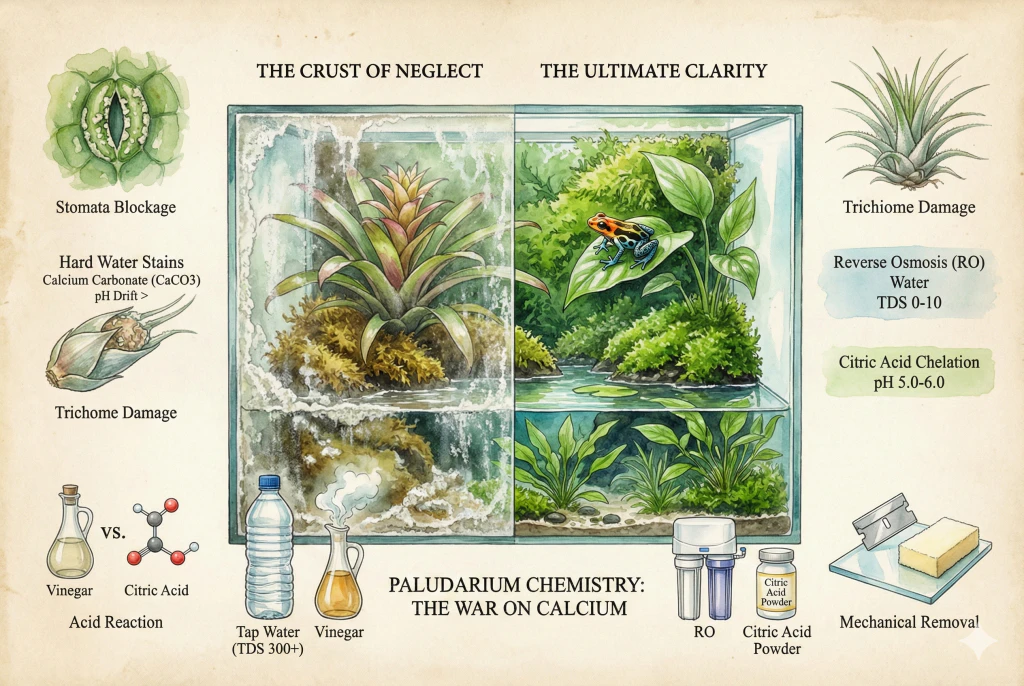
1. The Science (Why Your Water Turns Into Rock)
That white crust is mineral residue from your water, not ordinary dirt. Hard water is defined mainly by dissolved calcium (Ca²⁺) and magnesium (Mg²⁺), often picked up where the local geology is limestone or chalk.
How hard your tap water is depends on your region, so check your local water report rather than assume.
A common culprit is temporary hardness from dissolved calcium bicarbonate. As misted water evaporates and loses CO₂, the balance can shift so that calcium carbonate (CaCO₃), the same mineral as limestone, precipitates onto the glass.
Concentration, CO₂ loss, temperature, and pH all influence whether and how fast this happens.
The heat from your lights can speed this up on the upper rim, for the same reason a kettle scales. Permanent hardness from calcium sulfate or chloride is not removed by heat the way temporary hardness is. Once water fully evaporates, whatever was dissolved is left behind, including magnesium, sodium, silica, and other nonvolatile solids in your feed water.
Where normal mist lands, I set a clean removable glass tile through 20 normal misting cycles and photograph it 24 hours after the final cycle. Twenty cycles leave enough repeated deposits to compare while the final dry day keeps a fresh droplet from exaggerating the residue.
When I change source water or nozzle direction, I use a new tile and repeat the same 20-cycle run with the original nozzle pulse and drying position. Equal cycle count and final drying time distinguish new mineral deposition from old glass that was not fully cleaned.
Why the residue sticks
Glass is microscopically rough, so mineral crystals can nucleate in the valleys and bond mechanically.
If a wet deposit sits for months, the trapped alkaline water can contribute to staining or etching of the surface over time.
If the glass still looks cloudy after you remove the crust, etching is one possibility, but so are residual film, soap or silicone smears, micro-scratches, coating damage, and internal condensation. Rule those out before assuming the damage is permanent.
It may also be more than cosmetic, although the evidence is limited.
Heavy mineral deposits on epiphyte leaves could interfere with gas exchange and surface absorption, but the effect depends on the species, leaf surface, coverage, and irrigation chemistry. Direct evidence has not established harm to mosses or frogs from surface calcium-carbonate crust alone. Amphibian skin is highly permeable and sensitive to water chemistry, but that is different from demonstrated harm from a deposit on the glass.
Treat keeping the glass and plants clear as good husbandry, not an emergency.
Hardness of Water (U.S. Geological Survey)
Water Quality. pH and Alkalinity (UMass Extension Greenhouse & Floriculture)
2. Removal (Dissolving the Calcium)
Work on an Animal-Free Surface
Where you can, take out removable glass and clean it outside the tank, or move the animals to temporary holding first. Food-grade and organic labels do not make a concentrated acid solution safe next to animals. Dose and route determine the hazard, not the label.
Working in an inhabited enclosure means you cannot reliably control splashes, runoff, or residue, so treat that as a last resort under the precautions described in the walkthrough below.
Soften the Scale Chemically
Scraping dry scale can scratch the glass, so wet and soften the deposit first with a mild acid, which converts insoluble CaCO₃ into more soluble calcium salts.
White vinegar (acetic acid) works on light stains, and its fumes are best kept away from amphibians in an enclosed space. Citric acid is a reasonable alternative. It's odorless and chelates calcium, keeping it in solution.
Whether it actually outperforms vinegar depends on concentration, contact time, and the deposit, not on any single property, so odorless means you can't use smell to judge safety or rinsing, not that the solution is harmless.
Use the poultice technique by soaking paper towels in the solution, pressing them onto the glass, and giving the acid time to work.
Exact contact time depends on the concentration, the surface, and how heavy the deposit is. Check periodically rather than treating any fixed number of minutes as a guarantee.
Milliard Citric Acid
Milliard Citric Acid is suited to repeated, bulk descaling when you can work on removable glass outside the enclosure. Food-grade purity does not make a concentrated solution safe around animals. Use the weakest solution that softens the scale, wear splash goggles and compatible gloves, keep it off carbonate rock, shells, and porous substrate, and rinse thoroughly with plain water. Because the acid is odorless, collect and check the rinse water rather than relying on smell.
Scrape Mechanically on Bare Glass
Once softened, a fresh stainless-steel razor blade held at a low angle can lift the deposit. Carbon steel is a poor choice because it rusts.
This is for uncoated flat glass. Acrylic and polycarbonate scratch easily, and some coated or etched glass can be damaged too, so confirm your tank's material and any surface restrictions first, and prefer an acrylic-safe tool or repeated mild acid treatment where a blade isn't appropriate.
Inspect the blade for chips, keep well clear of silicone seams, cut away from your body, and use a handled holder with a guard. A handle helps but doesn't make a razor finger-safe.
Stainless Steel Algae Scraper
Stainless Steel Algae Scraper suits flat, uncoated glass after the scale has softened. Do not use it on acrylic, and confirm that any replacement blade fits the holder before buying spares. A fresh, undamaged blade and a clean surface matter more than aggressive pressure. Trapped grit under any blade can still scratch.
A wetted melamine sponge can buff faint haze, but be cautious with it. A 2024 study found that melamine foam sheds poly(melamine-formaldehyde) microplastic fibers as it abrades, and those fibers can be far too small (tens to hundreds of micrometers) to reliably remove by picking up visible crumbs. An ordinary vacuum may miss them or redistribute them, and isn't suited to a damp enclosure.
If you use it, do so on glass removed from the tank and rinse it outside, or skip the foam and rely on the less-abrasive steps above.
3. Prevention (Mist With Low-Mineral Water)
Use Lower-Mineral Misting Water
The fewer dissolved solids in your misting water, the less residue ends up on the glass. Aim for the lowest-mineral water you practically can.
A zero reading on a consumer TDS meter means the level is below what the meter can resolve, not that the water is chemically pure, so treat it as very low rather than absolute.
Tap water (often somewhere around 150–400+ TDS, but it varies widely by region) and bottled spring water usually leave visible residue. Distilled and reverse-osmosis / deionized (RO/DI) water leave much less.
Filter pitchers and fridge filters vary by cartridge. Carbon-based media mainly target chlorine, but some ion-exchange cartridges do reduce carbonate hardness and scale-forming Ca/Mg, so check the specific product's claims and measure your result rather than assuming a whole brand does or doesn't remove minerals.
If you mist a lot, an RO unit can be a convenient way to make low-mineral water at the source, though it's one option among several (distilled jugs work too), and it comes with its own upkeep, covered below.
RO Buddie
RO Buddie suits low-volume paludarium misting when buying or carrying distilled water is impractical. It is not a maintenance-free replacement for distilled water. It produces a waste stream and needs cartridge changes, flushing, and a TDS check. Its output and mineral rejection vary with your feed water, pressure, and temperature, so compare its ongoing cost and upkeep with the amount of water you actually use.
Use RO/DI water thoughtfully in any actual water feature. Very low-ion water isn't simply too empty. The real issue is that freshwater animals regulate their internal salts, and water with too few ions can add to that osmotic burden differently for each species.
Amphibians, shrimp, snails, and fish have different target hardness, pH, and ion needs, so match the water in a pond or pool to the specific animals' care requirements and test it.
A product like Seachem Equilibrium is one option for raising GH, but note the manufacturer defines it as a Ca/Mg/K blend for planted aquariums that does not maintain KH, dosed against a measured GH target, so it isn't a universal remineralizer, and it shouldn't be used to top off water lost to evaporation (where minerals are left behind and plain water is what's needed).
Don’t expect your cleanup crew to help. Springtails and isopods eat mold and detritus, not limestone, and heavy chemical cleaners will kill them.
Wipe the glass weekly with a lint-free microfiber cloth to remove dust before it becomes a nucleation site.
Zflow Microfiber Cloths
Zflow Microfiber Cloths are useful for keeping one clean cloth dedicated to the weekly glass wipe. A clean microfiber cloth generally leaves less lint than a paper towel, but any cloth carrying grit can scratch the glass. Wash it separately from oily cleaning rags and replace it when it no longer lifts dust cleanly.
4. The Chemistry, Briefly
Citric acid both supplies acidity and holds dissolved calcium in solution until you rinse it away. Its real-world performance depends on concentration, contact time, temperature, and the deposit, so do not expect a fixed recipe to work equally on every stain.
Commercial glass-cleaning gels are buffered formulations, not simply bulk citric acid with a thickener. A gel can be convenient for a small, controlled spot, while bulk citric acid makes sense only for removable glass cleaned outside the enclosure. Do not transfer a gel’s contact-time instructions directly to a stronger DIY solution.
Never Use Muriatic Acid in an Occupied Vivarium
It works fast, but the fumes are corrosive, it crashes substrate pH, and it burns skin on contact. Use full PPE and adequate ventilation whenever handling it at all.
Preferring the organic acids (citric/acetic) is reasonable, but not because they're natural metabolic compounds (that's a fallacy).
Dose and exposure route decide the hazard. Concentrated citric or acetic solutions still irritate eyes and skin and can attack carbonate stone, shells, grout, some metals, and living tissue.
Avoiding HCl near animals is right, but it doesn't make a strong food-grade acid automatically animal-safe.
5. Protecting Your Equipment
Hard water also affects your gear. Misting-system nozzles have tiny orifices, so mineral scale can gradually narrow them (degrading the spray pattern and eventually clogging them, which raises back-pressure on the pump).
How far that goes, and whether it reaches the point of stressing fittings, depends on your specific system, feed hardness, and duty cycle rather than being an inevitable sequence.
Ultrasonic foggers throw fine mineral-laden droplets into the air, which can settle out as white dust (EPA guidance on home humidifiers notes the same effect, and it's all the source-water minerals, not just calcium carbonate).
How much dust and how far it spreads depend on room size, ventilation, run time, and water composition.
Scale on the transducer can also degrade performance over time. Exactly how it affects a given unit's lifespan varies by model.
Lower-mineral feed water means less scale, cleaning, and wear. The interval still depends on your water, run time, and each device’s design, so inspect the spray pattern and fogger regularly instead of relying on a fixed schedule.
6. Myth-Busting
Myth. Glass Absorbs Cleaners
Ordinary uncoated float glass is non-porous, so it doesn't soak cleaner into the bulk glass.
But the reason to keep Windex out of an inhabited tank isn't just ammonia (which the Original formula contains). These cleaners also include detergents, solvents, and fragrance, and overspray or runoff can reach animals.
If you use it on the outside, spray the cloth rather than the tank, check that it's compatible with your tank's material and any coatings, and keep it clear of seams and the animals.
Myth. Boiling Water Softens Scale
Only partly. Boiling precipitates temporary (bicarbonate) hardness but does nothing to permanent hardness, and boiling off steam actually concentrates the remaining salts.
Boiled water still stains.
Myth. Magnetic Cleaners Scratch Glass
The scratches usually come from grit the magnet picks up near the substrate and then grinds across the glass, so keep magnets well away from the soil line.
On acrylic or coated surfaces, be extra careful and follow the manufacturer's clearance guidance.
7. The Weekend Restoration
Set up the workspace first. The safest way to do acid removal is with the animals out. Move them to temporary holding, or take out removable glass and work on it outside the tank.
Merely covering the water section is not an equivalent substitute. A paper-towel poultice can slip or drip, and acid solution can travel to seams, rock, shells, substrate, and the water feature.
Turn off the misters, ventilate the area, wear splash goggles and compatible gloves, and have plenty of plain water ready to rinse and collect. Isolate porous materials you can't protect.
Dissolve citric acid in warm water to make your working solution. Keep in mind that a couple of tablespoons per cup is a strong, low-pH mix (see the caveats above). Use the mildest concentration that does the job, and don't treat it as gentle just because it's food-grade.
Soak paper towels in the solution, press them over the worst stains, and give the acid time to work. Check periodically rather than assuming a fixed number of minutes.
Peel them off, re-wet, and, on bare uncoated glass only, scrape gently top-to-bottom with the stainless blade, keeping clear of the silicone seams.
Let the softened deposit do the work rather than forcing the blade.
Rinse thoroughly with plain water and collect the rinse rather than letting it soak into the substrate.
Because the acid is odorless, you can't judge completeness by smell. Check the collected rinse water instead, and confirm the surface pH is back to neutral before returning animals.
Then drain the misting reservoir and refill with low-mineral (RO/DI or distilled) water.
Hard water stains are largely a symptom of the misting water. Switching to low-mineral water and cleaning up the deposits greatly reduces how often they return. Splashes, mineralized pond or feature water, fertilizer, substrate dust, and an exhausted DI stage can still leave marks.
Affiliate Disclosure
This article contains Amazon affiliate links. As an Amazon Associate I earn from qualifying purchases. If you use these links, the site may earn a commission at no extra cost to you. Product availability, price, and specifications can change. Check the current listing before buying.