
How to Get Rid of Mealybugs on Philodendron When Neem Fails
How to get rid of mealybugs on philodendron when neem fails. Identify the pest, time label-directed treatment to crawlers, then count clean weeks.
Elena Vargas · Published 2026-10-22 · 21 min read
Key Takeaways
- Wet soil does not cause mealybugs or scale. They ride in on new plants, cuttings, tools, pots and poles.
- Use a 10x lens to identify the pest and inspect protected plant parts before choosing treatment.
- Neem alone often fails because wax and egg sacs shed sprays and its residue fades within a few days.
- Time contact treatments to the crawler stage and follow the label’s application interval and maximum treatment limits.
- Use 8 to 10 clean weekly inspections as a cautious isolation review point, not a guarantee or spray schedule.
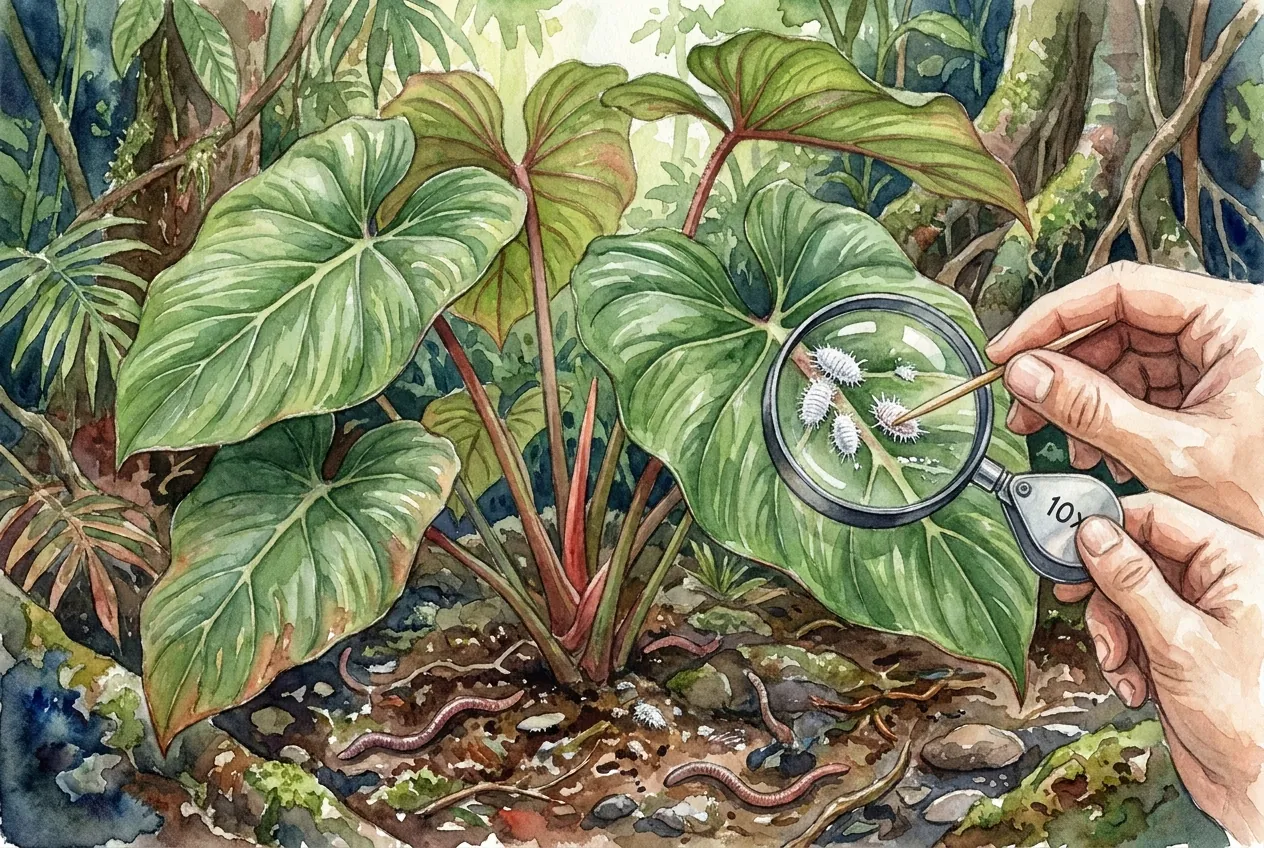
White fluff in a philodendron leaf axil rarely means you watered too much. It usually means a sap-feeding insect rode in on a plant, cutting, tool or support and has been breeding where your eyes skip.
Getting rid of mealybugs on a philodendron takes a sequence, not a spray. Identify the pest, isolate the plant, check its neighbors, remove what you can reach by hand, and treat with a label-directed product class timed to the crawler stage.
Then keep it isolated through repeated inspections with no new finds.
Neem alone usually fails because wax, egg sacs and scale covers shed contact sprays, and the colonies that matter sit inside sheaths a quick mist never reaches.
Identify the Pest Before Treating Anything
Mealybugs, soft scales and armored scales differ in wax, cover and honeydew, and those differences decide which product class can reach them. A hand lens comes before any bottle.
Telling citrus, longtailed and obscure mealybugs apart under a 10x lens
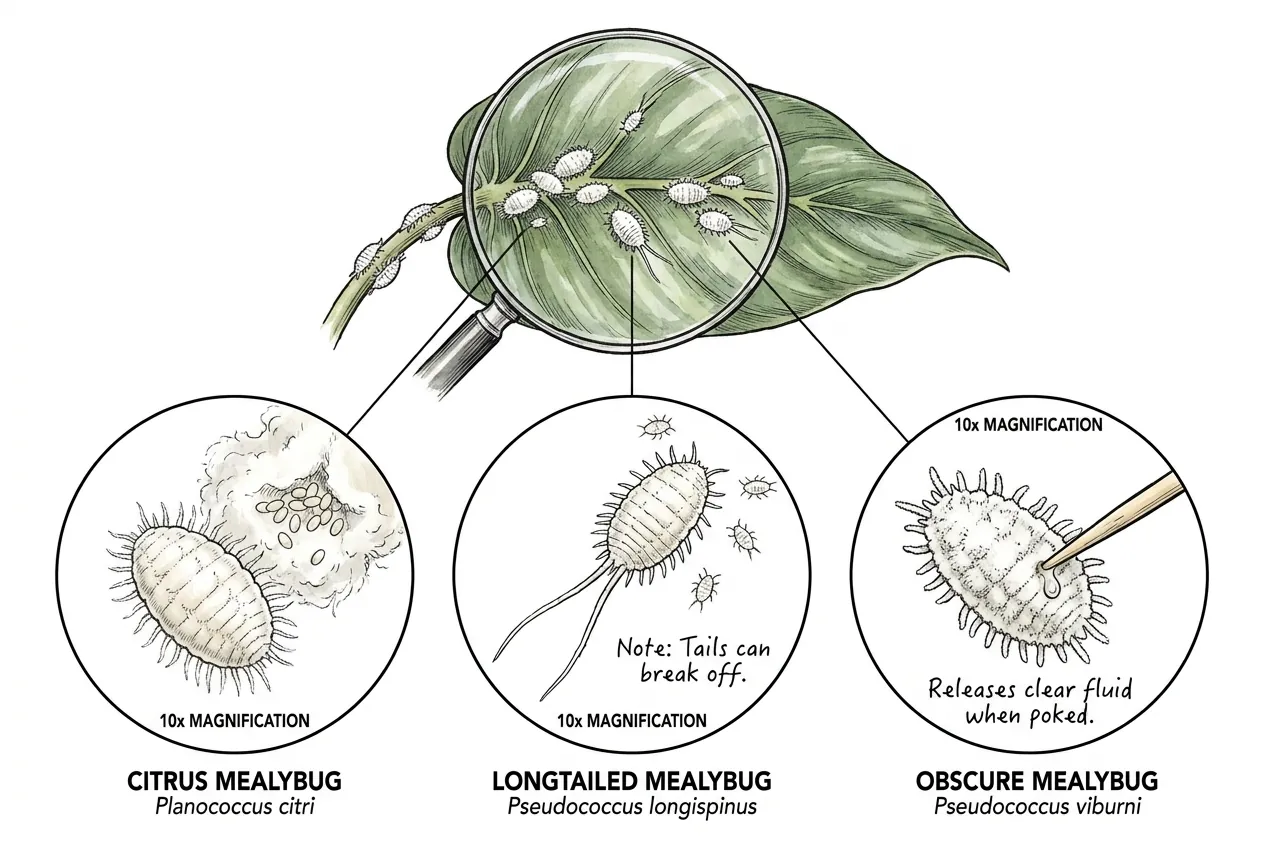
Push the wax aside with a toothpick before naming anything, since the body underneath carries the field marks. Full-grown females are white, wingless and 2 to 5 mm long.
Citrus mealybug has short, even wax filaments, and a single female can produce up to 600 eggs in the cottony sacs most growers notice first.
Longtailed mealybug carries two tail filaments longer than its body and gives birth to live nymphs, so a colony without cotton is still breeding.
Obscure mealybug has distinct filaments and a powdery wax coat, lays its eggs in cottony sacs, and releases a clear fluid when poked.
Telling soft scale from armored scale on the petiole
Slide a toothpick edge under a brown bump on a petiole. An armored scale’s flat cover lifts off like a lid and leaves the body on the plant.
A soft scale’s surface is its own body wall, so the whole insect comes away.
Brown soft scale is oval, yellowish to brown and about 1/10 to 1/6 inch long, in colonies of mixed sizes.
Honeydew is the second tell, since soft scales and mealybugs excrete sticky sugar while armored scales make none.
Do the lift test before buying anything, because phloem-moving systemic products reach soft scale far better than armored scale.
Sticky droplets on new leaves that are not honeydew
Stickiness means honeydew only when it sits below a colony. Many Philodendron species carry extrafloral nectaries on the prophyll, leaf and spathe that work in young organs.
Clear beads on new growth with nothing living above them may be nectar.
Honeydew forms a spreading glaze below the feeders, often with black sooty mold. Look straight up from the glaze into the sinus and sheath above it.
White fluff in the root ball is a different pest
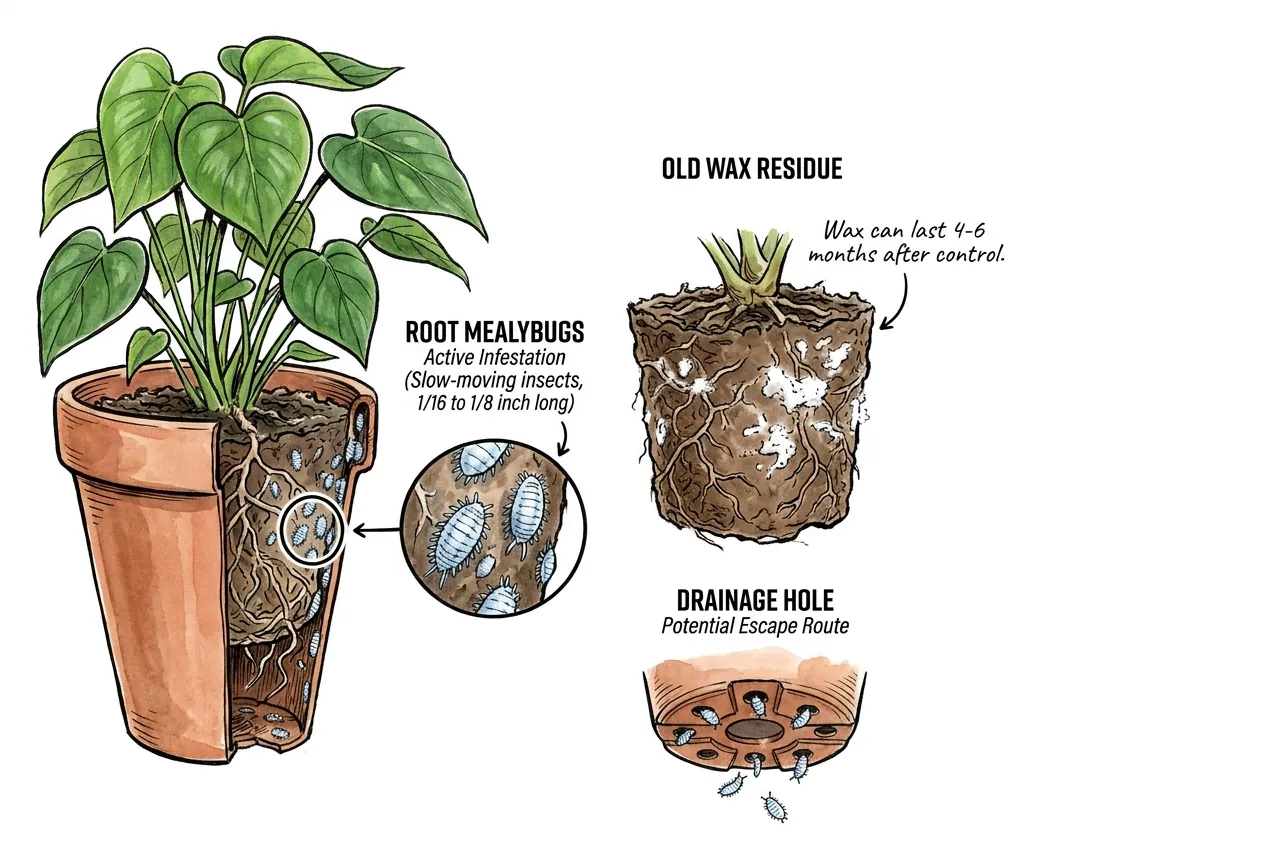
If a plant stalls with clean leaves, check its root ball. Root mealybugs are bluish white, about 1/16 to 1/8 inch long, and resemble slow springtails.
After watering they can crawl out of drainage holes to nearby pots.
Their wax can take 4 to 6 months to break down after control, so old residue alone does not prove live insects.
The guide to root pests on Philodendron verrucosum covers the root-zone lockdown.
Why Wet Soil Is Not the Cause
Wet soil gets blamed because watering is the last thing most growers changed before they noticed fluff.
Mealybugs are often introduced on new plants, tools or pots, and the wingless females reach a new host by crawling or riding on ants, birds or people.
Autumn is a discovery window, not a cause. Rinse patio plants before bringing them in once nights dip into the 50s °F, since anything riding on them comes in too.
What wet potting mix really breeds
Wet media favors fungus gnats, covered in the fungus gnat control chooser, and root rot organisms such as Pythium and Phytophthora.
Foliar mealybugs and scale feed above the media, so wet mix does not create them. If anything, a lab study points the other way, since a cassava mealybug developed and reproduced better on water-stressed plants.
Nitrogen has a clearer link. In one greenhouse study, citrus mealybugs on coleus fed 200 and 400 ppm nitrogen had the greatest egg loads and shortest development.
Easing off fertilizer during an infestation is a precaution, not a cure.
Fixing your watering will help with fungus gnats and root rot, but it will not remove a single mealybug from a leaf axil.
Where Mealybugs Hide on a Philodendron
A philodendron’s hiding places are structural, built by the way it wraps and supports each new leaf.
Cataphylls, petiole sheaths and the leaf sinus
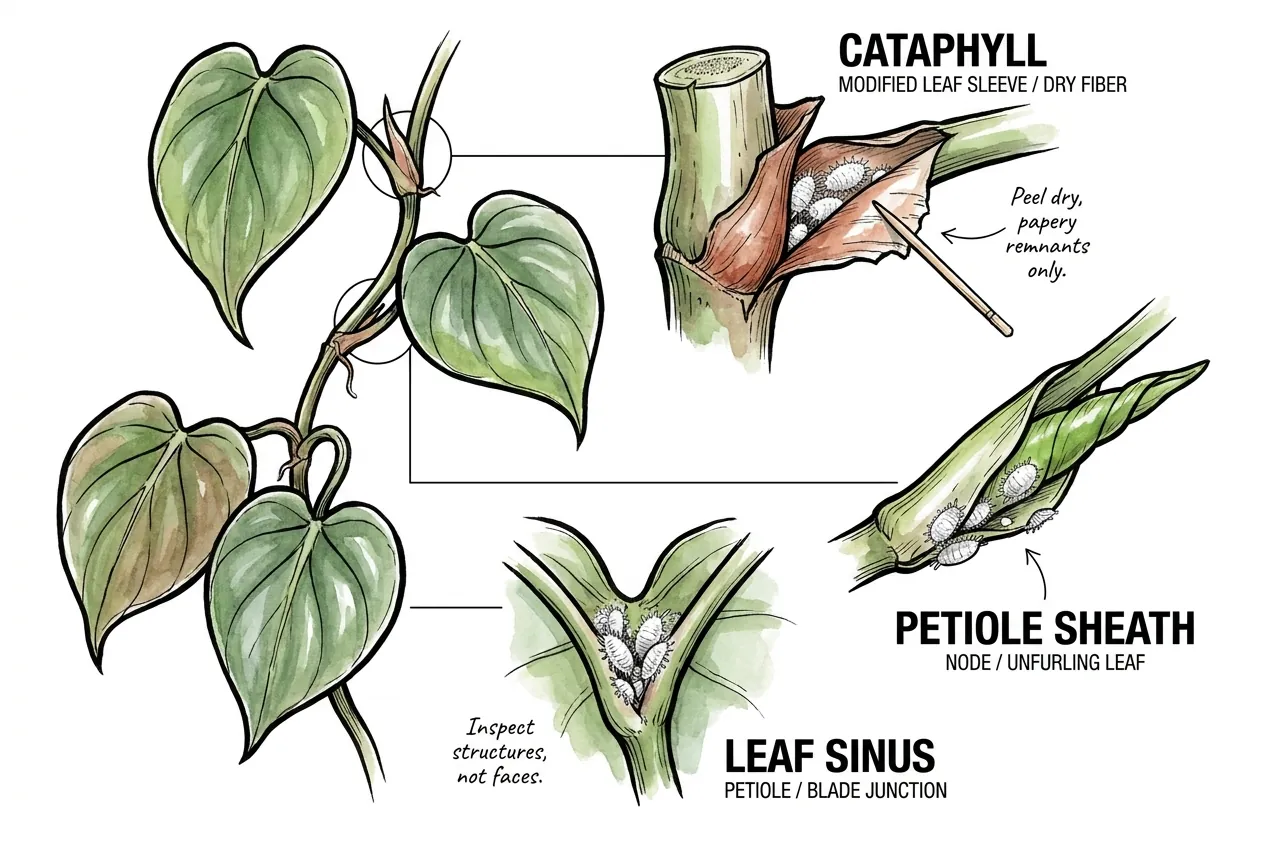
Mealybugs congregate at petiole-stem junctions, leaf undersides, stem tips and under leaf sheaths. Cataphylls, the modified leaves that wrap each new leaf, persist on many climbers as papery sleeves or reddish brown fibers. The leaf sinus is another tight fold.
Peel back only dry, papery cataphyll remnants with a toothpick, and never tear a living green cataphyll or force open an unfurling leaf.
Philodendron verrucosum petioles carry whitish, hair-like scales up to about 9 mm long that look like nymphs or small egg sacs at arm’s length.
Smears tend to linger on a matte velvet blade, so inspect it by eye, lens and raking light and keep oily products off.
Inspect structures, not leaf faces, because a plant that looks clean at arm’s length can still hold a colony in every sheath.
Moss poles, plant ties, pot rims and the shelf beneath
Mealybugs hide beneath tape on stakes, and adult females crawl off plants to lay eggs in crevices.
Check every pot and stake, scrub smooth plastic supports, and discard infested items that cannot be scrubbed.
A moss or coir pole with insects or egg sacs in its fibers is safer replaced, because no inspection can prove it clean.
Where aerial roots have grown into it, cut the old pole away around them. The moss pole chooser covers the replacement.
Quick check with the same six-stop route
Inspect each isolated philodendron with a 10x lens and side lighting on the same weekday. Photograph the six locations below before removing reachable pests. The route catches sheltered colonies that a check of leaf faces misses.
- The newest leaf and its cataphyll or sheath, peeling only dry remnants.
- Every petiole-to-stem junction, from the top down.
- The leaf sinus and the first few centimeters of the underside midrib.
- The primary veins under the two oldest leaves.
- Nodes, aerial roots, the pole’s contact face and the underside of every tie.
- The pot rim, drainage holes, saucer and the shelf directly below.
Record clearly moving insects, suspected insects, and old wax separately. Do not crush insects to certify whether a colony is alive. A wet smear can remain after death, and an immobile insect can still be alive. An uncertain find keeps the plant isolated for another close inspection.
Under an armored cover I look for a colored body that releases fluid, the live sign UConn uses. A round exit hole means a parasitoid already killed it.
Remove accessible insects and suspicious egg sacs after photographing them. Compare remaining wax with the photograph next week. Fresh cotton is a reason to inspect for insects or eggs, not proof of viable eggs by itself.
Crawlers, Generation Time and the Treatment Window
Contact products kill young stages far better than old ones, and young stages keep arriving for weeks.
How long one mealybug generation takes in a heated room
Development speeds up with warmth and slows sharply in cool rooms.
| Measure | Value | Setting |
|---|---|---|
| Female citrus mealybug nymphal period | 35.2 days at 20°C (68°F) | Lab, coffee plants |
| Female citrus mealybug nymphal period | 23.2 days at 25°C (77°F) | Lab, coffee plants |
| Citrus mealybug egg hatch | 6 to 10 days or several weeks | Extension, varies by season |
| Citrus mealybug new adult generation | 6 to 10 weeks | Extension |
| Brown soft scale generation | About 60 days | Extension, frequent indoors |
An egg sac missed in a dry cataphyll in mid-October at 20°C hatches over the next week or two, and its females need about five more weeks to show.
Why crawlers are the stage contact sprays actually kill
Newly hatched crawlers stay nearly waxless until they settle. In a peer-reviewed trial, oil and soap both killed 1-day-old scales, but tolerance rose after settling.
In the field, oil controlled settled armored scales at 83 to 90 percent but settled soft scale at only 5 percent, where soap did better.
Hidden stages can produce new crawlers after one application. Keep inspecting, but let the product label control whether and when another application is allowed.
Optional crawler monitoring on a separate support
If scale crawlers are difficult to find, a removable sticky band on a separate support can supplement lens inspections. Keep adhesive away from stems, petioles, leaves, and emerging roots. Inspect at the same weekly interval and record the location. An empty trap does not clear hidden colonies.
Any suspected crawler needs identification before choosing treatment. Trap checks never override the product’s application interval, maximum number of treatments, or plant restrictions. Do not keep applying a pesticide for the entire quarantine simply because monitoring continues.
Why Neem Alone Usually Fails
Neem falls short on chemistry, armor and timing.
Three different products share the name neem
Azadirachtin, the most active part of neem, reduces feeding and interferes with insect hormones. That matters for stages with a molt ahead, and an adult female mealybug will not molt again.
Clarified hydrophobic neem oil is the azadirachtin-free fraction and smothers on contact like a horticultural oil. Cold-pressed neem oil can contain some of both.
Leaf shine and plant tonic bottles are a separate trap. Neem and azadirachtin are not on the minimum-risk exemption list, so a neem product without an EPA registration number is not a pest-control product.
Its film also brings the problems in why oily leaf shine coatings backfire.
Wax, egg sacs and a residue that fades in days
Adult mealybug wax is nearly impervious to most insecticides. In a lab study, removing it made one insecticide 10.6 times more effective against citrus mealybug.
A cottony egg sac keeps spray off the eggs inside. Azadirachtin breaks down on leaves with a half-life of 1 to 2.5 days, long before the last of those eggs hatch.
Systematic check of five marked locations
Before treatment, photograph five infested locations, or all locations if fewer. Include an exposed surface and a sheltered sheath when both are infested. Record what you remove by hand, the product, application date, and the next application allowed by the label. Treat the marked locations too.
Re-photograph on day 4 and at the next scheduled weekly inspection. Day 4 is a convenient early check for contact-treatment coverage and leaf injury, not a mortality deadline or a re-treatment interval. For slow-acting products, use the label’s expected response period.
Compare new moving insects, suspected insects, and visible damage separately. Repeated finds in sheltered locations call for checking access and coverage. Finds everywhere call for rechecking identification and the product label. Neither pattern alone proves resistance. Remove reachable pests and keep isolation instead of increasing dose or shortening the label interval.
A Control Plan Built on Product Classes and the Label
For a light infestation, isolation, physical removal, and the weekly route are enough to begin. Use the five-location record when pests keep returning or when you need to distinguish missed hiding places from a poor treatment match.
On the treatment side, hand removal comes first. A cotton swab dipped in 70% or less isopropyl alcohol in water kills or removes the mealybugs it touches.
Spot-test it on a small part of the plant 1 to 2 days beforehand.
Tweezers or the swab also lift large soft scales and egg sacs that no spray reaches. The swab touches only the insect, never a whole blade.
Choosing between insecticidal soap, horticultural oil and neem
Soap, horticultural oil and clarified neem oil all work on contact and leave nothing active once dry. Coverage and the label’s repeat schedule do the work.
Soap fits crawlers, young nymphs and soft scale but not eggs, armored covers or waxy adults.
Oil fits crawlers and settled armored scale but not settled soft scale or adults.
Choose a class, not a brand. That means a registered insecticidal soap labeled for mealybugs on indoor ornamentals, or a horticultural or clarified neem oil whose label lists houseplants and your pest.
Plant-based oils such as neem may burn plants more readily than refined oils. Skip oil on velvet-leaved species.
Pick the product class by the pest and stage in front of you, not by which bottle sounds strongest.
Where a houseplant-labeled systemic fits and where it does not
Systemics move from the potting mix into the sap, act more slowly than contact sprays, and reach phloem feeders best.
UC IPM states that imidacloprid controls soft scales but does not control armored scales.
Mealybugs are the weak spot. In a peer-reviewed coleus trial, curative soil-applied imidacloprid, dinotefuran and thiamethoxam never exceeded 35 percent citrus mealybug mortality, against an 80 percent benchmark.
In one experiment, preventative azadirachtin and five other systemics never passed 22 percent, and even four times the label rate, a research condition only, never passed 61 percent.
A houseplant-labeled systemic is therefore a reasonable class for widespread brown soft scale, not a replacement for removal and contact coverage against mealybugs.
Imidacloprid can last months or years in soil and is very toxic to honeybees, and animals that swallow enough may tremble or have trouble walking.
Keep treated pots away from pets that dig and off flowering patio spots.
Mealybug destroyer beetles in a winter living room
Below 68°F and under short days, the mealybug destroyer beetle reproduces far more slowly. Eating the waxy eggs of egg-sac producers triggers its egg laying, so longtailed mealybug, which makes no egg masses, is a poor target.
Its larvae resemble mealybugs but move faster and grow to over twice an adult female’s size, so spare them.
Cutting back to a clean node or discarding the plant
UC IPM suggests discarding severely infested houseplants rather than repeatedly treating them. Bag prunings and spent mix at once, since moist plant debris can carry live mealybugs.
A heavily infested plant may be better discarded than repeatedly treated. If saving a visibly clean node cutting, root it separately in fresh medium and inspect it as a potentially infested plant. A clean-looking cutting can still carry hidden insects.
Treating Without Burning the Plant or Harming the Household
Any contact product that kills a mealybug can injure a leaf under the wrong conditions, and the heating season stacks several.
Labels are legally enforceable, so using an outdoor-only product on an indoor philodendron violates federal law.
Every rate, dilution, repeat interval and spray volume comes from the product label, and a failed treatment never justifies changing them.
Follow the label on gloves, eye protection and ventilation, and keep products in their original containers, out of reach of children and pets.
Heat vents, grow lights and the conditions check before any spray
Soap is more likely to injure plants that are above 90°F, drought-stressed, freshly transplanted, unrooted or carrying soft young growth.
Oil should not go on above 90°F or when relative humidity stays over 90 percent for 48 hours.
Maryland Extension sets a stricter 85°F ceiling for oil and says to rehydrate drought-stressed plants first.
Sudden temperature change and prolonged wind raise oil-burn risk, and a register’s airstream or a close strong light is the indoor version. Move the plant clear of both before any spray.
Check the root-zone moisture and the product’s plant-condition restrictions before treatment. Do not water an already-wet pot just because a spray is planned. Spot-test as directed, keep the plant out of direct heat and intense light, and allow foliage to dry before returning it to a humid cabinet.
Skip homemade sprays. Dish detergents cut through a leaf’s protective layers even when watered down, vinegar and alcohol are phytotoxic, and cooking oils carry impurities that raise injury risk. Alcohol goes on a swab, never across foliage.
Pets, children and aquariums near a treated plant
Keep pets away from a treated plant for the label’s stated time or until the product dries, whichever is longer.
Philodendrons are already toxic to cats and dogs through insoluble calcium oxalates, so a pet chewing a treated leaf meets both hazards.
Move the plant to a separate treatment area away from aquariums. Prevent spray, runoff, tools, and treated drainage from contacting tank water. Covering a nearby tank alone is not a reason to spray beside it.
If a pet is exposed, call a veterinarian or the ASPCA Animal Poison Control Center at 888-426-4435, where a fee may apply, with the product label in hand.
Isolation and the Return-to-Collection Check
New plants with no known pests get at least three weeks of quarantine in a separate area.
A treated plant must also show that no egg or hidden nymph survived, which takes a longer run of clean inspections.
Eight clean weeks in a warm room, ten in a cool one
Use eight consecutive weekly inspections without confirmed or suspected pests as a cautious return-to-collection review point. Extend the observation to ten weeks in a cool room or when scale identification remains uncertain. These are practical monitoring periods, not proof of eradication and not a pesticide schedule.
Keep a date, room-temperature range, six-stop result, and photo for each inspection. A new live or uncertain find restarts the clean-inspection count after removal and reassessment. A missed inspection does not count as clean. Use a min/max thermometer if a day-night temperature range is needed, rather than one weekly spot reading.
Hidden stages and temperature-dependent development explain the long observation period. Cold conditions may prolong development further, so do not release a plant merely because ten weeks elapsed. Continue checking after it returns and keep it from touching neighboring foliage initially.
Ants, neighboring plants and the empty shelf spot
Ants protect honeydew producers from natural enemies and carry mealybugs between plants. Properly used baits are more effective and safer than sprays indoors, so place label-directed bait stations off the plant and wash away the trail.
On the day you find the infestation, inspect every neighbor that shared leaf contact, a tray, a pole, tools or an ant trail. Add any with finds to the weekly route.
Scrub the empty shelf spot and check it weekly through the crawler window. Stippling or webbing on a neighbor points to the heating-season spider mite and thrips window instead.
The Release Decision and the Next Infestation
The final call rests on inspection evidence, not on a change in watering or one more neem spray.
Every new plant, cutting and pole deserves the same lens check and isolation before it touches the collection.