
Anthurium Clarinervium New Leaf Aborting: A Differential Guide
Anthurium clarinervium new leaf aborting? A wet, stagnant crown is one likely driver, not the only one. Work through the differential before you treat.
Priya Patel · Published 2026-06-24 · 33 min read
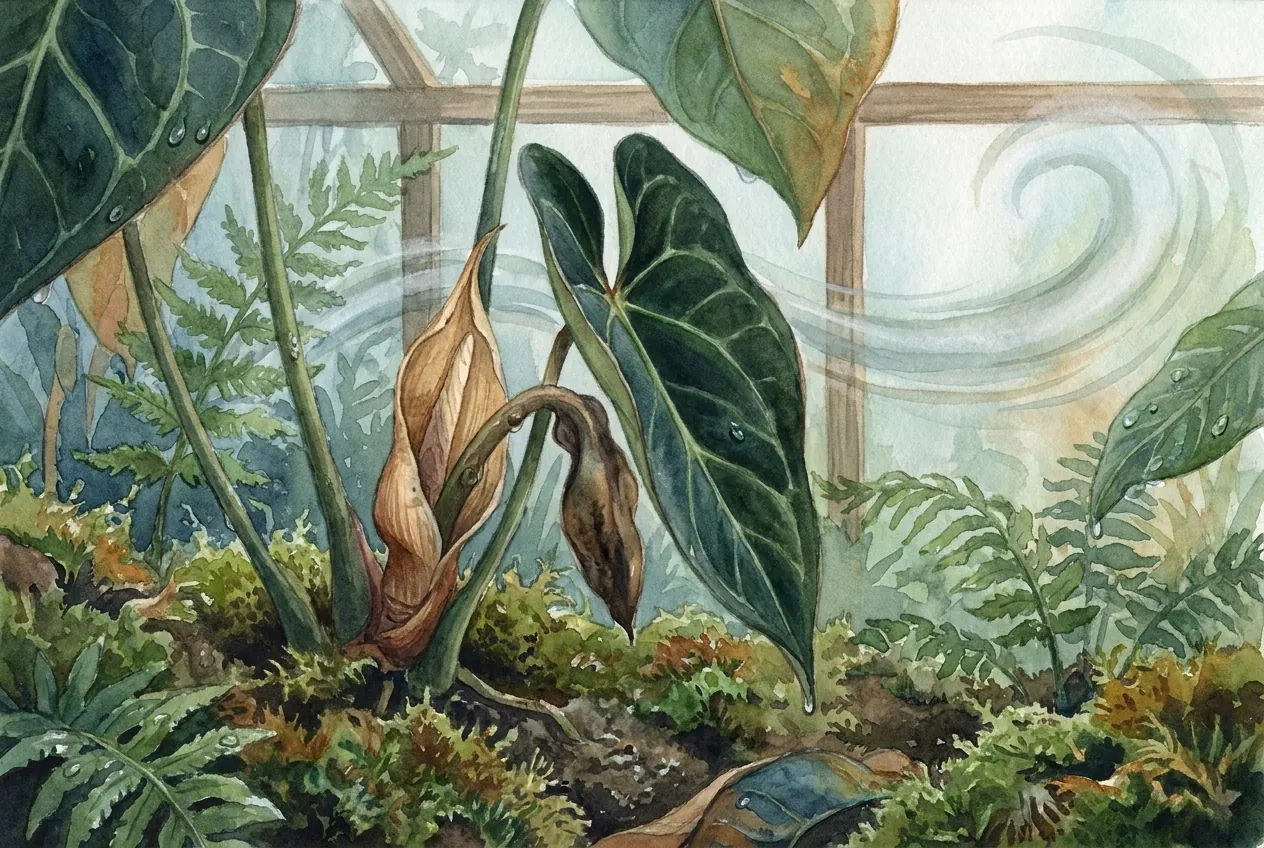
Key Takeaways
- New leaf aborting is a symptom, not a diagnosis. A wet, stagnant crown is one plausible driver, but rule out watering, roots, temperature, pests, and physical damage too.
- A normal cataphyll dries papery-tan and odorless. A soft, dark, foul-smelling spear points to rot, but texture and smell are clues, not a confirmed pathogen ID.
- A moderate cabinet with steady gentle airflow helps. Aim for roughly 65-80% RH rather than near-saturation, and measure VPD because its exact value depends on temperature.
- Smell, texture, and location can suggest a pathogen group but cannot confirm one in the field. Overlap is common, so a lab or extension service is needed for confirmation.
- Water at the roots, use a chunky free-draining mix, and judge spears by firmness and color rather than days elapsed.
New leaf aborting is a symptom with several possible causes, not a diagnosis. A crown that stays wet and still is one common cause, but watering, roots, temperature, pests, and physical damage can look similar.
When a sheathed spear turns soft, brown, and mushy before it unfurls, dry air is rarely the reason.
Near-saturated cabinet air plus a stagnant crown can keep the emerging leaf permanently wet, and a persistently wet surface is what rot organisms need.
But other causes, overwatering and root rot, cold, physical damage, pests, or an unhealthy plant, produce similar-looking failures, so confirm the picture on your own plant before you act.
Start with the spear’s firmness, smell, and whether the crown stays wet. Then correct the crown environment, inspect roots and pests, and seek a diagnosis if tissue is softening or lesions keep spreading.
What is a cataphyll, and is a dry brown sheath normal?
A dry, tan, papery sheath around a new leaf is normal. That structure is the cataphyll, and drying to a crackly scale is its designed end-state, not a failure.
A cataphyll is a reduced, modified leaf in the same structural class as a bud scale. It wraps and protects the emerging spear as it pushes up from the center of the crown.
Once the leaf it shields has hardened off, the cataphyll has finished its work. In this species the cataphyll is described as subcoriaceous, and it often splits and persists rather than dropping cleanly away.
Every three days, I photograph the cataphyll seam and the swelling behind it from the same angle without prying it open. Three days usually reveals movement without adding daily handling that can bruise the spear or erase the best evidence.
That photo record tracks whether the swelling advances, stops, or softens alongside root-zone moisture and temperature. Progress behind a brown sheath keeps me from misting or cutting tissue that was functioning normally.
Why a spent cataphyll dries instead of rotting
A cataphyll lacks the full lamina of a real foliage leaf, and when it senesces it typically dehydrates and papers over rather than rotting.
That is why the normal end-state is usually crispy and tan, not slimy and dark. A spent cataphyll that instead stays wet and soft is worth a closer look.
In Anthurium specifically, the cataphyll is the protective sheath that houses new growth as the plant matures.
Once a plant transitions to adult growth, new leaves emerge from within this sheath rather than from the juvenile petiole pattern.
So the brown wrapper at the base of your new leaf is the cataphyll doing its job.
The decision gate is not color, but texture, turgor, and smell. A dry, firm, odorless sheath that crackles like paper is a spent cataphyll.
Leave it alone, or peel it gently only if it is physically trapping water against the crown.
Cataphyll
Anthurium Anatomy Guide for Growers
How do I tell a normal cataphyll from a rotting spear?
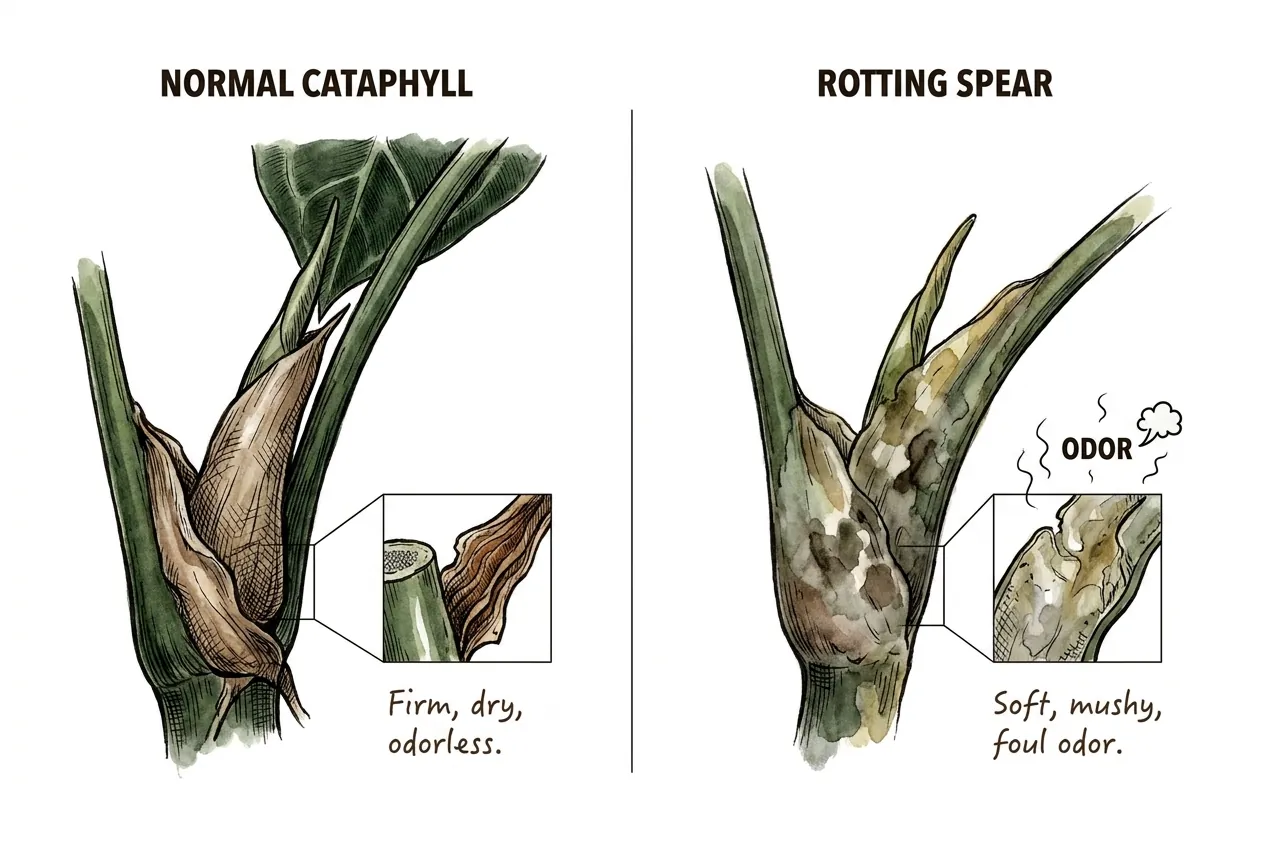
Diagnose rot by feel and smell, not by color. Rot is water-soaked, soft, and mushy tissue that smells foul. A spent cataphyll is dry, firm, and odorless.
Soft rot typically progresses in a recognizable way. It starts as water-soaked spots, then the interior tissue becomes mushy and discolored, ranging anywhere from cream to black.
The giveaway is the odor. Soft rots are known for a strong, disagreeable smell that accompanies the breakdown of tissue.
In a related aroid, konjac, soft-rot tissue turned yellowish-brown to grayish-white with a sticky-paste texture and a distasteful odor. The kind of maceration that gives soft rot its characteristic feel.
That said, konjac is not Anthurium, so read this as a general soft-rot description, not a species-specific diagnosis.
Why texture is often an earlier clue than color
Soft-rot bacteria secrete enzymes that dissolve the middle lamella, the glue holding plant cells together.
In classic soft rot, cells lose adhesion and collapse into mush, and this can begin before the color fully changes.
So for that type of rot, loss of firmness is often an earlier signal than browning, though this is a general soft-rot pattern, not a validated test for a specific pathogen.
A spear that looks only slightly tan but has gone soft is a warning sign. A uniformly brown spear that snaps dry is more consistent with desiccation than with soft rot.
Neither observation confirms which organism, if any, is involved.
Normal spent cataphyll vs rotting spear
| Trait | Normal spent cataphyll | Rotting spear |
|---|---|---|
| Texture | Dry, firm, papery | Wet, soft, mushy |
| Squeeze test | Crackles | Smears like paste |
| Color | Tan to brown | Cream to black |
| Odor | None | Strong, foul |
| Action | Leave it | Intervene now |
Bacterial Soft Rot
A Loop-Mediated Isothermal Amplification Assay for Rapid Detection of Pectobacterium aroidearum
How firm is the spear, and when is it already lost?
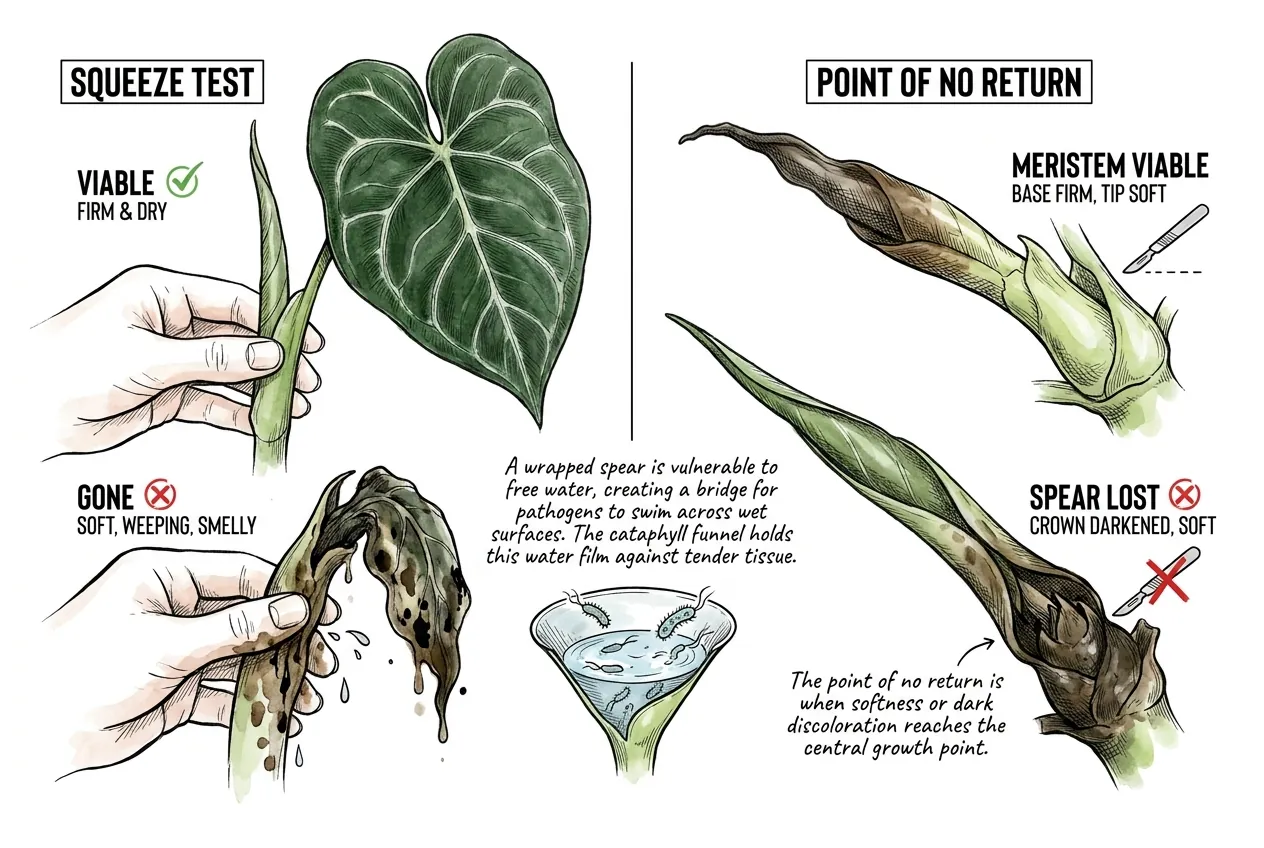
Firmness is a useful clue, but handle a vulnerable spear as little as possible. Soft-rot bacteria and Xanthomonas enter through fresh wounds and torn tissue, so repeatedly pinching or squeezing very young rolled leaves can bruise them and can move pathogens on your fingers.
Prefer looking over touching. A firm, dry, papery sheath reads as viable, while a spear that is visibly soft, water-soaked, weeping, or foul is likely failing.
If you must check firmness, do it once, gently, with clean hands, not as a routine.
Sometimes the spear looks soft only at its distal tip while the base and crown stay firm and dry.
Growing tissue may still sit below the lesion, so that spear can sometimes still produce a leaf if the rot stops spreading.
The point of no return is generally when softness or dark discoloration reaches the central growth point.
Once the crown itself is darkened, softened, or water-soaked, the emerging leaf is usually lost.
At that stage your goal shifts from saving the leaf to protecting the rest of the plant (isolate it and, if you choose to cut, work carefully and disinfect tools).
Because pathogens like Xanthomonas can be systemic and latent, cutting does not guarantee the plant is clean.
The reason a wrapped spear is so vulnerable is free water. Bacteria can swim across wet surfaces, so a spear that never dries is exactly the bridge a pathogen needs.
The cataphyll funnel in a warm, humid, stagnant cabinet holds that water film against the most tender tissue on the plant.
Anthurium Diseases. Identification and Control in Commercial Greenhouse Operations (UF/IFAS PP292)
Root Rots of Indoor Plants
Why does high humidity make the new leaf rot?
High humidity drowns the spear because near-saturated air has almost no vapor-pressure deficit, so the leaf surface and cataphyll funnel never dry. Add still air, and that water film persists for hours.
That is exactly the wet window pathogens need.
This is the core of the whole problem. The danger is not humid air in the abstract. The danger is persistent free water on the surface, and high humidity plus no airflow is simply the recipe that keeps that water sitting there.
What is VPD and why does saturated air stop the spear from drying?
VPD, vapor-pressure deficit, is the gap between how much water the air could hold and how much it actually holds.
As humidity climbs toward 100%, that gap shrinks toward zero, and the air loses its power to pull moisture off a wet surface.
Transpiration is driven by that gap, as water moves from the wet interior of the leaf to the drier air outside.
At very low VPD the gradient is small, so both transpiration and the evaporation of surface films slow markedly.
(Surface water and internal transpiration are related but not identical, and the rate that actually matters depends on leaf temperature and air movement, not just the room reading.)
Push humidity all the way to dew point and water can condense onto the coolest surfaces in the cabinet.
A spear emerging at near-saturation has very little drying power. Keep the cabinet below the point where surfaces condense and use gentle air movement to let the crown dry.
What is the impact of VPD on crop development?
Why does still air keep the crown wet even at a good humidity reading?
A good hygrometer reading can still sit above a wet crown. In still air, a pocket of humid air clings to the leaf and slows drying far more than the room reading suggests.
What this means for your cabinet
Use gentle airflow to keep the cabinet air moving, not a hard stream aimed at the plant, so the crown can dry between wet periods.
A hygrometer that reads a healthy 75% can still sit above a crown that stays wet, because the still-air layer over that crown is thick.
The number at the meter is not necessarily the number at the spear.
Leaf Boundary Layer Resistance (University of Wisconsin CALS)
2127 – Moisture and Disease on Leaves (Colorado State PlantTalk)
What humidity and VPD band should a clarinervium cabinet run?
As a starting point, aim for roughly 65 to 80% relative humidity with gentle continuous airflow rather than 90% or higher.
A moderate band protects velvet tissue while still leaving enough deficit for the spear surface to dry between waterings.
Anthuriums are generally described as preferring fairly high humidity. There is no published trial pinning down an exact optimum band or VPD for a clarinervium spear, so treat any specific number as a guide to be checked, not a validated setpoint.
Remember that RH and VPD are not interchangeable across temperatures. The same relative humidity gives a different VPD as the temperature changes, so 65 to 80% RH does not map cleanly onto a single 0.6 to 0.9 kPa figure.
For example, near 21°C, 65% and 80% RH correspond to roughly 0.87 and 0.50 kPa, while at 24°C they shift to roughly 1.04 and 0.60 kPa.
Read VPD off a meter at your own cabinet temperature rather than assuming a fixed conversion.
Bacterial soft rot is reported to decay tissue most aggressively between roughly 70 and 80°F and to be especially severe when oxygen is limited (the warm, wet, stagnant crown you want to avoid).
The fix is two-pronged and matches the extension playbook. Lower humidity into the target band by increasing air circulation and venting, and keep the foliage dry so no film pools in the crown.
The fan and the humidity dial-down are not separate fixes. They both attack the same wet-surface dwell time.
Bacterial pathogens and water-soaking under high humidity (NCBI/PMC review)
Bacterial Soft Rot (UW-Madison Horticulture)
Which pathogen is rotting the spear (bacterial, oomycete, or other?)
Three pathogen groups can rot Anthurium spears and roots. Bacterial soft rot, Xanthomonas blight, and oomycete (water-mold) root and crown rot.
Note that oomycetes such as Pythium and Phytophthora are fungus-like, not true fungi. Their typical presentations differ, and the signs below can help you form a working hypothesis.
They do not confirm a diagnosis. Symptoms overlap, secondary microbes muddy the picture, and university plant-diagnostic labs caution that very few plant diseases can be identified reliably by eye alone.
Treat what follows as possible clues, and confirm anything important through a diagnostic lab or your local extension service before committing to an invasive treatment.
How does bacterial soft rot present?
Bacterial soft rot tends to be a wet, slimy, fast, foul-smelling collapse (the spear-turned-to-mush-in-days failure).
It is caused by soft-rot bacteria in the genus Pectobacterium (several species once grouped under the older name Erwinia).
The progression is water-soaked spots that enlarge, become sunken and soft, then turn the interior mushy and discolored from cream to black.
A susceptible organ can convert into a soft, watery, decayed mass within roughly 3 to 5 days once infection takes hold.
High humidity is required for disease development, and the bacterium infects through fresh wounds.
Why a stagnant crown accelerates it
Pectobacterium secretes pectinases that dissolve the middle lamella, so tissue literally liquefies.
The reaction is far more aggressive in low-oxygen conditions, which is exactly the micro-environment of a spear sitting permanently wet in a still crown.
The limited-oxygen severity note is the direct link between a sealed, saturated cabinet and a fast collapse.
If the spear is mushy, slimy, and smells bad, treat it as bacterial soft rot. First stop the wet, low-oxygen condition by drying the crown and adding airflow.
Then remove the liquefying tissue before it reaches the growth point.
Bacterial Soft Rot (UW-Madison Horticulture)
How does Xanthomonas bacterial blight differ, and how does it spread?
Xanthomonas bacterial blight is Anthurium's signature systemic disease, and it rides in on guttation water.
Instead of one mushy spear, it shows yellow, water-soaked lesions that advance in V-shapes from the leaf margins, often with a bronze cast.
The bacteria enter through the hydathodes, the water pores along the leaf margins. A peer-reviewed study confirms the pathogen enters anthurium leaves through these upper-epidermis water pores and that the hydathode is the primary entry point.
In one setup each leaf exuded roughly 100 to 500 microliters of guttation fluid overnight.
Why guttation both admits and feeds the bacterium
Guttation is root-pressure-driven water pushed out through hydathodes at night, exactly when a high-humidity, low-VPD cabinet is slow to evaporate it.
That standing droplet is both an entry route and a food source. Glutamine, a nutrient for Xanthomonas, is released in guttation fluid, so the same droplet that lets the bacterium in can also feed it.
This links back to the humidity picture. Low VPD leaves persistent guttation droplets at the leaf margins, which can become an entry point for margin-based infection.
Whether those droplets then run back into the crown depends on leaf angle, surface, and air movement and has not been specifically documented here, so treat crown pooling as a plausible mechanism rather than a certainty.
Because Xanthomonas blight can be latent and systemic, any response should include isolation and sterile tools, not just drying out.
Suppression of Bacterial Blight by a Bacterial Community Isolated from Guttation Fluids of Anthuriums
How does oomycete root and crown rot differ?
Oomycete (Phytophthora and Pythium) rot often rises from wet substrate rather than from the leaf margins, and it is frequently less foul-smelling than bacterial soft rot because no pectinase liquefaction is involved.
Do not treat texture as a hard rule, though. Extension sources note that Pythium roots can turn brown-to-black and soft or mushy with a sloughing outer layer, and Phytophthora can make root tips and lower stems soft and mushy too.
So firm equals oomycete is unreliable.
A more useful sign is where the trouble starts and how the roots behave. Root sloughing, the outer root tissue slipping off the core, is a classic diagnostic clue.
Infected plants may wilt even though the soil is adequately moist, and water-saturated soils favor disease.
On the crown, darkened areas in the bark can develop, sometimes with reddish-brown zones separated from healthy tissue by a dark line.
These oomycetes produce motile zoospores that swim in a film of free water, so a water-retentive, poorly drained mix and soggy substrate favor them.
They tend to attack from the roots and substrate upward rather than from the leaf margins.
Even so, these are tendencies, not a substitute for laboratory confirmation.
Three-way comparison (possible clues, not a diagnosis)
The table below summarizes typical tendencies. It is a starting point for narrowing possibilities, not a confirmation test.
Any of these can present atypically, and confirming the actual cause needs a diagnostic lab or extension consultation.
| Trait | Bacterial soft rot | Xanthomonas blight | Phytophthora / Pythium |
|---|---|---|---|
| Texture (typical) | Slimy, liquefying | Margin V-lesions | Dark rot, can be soft or firm |
| Odor | Strong, foul | Mild to none | Mild to none |
| Speed | Very fast, days | Moderate, systemic | Moderate, soil-driven |
| Origin | Wet wounds, crown | Leaf-margin hydathodes | Roots, substrate up |
| Rescue | Dry out, airflow, remove | Isolate, sterile tools | Fix drainage, repot |
Anthurium Diseases (UF/IFAS PP292)
Phytophthora Root and Crown Rot (UC IPM)
How do I respond to an aborting spear (dry it out or cut my losses?)
The practical decision is this. If the spear is soft only at the tip with a firm, dry base and crown, the most defensible move is to correct the environment, dry the crown, add gentle airflow, fix watering and drainage, and watch closely.
If the crown is already mushy, water-soaked, or foul-smelling, the leaf is likely lost, and the goal shifts to isolating the plant and, if you choose, removing rotted tissue.
Does a hydrogen peroxide flush cure spear rot?
No. Household 3% hydrogen peroxide is a brief, shallow surface oxidizer, not a cure, and it is not a validated treatment for an Anthurium spear.
It cannot reach bacteria already multiplying inside collapsing tissue, and it does not distinguish a pathogen cell from your plant's own tissue, so on tender new growth it can burn what it touches.
The evidence often cited for peroxide does not actually support using it on a living spear.
The study in question dipped hybrid Phalaenopsis orchid roots, not Anthurium leaves, cataphylls, or any pathogen, for three minutes in 0%, 3%, 6%, and 12% solutions.
The 6% and 12% concentrations permanently damaged roots, and even 3% caused minor root damage and failed to control the target algae.
The authors' practical conclusion was that growers should be cautious about using peroxide as a root-health remedy and should fix cultural conditions instead.
That is the opposite of a green light to flush a spear.
Why peroxide cannot reach established rot
Peroxide is a reactive oxygen species that oxidizes membranes on contact, then decomposes into water and oxygen within seconds.
Its fizz on living tissue is the catalase enzyme breaking it down, which is also why any antimicrobial effect is brief and shallow.
Once soft-rot bacteria have colonized tissue, a surface oxidizer cannot reach the bacteria multiplying deep inside a collapsing spear.
Because no evidence shows that 3% peroxide safely treats an Anthurium spear, and it can damage tender tissue, do not flush a living spear with it.
If you clean a fresh cut surface after excision, treat it as an unvalidated choice, never as a daily drench or a rescue for a mushy crown.
Dry the crown, improve airflow, correct watering and drainage, and remove clearly dead tissue.
Characterizing the Phytotoxic Effects of Hydrogen Peroxide Root Dips on Hybrid Phalaenopsis Orchid Plants
When do I cut my losses, and how do I cut carefully?
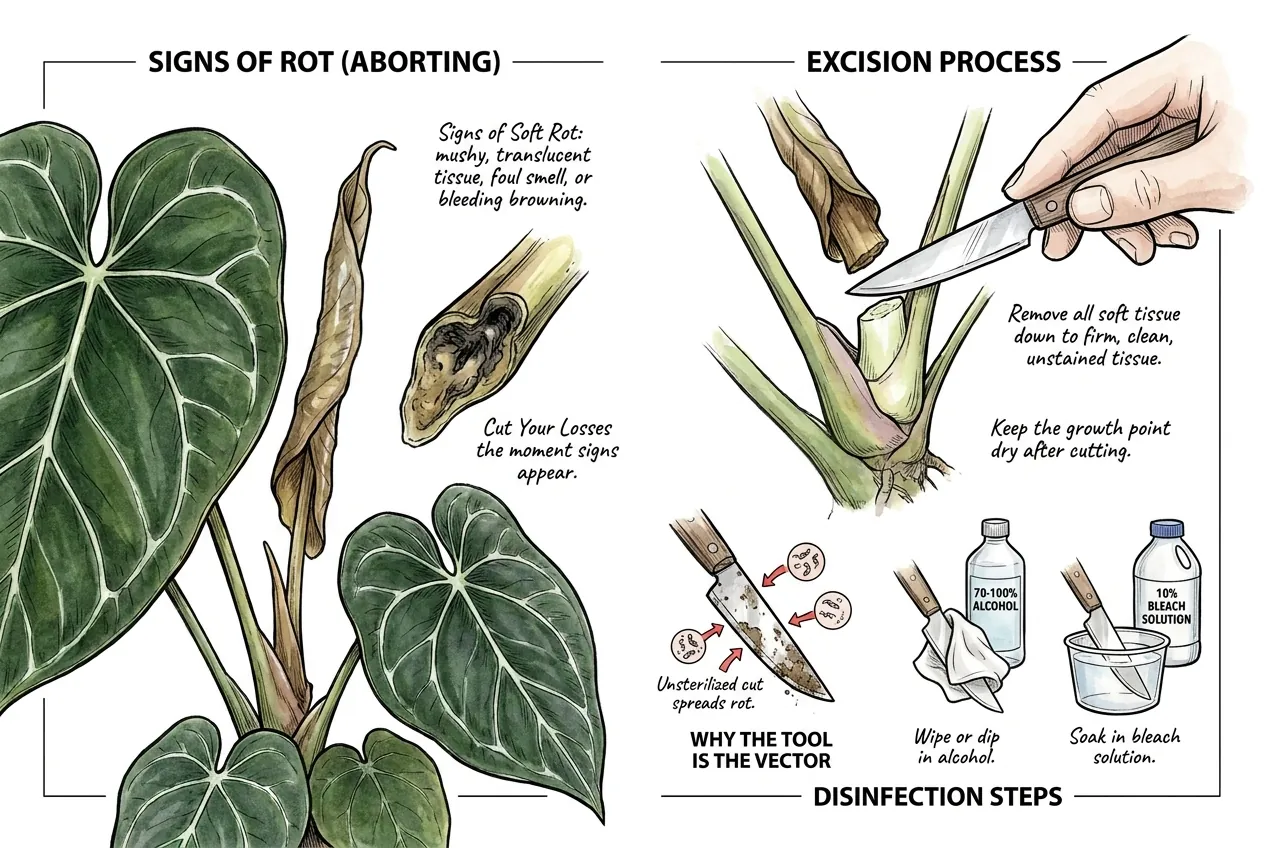
Consider giving up on the leaf once the spear is mushy or translucent, smells foul or sour, or the browning is spreading toward the central growth point.
At that stage no chemical reverses the damage. Removing dead tissue can slow a local rot, but understand its limits. Cutting to visibly clean tissue does not cure a systemic infection, the pathogen may already sit in surrounding or vascular tissue, and cutting near the shoot growing point can cost future growth.
If you do cut, remove soft tissue back toward firm, clean, unstained tissue with a freshly disinfected blade, working conservatively near the growing point.
Disinfect the blade again afterward, isolate the plant from your collection, and keep the growth point dry.
This is a salvage attempt with an uncertain outcome, not a guaranteed fix. If Xanthomonas blight is a real possibility, discarding a badly infected plant is the safer choice, since it can spread invisibly to the rest of your collection.
Why the tool is the vector
Soft-rot bacteria ride on blades, so an unsterilized cut spreads rot to the next plant and re-inoculates the next cut on the same plant.
Clean visible debris off the blade first, because soil and organic residue consume disinfectant before it reaches the microbes.
For home use, wipe or dip tools in 70 to 100% alcohol, which acts on contact. Alternatively, soak them in a 10% household-bleach solution (one part bleach to nine parts water) for about 30 minutes, then rinse to prevent corrosion.
Alcohol denatures bacterial proteins and bleach oxidizes them, but both fail on a dirty blade, so clean off visible debris first.
Bleach is corrosive and its fumes are an irritant, so work in a ventilated area, wear eye protection, never mix bleach with other cleaners, and rinse tools afterward.
Correcting conditions vs cutting
| Factor | Correct conditions & dry out | Cut away rotted tissue |
|---|---|---|
| What it does | Removes the wet, stagnant conditions rot needs | Physically removes clearly dead tissue |
| Best for | Early, still-firm spear. Prevention | Localized rot with firm tissue below |
| Main risk | May not stop rot already established | Damaging the growing point. Spreading disease on tools |
| Cures rot? | No (reduces the conditions that drive it) | Not guaranteed. Will not clear a systemic infection |
Anthurium Diseases (UF/IFAS PP292)
Disinfecting Your Garden Tools (UF/IFAS Gardening Solutions)
How do watering and substrate set up crown rot?
A wet crown plus a water-holding root zone is what quietly stages cataphyll rot. Overhead misting and watering leave a persistent film in the cataphyll funnel.
Bacteria swim across wet surfaces, so the single most-cited control is to keep the foliage dry.
How should I water to keep the crown dry?
Redirect all water to the roots. The cataphyll wraps the spear in a tight, upward-facing funnel, a perfect cup that catches misting, splash, and condensation.
The problem is that the water does not leave.
The key is not to pour water into the crown, and to make sure the mix drains fully. Careful top-watering at the pot edge does this fine (aim a narrow stream at the medium around the rim, never into the center where the spear emerges).
Bottom-watering and drip irrigation also keep the crown dry, but they are options, not the only right answer. A shared bottom-watering tray can move pathogens between pots and let soluble salts build up without occasional top-down leaching, and a pot left standing in water invites root rot.
Whatever method you use, let the medium drain and do not leave the pot sitting in runoff.
Why guttation re-wets the crown even if you never mist
Even a grower who never sprays can keep the crown wet from the inside. The medium goes warm and wet while the night air sits still and saturated.
The plant then pushes water out through its leaf margins as guttation, and in still, saturated air those droplets are slow to evaporate.
Guttation droplets form at night when humidity is high and the potting mix is warm and wet.
Those droplets carry sugars and, on an already-infected plant, bacteria, so persistent guttation is a plausible internal re-wetting and re-inoculation route, though exactly where the droplets end up depends on leaf angle, surface, and air movement, so treat runs back into the crown as a likely mechanism rather than a measured fact.
Keep the root zone on the drier side at night and keep gentle air moving so the droplets evaporate instead of lingering.
Root, Crown, and Stem Rots on Flowers (University of Maryland Extension)
What substrate stops the wet feet that feed rot?
Use a chunky, fast-draining, bark-based aroid mix in a pot with real drainage holes. A dense, water-retentive mix keeps the whole root zone, and by extension the crown, saturated far too long.
The commercial answer for Anthurium is an open, well-aerated medium with high drainage. UF/IFAS roots Anthurium in a 1/1/1 mix of peat, perlite, and bark, targeting pH 6.0 to 6.5, with drip or sub-irrigation.
Water-mold root rots can usually be avoided by using light, well-drained soil mixes.
Why this matches a limestone lithophyte
Large particles like bark, perlite, pumice, and charcoal create macropores that drain fast and pull air into the root zone after every watering.
Water-mold pathogens are favored by saturated, poorly drained conditions, so a fast-draining, well-aerated mix lowers the risk, but it does not confer resistance or fully prevent infection, since these organisms can also arrive on infected stock and persist in merely moist media.
Pair the mix with clean plants and good sanitation, not the mix alone.
A fast-draining mix also matches where clarinervium grows. It occurs on limestone in a seasonally dry region, so it does poorly in heavy, water-holding soil that stays wet.
One practical correction matters here. Do not put rocks or gravel at the bottom of the pot, because a gravel layer raises, not lowers, the saturated zone.
Cultural Guidelines for Commercial Production of Interiorscape Anthurium (UF/IFAS EP159)
Root Rots on Houseplants (UW-Madison Horticulture)
Anthurium clarinervium (habitat reference)
How do I fix the cabinet environment for good?
The durable fix pairs two moves. Bring humidity down out of the near-saturation zone into a moderate band, and add gentle air movement so the crown is not sitting in a still, humid pocket.
The exact VPD that corresponds to a given RH depends on temperature, so treat any single kPa figure as a starting point and measure your own cabinet (see the temperature note below).
Both moves attack the same thing. How long free water lingers on the crown. Air circulation matters because still air lets a humid boundary layer sit against the leaf even when the room reading looks fine, so do not rely on humidity control alone.
How much airflow is gentle enough for velvet leaves?
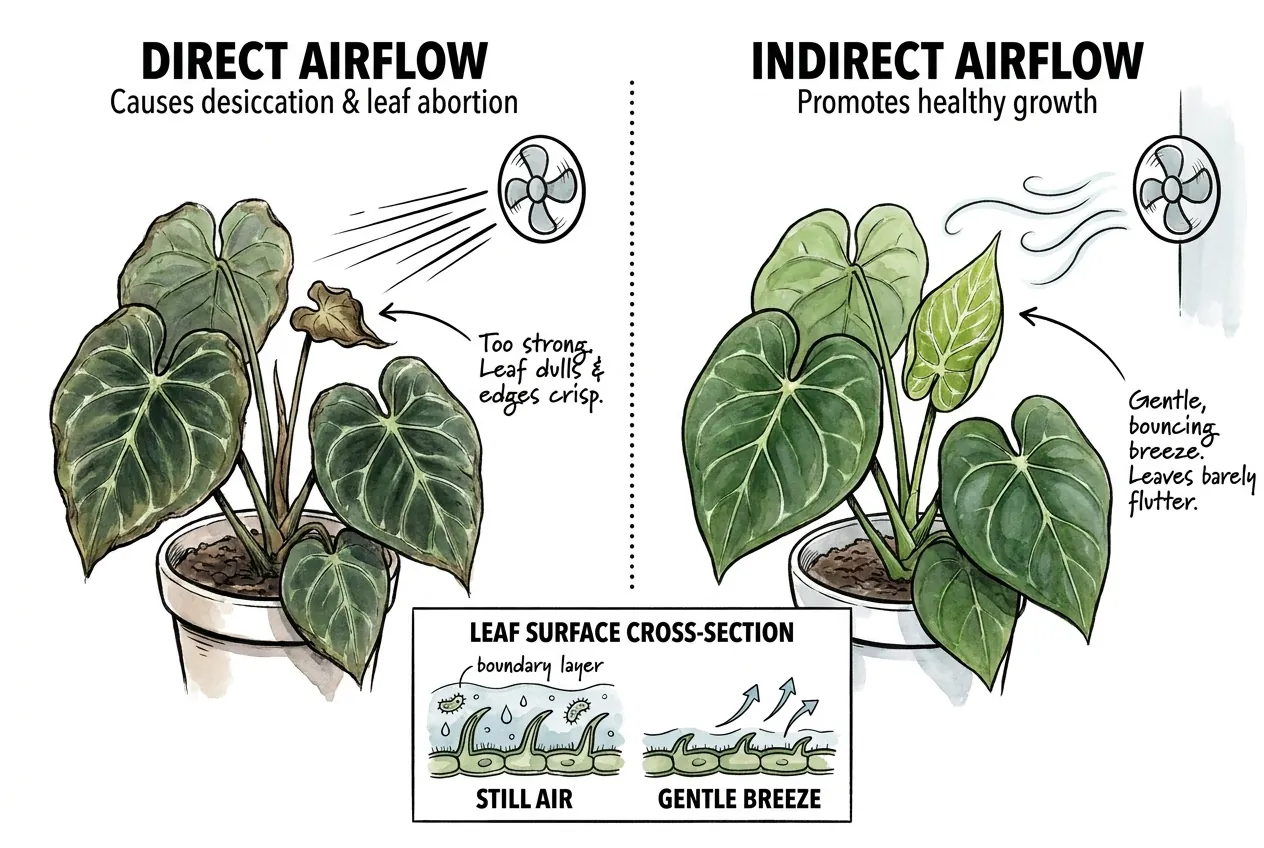
A common greenhouse target is roughly 50 to 100 ft/min of gentle horizontal airflow, aimed indirectly so leaves barely flutter.
That figure comes from horizontal-air-flow design for large greenhouses, where it circulates the whole air mass and keeps nighttime leaf temperature close to air temperature so leaves do not cool below dew point and condense.
In a small cabinet, a clip fan can easily exceed that as a local jet in one spot while leaving a dead zone in another, so use the number as a rough target and, ideally, verify the actual velocity at crown height rather than assuming a fan setting delivers it.
Moving air strips the stale, near-saturated boundary layer off the leaf and replaces it with drier bulk air.
The spear surface can then exchange moisture and dry, producing a drier canopy microclimate.
How to position the fan without burning leaves
Aim a small clip or circulation fan to graze the canopy or bounce off a wall, not to blast the crown. Indirect, low-velocity, ideally oscillating airflow is the goal.
Velvet leaves desiccate under a direct jet. So if you see edge crisping or dulling of the velvet, point the fan at a wall and drop to the lowest speed.
The spec that matters for a velvet-leaf cabinet is low, controllable velocity. A fan with graduated speeds and a head you can aim at a wall lets you stay gentle.
The fan is infrastructure, not a cure. It helps the crown dry, but it does not treat an already-infected spear, and buying any particular model does not by itself guarantee a target velocity at plant height.
What to look for in a cabinet fan
A small clip-on circulation fan suits a cabinet. Look for a brushless motor, enough speed control to produce gentle airflow, and a head you can aim away from the crown. Choose one whose manufacturer documents a damp-location or ingress-protection rating appropriate for the placement. A splash-resistance rating covers only the exposure defined by that rating, not direct or continuous water contact.
Two things to weigh. A manual-swivel fan with no auto-oscillation stays fixed unless you move it, and in a small cabinet its output can be more than you need. Start on low and measure air movement at crown height with an anemometer, because a speed number does not describe leaf-level airflow.
If you want the air to sweep on its own, look at an oscillating model instead. To choose airflow gear by measured velocity at plant height, it helps to match fan, humidifier, and sensor to your target VPD band.
A very small cabinet often does better with a compact 4-inch fan that can be turned right down for the measured space.
Horizontal Air Flow is Best for Greenhouse Air Circulation (Farm Energy, eXtension)
Horizontal Air Flow Systems (UConn IPM)
Track Conditions at Crown Height
Temperature and RH together are more useful than RH alone because the same humidity can dry a crown differently in a warm cabinet. A sensor at crown height can reveal whether the enclosure reaches near-saturation after watering or misting.
Use the readings as a trend, not a diagnosis. The sensor reports air conditions, not the temperature of the spear or the amount of water trapped inside the cataphyll.
Adjust Without Creating Condensation
Reduce excessive humidity gradually, increase ventilation or gentle circulation, and watch for condensation. The goal is not a perfect number. It is a crown that dries between waterings without turning the plant into a dry-air case.
Why should greenhouse growers pay attention to vapor-pressure deficit and not relative humidity? (MSU Extension)
What does normal clarinervium growth look like, and is slow the same as aborting?
Slow is not aborting. Clarinervium is a documented slow-to-moderate grower, so a firm, well-colored spear that takes weeks to unfurl is behaving normally.
Judge a spear by firmness and color, never by calendar speed.
This matters because a common mistake is to panic over a perfectly healthy slow spear. A new leaf emerges as a tightly-rolled spear that unfurls and hardens off over a period of weeks, and unfurling time varies with temperature, light, root health, and plant maturity.
What does clarinervium's natural habitat suggest?
Clarinervium comes from seasonally dry limestone country in the Chiapas highlands. It is usually described as terrestrial, rooting deeply among rocks, and more occasionally growing on rock faces (epipetric), rather than as a wet-swamp or fully epiphytic plant.
Kew's Plants of the World Online places it primarily in the seasonally dry tropical biome.
The practical takeaway follows from the growing medium and drainage rather than from a precise reconstruction of its wild microclimate.
Free-draining media let the roots dry between waterings, which suits a plant from well-drained limestone soils. A permanently saturated crown is the opposite of that.
So lean toward a chunky free-draining mix, humidity in a moderate band rather than near-saturation, and real air movement so the crown can dry between waterings.
A sealed cabinet held near 90% with a humidifier and no fan is a very different environment from its native ground. You do not need to know its exact wild humidity to see that a stagnant, near-saturated crown is a poor match.
Anthurium clarinervium Matuda. Plants of the World Online (Kew)
What does a healthy new leaf look like as it emerges?
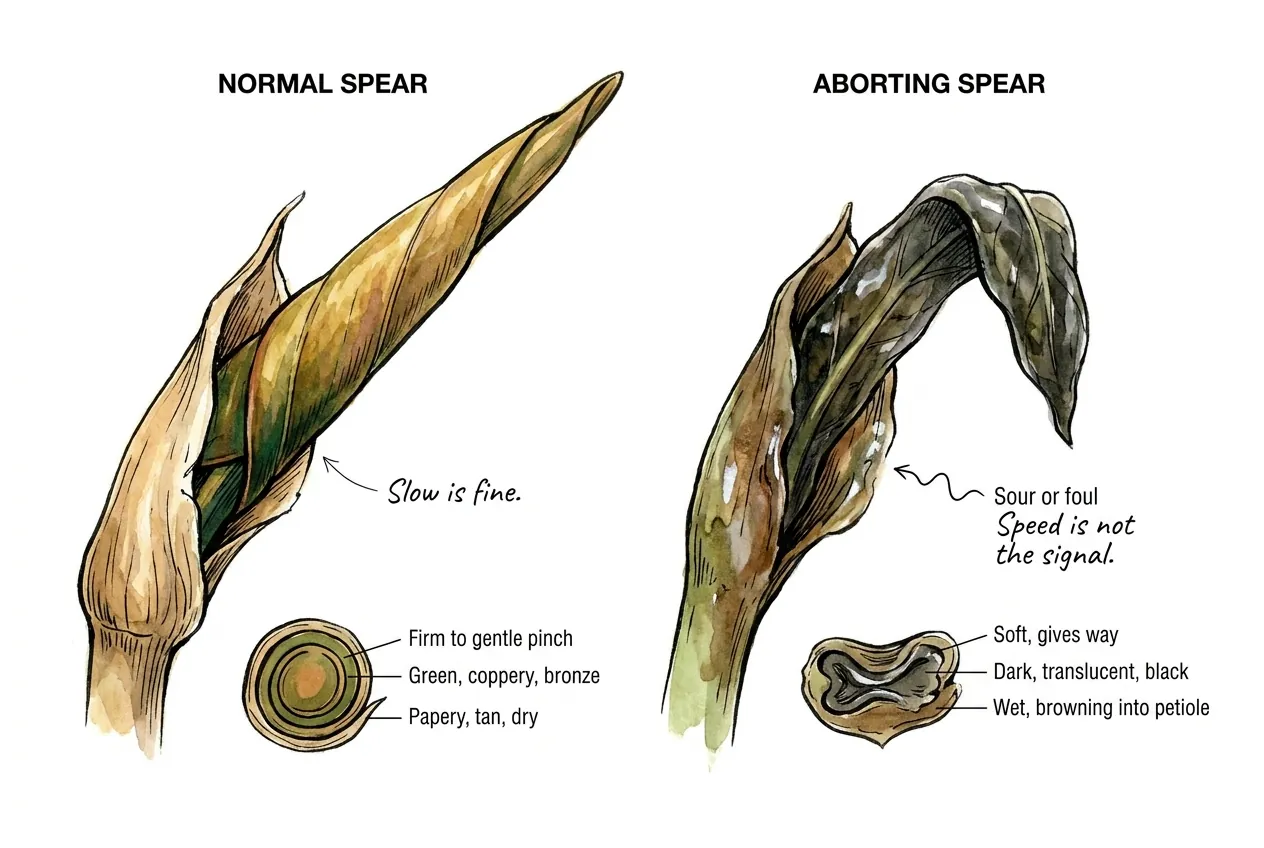
A normal new leaf is a firm, tightly-rolled spear that emerges yellowish-brown to coppery and darkens to deep green over a few weeks. A pale or bronze new leaf is normal, not a failure.
Pigmentation and chloroplast maturation lag behind expansion, so the coppery juvenile color is expected in velvet anthuriums.
New leaves on clarinervium are initially yellowish-brown before turning dark green as they mature. Do not blast the spear with stronger light to green it up.
Normal spear vs aborting spear
| Trait | Normal spear | Aborting spear |
|---|---|---|
| Firmness | Firm to a gentle pinch | Soft, gives way |
| Color | Green, coppery, bronze | Dark, translucent, black |
| Cataphyll | Papery, tan, dry | Wet, browning into petiole |
| Odor | None | Sour or foul |
| Speed | Slow is fine | Speed is not the signal |
Judge by the left column versus the right, not by how many days have passed. A firm, well-colored spear inside a dry sheath that stays unopened for a week or two is usually just growing slowly, often at the cooler end of its comfort range.
Care guides commonly suggest bright-indirect light and a warm room around 68 to 82°F. Run gentle airflow and re-check the spear each week.
If a spear that looked firm starts to soften, darken, or smell, stop assuming slow and look for another cause.
Anthurium Clarinervium Care. Smart Garden Guide
Expert Tips to Help Your Anthurium Clarinervium Thrive. Garden Betty
How do I stop the next leaf from aborting?
Build a standing environment that keeps the crown able to dry, then lock in watering, hygiene, and quarantine habits.
When cataphyll rot is the cause, it is usually a moisture-management problem rather than bad luck, so the prevention routine below focuses on keeping the crown from staying wet, while you also stay alert to other causes.
What standing environment prevents the wet-crown trap?
Keep the cabinet moderate rather than near-saturated, and run gentle indirect circulation so the crown dries between waterings. If water lingers in the cataphyll or surfaces begin to condense, lower the humidity or improve ventilation.
The plant experiences conditions at the crown, not at a distant shelf sensor. Place the sensor near the growth point but out of direct mist and fan flow, then use the readings to spot prolonged saturation.
Why should greenhouse growers pay attention to vapor-pressure deficit and not relative humidity? (MSU Extension)
Horizontal Air Flow is Best for Greenhouse Air Circulation (Farm Energy, eXtension)
What permanent watering, hygiene, and quarantine habits keep rot out?
Make base watering, dry-crown hygiene, tool sanitation, and new-plant isolation permanent rules.
These habits remove the water film pathogens swim across and stop you importing the next outbreak.
Water at the substrate, never overhead onto the crown, and stop misting into the funnel. After watering or a humid night, blot or air-dry standing water at the growth point.
Remove decayed cataphyll debris promptly, since it is both a moisture trap and a bacterial reservoir.
Tool sanitation and quarantine
Sanitize any cutting tool between plants (a 70% alcohol wipe works on contact, or use the 10% bleach soak and rinse described above) and discard rather than compost any rotted tissue.
Quarantine every new plant with weekly inspection before it joins the collection. A 2 to 4 week quarantine is a sensible minimum that catches obvious pests and acute problems, but it is not a clean bill of health for Xanthomonas. Infections can stay symptomless for months while still shedding bacteria in guttation fluid.
For blight specifically, favor known disease-free stock, keep records of where plants came from, watch new plants for longer, and use diagnostic testing if a plant looks suspect.
Early-warning checklist for every new spear
Watch five things on each emerging spear, mostly by looking rather than handling. Note firm versus softening (check gently and rarely, with clean hands, to avoid bruising or contaminating the tissue), tan-papery versus dark, translucent, or wet, any sour or foul odor, standing water in the funnel, and roughly how long the crown stays wet after watering.
Act before softening reaches the growth point to give the remaining crown tissue the best chance of recovery.
Suppression of Bacterial Blight by Guttation-Fluid Bacterial Communities (Anthurium)
Avoid overwatering to prevent plant diseases (UGA CAES)
Key Takeaways
New leaf aborting is a symptom with several possible causes. A wet, stagnant crown is a common and under-recognized one, but it is not the only one, so work through the differential before you treat.
- Read the sheath by feel and smell as well as color. A dry, firm, papery, odorless sheath is a normal spent cataphyll, while a wet, soft, mushy, foul-smelling spear points to rot. These are clues, not a confirmed pathogen ID.
- Keep the cabinet in a moderate band rather than near-saturation, with steady gentle airflow, and measure VPD at your own temperature instead of trusting a fixed number. Verify air movement at crown height rather than assuming a fan setting delivers it.
- Use smell, texture, and location as possible clues to bacterial soft rot, oomycete, or Xanthomonas, not a field diagnosis. Symptoms overlap. A diagnostic lab or extension service confirms it. Xanthomonas can be latent and systemic, so isolate and use sterile tools.
- Peroxide is not a validated spear treatment and can burn tender tissue. Rely on drying the crown, airflow, and drainage instead. If the crown is mushy or foul, isolate the plant and, if you cut, do so conservatively. Cutting is a salvage attempt, not a cure.
- Make base or edge watering (never into the crown), a chunky free-draining mix, dry-crown hygiene, tool sanitation, and quarantine of new plants permanent habits. Judge every spear by firmness and color, since slow is not aborting.