
Aquarium Cooling Product Chooser: Fan vs Chiller
This aquarium cooling product chooser shows what to buy when a planted tank overheats: fan, thermometer, circulation or chiller for Anubias and Buce.
Elena Vargas · Published 2026-06-23 · 31 min read
Key Takeaways
- Measure water temperature before buying a cooling tool. The required cooling is the gap between your measured peak and your species’ setpoint, not a fixed number.
- Anubias, Bucephalandra, and Cryptocoryne care ranges vary by species and cultivar. Set your action point from your own plants’ measured response rather than one genus-wide threshold.
- A warm, lightly stocked tropical tank often needs an evaporative fan plus surface circulation first. Re-measure because the temperature drop depends on room humidity and heat load.
- Choose a chiller when the species setpoint and heat load require stable cooling. It rejects the removed heat and compressor work into the room.
- Avoid bare ice and large unmatched cold-water changes. Cool gently and monitor a probe to limit shock and chemistry mismatch.
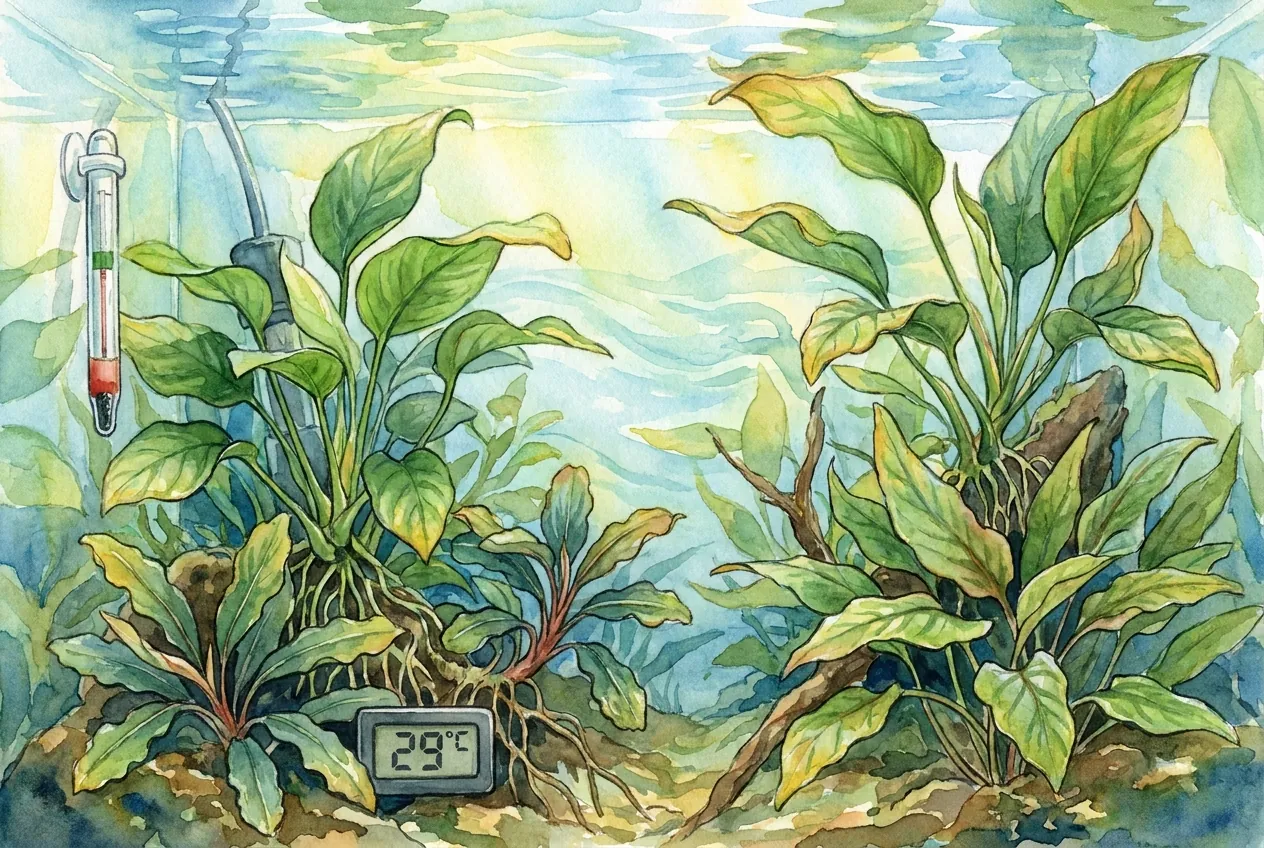
Your room hits 31 °C, the tank creeps past 28 °C, and an Anubias rhizome starts going soft and black.
Softening can come from several causes, so before you diagnose rot, rule out mechanical damage, a buried rhizome, and water quality. The panic move is a handful of ice cubes.
The better move is to measure first, then cool gently with a couple of cheap tools, and only sometimes a chiller.
Choose cooling in this order. Measure water temperature, improve surface exchange, test an evaporative fan, then add a chiller only if the measured heat load still requires it. Product limits are starting points to verify against your own tank, not fixed rules.
What is the fastest safe way to cool an overheating planted tank?
For a warm, lightly-stocked tropical tank, a reasonable first trial is an evaporative clip-on fan plus surface circulation, after you confirm the true water temperature on an in-water probe.
That combination usually costs the least per degree and, unlike a chiller, adds no compressor or condenser heat to the room, though it does raise room humidity.
How many degrees it buys varies with room humidity and heat load, so re-measure to confirm.
A chiller earns its place when a species’ setpoint, the worst-case ambient, and the tank’s heat load call for it, including small cold-water or sensitive setups, not tank size alone.
Measurement is step zero because every cooling choice is a temperature-control choice. The amount of cooling you need is often only a couple of degrees, which can be smaller than the error of a guess or a stick-on glass strip, so knowing whether the water is 27 °C or 31 °C changes what you buy.
Before sizing a fan or chiller, I log tank and room temperature from before the lights start through the overnight low. I note pump and light schedules on the same chart, because one afternoon reading cannot show whether the heat comes from the room or the equipment cycle.
I test shading, lid position, or safer room-air changes one at a time and repeat the curve. The remaining peak and required temperature drop become my equipment requirement instead of a guess based only on tank volume.
Cooling Decision Sequence
First, read true water temperature with an in-tank probe. For a typical warm tropical tank, add circulation and an evaporative fan, then measure the drop rather than assuming it.
Escalate to a chiller if the water still sits above your species’ band overnight or the room never cools.
What should you NOT do, and why?
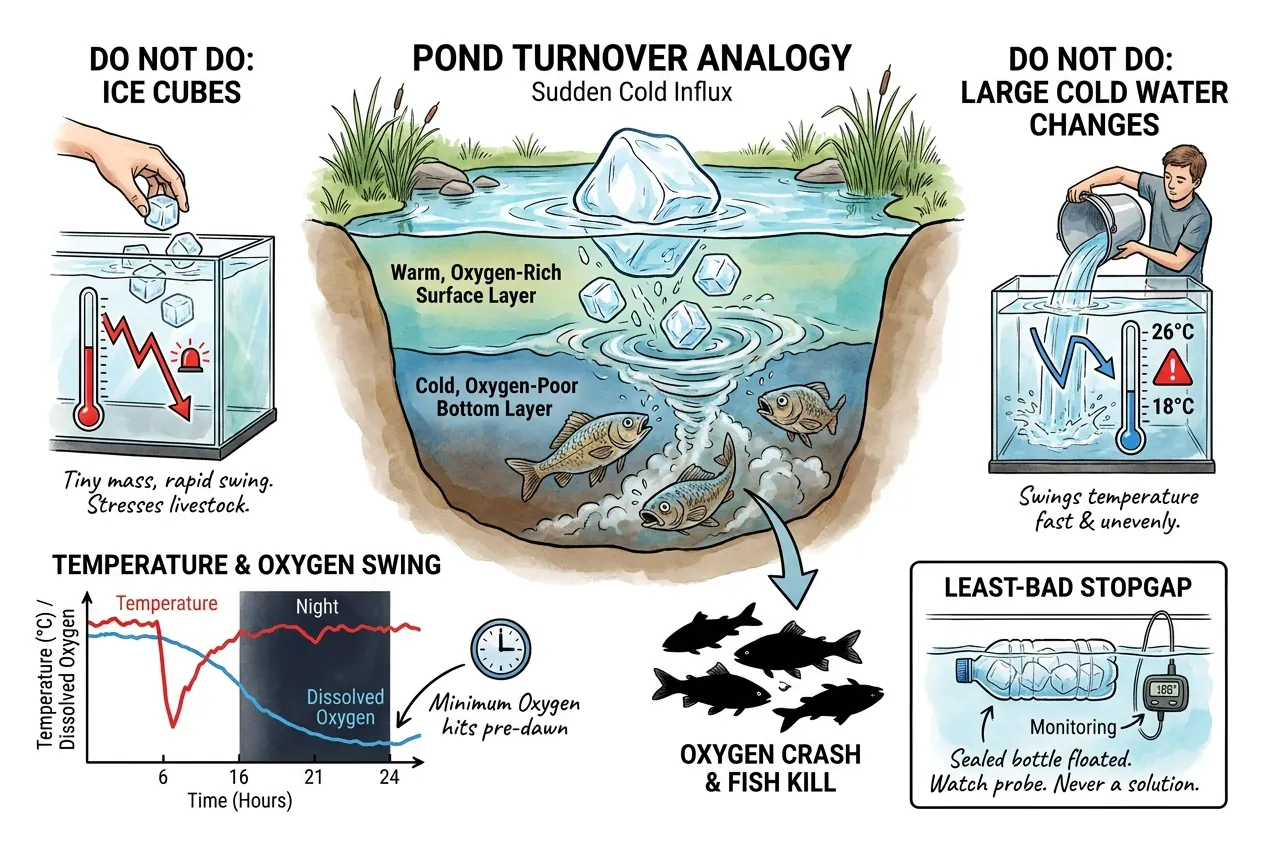
Avoid bare ice cubes dropped into the tank and large, unmatched cold water changes. The problem is not that cold water carries less oxygen. Colder water actually holds more.
The real risks are a fast, uneven temperature swing that shocks livestock and plants, a chlorine or chemistry mismatch from untreated tap water, and cold spots where the water enters.
The safer emergency options are distinct. A sealed frozen bottle or ice pack floated while you watch a probe, a temperature-matched partial water change with dechlorinated water, and a fan or room cooling.
Cool gently and let a probe limit the rate.
Why Pond Turnover Is a Poor Aquarium Analogy
A pond turnover fish kill happens in a deep, stratified pond where a low-oxygen bottom layer gets mixed up by a sudden cold rain.
A typical shallow, filtered, circulating aquarium does not have that oxygen-poor bottom layer, so it is a poor analogy for a tank.
In a tank the danger from a cold dump is the shock and any contamination, not a turnover.
Change gently. Keep the rate of change modest and watch the probe rather than targeting a single fixed rate, since a safe rate of change depends on species, starting temperature, acclimation, and how long the change lasts.
A sealed frozen bottle floated while you watch a probe is a reasonable monitored stopgap, better than bare ice, but not a standing solution.
Two variables to watch over a heat spell are the day-night temperature swing and dissolved oxygen.
After a night of respiration with no photosynthesis, dissolved oxygen tends to reach its low before dawn, though the exact timing depends on your light schedule, plant and algae load, and room conditions.
A tank that looks fine at noon can stress its fish overnight, so watch the measured overnight low rather than a fixed clock time.
Dissolved Oxygen and Water
Why does warm water put your plants and fish at risk?
Warm water squeezes oxygen from two sides. It physically holds less while organisms in the tank tend to burn it faster.
At zero salinity and 1 atm, 100-percent-saturation freshwater oxygen capacity falls from 9.09 mg/L at 20 °C to 8.26 mg/L at 25 °C to 7.56 mg/L at 30 °C. On the demand side, one acute goldfish study measured oxygen consumption rising to about triple baseline as the fish warmed toward 30 °C. The exact response varies by species and acclimation, but the general direction is that supply falls while demand climbs.
When oxygen runs low, a stagnant film can form over the substrate and rhizomes, and low oxygen in that microzone is one plausible stressor for Anubias and Buce, though it is not a proven cause of rot on its own.
In fish it can end with gasping at the surface, where the last oxygen sits, alongside other possible causes such as toxins or gill disease.
Cooling and circulation help with both the temperature and the oxygen side.
How much oxygen does warm water actually lose?
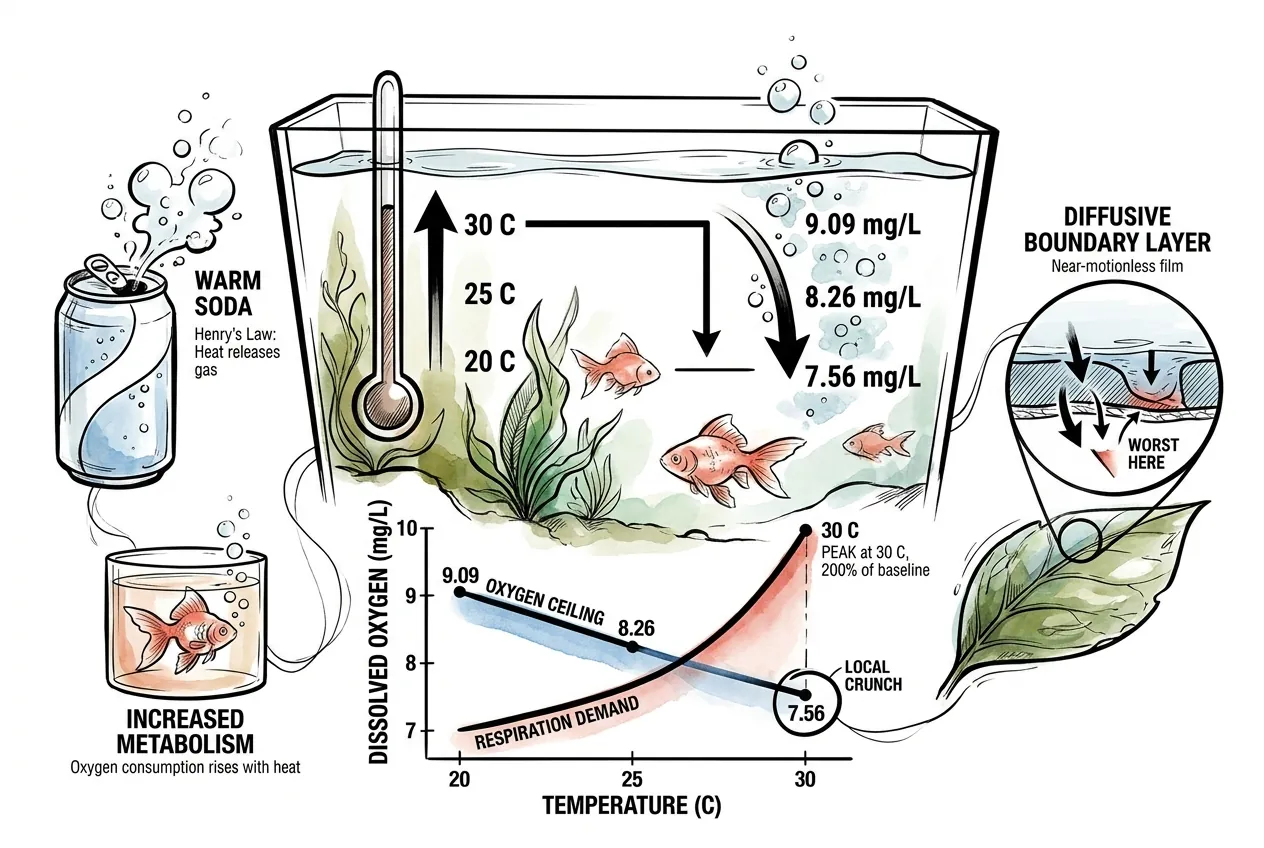
Across a 10 °C warming, the saturation ceiling drops about 17 percent, and the numbers come from a published government table.
The USGS National Field Manual, Table 6.2-2, lists 100-percent-saturation oxygen for salinity-zero freshwater at 1 atm.
Reading that table gives 9.09 mg/L at 20 °C, 8.26 mg/L at 25 °C, and 7.56 mg/L at 30 °C. These are saturation ceilings, not your tank’s actual reading, which respiration, aeration, and altitude also move.
Oxygen solubility falls with temperature because of Henry’s law. Dissolving oxygen into water releases heat, so adding heat pushes the equilibrium back toward the gas phase.
The everyday version is warm soda, which holds far less fizz than a chilled can.
Demand tends to move the opposite way. In one acute study, researchers warmed eight juvenile goldfish from about 21 to 30 °C at 0.1 °C per minute and saw oxygen consumption peak near 200 percent of baseline, a transient result a few hours into the ramp, with a measured Q10 of 3.06.
That is one species under acute warming, not a steady-state figure for every fish, and the authors reported no sublethal harm over that exposure.
Still, the general pattern holds. As the ceiling falls toward 7.56 mg/L at 30 °C, respiration tends to rise.
Locally, oxygen moves slowest through the diffusive boundary layer, the thin near-motionless film on a surface.
Limnology microelectrode work on sediment and detritus measured that stagnant sublayer at roughly 0.5 mm under laminar flow, where oxygen moves only by slow molecular diffusion.
That figure is from sediment, not from a plant rhizome, so treat it as illustrating the mechanism rather than a measured value for Anubias tissue.
As a general principle, flow thins the boundary layer, which is why circulation helps.
USGS National Field Manual, Chapter A6.2, Dissolved Oxygen, Table 6.2-2
Metabolic Rate of Goldfish (Carassius auratus) in the Face of Common Aquaculture Challenges
Diffusive boundary layers and the oxygen uptake of sediments and detritus
At what temperature do Anubias, Bucephalandra and Cryptocoryne start failing?
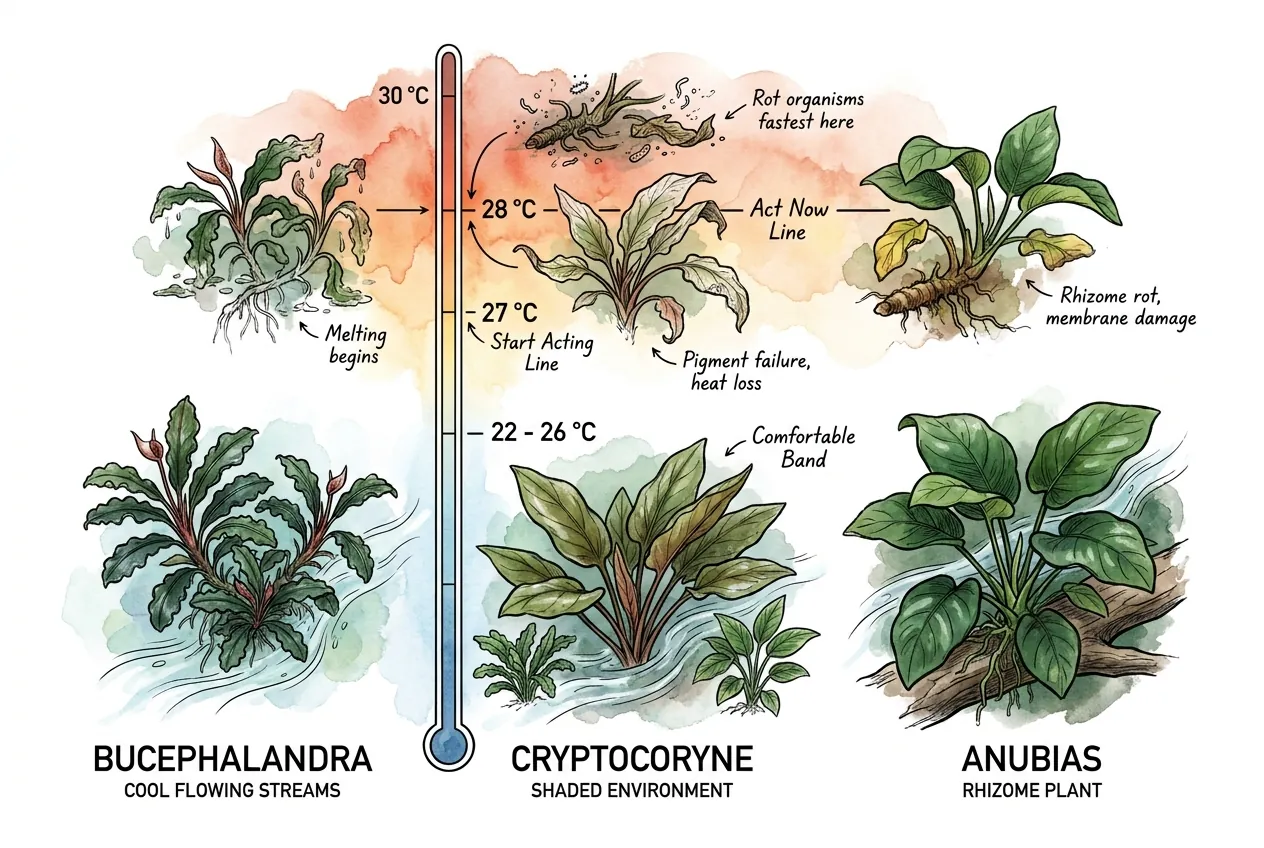
These three genera are generally cool, shaded, flowing-stream plants that tend to prefer temperatures in the low-to-mid 20s C. Exact comfortable ranges vary by species and cultivar, and some, such as Anubias barteri, are commonly listed as tolerating up to about 28 to 30 °C. So rather than a single genus-wide line, watch your own plants. Warmer water plus a stagnant, buried rhizome is a plausible risk, but the point to act on is your measured peak against what your specific plants tolerate.
One peer-reviewed Anubias study concerns cold stress, not a high-temperature action point. No study establishes a 27 or 28 °C upper limit across these genera, so set the action point from the needs and measured response of the species in the tank.
For the genus-specific picture, see our notes on Anubias rhizome rot in summer heat and Cryptocoryne heat loss.
It is often suggested that rot organisms run faster in warm water, and that is biologically plausible, but the specifics are not settled for these plants.
The Pythium species whose 28 to 32 °C growth optimum is sometimes cited (Pythium insidiosum) is a human and animal pathogen, not a confirmed Anubias rhizome pathogen, and the definitive cause of Anubias rhizome rot is not established.
Treat a warm-plus-stagnant-plus-buried rhizome as predisposed tissue, not as a diagnosis.
Low oxygen is one plausible way heat can worsen plant stress, but it does not establish a simple oxygen rule for rhizome disease. Maintain surface movement as a preventive measure while checking burial, injury, and water quality separately.
Cryptocoryne Melt Is a Separate Response
Cryptocoryne melt is a separate, usually reversible event. It is a stress-triggered leaf-shedding response where the rhizome typically stays alive and regrows once conditions stabilize.
Heat is only one possible trigger. Relocation and changes in water chemistry, light, CO2, and nutrients can also set it off.
The fix is stabilizing conditions, not dosing a cure, so do not uproot a firm rhizome.
Keep the Bucephalandra context in view via our Bucephalandra care guide.
Integrative Analyses of Two Anubias Genotypes to Low-Temperature Stress
Cryptocoryne Melt
What specs actually decide which cooling product to buy?
Each role has a few measurable specs worth checking, so buy to those rather than to the marketing.
No single number decides it. A fan depends on airflow, wet-bulb temperature, tank width and open-top access. A chiller on heat load, flow window, ventilation and electrical rating.
A thermometer needs stated accuracy of plus or minus 0.5 to 1.0 °C with 0.1 °C resolution and an in-water sensor. Note that resolution is not accuracy, and a manufacturer’s stated accuracy is not the same as an independent calibration.
A circulation pump needs a stated GPH and, ideally, adjustable flow, matched to your existing filter return and livestock.
A chiller needs a tank-size rating, a wattage or BTU figure, and a required pump-flow window.
A controller needs a stated switching accuracy, a settable deadband, and a relay rating you do not exceed.
Use the table as a starting-point comparison. The thresholds are typical values, not guarantees, and every option also depends on wet-area electrical safety and calibration.
| Role | Measurable spec to demand | Threshold to look for | Main tradeoff | Who should SKIP |
|---|---|---|---|---|
| Evaporative cooling fan | airflow (CFM), adjustable head, open-top mount, splash/IP | drop varies with wet-bulb. Often a few C | raises evaporation and GH/TDS drift. Limited by humidity | sealed-lid keepers. Anyone needing a large drop in a humid room |
| Digital thermometer | stated accuracy plus/minus 0.5-1.0 °C AND 0.1 °C resolution, sensor in water | plus/minus 0.5-1.0 °C is fine for daily use (lab field grade is plus/minus 0.2 °C) | stated accuracy is not calibrated. Cheap probes drift. Batteries die silently | nobody, but never trust one cheap probe alone for an irreversible move |
| Circulation / wavemaker | stated GPH/LPH, adjustable nozzle/intensity | ~5-10x turnover/hr planted | too much flow uproots delicate plants | nano keepers of fine-leaved plants / slow livestock |
| Aquarium chiller | tank-size rating + W/BTU/hr + pump-flow window + ventilation | size to heat load and pull-down time (~8.3 BTU is the energy per gallon per F, not a rate) | most expensive. Rejects heat plus compressor work into room | tanks a fan already holds. Anyone who cannot vent the exhaust |
| Temperature controller | switching accuracy + deadband | plus/minus 1 °C, 0.1 °C resolution | extra cost + single probe failure point | single-fan keepers who watch the tank daily |
How To Choose an Aquarium Chiller and How It Works
Which cooling tool solves which problem?
Match the Tool to the Measured Problem
Each product mainly addresses one part of the warm-water problem. The fan and chiller move temperature.
The thermometer measures it, the circulation pump raises gas exchange and mixing, and the controller automates the setpoint.
How does a cooling fan drop the temperature?
A surface fan cools by accelerating evaporation. Each kilogram of water that leaves as vapor carries away its latent heat, roughly 2,440 kJ near room temperature (the often-quoted 2,257 kJ/kg is the value near boiling).
The fan does not refrigerate anything. It sweeps humid air off the surface so evaporation keeps running, and that phase change pulls energy out of the water left behind.
Fan cooling works by evaporation, so it helps far more in dry air than in a humid room. The result also depends on surface area, airflow, and the tank’s heat load. Measure your own before-and-after temperature change before relying on a fan during a heat event.
For the fan role you want a stated airflow (CFM) to match the tank footprint, an adjustable head, an open-top mount, and splash-resistant construction, since the surface must be open.
Liveek Aquarium Cooling Fan
The Liveek Aquarium Cooling Fan suits an open-top tank where a few degrees of evaporative cooling may be enough. It is not a substitute for a chiller in a humid room or a high-heat setup. Measure the actual drop and plan for extra evaporation.
The main tradeoff comes from the evaporation itself. Top-off rises, commonly on the order of a percent or two of tank volume per day, though the actual rate depends on your surface area, lid, fan speed and humidity, so measure it.
Because only pure water leaves, GH and TDS drift upward unless you top off with RO or distilled water.
Skip this fan if you keep a sealed glass lid you will not open, or if you need a large drop in a humid room where evaporation is limited.
FS-602 Aquarium Cooling Fan
The FS-602 Aquarium Cooling Fan fills the same role for an open-top, fan-appropriate tank. Compare fit, mounting, noise, and return policy rather than assuming it out-cools another fan from the head count alone. Its real result still depends on humidity and tank size.
Whatever fan you use, remember the surface is now open. Guard against jumping livestock, watch the falling water level so heaters and filter intakes stay submerged, run a drip loop on the cord, and plug into a GFCI/RCD outlet with the adapter kept dry and clear of splash.
Effects of mechanical aeration on evaporation rate and water temperature
Enthalpy of vaporization
What aquarium thermometer is accurate enough to manage cooling?
You want a submersible digital probe stating plus or minus 0.5 to 1.0 °C accuracy and 0.1 °C resolution.
The cooling you are trying to measure is often only a couple of degrees, which can be smaller than the error of cheaper tools.
If a fan moves the water only a couple of degrees, an instrument carrying plus or minus 1.5 to 2 °C of error can hide whether the fan worked at all. Measurement is the enabling step, not an afterthought.
For context, federal field standards are far stricter than any hobby tool. USGS requires a traceable field thermometer to read within plus or minus 0.2 °C of a certified reference, and retires thermistors that drift past that.
That is a lab QA bar for calibrated instruments, not a consumer buying threshold, and a listing’s stated accuracy is not the same as being calibrated against a known reference.
A consumer aquarium probe at plus or minus 1 °C is fine for daily management. It beats a stick-on strip because it sits in the water rather than reading the glass, which couples to both the water and the room.
Hobby comparisons sometimes report strips disagreeing with an internal probe by a few degrees F, but that gap depends on placement and the room-to-water difference and has not been characterized in a controlled test.
PAIZOO LED Aquarium Thermometer
The PAIZOO LED Aquarium Thermometer suits continuous in-water monitoring during a heat event. Treat it as a convenience monitor, not a calibration reference, and cross-check it periodically with another in-water probe.
Its tradeoff is that USB power needs an outlet and cable run, with the adapter kept dry and a drip loop on the cord.
Cross-check a single probe against a second reference when a prized plant or fish is at risk.
hygger External Aquarium Thermometer
The hygger HG073 thermometer is useful for a quick external glass reading, not as an independent water-temperature reference. Use a second in-water probe or calibrated reference when a cooling decision depends on the number.
USGS Techniques and Methods, Book 9, Chapter A6.1, Temperature
Using a total immersion thermometer only partially immersed
How does circulation raise dissolved oxygen without stressing plants?
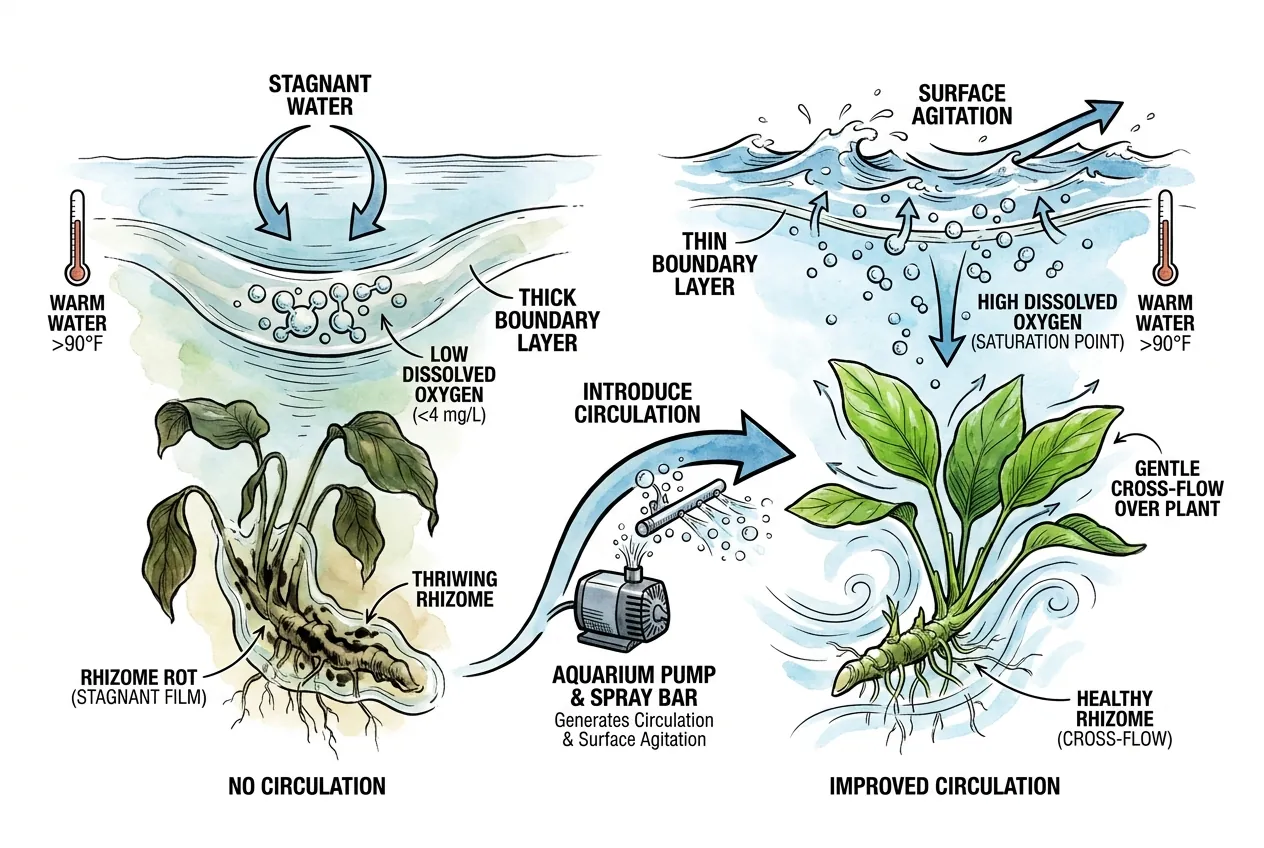
Surface agitation is a cheap way to raise gas exchange. Gas crosses the surface roughly in proportion to interface area divided by boundary-layer thickness, and stirring improves both terms.
A recirculating-aquaculture extension source states the mechanism. Gas movement depends on the interface surface area and the inverse of the stagnant boundary-layer thickness.
Choppier water raises the area and shrinks the film at the same time. What it does not do is set a fixed dissolved-oxygen number for your tank. The actual level also depends on demand, temperature, and the water-to-air gradient.
This matters in heat because warm water already holds less oxygen. UF/IFAS reports freshwater saturation falls from 11.9 mg/L at 45 °F to 7.4 mg/L at 90 °F, and recommends about 5 mg/L for health with emergency aeration below roughly 4 mg/L in pond aquaculture.
A small pump cannot add oxygen the water cannot hold. It can speed the approach toward equilibrium and reduce the chance of a glassy, poorly-exchanging surface, but whether your surface would otherwise sag below 4 mg/L is something only a dissolved-oxygen measurement can tell you.
Circulation can also break up a warm stagnant film over Anubias and Buce rhizomes. These plants come from flowing streams and generally tolerate more current than fine-leaved stems, so gentle cross-flow keeps oxygenated water moving over the tissue.
That is a reasonable preventive. It is not a guarantee against rot, which has other contributing causes.
hygger 792 GPH Wave Maker
The hygger 792 GPH Wave Maker suits a keeper who deliberately wants strong, directed circulation. Its fixed output makes it a poor default for a nano with shrimp, slow fish, or fine-leaved stems. Choose an adjustable lower-output pump and aim it at the glass in those tanks.
hygger HG070 Cross Flow Wave Maker
The hygger HG070 Cross Flow Wave Maker suits a genuinely large tank that needs adjustable whole-tank movement. Even its lower setting is too strong for a nano or many shrimp tanks, so treat it as a large-tank option rather than a general circulation upgrade.
A common planted-tank starting point is roughly 5 to 10x tank volume per hour in total turnover, delivered as high-volume, low-velocity flow.
Treat that as a rule of thumb, not a law. Adjust for head loss, tank geometry, your existing filter flow, and your plant and livestock tolerance, since too much flow uproots delicate plants, shreds fine leaves, and stresses slow fish.
Recirculation Aquaculture, Water Quality. Gases
Dissolved Oxygen for Fish Production (UF/IFAS FA002)
When is an aquarium chiller worth the cost?
A chiller earns its cost when a species’ setpoint, the worst-case ambient, and the tank’s heat load call for it, which can include small cold-water or sensitive setups, not just large or valuable tanks.
It is the most expensive option, and it rejects heat into the room.
It is a heat pump, so every BTU it pulls from the water, plus the compressor’s own work, is rejected into the air through the condenser.
Run it in a sealed cabinet and it warms the very ambient your fan depends on, so give it the clearance the manufacturer specifies.
Two technologies dominate. Thermoelectric (Peltier) units use no refrigerant, though most still have a heatsink fan, and run at a lower coefficient of performance.
Compressor units are more efficient and carry the capacity to hold a setpoint on larger tanks.
Efficiency figures vary by design, so the general rule is Peltier for very small, low heat-load systems and a compressor for bigger jobs.
IceProbe IPAC-50W Chiller
The IceProbe IPAC-50W chiller suits a very small shrimp or Buce system where a compressor would be excessive. Its thermoelectric capacity falls quickly as volume and room heat rise, so it is a nano-only tool and may need a separate controller.
Active Aqua AACH10HP Chiller
The Active Aqua AACH10HP chiller suits a system whose measured heat load exceeds what fan cooling can hold. It needs separately matched circulation, hoses, and ventilation clearance. Follow the manufacturer’s flow range, and skip it if a fan plus circulation already holds the target temperature or exhaust heat cannot be vented.
Chiller size depends on both the initial pull-down and the heat that keeps entering the tank from the room, lights, pumps, and plumbing. Use the manufacturer’s derated capacity for your conditions, leave headroom, and follow the minimum compressor run and off times to avoid short-cycling.
Thermoelectric cooling
Thermodynamic comparison of Peltier, Stirling, and vapor compression portable coolers
How does a temperature controller automate cooling?
A plug-in controller is the cheap brain that makes a dumb fan or chiller behave. It switches a cooling outlet on above a setpoint and a heating outlet on below a floor.
That closes the loop so day-night ambient swings stop translating straight into water-temperature swings.
It is the insurance against an unattended fan over-cooling the tank once the room finally cools overnight.
Inkbird ITC-308S Temperature Controller
The Inkbird ITC-308S controller suits an unattended fan or small chiller that needs a temperature boundary and high/low alarm. Keep the combined heating and cooling load within the controller’s total rating, cross-check the probe periodically, and confirm that a compressor chiller permits external on/off switching before connecting it.
The plug-in probe is worth having because a worn probe can be replaced rather than scrapping the unit. Its tradeoff is extra cost and one more failure point.
The NTC probe drifts with age, so cross-check it periodically against an independent probe. The manufacturer provides a calibration offset, but calibration alone will not fix a failed sensor.
Skip the controller if you manually run a single fan and watch the tank daily, since the added cost and failure point may not pay off, but note that manual control still carries the risk of an unattended overnight swing, so weigh the consequence of failure and whether you need its high/low alarm.
Set a small deadband, around 0.5 to 1 °C, so the cooler cycles instead of chattering. That is fine for a fan. For a compressor chiller, also set the manufacturer’s minimum off-time or a delay so the compressor does not short-cycle, and confirm the chiller allows external on/off switching.
Place the probe in the water away from the heater.
Chiller Troubleshooting Guide. Common Problems and Solutions
How do you set up summer cooling step by step?
Build cheapest-first and stop as soon as the water settles into your species’ safe range. Each step addresses a different variable, so jumping straight to a chiller often wastes money and heats the room.
Many typical tropical tanks are held by the fan-plus-circulation step, though small cold-water or sensitive setups may need a chiller from the start.
Step 0. Measure the true water temperature
Drop a digital probe mid-column, away from the heater and glass, and confirm the water is actually above your plants’ range. Believe an in-water probe, not a stick-on strip.
The cooling you need is the gap between your measured peak and your setpoint, which can be smaller than the error of a guess.
Step 1. Circulate to raise gas exchange
Raise or redirect the filter return so the surface ripples, then, if needed, add a modest circulation pump aimed across the top and into dead corners, sized to your tank and livestock.
Run it 24/7, prioritizing overnight when photosynthesis stops. This is the lowest-wattage way to guard against the overnight oxygen low.
Step 2. Add an evaporative fan
Clip a multi-head fan across the open surface and run it hardest when the room air is driest, which is often but not always overnight.
Re-measure after 30 to 60 minutes and again overnight, allowing that it can take longer to settle.
The drop depends on humidity, so measure it rather than assuming, and top off evaporative loss with RO or distilled water.
Step 3. Escalate to a chiller only if needed
If the water still sits above your species’ range overnight, size a chiller to your heat load, with a controller to bound the setpoint.
Target the upper end of your plants’ comfortable range rather than the coldest setting, so the cooler does less work and swings less.
Keep the day-night change modest, since the rate of change is a stressor on its own, but set the exact limit from your species rather than a fixed number.
Understanding and Preventing Fish Kills in Your Pond (NMSU W-105)
Who should NOT buy each cooling product?
Each product class has a group that should skip it, so match the tool to your tank before spending.
Two avoidable mistakes are buying a chiller a fan would have covered, and trusting a stick-on strip instead of an in-water probe.
Who should skip the cooling fan?
Skip the fan if your tank has a sealed glass lid you will not open. Evaporation needs air exchange over an open surface, and a sealed lid saturates the air and stops cooling.
A partially vented lid or a ducted setup is a middle option.
Skip it too if you need a large drop in a humid room, where evaporation cannot deliver it. Calculate the required drop against the room’s wet-bulb temperature rather than assuming a fixed ceiling, and look at a chiller if a fan cannot cover the gap.
Who should skip the chiller?
Skip the chiller if a fan plus circulation already holds your range, or if you cannot vent the exhaust heat.
A chiller raises room ambient, so a sealed stand or a small unventilated closet defeats it.
Decide from your animals’ thermal needs and heat load, not just budget or tank size, since some small sensitive setups genuinely need one.
Thermoelectric units in particular weaken on larger or poorly-insulated volumes, so they are best kept to small, low heat-load tanks.
Who should skip a strong wavemaker?
Skip a strong wavemaker if you keep a nano of delicate fine-leaved plants and slow livestock that want gentle flow.
Choose a small adjustable pump you can turn down, aimed at the glass to diffuse the current. Aiming a fixed high-output pump changes direction but not the total flow, so it is not enough on its own.
Too much velocity uproots plants and stresses slow fish.
Who should skip the temperature controller?
Skip the controller if you manually run a single fan and watch the tank daily. The automation’s extra cost and added probe failure point are not worth it for a one-fan, daily-checked setup.
Everyone else automating an unattended cooler should keep it.
Who should skip the thermometer?
Nobody should skip the thermometer, but never make an irreversible move on a single cheap probe.
Cross-check a second reference before setting a chiller setpoint or doing a large water change. Cheap probes drift and batteries die silently.
What goes wrong over time and how do you maintain it?
Most tools degrade in predictable ways, so put each on a maintenance interval and keep one independent probe as a reference.
Many of these failures are gradual and preventable, though relays, motors, power and seals can also fail abruptly, so do not rely on a single point.
A cooler that still runs can quietly be doing far less than you think.
What does the fan need over time?
The fan’s main ongoing cost is evaporation, because the cooling is water loss. Top-off can run on the order of a percent or two of tank volume per day, but the real figure depends on your surface area, lid, fan speed and humidity, so measure your own loss.
As pure water leaves, GH and TDS drift upward as minerals concentrate.
Top off only with RO or distilled water. On tap-water top-off a shrimp or soft-water tank can gain meaningful TDS over a few days. The exact ppm rise depends on your top-off volume and your tap water’s TDS, so calculate it from those rather than a fixed number.
What does the circulation pump need over time?
A circulation pump’s impeller fouls with biofilm and then scale, quietly bleeding off the flow that was keeping gas exchange up.
Pull and clean the impeller every 1 to 3 months, more often under heavy bioload. The hygger HG017 manual simply calls for clear water and a soft cloth, if you use a scale-removing acid soak, follow the manufacturer’s guidance on type, concentration and contact time, since seal, ceramic and magnet compatibility varies by pump.
What does the chiller need over time?
A chiller can lose performance from a dust-clogged condenser or from running outside its pump-flow window.
A dust-blanketed condenser insulates, so head pressure rises and the unit rejects more heat for less cooling.
Before servicing, unplug it. Clean the condenser and any removable filters on a regular schedule, more often in dusty rooms, using water and a soft brush or a vacuum as the manufacturer directs. The Active Aqua manual calls for removing the filters and washing them gently, not blasting the fins.
If you use compressed air, keep it at or below 30 psi with chip guarding and eye protection per OSHA, since higher pressure can bend the fins and throw debris.
Keep the feed pump inside the rated GPH window.
What does the controller need over time?
The controller concentrates the system’s reliability into one NTC probe, which can drift with age and then hold the wrong number faithfully.
Inkbird provides a calibration offset for its probes, but calibration will not rescue a failed sensor.
Periodically cross-check against a second in-water probe, ideally a known or calibrated reference, and prefer a plug-in-probe model so a worn probe can be replaced.
How to Choose an Aquarium Chiller (and How It Works)
Common questions about cooling an aquarium
Do I really need a chiller?
Many keepers of warm-room tropical tanks do not. A fan plus circulation holds the range for a lot of tanks at a fraction of the cost and with no compressor heat added to the room.
A chiller makes sense when a species’ setpoint, the worst-case ambient, and the heat load call for it, which can include some small cold-water or sensitive setups.
Will a fan alone save my Anubias?
Often yes, if your room air is dry enough for evaporation to work and you keep the top open.
How many degrees a fan buys depends on humidity and heat load, so measure it. It may be enough to bring an over-warm tank back into range.
If the room stays warm and humid around the clock, a fan may not hold overnight and you may need a chiller.
How much does evaporation cost me in top-off?
Running a fan, expect noticeably more top-off, often on the order of a percent or two of tank volume per day, though the actual amount depends on fan speed, surface area and humidity.
Measure your own loss, watch the water level so heaters and intakes stay submerged, and use RO or distilled water so GH and TDS stay steady.
Does a wavemaker stress my crypts?
Only if the flow is too strong or aimed as a direct jet. Crypts and fine-leaved stems want high-volume, low-velocity movement, not a blast.
Use an adjustable pump on a low setting and aim it across the tank or toward the glass.
Is a cheap thermometer good enough?
A cheap submersible digital probe with a stated plus or minus 1 °C accuracy is fine for daily trend management.
It beats a stick-on strip that reads the glass, though a listed accuracy is not the same as a calibrated one.
The caveat is to cross-check it against a second reference, ideally a known or calibrated one, before any irreversible cooling move. Two cheap probes agreeing does not rule out a shared bias.
Cheap probes drift and batteries die silently.
Dissolved Oxygen (Texas A&M AgriLife AquaPlant)
Key Takeaways
- Measure first. Read true water temperature on an in-water probe. The cooling you need is the gap to your species’ setpoint, not a fixed number.
- Anubias, Buce and Crypts prefer cooler stream conditions, but comfortable ranges vary by species and cultivar, so act on your own plants’ measured symptoms.
- A common first trial for a warm tropical tank is an evaporative fan plus surface circulation. The drop depends on humidity and heat load, so re-measure. It adds no compressor heat but raises humidity.
- Consider a chiller when a species’ setpoint, worst-case ambient and heat load call for it, not tank size or value alone. It rejects heat into the room.
- Avoid bare ice and large unmatched cold water changes. The real risk is a fast, uneven cold shock and chemistry mismatch, so cool gently and monitor a probe.
Affiliate Disclosure
This article contains Amazon affiliate links. As an Amazon Associate I earn from qualifying purchases. If you use these links, the site may earn a commission at no extra cost to you. Product availability, price, and specifications can change. Check the current listing before buying.