
Bucephalandra Algae Lockout: Why Tannin Tanks Stay Clean
How tannin-stained water may help discourage algae on Bucephalandra while keeping pH stable (the proposed mechanisms, an honest look at the evidence, a starting recipe for 75 gallons, and common failure modes in blackwater scapes).
Marcus Hale · Published 2026-06-09 · 25 min read
Key Takeaways
- Bucephalandra can collect algae because it grows slowly and keeps leaves for a long time. That is a plausible explanation, not a single confirmed cause.
- Tannin staining may shift the balance against algae by filtering light and changing iron chemistry. It is a helpful environmental tilt rather than a guaranteed lockout.
- Normal KH usually buffers the acid load from botanicals. Low-KH and RO-based tanks can still swing or crash, so test rather than assume.
- Use a moderate botanical starting load and adjust from the tank’s color, pH, KH, and plant response. The recipe is a starting point, not a calibrated promise.
- When a stained tank misbehaves, check light, KH, chemical filtration, oxygen, nutrients, and livestock compatibility together. Do not rely on a pH-KH-CO2 lookup table in water rich in organic acids.
Why does Bucephalandra get more algae than fast-growing plants?
Part of the reason is that Bucephalandra takes up nutrients slowly. Fast-growing stem plants like Rotala rotundifolia strip nitrate and other nutrients from the water column far faster than a slow aroid rhizome does.
Exact uptake rates depend on tank volume, plant mass, light, and CO2, so treat any single per-hour figure as illustrative rather than measured, but the direction is real. A Buce-dominant tank leaves more surplus nutrient standing in the water.
Surplus nitrate, phosphate, iron, and ammonia in the water is exactly what opportunistic algae exploit, though nutrients are only one factor alongside light, flow, and existing biofilm.
The leaf surface adds to it. Bucephalandra leaves are long-lived, often many months, while a fast stem plant sheds and replaces leaves in weeks.
Exact leaf lifespans vary with cultivar and growing conditions, but the practical effect is that any algae that establishes on a Buce leaf has a long, stable surface to colonize, with no regular shedding to reset it.
Bucephalandra also carries a thick waxy cuticle, which many hobbyists associate with its iridescent sheen. Its effect on algae-spore attachment or nutrient uptake has not been measured specifically for this genus, so do not use it to predict whether a leaf will stay algae-free.
I choose one similarly aged leaf at the exposed edge and one under a light hardscape shadow, then photograph both before changing tannins, light, or flow. Slow Bucephalandra growth makes random leaf comparisons especially misleading.
New algae area and new plant growth get separate marks on each leaf. If only the exposed leaf worsens, I correct local light and flow before treating the whole tank water as the cause.
Which algae actually colonize Bucephalandra?
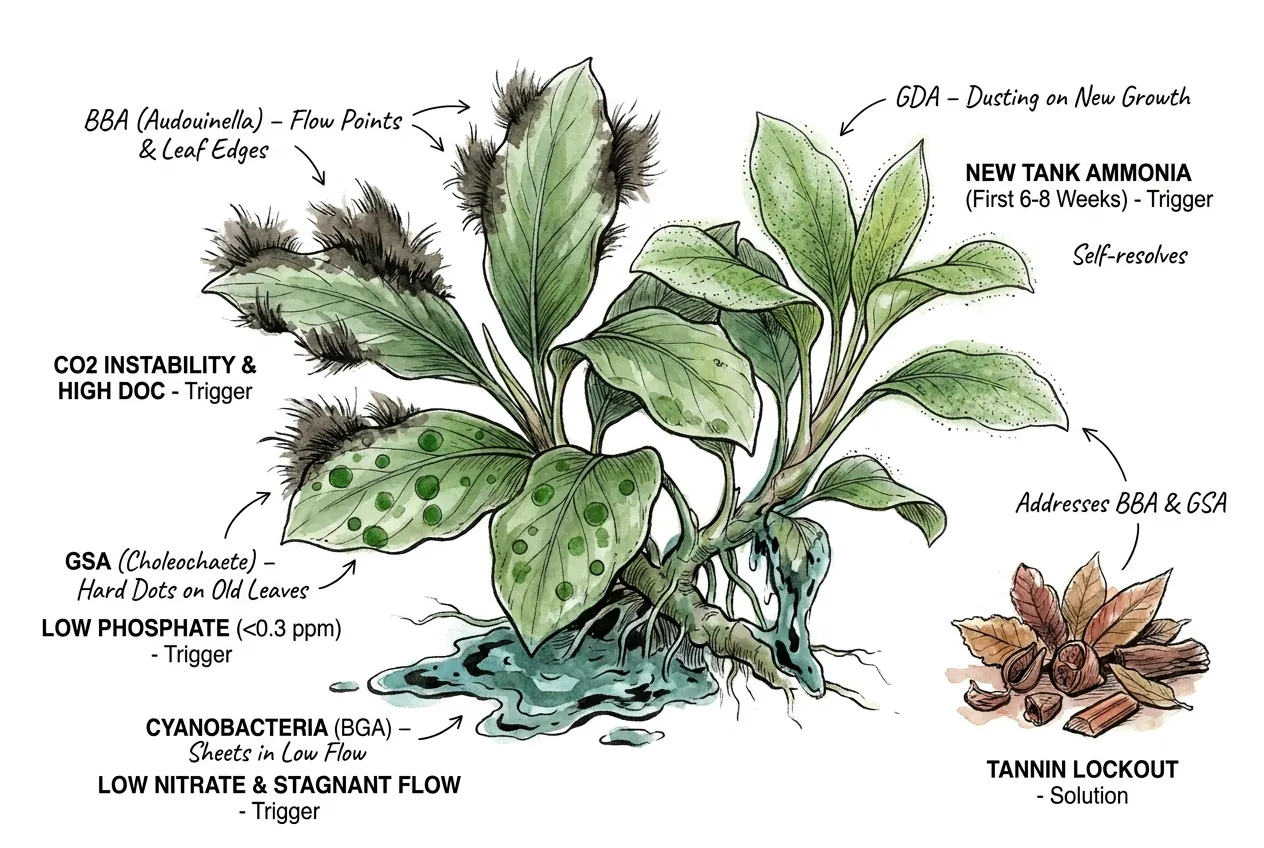
Four types show up commonly on Bucephalandra. Black brush algae (BBA) tufts at flow points and along leaf edges.
Green spot algae (GSA) forms hard 1-3 mm circular dots on the oldest leaves. These hobby names describe what the algae looks like, not a confirmed genus (pinning them to a specific species needs a microscope, so treat any Latin name you see attached to them as a best guess).
Green dust algae (GDA) often coats new tanks in the first weeks and tends to fade as the tank matures.
Cyanobacteria (BGA, not a true alga) lays sheets across substrate and creeps up onto Buce in low-flow corners.
The triggers overlap rather than being one-to-one. BBA is commonly associated with unstable CO2 and a high dissolved-organic-carbon load. GSA is often linked to low phosphate.
GDA is usually a new-tank phase. Cyanobacteria tends to appear where nitrate is low and flow is stagnant.
These are correlations aquarists report, not single sufficient causes. The same tank can show several at once for different reasons.
Because of that overlap, guessing wrong is easy. Adding phosphate does not reliably fix BBA, and scrubbing GDA off too early can just reset the visible cycle.
Confirm what you are looking at before you dose.
Tannin staining may help with several algae problems, but no controlled outcome data shows that it works best for BBA or GSA. Identify the algae first and correct light, flow, CO2, and nutrients alongside any botanical change.
Why doesn’t EI dosing fix Buce algae?
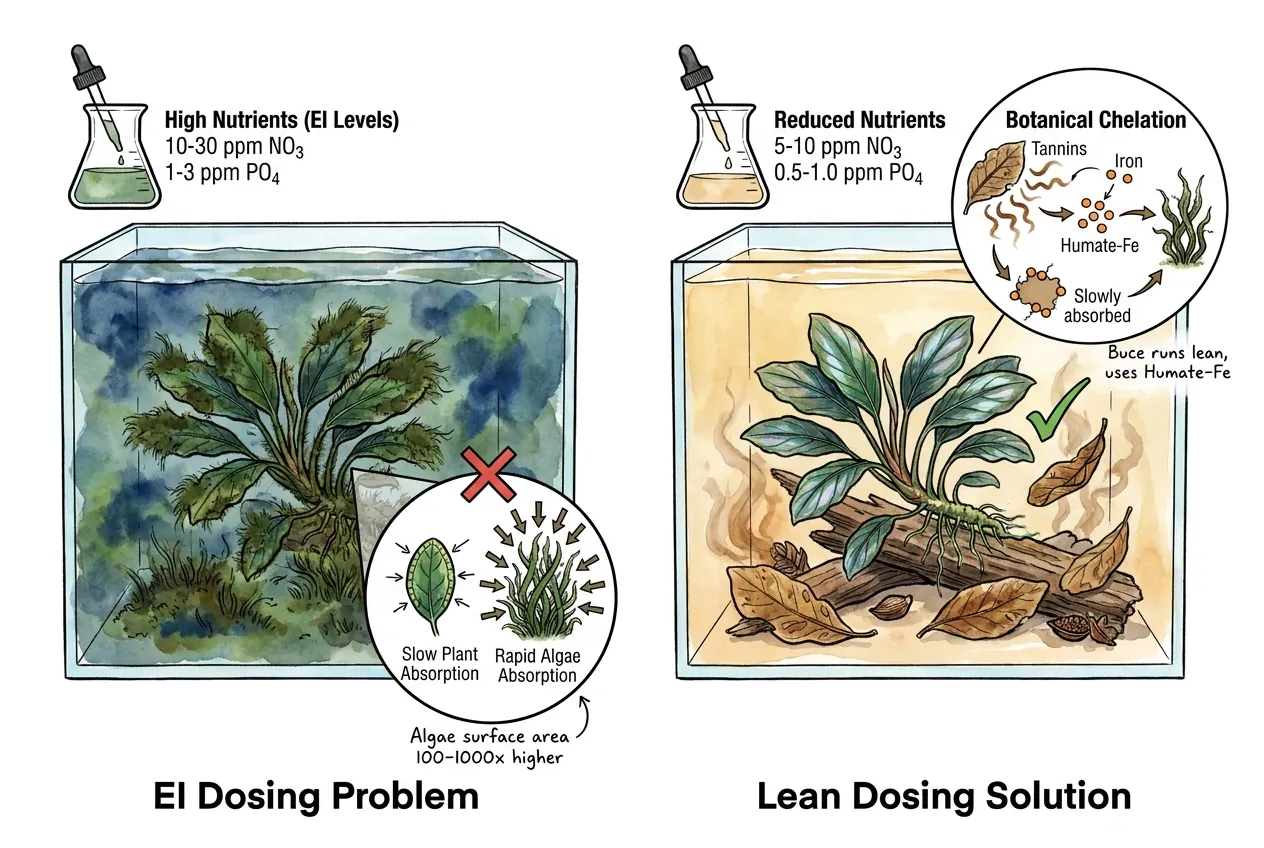
Estimative Index dosing supplies non-limiting nutrients and resets the water column with a large weekly water change, on the assumption that fast-growing plants are consuming the surplus in between.
A Buce-dominant tank has little of that fast uptake, so EI levels of 10-30 ppm NO3 and 1-3 ppm PO4 can leave a large standing nutrient pool that algae are well suited to exploit (their high surface-area-to-volume ratio lets them take up nutrients efficiently even at low concentrations).
The fix is not necessarily stopping fertilizer dosing. Dialing back the dose and shifting the form of iron can tilt the balance toward the plants. The iron chemistry is covered further below, with the caveat that it moves the odds rather than acting as a switch.
A working dosing protocol for Buce-dominant tanks
As a starting point, many Buce keepers run leaner than EI, for example nitrate around 5-10 ppm weekly and phosphate around 0.5-1.0 ppm, and lean on botanical-chelated iron instead of EDTA-Fe.
Treat these as a place to begin, not a fixed prescription. Fish load, substrate, water-change frequency, plant mass, and source water all shift the right numbers, so watch the plants and test rather than assuming.
Running too lean can starve the plants as easily as running rich can feed algae.
What’s actually dissolved in a tannin-stained tank?
The brown stain in a tannin-stained tank is not classical leather tannins. It is mostly humic and fulvic substances plus a smaller fraction of low-molecular-weight phenolics such as ellagitannins, gallotannins, and proanthocyanidins.
The exact split varies with the botanicals used and how you measure it. Humic and fulvic fractions are defined by extraction method, not by a fixed natural ratio, so treat any precise percentage breakdown with caution.
The hobby word tannins is a loose label.
The chemistry most often credited with the algae effect is the humic-fulvic fraction.
Across blackwater systems, humic plus fulvic acid make up the bulk of dissolved organic carbon.
The Rio Negro is often cited as roughly half humic, with fulvic and other acids making up the rest, but published values depend on season, sampling site, and analytical method.
Hobby blackwater tanks brewed from Indian almond leaves are chemically related but not identical, and there is no controlled evidence that they converge on the exact same composition as an Amazon river.
Pt-Co is a platinum-cobalt color scale. It measures how brown the water looks, not dissolved-organic content, acidity, or algae-suppressing potency. Two tanks made with different botanicals can look equally brown and behave differently, so no color target guarantees algae control.
How much tannin staining do I actually need?
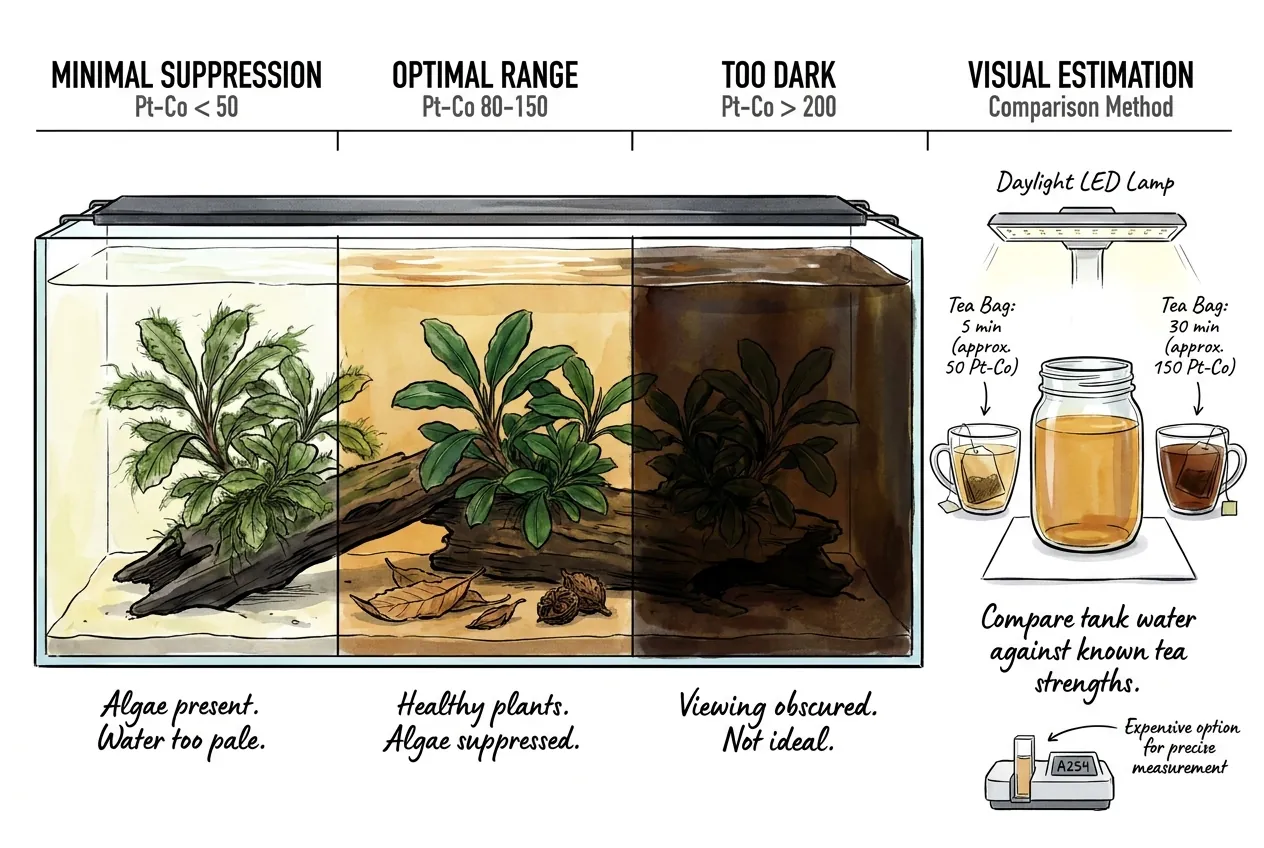
A moderate tea color, roughly Pt-Co 80-150 by eye, is a reasonable target for a visibly stained but still viewable tank.
Do not read a precise DOC concentration off that color. The relationship between color and dissolved organic carbon depends on which botanicals produced it, so the same brown can mean quite different DOC in two tanks.
Below a light tint the effect on algae is likely small. A very dark tank starts to obscure viewing.
You do not need a lab. Comparing a jar of tank water on a white card against your memory of previous weeks is enough to track whether the stain is holding, deepening, or fading.
Steeping ordinary tea to a similar shade can help you calibrate your eye, but it is not a measurement. Tea type, mass, water temperature, steep time, and lighting all shift the result, so do not treat a fixed steeping-time conversion as accurate.
If you want an instrument, note that UV absorbance at 254 nm (A254) is used together with a measured DOC value to characterize organic matter. It is not a universal one-line conversion to DOC concentration, because the ratio depends on the type of organic matter, path length, and interfering ions.
It is only worth the trouble if you are graphing tank chemistry over time with proper calibration.
Will tannin staining ever fade naturally?
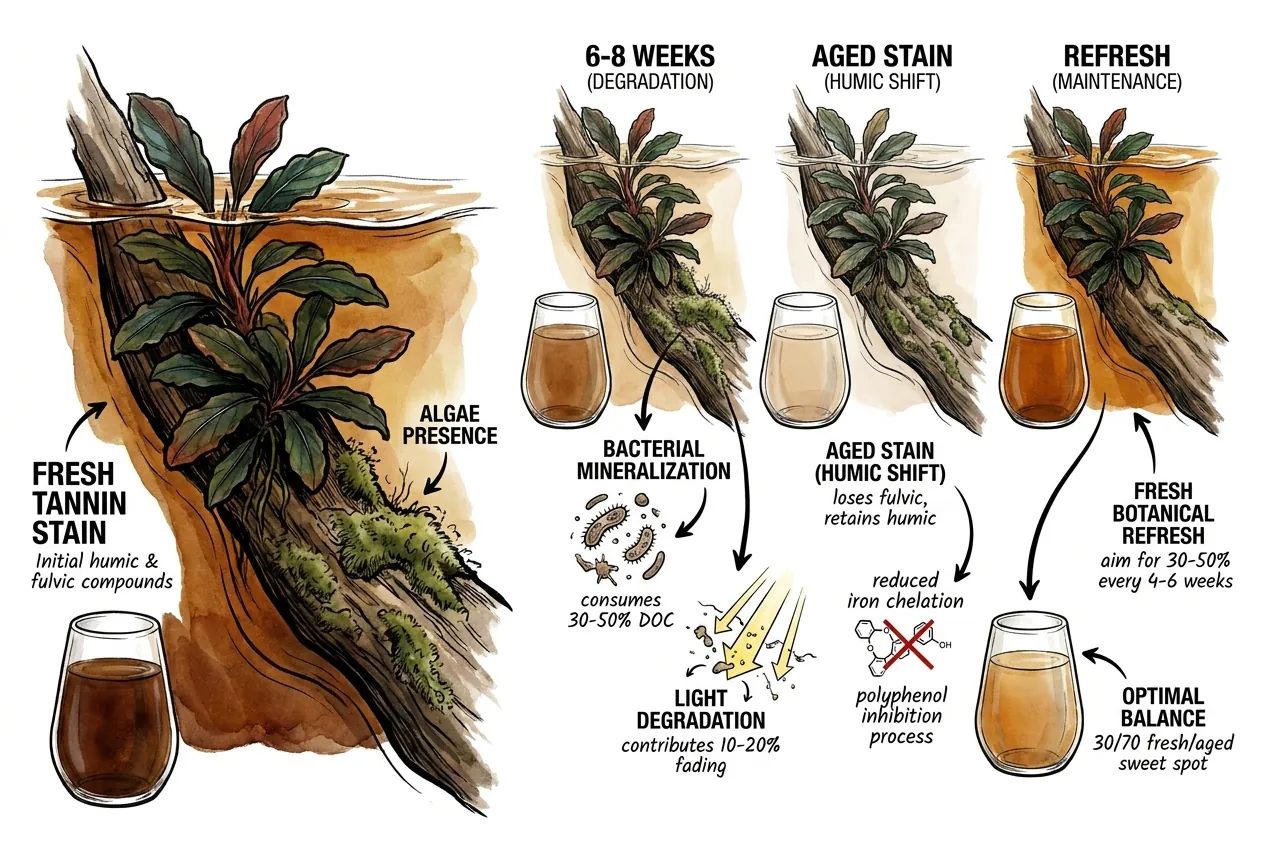
Yes. Bacteria mineralize dissolved organic carbon and light breaks some of it down, so a stain fades unless you replenish it. The rate depends on temperature, oxygen, the tank’s microbiome, botanical mass, and water changes.
In practice, replacing part of your botanical load every few weeks keeps the color roughly where you want it.
Refreshing something like a third to half of the leaves and cones on a monthly-ish cycle is a common starting rhythm (adjust based on how fast your own tank fades).
Fresh botanicals release more of the reactive polyphenols. Aged material has mostly given those up and contributes a steadier humic baseline.
Keeping a mix of fresh and aged material, rather than all of one, is a sensible way to get both. The best ratio is a matter of taste and observation, not a measured optimum.
How does humic acid actually stop algae?
Three mechanisms are usually proposed. Humic substances absorb UV-A and blue light more than red, they bind free iron, and some dissolved polyphenols can inhibit photosynthesis in cyanobacteria.
Each of these is a real chemical effect. What is far less established is that they combine into a reliable algae lockout that is safe for Buce. The sections below give the honest state of each mechanism, including where the evidence is thin or points the other way.
Why does tannin staining hit algae harder than plants?
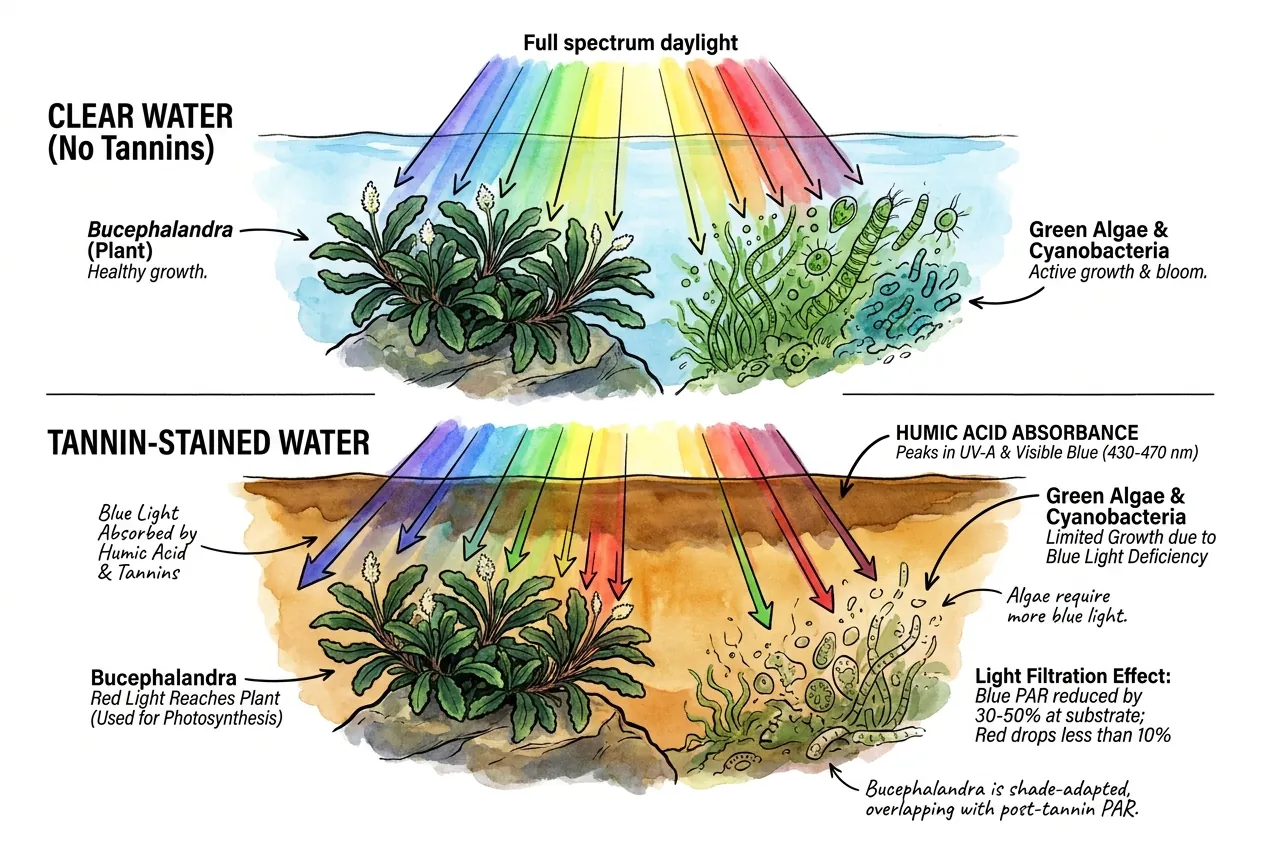
Colored dissolved organic matter absorbs shorter wavelengths more strongly, so a stained tank filters proportionally more UV-A and blue than red. The amount depends on the organic material, its concentration, and water depth, so no fixed blue- or red-light loss applies to every tank.
That direction is useful because blue is important to both algae and plants, but the balance is not one-sided.
Green algae and cyanobacteria absorb strongly in the blue and red, and cyanobacteria add phycobilin pigments in the 500-600 nm range. Vascular plants like Bucephalandra also lean on red and far-red.
So stain does not remove light for algae while sparing light for plants. It shifts the whole tank redder, which the shade-adapted Buce tends to tolerate well.
Bucephalandra is a shade-adapted Bornean rheophyte from fast-flowing, canopied streams, so it often tolerates the dimmer, redder light of a stained tank. Exact PAR figures for wild populations are estimates, not a measured care band.
Do humic acids really lock iron away from algae?
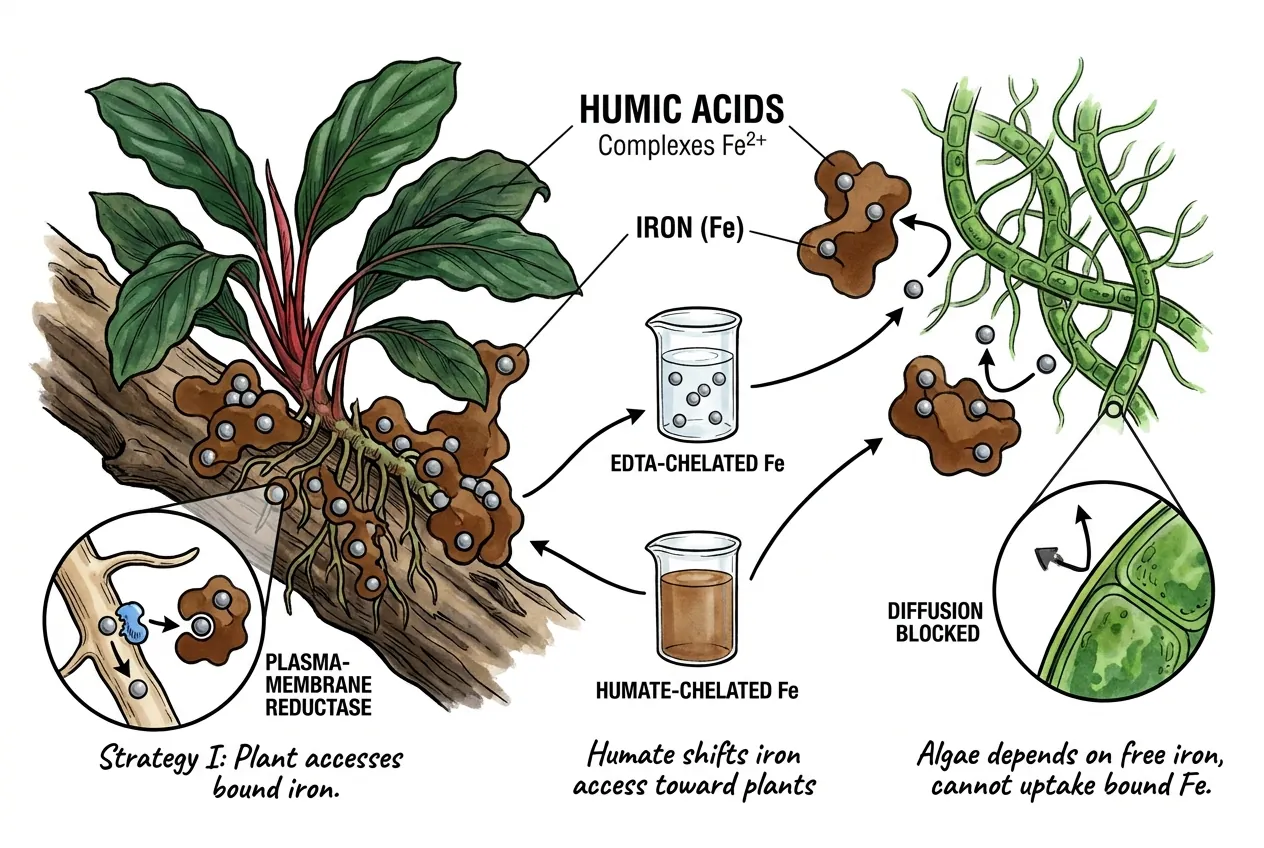
Partly, but this is where the popular explanation overreaches. Humic and fulvic acids do form complexes with iron and lower the concentration of free ferric/ferrous ions in the water.
It is tempting to conclude that this starves algae while feeding plants, but that is not what the iron-uptake literature shows.
Vascular plants like Bucephalandra use a plasma-membrane reductase known as Strategy I to pull iron off chelators at the root or rhizome surface.
The problem is that algae and cyanobacteria are not helpless here. They also use surface reductases, ligand exchange, and in many cases siderophores to access organically bound iron, and organically complexed including humic-bound iron has been reported as at least partly bioavailable to phytoplankton.
So humate-bound iron is not reserved for plants.
What binding iron to humics does do is change the form and availability of iron rather than switch algae off.
EDTA-chelated iron is readily available to plants and algae alike. Letting botanicals chelate ambient iron, or using a loosely-bound form like Fe-gluconate that ambient humics quickly take up, shifts the balance somewhat toward the plants.
Treat it as one factor that nudges the odds, not a lock that keeps algae out.
Practical iron dosing in a tannin-stained tank
Dose smaller amounts of plant-available iron more frequently, and judge the result by the plants’ color and new growth plus a water test, not by a target number alone. A single water-column iron concentration does not guarantee healthy tissue or the absence of algae.
Seachem Flourish Iron
Seachem Flourish Iron fits a tannin-stained tank only when plant symptoms or testing indicate an iron shortfall. Use it in small, measured doses according to the current label, not as an algae treatment or a drop-count shortcut.
Iron dosing caveat
Gluconate iron oxidizes fairly quickly, so it is best dosed little and often. Use it only if a test or plant symptoms actually indicate an iron shortfall.
Are polyphenols directly toxic to algae?
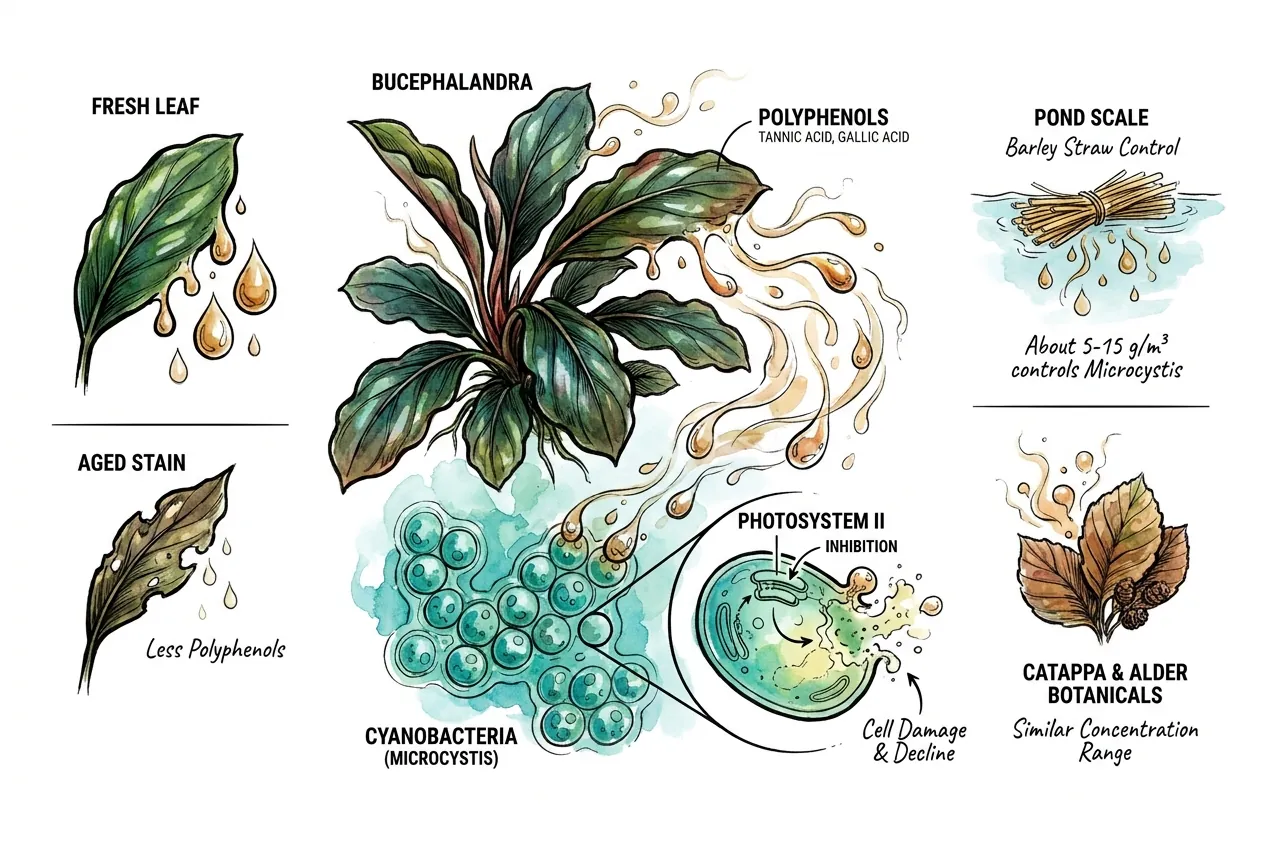
In the lab, some can be. Isolated compounds such as tannic acid and gallic acid have inhibited cyanobacteria at concentrations in the low tens of mg/L, though in those studies the effect was often algistatic (growth-slowing) and short-term rather than a kill.
That is a long way from proving that the mixed leachate from catappa or alder leaves reaches the same active compounds, at the same concentration, for the same duration, safely, in a stocked aquarium.
The commonly cited parallel is barley straw in ponds, but that comparison is weaker than it sounds.
Barley straw’s mode of action is still debated. Microbial decomposition, oxygen, light, and possibly hydrogen peroxide have all been implicated, and it needs weeks of rotting to do anything.
Its results are inconsistent. In one bioassay of a dozen algae it inhibited some, stimulated others, and did nothing to the rest, and pond field trials have shown no difference from controls.
So matching the chemistry to reliable control is not a safe generalization, and there is no bridge evidence that a given mass of catappa or alder matches barley straw’s dose or effect.
Evidence boundary
Fresh-leaf polyphenols may contribute some algae suppression independent of the light and iron effects, but the aquarium dose-response and non-target safety are not established.
Why doesn’t pH crash in a stained planted tank?
Usually because carbonate hardness (KH) buffers much of the acid load that botanicals add.
A tank with 3-4 dKH holds on the order of 1-1.4 milliequivalents per liter of bicarbonate alkalinity, which is enough to absorb the modest acidity that typical hobby tannin loads contribute, so pH tends to settle a few tenths lower rather than falling off a cliff.
How far it moves depends on how much botanical you add, your substrate, CO2, nitrification, and how often you change water, so this is a tendency, not a guarantee.
The Rio Negro reaches pH around 4 because it combines near-zero KH with high DOC and very low ionic strength.
Most hobby tanks do not reproduce all three at once, so a tap-water tank with normal KH usually has meaningful headroom.
That headroom is not unlimited, and low-KH or RO-based setups can still swing, so test rather than assume.
What KH do I actually need?
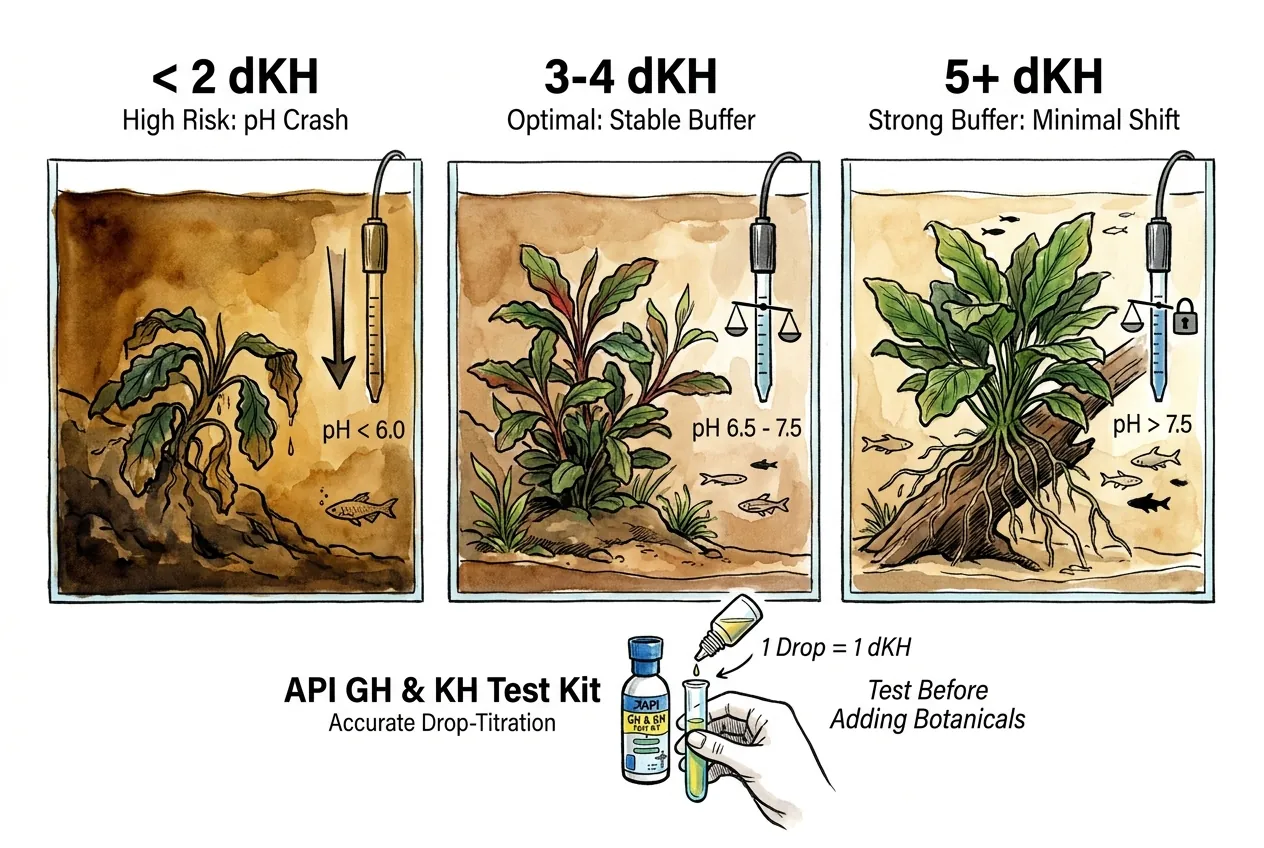
As a rough rule, keeping at least a couple of dKH of carbonate hardness gives you buffering headroom. The lower your KH, the more closely you should watch pH after adding botanicals, because very low-KH tanks can drop quickly.
Higher KH is more stable but pushes pH up, away from the soft, mildly acidic water many blackwater keepers want. There is a tradeoff, not a single safe number.
Tap water KH varies widely by region, so measure your own with a drop-titration KH kit before adding botanicals rather than trusting the municipal report.
Nitrification in the tank (and sometimes in the distribution system) can consume alkalinity over time, which is one reason the tap reading and a matured tank reading can differ, so retest periodically, not just once.
A drop-titration GH & KH test kit (the kind that counts drops to a color change, roughly one drop per dKH) is the practical tool for this.
It is inexpensive and precise enough to manage a tannin tank. If you need finer resolution for RO/DI blending you can step up to a lab-grade titration, though a handheld probe does not measure KH directly.
KH formula for the math-curious
The unit conversion is straightforward. KH in dKH multiplied by 0.36 gives roughly the milliequivalents per liter of alkalinity, so 3 dKH is about 1.07 meq/L. That tells you how much buffering you have, but it does not by itself tell you the final pH. The acid actually added by your botanicals is not something these numbers measure, so use the conversion to understand your buffer, then confirm the real outcome with a pH test.
When DOES pH crash in a stained tank?
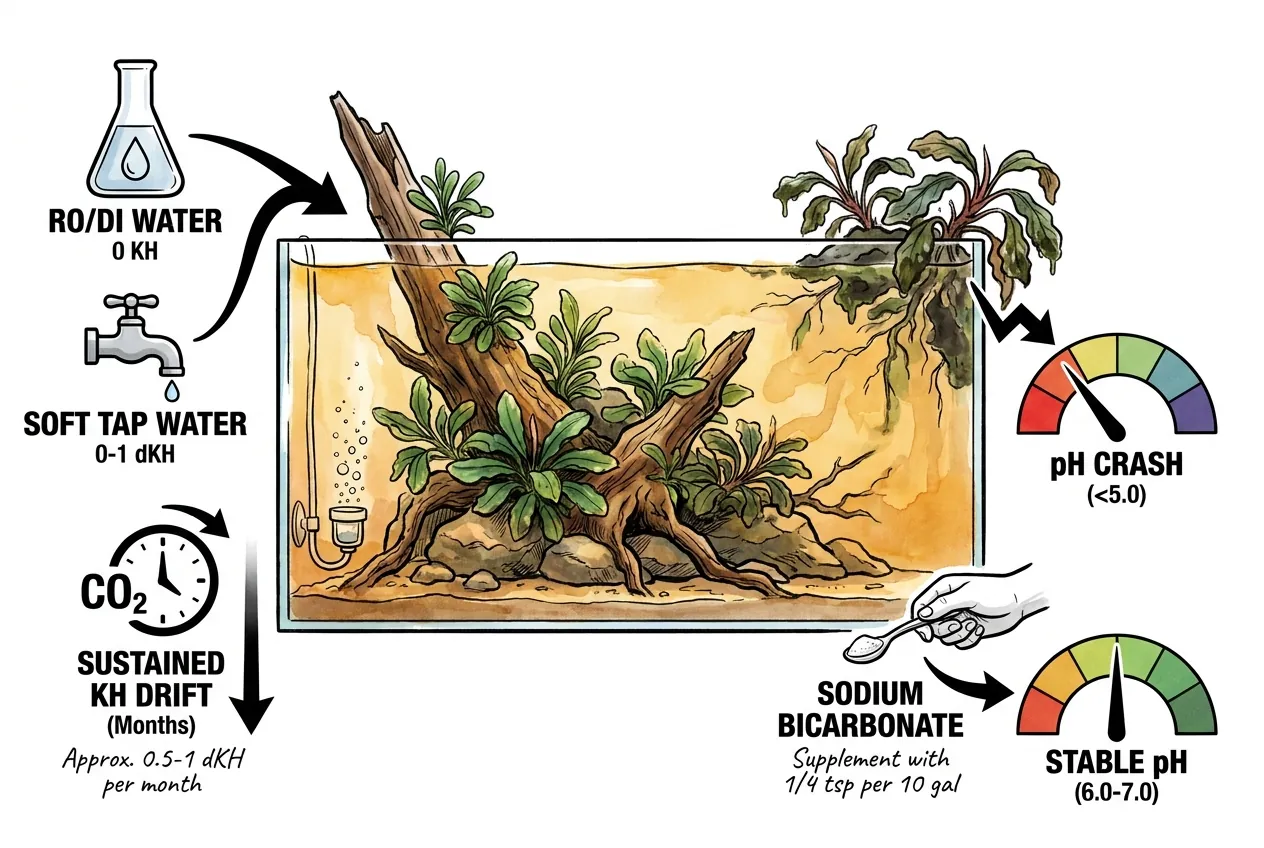
The common triggers are low or zero starting alkalinity, RO/DI water without remineralization, or soft tap water at 0-1 dKH, plus a slow loss of KH over time that goes unnoticed.
Note that CO2 injection does not itself consume alkalinity. Adding and removing CO2 shifts the carbonate equilibrium and pH, but total alkalinity stays put.
If your KH really is falling month over month, look for the actual acid source, nitrification, an acidic (buffering) substrate, or organic and mineral acids, rather than blaming the CO2.
Whatever the cause, the practical response is the same. Test KH periodically in any stained tank, and if it is drifting down, add a small amount of sodium bicarbonate during water changes to bring it back up.
As a rough guide, about 1/4 teaspoon per 10 gallons raises KH on the order of 1 dKH, but powder density and spoon packing vary, so on a stocked tank measure by weight and check KH before and after rather than trusting the spoon.
What botanical recipe actually works?
A reasonable starting point for a 75 gallon Bucephalandra-dominant tank aiming for a moderate tea color is something like 6-8 Indian almond (catappa) leaves plus 10-15 black alder cones, with 2-3 pieces of well-soaked mopani or seasoned driftwood as hardscape, then part of the leaves and cones refreshed every few weeks.
Because leaf size and tannin content vary a lot between batches, treat this as a first dose to observe and adjust. It is not a calibrated recipe that guarantees a specific color or algae outcome, so check the color and your water parameters and tune from there.
What each botanical contributes
Catappa gives a relatively fast initial release, alder cones release more slowly and last longer, and wood contributes a slow baseline.
This layering is a sensible way to get both an early burst and a steady background, though the exact release durations depend on the material.
How much catappa per gallon?
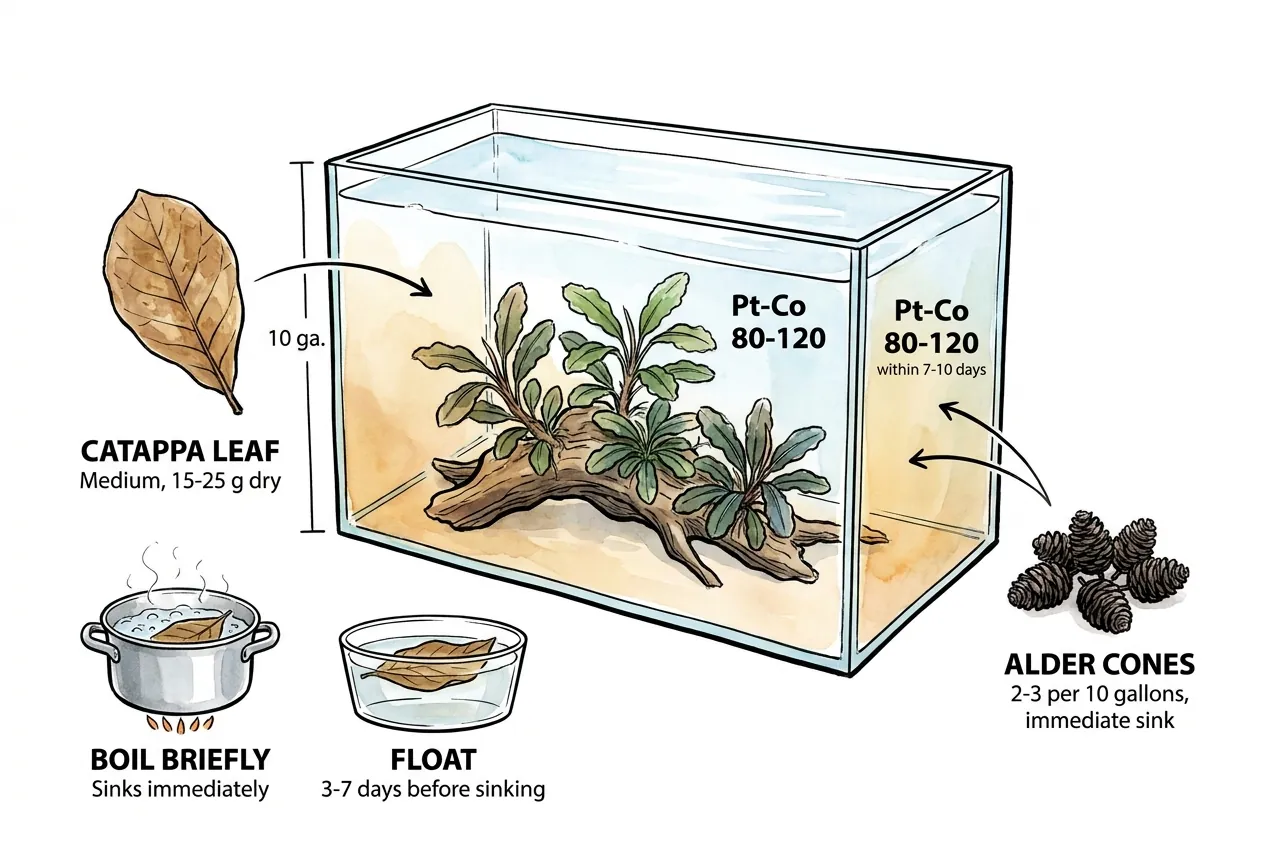
A rough starting dose is about one medium catappa leaf per 10 gallons, then adjust to hit the color you want over the following week or so. Because dry-leaf mass varies widely between batches, weigh leaves if you want repeatable dosing rather than counting them.
Boil briefly to make them sink immediately, or accept a few days of floating before they saturate and go down.
SunGrow Catappa Leaves
SunGrow catappa leaves suit the first, faster part of a botanical stain. Add them gradually and measure the tank response, because leaf size and tannin yield vary by batch.
Catappa product caveat
Leaf size and mass vary between batches, and the listing does not certify origin, per-leaf weight, or algal effect. Weigh leaves for consistent dosing and do not assume a fixed tannin yield per leaf.
SunGrow Alder Cones
SunGrow Alder Cones suit a slower, longer-lasting botanical contribution alongside catappa. Start gradually, especially in low-KH water, and adjust from pH, KH, color, and livestock response rather than a fixed cone count.
Alder cone caveat
Cones are acidic, so add them gradually in low-KH water and watch pH. Their tannin content has not been independently compared with every other botanical, so avoid ranking them as a universally strongest source.
Botanical comparison table
The values below are rough, relative guidance drawn from hobby experience, not measured assays (actual tannin content and release vary with species, drying, origin, and batch).
Use the table to compare botanicals against each other, not as absolute dosing figures.
| Botanical | Relative tannin content | Release profile | Dose per 10 gallons |
|---|---|---|---|
| Catappa leaf | Moderate | Fast burst, few weeks | ~1 medium leaf |
| Black alder cone | High | Sustained, longer-lasting | ~2-3 cones |
| Oak leaf | Low-moderate | Medium | ~2-4 leaves |
| Mopani wood | Low | Slow, long baseline | Bulk hardscape |
| Manzanita wood | Minimal | Minimal | Bulk hardscape |
| Magnolia leaf | Low-moderate | Slow | ~2-3 leaves |
| Banana leaf | Low-moderate | Fast, short-lived | ~1-2 strips |
Should I boil botanicals before adding?
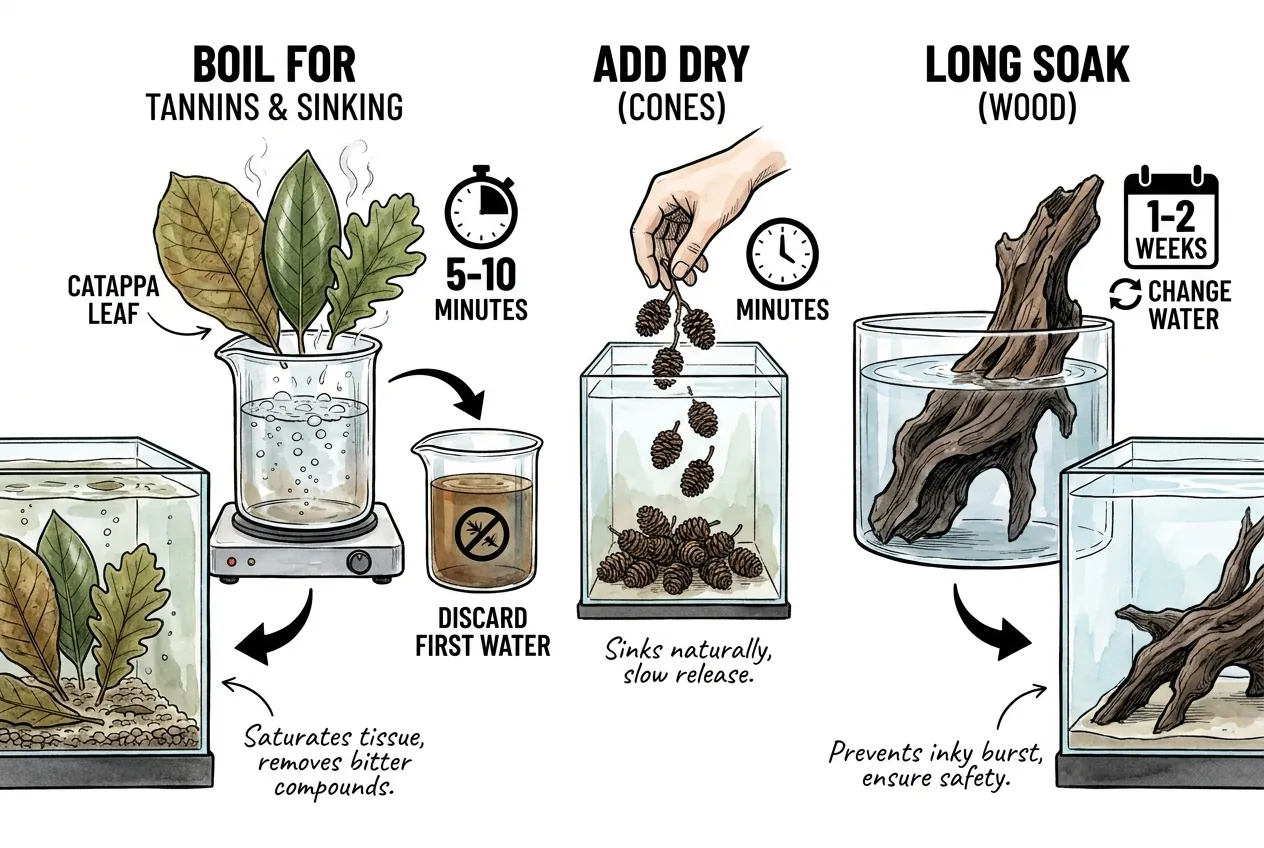
It is optional, and mainly about getting leaves to sink. A short boil (a few minutes) saturates catappa, magnolia, and oak leaves so they sink right away and releases some of the initial leaching outside the display tank.
It also throws away some of the soluble compounds you actually want, so it is a convenience step, not a requirement (a rinse and a few days of floating works too).
More important than boiling is making sure the botanicals are clean and free of pesticide residue or unknown treatment.
Alder cones sink dry and release slowly, so there is no need to boil them. Add them dry and they usually go down within minutes.
Wood such as mopani benefits from soaking in changed water for a week or two before it goes in, because fresh wood can leach heavily and darken the water suddenly.
Also confirm the wood is aquarium-safe and untreated before use.
How often do I refresh botanicals?
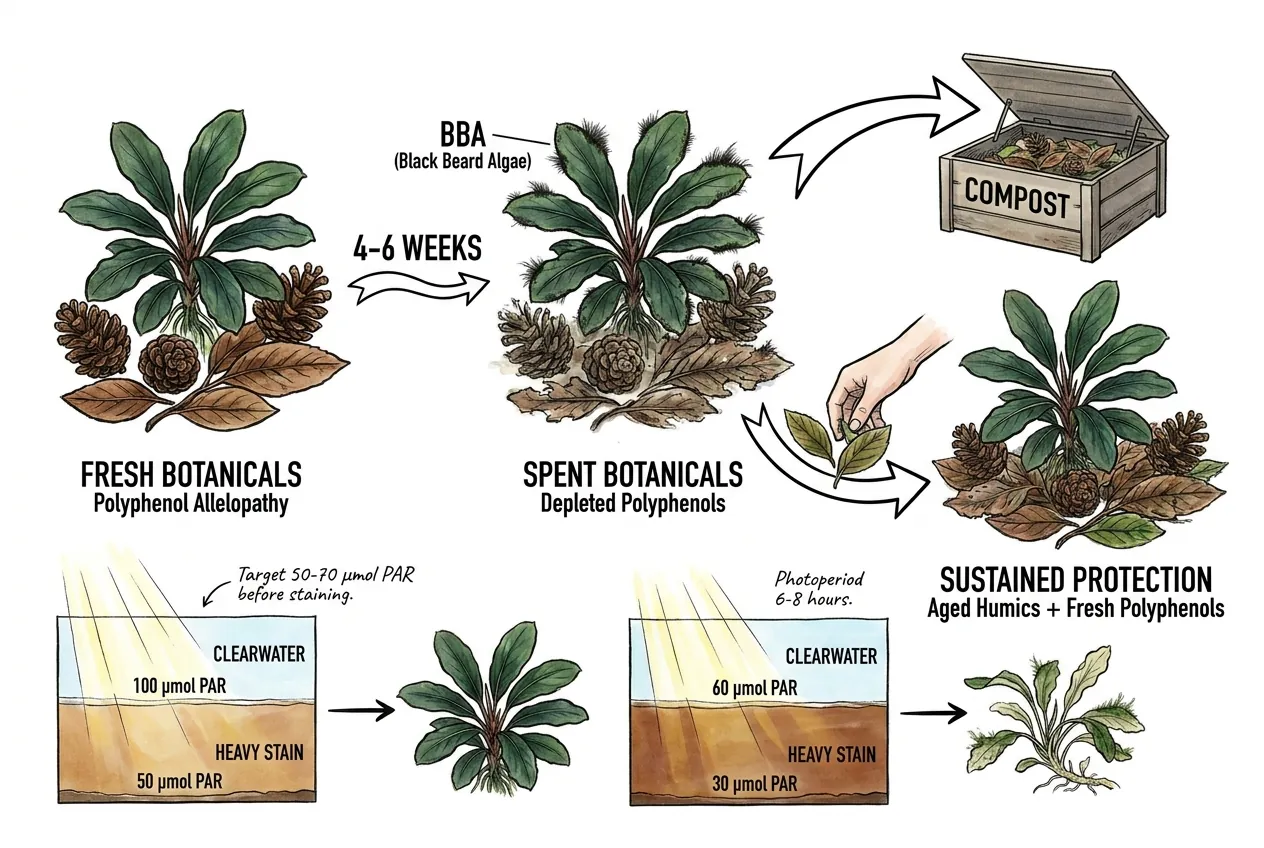
On a roughly monthly cycle, replace part of the leaves and cones (something like a third to half) with fresh material, and compost the spent botanicals.
The idea is to keep some fresh, reactive material in the mix on top of the steadier aged baseline.
Let the tank tell you when to adjust. If the color is holding but algae starts creeping back, refreshing sooner is a reasonable move. If the color is fading but algae stays controlled, you can stick to your usual schedule.
You cannot reliably read the exact chemistry from color alone, so treat these as practical cues rather than precise diagnostics.
How do I light a tannin-stained tank?
Account for the fact that stain reduces light at the substrate. Bucephalandra is a low-to-moderate-light plant, so aim modest and remember the tannins will dim things further.
Exactly how much they dim depends on your fixture’s spectrum, tank depth, and how dark the water is, so a PAR meter on your own tank beats any predicted number.
A photoperiod in the 6-8 hour range is a common starting point. Adjust based on plant response and algae.
The practical point is that stain and light interact, so it is easy to end up too dim if you plan them separately.
Start a stained Buce tank on the brighter side of low light, then let it settle. If the Buce starts producing pale, stretched leaves, the combined light is too low and you should raise intensity or lighten the stain.
Does CO2 still work normally in stained water?
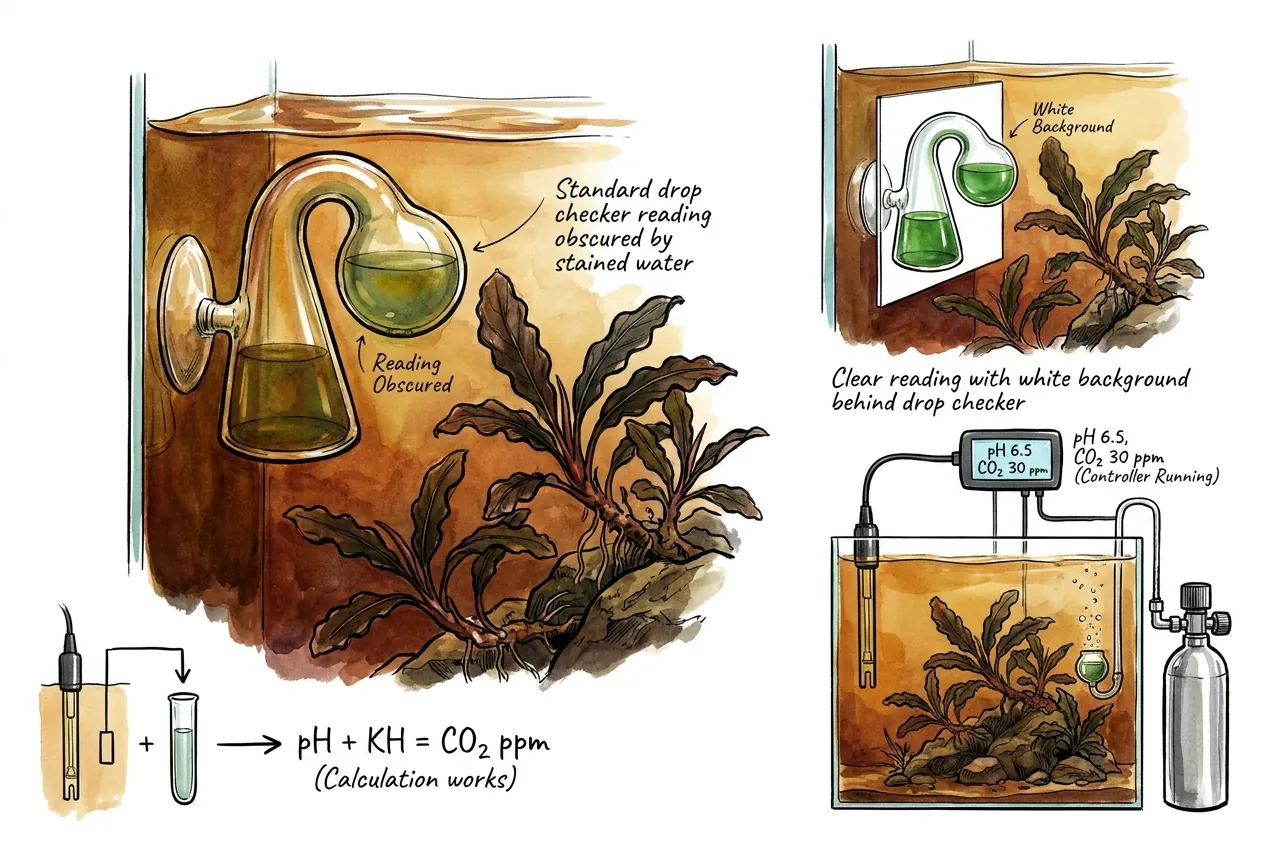
CO2 solubility and dissolution are set by physics and are not changed by tannin staining. What tannins do change is how you should measure CO2.
Drop checkers still work, with one caveat. The bromothymol blue indicator color is hard to read against amber-tinted water.
Because the drop checker uses an isolated reference solution rather than tank water, the amber tint is only an optical problem (suction-cup it against a strip of white acrylic on the back glass and reading clarity returns).
Do not rely on a pH-KH-CO2 lookup table or pH controller alone in a tannin-stained tank. Tannins and other organic acids can make the calculated CO2 reading too high or too low, which risks overdosing or underdosing livestock. Use a drop checker with a known reference solution, and watch animal behavior and surface agitation instead of trusting one calculated number.
Should I use higher or lower light spectrum bias?
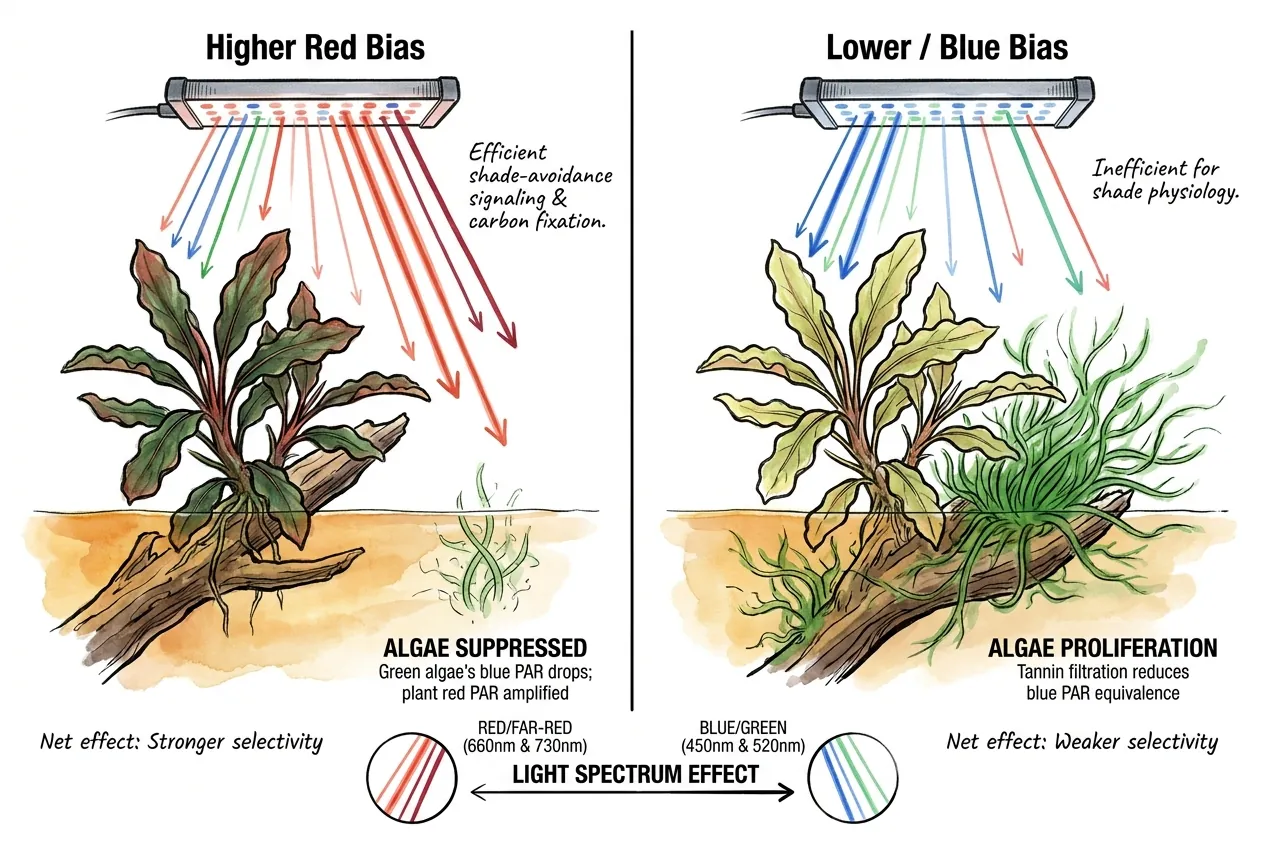
Nudging a tunable LED a little warmer can help replace some of the blue light that stain removes. Make it a mild adjustment guided by plant response, not a precise formula. No Bucephalandra trial establishes an optimal red boost.
Do not expect this to selectively starve algae. Algae use red light too, so a redder spectrum is not a targeted algae control on top of the stain. It is mainly about keeping enough usable light on the plants.
How do I diagnose and fix problems in a stained tank?
Five common issues in stained Buce tanks are light too high, KH too low, chemical filtration removing tannins, a shrimp parameter mismatch, and simple over-darkening (each covered below).
These are not the only possibilities. Algae and livestock problems also stem from things like tank maturity, circulation, overfeeding, CO2 delivery, ammonia or nitrite, temperature, and contamination, so rule those out too rather than assuming the cause is on this short list.
Why does my tannin-stained tank still have algae?
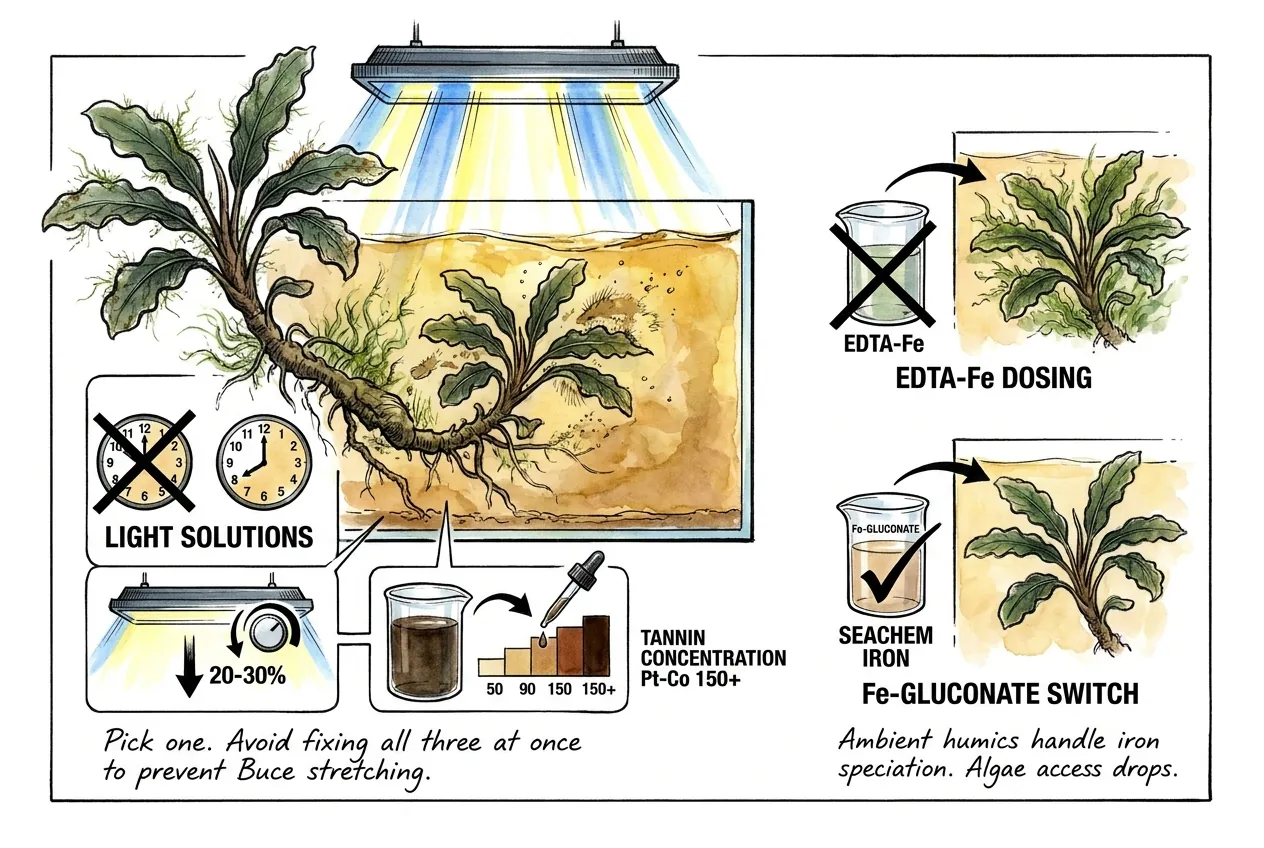
Light is a frequent culprit. Stain reduces blue light but does not eliminate it, so if your starting light was high, the tank can still be bright enough at the substrate to feed algae.
There is no single universal PAR threshold. Spectrum, photoperiod, nutrients, and CO2 all factor in, so treat excessive light as one hypothesis to test.
Change one variable at a time so you can see what worked. Shorten the photoperiod, dim the light, or deepen the stain a little.
Adjusting all of them at once can leave the Buce too dark and stretched.
Iron form is worth checking too. EDTA-chelated iron is available to plants and algae alike, so shifting to a loosely-bound form such as Fe-gluconate (for example Seachem Flourish Iron) and letting ambient humics take up the iron can tilt the balance toward the plants.
As noted earlier, this nudges the odds rather than cutting algae off, so pair it with the light and nutrient adjustments rather than relying on it alone.
Why did my pH crash after adding tannins?
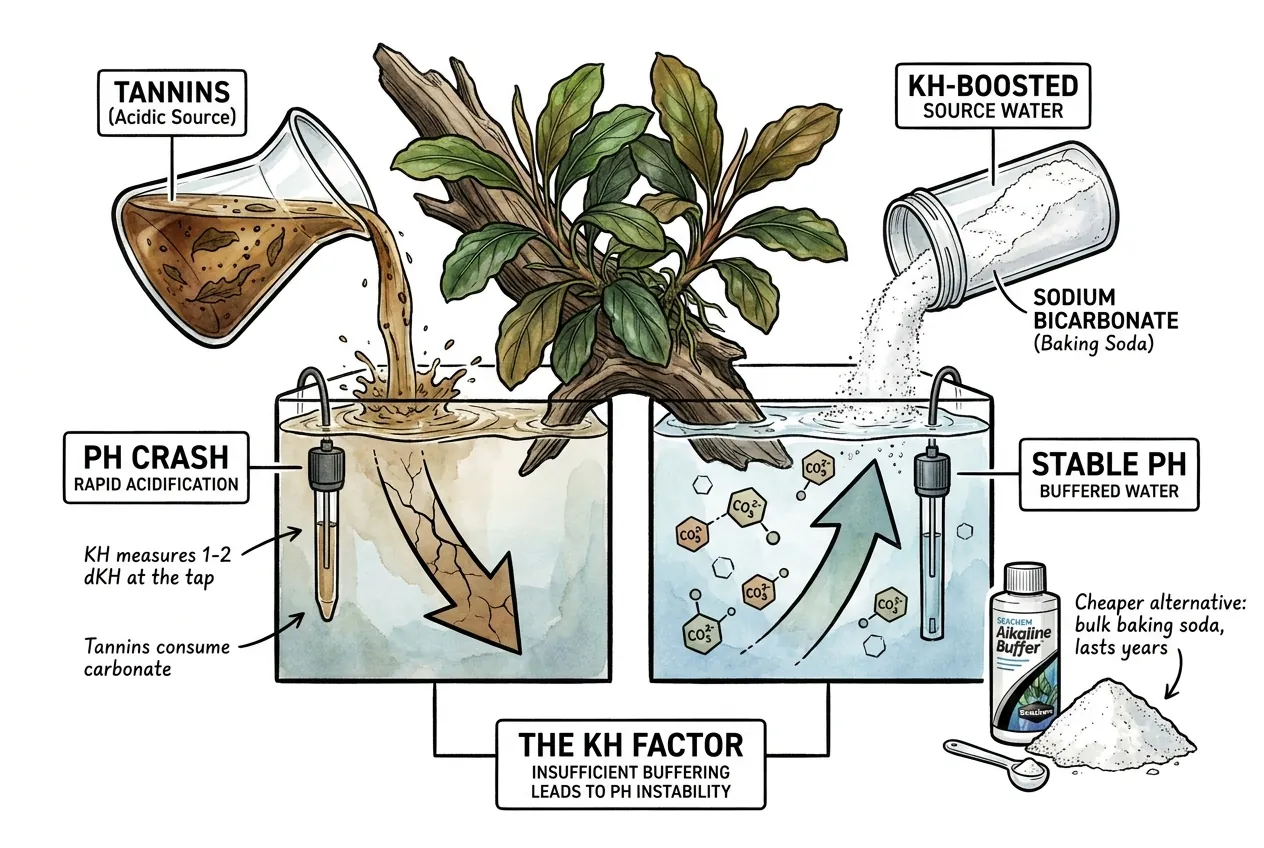
Usually the KH was lower than you thought. Pure RO/DI water has zero KH, and some tap water measures lower at the tap than the utility’s report suggests.
The mechanism is often nitrification consuming alkalinity in the system rather than the disinfection step itself, and how much it drops varies by utility, so measure your own tap rather than assuming a fixed loss.
Always measure KH at the tap before committing to a blackwater plan.
To recover, do a partial water change with KH-boosted source water. Dissolving sodium bicarbonate (baking soda) is the simplest option. Roughly 1/4 teaspoon per 10 gallons raises KH on the order of 1 dKH, but confirm with a test since spoon measures are approximate.
Make the change gradually so livestock are not shocked by a fast pH or KH swing.
Seachem Alkaline Buffer
Seachem Alkaline Buffer is for a tank that needs both more alkalinity and a higher pH. It is a poor fit for a deliberately soft, mildly acidic blackwater tank. For a modest KH correction there, dose sodium bicarbonate against repeated tests instead. Follow the current label rather than a memorized ratio.
Why does my tannin staining disappear within 2 days?
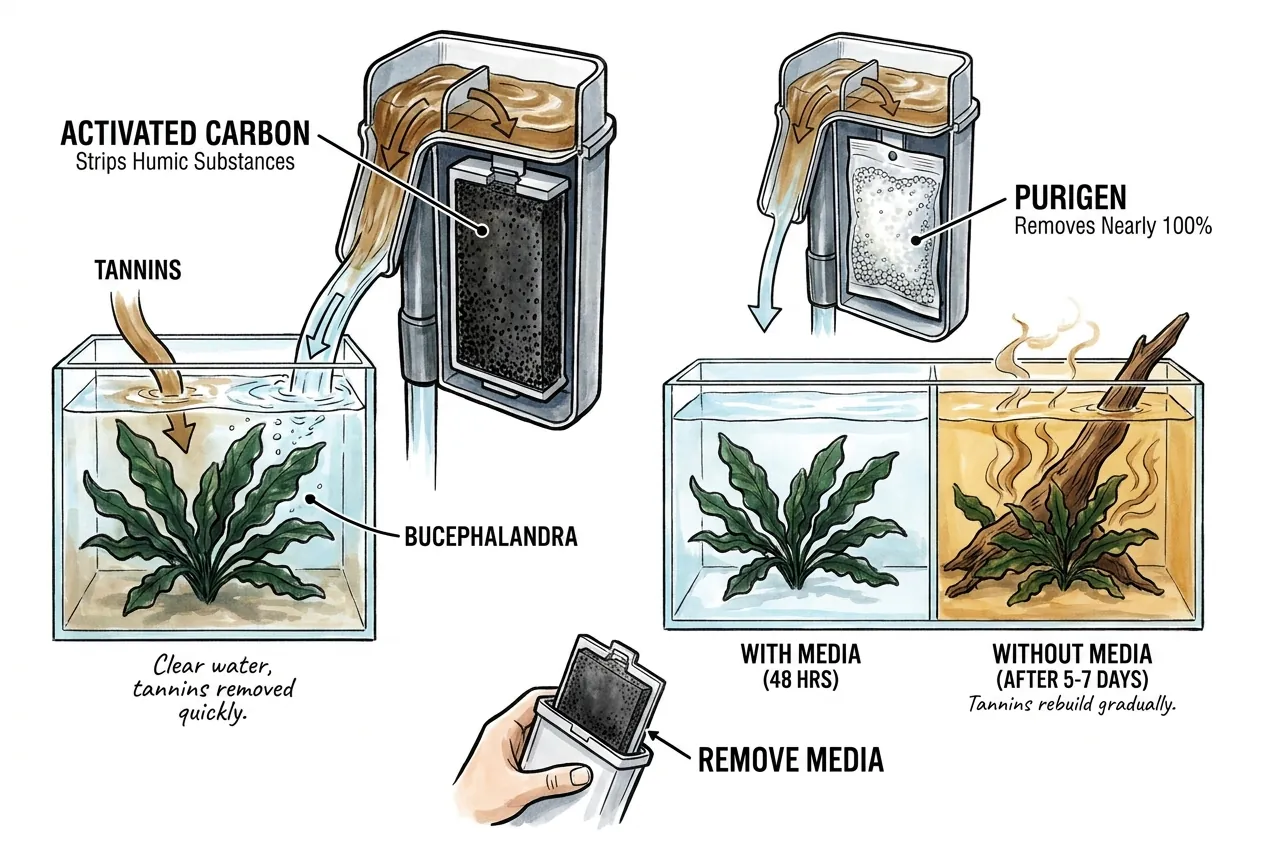
Activated carbon or Purigen is almost certainly in the filter. Both pull colored organics out of the water, often quickly. How fast and how completely depends on the media mass, flow, and how loaded the water is, so treat any exact percentage-in-X-hours figure as a rough impression rather than a spec.
Seachem itself notes that Purigen’s tannin removal can take anywhere from a day to more than a week depending on conditions.
Remove activated carbon and Purigen before starting a tannin tank. Many stock filters ship with a carbon insert in the cartridge (pull it before first use).
After removal, give it several days and recheck. The stain should rebuild as the botanicals keep releasing.
Why are my shrimp dying in the stained tank?
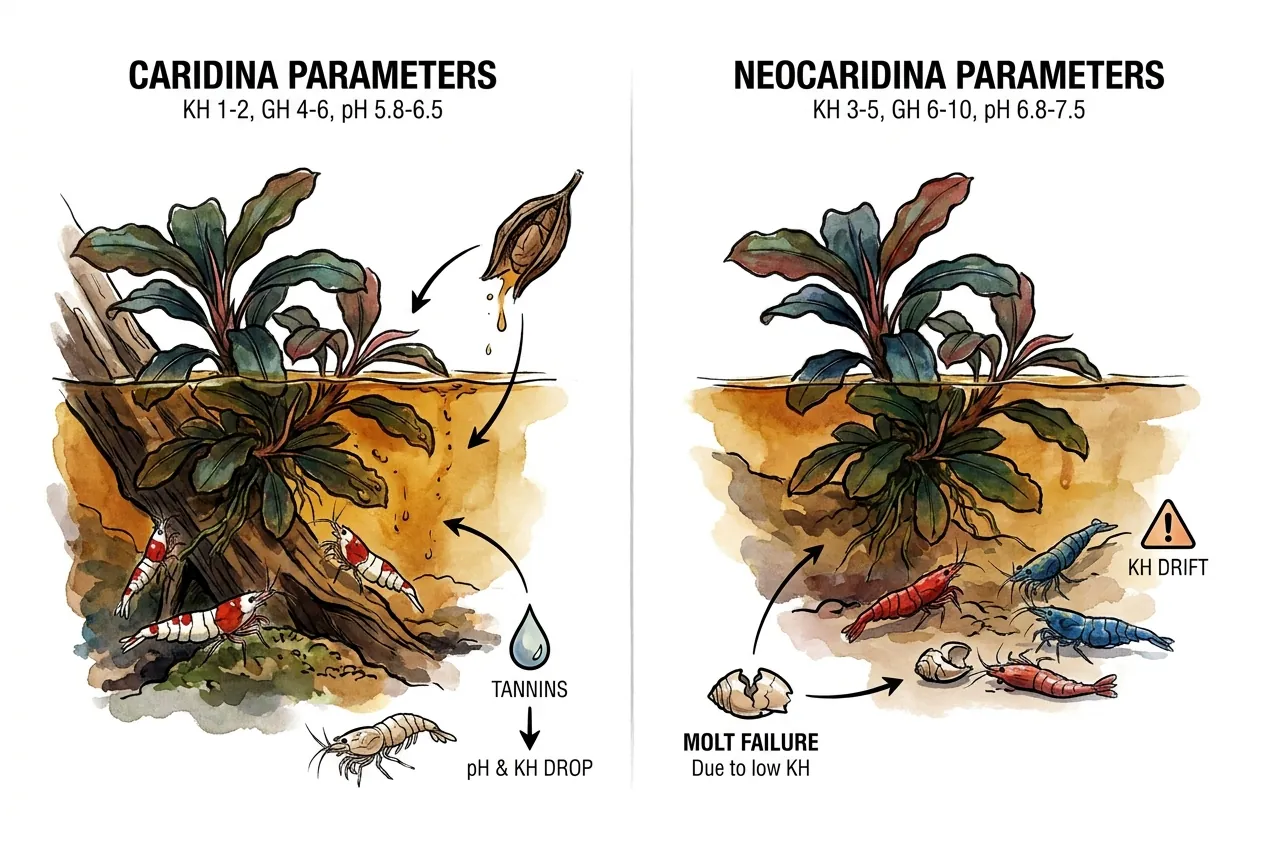
Before blaming water hardness, rule out the usual shrimp killers first. Ammonia or nitrite, copper or pesticide contamination (including from plants and food), low oxygen, temperature swings, poor acclimation, and disease.
These cause far more shrimp deaths than a slightly-off KH does.
Once those are excluded, a parameter mismatch is worth checking. As a rough guide, the popular ornamental Caridina strains (crystal red, taiwan bee) are usually kept in softer, more acidic water than the common Neocaridina strains (cherry, blue dream), which prefer harder, more neutral-to-alkaline water.
These are starting ranges for specific strains, not fixed rules for the whole genus, and GH mineral content and diet matter as much as the raw numbers.
A stained tank tends to run softer and more acidic, which happens to suit Caridina-type strains.
Molting problems can result from unsuitable water, but they usually reflect a mix of factors, calcium and magnesium availability (GH), diet, osmoregulation, temperature, and overall health, rather than KH alone acting as a countdown timer.
If you keep both types together, expect a compromise. Neither may be at its optimum, so match the setup to the species you care about most and monitor closely.
Why is my tank too dark to view the fish?
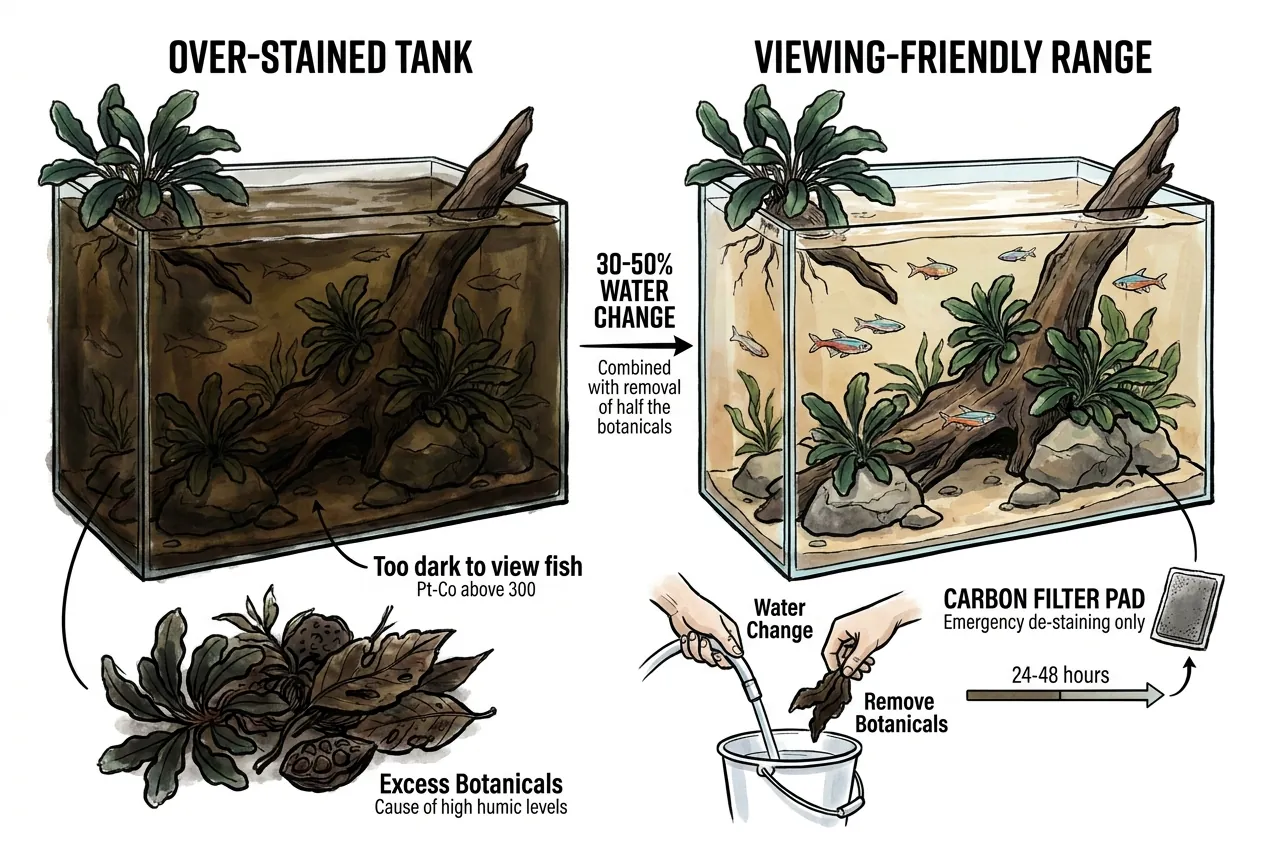
You have simply over-stained. This is an aesthetic issue. The water is too dark to enjoy the fish, not past a toxicity threshold, so too dark is a judgment call rather than a fixed Pt-Co number.
The fix is a partial water change plus removing some of the botanicals, done gradually so you do not swing the chemistry on your livestock.
Give it a week and reassess. The color should ease back toward a viewable tea shade as the water changes and reduced botanical load take effect.
How fast depends on how much botanical is still releasing and the color of your source water.
CFS Aquarium Carbon Pad
If you need to lighten the water quickly, a temporary carbon run is one option. The CFS Aquarium Carbon Pad suits a filter that accepts cut-to-fit media. Use it only for short-term clearing, not as part of a tannin-staining routine.
Carbon pad caveat
Its carbon capacity is not specified, so how fast it clears the water depends on your setup. Check progress rather than assuming a fixed clearing time.
It also strips beneficial organics and some trace minerals, so use it as a short-term measure, then remove it, do a water change, and restock botanicals more conservatively.
What to Track Over Several Weeks
Change one variable at a time, then track water color, KH, pH, plant growth, algae spread, and livestock behavior for several weeks. Do not expect a fixed color reading, refresh date, or week-by-week algae result. Flow, stocking, light, botanicals, and tank maturity all change the outcome.
Key Takeaways
- Bucephalandra tends to accumulate algae because its slow growth and long-lived leaves offer a stable surface, while its low nutrient uptake leaves more in the water for algae to use. This is a plausible explanation, not a proven single cause.
- Tannin staining plausibly discourages algae in three ways, filtering blue and UV light, binding iron, and possibly some direct polyphenol effect on cyanobacteria, but none of these is a switch, and algae can still access organically bound iron, so treat it as a helpful tilt rather than a lockout.
- Carbonate hardness buffers most of the acid botanicals add, so a tank with normal KH usually shifts pH only modestly. Very low-KH and RO-based tanks can still crash, so test rather than assume. Tap water alone is not a safety guarantee.
- A reasonable starting recipe for a 75 gallon tank is roughly 6-8 catappa leaves plus 10-15 alder cones with wood hardscape, refreshed partly each month (then tuned by observing color and parameters).
- Common things to check when a stained tank misbehaves are light, KH, and chemical filtration, but rule out ammonia/nitrite, contamination, and other causes too. Never trust a pH-KH-CO2 table or controller in stained water. Organic acids make its CO2 estimate unreliable.
Affiliate Disclosure
This article contains Amazon affiliate links. As an Amazon Associate I earn from qualifying purchases. If you use these links, the site may earn a commission at no extra cost to you. Product availability, price, and specifications can change. Check the current listing before buying.