
Dry Farming Techniques: Grow Food Without Irrigation
Maritime dry farming: how to grow vegetables on stored winter rain in places like western Oregon and coastal California. Site assessment, soil water capacity, early prep, moist-zone planting, mulch tradeoffs, spacing, varieties, and weed control.
Marcus Hale · Published 2026-02-11 · 18 min read
Key Takeaways
- Maritime dry farming lives on stored winter rain. It is not neglect. You rely on wet-season moisture held deep in the soil so summer crops can draw on it without irrigation. Use these steps for the western-Oregon and coastal-California, winter-rain style of dry farming, not for Hopi runoff/monsoon farming or Palouse dryland grain.
- Site assessment comes first. Deep soils with good available-water-holding capacity matter, but so do effective rooting depth, restrictive layers, drainage, rainfall recharge, and summer climate. Sandy soils hold little water. Heavy clay holds a lot at high tension, so it is not automatically the best choice.
- Prep early and only as much as needed. If a compacted layer is diagnosed, loosen it before the rains. Otherwise minimize tillage. Plant so the root ball sits in the moist zone, and give each plant enough soil to draw from.
- Surface management can slow evaporation. A shallow dust mulch and a thicker organic mulch each have tradeoffs. In OSU trials a dust mulch did not measurably out-dry a shallow clean cultivation, so treat it as one option, not a seal.
- Flavor is a tradeoff, not a guarantee. On the cool, foggy California coast, reduced moisture can concentrate sugars and acids in small tomatoes, but yields are lower and blossom-end rot more common. In cooler, wetter regions taste trials have found dry-farmed and irrigated fruit about equal. Control weeds early because they compete for scarce water.
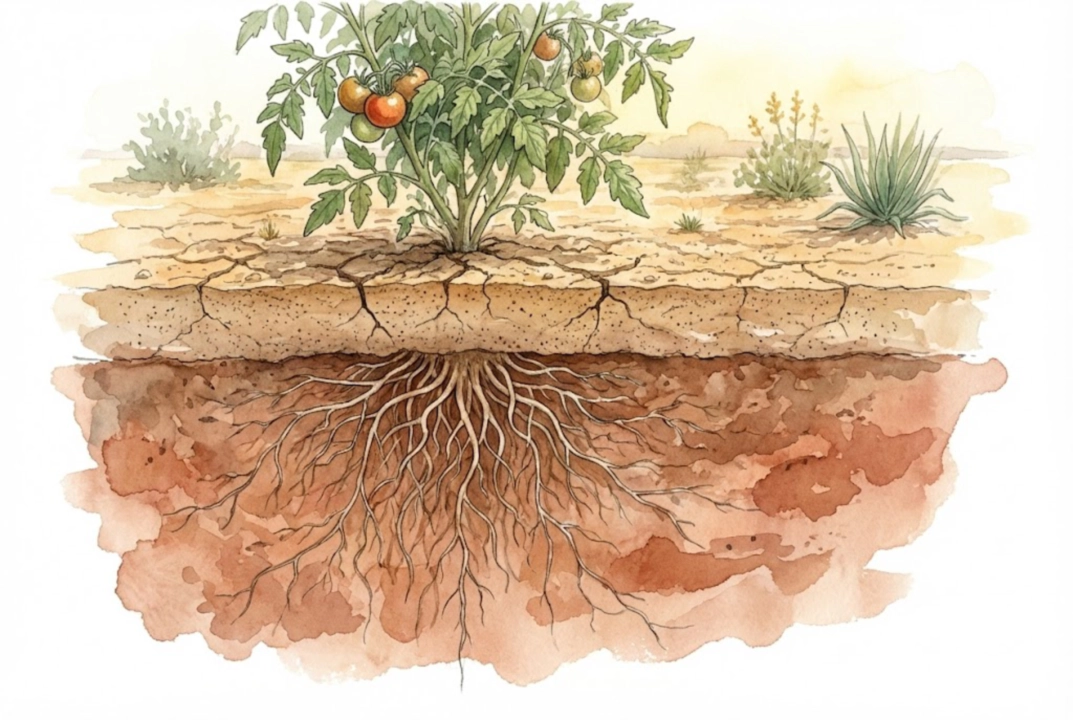
Dry farming grows a summer crop with little or no irrigation, drawing instead on moisture that winter rains stored deep in the soil.
On the right site it can cut irrigation water sharply and, in some coastal cases, produce smaller but more intensely flavored fruit.
It is not magic and not a free lunch. Dry-farmed crops usually yield less than irrigated ones, can show more physiological disorders such as blossom-end rot, and only work where soil and climate cooperate.
These steps apply to the winter-rain system used in western Oregon and coastal California.
What is dry farming and how does it actually work?
Store Winter Rain in the Root Zone
Dry farming, in the maritime sense used here, is growing a crop through a dry summer on residual moisture that the soil stored during the rainy winter.
It is not simply ignoring your garden, and it is more than drought tolerance. It combines a suitable site with soil management, timing, and weed control so roots can reach deep stored water.
It is also not the only kind of dryland agriculture. Hopi farming in Arizona relies on runoff and summer monsoon rain, and the Palouse dryland grain system depends on winter precipitation and fallow.
Those are different techniques from the winter-rain vegetable dry farming described here.
Oregon State University uses roughly 20 or more inches of winter rain as a screening threshold for this maritime, central-coast style of dry farming.
That is a starting filter for the Pacific Northwest and California coast, not a definition that covers every dryland system in the West.
Stored water can move upward as the surface dries, while roots and weeds also draw from the profile.
Shallow cultivation may slow surface loss, but it cannot seal the soil or replace a deep, well-charged root zone.
Does soil texture matter for dry farming?
It matters, but it is not the only thing that matters. Texture sets how much water a foot of soil can hold and release to plants (its available-water-holding capacity, AWHC).
Sandy soils hold little. Medium-textured soils hold the most usable water. The values below are approximate ranges from OSU Extension’s site-assessment material.
| Soil Texture | Available Water per Foot | Notes |
|---|---|---|
| Sand | ~0.6 inch | Holds little water, drains fast |
| Silt loam | ~2.4 inches | Among the better dry-farm soils |
| Silty clay loam | ~2.0 inches | Also favored when deep |
| Clay | ~1.4 inches | Holds much total water at high tension. Less is plant-available, and aeration and infiltration can be limiting |
Note that heavy clay is not the top choice. It can hold a lot of total water, but much of it is held so tightly that plants cannot use it, and drainage and root aeration can suffer.
OSU lists deep silt loam and silty clay loam among the best dry-farm soils, not pure clay.
Texture is only one input. Effective rooting depth, gravel content, a restrictive layer or plow pan, structure and organic matter, how much rain recharges the profile, and summer temperature, humidity, and wind all shape whether a site can dry farm a given crop.
A shallow, sandy, or hardpan-limited soil is a poor candidate regardless of surface texture.
Plan from the water stored in the root zone, not from a fixed gallon-per-plant rule. Check soil moisture when planting and through the season so you know whether the reserve is actually there.
Handheld probes show only shallow, relative moisture. A Long-probe moisture meter can help compare wetter and drier spots in the upper soil, but it cannot confirm moisture several feet down where a dry-farm crop may need to root.
Use Methods That Match Your Region
Growing food without irrigation is old, and it takes different forms in different places, so it is not a single ancestral method.
The Hopi have farmed corn in Arizona for many centuries in an area receiving under about 10 inches of rain a year, using an accumulated body of dryland knowledge that includes runoff and floodwater capture, deep planting, and crop selection tied to place and community.
That is a distinct tradition, not a template that transfers directly to coastal-vegetable dry farming.
In parts of California, non-irrigated vineyards, orchards, and some annual crops were grown before large aqueduct systems were built.
More recently, growers on the California Central Coast, documented in interviews with farms such as Dirty Girl Produce near Santa Cruz, have shown that dry farming can pair distinctive flavor with lower water use, though with tradeoffs in yield, market access, and site suitability.
How do you prepare soil to maximize water retention?
Prepare Only Diagnosed Constraints
The goal is to let winter rain soak in and reach the root zone, and then hold it. How much preparation that takes depends on the soil.
OSU’s guidance is to minimize tillage, avoid over-working the soil, and correct problems only where you find them.
If you diagnose a compacted layer or plow pan, break it before the rains with ripping or a deep-rooted cover crop, if the soil already takes water and roots well, extra digging mostly loses moisture and structure.
For fertility, follow a soil test rather than adding organic matter or nitrogen in bulk, since excess nitrogen and salinity can worsen problems such as blossom-end rot.
What is double digging?
Double digging is a traditional method that loosens soil to roughly 24 inches by removing the top 12 inches, loosening the 12 inches below without mixing the layers, and replacing the topsoil.
It can help where a compaction layer is limiting infiltration or rooting, but it is labor-intensive and is not a universal requirement for dry farming.
Work the soil only when it is at the right moisture. Digging wet clay causes compaction and smearing, so do not work it when it is too wet.
A Bully Tools broadfork can suit manual loosening when you have diagnosed a shallow compacted layer. Its roughly 11-inch tines open upper soil, not a full 24-inch layer or deep subsoil.
Do not use it near buried utilities or where rocks, wet clay, or your own physical limits make the task unsafe.
Why it works
- Water entry. Loosening a compacted layer can help winter rain infiltrate instead of running off, though the effect depends on slope, texture, structure, and how wet the soil is.
- Root access. Removing a genuine root-restricting layer can let roots grow deeper. Bedrock, a duripan, salinity, or smeared wet soil are not fixed by a broadfork, and different crops have different root architecture.
When should you start preparing?
Prepare while the soil is at a workable moisture and before the rains you are counting on have passed, which usually means fall or early spring in maritime climates.
The point is to have any needed loosening done, and drainage problems corrected, so the profile can fill and hold water.
Watch soil moisture rather than the calendar. Working soil that is too wet causes compaction and smearing, so wait until it is neither muddy nor bone-dry.
The right window varies by region. In the mid-Willamette Valley, for example, tomatoes are typically planted in early May and melons in mid-May or June, so a blanket rule that the water is already gone by May does not hold everywhere.
What is a dust mulch and why is it controversial?
A dust mulch is a layer of loose, dry, cultivated surface soil, often a couple of inches deep, kept between the plants.
It is a traditional dry-farm practice, and how useful it is has been questioned by research.
How it is meant to work
The idea is that loosening the top layer partly breaks the continuity of fine pores that draw water toward the surface, slowing evaporation from the soil below.
In practice this is not a complete seal, and evaporation does not simply stop at the bottom of the loose layer.
Importantly, the benefit is limited. OSU reports that soil evaporation is generally smaller than water lost through crop and weed transpiration, and that in trials a dust mulch did not measurably out-perform a shallow (1–2 inch) clean cultivation for keeping the profile moist.
So treat a dust mulch as one optional surface treatment, not a guaranteed moisture seal, and keep the tillage shallow to avoid drying and disturbing more soil than necessary.
How do you create and maintain it?
- Initial cultivation. Once the soil is workable (not mud), shallowly hoe or cultivate the surface until it is loose. Keep it shallow, roughly the top inch or two, since tilling deeper dries out and disturbs more soil.
- Maintenance. Re-loosen the surface if a crust forms after rain, but judge it by soil condition and erosion risk rather than re-cultivating after every small shower.
- Around plants. Cultivate carefully near transplants so you do not damage shallow crop roots or stems. Keep the tool well away from the stem.
Isn’t destroying soil structure bad?
Frequent shallow tillage can disturb soil aggregates and fungal hyphae. How much, and how fast the soil recovers, depends on the soil, implement, moisture, and depth.
That is a real tradeoff to weigh against any evaporation benefit, which the trials above suggest is modest.
Because of that, many organic dry farmers use a thick organic mulch (straw or wood chips) instead of a dust mulch.
A heavy straw layer can reduce evaporation, suppress weeds, and moderate surface temperature while protecting soil life, but it is not simply interchangeable with a dust mulch. The effect varies with the material and depth, and organic mulches can keep soil cooler in spring, tie up nitrogen, and harbor slugs or rodents.
Choosing between them
Both are options. Match the choice to your site and materials, weighing local mulch availability, labor, soil temperature, weed and pest pressure, and, in some areas, fire risk, rather than treating it as simply a matter of budget.
How deep should you plant seedlings?
Plant Into the Moist Zone
The aim is to set the root ball into moist soil, below the dry surface layer, rather than to bury the stem for its own sake. How deep is right depends on the crop.
Tomatoes
They are the well-known exception to normal transplant depth. They can form roots along a buried stem, so planting them deeper, with part of the stem below ground, is a recognized practice.
Even so, avoid cold, wet soil, which can rot a buried stem.
Melons, Squash, and Other Transplants
They are not tomatoes. General transplant guidance is to plant them at about the same depth as the container. Burying the stem or crown can invite rot and low-oxygen problems.
When OSU’s dry-farmed melon guide says to plant deeply, it means setting a well-watered root ball into contact with moist soil, not burying 50–70% of the stem.
Do not bury melon or squash stems up to the true leaves.
Why set the root ball into the moist zone?
- Adventitious roots (tomatoes). A buried tomato stem can grow additional roots over time. This is a tomato trait, not something to expect instantly or from every crop.
- Moisture contact. Placing the root ball in the moist zone under the dry surface crust gives roots access to stored water. Deeper is not automatically safer, so match the depth to the crop, its stem or crown, and soil temperature and oxygen.
How far apart to plant
Dry-farm spacing is usually wider than irrigated spacing so each plant can draw on more soil water, but the numbers come from trials and are best given as row spacing by in-row spacing, not a single distance.
- Tomatoes. OSU dry-farm tomato trials in western Oregon used systems such as 6-foot rows with 2 feet in-row, or 5-foot rows with 3 feet in-row. In one trial higher density actually reduced late-season blossom-end rot, so wider is not always better.
- Melons and watermelon. OSU melon trials used 7-foot rows with 3, 4, or 5 feet in-row and found no significant difference in yield, fruit number, or weight across that range.
The real tradeoff is between water available per plant and yield per area. Very wide spacing leaves soil water unused and gives lower area yield while increasing the ground you have to keep weeded. Too tight can stress plants where water is limited.
Choose within the tested ranges for your crop and site.
Which tomato varieties work best?
Early Girl
It is the best-known cultivar in California’s coastal dry-farm scene, closely associated with dry-farmed tomatoes on the Central Coast.
Why Early Girl?
It is an early, indeterminate F1 hybrid. Burpee lists it at about 59 days from transplant with 4–5 ounce fruit.
Setting fruit relatively early can help a crop mature before the deepest soil moisture is drawn down, though how much that helps depends on region, planting date, and the season.
Be cautious about claims of a special deep taproot. Tomatoes have a branching, largely fibrous root system, and the actual rooting pattern depends on soil, transplanting, and moisture.
There is no reliable measurement of a unique 6-foot Early Girl taproot. Note too that Early Girl has generally performed poorly in Oregon trials, with more blossom-end rot, smaller fruit, and lower marketable yield, so it is a coastal-California favorite rather than a universal champion.
The flavor difference
Water stress can raise the soluble-solids (sugar) content of tomatoes, so dry-farmed coastal fruit is often described as more intensely flavored.
But there is no paired trial behind a fixed 10–12 Brix versus 5–6 Brix figure, so treat that as an illustration rather than a measured result.
Seed for the classic Burpee Early Girl Tomato Seeds is widely available, but confirm a variety suits your site before buying.
The flavor effect is a tradeoff, not a free lunch, and it is strongest on the cool, foggy California coast.
The same drought stress tends to give smaller fruit and more blossom-end rot, and in cooler, wetter regions such as western Oregon taste trials have found dry-farmed and irrigated tomatoes about equally flavorful.
What other varieties work?
If Early Girl is not suitable or available, other tomatoes some growers try include the following.
- Chianti Rose. A beefsteak type that some growers report doing reasonably well. Results depend on your conditions, and there is no published dry-farm trial to point to.
- San Marzano and other paste types. Possible, but OSU cautions that elongated pear and paste tomatoes are generally more prone to blossom-end rot, so they are often a poorer fit for dry farming unless conditions are managed carefully.
Can you really grow melons without water?
What the Trials Actually Show
Yes, on a suitable site. OSU has run dry-farmed melon and watermelon trials in western Oregon, so it is a documented practice, though success still depends on soil water storage, season length, establishment, and variety.
Melons and watermelons are grown successfully without irrigation in these trials, but there is no side-by-side comparison establishing that they root deeper or are simply better adapted than tomatoes. Treat that as an open question rather than a fact.
Some varieties used in trials
- Christmas (watermelon). In OSU trials, this stored well and kept for months (into winter), though its flavor rated lower than some other entries. Extremely drought tolerant is not something the trial established.
- Dark Star (zucchini). A bush-type summer squash selected in Northern California dry-farm trials, reported around 15 lb per plant on average in western Oregon. It is a squash, not a melon, and there is no root study showing 8-foot roots.
- Hopi Pale Grey (squash). A winter squash sold as a Hopi-origin heirloom. If you grow it, look for Hopi-led seed sources and be mindful of seed sovereignty, since the provenance and cultural attribution behind marketing copy are not always verified.
For establishment, water in the transplants so the root ball makes good contact with moist soil, then irrigate further only as needed.
Amounts vary with how moist the soil already is. OSU tomato guidance is to water as needed at establishment, its melon trials watered in with roughly 1 liter (about a quart) per plant, and on some moist sites crops established with no watering at all.
A one-size dose of 2–3 gallons followed by a promise to never water again can fail from either too much or too little water, so judge it by conditions.
Why does weed control matter so much?
Why Early Control Matters
Weeds compete with dry-farm crops for the same scarce soil water, and controlling them makes a large difference.
In OSU trials, weeded plots produced several times the marketable yield of unweeded plots (more than seven-fold in one comparison).
There is no reliable figure for exactly how much water a single pigweed uses. That depends on the species, size, density, and weather, so avoid fixed per-weed water numbers.
Weeds are competitors for water, not parasites, and some are edible or provide ground cover. The practical point is that they draw down the water your crop is relying on.
The strategy
- Control early. Remove weeds while they are small, when they are easiest to kill and have taken the least water. Early-season control matters most, matching the large yield differences OSU found.
- Shallow hoeing. A stirrup or hula hoe works well for weeds between transplants. Keep it shallow and away from crop roots and stems.
- Monitor. Scout regularly so weeds do not get ahead of you, since sustained competition can reduce yield.
Where in the West does this actually work?
Assess Climate and Soil Together
Suitability depends on more than one factor. Annual and winter rainfall, effective soil depth and available-water capacity, summer temperature, humidity, wind, season length, and the crop and cultivar.
A cool, humid summer and a deep, water-holding soil both help.
Before committing a bed to dry farming, I open narrow test holes at the bed center and both ends, then check moisture at 10, 20, and 30 centimeters. The three depths show whether damp surface soil continues into the young crop’s root zone. I record texture, rooting obstructions, and where a squeezed sample stops holding together.
I repeat the same holes shortly before transplanting. If the deeper layer has dried or one end is much shallower, I reduce the planned area or provide supplemental irrigation. I do not expect a cultivar name to compensate for a missing water reserve.
More favorable regions
- Coastal California (Santa Cruz, Marin). Cool, foggy mornings lower evaporative demand, which is part of why Early Girl dry farming works there. Within the fog belt, soil depth, winter recharge, and summer heat still vary, so assess the specific site.
- Willamette Valley, Oregon. The region where much dry-farm vegetable research is done. Deep silt loam and silty clay loam are the soils OSU favors. Poorly drained heavy clay is not automatically ideal, so match crop and soil to the site.
- Palouse, Washington. A productive dryland grain and legume region. It relies on fallow, winter precipitation, and deep rooting at field scale, which is a different system and not direct proof that transplant tomatoes and melons will dry farm there.
More difficult regions
- High desert and hot inland valleys. Where summers are very hot (frequent 100°F+ days), evaporative demand is high and dry farming vegetables is risky. Some supplemental irrigation is often needed. Judge this by summer VPD, night temperatures, heat duration, and the soil water budget rather than a single temperature.
The soil can supply water only as fast and as long as the root zone allows. When crop demand exceeds that supply, plants suffer. Deep rooting volume, stored water, and hot, dry, windy weather determine that balance.
Tomato Dry Farming as an Agroecological Model for California
Dry-Farmed Melon and Watermelon Production in Western Oregon | OSU Extension
Dry-Farm Tomato Production in Western Oregon | OSU Extension
Dry Farming Vegetables. Assessing Your Site’s Potential | OSU Extension
Affiliate Disclosure
This article contains Amazon affiliate links. As an Amazon Associate I earn from qualifying purchases. If you use these links, the site may earn a commission at no extra cost to you. Product availability, price, and specifications can change. Check the current listing before buying.