
Terrarium Brown Moss: Troubleshooting Rot and Recovery
Troubleshoot brown terrarium moss by checking texture, water level, water quality, light, heat, and species needs, then correct dry-out or rot without treating every moss the same way.
Samuel Reed · Published 2025-12-14 · 11 min read
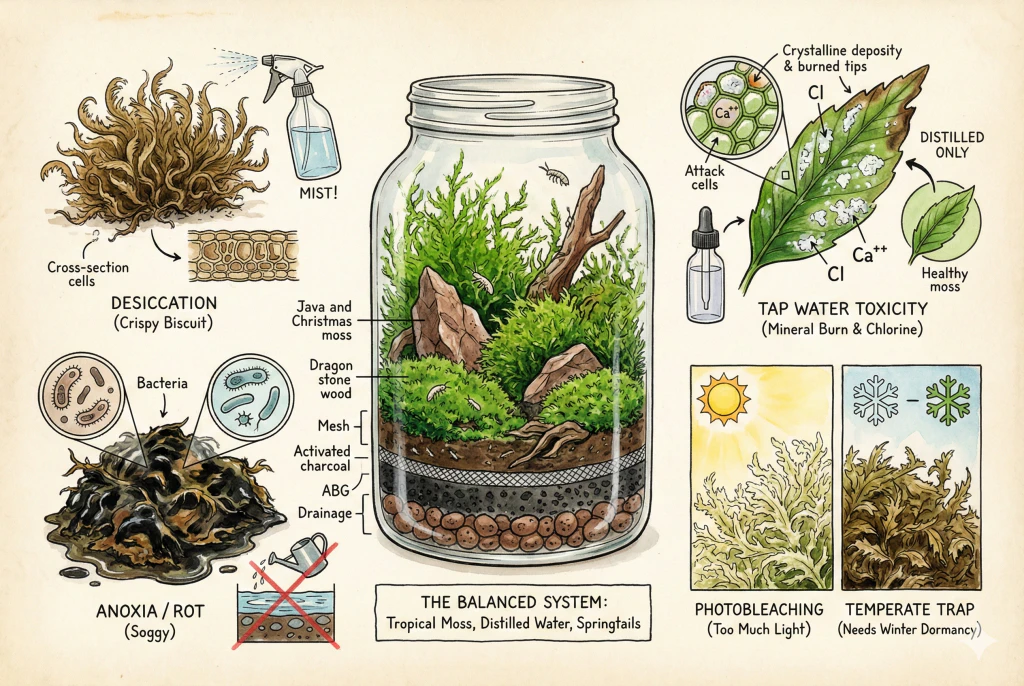
Key Takeaways
- Moss is non-vascular and many species take up water directly through their surfaces. Rhizoids mainly anchor, but rhizoid mats and plant structure can still conduct water by capillary action, so surface wetness matters, not just soil moisture.
- Water quality can matter, but it depends on your species and your actual water. Chloramine does not evaporate on standing, and hard water leaves visible mineral crust. Test your water rather than assume all tap water is toxic.
- Texture alone does not confirm what happened. Dry-and-crispy is often desiccation, while dark-and-mushy with a foul smell points to decay. Judge viability from species history, smell, tissue integrity, and new green growth after rehydrating.
- A stable build uses a false-bottom reservoir, a mesh barrier, an airy substrate, and gently secured moss. Manage water by measured volume and reservoir level, not by a mist-only rule.
- Identify your moss by supplier scientific name and source habitat before choosing a routine. Aquatic or semi-aquatic hobby mosses need an emersed transition, temperate mosses do not share one universal winter requirement, and Selaginella is a vascular lycophyte rather than a true moss.
A moss jar that browns and molds is a common disappointment, often because moss is treated like a decoration rather than a plant with particular needs, and those needs vary a lot from species to species.
Start by identifying whether the moss is dry, rotting, crusted with minerals, overheated, or simply adapting to a new setting. One routine does not fit every moss.
1. Give Moss the Surface Moisture and Air It Needs
Start With Surface Wetness
Moss is still a land plant, but it works differently from the vascular houseplants most people are used to, and that difference explains a lot of moss care.
Outside the glass, I set a small removable grid and photograph the same moss squares without pulling or repeatedly touching them. New green tips can begin inside a brown patch before the mat looks recovered from a distance.
Those tip boundaries and surface drying are tracked after I change one condition. The grid keeps me from discarding a recovering section or crediting a change made somewhere else in the enclosure.
Moss leans on its surfaces, not on internal plumbing
Moss does not behave like an ordinary rooted houseplant. Many species take up much of their water through the surface, while their rhizoids mostly anchor them.
Keep both the moss surface and its contact with the substrate lightly hydrated. Do not rely on a permanently wet substrate or a fixed humidity number. Watch surface wetness, temperature, airflow, and how long the moss stays hydrated.
Poikilohydry (moss water content tracks the environment)
Moss water content rises and falls with the environment more directly than it does in most houseplants. That is why a sealed jar can swing from dry to waterlogged quickly.
Some mosses recover after drying, but others do not. Treat apparent recovery as something to confirm with new green growth, not as a promise that every brown patch will revive.
This is why brown moss can sometimes recover. But texture alone doesn’t tell you whether it will. Dead tissue can also be dry and brittle, and heat- or toxin-killed tissue isn’t always mushy.
Treat crispy-brown and mushy-brown as clues, not diagnoses (see the diagnosis section below), and confirm viability by whether new green growth appears after rehydration.
Gas exchange
Oxygen availability depends on the species, water movement, and how much decaying organic matter is present, not on submergence by itself.
Aquatic mosses grow fully submerged, so the idea that submerged moss always suffocates is not a universal rule. What does cause trouble in a jar is a stagnant, organic-rich, low-oxygen layer. Decomposition there can turn dark and slimy and give off a rotten-egg smell.
If you see that, the priority is to remove the decayed material, drain excess water, and increase gas exchange. Regardless of exactly which microbes are involved.
Water quality (test, don’t assume)
Whether tap water is a problem depends on your local water and the moss species, so first check a current water report or measure pH, TDS, GH, and KH.
Two effects are well supported. Chloramine does not simply evaporate on standing as chlorine does. Hard water concentrated in a closed jar also leaves visible white mineral crust on glass and tissue.
However, treating chlorine, chloramine, calcium, magnesium, copper, and fluoride as guaranteed poisons goes beyond the evidence. Commercial aquatic mosses such as Taxiphyllum are routinely cultured in tap water, and temperate mosses have been grown indoors with weekly tap-water irrigation.
Low-mineral water such as distilled, RO, or clean rainwater is a reasonable and repeatable option if your water is very hard or heavily treated. It is not the only safe choice, and rainwater can collect contaminants from the capture surface.
2. Building a Stable Biosphere
Set Up the Container Before Misting
A durable jar starts with a sensible build. Clear glass lets you see and light the moss easily. Heavily colored glass reduces light transmission, so judge suitability by the actual light reaching the moss.
A narrow opening tends to hold humidity better, but how often you need to mist depends on the lid seal, volume, substrate, plant mass, and room conditions together.
Build and Monitor the False Bottom
A false-bottom reservoir with roughly 1–2 inches of LECA or pea gravel, adjusted to the container, gives excess water a place to collect below the substrate. It is a collection space rather than a drain, so the water stays in the jar. Keep the level visible and have a way to siphon it out.
A mesh barrier above it keeps substrate particles from washing down into the reservoir. It separates particles but does not stop capillary wicking, so it will not prevent a saturated substrate from staying wet. Choose mesh by material grade, corrosion and fraying resistance, and cleanability. Plastic and stainless screens are also used.
Choose an Airy Substrate
An airy ABG-style mix works well because tree fern fiber and orchid bark provide structure and airflow, while sphagnum, peat, and charcoal contribute moisture retention and adsorption. Fine potting soil can compact and stay saturated, although not every potting soil turns to sludge. Particle size, drainage, and depth matter more than the label.
Charcoal has a finite adsorption capacity rather than filtering indefinitely. Fine substrate over a coarse reservoir can also create a perched water table, so check bulk substrate moisture directly instead of assuming the reservoir keeps it dry.
Josh's Frogs ABG Mix (4-quart) suits a moss terrarium that needs an airy, moisture-holding substrate without mixing separate components. It is not sterile, so inspect or quarantine it if pests or contamination would be a problem. Any comparable airy terrarium mix can work when its moisture behavior fits the moss.
Match Hardscape to Water Chemistry
For hardscape, largely inert rock such as dragon stone or lava rock and aquarium-safe wood are common choices.
Carbonate rock such as limestone or Seiryu stone can dissolve to raise hardness and pH. That suits calcium-loving calcicole mosses but not calcium-avoiding ones, so match the rock to your species rather than treating limestone as always harmful. Rinse and soak-test any stone while checking pH, GH, and KH in low-mineral water because even batches sold as inert can vary. Gently secure the moss against damp substrate for good contact. Pressing too hard can crush the shoots, and some species attach better when tied with thread onto wood or rock.
Working in a small jar takes some reach and precision. Long aquascaping tools help, though clean household tweezers and scissors do the same job.
Ohtomber tool kit can make placement easier in a deep or narrow jar where your fingers would crush the moss or mark the glass. It is optional. Clean household tweezers and scissors work as well for a simple build.
Hydrate by Measured Volume
An uncontrolled pour can erode the surface and flood the reservoir, so misting is a gentle way to wet the surface. The important variables are amount and distribution, not the method.
Aim for substrate about as damp as a wrung-out sponge, droplets on the leaves, and only a little water in the reservoir. Watch the reservoir level so it stays below the substrate.
Misting alone can still oversaturate if you do it too often, and a pipette or measured pour is fine for adding a known volume.
A continuous fine-mist sprayer applies water in small droplets, which is convenient for coating the surface evenly.
BeautifyBeauties sprayer can help apply a light, even surface mist. It is a convenience item, not an overwatering safeguard. An adjustable sprayer or pipette works too when you control the total volume and frequency.
3. The Secrets of a Long-Lived Mossarium
Know your species (and be skeptical of trade names)
Garden centers sell locally harvested mood moss and sheet moss, but common names are unreliable. Mood moss in the trade often means Dicranum scoparium, while Leucobryum glaucum is a cushion or white moss. Sheet moss is sold as Hypnum but may be mislabeled.
If you harvest wild moss, first check landowner permission and local rules on protected species, take minimally without damaging the habitat, and quarantine and inspect it for pests, eggs, and disease before adding it to a jar.
Temperate mosses do not share one universal cold-winter requirement. Watch your particular species instead of assuming room temperature will kill it after a fixed number of months.
Java moss and Christmas moss are aquatic or semi-aquatic hobby plants, so confirm the supplier’s scientific name and whether the material is submerged or emersed. Move aquatic-grown moss to a moist, aerated jar gradually.
Spike moss, Selaginella, is a different vascular plant and needs its own care plan.
Some dieback after transplanting is common (but don’t assume it’s harmless)
Moss moved into a jar can shed old growth adapted to its previous environment while it acclimates, so some browning of tips or old fronds may just be adjustment.
Emerging green tips are a good sign that some tissue is alive, but they don’t rule out desiccation, heat stress, contamination, or rot happening at the same time.
Rather than waiting a fixed number of weeks, watch for warning signs, spreading dark mush, foul smell, or dieback that keeps advancing, and act on those instead of ignoring them.
Early mold (observe before reacting)
White fuzz sometimes blooms in the first weeks, often on fresh substrate and decaying plant matter.
Rather than assuming it’s harmless, note how much material is affected, whether it’s spreading, any odor, and whether the moss itself is being harmed.
Don’t spray bleach into a living jar (it’s hard on the whole system and won’t safely resolve an unidentified mold). Instead remove affected material, correct excess moisture, and isolate the jar if it worsens. Springtails (often Folsomia candida) graze on some fungi and detritus and are a common terrarium cleanup crew. Source them from a clean culture, make sure the enclosure stays humid enough for them, and don’t rely on them to fix an underlying moisture or decay problem.
Springtails Support Cleanup, Not a Mold Cure
Springtails can graze on some fungi and decaying material, but they do not make excess water, poor airflow, or rotting tissue safe. Correct those conditions first.
Light (bright shade, and mind the heat)
Moss is shade-tolerant, not dark-tolerant. Low light does not mean a dark hallway. Aim for bright, indirect light and keep the jar out of direct sun, which can overheat a sealed container and bleach the moss.
A daylight-white lamp (around 5000–6500 K) is a reasonable choice, but Kelvin describes a lamp’s approximate color, not its brightness or output. Two lamps with the same Kelvin rating can produce different amounts of light, so judge intensity at the moss surface and adjust the photoperiod to suit.
Stretched, leggy growth and pale color can come from low light, but also from heat, nutrients, or age. Do not read them as evidence of a single cause.
4. Diagnosing the Brown
Use Texture as a Clue, Not a Diagnosis
Different browns point to different problems, but treat each as an observation to check, not a confirmed diagnosis.
- Crispy and dry (light brown/grey, brittle, curling). Usually points to desiccation, though dead tissue can look the same. Start with a low-risk test. Rehydrate a small patch with low-mineral water and cover it rather than saturating the whole jar. Watch for green tips or firmer, greener tissue over the next days. If nothing greens up, the tissue is likely dead and should be removed. Do not flood a sealed, potentially rotting jar in the hope of immediate recovery.
- Dark and slimy Brown or black mushy tissue with a foul or rotten-egg smell points to low-oxygen decay, often from waterlogging. Open the jar to increase gas exchange, remove slimy material with a sanitized tool before it spreads, lower the reservoir level, and let the surface dry to an appropriate point for the species. Do not make it bone-dry, which can worsen desiccation of surviving tissue. Springtails are not a cure. Correct the moisture and oxygen problem.
- White crust White or tan tips and a ring at the glass waterline usually indicate mineral deposits from concentrating hard water. Confirm with GH, pH, and TDS tests because crust on glass does not prove that the tissue is burned. Consider switching to lower-mineral water and trim crusty tips. Flush and siphon only if the jar has proper access. Heavy flushing in a sealed jar with no drain can simply redistribute the salts.
- Pale or bleached (pale-yellow/white, not crusty). Can be too much light or heat, but also nutrient issues, pH, old growth, or a pathogen. Try moving it out of strong light or dimming the lamp first, and reassess the other possibilities if it doesn’t recover.
5. Conclusion
Use a Species-Specific Recovery Plan
Identify the moss, test your water, and use texture, water level, light, and heat as clues before you change the whole jar. Dry-and-crispy and dark-and-slimy moss need different responses. An aquatic hobby moss is not a drop-in replacement without an emersed transition.
Keep the reservoir under control and respond early to decay, overheating, or mineral crust. A closed jar can be stable, but it still needs attention to light, heat, water level, gas exchange, and new damage.
Affiliate Disclosure
This article contains Amazon affiliate links. As an Amazon Associate I earn from qualifying purchases. If you use these links, the site may earn a commission at no extra cost to you. Product availability, price, and specifications can change. Check the current listing before buying.