
Alocasia Drooping: Diagnose & Fix Leaves and Root Rot
Why your Alocasia is drooping: a step-by-step way to tell underwatering, light and cold stress, spider mites, and root rot apart, and the right response for each.
Jordan Cole · Published 2025-12-10 · 14 min read
Key Takeaways
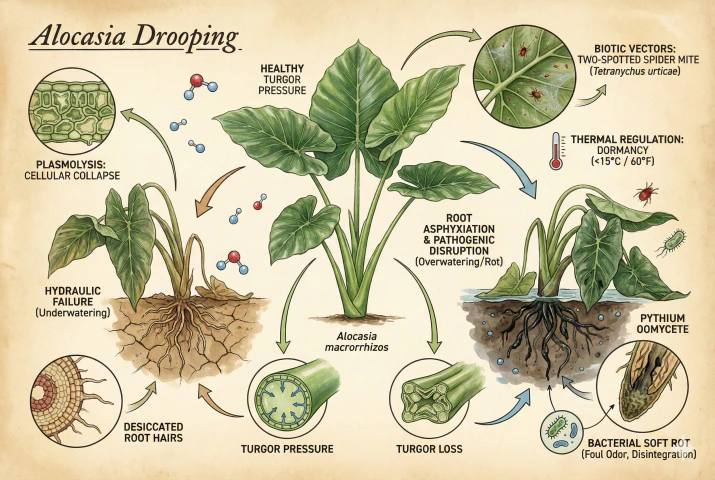
- Drooping is a posture, not a single problem. It can come from lost turgor (underwatering), root damage from overwatering or rot, pests, cold, a bent or aging petiole, or transplant stress, and the fixes differ, so work out the cause before you act.
- Check the whole plant, not one clue. Root-ball moisture, root color and firmness, leaf undersides, recent cold, repotting or shipping, and light. Several causes can overlap at once.
- Wet soil plus drooping raises suspicion of root trouble, but it does not confirm rot on its own. Recent watering, cold, transplant injury, or a compacted, airless mix can look the same. Unpot and inspect the roots before cutting.
- A foul smell is a non-specific red flag, not a species test. Odor cannot reliably tell bacterial soft rot from Pythium. Only a diagnostic lab can confirm the pathogen. For a badly rotted plant, discarding it is often the safest choice.
- Alocasia are medium-light plants that like warmth (roughly 16 °C and up) and moderate humidity. If you use any pesticide or fungicide, follow that product’s label for the plant, site, dilution, and interval. Several popular products are labeled outdoor-only or foliar-only.
A drooping Alocasia is a posture you can see, but the causes behind it are very different. Water deficit that drops leaf turgor, root damage from waterlogging or rot, pests, cold, a bent or aging petiole, and transplant stress can all produce it, and more than one cause can be present at the same time.
Because the responses differ and sometimes are opposite, work out what is actually happening before you act. The observations below show which possibilities each clue raises and how to confirm the cause before choosing a fix.
A Step-by-Step Way to Narrow It Down
Rather than scoring the plant, work through these observations in order. Each one narrows the possibilities. Several causes can coexist, so note everything you find before deciding on a response.
Treat these as suspicions to confirm, not verdicts.
- Isolate the plant. If there is any hint of pests or rot (webbing, mushy tissue, a foul smell), move it away from other plants and use clean tools before you handle it.
- Check root-ball moisture. Feel the weight of the pot and the mix at the center of the root ball, not just the surface. Bone-dry and light points toward underwatering. Saturated for days points toward waterlogging or rot, but does not confirm it.
- Inspect the leaves and undersides. Look for silvery stippling, fine webbing, or a dull, matte surface (possible spider mites), versus a single oldest leaf yellowing while the rest stay firm (possible normal aging), versus stretched, thin petioles (possible low light).
- Review the environment. Recent cold or a draft, a repot or shipment in the last couple of weeks, or a dim location can each cause drooping on their own.
- Inspect the roots if anything above is unclear or the mix is wet. Unpot gently and look at root color and firmness. This is the only reliable way to judge root rot, and it is worth doing before any cutting or chemical treatment.
Each section explains what raises suspicion of a cause and how to confirm it.
Before adding water to a drooping Alocasia, I record drained pot weight and moisture at more than one depth. The same note captures petiole firmness and whether the newest leaf or only the oldest leaf moved. The photograph is taken before lifting or rotating the plant.
If the pot is still heavy and the petiole base is soft, I inspect roots rather than following the visual reflex to water. If the pot is light and every leaf firms after normal watering, I keep that weight as the next reference.
Diagnosis by Cause
Normal Physiology or Minor Hydraulic Stress
A dry root ball or an aging leaf can make a leaf droop temporarily without meaning the plant is diseased. Alocasia leaves stay upright partly through water pressure inside their soft petioles.
When leaves lose water faster than roots can replace it, that pressure falls and the leaf sags. A bent petiole, normal leaf aging, or the weight of a large blade can look similar, so check the soil and the rest of the plant before watering.
Natural Senescence
As a new leaf emerges, an Alocasia often pulls mobile nutrients (N, P, K) from its oldest leaf, which then droops, yellows, and dies back.
Indoors, where light is lower than the tropics, plants tend to hold fewer leaves at once, though the exact number depends on the species or cultivar, corm and root size, light, and feeding.
If only the oldest leaf is fading while the newest growth stays firm and the roots look healthy, this is likely normal aging. You can leave the leaf to yellow so the plant reclaims those nutrients.
But older leaves are also where chronic root stress, nutrient problems, mites, or bacterial lesions often show up first, so check the rest of the plant before assuming it is nothing.
Remove a leaf earlier than full brown-and-crispy if it becomes a pest or disease reservoir, if the petiole is collapsing, or if it is physically damaged.
Underwatering and Hydrophobic Soil
If the mix is dry and the pot feels light, the plant may simply be short of water, and dry peat turns hydrophobic, so water can channel down the sides without wetting the root ball.
A bottom soak helps rewet a hydrophobic root ball. Stand the pot in tepid water up to the soil line until the center of the root ball is moist again.
How long that takes depends on pot size, mix, and compaction (a small pot may saturate in minutes, while a large, water-repellent root ball can stay dry even after a long soak) so check the center rather than watching the clock, then let the pot drain fully and keep the crown out of standing water.
Letting an Alocasia swing between bone-dry and soaked is hard on fine roots, so aim for more even moisture.
Sustee Aquameter can help if you struggle to judge when the center of a pot is drying. It is a watering-timing aid, not a diagnosis of root health or rot, and it works only when placed at the correct depth for the pot. Pair it with pot weight and a direct check of the mix.
Transplant Shock
Repotting can damage the fine roots that do most of the drinking, so a plant may droop even in moist soil until they regrow.
Recovery is often on the order of a couple of weeks to a month, but that varies with pot size, how much root was lost, season, temperature, and light. Treat it as a rough expectation, not a guarantee.
Petiole damage, a change in how the new mix holds water, or contamination introduced during the repot can also cause post-repot wilting.
Hold off on fertilizer during recovery. Modestly higher humidity can reduce evaporative demand, but don’t combine high humidity with a soggy mix and still air. That raises rot risk.
Watch for warning signs while you wait. Worsening collapse, new lesions, a foul smell, or roots that never recover all warrant unpotting and re-checking the roots.
Global analysis of plasticity in turgor loss point, a key drought tolerance trait
Environmental & Lighting Stress
If the plant is pest-free and watered correctly but still droops, look to its environment.
Lighting and Etiolation
Alocasia are better described as medium-light plants than shade plants. The tropical understory is far brighter than a dim room corner.
In weak light they stretch their petioles toward the light, and those elongated, thinner stems are less able to hold up a heavy blade.
Persistently low light also tends to show as pale color, slow growth, and leaf drop.
University of Minnesota Extension places Alocasia in the medium-light range, around 150–250 µmol/m²/s PPFD at the leaf.
Treat that as a target to aim toward, not a hard cutoff. The right level also depends on the species or cultivar, how far the light sits from the leaf, the photoperiod and resulting daily light integral, and how the plant has been acclimated.
Move the plant within a couple of feet of an east- or west-facing window, or add a grow light, and increase intensity gradually rather than all at once.
SANSI 36W Grow Light Bulb is useful for a plant whose long, pale petioles and slow growth point to weak light. The result at the leaf depends on distance and coverage, so it is not a substitute for checking how the plant responds. Start farther away, increase gradually, and follow the fixture’s heat-clearance guidance to avoid scorching tender leaves.
Cold Stress and Dormancy
Tropical Alocasia dislike cold drafts, and as temperatures fall, growth and root uptake slow, so a chilled plant takes up water poorly even in moist soil.
The RHS suggests keeping actively growing plants above about 16 °C and allowing a cooler winter rest.
There is no clean single-temperature threshold that switches on drooping, so treat cold as a contributing factor rather than a precise cutoff. Pay attention to the actual root-zone temperature and how long the plant was exposed.
After prolonged cold or low light, an Alocasia may drop its leaves and retreat to the corm.
That can be a seasonal rest, but chilling injury, root damage, and death can look the same from the outside. A firm corm is a hopeful sign, not proof the plant is alive.
Keep Alocasia away from AC vents and drafty windows.
Humidity and VPD
Very dry air can make a drooping problem worse by pulling water from leaves faster. Keep a lived-in room within a moderate range and avoid condensation on windows or walls. Grouping plants can create a slightly gentler microclimate without raising humidity throughout the room.
Levoit Classic 300S can help only when dry room air is part of the problem. Set it to a room-appropriate level around 40 to 50%, keep gentle air movement, and do not use it to compensate for a cold draft, wet roots, or poor light.
Empty and refill the tank daily with fresh distilled or low-mineral water, clean the unit regularly, and stop if condensation develops. Humidity should reduce leaf stress without making the room, foliage, or pot stay wet.
Pest Infestation (Spider Mites)
A common indoor pest on Alocasia is the two-spotted spider mite (Tetranychus urticae). Mites feed on the leaf underside and remove cell contents, so leaves develop fine stippling and a dull, bronzed look, and heavy infestations can lead to yellowing and leaf drop. Fine webbing usually appears only once populations are high.
Drooping alone is not a specific mite symptom (it overlaps with drought stress) so confirm mites before treating for them.
Because early infestations are easy to miss, check the undersides with a hand lens, or tap a leaf over white paper and look for tiny moving specks and eggs.
Mites do reproduce quickly in warm, dry conditions (development typically runs on the order of one to two weeks, and can be under a week in hot conditions) so a one-time treatment usually isn’t enough and repeat checks matter.
Start mechanically once you’ve confirmed mites. Isolate the plant from your others, then rinse the leaf undersides in the shower with tepid water to knock down the population and remove webbing.
Keep monitoring the undersides and repeat as needed. If you go on to a spray, choose a product whose label lists both the pest and use on your kind of plant in your setting, and follow that label exactly for dilution, interval, timing, and disposal.
Insecticidal soaps and horticultural oils labeled for indoor houseplant use are common options for mites. Whichever you pick, patch-test first, since Alocasia leaves can be sensitive.
Root Rot or Bacterial Disease
If the soil is wet but the plant is drooping, the roots may be compromised. A plant can dehydrate when damaged roots stop moving water.
Wet soil plus drooping raises suspicion, but it does not confirm rot on its own. Recent watering, cold-slowed uptake, transplant injury, a compacted or airless mix, or a vascular or petiole problem can look similar, and root rot can also be present even when the surface has dried.
The way to confirm is to unpot and look at the roots. Healthy roots are firm and pale, while rotted roots are brown, soft, and may slough.
Bacterial wilt can also cause wilting in moist soil, and the symptoms of Pythium, Phytophthora, Rhizoctonia, and bacterial disease overlap, so the specific pathogen usually can’t be named without a diagnostic lab.
Pythium Root Rot
It is caused by an oomycete (water mold), not a true fungus. It thrives in wet, poorly aerated soil and spreads through water to infect roots.
Affected roots turn brown to black and mushy, and a useful clue is sloughing (pull a root and the outer sheath slides off, leaving a thin, hair-like core).
Phytophthora produces very similar symptoms and is managed similarly, so root sloughing is a better guide than any smell.
Bacterial Soft Rot
It can be fast-moving. Bacteria break down the tissue holding cells together, so a petiole base can turn mushy and collapse in a short time, sometimes detaching from the corm with a slimy texture.
A foul smell is a warning sign, but it is not a reliable way to tell bacterial rot from an oomycete.
Decaying tissue smells because of anaerobic breakdown and mixed microbes, early infections may have little odor, and whether people describe a smell as fishy or musty is subjective and varies with the mix, fertilizer, and decomposing matter.
Treat odor as a non-specific red flag. Naming the actual pathogen reliably requires a diagnostic lab.
Watering won’t fix a rotted root system. A sensible sequence starts by isolating the plant, unpotting it, and inspecting the roots.
With a tool you disinfect between cuts, remove only tissue that is clearly dead, soft, brown, or sloughing, and stop at firm, healthy tissue rather than cutting aggressively into the corm.
Repot into fresh, sanitized, airy mix and a clean container (don’t reuse the old soil), then monitor.
If most of the root system is gone or the rot keeps advancing, discarding the plant is often the safest option, both for the plant and to avoid spreading the problem to your others.
Extension guidance is realistic that home fungicide rescues have limits and that badly affected plants are sometimes best discarded.
Skip improvised chemical dips on freshly cut roots. Household hydrogen peroxide diluted to roughly 1% and applied to cut root or corm tissue for 10–15 minutes has no established basis for treating Alocasia rot, and off-label, higher-than-labeled peroxide can itself cause tissue damage.
Any chemical treatment should only be used when your plant, the site, and the target pathogen appear on that product’s label.
A good recovery substrate is a quality base soil cut with coarse perlite or pumice to raise air-filled porosity.
Keep in mind that a more porous mix also dries faster (so it may need watering more often) and can be too coarse for very young or fine-rooted plants, and porosity alone won’t prevent rot if the plant sits in standing water or the stock or tools are contaminated.
Use Copper Fungicides Only as Labeled
Copper products are labeled as protective foliar sprays for specific plants and diseases, applied to leaves before infection and repeated on a set interval. They are not labeled as root or corm dips, root drenches, or treatments for cut surgical wounds or Pythium root rot.
Product labels stress correct disease identification, warn about copper phytotoxicity, and carry human-safety and aquatic-toxicity cautions.
Because a consumer copper RTU is not labeled for Alocasia root treatment, it is not the right tool for the root problem described here. For suspected bacterial or oomycete rot, prioritize isolation, sanitation, and diagnosis.
Pythium (Penn State Extension)
Anthurium Diseases. Identification and Control in Commercial Greenhouse Operations (UF/IFAS Extension)
Diagnose the Droop Before You React
A drooping Alocasia is worth diagnosing rather than reacting to. Environmental causes (water, light, and temperature) are usually reversible once you correct the conditions, and the plant often recovers over a few weeks.
Pests and root disease need more decisive action. A rot-stricken plant can’t be watered back to health, and depending on how much healthy root remains, the choice is between careful repotting into fresh, airy mix and discarding the plant to protect the rest of your collection.
Remember that more than one cause can be present at once.
Over the long run, a chunky, porous aroid mix is one of the most useful levers you have, because it reduces the risk from dense, constantly saturated peat.
It is not a cure-all, though. Root rot also depends on how often you water, pot geometry and drainage, temperature, clean stock and tools, and root injury, so manage substrate alongside watering, sanitation, and environment rather than treating it as a single fix.
Affiliate Disclosure
This article contains Amazon affiliate links. As an Amazon Associate I earn from qualifying purchases. If you use these links, the site may earn a commission at no extra cost to you. Product availability, price, and specifications can change. Check the current listing before buying.